
Mr. Rupam R. Fedujwar
Transportation Engineering
School of Infrastructure
IIT Bhubaneswar
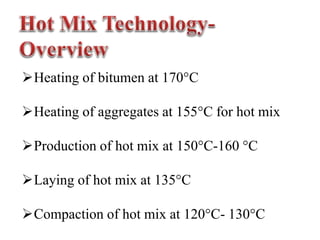
Heating of bitumen at 170°C
Heating of aggregates at 155°C for hot mix
Production of hot mix at 150°C-160 °C
Laying of hot mix at 135°C
Compaction of hot mix at 120°C- 130°C
 Noise and air pollution
 High energy consumption
 Limited working season- No work during rains and cold
winters
 Sensitive to temperature control during entire process.
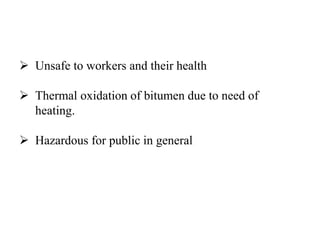
 Unsafe to workers and their health
 Thermal oxidation of bitumen due to need of
heating.
 Hazardous for public in general
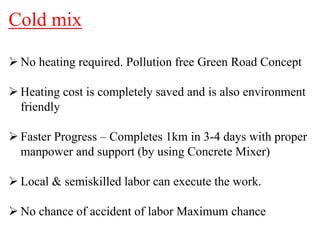
Cold mix
 No heating required. Pollution free Green Road Concept
 Heating cost is completely saved and is also environment
friendly
 Faster Progress – Completes 1km in 3-4 days with proper
manpower and support (by using Concrete Mixer)
 Local & semiskilled labor can execute the work.
 No chance of accident of labor Maximum chance
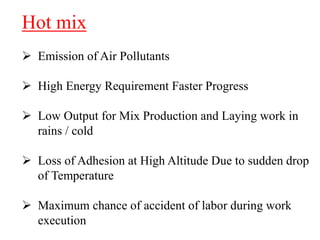
Hot mix
 Emission of Air Pollutants
 High Energy Requirement Faster Progress
 Low Output for Mix Production and Laying work in
rains / cold
 Loss of Adhesion at High Altitude Due to sudden drop
of Temperature
 Maximum chance of accident of labor during work
execution
 Mojor difficulty with CMA is that the majority of laboratory
evaluations and tests were originally designed for hot-mix asphalt.
 There exists an incomplete understanding between viscosity gain
of cold-mix binder (CMB) and strength development of CMA.
 The objective was to develop effective test procedures to assess
the engineering properties and performance of the CMA.
 Cold-mix asphalt (CMA) is routinely used for pothole
patching or trench reinstatements.
 Cutback asphalt binder is the most commonly employed
cold-mix binder (CMB) to mix with aggregate because
Its lowerbinder viscosity is desired for storage workability
of CMA.
 Cutback asphalt is basically an asphalt dissolved in
kerosene or a similar petroleum solvent, in which state it is
mixed with aggregates.
 The majority of the laboratory tests are originally
designed for hot-mix asphalt.
 There are problems associated with workability in storage
and time required to achieve full strength after paving
because there are opposite demands on the materials for
handling and for performance in the potholes
 It is essential to develop effective test procedures for
evaluating the engineering properties and performance of
CMA patching materials.
 Because there are no universal test methods for CMA
patching materials that are used by highway agencies,
implementation of the findings of this study will
have research significance.
CMBs
 Four types of cold-mix binder used for this test CMB-1, CMB-2,
CMB-3,and CMB-4, respectively.
 Because both the patching mixes unmodified with MC-70
cutback, and CMB-4 manufactured with unmodified asphalt and
MC-70 asphalt always failed prematurely in the field in Taiwan,
three types of proprietary modified cold-mix binders were chosen
in this research for making comparisons.
 The three types of polymer modifiers make different setting time
for theCMBs.
Aggregate and Gradation
Two type of gradation used
1) Dence graded asphalt mix(DE)
2) Open graded asphalt mix(OP)
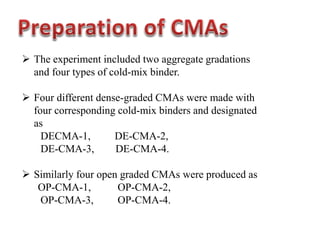
 The experiment included two aggregate gradations
and four types of cold-mix binder.
 Four different dense-graded CMAs were made with
four corresponding cold-mix binders and designated
as
DECMA-1, DE-CMA-2,
DE-CMA-3, DE-CMA-4.
 Similarly four open graded CMAs were produced as
OP-CMA-1, OP-CMA-2,
OP-CMA-3, OP-CMA-4.
In accordance with the Public Construction Commission (2010)
specification and test methods proposed by Minegishi et al. (2010),the
samples were cured using an ambient temperature curing process at
25°C for 336 h to investigate the workability evolution and the
strength development for the CMAs.
Some samples were cured using accelerated curing process at
110°C for 24 h prior to laboratory testing in order to achieve the
mature state of the CMAs. All samples were monitored and the test
measurements were recorded over the curing period.
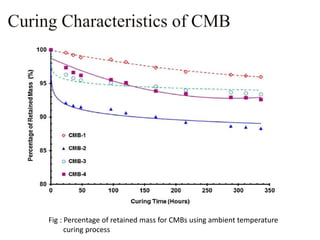
Fig : Percentage of retained mass for CMBs using ambient temperature
curing process
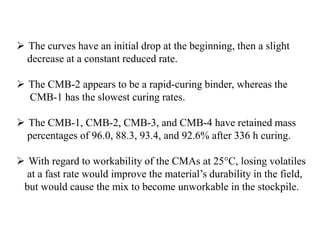
 The curves have an initial drop at the beginning, then a slight
decrease at a constant reduced rate.
 The CMB-2 appears to be a rapid-curing binder, whereas the
CMB-1 has the slowest curing rates.
 The CMB-1, CMB-2, CMB-3, and CMB-4 have retained mass
percentages of 96.0, 88.3, 93.4, and 92.6% after 336 h curing.
 With regard to workability of the CMAs at 25°C, losing volatiles
at a fast rate would improve the material’s durability in the field,
but would cause the mix to become unworkable in the stockpile.
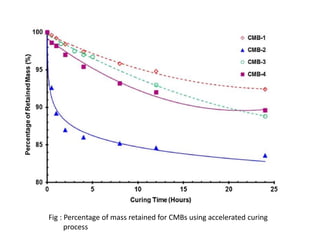
Fig : Percentage of mass retained for CMBs using accelerated curing
process
 In comparison with the CMBs cured at 25°C, the retained mass
percentages reduce drastically with curing time by means of the
accelerated curing process.
 There is an indication of a similar trend in curing rate among the
CMBs.
 The four curves exhibit more rapid curing rates at the beginning
but change only slightly after a few hours.
 The CMB-1, CMB-2, CMB-3, and CMB-4 have the remaining
percentages of 92.4, 83.6, 88.8, and 89.6% after 24 h curing.
 Because most of the volatiles escape from the CMBs, the
evaporation percentages of 7.6, 16.4, 11.2, and 10.4% for the
respective CMBs are employed to determine the optimum CMB
contents of the CMAs.
 The indirect tensile test was performed in accordance with
ASTM D6931 (ASTM 2007) by loading a cylindrical
specimen with a single compressive load at deformation rate of
50.8 mm/min and test temperature of 25°C.
 The load was applied along the vertical diameter plane of the
specimen through a curved loading strip, causing the specimen
to fail by splitting along the vertical diameter.
 The peak load at failure was measured over the ambient
temperature curing time. The test results were used to assess
the tensile strength of the CMAs.
Fig : Indirect tensile strength at 25°C for CMAs after curing at 25°C
for 24 h
 Fig. shows that the tensile strength for the dense-graded CMAs
ranges from about 96.8 to 217.4 kPa, whereas those for the
open-graded CMAs ranges from 15.7 to 51.3 kPa.
 The results demonstrate an increase in indirect tensile strength
with increasing CMB viscosity, indicating a higher viscosity
value providing better strength in a CMA mix.
 The results also show that the gradation is an important factor
in determining mixture strength.
 The main factor that contributes to indirect tensile strength is
the binder viscosity. The softer binder reduces cohesiveness,
thus the lower tensile strength for the CMAs.
 Ideally, as a patching mixture is filled in a pothole, the
binder should cure immediately, leaving a stiff binder.
 Thus, it appears that the CMA is more flexible than
the HMA so that the CMA may be more desirable to
accommodate shrinkage or cracking in the pothole
 The viscosity test was conducted to measure the consistence
of asphalt binder according to ASTM D2196 (ASTM
2010)., was used to measure the viscosity of the CMBs, AC-
20, and AR-80asphalt binders.
 The CMBs were tested at temperatures ranging from 25 to
110°C. In addition, the AC-20 and AR-80 asphalt binders
were tested at temperatures between 60 and 175°C. The
values of viscosity over time were recorded.
• The CMB viscosities measured after an accelerated curing process
have the potential for predicting the stability of the CMAs at mature
state. The accelerated curing process with 110°C for 24 h is effective
to forecast the ultimate strength of the CMAs
• The indirect tensile strength test is effective to distinguish the
cohesiveness of the CMAs. The results demonstrate that dense
gradation together with the high viscosity binder improved the
indirect tensile strength of the CMAs
• In this study, the DE-CMA-2 has acceptable storage workability
together with the best performance. The curing characteristic
of the CMB-2 is desired for manufacturing a good cold-mix
asphalt patching material
• Dense-graded CMA with the CMB-2 and the residual binder
content of 5.2% were recommended for repairing potholes in
relatively warm-temperature regions and in wet weather; and
• The future scope of the work is to propose acceptance criteria
for cold-mix asphalt to guarantee successful asphalt patching
materials in the field.

Cold mix asphalt

  • 1.
    Mr. Rupam R.Fedujwar Transportation Engineering School of Infrastructure IIT Bhubaneswar
  • 2.
    Heating of bitumenat 170°C Heating of aggregates at 155°C for hot mix Production of hot mix at 150°C-160 °C Laying of hot mix at 135°C Compaction of hot mix at 120°C- 130°C
  • 4.
     Noise andair pollution  High energy consumption  Limited working season- No work during rains and cold winters  Sensitive to temperature control during entire process.
  • 5.
     Unsafe toworkers and their health  Thermal oxidation of bitumen due to need of heating.  Hazardous for public in general
  • 7.
    Cold mix  Noheating required. Pollution free Green Road Concept  Heating cost is completely saved and is also environment friendly  Faster Progress – Completes 1km in 3-4 days with proper manpower and support (by using Concrete Mixer)  Local & semiskilled labor can execute the work.  No chance of accident of labor Maximum chance
  • 8.
    Hot mix  Emissionof Air Pollutants  High Energy Requirement Faster Progress  Low Output for Mix Production and Laying work in rains / cold  Loss of Adhesion at High Altitude Due to sudden drop of Temperature  Maximum chance of accident of labor during work execution
  • 10.
     Mojor difficultywith CMA is that the majority of laboratory evaluations and tests were originally designed for hot-mix asphalt.  There exists an incomplete understanding between viscosity gain of cold-mix binder (CMB) and strength development of CMA.  The objective was to develop effective test procedures to assess the engineering properties and performance of the CMA.
  • 11.
     Cold-mix asphalt(CMA) is routinely used for pothole patching or trench reinstatements.  Cutback asphalt binder is the most commonly employed cold-mix binder (CMB) to mix with aggregate because Its lowerbinder viscosity is desired for storage workability of CMA.  Cutback asphalt is basically an asphalt dissolved in kerosene or a similar petroleum solvent, in which state it is mixed with aggregates.
  • 12.
     The majorityof the laboratory tests are originally designed for hot-mix asphalt.  There are problems associated with workability in storage and time required to achieve full strength after paving because there are opposite demands on the materials for handling and for performance in the potholes  It is essential to develop effective test procedures for evaluating the engineering properties and performance of CMA patching materials.  Because there are no universal test methods for CMA patching materials that are used by highway agencies, implementation of the findings of this study will have research significance.
  • 13.
    CMBs  Four typesof cold-mix binder used for this test CMB-1, CMB-2, CMB-3,and CMB-4, respectively.  Because both the patching mixes unmodified with MC-70 cutback, and CMB-4 manufactured with unmodified asphalt and MC-70 asphalt always failed prematurely in the field in Taiwan, three types of proprietary modified cold-mix binders were chosen in this research for making comparisons.  The three types of polymer modifiers make different setting time for theCMBs.
  • 14.
    Aggregate and Gradation Twotype of gradation used 1) Dence graded asphalt mix(DE) 2) Open graded asphalt mix(OP)
  • 15.
     The experimentincluded two aggregate gradations and four types of cold-mix binder.  Four different dense-graded CMAs were made with four corresponding cold-mix binders and designated as DECMA-1, DE-CMA-2, DE-CMA-3, DE-CMA-4.  Similarly four open graded CMAs were produced as OP-CMA-1, OP-CMA-2, OP-CMA-3, OP-CMA-4.
  • 17.
    In accordance withthe Public Construction Commission (2010) specification and test methods proposed by Minegishi et al. (2010),the samples were cured using an ambient temperature curing process at 25°C for 336 h to investigate the workability evolution and the strength development for the CMAs. Some samples were cured using accelerated curing process at 110°C for 24 h prior to laboratory testing in order to achieve the mature state of the CMAs. All samples were monitored and the test measurements were recorded over the curing period.
  • 18.
    Fig : Percentageof retained mass for CMBs using ambient temperature curing process
  • 19.
     The curveshave an initial drop at the beginning, then a slight decrease at a constant reduced rate.  The CMB-2 appears to be a rapid-curing binder, whereas the CMB-1 has the slowest curing rates.  The CMB-1, CMB-2, CMB-3, and CMB-4 have retained mass percentages of 96.0, 88.3, 93.4, and 92.6% after 336 h curing.  With regard to workability of the CMAs at 25°C, losing volatiles at a fast rate would improve the material’s durability in the field, but would cause the mix to become unworkable in the stockpile.
  • 20.
    Fig : Percentageof mass retained for CMBs using accelerated curing process
  • 21.
     In comparisonwith the CMBs cured at 25°C, the retained mass percentages reduce drastically with curing time by means of the accelerated curing process.  There is an indication of a similar trend in curing rate among the CMBs.  The four curves exhibit more rapid curing rates at the beginning but change only slightly after a few hours.  The CMB-1, CMB-2, CMB-3, and CMB-4 have the remaining percentages of 92.4, 83.6, 88.8, and 89.6% after 24 h curing.  Because most of the volatiles escape from the CMBs, the evaporation percentages of 7.6, 16.4, 11.2, and 10.4% for the respective CMBs are employed to determine the optimum CMB contents of the CMAs.
  • 22.
     The indirecttensile test was performed in accordance with ASTM D6931 (ASTM 2007) by loading a cylindrical specimen with a single compressive load at deformation rate of 50.8 mm/min and test temperature of 25°C.  The load was applied along the vertical diameter plane of the specimen through a curved loading strip, causing the specimen to fail by splitting along the vertical diameter.  The peak load at failure was measured over the ambient temperature curing time. The test results were used to assess the tensile strength of the CMAs.
  • 23.
    Fig : Indirecttensile strength at 25°C for CMAs after curing at 25°C for 24 h
  • 24.
     Fig. showsthat the tensile strength for the dense-graded CMAs ranges from about 96.8 to 217.4 kPa, whereas those for the open-graded CMAs ranges from 15.7 to 51.3 kPa.  The results demonstrate an increase in indirect tensile strength with increasing CMB viscosity, indicating a higher viscosity value providing better strength in a CMA mix.  The results also show that the gradation is an important factor in determining mixture strength.  The main factor that contributes to indirect tensile strength is the binder viscosity. The softer binder reduces cohesiveness, thus the lower tensile strength for the CMAs.
  • 25.
     Ideally, asa patching mixture is filled in a pothole, the binder should cure immediately, leaving a stiff binder.  Thus, it appears that the CMA is more flexible than the HMA so that the CMA may be more desirable to accommodate shrinkage or cracking in the pothole
  • 26.
     The viscositytest was conducted to measure the consistence of asphalt binder according to ASTM D2196 (ASTM 2010)., was used to measure the viscosity of the CMBs, AC- 20, and AR-80asphalt binders.  The CMBs were tested at temperatures ranging from 25 to 110°C. In addition, the AC-20 and AR-80 asphalt binders were tested at temperatures between 60 and 175°C. The values of viscosity over time were recorded.
  • 27.
    • The CMBviscosities measured after an accelerated curing process have the potential for predicting the stability of the CMAs at mature state. The accelerated curing process with 110°C for 24 h is effective to forecast the ultimate strength of the CMAs • The indirect tensile strength test is effective to distinguish the cohesiveness of the CMAs. The results demonstrate that dense gradation together with the high viscosity binder improved the indirect tensile strength of the CMAs
  • 28.
    • In thisstudy, the DE-CMA-2 has acceptable storage workability together with the best performance. The curing characteristic of the CMB-2 is desired for manufacturing a good cold-mix asphalt patching material • Dense-graded CMA with the CMB-2 and the residual binder content of 5.2% were recommended for repairing potholes in relatively warm-temperature regions and in wet weather; and • The future scope of the work is to propose acceptance criteria for cold-mix asphalt to guarantee successful asphalt patching materials in the field.