Prof. Sameer Mathur, Ph.D.
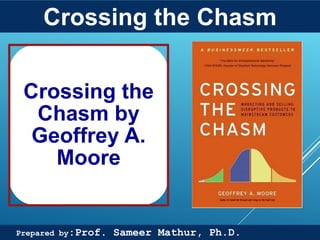
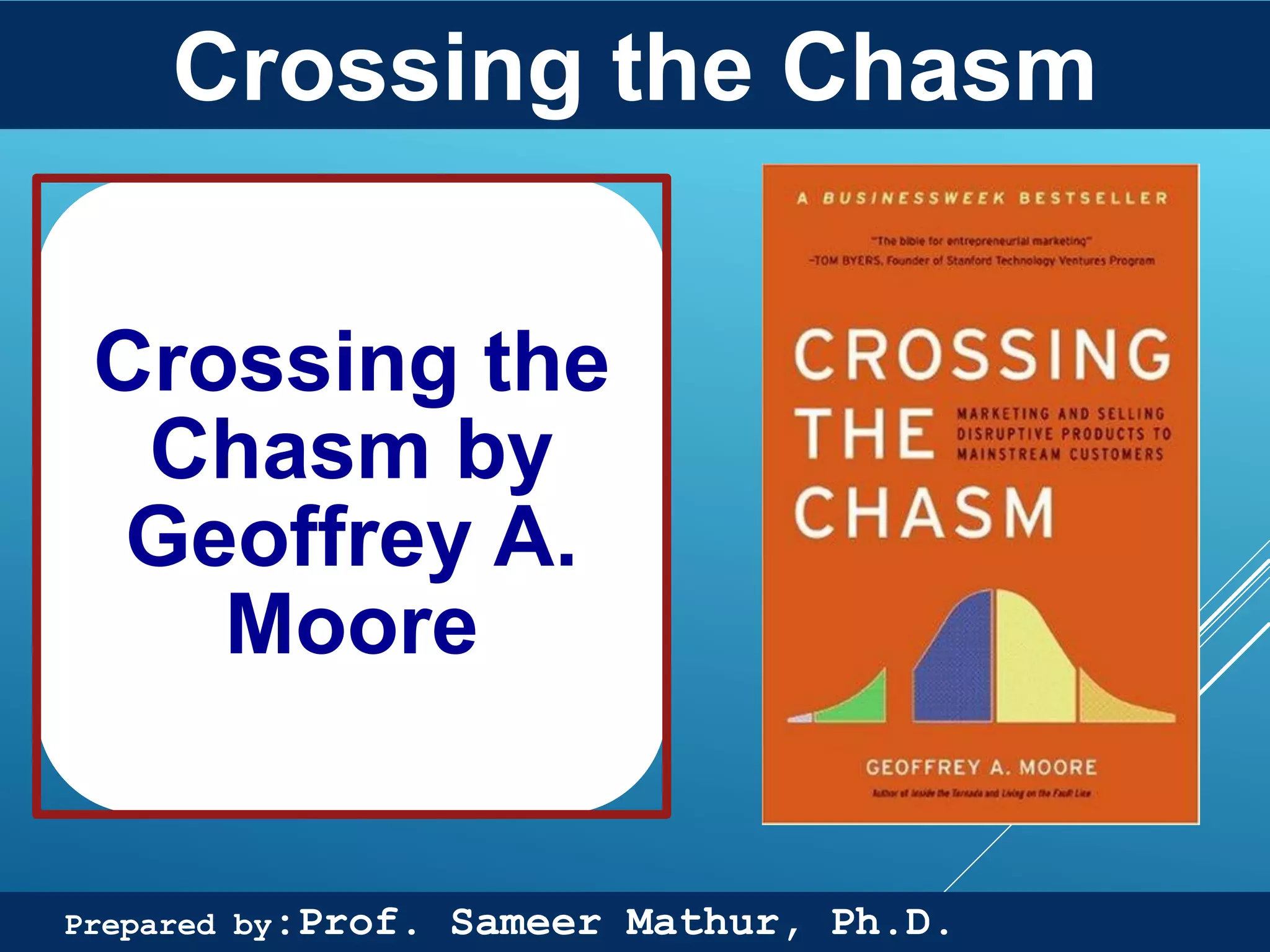
Crossing the
Chasm by
Geoffrey A.
Moore
Crossing the Chasm
11
Prepared by:Prof. Sameer Mathur, Ph.D.
Prof. Sameer Mathur, Ph.D.
Brief Summary
2www.BuddingMarkets.com
To make money with disruptive
technologies in this era, they
need to be brought to market
and adopted quickly.
Problem is that initial
marketing strategies needed to
break into market of early
adopters Doesn’t work once a
company begins marketing to
the mass market.
Prof. Sameer Mathur, Ph.D.
Contents
3
1. If Bill Gates Can be a Billionaire
2. High Tech Marketing
3. Defining the Chasm
4. The D-Day Analogy
5. Getting Beyond the Chasm
Prof. Sameer Mathur, Ph.D.
If Bill Gates can be a Billionaire
4
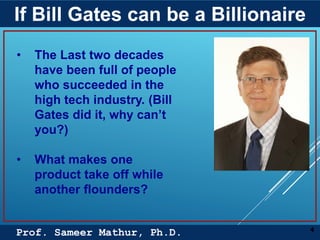
• The Last two decades
have been full of people
who succeeded in the
high tech industry. (Bill
Gates did it, why can’t
you?)
• What makes one
product take off while
another flounders?
Prof. Sameer Mathur, Ph.D.
If Bill Gates can be a Billionaire
5
• When Products fail the
company scapegoat is
typically the VP of
Marketing.
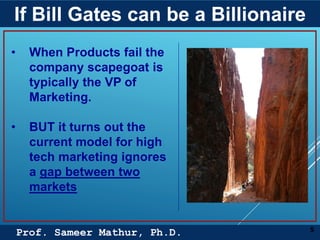
• BUT it turns out the
current model for high
tech marketing ignores
a gap between two
markets
Prof. Sameer Mathur, Ph.D.
If Bill Gates can be a Billionaire
6
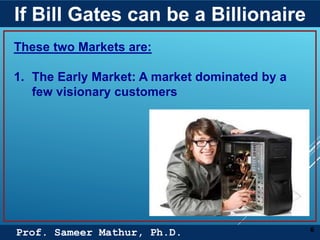
These two Markets are:
1. The Early Market: A market dominated by a
few visionary customers
Prof. Sameer Mathur, Ph.D.
If Bill Gates can be a Billionaire
7
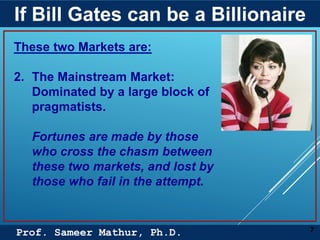
These two Markets are:
2. The Mainstream Market:
Dominated by a large block of
pragmatists.
Fortunes are made by those
who cross the chasm between
these two markets, and lost by
those who fail in the attempt.
Prof. Sameer Mathur, Ph.D.
High Tech Marketing
8
The Technology Adoption Life Cycle is a model
for understand the acceptance of new products.
Examples:
Innovator or early adopter: “I want to be the first
on my block with an electric car”
Early Majority: “When I have seen electric cars
prove themselves and when there are enough
service stations on the road.”
Prof. Sameer Mathur, Ph.D.
High Tech Marketing
9
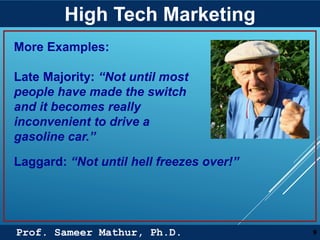
More Examples:
Late Majority: “Not until most
people have made the switch
and it becomes really
inconvenient to drive a
gasoline car.”
Laggard: “Not until hell freezes over!”
Prof. Sameer Mathur, Ph.D.
High Tech Marketing
10
High Tech Marketing Model
Attitudes toward technology adoption become
significant to marketing whenever people are
introduced to discontinuous innovations that
require a change in current mode of behavior.
Prof. Sameer Mathur, Ph.D.
High Tech Marketing
11
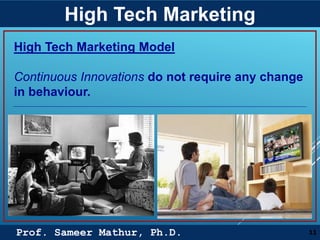
High Tech Marketing Model
Continuous Innovations do not require any change
in behaviour.
Prof. Sameer Mathur, Ph.D.
High Tech Marketing
12
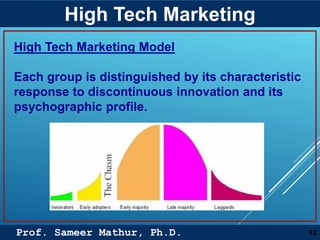
High Tech Marketing Model
Each group is distinguished by its characteristic
response to discontinuous innovation and its
psychographic profile.
Prof. Sameer Mathur, Ph.D.
High Tech Marketing
13
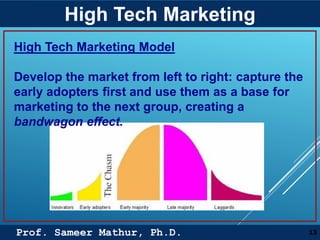
High Tech Marketing Model
Develop the market from left to right: capture the
early adopters first and use them as a base for
marketing to the next group, creating a
bandwagon effect.
Prof. Sameer Mathur, Ph.D.
High Tech Marketing
14
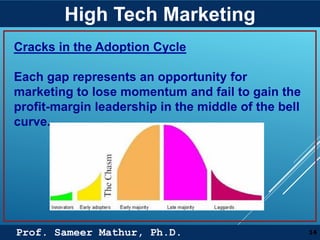
Cracks in the Adoption Cycle
Each gap represents an opportunity for
marketing to lose momentum and fail to gain the
profit-margin leadership in the middle of the bell
curve.
Prof. Sameer Mathur, Ph.D.
High Tech Marketing
15
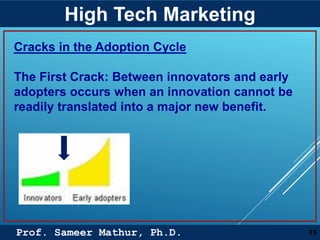
Cracks in the Adoption Cycle
The First Crack: Between innovators and early
adopters occurs when an innovation cannot be
readily translated into a major new benefit.
Prof. Sameer Mathur, Ph.D.
High Tech Marketing
16
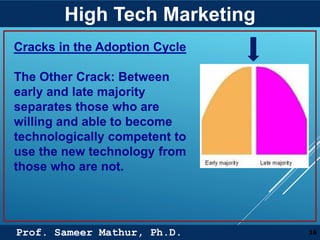
Cracks in the Adoption Cycle
The Other Crack: Between
early and late majority
separates those who are
willing and able to become
technologically competent to
use the new technology from
those who are not.
Prof. Sameer Mathur, Ph.D.
High Tech Marketing
17
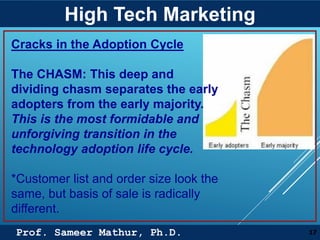
Cracks in the Adoption Cycle
The CHASM: This deep and
dividing chasm separates the early
adopters from the early majority.
This is the most formidable and
unforgiving transition in the
technology adoption life cycle.
*Customer list and order size look the
same, but basis of sale is radically
different.
Prof. Sameer Mathur, Ph.D.
High Tech Marketing
18
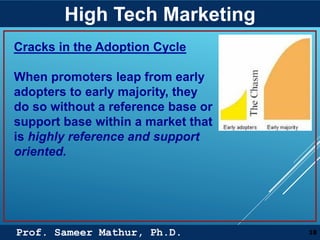
Cracks in the Adoption Cycle
When promoters leap from early
adopters to early majority, they
do so without a reference base or
support base within a market that
is highly reference and support
oriented.
Prof. Sameer Mathur, Ph.D.
High Tech Marketing
19
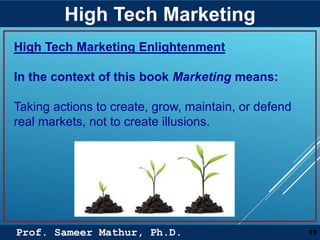
High Tech Marketing Enlightenment
In the context of this book Marketing means:
Taking actions to create, grow, maintain, or defend
real markets, not to create illusions.
Prof. Sameer Mathur, Ph.D.
High Tech Marketing
20
High Tech Marketing Enlightenment
For high tech organizations the real market is
defined as:
• A set of actual or potential customers
• For a given set of products or services
• Who have a common set of needs or wants
• Who reference each other when making a
buying decision
Prof. Sameer Mathur, Ph.D.
High Tech Marketing
21
High Tech Marketing Enlightenment
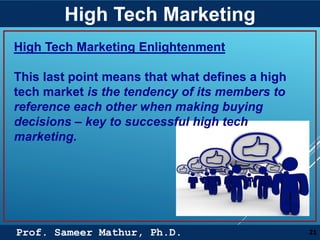
This last point means that what defines a high
tech market is the tendency of its members to
reference each other when making buying
decisions – key to successful high tech
marketing.
Prof. Sameer Mathur, Ph.D.
Defining the Chasm
22
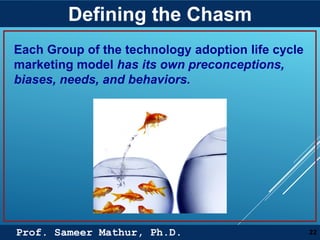
Each Group of the technology adoption life cycle
marketing model has its own preconceptions,
biases, needs, and behaviors.
Prof. Sameer Mathur, Ph.D.
Defining the Chasm
23
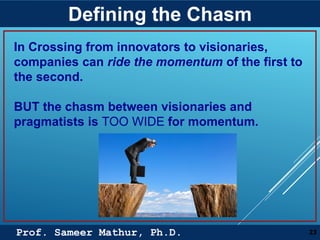
In Crossing from innovators to visionaries,
companies can ride the momentum of the first to
the second.
BUT the chasm between visionaries and
pragmatists is TOO WIDE for momentum.
Prof. Sameer Mathur, Ph.D.
Defining the Chasm
24
Why Pragmatists don’t like visionaries:
1. Lack of Respect for value of colleagues’
experiences.
2. Taking a greater interest in technology than
their industry.
3. Failing to recognize the importance of
existing product infrastructure.
4. Overall disruptiveness.
Prof. Sameer Mathur, Ph.D.
The D-Day Analogy
25
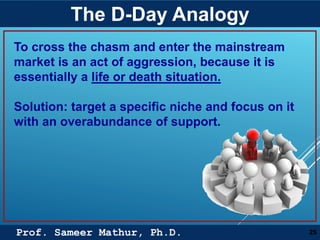
To cross the chasm and enter the mainstream
market is an act of aggression, because it is
essentially a life or death situation.
Solution: target a specific niche and focus on it
with an overabundance of support.
Prof. Sameer Mathur, Ph.D.
The D-Day Analogy
26
The D-Day Allied invasion of Normandy provides
an excellent analogy:
• The Long-term goal is to enter and take control
of a mainstream market (Europe) that is currently
dominated by an entrenched competitor (The
Axis).
•The company assembles an invasion force
comprising other products and companies (The
Allies).
Prof. Sameer Mathur, Ph.D.
The D-Day Analogy
27
• The early goal is to transition from an early
market base (England) to a strategic target
market segment in the mainstream (The Beaches
of Normandy).
• The chasm (English Channel) separates the
company from its goal.
• The Company crosses the chasm as fast as
possible, focused exclusively on the point of
attack (D-Day).
Prof. Sameer Mathur, Ph.D.
The D-Day Analogy
28
• The company forces the competitor out of its
targeted niche markets (Secure the beachhead).
• Then it moves out to take over additional
market segments (Districts of France).
• Finally, it achieves overall market domination
(The Liberation of Europe).
Prof. Sameer Mathur, Ph.D.
The D-Day Analogy
29
Trying to cross the chasm without taking a niche
market approach is like trying to light a fire
without kindling.
Prof. Sameer Mathur, Ph.D.
The D-Day Analogy
30
Companies need to be market-driven and not
sales-driven. They must commit themselves to
providing the whole product.
The niche should be strategically selected so
that it creates an entry point into a larger
segment.
Prof. Sameer Mathur, Ph.D.
The D-Day Analogy
31
Target the Point of Attack
• Crossing the Chasm is already high-risk
• The Visionaries are so different from new target
customers (pragmatists) that it is unwise to
extrapolate results.
Prof. Sameer Mathur, Ph.D.
The D-Day Analogy
32
Informed Intuition: rather than analytical reason,
intuition is the most trustworthy decision-making
tool to use.
Prof. Sameer Mathur, Ph.D.
The D-Day Analogy
33
To find a niche, companies need
to focus on target-customer
characterization.
• Create a customer profile for
each customer and application of
the product.
• Prioritize desirable target
market segment opportunities
and now there is a more helpful
set of material to work with.
Prof. Sameer Mathur, Ph.D.
The D-Day Analogy
34
What is most important is to choose swiftly and
get on with it.
Commission market research early in the
process to make sure the target is working.
Prof. Sameer Mathur, Ph.D.
The D-Day Analogy
35
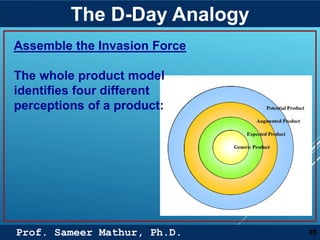
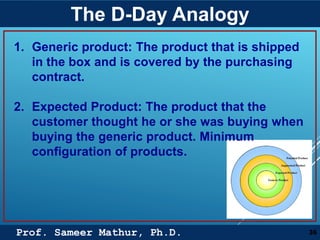
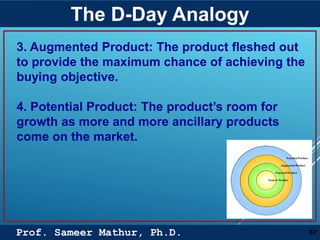
Assemble the Invasion Force
The whole product model
identifies four different
perceptions of a product:
Prof. Sameer Mathur, Ph.D.
The D-Day Analogy
36
1. Generic product: The product that is shipped
in the box and is covered by the purchasing
contract.
2. Expected Product: The product that the
customer thought he or she was buying when
buying the generic product. Minimum
configuration of products.
Prof. Sameer Mathur, Ph.D.
The D-Day Analogy
37
3. Augmented Product: The product fleshed out
to provide the maximum chance of achieving the
buying objective.
4. Potential Product: The product’s room for
growth as more and more ancillary products
come on the market.
Prof. Sameer Mathur, Ph.D.
The D-Day Analogy
38
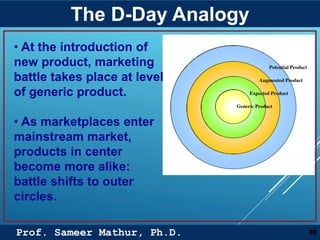
• At the introduction of
new product, marketing
battle takes place at level
of generic product.
• As marketplaces enter
mainstream market,
products in center
become more alike:
battle shifts to outer
circles.
Prof. Sameer Mathur, Ph.D.
The D-Day Analogy
39
• To dominate a mainstream marketplace:
produce the whole product.
* Visionaries must take responsibility for
creating the whole product to achieve their
dream.
* Pragmatists want the whole product to be
readily available from the outset.
Prof. Sameer Mathur, Ph.D.
The D-Day Analogy
40
Pragmatists wait for a strong leader and then
back that candidate forcefully in an effort to
squeeze out other alternatives.
Prof. Sameer Mathur, Ph.D.
The D-Day Analogy
41
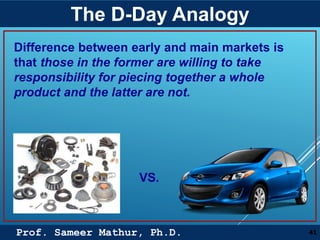
Difference between early and main markets is
that those in the former are willing to take
responsibility for piecing together a whole
product and the latter are not.
VS.
Prof. Sameer Mathur, Ph.D.
The D-Day Analogy
42
Defining the Battle
It is critical to define the competition, determine
their current relationship to target customer, and
gauge how best to position the company to force
them out of the target market segment.
Competition will come from already established
credibility with pragmatist buyers.
Prof. Sameer Mathur, Ph.D.
The D-Day Analogy
43
Acknowledge the competition but differentiate
from them. Focus on values and concerns of
pragmatists, not visionaries.
Prof. Sameer Mathur, Ph.D.
The D-Day Analogy
44
Launch the Invasion
Use distribution-oriented pricing to attract
customer-oriented distribution.
Prof. Sameer Mathur, Ph.D.
The D-Day Analogy
45
Distribution Channels
Direct Sales
Two-Tier Retail
One-Tier Retail
Internet Retail
Two-Tier value-added reselling
National roll-ups
Original equipment manufacturers
(OEMS)
Systems integrators
Prof. Sameer Mathur, Ph.D.
The D-Day Analogy
46
Various channels optimized for different
purposes:
Direct sales forces – Best for creating demand
Retail superstores – Best for fulfilling it
Customer-oriented pricing: can be based on
perceived value of owning cutting-edge
technology.
Prof. Sameer Mathur, Ph.D.
The D-Day Analogy
47
Vendor-Oriented Pricing: Comes from internal
issues of cost of goods/sales and promised rate
of return. Worst basis for pricing decisions in the
chasm.
Prof. Sameer Mathur, Ph.D.
The D-Day Analogy
48
Distributor-Oriented Pricing:
The price visionaries pay is
probably too high, so don’t
let it be an issue for the
pragmatist.
Solution: Set pricing at the
market leader point and
build disproportionately
high reward.
Prof. Sameer Mathur, Ph.D.
Getting Beyond the Chasm
49
Its effects extend to all areas of the enterprise.
Finance, organizational development, and R&D
must all be ready to aggressively attack
mainstream market.
The purpose of the post-chasm enterprise is to
make money, unlike pre-chasm entity whose
purpose is to create a new product.
Prof. Sameer Mathur, Ph.D.
Getting Beyond the Chasm
50
How do managers neutralize the chasm?
Investors can only expect to make a reasonably
predictable ROI when a sustainable whole
product is created and installed in the
mainstream market.
Management must change from pioneers to
settlers.
Prof. Sameer Mathur, Ph.D.
Getting Beyond the Chasm
51
Finally, when crossing the chasm companies
should add two new job titles:
Target market segment manager: who stewards
the visionary’s product to learn about what will
be needed for whole product.
Prof. Sameer Mathur, Ph.D.
Getting Beyond the Chasm
52
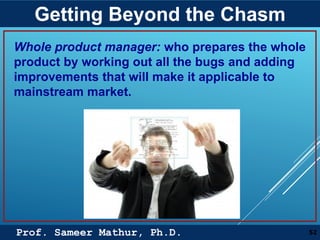
Whole product manager: who prepares the whole
product by working out all the bugs and adding
improvements that will make it applicable to
mainstream market.
Prof. Sameer Mathur, Ph.D.
IMAGE CREDITS
 https://encrypted-tbn3.gstatic.com/images?q=tbn:ANd9GcQ-tYn-
8mThKkrpUOpTWZx7ZSWKocBOAc1YNP1IQ-2Ng4PrZsQbLA
 http://i1-news.softpedia-static.com/images/news2/Bill-Gates-Testifies-in-Novell-Lawsuit-Today-2.jpg
 http://progressivetimes.files.wordpress.com/2010/06/chasm.jpg
 http://images.sodahead.com/polls/003624523/167766578_12231043_xlarge.jpeg
 http://summarytown.com/media/images/book_covers/CrossingTheChasm.jpg
 http://www.kminnovations.com/wp-content/uploads/2679934980_653f8c63ac_o.png
 http://www.ideachampions.com/weblogs/Lightbulb%20flowers.jpg
 http://abagond.files.wordpress.com/2008/03/telephone.jpg
 http://upload.wikimedia.org/wikipedia/commons/9/97/Family_watching_television_1958.jpg
 http://listdose.com/wp-content/uploads/2013/07/watching-tv.jpg
 http://suewaters.wikispaces.com/file/view/Slide12B.JPG/31092781/Slide12B.JPG
 http://engage.synecoretech.com/Portals/141995/images/new-study-SMBs-embrace-digital-marketing-
poised-for-growth.jpg
 http://www.agencypost.com/wp-content/uploads/2013/01/online-word-of-mouth.jpg
 http://leadersgrowth.files.wordpress.com/2013/05/attracting-early-adopters-startups1.jpg
 http://d2cincinnati.com/wp-content/uploads/2013/06/Gap-In-Mountain.jpg
53
Getting Beyond the Chasm
Prof. Sameer Mathur, Ph.D.
IMAGE CREDITS
 http://www.xtmotion.co.uk/wp-content/uploads/2010/11/niche2.png
 http://4.bp.blogspot.com/-qnA7YgFrhX8/TrdKk4wF0cI/AAAAAAAAAUY/dnya6EU-SRs/s1600/Fire+Badge_21.jpg
 http://www.svcc.net/uploads/EntryPoint680X260new.jpg
 http://blarneystone.ca/wp-content/uploads/2012/10/Darts.jpg
 http://cdn.madamenoire.com/wp-content/uploads/2012/08/woman-intuition.jpg
 http://writingpiecesofme.files.wordpress.com/2013/07/arrow-shooting.jpg
 http://rmsbunkerblog.files.wordpress.com/2012/01/what-is-market-research.jpg
 http://img.docstoccdn.com/thumb/orig/72358632.png
 http://www.nortruck.co.uk/wp-content/uploads/2011/03/Nortruck-General-Parts.jpg
 http://www.discountcar.com/images/cars/large/large-car4.png
 http://4.bp.blogspot.com/_G3seaVNo3Fs/TM7x0rrRHYI/AAAAAAAAACo/fxHI_17nWG0/s1600/leadership.jpg
 http://www.whackk.com/sites/default/files/malerunnerwinningrace.jpg
 http://www.lindsayburoker.com/wp-content/uploads/2010/12/ebook-pricing.jpg
 http://ideal-man.coach66.ru/wp-content/uploads/2013/07/money.jpg
 http://reachfinancialindependence.com/wp-content/uploads/2013/09/Money-Fix-Problems.jpg
 http://sherrycook.files.wordpress.com/2013/10/148_thinking_person2.gif
 http://us.123rf.com/400wm/400/400/dmitrimaruta/dmitrimaruta1201/dmitrimaruta120100233/12106981-
programmer-working-with-a-touch-screen-interface-isolated-on-white.jpg
54
Getting Beyond the Chasm
55
Prof. Sameer Mathur, Ph.D.
Sameer Mathur
Indian Institute of Management,
Lucknow
Marketing Professor 2013 –
Marketing Professor 2009 – 2013
Ph.D. and M.S. (Marketing) 2003 – 2009

Crossing The Chasm by Geoffrey A. Moore

  • 1.
    Prof. Sameer Mathur,Ph.D. Crossing the Chasm by Geoffrey A. Moore Crossing the Chasm 11 Prepared by:Prof. Sameer Mathur, Ph.D.
  • 2.
    Prof. Sameer Mathur,Ph.D. Brief Summary 2www.BuddingMarkets.com To make money with disruptive technologies in this era, they need to be brought to market and adopted quickly. Problem is that initial marketing strategies needed to break into market of early adopters Doesn’t work once a company begins marketing to the mass market.
  • 3.
    Prof. Sameer Mathur,Ph.D. Contents 3 1. If Bill Gates Can be a Billionaire 2. High Tech Marketing 3. Defining the Chasm 4. The D-Day Analogy 5. Getting Beyond the Chasm
  • 4.
    Prof. Sameer Mathur,Ph.D. If Bill Gates can be a Billionaire 4 • The Last two decades have been full of people who succeeded in the high tech industry. (Bill Gates did it, why can’t you?) • What makes one product take off while another flounders?
  • 5.
    Prof. Sameer Mathur,Ph.D. If Bill Gates can be a Billionaire 5 • When Products fail the company scapegoat is typically the VP of Marketing. • BUT it turns out the current model for high tech marketing ignores a gap between two markets
  • 6.
    Prof. Sameer Mathur,Ph.D. If Bill Gates can be a Billionaire 6 These two Markets are: 1. The Early Market: A market dominated by a few visionary customers
  • 7.
    Prof. Sameer Mathur,Ph.D. If Bill Gates can be a Billionaire 7 These two Markets are: 2. The Mainstream Market: Dominated by a large block of pragmatists. Fortunes are made by those who cross the chasm between these two markets, and lost by those who fail in the attempt.
  • 8.
    Prof. Sameer Mathur,Ph.D. High Tech Marketing 8 The Technology Adoption Life Cycle is a model for understand the acceptance of new products. Examples: Innovator or early adopter: “I want to be the first on my block with an electric car” Early Majority: “When I have seen electric cars prove themselves and when there are enough service stations on the road.”
  • 9.
    Prof. Sameer Mathur,Ph.D. High Tech Marketing 9 More Examples: Late Majority: “Not until most people have made the switch and it becomes really inconvenient to drive a gasoline car.” Laggard: “Not until hell freezes over!”
  • 10.
    Prof. Sameer Mathur,Ph.D. High Tech Marketing 10 High Tech Marketing Model Attitudes toward technology adoption become significant to marketing whenever people are introduced to discontinuous innovations that require a change in current mode of behavior.
  • 11.
    Prof. Sameer Mathur,Ph.D. High Tech Marketing 11 High Tech Marketing Model Continuous Innovations do not require any change in behaviour.
  • 12.
    Prof. Sameer Mathur,Ph.D. High Tech Marketing 12 High Tech Marketing Model Each group is distinguished by its characteristic response to discontinuous innovation and its psychographic profile.
  • 13.
    Prof. Sameer Mathur,Ph.D. High Tech Marketing 13 High Tech Marketing Model Develop the market from left to right: capture the early adopters first and use them as a base for marketing to the next group, creating a bandwagon effect.
  • 14.
    Prof. Sameer Mathur,Ph.D. High Tech Marketing 14 Cracks in the Adoption Cycle Each gap represents an opportunity for marketing to lose momentum and fail to gain the profit-margin leadership in the middle of the bell curve.
  • 15.
    Prof. Sameer Mathur,Ph.D. High Tech Marketing 15 Cracks in the Adoption Cycle The First Crack: Between innovators and early adopters occurs when an innovation cannot be readily translated into a major new benefit.
  • 16.
    Prof. Sameer Mathur,Ph.D. High Tech Marketing 16 Cracks in the Adoption Cycle The Other Crack: Between early and late majority separates those who are willing and able to become technologically competent to use the new technology from those who are not.
  • 17.
    Prof. Sameer Mathur,Ph.D. High Tech Marketing 17 Cracks in the Adoption Cycle The CHASM: This deep and dividing chasm separates the early adopters from the early majority. This is the most formidable and unforgiving transition in the technology adoption life cycle. *Customer list and order size look the same, but basis of sale is radically different.
  • 18.
    Prof. Sameer Mathur,Ph.D. High Tech Marketing 18 Cracks in the Adoption Cycle When promoters leap from early adopters to early majority, they do so without a reference base or support base within a market that is highly reference and support oriented.
  • 19.
    Prof. Sameer Mathur,Ph.D. High Tech Marketing 19 High Tech Marketing Enlightenment In the context of this book Marketing means: Taking actions to create, grow, maintain, or defend real markets, not to create illusions.
  • 20.
    Prof. Sameer Mathur,Ph.D. High Tech Marketing 20 High Tech Marketing Enlightenment For high tech organizations the real market is defined as: • A set of actual or potential customers • For a given set of products or services • Who have a common set of needs or wants • Who reference each other when making a buying decision
  • 21.
    Prof. Sameer Mathur,Ph.D. High Tech Marketing 21 High Tech Marketing Enlightenment This last point means that what defines a high tech market is the tendency of its members to reference each other when making buying decisions – key to successful high tech marketing.
  • 22.
    Prof. Sameer Mathur,Ph.D. Defining the Chasm 22 Each Group of the technology adoption life cycle marketing model has its own preconceptions, biases, needs, and behaviors.
  • 23.
    Prof. Sameer Mathur,Ph.D. Defining the Chasm 23 In Crossing from innovators to visionaries, companies can ride the momentum of the first to the second. BUT the chasm between visionaries and pragmatists is TOO WIDE for momentum.
  • 24.
    Prof. Sameer Mathur,Ph.D. Defining the Chasm 24 Why Pragmatists don’t like visionaries: 1. Lack of Respect for value of colleagues’ experiences. 2. Taking a greater interest in technology than their industry. 3. Failing to recognize the importance of existing product infrastructure. 4. Overall disruptiveness.
  • 25.
    Prof. Sameer Mathur,Ph.D. The D-Day Analogy 25 To cross the chasm and enter the mainstream market is an act of aggression, because it is essentially a life or death situation. Solution: target a specific niche and focus on it with an overabundance of support.
  • 26.
    Prof. Sameer Mathur,Ph.D. The D-Day Analogy 26 The D-Day Allied invasion of Normandy provides an excellent analogy: • The Long-term goal is to enter and take control of a mainstream market (Europe) that is currently dominated by an entrenched competitor (The Axis). •The company assembles an invasion force comprising other products and companies (The Allies).
  • 27.
    Prof. Sameer Mathur,Ph.D. The D-Day Analogy 27 • The early goal is to transition from an early market base (England) to a strategic target market segment in the mainstream (The Beaches of Normandy). • The chasm (English Channel) separates the company from its goal. • The Company crosses the chasm as fast as possible, focused exclusively on the point of attack (D-Day).
  • 28.
    Prof. Sameer Mathur,Ph.D. The D-Day Analogy 28 • The company forces the competitor out of its targeted niche markets (Secure the beachhead). • Then it moves out to take over additional market segments (Districts of France). • Finally, it achieves overall market domination (The Liberation of Europe).
  • 29.
    Prof. Sameer Mathur,Ph.D. The D-Day Analogy 29 Trying to cross the chasm without taking a niche market approach is like trying to light a fire without kindling.
  • 30.
    Prof. Sameer Mathur,Ph.D. The D-Day Analogy 30 Companies need to be market-driven and not sales-driven. They must commit themselves to providing the whole product. The niche should be strategically selected so that it creates an entry point into a larger segment.
  • 31.
    Prof. Sameer Mathur,Ph.D. The D-Day Analogy 31 Target the Point of Attack • Crossing the Chasm is already high-risk • The Visionaries are so different from new target customers (pragmatists) that it is unwise to extrapolate results.
  • 32.
    Prof. Sameer Mathur,Ph.D. The D-Day Analogy 32 Informed Intuition: rather than analytical reason, intuition is the most trustworthy decision-making tool to use.
  • 33.
    Prof. Sameer Mathur,Ph.D. The D-Day Analogy 33 To find a niche, companies need to focus on target-customer characterization. • Create a customer profile for each customer and application of the product. • Prioritize desirable target market segment opportunities and now there is a more helpful set of material to work with.
  • 34.
    Prof. Sameer Mathur,Ph.D. The D-Day Analogy 34 What is most important is to choose swiftly and get on with it. Commission market research early in the process to make sure the target is working.
  • 35.
    Prof. Sameer Mathur,Ph.D. The D-Day Analogy 35 Assemble the Invasion Force The whole product model identifies four different perceptions of a product:
  • 36.
    Prof. Sameer Mathur,Ph.D. The D-Day Analogy 36 1. Generic product: The product that is shipped in the box and is covered by the purchasing contract. 2. Expected Product: The product that the customer thought he or she was buying when buying the generic product. Minimum configuration of products.
  • 37.
    Prof. Sameer Mathur,Ph.D. The D-Day Analogy 37 3. Augmented Product: The product fleshed out to provide the maximum chance of achieving the buying objective. 4. Potential Product: The product’s room for growth as more and more ancillary products come on the market.
  • 38.
    Prof. Sameer Mathur,Ph.D. The D-Day Analogy 38 • At the introduction of new product, marketing battle takes place at level of generic product. • As marketplaces enter mainstream market, products in center become more alike: battle shifts to outer circles.
  • 39.
    Prof. Sameer Mathur,Ph.D. The D-Day Analogy 39 • To dominate a mainstream marketplace: produce the whole product. * Visionaries must take responsibility for creating the whole product to achieve their dream. * Pragmatists want the whole product to be readily available from the outset.
  • 40.
    Prof. Sameer Mathur,Ph.D. The D-Day Analogy 40 Pragmatists wait for a strong leader and then back that candidate forcefully in an effort to squeeze out other alternatives.
  • 41.
    Prof. Sameer Mathur,Ph.D. The D-Day Analogy 41 Difference between early and main markets is that those in the former are willing to take responsibility for piecing together a whole product and the latter are not. VS.
  • 42.
    Prof. Sameer Mathur,Ph.D. The D-Day Analogy 42 Defining the Battle It is critical to define the competition, determine their current relationship to target customer, and gauge how best to position the company to force them out of the target market segment. Competition will come from already established credibility with pragmatist buyers.
  • 43.
    Prof. Sameer Mathur,Ph.D. The D-Day Analogy 43 Acknowledge the competition but differentiate from them. Focus on values and concerns of pragmatists, not visionaries.
  • 44.
    Prof. Sameer Mathur,Ph.D. The D-Day Analogy 44 Launch the Invasion Use distribution-oriented pricing to attract customer-oriented distribution.
  • 45.
    Prof. Sameer Mathur,Ph.D. The D-Day Analogy 45 Distribution Channels Direct Sales Two-Tier Retail One-Tier Retail Internet Retail Two-Tier value-added reselling National roll-ups Original equipment manufacturers (OEMS) Systems integrators
  • 46.
    Prof. Sameer Mathur,Ph.D. The D-Day Analogy 46 Various channels optimized for different purposes: Direct sales forces – Best for creating demand Retail superstores – Best for fulfilling it Customer-oriented pricing: can be based on perceived value of owning cutting-edge technology.
  • 47.
    Prof. Sameer Mathur,Ph.D. The D-Day Analogy 47 Vendor-Oriented Pricing: Comes from internal issues of cost of goods/sales and promised rate of return. Worst basis for pricing decisions in the chasm.
  • 48.
    Prof. Sameer Mathur,Ph.D. The D-Day Analogy 48 Distributor-Oriented Pricing: The price visionaries pay is probably too high, so don’t let it be an issue for the pragmatist. Solution: Set pricing at the market leader point and build disproportionately high reward.
  • 49.
    Prof. Sameer Mathur,Ph.D. Getting Beyond the Chasm 49 Its effects extend to all areas of the enterprise. Finance, organizational development, and R&D must all be ready to aggressively attack mainstream market. The purpose of the post-chasm enterprise is to make money, unlike pre-chasm entity whose purpose is to create a new product.
  • 50.
    Prof. Sameer Mathur,Ph.D. Getting Beyond the Chasm 50 How do managers neutralize the chasm? Investors can only expect to make a reasonably predictable ROI when a sustainable whole product is created and installed in the mainstream market. Management must change from pioneers to settlers.
  • 51.
    Prof. Sameer Mathur,Ph.D. Getting Beyond the Chasm 51 Finally, when crossing the chasm companies should add two new job titles: Target market segment manager: who stewards the visionary’s product to learn about what will be needed for whole product.
  • 52.
    Prof. Sameer Mathur,Ph.D. Getting Beyond the Chasm 52 Whole product manager: who prepares the whole product by working out all the bugs and adding improvements that will make it applicable to mainstream market.
  • 53.
    Prof. Sameer Mathur,Ph.D. IMAGE CREDITS  https://encrypted-tbn3.gstatic.com/images?q=tbn:ANd9GcQ-tYn- 8mThKkrpUOpTWZx7ZSWKocBOAc1YNP1IQ-2Ng4PrZsQbLA  http://i1-news.softpedia-static.com/images/news2/Bill-Gates-Testifies-in-Novell-Lawsuit-Today-2.jpg  http://progressivetimes.files.wordpress.com/2010/06/chasm.jpg  http://images.sodahead.com/polls/003624523/167766578_12231043_xlarge.jpeg  http://summarytown.com/media/images/book_covers/CrossingTheChasm.jpg  http://www.kminnovations.com/wp-content/uploads/2679934980_653f8c63ac_o.png  http://www.ideachampions.com/weblogs/Lightbulb%20flowers.jpg  http://abagond.files.wordpress.com/2008/03/telephone.jpg  http://upload.wikimedia.org/wikipedia/commons/9/97/Family_watching_television_1958.jpg  http://listdose.com/wp-content/uploads/2013/07/watching-tv.jpg  http://suewaters.wikispaces.com/file/view/Slide12B.JPG/31092781/Slide12B.JPG  http://engage.synecoretech.com/Portals/141995/images/new-study-SMBs-embrace-digital-marketing- poised-for-growth.jpg  http://www.agencypost.com/wp-content/uploads/2013/01/online-word-of-mouth.jpg  http://leadersgrowth.files.wordpress.com/2013/05/attracting-early-adopters-startups1.jpg  http://d2cincinnati.com/wp-content/uploads/2013/06/Gap-In-Mountain.jpg 53 Getting Beyond the Chasm
  • 54.
    Prof. Sameer Mathur,Ph.D. IMAGE CREDITS  http://www.xtmotion.co.uk/wp-content/uploads/2010/11/niche2.png  http://4.bp.blogspot.com/-qnA7YgFrhX8/TrdKk4wF0cI/AAAAAAAAAUY/dnya6EU-SRs/s1600/Fire+Badge_21.jpg  http://www.svcc.net/uploads/EntryPoint680X260new.jpg  http://blarneystone.ca/wp-content/uploads/2012/10/Darts.jpg  http://cdn.madamenoire.com/wp-content/uploads/2012/08/woman-intuition.jpg  http://writingpiecesofme.files.wordpress.com/2013/07/arrow-shooting.jpg  http://rmsbunkerblog.files.wordpress.com/2012/01/what-is-market-research.jpg  http://img.docstoccdn.com/thumb/orig/72358632.png  http://www.nortruck.co.uk/wp-content/uploads/2011/03/Nortruck-General-Parts.jpg  http://www.discountcar.com/images/cars/large/large-car4.png  http://4.bp.blogspot.com/_G3seaVNo3Fs/TM7x0rrRHYI/AAAAAAAAACo/fxHI_17nWG0/s1600/leadership.jpg  http://www.whackk.com/sites/default/files/malerunnerwinningrace.jpg  http://www.lindsayburoker.com/wp-content/uploads/2010/12/ebook-pricing.jpg  http://ideal-man.coach66.ru/wp-content/uploads/2013/07/money.jpg  http://reachfinancialindependence.com/wp-content/uploads/2013/09/Money-Fix-Problems.jpg  http://sherrycook.files.wordpress.com/2013/10/148_thinking_person2.gif  http://us.123rf.com/400wm/400/400/dmitrimaruta/dmitrimaruta1201/dmitrimaruta120100233/12106981- programmer-working-with-a-touch-screen-interface-isolated-on-white.jpg 54 Getting Beyond the Chasm
  • 55.
    55 Prof. Sameer Mathur,Ph.D. Sameer Mathur Indian Institute of Management, Lucknow Marketing Professor 2013 – Marketing Professor 2009 – 2013 Ph.D. and M.S. (Marketing) 2003 – 2009