26
Authors:
Andy Quarmby, The Value Engineers &Catherine Grainger, 3M
A FRESH LOOK AT PROPOSITION TESTING
27
In today’s business world, innovation is everything - and a critical element of that is understanding where the
strengths and weaknesses of your proposition are. Many companies still tussle with ensuring that their go-to-market
proposition is as compelling and punchy as possible, whilst also differentiating their brand.
3M is one of the world’s most renowned companies when it comes to innovation, staying at the forefront of
the many industries in which they operate. However, most of us don’t know much about the early years and
the difficulties that the Minnesota-based company once encountered. For nearly 20 years, the company faced
bankruptcy and only barely continued to keep its head above water.
A man named McKnight
In 1905, a man called William L McKnight was rejected for a low-paid manual role with the business, much to his
disappointment. After applying to the company for a second time, he was offered the post of assistant bookkeeper.
During his time at 3M, William McKnight would work his way up to CEO of the organisation and eventually become
a powerful influence on the company for years to come.
Throughout his time with the company, McKnight truly supported the need for innovation and allowed creativity to
thrive in the business - a deviant thinker for his time. As he advised: “Encourage experimental doodling; if you put
fences around people you get sheep”.
Unlike John Lasseter’s bosses at Disney studios, McKnight actually encouraged his colleagues to think outside
of the box, to be creative and to explore things they were passionate about. This led to the ‘15% Rule’, allowing
people to dedicate up to 15% of their time to a project of their choosing; a rule that still exists today throughout the
laboratories at 3M.
28
Making space for innovation and putting it at the heart of the business has led to 3M becoming one of the most
innovative and admired companies on the planet, with $32 billion in global sales across nearly two hundred
countries. One-third of those sales comes from products which didn’t exist five years ago.
As a business, 3M operates in a diverse range of industries, with the only constant being its position at the top of
the price-value pyramid, offering high-quality products at a premium price point. This, however, causes the brand a
number of challenges.
Identifying propositions that convey the value and benefits of the products they offer is more important than ever,
in order to justify this price level and differentiate from cheaper alternatives and ‘me-too’ offerings. Particularly in
stagnant industries or categories with little or no growth, such as healthcare, it is crucial to determine what sets 3M
apart from its competitors, and to understand how best to communicate to its target audiences.
So how do you test concepts to help sharpen your proposition and better convey the superior benefits of your
products? How do you do this in markets and industries where traditional methods of testing against database
norms is not an option?
When traditional concept testing won’t cut it
In this scenario (and many others), the traditional approach to concept testing just doesn’t cut it. 3M requires a
unique approach to cater for its presence in non-traditional and B2B markets, and to answer the challenge of how
to justify a higher price point. The majority of the business’ growth comes from market share gain from competitors
- so testing against a database of largely failed and unlaunched ideas gives no real indication of the likely strength of
a proposition in the market.
29
Oscar de la Hoya once said that: “To be the best, you have to beat the best”. It’s a statement that’s true across
any sport and indeed any industry. We must change the way we look at concept testing and use the existing
competition to provide a real-life, relative context against which to benchmark the strength of an idea - not a dated
list of ‘nearly’ ideas on a database.
Customers’ needs are changing quickly, and so must our approach to testing concepts and propositions. An
increasingly busy life means that when it comes to their purchase decision, consumers are making instant trade-offs
between brands and products. They simply don’t ponder a product’s likelihood to make them feel differently about
x, y or z, or how differentiated or credible they feel the brand may be because of a particular product. It comes
down to whether the package on offer (product quality, appearance, price etc.) weighs up better than
its alternatives.
Props with Punch: evaluating concepts and propositions head-to-head
The Props with Punch process was developed to address these issues and provide the best possible understanding
for brands like 3M of the strength of a proposition, as well as how to enhance and sharpen the message. By pitting
propositions head-to-head against the market leaders, the results are more reflective of a real-life context and better
account for all of the potential purchase drivers.
‘To be the best, you have to beat the best.’ It is an idea epitomised by tournaments such as the World Cup and the
Champions League, which sit at the pinnacle of the sporting world. The format of such tournaments - i.e. a group
stage followed by knockout clashes - forms the basis of a ‘trade-off’ section in the Props with Punch approach
to testing.
30
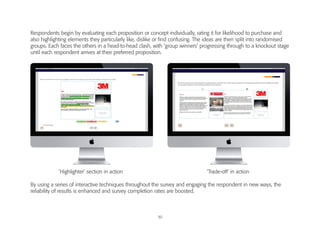
Respondents begin by evaluating each proposition or concept individually, rating it for likelihood to purchase and
also highlighting elements they particularly like, dislike or find confusing. The ideas are then split into randomised
groups. Each faces the others in a head-to-head clash, with ‘group winners’ progressing through to a knockout stage
until each respondent arrives at their preferred proposition.
By using a series of interactive techniques throughout the survey and engaging the respondent in new ways, the
reliability of results is enhanced and survey completion rates are boosted.
‘Highlighter’ section in action ‘Trade-off’ in action
Illustration
31
A case study: 3M
The use of a head-to-head testing methodology of this type has had six key benefits for 3M:
1. Applicable across industries and markets: Because the process isn’t dependent on availability of databases
or type of market, it can be replicated across the business to give consistency in future business operations.
2. True read on preference: Results show a clear ranking in order of preference. Because respondents have
answered in a more realistic context, the business receives a truer read and better understanding of how a
new idea or proposition will fare in the market.
3. Key differentiators identified: By understanding what really drives decision-making and what the key needs
in the market are, the methodology allows us to align these to brand perceptions, determining the benefits
that actually differentiate our brands from their competitors.
4. Correct tone and style of language: Competitors will often talk about almost identical benefits and
proof points, but do so in slightly different ways. Understanding the customer and how they want us to
communicate is vital for our brand - and can be the difference between success and failure. The business
learns the best way to articulate product benefits in language that resonates with the consumer.
5. Consumer profiling by preference: By profiling respondents with particular preferences, we can understand
what is driving the purchase decision for particular brands, and consequently how to communicate to the
different audiences. This enables our brands to target their audiences with relevant messages that they want
to hear - something that’s incredibly beneficial when it comes to retention and acquisition.
32
6. Compelling and successful propositions: At the end of the day, we want to develop propositions that are
both powerful and successful. By better understanding the customer, their needs and their perceptions of
brands in the market, we can tailor the proposition to be more appealing - and create communications that
are compelling, relevant and differentiating for the brand.
Since its introduction, we’ve conducted Props with Punch studies across a variety of 3M’s business units in more
than 10 countries. The impact can be seen in a number of changes set into motion. The nature of communications
has changed to a more sharpened and appealing proposition across the board, differentiating us from lower-priced
alternatives and conveying the key benefits that are most important for our customer base.
By better understanding the customer, their needs and perceptions of brands, we can tailor the proposition to be
more appealing - and create communications that are compelling, relevant and differentiating.
In understanding the potential of specific propositions, we have prioritised the areas within the business that
offer greatest opportunity and potential for growth, and subsequently reshuffled marketing spend and bolstered
sales forces as required to deliver on these. In being bold not only in the ways we innovate and challenge but also
how we validate our products, we can continue to have confidence in the 3M business and remain a leader in
the market.

A fresh approach to proposition testing

  • 1.
    26 Authors: Andy Quarmby, TheValue Engineers &Catherine Grainger, 3M A FRESH LOOK AT PROPOSITION TESTING
  • 2.
    27 In today’s businessworld, innovation is everything - and a critical element of that is understanding where the strengths and weaknesses of your proposition are. Many companies still tussle with ensuring that their go-to-market proposition is as compelling and punchy as possible, whilst also differentiating their brand. 3M is one of the world’s most renowned companies when it comes to innovation, staying at the forefront of the many industries in which they operate. However, most of us don’t know much about the early years and the difficulties that the Minnesota-based company once encountered. For nearly 20 years, the company faced bankruptcy and only barely continued to keep its head above water. A man named McKnight In 1905, a man called William L McKnight was rejected for a low-paid manual role with the business, much to his disappointment. After applying to the company for a second time, he was offered the post of assistant bookkeeper. During his time at 3M, William McKnight would work his way up to CEO of the organisation and eventually become a powerful influence on the company for years to come. Throughout his time with the company, McKnight truly supported the need for innovation and allowed creativity to thrive in the business - a deviant thinker for his time. As he advised: “Encourage experimental doodling; if you put fences around people you get sheep”. Unlike John Lasseter’s bosses at Disney studios, McKnight actually encouraged his colleagues to think outside of the box, to be creative and to explore things they were passionate about. This led to the ‘15% Rule’, allowing people to dedicate up to 15% of their time to a project of their choosing; a rule that still exists today throughout the laboratories at 3M.
  • 3.
    28 Making space forinnovation and putting it at the heart of the business has led to 3M becoming one of the most innovative and admired companies on the planet, with $32 billion in global sales across nearly two hundred countries. One-third of those sales comes from products which didn’t exist five years ago. As a business, 3M operates in a diverse range of industries, with the only constant being its position at the top of the price-value pyramid, offering high-quality products at a premium price point. This, however, causes the brand a number of challenges. Identifying propositions that convey the value and benefits of the products they offer is more important than ever, in order to justify this price level and differentiate from cheaper alternatives and ‘me-too’ offerings. Particularly in stagnant industries or categories with little or no growth, such as healthcare, it is crucial to determine what sets 3M apart from its competitors, and to understand how best to communicate to its target audiences. So how do you test concepts to help sharpen your proposition and better convey the superior benefits of your products? How do you do this in markets and industries where traditional methods of testing against database norms is not an option? When traditional concept testing won’t cut it In this scenario (and many others), the traditional approach to concept testing just doesn’t cut it. 3M requires a unique approach to cater for its presence in non-traditional and B2B markets, and to answer the challenge of how to justify a higher price point. The majority of the business’ growth comes from market share gain from competitors - so testing against a database of largely failed and unlaunched ideas gives no real indication of the likely strength of a proposition in the market.
  • 4.
    29 Oscar de laHoya once said that: “To be the best, you have to beat the best”. It’s a statement that’s true across any sport and indeed any industry. We must change the way we look at concept testing and use the existing competition to provide a real-life, relative context against which to benchmark the strength of an idea - not a dated list of ‘nearly’ ideas on a database. Customers’ needs are changing quickly, and so must our approach to testing concepts and propositions. An increasingly busy life means that when it comes to their purchase decision, consumers are making instant trade-offs between brands and products. They simply don’t ponder a product’s likelihood to make them feel differently about x, y or z, or how differentiated or credible they feel the brand may be because of a particular product. It comes down to whether the package on offer (product quality, appearance, price etc.) weighs up better than its alternatives. Props with Punch: evaluating concepts and propositions head-to-head The Props with Punch process was developed to address these issues and provide the best possible understanding for brands like 3M of the strength of a proposition, as well as how to enhance and sharpen the message. By pitting propositions head-to-head against the market leaders, the results are more reflective of a real-life context and better account for all of the potential purchase drivers. ‘To be the best, you have to beat the best.’ It is an idea epitomised by tournaments such as the World Cup and the Champions League, which sit at the pinnacle of the sporting world. The format of such tournaments - i.e. a group stage followed by knockout clashes - forms the basis of a ‘trade-off’ section in the Props with Punch approach to testing.
  • 5.
    30 Respondents begin byevaluating each proposition or concept individually, rating it for likelihood to purchase and also highlighting elements they particularly like, dislike or find confusing. The ideas are then split into randomised groups. Each faces the others in a head-to-head clash, with ‘group winners’ progressing through to a knockout stage until each respondent arrives at their preferred proposition. By using a series of interactive techniques throughout the survey and engaging the respondent in new ways, the reliability of results is enhanced and survey completion rates are boosted. ‘Highlighter’ section in action ‘Trade-off’ in action Illustration
  • 6.
    31 A case study:3M The use of a head-to-head testing methodology of this type has had six key benefits for 3M: 1. Applicable across industries and markets: Because the process isn’t dependent on availability of databases or type of market, it can be replicated across the business to give consistency in future business operations. 2. True read on preference: Results show a clear ranking in order of preference. Because respondents have answered in a more realistic context, the business receives a truer read and better understanding of how a new idea or proposition will fare in the market. 3. Key differentiators identified: By understanding what really drives decision-making and what the key needs in the market are, the methodology allows us to align these to brand perceptions, determining the benefits that actually differentiate our brands from their competitors. 4. Correct tone and style of language: Competitors will often talk about almost identical benefits and proof points, but do so in slightly different ways. Understanding the customer and how they want us to communicate is vital for our brand - and can be the difference between success and failure. The business learns the best way to articulate product benefits in language that resonates with the consumer. 5. Consumer profiling by preference: By profiling respondents with particular preferences, we can understand what is driving the purchase decision for particular brands, and consequently how to communicate to the different audiences. This enables our brands to target their audiences with relevant messages that they want to hear - something that’s incredibly beneficial when it comes to retention and acquisition.
  • 7.
    32 6. Compelling andsuccessful propositions: At the end of the day, we want to develop propositions that are both powerful and successful. By better understanding the customer, their needs and their perceptions of brands in the market, we can tailor the proposition to be more appealing - and create communications that are compelling, relevant and differentiating for the brand. Since its introduction, we’ve conducted Props with Punch studies across a variety of 3M’s business units in more than 10 countries. The impact can be seen in a number of changes set into motion. The nature of communications has changed to a more sharpened and appealing proposition across the board, differentiating us from lower-priced alternatives and conveying the key benefits that are most important for our customer base. By better understanding the customer, their needs and perceptions of brands, we can tailor the proposition to be more appealing - and create communications that are compelling, relevant and differentiating. In understanding the potential of specific propositions, we have prioritised the areas within the business that offer greatest opportunity and potential for growth, and subsequently reshuffled marketing spend and bolstered sales forces as required to deliver on these. In being bold not only in the ways we innovate and challenge but also how we validate our products, we can continue to have confidence in the 3M business and remain a leader in the market.