DESIGN AND
ANALYSIS OF
MACHINE
LEARNING
EXPERIMENTS
Presentd By
J.Kowsy Sara
Assistant Professor
AI&ML
Rathinam Technical Campus
kowsysara.soc@rathinam.in
DESIGN AND ANALYSIS OF MACHINE
LEARNING EXPERIMENTS
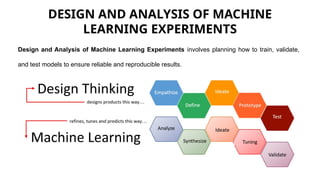
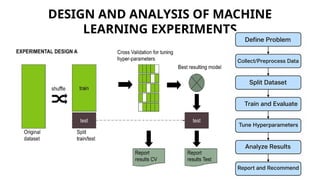
Design and Analysis of Machine Learning Experiments involves planning how to train, validate,
and test models to ensure reliable and reproducible results.
DESIGN AND ANALYSIS OF MACHINE
LEARNING EXPERIMENTS
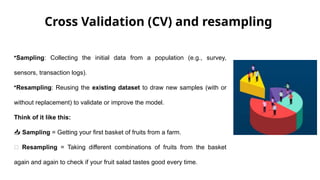
Cross Validation (CV) and resampling
•Sampling: Collecting the initial data from a population (e.g., survey,
sensors, transaction logs).
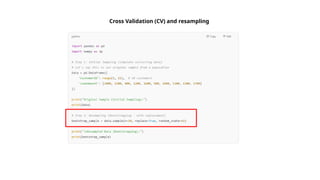
•Resampling: Reusing the existing dataset to draw new samples (with or
without replacement) to validate or improve the model.
Think of it like this:
📥 Sampling = Getting your first basket of fruits from a farm.
🔄 Resampling = Taking different combinations of fruits from the basket
again and again to check if your fruit salad tastes good every time.
Cross Validation (CV) and resampling
Types of Resampling:
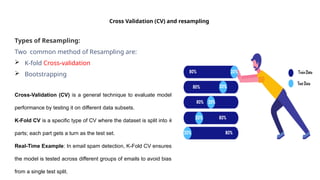
Two common method of Resampling are:
 K-fold Cross-validation
 Bootstrapping
Cross-Validation (CV) is a general technique to evaluate model
performance by testing it on different data subsets.
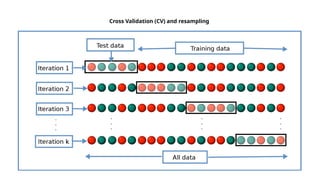
K-Fold CV is a specific type of CV where the dataset is split into k
parts; each part gets a turn as the test set.
Real-Time Example: In email spam detection, K-Fold CV ensures
the model is tested across different groups of emails to avoid bias
from a single test split.
Cross Validation (CV) and resampling
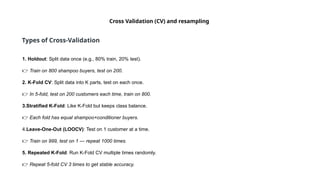
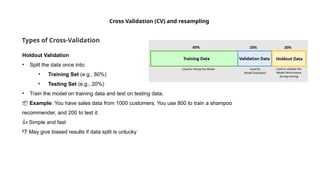
Types of Cross-Validation
1. Holdout: Split data once (e.g., 80% train, 20% test).
👉 Train on 800 shampoo buyers, test on 200.
2. K-Fold CV: Split data into K parts, test on each once.
👉 In 5-fold, test on 200 customers each time, train on 800.
3.Stratified K-Fold: Like K-Fold but keeps class balance.
👉 Each fold has equal shampoo+conditioner buyers.
4.Leave-One-Out (LOOCV): Test on 1 customer at a time.
👉 Train on 999, test on 1 — repeat 1000 times.
5. Repeated K-Fold: Run K-Fold CV multiple times randomly.
👉 Repeat 5-fold CV 3 times to get stable accuracy.
Cross Validation (CV) and resampling
Types of Cross-Validation
Holdout Validation
• Split the data once into:
• Training Set (e.g., 80%)
• Testing Set (e.g., 20%)
• Train the model on training data and test on testing data.
📦 Example: You have sales data from 1000 customers. You use 800 to train a shampoo
recommender, and 200 to test it.
👍 Simple and fast
May give biased results if data split is unlucky
👎
Cross Validation (CV) and resampling
Types of Cross-Validation
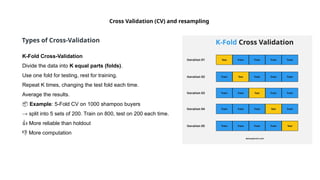
K-Fold Cross-Validation
Divide the data into K equal parts (folds).
Use one fold for testing, rest for training.
Repeat K times, changing the test fold each time.
Average the results.
📦 Example: 5-Fold CV on 1000 shampoo buyers
→ split into 5 sets of 200. Train on 800, test on 200 each time.
👍 More reliable than holdout
More computation
👎
Cross Validation (CV) and resampling
Types of Cross-Validation
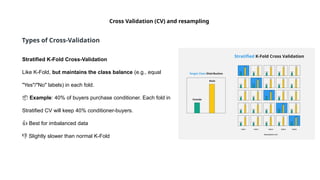
Stratified K-Fold Cross-Validation
Like K-Fold, but maintains the class balance (e.g., equal
"Yes"/"No" labels) in each fold.
📦 Example: 40% of buyers purchase conditioner. Each fold in
Stratified CV will keep 40% conditioner-buyers.
👍 Best for imbalanced data
Slightly slower than normal K-Fold
👎
Cross Validation (CV) and resampling
Types of Cross-Validation
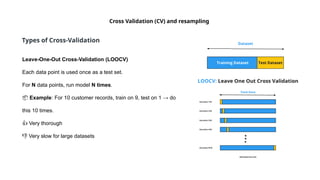
Leave-One-Out Cross-Validation (LOOCV)
Each data point is used once as a test set.
For N data points, run model N times.
📦 Example: For 10 customer records, train on 9, test on 1 → do
this 10 times.
👍 Very thorough
Very slow for large datasets
👎
Cross Validation (CV) and resampling
Types of Cross-Validation
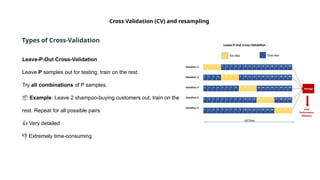
Leave-P-Out Cross-Validation
Leave P samples out for testing, train on the rest.
Try all combinations of P samples.
📦 Example: Leave 2 shampoo-buying customers out, train on the
rest. Repeat for all possible pairs.
👍 Very detailed
Extremely time-consuming
👎
Cross Validation (CV) and resampling
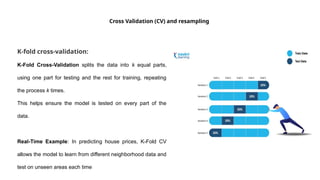
K-fold cross-validation:
K-Fold Cross-Validation splits the data into k equal parts,
using one part for testing and the rest for training, repeating
the process k times.
This helps ensure the model is tested on every part of the
data.
Real-Time Example: In predicting house prices, K-Fold CV
allows the model to learn from different neighborhood data and
test on unseen areas each time
Cross Validation (CV) and resampling
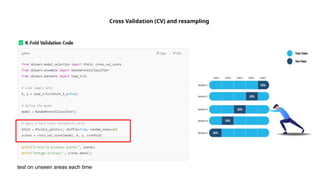
K-fold cross-validation:
K-Fold Cross-Validation splits the data into k equal parts,
using one part for testing and the rest for training, repeating
the process k times.
This helps ensure the model is tested on every part of the
data.
Real-Time Example: In predicting house prices, K-Fold CV
allows the model to learn from different neighborhood data and
test on unseen areas each time
Cross Validation (CV) and resampling
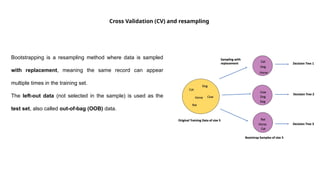
Bootstrapping is a resampling method where data is sampled
with replacement, meaning the same record can appear
multiple times in the training set.
The left-out data (not selected in the sample) is used as the
test set, also called out-of-bag (OOB) data.
Measuring Classifier Performance
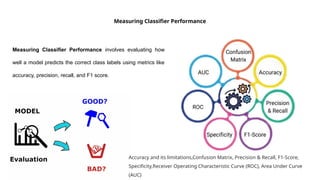
Measuring Classifier Performance involves evaluating how
well a model predicts the correct class labels using metrics like
accuracy, precision, recall, and F1 score.
Accuracy and its limitations,Confusion Matrix, Precision & Recall, F1-Score,
Specificity,Receiver Operating Characteristic Curve (ROC), Area Under Curve
(AUC)
Measuring Classifier Performance
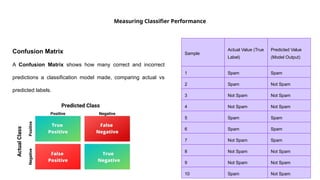
Confusion Matrix
A Confusion Matrix shows how many correct and incorrect
predictions a classification model made, comparing actual vs
predicted labels.
Sample
Actual Value (True
Label)
Predicted Value
(Model Output)
1 Spam Spam
2 Spam Not Spam
3 Not Spam Not Spam
4 Not Spam Not Spam
5 Spam Spam
6 Spam Spam
7 Not Spam Spam
8 Not Spam Not Spam
9 Not Spam Not Spam
10 Spam Not Spam
Measuring Classifier Performance
Sample
Actual Value (True
Label)
Predicted Value
(Model Output)
1 Spam Spam
2 Spam Not Spam
3 Not Spam Not Spam
4 Not Spam Not Spam
5 Spam Spam
6 Spam Spam
7 Not Spam Spam
8 Not Spam Not Spam
9 Not Spam Not Spam
10 Spam Not Spam
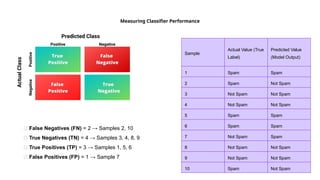
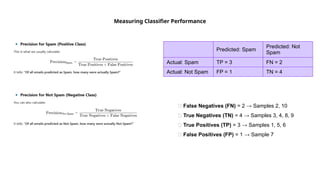
❌ False Negatives (FN) = 2 → Samples 2, 10
✅ True Negatives (TN) = 4 → Samples 3, 4, 8, 9
✅ True Positives (TP) = 3 → Samples 1, 5, 6
❌ False Positives (FP) = 1 → Sample 7
Measuring Classifier Performance
❌ False Negatives (FN) = 2 → Samples 2, 10
✅ True Negatives (TN) = 4 → Samples 3, 4, 8, 9
✅ True Positives (TP) = 3 → Samples 1, 5, 6
❌ False Positives (FP) = 1 → Sample 7
Predicted: Spam
Predicted: Not
Spam
Actual: Spam TP = 3 FN = 2
Actual: Not Spam FP = 1 TN = 4
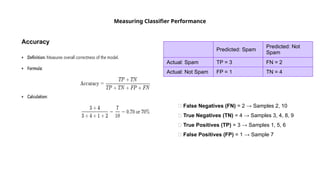
Accuracy
Measuring Classifier Performance
❌ False Negatives (FN) = 2 → Samples 2, 10
✅ True Negatives (TN) = 4 → Samples 3, 4, 8, 9
✅ True Positives (TP) = 3 → Samples 1, 5, 6
❌ False Positives (FP) = 1 → Sample 7
Predicted: Spam
Predicted: Not
Spam
Actual: Spam TP = 3 FN = 2
Actual: Not Spam FP = 1 TN = 4
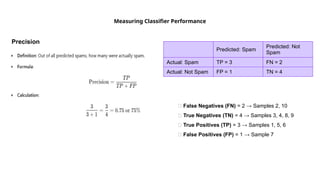
Precision
Measuring Classifier Performance
❌ False Negatives (FN) = 2 → Samples 2, 10
✅ True Negatives (TN) = 4 → Samples 3, 4, 8, 9
✅ True Positives (TP) = 3 → Samples 1, 5, 6
❌ False Positives (FP) = 1 → Sample 7
Predicted: Spam
Predicted: Not
Spam
Actual: Spam TP = 3 FN = 2
Actual: Not Spam FP = 1 TN = 4
Precision
Measuring Classifier Performance
❌ False Negatives (FN) = 2 → Samples 2, 10
✅ True Negatives (TN) = 4 → Samples 3, 4, 8, 9
✅ True Positives (TP) = 3 → Samples 1, 5, 6
❌ False Positives (FP) = 1 → Sample 7
Predicted: Spam
Predicted: Not
Spam
Actual: Spam TP = 3 FN = 2
Actual: Not Spam FP = 1 TN = 4
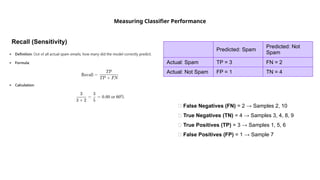
Recall (Sensitivity)
Measuring Classifier Performance
❌ False Negatives (FN) = 2 → Samples 2, 10
✅ True Negatives (TN) = 4 → Samples 3, 4, 8, 9
✅ True Positives (TP) = 3 → Samples 1, 5, 6
❌ False Positives (FP) = 1 → Sample 7
Predicted: Spam
Predicted: Not
Spam
Actual: Spam TP = 3 FN = 2
Actual: Not Spam FP = 1 TN = 4
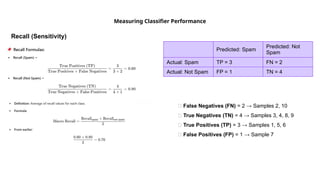
Recall (Sensitivity)
Measuring Classifier Performance
❌ False Negatives (FN) = 2 → Samples 2, 10
✅ True Negatives (TN) = 4 → Samples 3, 4, 8, 9
✅ True Positives (TP) = 3 → Samples 1, 5, 6
❌ False Positives (FP) = 1 → Sample 7
Predicted: Spam
Predicted: Not
Spam
Actual: Spam TP = 3 FN = 2
Actual: Not Spam FP = 1 TN = 4
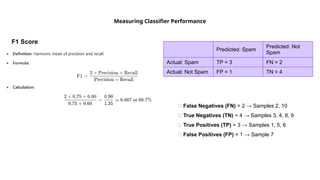
F1 Score
t test, McNemar's test, K-fold CV paired t test
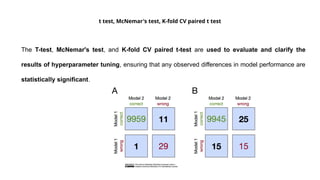
The T-test, McNemar's test, and K-fold CV paired t-test are used to evaluate and clarify the
results of hyperparameter tuning, ensuring that any observed differences in model performance are
statistically significant.
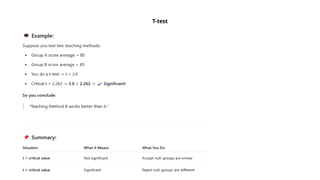
t-Test
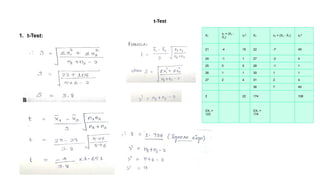
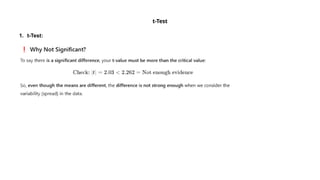
1. t-Test:
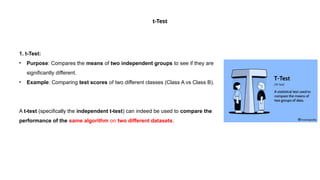
• Purpose: Compares the means of two independent groups to see if they are
significantly different.
• Example: Comparing test scores of two different classes (Class A vs Class B).
A t-test (specifically the independent t-test) can indeed be used to compare the
performance of the same algorithm on two different datasets.
t-Test
1. t-Test:
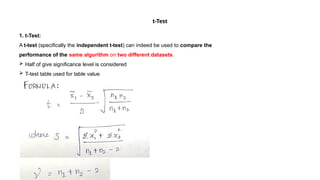
A t-test (specifically the independent t-test) can indeed be used to compare the
performance of the same algorithm on two different datasets.
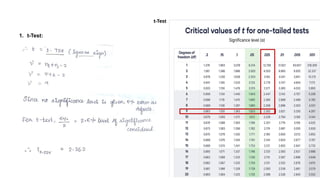
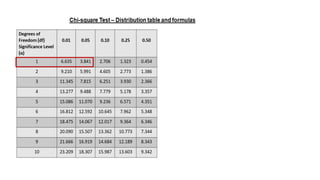
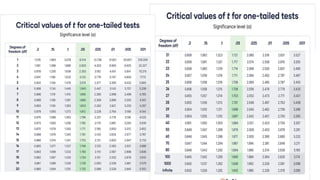
 Half of give significance level is considered
 T-test table used for table value
t-Test
1. t-Test:
X₁ x = (X - )
₁ ₁ X
̄ ₁ x ²
₁ X₂ x = (X - )
₂ ₂ X
̄ ₂ x ²
₂
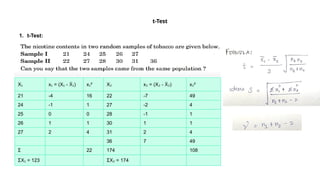
21 -4 16 22 -7 49
24 -1 1 27 -2 4
25 0 0 28 -1 1
26 1 1 30 1 1
27 2 4 31 2 4
36 7 49
Σ 22 174 108
ΣX = 123
₁ ΣX = 174
₂
t-Test
1. t-Test: X₁
x = (X -
₁ ₁
)
X
̄ ₁
x ²
₁ X₂ x = (X - )
₂ ₂ X
̄ ₂ x ²
₂
21 -4 16 22 -7 49
24 -1 1 27 -2 4
25 0 0 28 -1 1
26 1 1 30 1 1
27 2 4 31 2 4
36 7 49
Σ 22 174 108
ΣX =
₁
123
ΣX =
₂
174
t-Test
1. t-Test:
t-Test
1. t-Test:
T-test
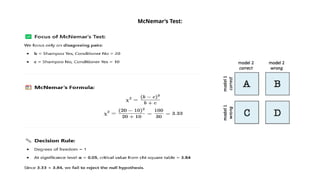
McNemar’s Test:
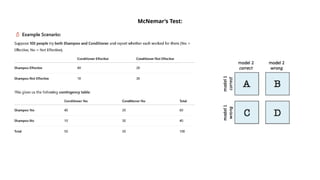
2. McNemar’s Test:
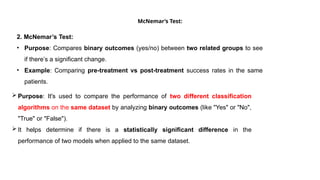
• Purpose: Compares binary outcomes (yes/no) between two related groups to see
if there’s a significant change.
• Example: Comparing pre-treatment vs post-treatment success rates in the same
patients.
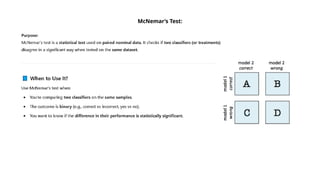
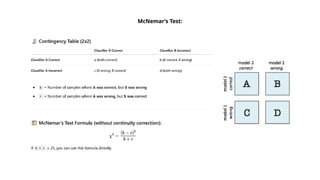
 Purpose: It's used to compare the performance of two different classification
algorithms on the same dataset by analyzing binary outcomes (like "Yes" or "No",
"True" or "False").
 It helps determine if there is a statistically significant difference in the
performance of two models when applied to the same dataset.
McNemar’s Test:
McNemar’s Test:
McNemar’s Test:
McNemar’s Test:
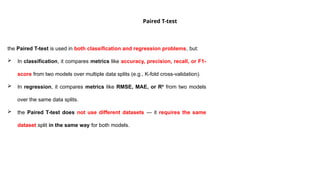
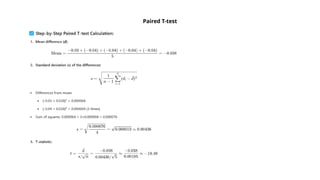
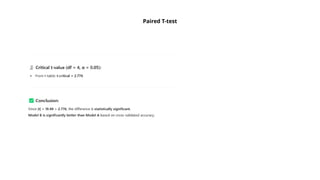
Paired T-test
the Paired T-test is used in both classification and regression problems, but:
 In classification, it compares metrics like accuracy, precision, recall, or F1-
score from two models over multiple data splits (e.g., K-fold cross-validation).
 In regression, it compares metrics like RMSE, MAE, or R² from two models
over the same data splits.
 the Paired T-test does not use different datasets — it requires the same
dataset split in the same way for both models.
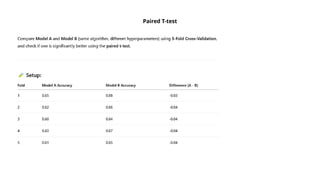
Paired T-test
Paired T-test
Paired T-test

UNIT - 5 DESIGN AND ANALYSIS OF MACHINE LEARNING EXPERIMENTS

  • 1.
    DESIGN AND ANALYSIS OF MACHINE LEARNING EXPERIMENTS PresentdBy J.Kowsy Sara Assistant Professor AI&ML Rathinam Technical Campus kowsysara.soc@rathinam.in
  • 2.
    DESIGN AND ANALYSISOF MACHINE LEARNING EXPERIMENTS Design and Analysis of Machine Learning Experiments involves planning how to train, validate, and test models to ensure reliable and reproducible results.
  • 3.
    DESIGN AND ANALYSISOF MACHINE LEARNING EXPERIMENTS
  • 5.
    Cross Validation (CV)and resampling •Sampling: Collecting the initial data from a population (e.g., survey, sensors, transaction logs). •Resampling: Reusing the existing dataset to draw new samples (with or without replacement) to validate or improve the model. Think of it like this: 📥 Sampling = Getting your first basket of fruits from a farm. 🔄 Resampling = Taking different combinations of fruits from the basket again and again to check if your fruit salad tastes good every time.
  • 6.
    Cross Validation (CV)and resampling
  • 7.
    Cross Validation (CV)and resampling Types of Resampling: Two common method of Resampling are:  K-fold Cross-validation  Bootstrapping Cross-Validation (CV) is a general technique to evaluate model performance by testing it on different data subsets. K-Fold CV is a specific type of CV where the dataset is split into k parts; each part gets a turn as the test set. Real-Time Example: In email spam detection, K-Fold CV ensures the model is tested across different groups of emails to avoid bias from a single test split.
  • 8.
    Cross Validation (CV)and resampling
  • 9.
    Cross Validation (CV)and resampling Types of Cross-Validation 1. Holdout: Split data once (e.g., 80% train, 20% test). 👉 Train on 800 shampoo buyers, test on 200. 2. K-Fold CV: Split data into K parts, test on each once. 👉 In 5-fold, test on 200 customers each time, train on 800. 3.Stratified K-Fold: Like K-Fold but keeps class balance. 👉 Each fold has equal shampoo+conditioner buyers. 4.Leave-One-Out (LOOCV): Test on 1 customer at a time. 👉 Train on 999, test on 1 — repeat 1000 times. 5. Repeated K-Fold: Run K-Fold CV multiple times randomly. 👉 Repeat 5-fold CV 3 times to get stable accuracy.
  • 10.
    Cross Validation (CV)and resampling Types of Cross-Validation Holdout Validation • Split the data once into: • Training Set (e.g., 80%) • Testing Set (e.g., 20%) • Train the model on training data and test on testing data. 📦 Example: You have sales data from 1000 customers. You use 800 to train a shampoo recommender, and 200 to test it. 👍 Simple and fast May give biased results if data split is unlucky 👎
  • 11.
    Cross Validation (CV)and resampling Types of Cross-Validation K-Fold Cross-Validation Divide the data into K equal parts (folds). Use one fold for testing, rest for training. Repeat K times, changing the test fold each time. Average the results. 📦 Example: 5-Fold CV on 1000 shampoo buyers → split into 5 sets of 200. Train on 800, test on 200 each time. 👍 More reliable than holdout More computation 👎
  • 12.
    Cross Validation (CV)and resampling Types of Cross-Validation Stratified K-Fold Cross-Validation Like K-Fold, but maintains the class balance (e.g., equal "Yes"/"No" labels) in each fold. 📦 Example: 40% of buyers purchase conditioner. Each fold in Stratified CV will keep 40% conditioner-buyers. 👍 Best for imbalanced data Slightly slower than normal K-Fold 👎
  • 13.
    Cross Validation (CV)and resampling Types of Cross-Validation Leave-One-Out Cross-Validation (LOOCV) Each data point is used once as a test set. For N data points, run model N times. 📦 Example: For 10 customer records, train on 9, test on 1 → do this 10 times. 👍 Very thorough Very slow for large datasets 👎
  • 14.
    Cross Validation (CV)and resampling Types of Cross-Validation Leave-P-Out Cross-Validation Leave P samples out for testing, train on the rest. Try all combinations of P samples. 📦 Example: Leave 2 shampoo-buying customers out, train on the rest. Repeat for all possible pairs. 👍 Very detailed Extremely time-consuming 👎
  • 15.
    Cross Validation (CV)and resampling K-fold cross-validation: K-Fold Cross-Validation splits the data into k equal parts, using one part for testing and the rest for training, repeating the process k times. This helps ensure the model is tested on every part of the data. Real-Time Example: In predicting house prices, K-Fold CV allows the model to learn from different neighborhood data and test on unseen areas each time
  • 16.
    Cross Validation (CV)and resampling K-fold cross-validation: K-Fold Cross-Validation splits the data into k equal parts, using one part for testing and the rest for training, repeating the process k times. This helps ensure the model is tested on every part of the data. Real-Time Example: In predicting house prices, K-Fold CV allows the model to learn from different neighborhood data and test on unseen areas each time
  • 17.
    Cross Validation (CV)and resampling Bootstrapping is a resampling method where data is sampled with replacement, meaning the same record can appear multiple times in the training set. The left-out data (not selected in the sample) is used as the test set, also called out-of-bag (OOB) data.
  • 18.
    Measuring Classifier Performance MeasuringClassifier Performance involves evaluating how well a model predicts the correct class labels using metrics like accuracy, precision, recall, and F1 score. Accuracy and its limitations,Confusion Matrix, Precision & Recall, F1-Score, Specificity,Receiver Operating Characteristic Curve (ROC), Area Under Curve (AUC)
  • 19.
    Measuring Classifier Performance ConfusionMatrix A Confusion Matrix shows how many correct and incorrect predictions a classification model made, comparing actual vs predicted labels. Sample Actual Value (True Label) Predicted Value (Model Output) 1 Spam Spam 2 Spam Not Spam 3 Not Spam Not Spam 4 Not Spam Not Spam 5 Spam Spam 6 Spam Spam 7 Not Spam Spam 8 Not Spam Not Spam 9 Not Spam Not Spam 10 Spam Not Spam
  • 20.
    Measuring Classifier Performance Sample ActualValue (True Label) Predicted Value (Model Output) 1 Spam Spam 2 Spam Not Spam 3 Not Spam Not Spam 4 Not Spam Not Spam 5 Spam Spam 6 Spam Spam 7 Not Spam Spam 8 Not Spam Not Spam 9 Not Spam Not Spam 10 Spam Not Spam ❌ False Negatives (FN) = 2 → Samples 2, 10 ✅ True Negatives (TN) = 4 → Samples 3, 4, 8, 9 ✅ True Positives (TP) = 3 → Samples 1, 5, 6 ❌ False Positives (FP) = 1 → Sample 7
  • 21.
    Measuring Classifier Performance ❌False Negatives (FN) = 2 → Samples 2, 10 ✅ True Negatives (TN) = 4 → Samples 3, 4, 8, 9 ✅ True Positives (TP) = 3 → Samples 1, 5, 6 ❌ False Positives (FP) = 1 → Sample 7 Predicted: Spam Predicted: Not Spam Actual: Spam TP = 3 FN = 2 Actual: Not Spam FP = 1 TN = 4 Accuracy
  • 22.
    Measuring Classifier Performance ❌False Negatives (FN) = 2 → Samples 2, 10 ✅ True Negatives (TN) = 4 → Samples 3, 4, 8, 9 ✅ True Positives (TP) = 3 → Samples 1, 5, 6 ❌ False Positives (FP) = 1 → Sample 7 Predicted: Spam Predicted: Not Spam Actual: Spam TP = 3 FN = 2 Actual: Not Spam FP = 1 TN = 4 Precision
  • 23.
    Measuring Classifier Performance ❌False Negatives (FN) = 2 → Samples 2, 10 ✅ True Negatives (TN) = 4 → Samples 3, 4, 8, 9 ✅ True Positives (TP) = 3 → Samples 1, 5, 6 ❌ False Positives (FP) = 1 → Sample 7 Predicted: Spam Predicted: Not Spam Actual: Spam TP = 3 FN = 2 Actual: Not Spam FP = 1 TN = 4 Precision
  • 24.
    Measuring Classifier Performance ❌False Negatives (FN) = 2 → Samples 2, 10 ✅ True Negatives (TN) = 4 → Samples 3, 4, 8, 9 ✅ True Positives (TP) = 3 → Samples 1, 5, 6 ❌ False Positives (FP) = 1 → Sample 7 Predicted: Spam Predicted: Not Spam Actual: Spam TP = 3 FN = 2 Actual: Not Spam FP = 1 TN = 4 Recall (Sensitivity)
  • 25.
    Measuring Classifier Performance ❌False Negatives (FN) = 2 → Samples 2, 10 ✅ True Negatives (TN) = 4 → Samples 3, 4, 8, 9 ✅ True Positives (TP) = 3 → Samples 1, 5, 6 ❌ False Positives (FP) = 1 → Sample 7 Predicted: Spam Predicted: Not Spam Actual: Spam TP = 3 FN = 2 Actual: Not Spam FP = 1 TN = 4 Recall (Sensitivity)
  • 26.
    Measuring Classifier Performance ❌False Negatives (FN) = 2 → Samples 2, 10 ✅ True Negatives (TN) = 4 → Samples 3, 4, 8, 9 ✅ True Positives (TP) = 3 → Samples 1, 5, 6 ❌ False Positives (FP) = 1 → Sample 7 Predicted: Spam Predicted: Not Spam Actual: Spam TP = 3 FN = 2 Actual: Not Spam FP = 1 TN = 4 F1 Score
  • 27.
    t test, McNemar'stest, K-fold CV paired t test The T-test, McNemar's test, and K-fold CV paired t-test are used to evaluate and clarify the results of hyperparameter tuning, ensuring that any observed differences in model performance are statistically significant.
  • 28.
    t-Test 1. t-Test: • Purpose:Compares the means of two independent groups to see if they are significantly different. • Example: Comparing test scores of two different classes (Class A vs Class B). A t-test (specifically the independent t-test) can indeed be used to compare the performance of the same algorithm on two different datasets.
  • 29.
    t-Test 1. t-Test: A t-test(specifically the independent t-test) can indeed be used to compare the performance of the same algorithm on two different datasets.  Half of give significance level is considered  T-test table used for table value
  • 30.
    t-Test 1. t-Test: X₁ x= (X - ) ₁ ₁ X ̄ ₁ x ² ₁ X₂ x = (X - ) ₂ ₂ X ̄ ₂ x ² ₂ 21 -4 16 22 -7 49 24 -1 1 27 -2 4 25 0 0 28 -1 1 26 1 1 30 1 1 27 2 4 31 2 4 36 7 49 Σ 22 174 108 ΣX = 123 ₁ ΣX = 174 ₂
  • 31.
    t-Test 1. t-Test: X₁ x= (X - ₁ ₁ ) X ̄ ₁ x ² ₁ X₂ x = (X - ) ₂ ₂ X ̄ ₂ x ² ₂ 21 -4 16 22 -7 49 24 -1 1 27 -2 4 25 0 0 28 -1 1 26 1 1 30 1 1 27 2 4 31 2 4 36 7 49 Σ 22 174 108 ΣX = ₁ 123 ΣX = ₂ 174
  • 32.
  • 33.
  • 34.
  • 36.
    McNemar’s Test: 2. McNemar’sTest: • Purpose: Compares binary outcomes (yes/no) between two related groups to see if there’s a significant change. • Example: Comparing pre-treatment vs post-treatment success rates in the same patients.  Purpose: It's used to compare the performance of two different classification algorithms on the same dataset by analyzing binary outcomes (like "Yes" or "No", "True" or "False").  It helps determine if there is a statistically significant difference in the performance of two models when applied to the same dataset.
  • 37.
  • 38.
  • 39.
  • 40.
  • 42.
    Paired T-test the PairedT-test is used in both classification and regression problems, but:  In classification, it compares metrics like accuracy, precision, recall, or F1- score from two models over multiple data splits (e.g., K-fold cross-validation).  In regression, it compares metrics like RMSE, MAE, or R² from two models over the same data splits.  the Paired T-test does not use different datasets — it requires the same dataset split in the same way for both models.
  • 43.
  • 44.
  • 45.