






Fishing Gear (Without Net)
Course Title: Fish Harvesting & Handling Lab/Field Work
Course Code: FIMS3104
Group: 04
Group : 04
Name Roll
Fishing Gear
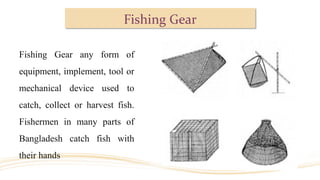
Fishing Gear any form of
equipment, implement, tool or
mechanical device used to
catch, collect or harvest fish.
Fishermen in many parts of
Bangladesh catch fish with
their hands
Types of Fishing Gear
 Fishing nets
 Traps
 Hooks and lines
 Spears and harpoons
 Mechanized pumps
Fishing Traps
Fishing Traps
A fishing trap is a trap used for fishing. Trap fishing is a passive fishing technique of
ancient origin.
Fishing traps are mostly bamboo and wooden made mechanical device used in
shallow water by both professional and non professional fishermen. It is very difficult
to classify the traps because same device has difficult names in different dristrict.
Different traps seen in different parts of the country are Bega, Darkee, Anta, Tepai,
Dheal, Cheng, Chari, Chandi Bair, Bana, Polo, Raboni, Anga etc.
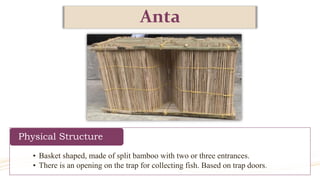
Anta
• Basket shaped, made of split bamboo with two or three entrances.
• There is an opening on the trap for collecting fish. Based on trap doors.
Physical Structure
Operation
The trap is sunken (1 to 1.5 feet below from water surface) in shallow, where small current
is present during early morning and evening Checked up every one or two hour interval.
Catch composition
Usually small fishes including Tengra, Punti, Chanda, Khalisha, Gur-koi small prawn etc.
Price
80-100 taka
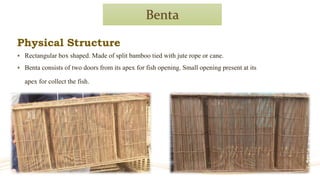
Benta
Physical Structure
⁎ Rectangular box shaped. Made of split bamboo tied with jute rope or cane.
⁎ Benta consists of two doors from its apex for fish opening. Small opening present at its
apex for collect the fish.
Size
Height: 2 to 2.5 feet Length: 3 to 4 feet
Width: 0.3 to 0.5 feet Gap between two bamboo sticks: 0.5 to 1 cm.
Operation
Set in shallow part of the Beel with the help of bamboo pole or tree branches during
early morning or evening
Catch composition
Mainly small fishes, Baim, Koi, Punti, Tengra, Kaski, Mola, Moya, Chapila, Chanda,
Khalisha, Gur-koi small prawn etc.
Price
120-150 taka
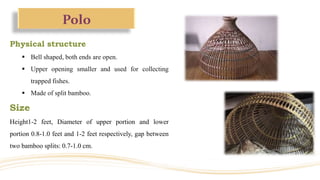
Polo
Physical structure
 Bell shaped, both ends are open.
 Upper opening smaller and used for collecting
trapped fishes.
 Made of split bamboo.
Size
Height1-2 feet, Diameter of upper portion and lower
portion 0.8-1.0 feet and 1-2 feet respectively, gap between
two bamboo splits: 0.7-1.0 cm.
Operation
Fishermen presses this trap on the bottom mud in shallow water and put his hand
through the top opening for catching trapped fishes.
Catch composition
Varieties of species including Koi, Boal, Shol etc.
Price
200-450 taka
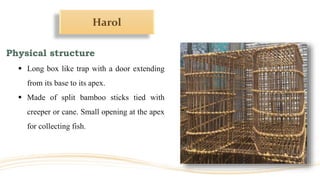
Harol
Physical structure
 Long box like trap with a door extending
from its base to its apex.
 Made of split bamboo sticks tied with
creeper or cane. Small opening at the apex
for collecting fish.
Size
Height: 3-4 feet Length: 2-3 feet
Width: 1.5-2.5 feet Gap Between Two Bamboo Sticks: 1-4 cm
Operation
Used in shallow portion of the Beel. In front of harol a barrier is created with split bamboo.
The trap checked up every one or two hour interval.
Catch Composition
Usually large sized fishes, such as Carpio, Rui, Catla, Boal, Taki, Shol, Gazar, Shal, Baim etc.
Price
250-500 taka
Icha Chai
Physical Structure
Icha chai is a triangular or cylindrical shaped trap made of bamboo splits and threads.
Size
The length and the width are typically about half and quarter of a meter respectively
Operation
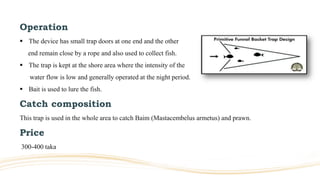
 The device has small trap doors at one end and the other
end remain close by a rope and also used to collect fish.
 The trap is kept at the shore area where the intensity of the
water flow is low and generally operated at the night period.
 Bait is used to lure the fish.
Catch composition
This trap is used in the whole area to catch Baim (Mastacembelus armetus) and prawn.
Price
300-400 taka
Kholoi
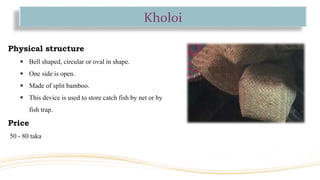
Physical structure
 Bell shaped, circular or oval in shape.
 One side is open.
 Made of split bamboo.
 This device is used to store catch fish by net or by
fish trap.
Price
50 - 80 taka
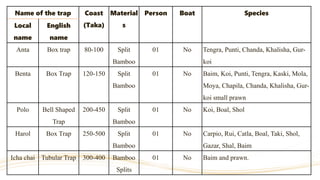
Name of the trap Coast
(Taka)
Material
s
Person Boat Species
Local
name
English
name
Anta Box trap 80-100 Split
Bamboo
01 No Tengra, Punti, Chanda, Khalisha, Gur-
koi
Benta Box Trap 120-150 Split
Bamboo
01 No Baim, Koi, Punti, Tengra, Kaski, Mola,
Moya, Chapila, Chanda, Khalisha, Gur-
koi small prawn
Polo Bell Shaped
Trap
200-450 Split
Bamboo
01 No Koi, Boal, Shol
Harol Box Trap 250-500 Split
Bamboo
01 No Carpio, Rui, Catla, Boal, Taki, Shol,
Gazar, Shal, Baim
Icha chai Tubular Trap 300-400 Bamboo
Splits
01 No Baim and prawn.
 High species and size selectivity
 Low energy requirement in operation
 Excellent condition of the catch which are usually alive when caught
 High market value of the catch
 Traps can be made from locally available materials
 Traps are relatively difficult to operate and haul during rough weather
 High loss rate during operation
 Ghost fishing by lost traps leading to unwanted fishing mortality
Advantage of traps
Disadvantage of traps
Wounding Gears
• Wounding fishing gears were made up of bamboo, wood shifts with forks or group of iron points.
These devices were used when large fishes float or drift on the surface water.
• This fishing devices (Spears) are used to catch fish by throwing or wounding fishes.
Wounding Gears
We have found two types of spears in Noakhali
1. Konch
2. Teta
Konch
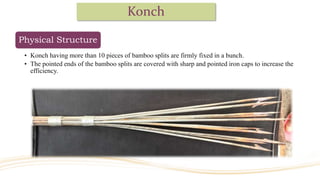
Physical Structure
• Konch having more than 10 pieces of bamboo splits are firmly fixed in a bunch.
• The pointed ends of the bamboo splits are covered with sharp and pointed iron caps to increase the
efficiency.
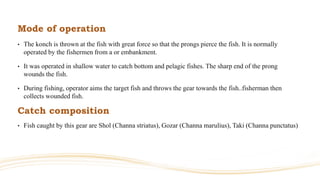
Mode of operation
• The konch is thrown at the fish with great force so that the prongs pierce the fish. It is normally
operated by the fishermen from a or embankment.
• It was operated in shallow water to catch bottom and pelagic fishes. The sharp end of the prong
wounds the fish.
• During fishing, operator aims the target fish and throws the gear towards the fish..fisherman then
collects wounded fish.
Catch composition
• Fish caught by this gear are Shol (Channa striatus), Gozar (Channa marulius), Taki (Channa punctatus)
Teta
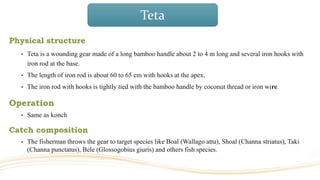
Physical structure
• Teta is a wounding gear made of a long bamboo handle about 2 to 4 m long and several iron hooks with
iron rod at the base.
• The length of iron rod is about 60 to 65 cm with hooks at the apex.
• The iron rod with hooks is tightly tied with the bamboo handle by coconut thread or iron wire.
Operation
• Same as konch
Catch composition
• The fisherman throws the gear to target species like Boal (Wallago attu), Shoal (Channa striatus), Taki
(Channa punctatus), Bele (Glossogobius giuris) and others fish species.
Fig. Teta
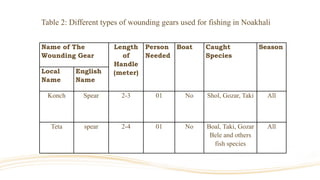
Name of The
Wounding Gear
Length
of
Handle
(meter)
Person
Needed
Boat Caught
Species
Season
Local
Name
English
Name
Konch Spear 2-3 01 No Shol, Gozar, Taki All
Teta spear 2-4 01 No Boal, Taki, Gozar
Bele and others
fish species
All
Table 2: Different types of wounding gears used for fishing in Noakhali
Need skilled person
Fishing is not possible in deep area
Fish are injured by spear so fish spoilage accelerated
Spear fishing is not profitable
• Easy to catch
• Operation of these gear is simple
• Spears can be made locally
Advantage of spear
Disadvantage of spear
Hook & Line
Hooks
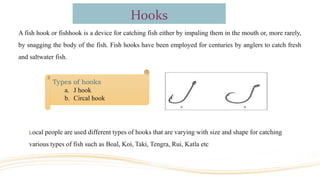
A fish hook or fishhook is a device for catching fish either by impaling them in the mouth or, more rarely,
by snagging the body of the fish. Fish hooks have been employed for centuries by anglers to catch fresh
and saltwater fish.
Local people are used different types of hooks that are varying with size and shape for catching
various types of fish such as Boal, Koi, Taki, Tengra, Rui, Katla etc
Types of hooks
a. J hook
b. Circal hook
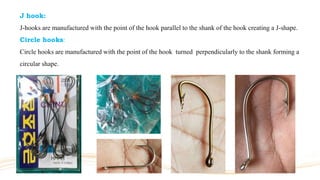
J hook:
J-hooks are manufactured with the point of the hook parallel to the shank of the hook creating a J-shape.
Circle hooks:
Circle hooks are manufactured with the point of the hook turned perpendicularly to the shank forming a
circular shape.
Line Fishing
 Fishing by means of hand or long lines with baited hooks is known as line fishing. A fishing line is a
cord used or made for angling.
Types of Line Fishing
There are various type of line fishing in Bangladesh but we only found two types of line fishing, these
are given bellow:
1. Hand line with wheel
2. Hand Line without wheel
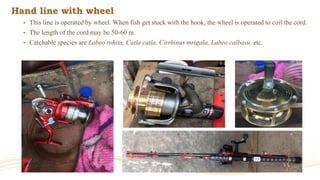
Hand line with wheel
• This line is operated by wheel. When fish get stuck with the hook, the wheel is operated to coil the cord.
• The length of the cord may be 50-60 m.
• Catchable species are Labeo rohita, Catla catla, Cirrhinus mrigala, Labeo calbasu, etc.
Hand line without wheel
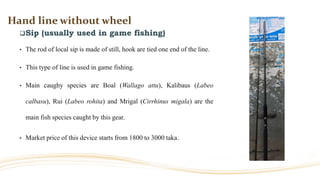
Sip (usually used in game fishing)
• The rod of local sip is made of still, hook are tied one end of the line.
• This type of line is used in game fishing.
• Main caughy species are Boal (Wallago attu), Kalibaus (Labeo
calbasu), Rui (Labeo rohita) and Mrigal (Cirrhinus migala) are the
main fish species caught by this gear.
• Market price of this device starts from 1800 to 3000 taka.
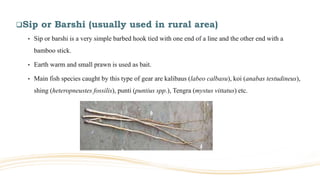
Sip or Barshi (usually used in rural area)
• Sip or barshi is a very simple barbed hook tied with one end of a line and the other end with a
bamboo stick.
• Earth warm and small prawn is used as bait.
• Main fish species caught by this type of gear are kalibaus (labeo calbasu), koi (anabas testudineus),
shing (heteropneustes fossilis), punti (puntius spp.), Tengra (mystus vittatus) etc.
Tana Barshi
• Tana Barshi contains one or two baited hooks having no float, is used to catch mainly
snakehead,great snakehead and wallago fish. Where small frog, various types small
fish are used as bait in the hook.
• Boal (Wallago attu), Shol, Taki, Gozar are the main fish species caught by this gear.
Choto Barshi
• Choto barshi is a type of gear which have a small stick, small thread and sigle hook.
• Main caught species are Koi (Anabas testudineus), Shing (Heteropneustes fossilis),
Punti (Puntius spp.), Tengra (Mystus vittatus) etc.
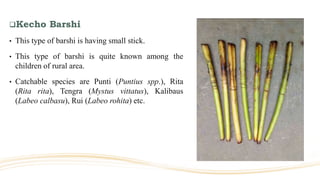
Kecho Barshi
• This type of barshi is having small stick.
• This type of barshi is quite known among the
children of rural area.
• Catchable species are Punti (Puntius spp.), Rita
(Rita rita), Tengra (Mystus vittatus), Kalibaus
(Labeo calbasu), Rui (Labeo rohita) etc.
Fishing gear
Fishing gear

Fishing gear

  • 2.
    Fishing Gear (WithoutNet) Course Title: Fish Harvesting & Handling Lab/Field Work Course Code: FIMS3104 Group: 04
  • 3.
  • 4.
    Fishing Gear Fishing Gearany form of equipment, implement, tool or mechanical device used to catch, collect or harvest fish. Fishermen in many parts of Bangladesh catch fish with their hands
  • 5.
    Types of FishingGear  Fishing nets  Traps  Hooks and lines  Spears and harpoons  Mechanized pumps
  • 6.
  • 7.
    Fishing Traps A fishingtrap is a trap used for fishing. Trap fishing is a passive fishing technique of ancient origin. Fishing traps are mostly bamboo and wooden made mechanical device used in shallow water by both professional and non professional fishermen. It is very difficult to classify the traps because same device has difficult names in different dristrict. Different traps seen in different parts of the country are Bega, Darkee, Anta, Tepai, Dheal, Cheng, Chari, Chandi Bair, Bana, Polo, Raboni, Anga etc.
  • 8.
    Anta • Basket shaped,made of split bamboo with two or three entrances. • There is an opening on the trap for collecting fish. Based on trap doors. Physical Structure
  • 9.
    Operation The trap issunken (1 to 1.5 feet below from water surface) in shallow, where small current is present during early morning and evening Checked up every one or two hour interval. Catch composition Usually small fishes including Tengra, Punti, Chanda, Khalisha, Gur-koi small prawn etc. Price 80-100 taka
  • 10.
    Benta Physical Structure ⁎ Rectangularbox shaped. Made of split bamboo tied with jute rope or cane. ⁎ Benta consists of two doors from its apex for fish opening. Small opening present at its apex for collect the fish.
  • 11.
    Size Height: 2 to2.5 feet Length: 3 to 4 feet Width: 0.3 to 0.5 feet Gap between two bamboo sticks: 0.5 to 1 cm. Operation Set in shallow part of the Beel with the help of bamboo pole or tree branches during early morning or evening Catch composition Mainly small fishes, Baim, Koi, Punti, Tengra, Kaski, Mola, Moya, Chapila, Chanda, Khalisha, Gur-koi small prawn etc. Price 120-150 taka
  • 12.
    Polo Physical structure  Bellshaped, both ends are open.  Upper opening smaller and used for collecting trapped fishes.  Made of split bamboo. Size Height1-2 feet, Diameter of upper portion and lower portion 0.8-1.0 feet and 1-2 feet respectively, gap between two bamboo splits: 0.7-1.0 cm.
  • 13.
    Operation Fishermen presses thistrap on the bottom mud in shallow water and put his hand through the top opening for catching trapped fishes. Catch composition Varieties of species including Koi, Boal, Shol etc. Price 200-450 taka
  • 14.
    Harol Physical structure  Longbox like trap with a door extending from its base to its apex.  Made of split bamboo sticks tied with creeper or cane. Small opening at the apex for collecting fish.
  • 15.
    Size Height: 3-4 feetLength: 2-3 feet Width: 1.5-2.5 feet Gap Between Two Bamboo Sticks: 1-4 cm Operation Used in shallow portion of the Beel. In front of harol a barrier is created with split bamboo. The trap checked up every one or two hour interval. Catch Composition Usually large sized fishes, such as Carpio, Rui, Catla, Boal, Taki, Shol, Gazar, Shal, Baim etc. Price 250-500 taka
  • 16.
    Icha Chai Physical Structure Ichachai is a triangular or cylindrical shaped trap made of bamboo splits and threads. Size The length and the width are typically about half and quarter of a meter respectively
  • 17.
    Operation  The devicehas small trap doors at one end and the other end remain close by a rope and also used to collect fish.  The trap is kept at the shore area where the intensity of the water flow is low and generally operated at the night period.  Bait is used to lure the fish. Catch composition This trap is used in the whole area to catch Baim (Mastacembelus armetus) and prawn. Price 300-400 taka
  • 18.
    Kholoi Physical structure  Bellshaped, circular or oval in shape.  One side is open.  Made of split bamboo.  This device is used to store catch fish by net or by fish trap. Price 50 - 80 taka
  • 19.
    Name of thetrap Coast (Taka) Material s Person Boat Species Local name English name Anta Box trap 80-100 Split Bamboo 01 No Tengra, Punti, Chanda, Khalisha, Gur- koi Benta Box Trap 120-150 Split Bamboo 01 No Baim, Koi, Punti, Tengra, Kaski, Mola, Moya, Chapila, Chanda, Khalisha, Gur- koi small prawn Polo Bell Shaped Trap 200-450 Split Bamboo 01 No Koi, Boal, Shol Harol Box Trap 250-500 Split Bamboo 01 No Carpio, Rui, Catla, Boal, Taki, Shol, Gazar, Shal, Baim Icha chai Tubular Trap 300-400 Bamboo Splits 01 No Baim and prawn.
  • 20.
     High speciesand size selectivity  Low energy requirement in operation  Excellent condition of the catch which are usually alive when caught  High market value of the catch  Traps can be made from locally available materials  Traps are relatively difficult to operate and haul during rough weather  High loss rate during operation  Ghost fishing by lost traps leading to unwanted fishing mortality Advantage of traps Disadvantage of traps
  • 21.
  • 22.
    • Wounding fishinggears were made up of bamboo, wood shifts with forks or group of iron points. These devices were used when large fishes float or drift on the surface water. • This fishing devices (Spears) are used to catch fish by throwing or wounding fishes. Wounding Gears We have found two types of spears in Noakhali 1. Konch 2. Teta
  • 23.
    Konch Physical Structure • Konchhaving more than 10 pieces of bamboo splits are firmly fixed in a bunch. • The pointed ends of the bamboo splits are covered with sharp and pointed iron caps to increase the efficiency.
  • 24.
    Mode of operation •The konch is thrown at the fish with great force so that the prongs pierce the fish. It is normally operated by the fishermen from a or embankment. • It was operated in shallow water to catch bottom and pelagic fishes. The sharp end of the prong wounds the fish. • During fishing, operator aims the target fish and throws the gear towards the fish..fisherman then collects wounded fish. Catch composition • Fish caught by this gear are Shol (Channa striatus), Gozar (Channa marulius), Taki (Channa punctatus)
  • 25.
    Teta Physical structure • Tetais a wounding gear made of a long bamboo handle about 2 to 4 m long and several iron hooks with iron rod at the base. • The length of iron rod is about 60 to 65 cm with hooks at the apex. • The iron rod with hooks is tightly tied with the bamboo handle by coconut thread or iron wire. Operation • Same as konch Catch composition • The fisherman throws the gear to target species like Boal (Wallago attu), Shoal (Channa striatus), Taki (Channa punctatus), Bele (Glossogobius giuris) and others fish species.
  • 26.
  • 27.
    Name of The WoundingGear Length of Handle (meter) Person Needed Boat Caught Species Season Local Name English Name Konch Spear 2-3 01 No Shol, Gozar, Taki All Teta spear 2-4 01 No Boal, Taki, Gozar Bele and others fish species All Table 2: Different types of wounding gears used for fishing in Noakhali
  • 28.
    Need skilled person Fishingis not possible in deep area Fish are injured by spear so fish spoilage accelerated Spear fishing is not profitable • Easy to catch • Operation of these gear is simple • Spears can be made locally Advantage of spear Disadvantage of spear
  • 29.
  • 30.
    Hooks A fish hookor fishhook is a device for catching fish either by impaling them in the mouth or, more rarely, by snagging the body of the fish. Fish hooks have been employed for centuries by anglers to catch fresh and saltwater fish. Local people are used different types of hooks that are varying with size and shape for catching various types of fish such as Boal, Koi, Taki, Tengra, Rui, Katla etc Types of hooks a. J hook b. Circal hook
  • 31.
    J hook: J-hooks aremanufactured with the point of the hook parallel to the shank of the hook creating a J-shape. Circle hooks: Circle hooks are manufactured with the point of the hook turned perpendicularly to the shank forming a circular shape.
  • 32.
    Line Fishing  Fishingby means of hand or long lines with baited hooks is known as line fishing. A fishing line is a cord used or made for angling. Types of Line Fishing There are various type of line fishing in Bangladesh but we only found two types of line fishing, these are given bellow: 1. Hand line with wheel 2. Hand Line without wheel
  • 33.
    Hand line withwheel • This line is operated by wheel. When fish get stuck with the hook, the wheel is operated to coil the cord. • The length of the cord may be 50-60 m. • Catchable species are Labeo rohita, Catla catla, Cirrhinus mrigala, Labeo calbasu, etc.
  • 34.
    Hand line withoutwheel Sip (usually used in game fishing) • The rod of local sip is made of still, hook are tied one end of the line. • This type of line is used in game fishing. • Main caughy species are Boal (Wallago attu), Kalibaus (Labeo calbasu), Rui (Labeo rohita) and Mrigal (Cirrhinus migala) are the main fish species caught by this gear. • Market price of this device starts from 1800 to 3000 taka.
  • 35.
    Sip or Barshi(usually used in rural area) • Sip or barshi is a very simple barbed hook tied with one end of a line and the other end with a bamboo stick. • Earth warm and small prawn is used as bait. • Main fish species caught by this type of gear are kalibaus (labeo calbasu), koi (anabas testudineus), shing (heteropneustes fossilis), punti (puntius spp.), Tengra (mystus vittatus) etc.
  • 36.
    Tana Barshi • TanaBarshi contains one or two baited hooks having no float, is used to catch mainly snakehead,great snakehead and wallago fish. Where small frog, various types small fish are used as bait in the hook. • Boal (Wallago attu), Shol, Taki, Gozar are the main fish species caught by this gear. Choto Barshi • Choto barshi is a type of gear which have a small stick, small thread and sigle hook. • Main caught species are Koi (Anabas testudineus), Shing (Heteropneustes fossilis), Punti (Puntius spp.), Tengra (Mystus vittatus) etc.
  • 37.
    Kecho Barshi • Thistype of barshi is having small stick. • This type of barshi is quite known among the children of rural area. • Catchable species are Punti (Puntius spp.), Rita (Rita rita), Tengra (Mystus vittatus), Kalibaus (Labeo calbasu), Rui (Labeo rohita) etc.