PADMASHREE SCHOOL OF PUBLIC HEALTH, BANGALORE
Dr. Rahul Shrivastava
BDS, MIDA, FAGE, MPH
INTRODUCTION
• Active Listening is a special way of reflecting back what the
other person has expressed to let him/her know you are
listening and to check your understanding of his/her meaning.
• Active Listening is a restatement of the other person's
communication, both the words and the accompanying
feelings, i.e., nonverbal cues—tone of voice, facial expression,
body posture.
• Active Listening requires that you suspend your own
judgments, reactions or evaluations so that you can have a
clear experience of the other person's thoughts and feelings.
DEFINITION
• Active listening is a way of listening and responding to
another person that improves mutual understanding.
• Active listening is a structured form of listening and
responding that focuses the attention on the speaker. The
listener must take care to attend to the speaker fully, and then
repeats, in the listener’s own words, what he or she thinks the
speaker has said.
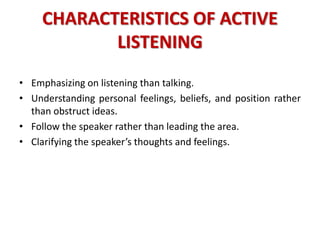
CHARACTERISTICS OF ACTIVE
LISTENING
• Emphasizing on listening than talking.
• Understanding personal feelings, beliefs, and position rather
than obstruct ideas.
• Follow the speaker rather than leading the area.
• Clarifying the speaker’s thoughts and feelings.
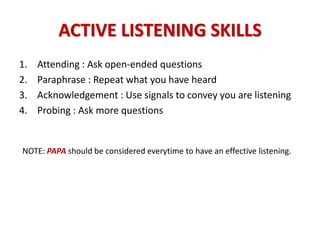
ACTIVE LISTENING SKILLS
1. Attending : Ask open-ended questions
2. Paraphrase : Repeat what you have heard
3. Acknowledgement : Use signals to convey you are listening
4. Probing : Ask more questions
NOTE: PAPA should be considered everytime to have an effective listening.
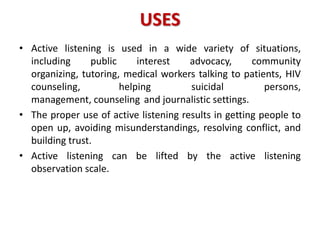
USES
• Active listening is used in a wide variety of situations,
including public interest advocacy, community
organizing, tutoring, medical workers talking to patients, HIV
counseling, helping suicidal persons,
management, counseling and journalistic settings.
• The proper use of active listening results in getting people to
open up, avoiding misunderstandings, resolving conflict, and
building trust.
• Active listening can be lifted by the active listening
observation scale.
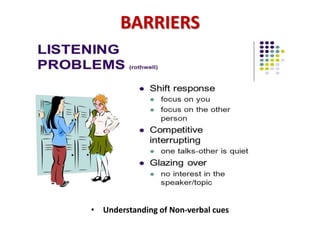
BARRIERS
• Understanding of Non-verbal cues
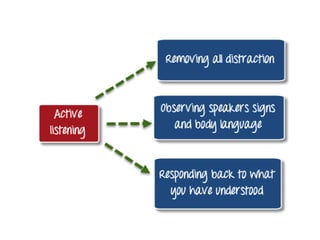
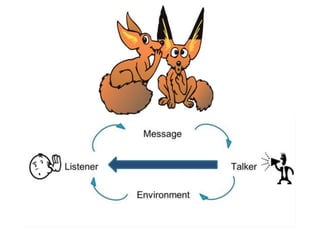
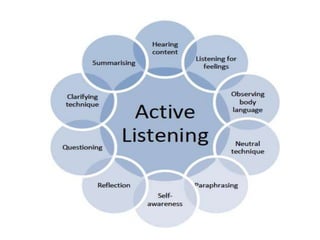
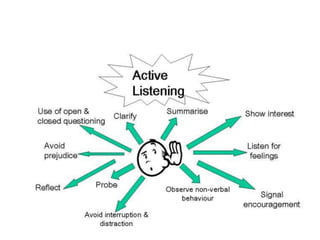
ACTIVE LISTENING MODEL
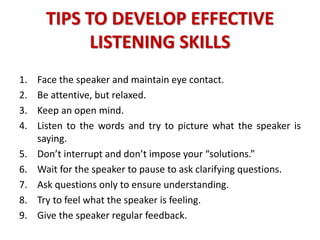
TIPS TO DEVELOP EFFECTIVE
LISTENING SKILLS
1. Face the speaker and maintain eye contact.
2. Be attentive, but relaxed.
3. Keep an open mind.
4. Listen to the words and try to picture what the speaker is
saying.
5. Don’t interrupt and don’t impose your “solutions.”
6. Wait for the speaker to pause to ask clarifying questions.
7. Ask questions only to ensure understanding.
8. Try to feel what the speaker is feeling.
9. Give the speaker regular feedback.
REFERENCES
• https://www.mindtools.com/CommSkll/ActiveListening.htm
• http://www.colorado.edu/conflict/peace/treatment/activel.ht
m
• https://www.td.org/Publications/Blogs/Management-
Blog/2014/07/Listening-Is-a-Leaders-Most-Important-Skill

Active listening dr rahul

  • 1.
    PADMASHREE SCHOOL OFPUBLIC HEALTH, BANGALORE Dr. Rahul Shrivastava BDS, MIDA, FAGE, MPH
  • 2.
    INTRODUCTION • Active Listeningis a special way of reflecting back what the other person has expressed to let him/her know you are listening and to check your understanding of his/her meaning. • Active Listening is a restatement of the other person's communication, both the words and the accompanying feelings, i.e., nonverbal cues—tone of voice, facial expression, body posture. • Active Listening requires that you suspend your own judgments, reactions or evaluations so that you can have a clear experience of the other person's thoughts and feelings.
  • 4.
    DEFINITION • Active listeningis a way of listening and responding to another person that improves mutual understanding. • Active listening is a structured form of listening and responding that focuses the attention on the speaker. The listener must take care to attend to the speaker fully, and then repeats, in the listener’s own words, what he or she thinks the speaker has said.
  • 8.
    CHARACTERISTICS OF ACTIVE LISTENING •Emphasizing on listening than talking. • Understanding personal feelings, beliefs, and position rather than obstruct ideas. • Follow the speaker rather than leading the area. • Clarifying the speaker’s thoughts and feelings.
  • 9.
    ACTIVE LISTENING SKILLS 1.Attending : Ask open-ended questions 2. Paraphrase : Repeat what you have heard 3. Acknowledgement : Use signals to convey you are listening 4. Probing : Ask more questions NOTE: PAPA should be considered everytime to have an effective listening.
  • 10.
    USES • Active listeningis used in a wide variety of situations, including public interest advocacy, community organizing, tutoring, medical workers talking to patients, HIV counseling, helping suicidal persons, management, counseling and journalistic settings. • The proper use of active listening results in getting people to open up, avoiding misunderstandings, resolving conflict, and building trust. • Active listening can be lifted by the active listening observation scale.
  • 11.
  • 12.
  • 13.
    TIPS TO DEVELOPEFFECTIVE LISTENING SKILLS 1. Face the speaker and maintain eye contact. 2. Be attentive, but relaxed. 3. Keep an open mind. 4. Listen to the words and try to picture what the speaker is saying. 5. Don’t interrupt and don’t impose your “solutions.” 6. Wait for the speaker to pause to ask clarifying questions. 7. Ask questions only to ensure understanding. 8. Try to feel what the speaker is feeling. 9. Give the speaker regular feedback.
  • 14.
    REFERENCES • https://www.mindtools.com/CommSkll/ActiveListening.htm • http://www.colorado.edu/conflict/peace/treatment/activel.ht m •https://www.td.org/Publications/Blogs/Management- Blog/2014/07/Listening-Is-a-Leaders-Most-Important-Skill