Quality adjusted life
years(QALYs)
Prepared by:
Ranjana Koirala
MPH 1st year
KISTMCTH
Introduction
 The quality-adjusted life year or quality-adjusted life-year (QALY) is a
generic measure of disease burden, including both the quality and the
quantity of life lived.
 It is used in economic evaluation to assess the value
of medical interventions. One QALY equates to one year in perfect health.
 QALY are a measure of the BoD based on an estimate of the quality and
quantity of additional years of life after a medical intervention.
Defining and Measuring a QALY
 Each year in perfect health is assigned the value of 1.0.
 If extra years are lived with disability, then the extra years of life without perfect
health are assigned a value between 0 and 1 depending on the nature of the
disability.
 The weighting of values is usually calculated by methods including visual analog
scales, standard gamble, and time-trade-off.
 This measure of QOL is challenged by those who claim that it is difficult to define
perfect health. Others argue that there are some health states with severe
suffering that should be assigned negative values because they are worse than
death. Finally, the impact of a patient's health status on the QOL of family and
friends is not included in this measure.
Aim of measuring QALYs
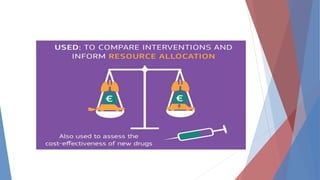
The QALY is commonly used in health economic
evaluations as a means of quantifying the
health effect of a medical intervention or a
prevention program and ultimately to help
payers allocate healthcare resources.
QALYs can be used to inform health insurance
coverage determinations, treatment decisions,
to evaluate programs, and to set priorities for
future programs.
The Calculation
 The QALY can be calculated using the following formula which assumes a utility value
(quality of life) between 1 = perfect health and 0 = dead:

Years of Life x Utility Value = #QALYs
 This means:
 If a person lives in perfect health for one year, that person will have 1 QALY.
(1 Year of Life × 1 Utility Value = 1 QALY)
 If a person lives in perfect health but only for half a year, that person will have 0.5 QALYs.
(0.5 Years of Life x 1 Utility Value = 0.5 QALYs)
 Conversely, if a person lives for 1 year in a situation with 0.5 utility (half of perfect health),
that person will also have 0.5 QALYs.
(1 Year of Life x 0.5 Utility Value = 0.5 QALYs)
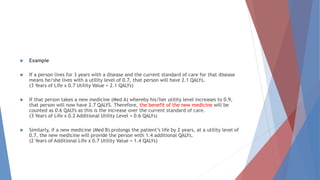
 Example
 If a person lives for 3 years with a disease and the current standard of care for that disease
means he/she lives with a utility level of 0.7, that person will have 2.1 QALYs.
(3 Years of Life x 0.7 Utility Value = 2.1 QALYs)
 If that person takes a new medicine (Med A) whereby his/her utility level increases to 0.9,
that person will now have 2.7 QALYS. Therefore, the benefit of the new medicine will be
counted as 0.6 QALYs as this is the increase over the current standard of care.
(3 Years of Life x 0.2 Additional Utility Level = 0.6 QALYs)
 Similarly, if a new medicine (Med B) prolongs the patient’s life by 2 years, at a utility level of
0.7, the new medicine will provide the person with 1.4 additional QALYs.
(2 Years of Additional Life x 0.7 Utility Value = 1.4 QALYs)
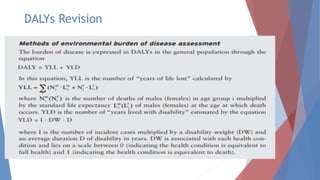
DALYs Revision
References
 wikipedia.org/wiki/Quality-adjusted_life_year#:~:text=The%20quality-
adjusted%20life%20year,one%20year%20in%20perfect%20health.
 https://www.celforpharma.com/insight/do-you-know-what-qaly-and-how-
calculate-
it#:~:text=QALY%20stands%20for%20Quality%20Adjusted,help%20payers%20allo
cate%20healthcare%20resources.
 Problems and solutions in calculating quality-adjusted life years (QALYs)

Quality adjusted life years(QALYs).pptx

  • 1.
    Quality adjusted life years(QALYs) Preparedby: Ranjana Koirala MPH 1st year KISTMCTH
  • 2.
    Introduction  The quality-adjustedlife year or quality-adjusted life-year (QALY) is a generic measure of disease burden, including both the quality and the quantity of life lived.  It is used in economic evaluation to assess the value of medical interventions. One QALY equates to one year in perfect health.  QALY are a measure of the BoD based on an estimate of the quality and quantity of additional years of life after a medical intervention.
  • 3.
    Defining and Measuringa QALY  Each year in perfect health is assigned the value of 1.0.  If extra years are lived with disability, then the extra years of life without perfect health are assigned a value between 0 and 1 depending on the nature of the disability.  The weighting of values is usually calculated by methods including visual analog scales, standard gamble, and time-trade-off.  This measure of QOL is challenged by those who claim that it is difficult to define perfect health. Others argue that there are some health states with severe suffering that should be assigned negative values because they are worse than death. Finally, the impact of a patient's health status on the QOL of family and friends is not included in this measure.
  • 4.
    Aim of measuringQALYs The QALY is commonly used in health economic evaluations as a means of quantifying the health effect of a medical intervention or a prevention program and ultimately to help payers allocate healthcare resources. QALYs can be used to inform health insurance coverage determinations, treatment decisions, to evaluate programs, and to set priorities for future programs.
  • 6.
    The Calculation  TheQALY can be calculated using the following formula which assumes a utility value (quality of life) between 1 = perfect health and 0 = dead:  Years of Life x Utility Value = #QALYs  This means:  If a person lives in perfect health for one year, that person will have 1 QALY. (1 Year of Life × 1 Utility Value = 1 QALY)  If a person lives in perfect health but only for half a year, that person will have 0.5 QALYs. (0.5 Years of Life x 1 Utility Value = 0.5 QALYs)  Conversely, if a person lives for 1 year in a situation with 0.5 utility (half of perfect health), that person will also have 0.5 QALYs. (1 Year of Life x 0.5 Utility Value = 0.5 QALYs)
  • 7.
     Example  Ifa person lives for 3 years with a disease and the current standard of care for that disease means he/she lives with a utility level of 0.7, that person will have 2.1 QALYs. (3 Years of Life x 0.7 Utility Value = 2.1 QALYs)  If that person takes a new medicine (Med A) whereby his/her utility level increases to 0.9, that person will now have 2.7 QALYS. Therefore, the benefit of the new medicine will be counted as 0.6 QALYs as this is the increase over the current standard of care. (3 Years of Life x 0.2 Additional Utility Level = 0.6 QALYs)  Similarly, if a new medicine (Med B) prolongs the patient’s life by 2 years, at a utility level of 0.7, the new medicine will provide the person with 1.4 additional QALYs. (2 Years of Additional Life x 0.7 Utility Value = 1.4 QALYs)
  • 10.
  • 13.