OBSERVATIONAL STUDIES
PROF DR RUBINA MUMTAZ
HOD COMMUNITY DENTISTRY
BV M09
LECTURE 6
LEARNING OBJECTIVES
By the end of this lecture, the student will be able to
• Discuss the characteristics, pros/cones and execute the
methodology of a cross sectional study
• Discuss the characteristics, pros/cones and execute the
methodology of a case control study
• Discuss the characteristics, pros/cones and execute the
methodology of a cohort study
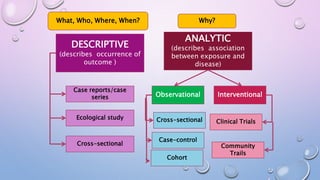
DESCRIPTIVE
(describes occurrence of
outcome )
ANALYTIC
(describes association
between exposure and
disease)
What, Who, Where, When? Why?
Case reports/case
series
Ecological study
Cross-sectional
Observational Interventional
Case-control
Cohort
Cross-sectional Clinical Trials
Community
Trails
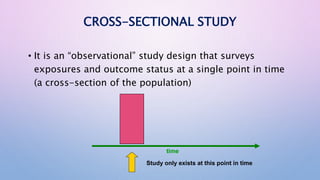
CROSS-SECTIONAL STUDY
• It is an “observational” study design that surveys
exposures and outcome status at a single point in time
(a cross-section of the population)
time
Study only exists at this point in time
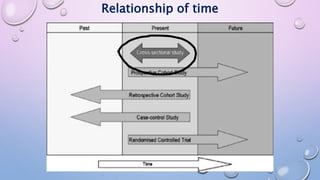
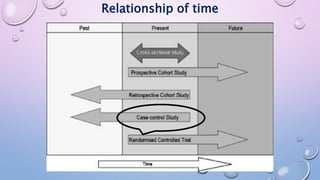
Relationship of time
CHARACTERISTICS OF A CROSS-SECTIONAL
STUDY
• It looks at a’ slice’ of a representative population
• It studies exposure and outcomes at the same times.
• Collects data on pre-determined measurements e.g. survey
questionnaires
• Primarily, this study provides information on prevalence of
disease and risk factors; never incidence (descriptive)
• It also can seek associations, generate and test hypotheses
and, by repetition, be used to measure change. (Analytical
e.g. Pre-and post-intervention KAP studies)
• Often used to study conditions that are relatively frequent
with long duration of expression (nonfatal, chronic
conditions); not suitable for studying rare or highly fatal
diseases or a disease with short duration of expression
ADVANTAGES
• Excellent for measuring the
population burden of disease.
• Cheaper to conduct; no follow
up required since its a snapshot
in time
• Can study multiple variables at
the same time
• Can give indirect insights on
the natural history of a disease
• Many findings and outcomes
can be analyzed to create new
theories/studies or in-depth
research
DISADVANTAGES
• Weakest observational design, (it
measures prevalence, not incidence
of disease). Prevalent cases are
survivors
• Only correlation possible. Temporal
sequence of exposure and effect is
impossible to determine
• Usually don’t know when disease
occurred
• Cannot be used for rare events or
quickly emerging diseases
(epidemics)
• Findings cannot be generalized as
STEPS IN CONDUCTING A CROSS SECTIONAL
STUDY
1. Define and identify a population
2. Define the outcomes and exposure
3. Create data collection tools e.g. Survey questionnaires. See Handout
4. Takes ethics clearance from appropriate organization
5. Determine mode of survey administration e.g. Face-to-face
interviews, telephone interviews, self-completed questionnaires,
computer-assisted approaches
6. Train staff who is going to collect the data
7. Take a sample from the representative population
8. Obtain consent from each subject
9. Measure
CASE CONTROL STUDY
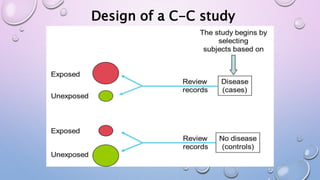
• It is an observational (because no intervention is
attempted) analytic (because we calculate a risk – odds
ratio) study design
• That compares patients who have a disease (cases )
• With patients who do not have the disease (controls),
• And looks back retrospectively to compare and to
determine the relationship between the exposure/s
(smoking , oral hygiene) and the disease
• Case control studies are also known as "retrospective
Relationship of time
Design of a C-C study
WHEN IS A C-C STUDY IS THE
CHOICE
• Feasible where disease outcomes are rare
• Feasible where disease outcomes are chronic
• Where you want to study one or more exposure/s to a
disease e.g role of diet, hygiene, smoking, drug use to
periodontitis
• When there is a system available to identify cases is
present e.g. Hospital
• When selection of controls from the source population
is possible
SELECTION OF CASES AND CONTROLS
CASES
• Step 1: Define the
disease e.g.
Periodontitis to be
defined by a specific
CPITN score as a cut off
value
• Step 2: Make an
eligibility criteria e.g.
age group, gender,
race, area of residence
etc
CONTROLS
• Controls are selected from the same study
population
• The control should resemble the case in all
respects except for the presence of disease
• The control must be at risk of getting the
disease.
• Comparability is more important than
representativeness in the selection of controls
• Matching of controls to case should at a
minimum 1:1 and maximum 4:1 (power of
study)
ADVANTAGES &
DISADVANTAGES
• Good for studying rare, chronic
diseases
• Cheaper and Less time needed to
conduct the study because the
condition or disease has already
occurred
• Simultaneously looks at multiple
risk factors
• Useful as initial studies to establish
an association
• Can answer questions that could
• Restricted to a single
outcome/disease
• Retrospective , hence poor data
quality because they rely on
memory and people with a
condition will be more motivated
to recall risk factors (also called
recall bias).
• Not good for evaluating
diagnostic tests because it’s
already clear that the cases have
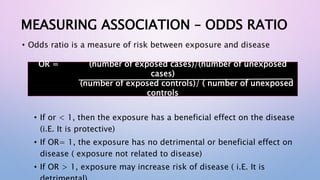
MEASURING ASSOCIATION – ODDS RATIO
• Odds ratio is a measure of risk between exposure and disease
• If or < 1, then the exposure has a beneficial effect on the disease
(i.E. It is protective)
• If OR= 1, the exposure has no detrimental or beneficial effect on
disease ( exposure not related to disease)
• If OR > 1, exposure may increase risk of disease ( i.E. It is
OR = (number of exposed cases)/(number of unexposed
cases)
(number of exposed controls)/ ( number of unexposed
controls
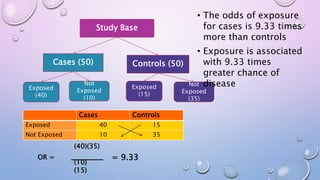
Study Base
Cases (50) Controls (50)
Exposed
(40)
Not
Exposed
(35)
Not
Exposed
(10)
Exposed
(15)
Cases Controls
Exposed 40 15
Not Exposed 10 35
OR =
(40)(35)
(10)
(15)
= 9.33
• The odds of exposure
for cases is 9.33 times
more than controls
• Exposure is associated
with 9.33 times
greater chance of
disease
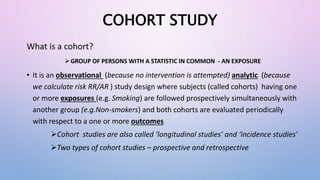
COHORT STUDY
What is a cohort?
GROUP OF PERSONS WITH A STATISTIC IN COMMON - AN EXPOSURE
• It is an observational (because no intervention is attempted) analytic (because
we calculate risk RR/AR ) study design where subjects (called cohorts) having one
or more exposures (e.g. Smoking) are followed prospectively simultaneously with
another group (e.g.Non-smokers) and both cohorts are evaluated periodically
with respect to a one or more outcomes
Cohort studies are also called ‘longitudinal studies’ and ‘incidence studies’
Two types of cohort studies – prospective and retrospective
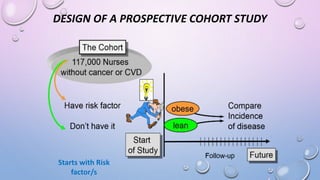
DESIGN OF A PROSPECTIVE COHORT STUDY
Starts with Risk
factor/s
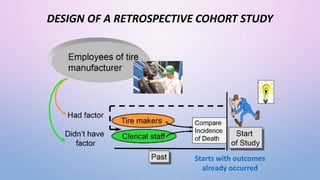
DESIGN OF A RETROSPECTIVE COHORT STUDY
Starts with outcomes
already occurred
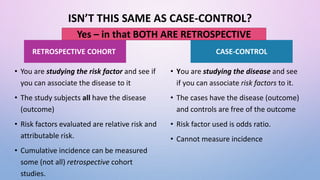
ISN’T THIS SAME AS CASE-CONTROL?
• You are studying the risk factor and see if
you can associate the disease to it
• The study subjects all have the disease
(outcome)
• Risk factors evaluated are relative risk and
attributable risk.
• Cumulative incidence can be measured
some (not all) retrospective cohort
studies.
• You are studying the disease and see
if you can associate risk factors to it.
• The cases have the disease (outcome)
and controls are free of the outcome
• Risk factor used is odds ratio.
• Cannot measure incidence
RETROSPECTIVE COHORT CASE-CONTROL
Yes – in that BOTH ARE RETROSPECTIVE
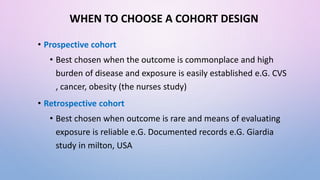
WHEN TO CHOOSE A COHORT DESIGN
• Prospective cohort
• Best chosen when the outcome is commonplace and high
burden of disease and exposure is easily established e.G. CVS
, cancer, obesity (the nurses study)
• Retrospective cohort
• Best chosen when outcome is rare and means of evaluating
exposure is reliable e.G. Documented records e.G. Giardia
study in milton, USA
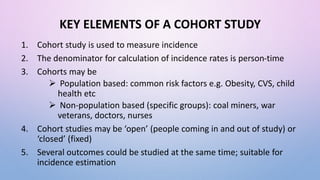
KEY ELEMENTS OF A COHORT STUDY
1. Cohort study is used to measure incidence
2. The denominator for calculation of incidence rates is person-time
3. Cohorts may be
 Population based: common risk factors e.g. Obesity, CVS, child
health etc
 Non-population based (specific groups): coal miners, war
veterans, doctors, nurses
4. Cohort studies may be ‘open’ (people coming in and out of study) or
‘closed’ (fixed)
5. Several outcomes could be studied at the same time; suitable for
incidence estimation
SELECTION OF COHORT SUBJECTS
 Cohort subjects are free of the disease at the start of the study
(opposite is true for retrospective cohort)
 But are equally susceptible to disease
 And are comparable
 Diagnostic and eligibility criteria for the disease should be defined
well in advance.
 Exposures may be single or multiple
EVALUATING EXPOSURE/FOLLOW UP
Evaluation is the most important aspect of cohort study; can be
done by
Personal interviews /mailed questionnaire
Reviews of records
Periodic medical examination or special testing
Environmental survey
• Some loss to follow up is inevitable due to death change of
address, migration, change of occupation etc. This is adjusted by
using the person-time statistic
• Ideally 80-90% follow up is an accurate cohort
WAYS TO REDUCE LOSS/IMPROVE FOLLOW UP
• Collect baseline information that will facilitate tracking subjects, e.g.,
Addresses, phone numbers and email addresses not only for the
subject, but also for possible contacts such as next of kin or close
friends.
• When feasible, use subjects who are easier to track. Studies sometimes
use doctors or nurses or other professionals because they are more
likely to remain interested in the study, and because they belong to
professional organizations that make it easer to track them down if
they relocate.
• Maintain regular contact via personal contact, mail, phone, or email;
Send participants newsletters periodically to keep them updated on the
study' progress.
ADVANTAGES & DISADVANTAGES
• We can find out incidence rate and
risk
• More than one disease related to
single exposure or vice versa
• Can establish cause – effect
temporal relationship
• Good when exposure is rare
• Minimizes selection and
information bias
• Losses to follow-up
• Often requires large samples
• Ineffective for rare diseases
• Long time to complete
• Expensive
• Ethical issues
QUESTIONS?
THANK YOU

BV M09 Lecture 6 OBSERVATIONAL STUDIES.pptx

  • 1.
    OBSERVATIONAL STUDIES PROF DRRUBINA MUMTAZ HOD COMMUNITY DENTISTRY BV M09 LECTURE 6
  • 2.
    LEARNING OBJECTIVES By theend of this lecture, the student will be able to • Discuss the characteristics, pros/cones and execute the methodology of a cross sectional study • Discuss the characteristics, pros/cones and execute the methodology of a case control study • Discuss the characteristics, pros/cones and execute the methodology of a cohort study
  • 3.
    DESCRIPTIVE (describes occurrence of outcome) ANALYTIC (describes association between exposure and disease) What, Who, Where, When? Why? Case reports/case series Ecological study Cross-sectional Observational Interventional Case-control Cohort Cross-sectional Clinical Trials Community Trails
  • 4.
    CROSS-SECTIONAL STUDY • Itis an “observational” study design that surveys exposures and outcome status at a single point in time (a cross-section of the population) time Study only exists at this point in time
  • 5.
  • 6.
    CHARACTERISTICS OF ACROSS-SECTIONAL STUDY • It looks at a’ slice’ of a representative population • It studies exposure and outcomes at the same times. • Collects data on pre-determined measurements e.g. survey questionnaires • Primarily, this study provides information on prevalence of disease and risk factors; never incidence (descriptive) • It also can seek associations, generate and test hypotheses and, by repetition, be used to measure change. (Analytical e.g. Pre-and post-intervention KAP studies) • Often used to study conditions that are relatively frequent with long duration of expression (nonfatal, chronic conditions); not suitable for studying rare or highly fatal diseases or a disease with short duration of expression
  • 7.
    ADVANTAGES • Excellent formeasuring the population burden of disease. • Cheaper to conduct; no follow up required since its a snapshot in time • Can study multiple variables at the same time • Can give indirect insights on the natural history of a disease • Many findings and outcomes can be analyzed to create new theories/studies or in-depth research DISADVANTAGES • Weakest observational design, (it measures prevalence, not incidence of disease). Prevalent cases are survivors • Only correlation possible. Temporal sequence of exposure and effect is impossible to determine • Usually don’t know when disease occurred • Cannot be used for rare events or quickly emerging diseases (epidemics) • Findings cannot be generalized as
  • 8.
    STEPS IN CONDUCTINGA CROSS SECTIONAL STUDY 1. Define and identify a population 2. Define the outcomes and exposure 3. Create data collection tools e.g. Survey questionnaires. See Handout 4. Takes ethics clearance from appropriate organization 5. Determine mode of survey administration e.g. Face-to-face interviews, telephone interviews, self-completed questionnaires, computer-assisted approaches 6. Train staff who is going to collect the data 7. Take a sample from the representative population 8. Obtain consent from each subject 9. Measure
  • 9.
    CASE CONTROL STUDY •It is an observational (because no intervention is attempted) analytic (because we calculate a risk – odds ratio) study design • That compares patients who have a disease (cases ) • With patients who do not have the disease (controls), • And looks back retrospectively to compare and to determine the relationship between the exposure/s (smoking , oral hygiene) and the disease • Case control studies are also known as "retrospective
  • 10.
  • 11.
    Design of aC-C study
  • 12.
    WHEN IS AC-C STUDY IS THE CHOICE • Feasible where disease outcomes are rare • Feasible where disease outcomes are chronic • Where you want to study one or more exposure/s to a disease e.g role of diet, hygiene, smoking, drug use to periodontitis • When there is a system available to identify cases is present e.g. Hospital • When selection of controls from the source population is possible
  • 13.
    SELECTION OF CASESAND CONTROLS CASES • Step 1: Define the disease e.g. Periodontitis to be defined by a specific CPITN score as a cut off value • Step 2: Make an eligibility criteria e.g. age group, gender, race, area of residence etc CONTROLS • Controls are selected from the same study population • The control should resemble the case in all respects except for the presence of disease • The control must be at risk of getting the disease. • Comparability is more important than representativeness in the selection of controls • Matching of controls to case should at a minimum 1:1 and maximum 4:1 (power of study)
  • 14.
    ADVANTAGES & DISADVANTAGES • Goodfor studying rare, chronic diseases • Cheaper and Less time needed to conduct the study because the condition or disease has already occurred • Simultaneously looks at multiple risk factors • Useful as initial studies to establish an association • Can answer questions that could • Restricted to a single outcome/disease • Retrospective , hence poor data quality because they rely on memory and people with a condition will be more motivated to recall risk factors (also called recall bias). • Not good for evaluating diagnostic tests because it’s already clear that the cases have
  • 15.
    MEASURING ASSOCIATION –ODDS RATIO • Odds ratio is a measure of risk between exposure and disease • If or < 1, then the exposure has a beneficial effect on the disease (i.E. It is protective) • If OR= 1, the exposure has no detrimental or beneficial effect on disease ( exposure not related to disease) • If OR > 1, exposure may increase risk of disease ( i.E. It is OR = (number of exposed cases)/(number of unexposed cases) (number of exposed controls)/ ( number of unexposed controls
  • 16.
    Study Base Cases (50)Controls (50) Exposed (40) Not Exposed (35) Not Exposed (10) Exposed (15) Cases Controls Exposed 40 15 Not Exposed 10 35 OR = (40)(35) (10) (15) = 9.33 • The odds of exposure for cases is 9.33 times more than controls • Exposure is associated with 9.33 times greater chance of disease
  • 17.
    COHORT STUDY What isa cohort? GROUP OF PERSONS WITH A STATISTIC IN COMMON - AN EXPOSURE • It is an observational (because no intervention is attempted) analytic (because we calculate risk RR/AR ) study design where subjects (called cohorts) having one or more exposures (e.g. Smoking) are followed prospectively simultaneously with another group (e.g.Non-smokers) and both cohorts are evaluated periodically with respect to a one or more outcomes Cohort studies are also called ‘longitudinal studies’ and ‘incidence studies’ Two types of cohort studies – prospective and retrospective
  • 18.
    DESIGN OF APROSPECTIVE COHORT STUDY Starts with Risk factor/s
  • 19.
    DESIGN OF ARETROSPECTIVE COHORT STUDY Starts with outcomes already occurred
  • 20.
    ISN’T THIS SAMEAS CASE-CONTROL? • You are studying the risk factor and see if you can associate the disease to it • The study subjects all have the disease (outcome) • Risk factors evaluated are relative risk and attributable risk. • Cumulative incidence can be measured some (not all) retrospective cohort studies. • You are studying the disease and see if you can associate risk factors to it. • The cases have the disease (outcome) and controls are free of the outcome • Risk factor used is odds ratio. • Cannot measure incidence RETROSPECTIVE COHORT CASE-CONTROL Yes – in that BOTH ARE RETROSPECTIVE
  • 21.
    WHEN TO CHOOSEA COHORT DESIGN • Prospective cohort • Best chosen when the outcome is commonplace and high burden of disease and exposure is easily established e.G. CVS , cancer, obesity (the nurses study) • Retrospective cohort • Best chosen when outcome is rare and means of evaluating exposure is reliable e.G. Documented records e.G. Giardia study in milton, USA
  • 22.
    KEY ELEMENTS OFA COHORT STUDY 1. Cohort study is used to measure incidence 2. The denominator for calculation of incidence rates is person-time 3. Cohorts may be  Population based: common risk factors e.g. Obesity, CVS, child health etc  Non-population based (specific groups): coal miners, war veterans, doctors, nurses 4. Cohort studies may be ‘open’ (people coming in and out of study) or ‘closed’ (fixed) 5. Several outcomes could be studied at the same time; suitable for incidence estimation
  • 23.
    SELECTION OF COHORTSUBJECTS  Cohort subjects are free of the disease at the start of the study (opposite is true for retrospective cohort)  But are equally susceptible to disease  And are comparable  Diagnostic and eligibility criteria for the disease should be defined well in advance.  Exposures may be single or multiple
  • 24.
    EVALUATING EXPOSURE/FOLLOW UP Evaluationis the most important aspect of cohort study; can be done by Personal interviews /mailed questionnaire Reviews of records Periodic medical examination or special testing Environmental survey • Some loss to follow up is inevitable due to death change of address, migration, change of occupation etc. This is adjusted by using the person-time statistic • Ideally 80-90% follow up is an accurate cohort
  • 25.
    WAYS TO REDUCELOSS/IMPROVE FOLLOW UP • Collect baseline information that will facilitate tracking subjects, e.g., Addresses, phone numbers and email addresses not only for the subject, but also for possible contacts such as next of kin or close friends. • When feasible, use subjects who are easier to track. Studies sometimes use doctors or nurses or other professionals because they are more likely to remain interested in the study, and because they belong to professional organizations that make it easer to track them down if they relocate. • Maintain regular contact via personal contact, mail, phone, or email; Send participants newsletters periodically to keep them updated on the study' progress.
  • 26.
    ADVANTAGES & DISADVANTAGES •We can find out incidence rate and risk • More than one disease related to single exposure or vice versa • Can establish cause – effect temporal relationship • Good when exposure is rare • Minimizes selection and information bias • Losses to follow-up • Often requires large samples • Ineffective for rare diseases • Long time to complete • Expensive • Ethical issues
  • 27.