CROSS CULTURAL COMMUNICATION 
GROUP MEMBERS- 
 SHIRLEY MASCARENHAS-839 
 JAYASHREE PARKE-845 
 RAHUL MARAIYA-838 
 AKSHAY PATANKAR-846 
 SUMIT MEHTA-840 
 OMKAR NEMLEKAR-843 
 VINAY MEHTA-841 
 CHIRANJIVI PALITA-844 
What is culture? 
“CULTURE IS THE ART OF ELEVATED TO A SET OF BELIEFS “ 
- TOM WOLFE 
Communication- 
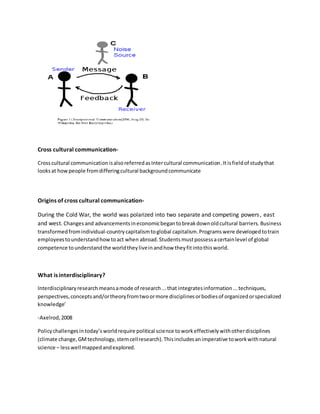
Communication is the sending of a message from a source to a receiver with least possible loss of 
meaning.
Cross cultural communication- 
Cross cultural communication is also referred as Inter cultural communication. It is field of study that 
looks at how people from differing cultural background communicate 
Origins of cross cultural communication- 
During the Cold War, the world was polarized into two separate and competing powers , east 
and west. Changes and advancements in economic began to break down old cultural barriers. Business 
transformed from individual-country capitalism to global capitalism. Programs were developed to train 
employees to understand how to act when abroad. Students must possess a certain level of global 
competence to understand the world they live in and how they fit into this world. 
What is interdisciplinary? 
Interdisciplinary research means a mode of research ... that integrates information ... techniques, 
perspectives, concepts and/or theory from two or more disciplines or bodies of organized or specialized 
knowledge’ 
-Axelrod, 2008 
Policy challenges in today’s world require political science to work effectively with other disciplines 
(climate change, GM technology, stem cell research). This includes an imperative to work with natural 
science – less well mapped and explored.
Global rise- 
Global rise is nothing but is the process of globalization, especially the increasing of global trade with 
different cultures, environment, different language and blend together. People from different culture 
find it is hard to communicate not only due to language barrier but also affected by culture styles. 
Cultures provide people with ways of thinking—ways of seeing, hearing, and interpreting the world. 
When the languages are different, and translation has to be used to communicate, the potential for 
misunderstandings increases. International literacy and cross-cultural understanding have become 
important for global rise with the help of understanding and gaining knowledge of different country’s 
cultural, technological, economic, and political health. 
Reasons for increase in cross cultural communications- 
 Increase in globalization 
 International networking 
 Intercultural understanding 
Steps taken by institutions for decreasing cross cultural barriers- 
 Organizational change 
 Curriculum innovation 
 Staff development 
 Student mobility 
 Worldwide research 
 Visiting faculty 
 Integration of international students 
 Acceptance to change 
On the positive side, cross culture communications help in- 
Sharing of ideas and experiences, view different perspectives, exposure to varied thoughts, reduction in 
biasness.
WYSE (World Youth Service Enterprise): 
The world youth service enterprise (WYSE), is a worldwide educational charity specializing in education 
and development for emerging leaders since 1989. In 1992, it came up with a vision to bring young 
people from around the world together who wanted to make a positive contribution to their 
communities. By this vision, people of different cultural backgrounds were able to face more global 
challenges than before, and got to know their inner leadership. WYSE’s vision involves the respect 
towards diversity of political, social and religious views of people from different cultures. Through the 
programs undertaken by WYSE, the barriers to cross cultural communication were rooted off and a new 
sense of common communication was developed. 
Case study- 
MEET (Middle East Education Through Technology): 
MEET is an innovative educational initiative aimed at creating a common professional language between 
Israeli and Palestinian young people. The sole purpose of MEET focuses on connecting young people 
through joint interest and to provide opportunities to learn about each other. It provides a safe forum 
for the Israelis and Palestinians to meet and discover one another’s cultures, and also to explore 
similarities and differences within them. 
Parameters perceived by people of different cultures- 
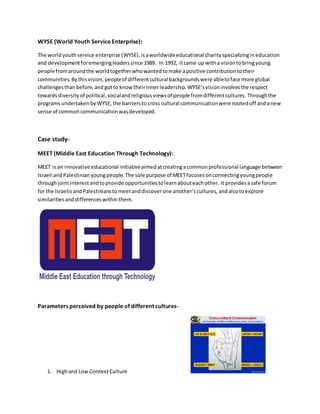
1. High and Low Context Culture
2. Non Verbal, Oral and Written 
High and Low Context Culture- 
It is the most important cultural dimension and immensely difficult to define. The idea of context in 
culture was put forth by anthropologist Edward T Hall . 
Low-context cultures assume that the individuals know very little about what they are being told, and 
therefore must be given a lot of background information. High-Context cultures assume the individual is 
knowledgeable about the subject and has to be given very little background information 
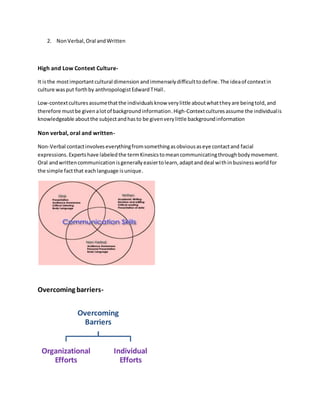
Non verbal, oral and written- 
Non-Verbal contact involves everything from something as obvious as eye contact and facial 
expressions. Experts have labeled the term Kinesics to mean communicating through body movement. 
Oral and written communication is generally easier to learn, adapt and deal wi th in business world for 
the simple fact that each language is unique. 
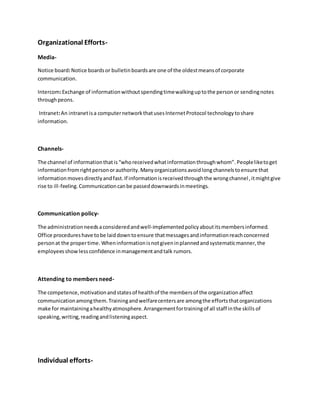
Overcoming barriers- 
Overcoming 
Barriers 
Organizational 
Efforts 
Individual 
Efforts
Organizational Efforts- 
Media- 
Notice board: Notice boards or bulletin boards are one of the oldest means of corporate 
communication. 
Intercom: Exchange of information without spending time walking up to the person or sending notes 
through peons. 
Intranet: An intranet is a computer network that uses Internet Protocol technology to share 
information. 
Channels- 
The channel of information that is “who received what information through whom”. People like to get 
information from right person or authority. Many organizations avoid long channels to ensure that 
information moves directly and fast. If information is received through the wrong channel , it might give 
rise to ill-feeling. Communication can be passed downwards in meetings. 
Communication policy- 
The administration needs a considered and well-implemented policy about its members informed. 
Office procedures have to be laid down to ensure that messages and information reach concerned 
person at the proper time. When information is not given in planned and systematic manner, the 
employees show less confidence in management and talk rumors. 
Attending to members need- 
The competence, motivation and states of health of the members of the organization affect 
communication among them. Training and welfare centers are among the efforts that organizations 
make for maintaining a healthy atmosphere. Arrangement for training of all staff in the skills of 
speaking, writing, reading and listening aspect. 
Individual efforts-
Improving listening skills- 
Each individual must find out his/her own special problems and barriers to listening. Training for good 
listening is largely personal responsibility and can be done by personal efforts. Your listening reflects 
your basic attitude to people rather than just skills. 
Practicing feedback skills- 
Getting feedback- 
The other person’s reaction or response to the manager gives important information about 
effectiveness of the communication, 
Inviting questions: it is a common method, but not always effective. 
Asking questions: it is find out what has been understood is another method 
Requesting summary: “will you summarize the main points of what I have said, so that I can check 
whether I missed any important points?” 
Giving feedback- 
In the role of communication, one has the responsibility to give feedback. One can check his own 
understanding by giving feedback. 
Skills while giving feedback: 
-be specific, not general, 
-give feedback immediately or soon after the event 
-be descriptive, not evaluating 
Receiving feedback- 
It is different from getting feedback which means arranging for and making effort to find out how your 
communication has been received by the audience. 
Accepting feedback requires training as much as the art of getting feedback: 
Genuine desire to improve, being non defensive, guard against over reacting. 
Improving cross-cultural communication
With globalization of business and growth of e-commerce, everyone will be required to interact with 
persons from other cultures in the course of their work. 
It is better to assume similarity until you are sure, depend on descriptive rather than evaluating, 
experience. 
Bibliography- 
1. Wikipedia 
2. Google 
3. Notes on communication 
4. Books on cross cultural communication 
5. Images downloaded from internet

Cross cultural hard copy

  • 1.
    CROSS CULTURAL COMMUNICATION GROUP MEMBERS-  SHIRLEY MASCARENHAS-839  JAYASHREE PARKE-845  RAHUL MARAIYA-838  AKSHAY PATANKAR-846  SUMIT MEHTA-840  OMKAR NEMLEKAR-843  VINAY MEHTA-841  CHIRANJIVI PALITA-844 What is culture? “CULTURE IS THE ART OF ELEVATED TO A SET OF BELIEFS “ - TOM WOLFE Communication- Communication is the sending of a message from a source to a receiver with least possible loss of meaning.
  • 2.
    Cross cultural communication- Cross cultural communication is also referred as Inter cultural communication. It is field of study that looks at how people from differing cultural background communicate Origins of cross cultural communication- During the Cold War, the world was polarized into two separate and competing powers , east and west. Changes and advancements in economic began to break down old cultural barriers. Business transformed from individual-country capitalism to global capitalism. Programs were developed to train employees to understand how to act when abroad. Students must possess a certain level of global competence to understand the world they live in and how they fit into this world. What is interdisciplinary? Interdisciplinary research means a mode of research ... that integrates information ... techniques, perspectives, concepts and/or theory from two or more disciplines or bodies of organized or specialized knowledge’ -Axelrod, 2008 Policy challenges in today’s world require political science to work effectively with other disciplines (climate change, GM technology, stem cell research). This includes an imperative to work with natural science – less well mapped and explored.
  • 3.
    Global rise- Globalrise is nothing but is the process of globalization, especially the increasing of global trade with different cultures, environment, different language and blend together. People from different culture find it is hard to communicate not only due to language barrier but also affected by culture styles. Cultures provide people with ways of thinking—ways of seeing, hearing, and interpreting the world. When the languages are different, and translation has to be used to communicate, the potential for misunderstandings increases. International literacy and cross-cultural understanding have become important for global rise with the help of understanding and gaining knowledge of different country’s cultural, technological, economic, and political health. Reasons for increase in cross cultural communications-  Increase in globalization  International networking  Intercultural understanding Steps taken by institutions for decreasing cross cultural barriers-  Organizational change  Curriculum innovation  Staff development  Student mobility  Worldwide research  Visiting faculty  Integration of international students  Acceptance to change On the positive side, cross culture communications help in- Sharing of ideas and experiences, view different perspectives, exposure to varied thoughts, reduction in biasness.
  • 4.
    WYSE (World YouthService Enterprise): The world youth service enterprise (WYSE), is a worldwide educational charity specializing in education and development for emerging leaders since 1989. In 1992, it came up with a vision to bring young people from around the world together who wanted to make a positive contribution to their communities. By this vision, people of different cultural backgrounds were able to face more global challenges than before, and got to know their inner leadership. WYSE’s vision involves the respect towards diversity of political, social and religious views of people from different cultures. Through the programs undertaken by WYSE, the barriers to cross cultural communication were rooted off and a new sense of common communication was developed. Case study- MEET (Middle East Education Through Technology): MEET is an innovative educational initiative aimed at creating a common professional language between Israeli and Palestinian young people. The sole purpose of MEET focuses on connecting young people through joint interest and to provide opportunities to learn about each other. It provides a safe forum for the Israelis and Palestinians to meet and discover one another’s cultures, and also to explore similarities and differences within them. Parameters perceived by people of different cultures- 1. High and Low Context Culture
  • 5.
    2. Non Verbal,Oral and Written High and Low Context Culture- It is the most important cultural dimension and immensely difficult to define. The idea of context in culture was put forth by anthropologist Edward T Hall . Low-context cultures assume that the individuals know very little about what they are being told, and therefore must be given a lot of background information. High-Context cultures assume the individual is knowledgeable about the subject and has to be given very little background information Non verbal, oral and written- Non-Verbal contact involves everything from something as obvious as eye contact and facial expressions. Experts have labeled the term Kinesics to mean communicating through body movement. Oral and written communication is generally easier to learn, adapt and deal wi th in business world for the simple fact that each language is unique. Overcoming barriers- Overcoming Barriers Organizational Efforts Individual Efforts
  • 6.
    Organizational Efforts- Media- Notice board: Notice boards or bulletin boards are one of the oldest means of corporate communication. Intercom: Exchange of information without spending time walking up to the person or sending notes through peons. Intranet: An intranet is a computer network that uses Internet Protocol technology to share information. Channels- The channel of information that is “who received what information through whom”. People like to get information from right person or authority. Many organizations avoid long channels to ensure that information moves directly and fast. If information is received through the wrong channel , it might give rise to ill-feeling. Communication can be passed downwards in meetings. Communication policy- The administration needs a considered and well-implemented policy about its members informed. Office procedures have to be laid down to ensure that messages and information reach concerned person at the proper time. When information is not given in planned and systematic manner, the employees show less confidence in management and talk rumors. Attending to members need- The competence, motivation and states of health of the members of the organization affect communication among them. Training and welfare centers are among the efforts that organizations make for maintaining a healthy atmosphere. Arrangement for training of all staff in the skills of speaking, writing, reading and listening aspect. Individual efforts-
  • 7.
    Improving listening skills- Each individual must find out his/her own special problems and barriers to listening. Training for good listening is largely personal responsibility and can be done by personal efforts. Your listening reflects your basic attitude to people rather than just skills. Practicing feedback skills- Getting feedback- The other person’s reaction or response to the manager gives important information about effectiveness of the communication, Inviting questions: it is a common method, but not always effective. Asking questions: it is find out what has been understood is another method Requesting summary: “will you summarize the main points of what I have said, so that I can check whether I missed any important points?” Giving feedback- In the role of communication, one has the responsibility to give feedback. One can check his own understanding by giving feedback. Skills while giving feedback: -be specific, not general, -give feedback immediately or soon after the event -be descriptive, not evaluating Receiving feedback- It is different from getting feedback which means arranging for and making effort to find out how your communication has been received by the audience. Accepting feedback requires training as much as the art of getting feedback: Genuine desire to improve, being non defensive, guard against over reacting. Improving cross-cultural communication
  • 8.
    With globalization ofbusiness and growth of e-commerce, everyone will be required to interact with persons from other cultures in the course of their work. It is better to assume similarity until you are sure, depend on descriptive rather than evaluating, experience. Bibliography- 1. Wikipedia 2. Google 3. Notes on communication 4. Books on cross cultural communication 5. Images downloaded from internet