Resident Status 
Lecture 2
Why Study Residential Status 
• Tax incidence on an assesse depends on his 
residential status. 
• E.g. An income, accrued to an individual outside 
India, is taxable in India, depends upon the 
residential status of the individual in India 
• Income earned by a foreign national in India or 
outside India is taxable in India depends on the 
residential status of the individual in India, rather 
than the citizenship.
Different taxable entities 
All taxable entities are divided in the following 
categories for the purpose of determining 
residential status: 
a. An individual; 
b. A Hindu undivided family; 
c. A firm or an association of persons; 
d. A joint stock company; and 
e. Any other person.
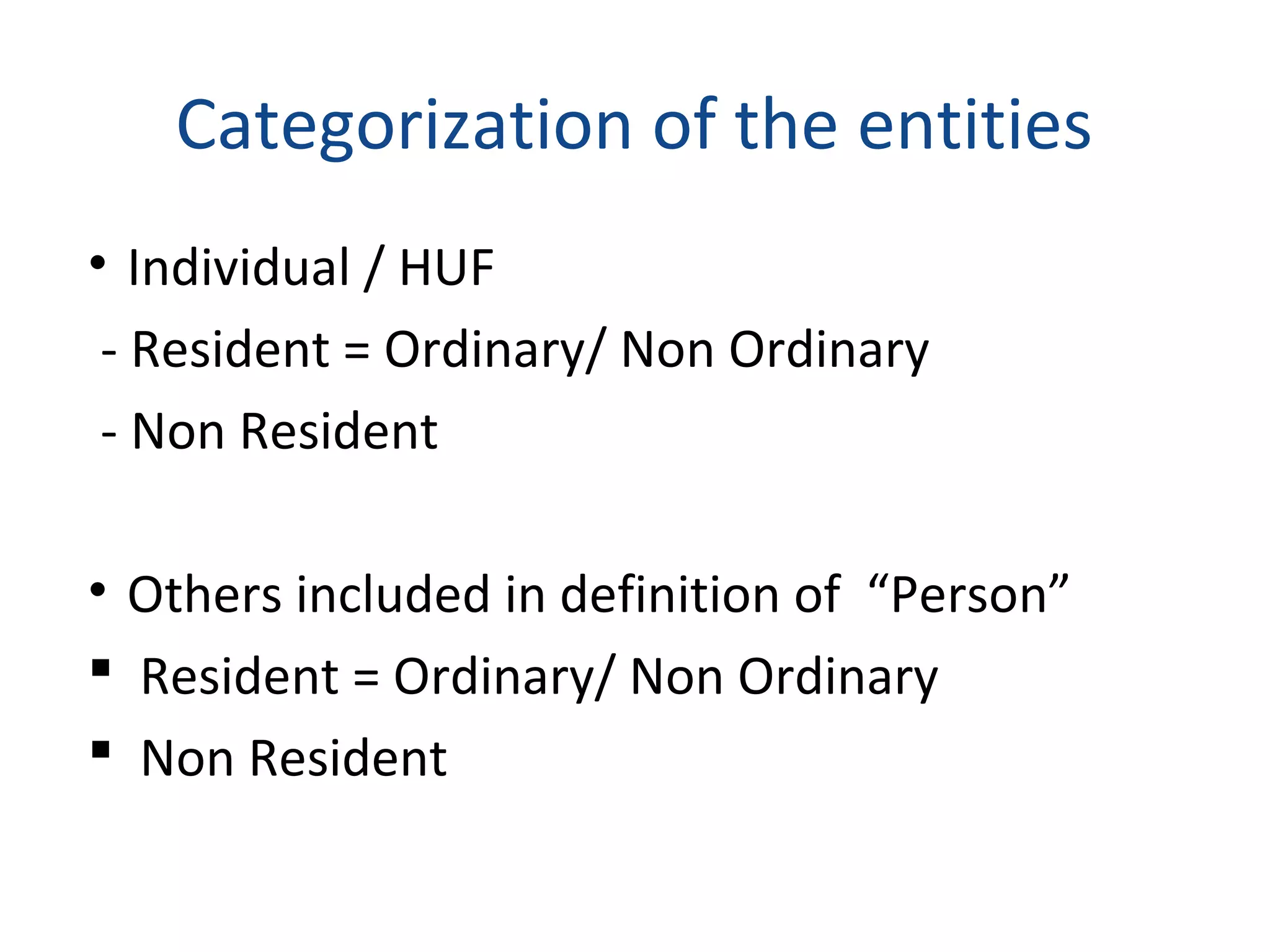
Categorization of the entities 
• Individual / HUF 
- Resident = Ordinary/ Non Ordinary 
- Non Resident 
• Others included in definition of “Person” 
 Resident = Ordinary/ Non Ordinary 
 Non Resident
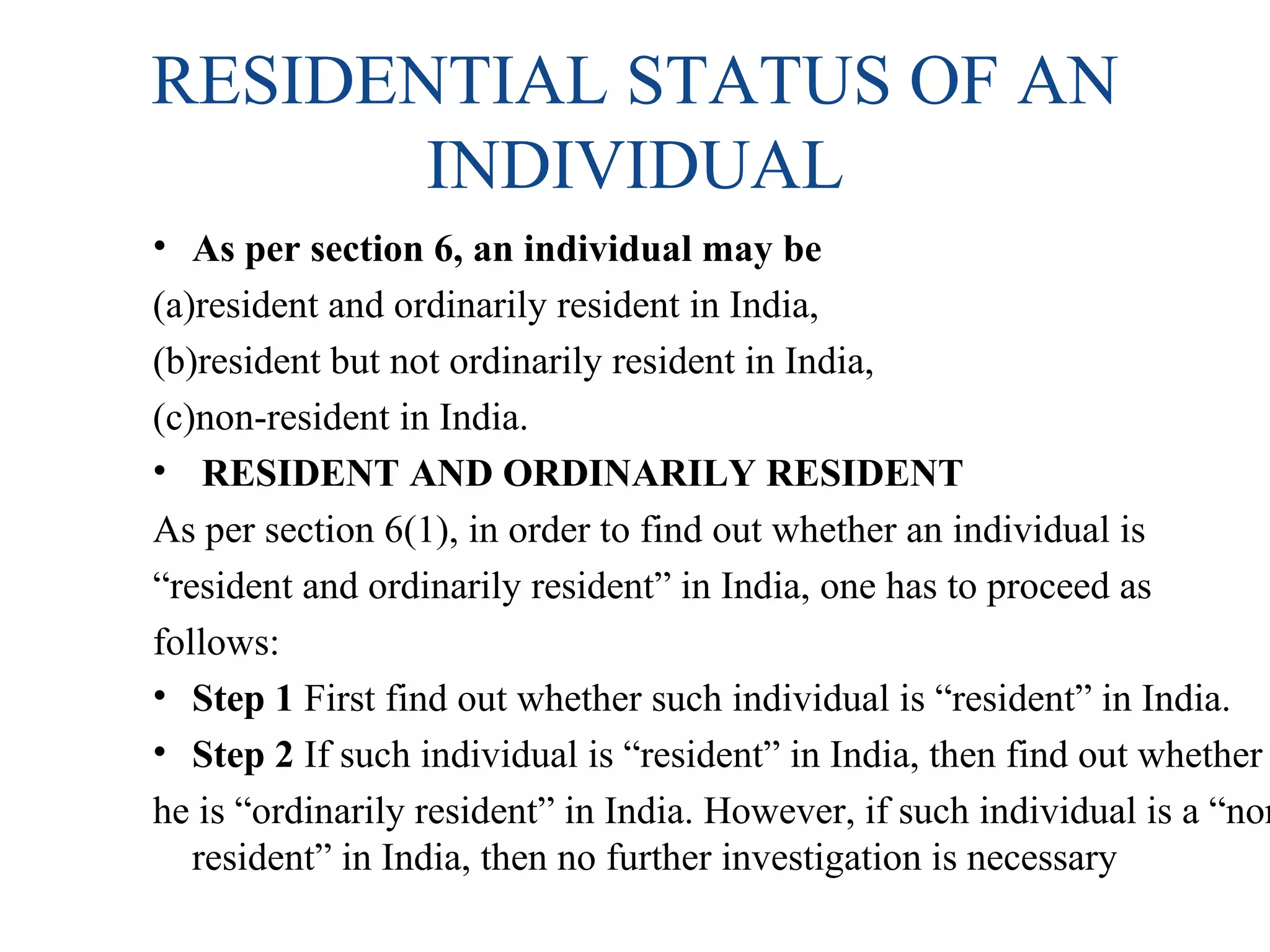
RESIDENTIAL STATUS OF AN 
INDIVIDUAL 
• As per section 6, an individual may be 
(a)resident and ordinarily resident in India, 
(b)resident but not ordinarily resident in India, 
(c)non-resident in India. 
• RESIDENT AND ORDINARILY RESIDENT 
As per section 6(1), in order to find out whether an individual is 
“resident and ordinarily resident” in India, one has to proceed as 
follows: 
• Step 1 First find out whether such individual is “resident” in India. 
• Step 2 If such individual is “resident” in India, then find out whether 
he is “ordinarily resident” in India. However, if such individual is a “non-resident” 
in India, then no further investigation is necessary
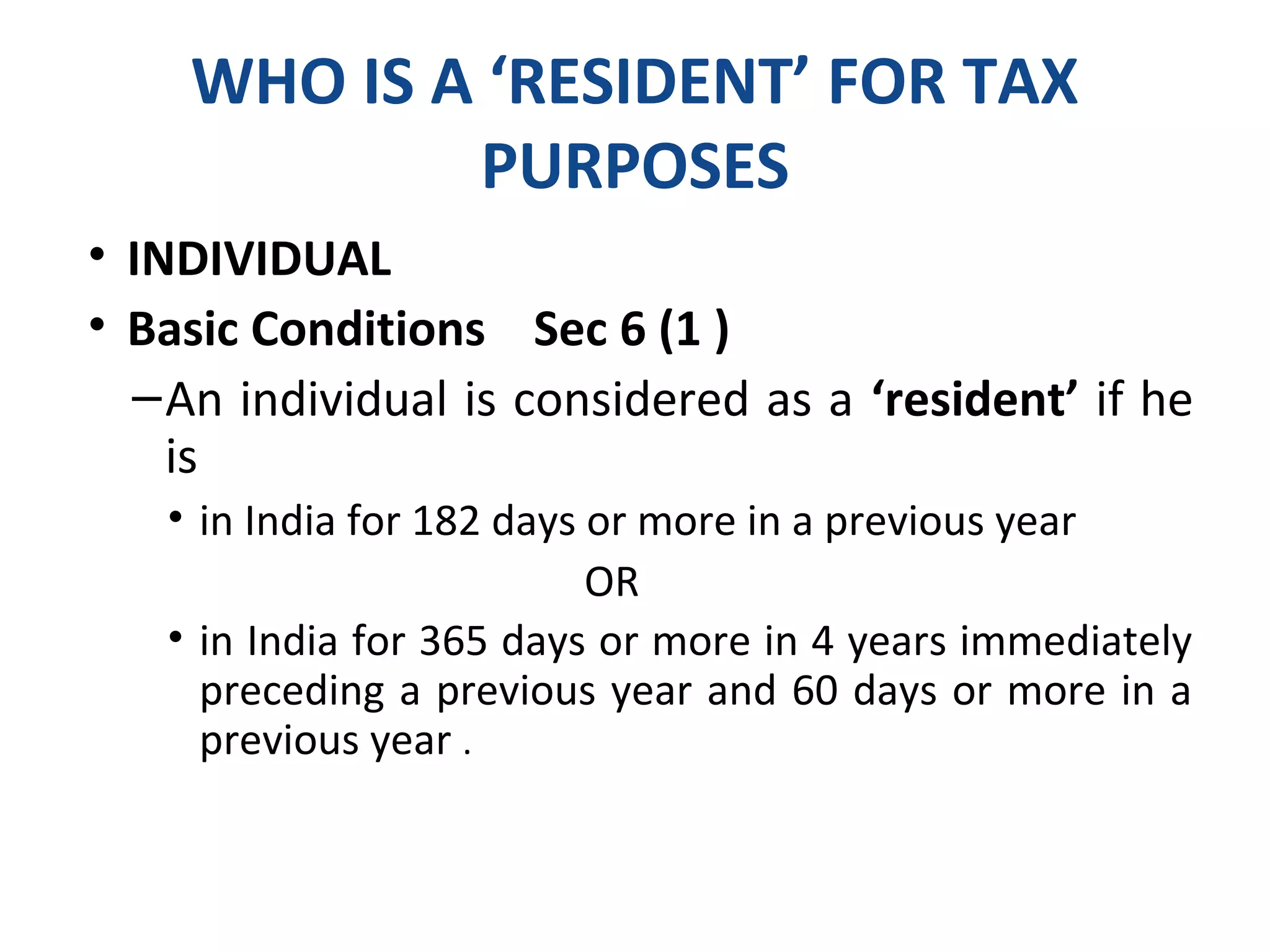
WHO IS A ‘RESIDENT’ FOR TAX 
PURPOSES 
• INDIVIDUAL 
• Basic Conditions Sec 6 (1 ) 
–An individual is considered as a ‘resident’ if he 
is 
• in India for 182 days or more in a previous year 
OR 
• in India for 365 days or more in 4 years immediately 
preceding a previous year and 60 days or more in a 
previous year .
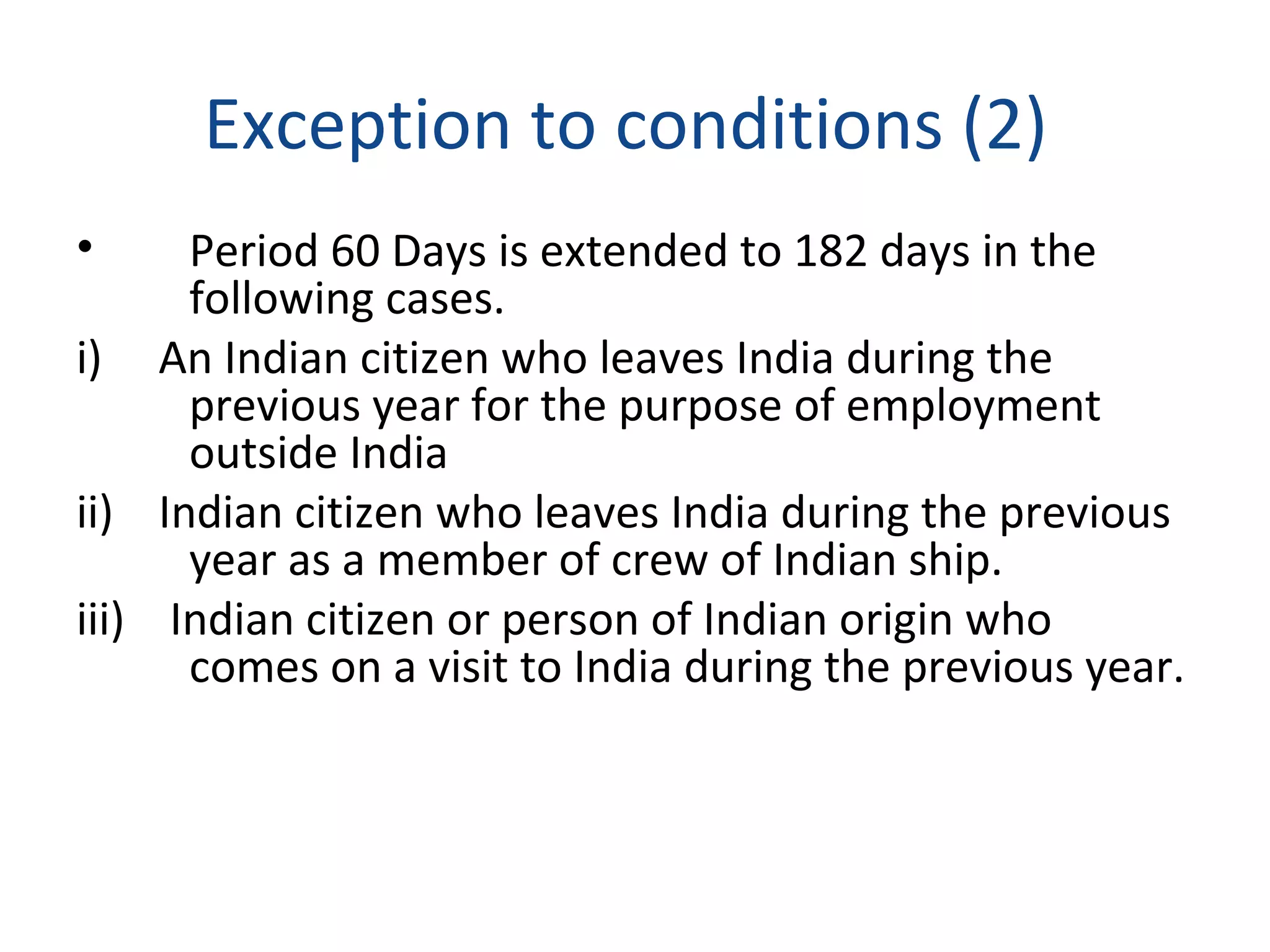
Exception to conditions (2) 
• Period 60 Days is extended to 182 days in the 
following cases. 
i) An Indian citizen who leaves India during the 
previous year for the purpose of employment 
outside India 
ii) Indian citizen who leaves India during the previous 
year as a member of crew of Indian ship. 
iii) Indian citizen or person of Indian origin who 
comes on a visit to India during the previous year.
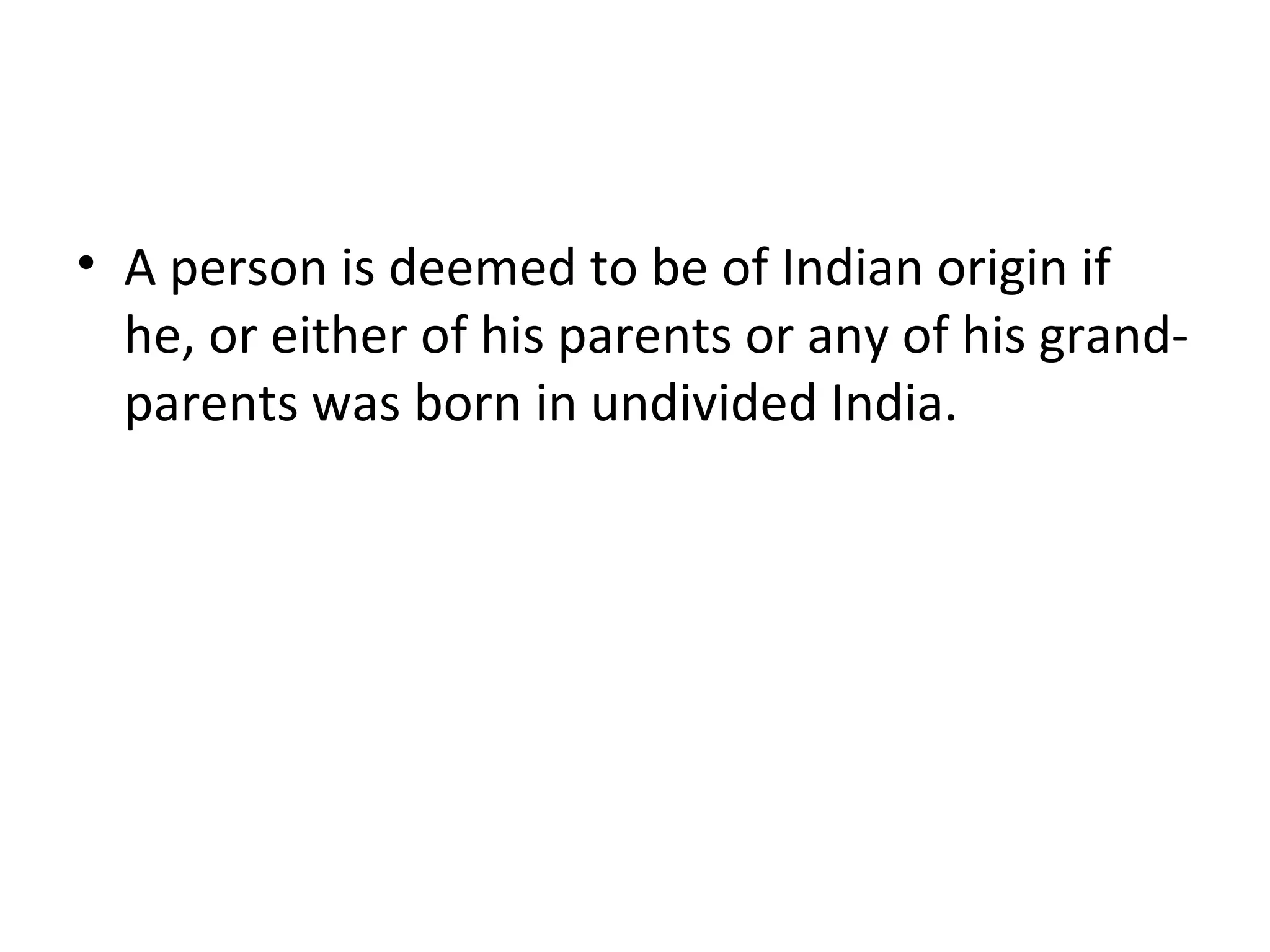
• A person is deemed to be of Indian origin if 
he, or either of his parents or any of his grand-parents 
was born in undivided India.
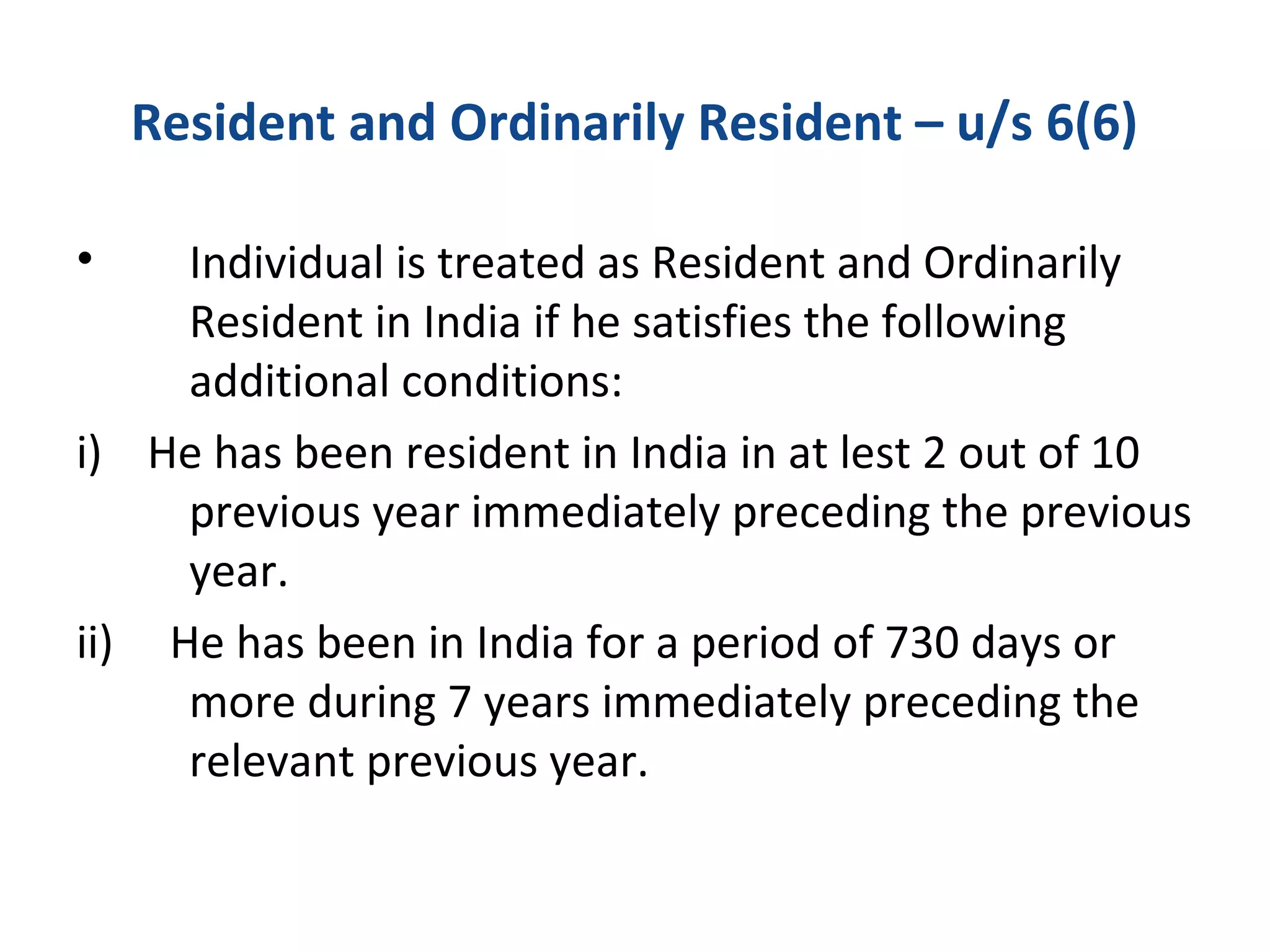
Resident and Ordinarily Resident – u/s 6(6) 
• Individual is treated as Resident and Ordinarily 
Resident in India if he satisfies the following 
additional conditions: 
i) He has been resident in India in at lest 2 out of 10 
previous year immediately preceding the previous 
year. 
ii) He has been in India for a period of 730 days or 
more during 7 years immediately preceding the 
relevant previous year.
RESIDENT BUT NOT ORDINARILY 
RESIDENT 
 As per section 6(1), an individual who satisfies at least one of the basic 
conditions[Basic condition (a)He is in India in the previous year for a period of 
182 
days or more. Basic condition (b)He is in India for a period of 60 days or more 
during the previous year and 365 days or more during 4 years immediately 
preceding the previous year] 
but does not satisfy the two additional conditions 
1.An Indian citizen who leaves India during the previous year for the purpose of 
taking employment outside India or an Indian citizen leaving India during the 
previous year as a member of the crew of an Indian ship. 
2. An Indian citizen or a person of Indian origin who comes on visit to India 
during the previous year (a person is said to be of Indian origin if either their 
any of his parents or any of his grand parents was born in undivided India)], is 
treated as a resident but not ordinarily resident in India.
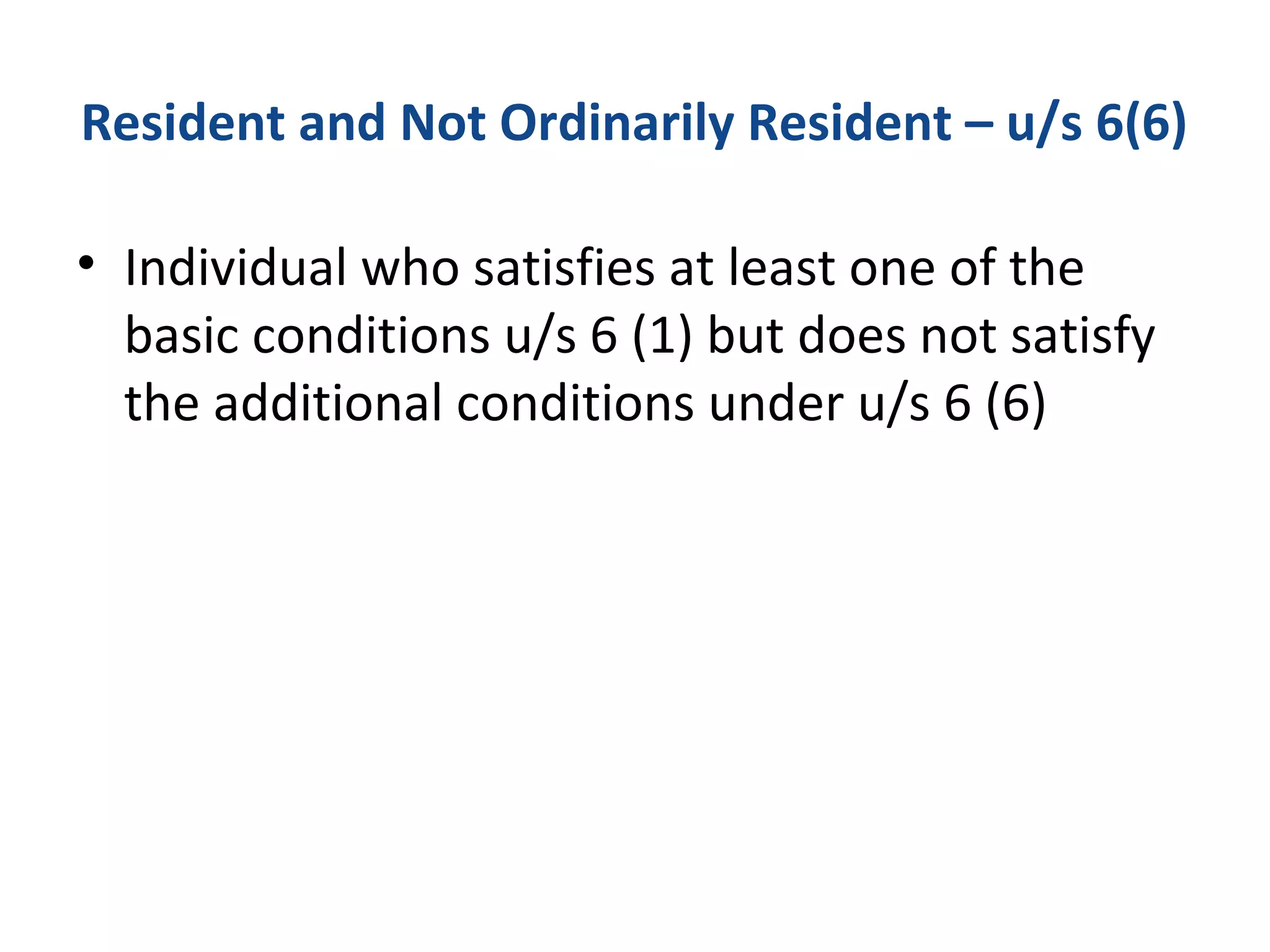
Resident and Not Ordinarily Resident – u/s 6(6) 
• Individual who satisfies at least one of the 
basic conditions u/s 6 (1) but does not satisfy 
the additional conditions under u/s 6 (6)
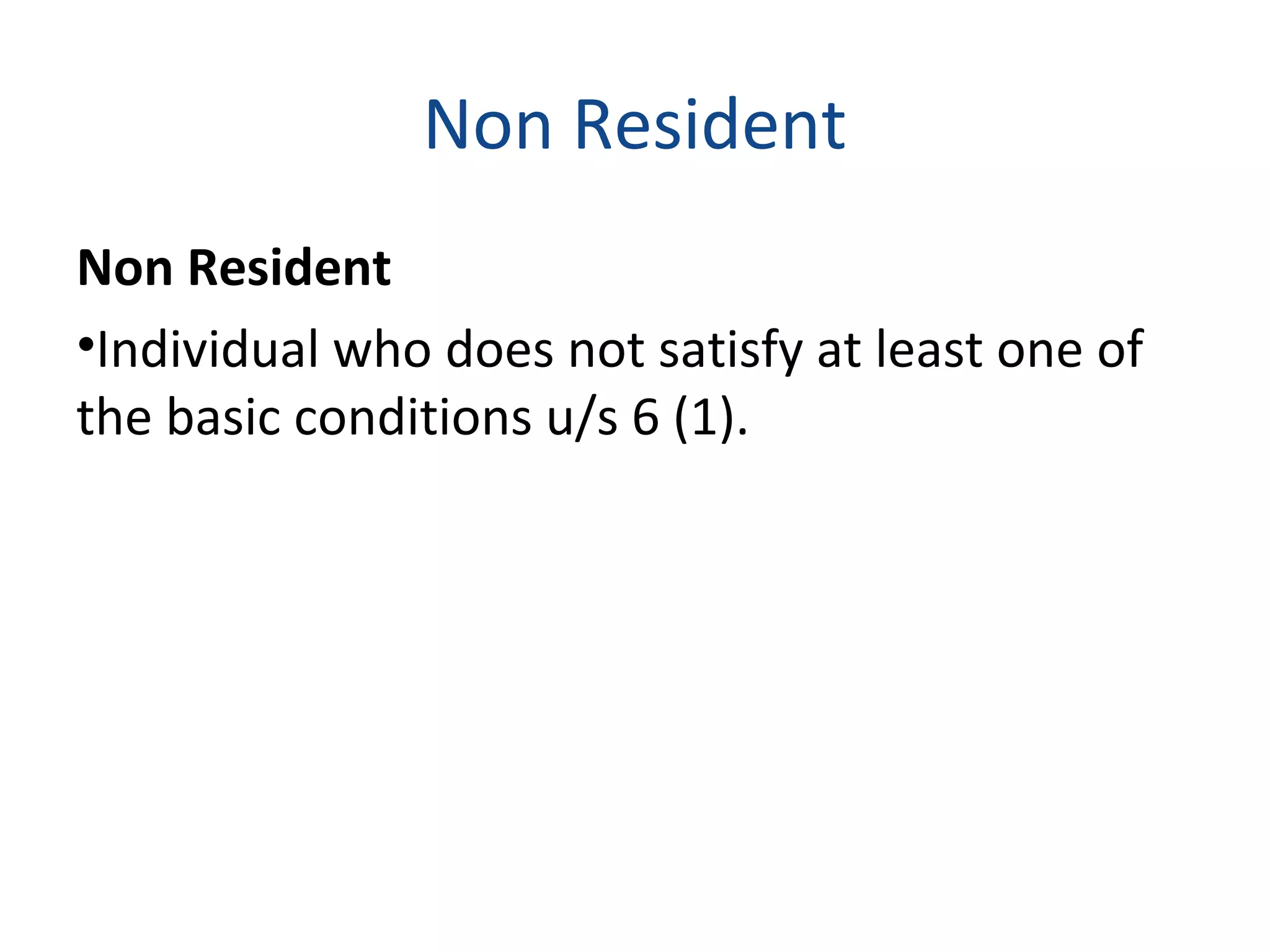
Non Resident 
Non Resident 
•Individual who does not satisfy at least one of 
the basic conditions u/s 6 (1).
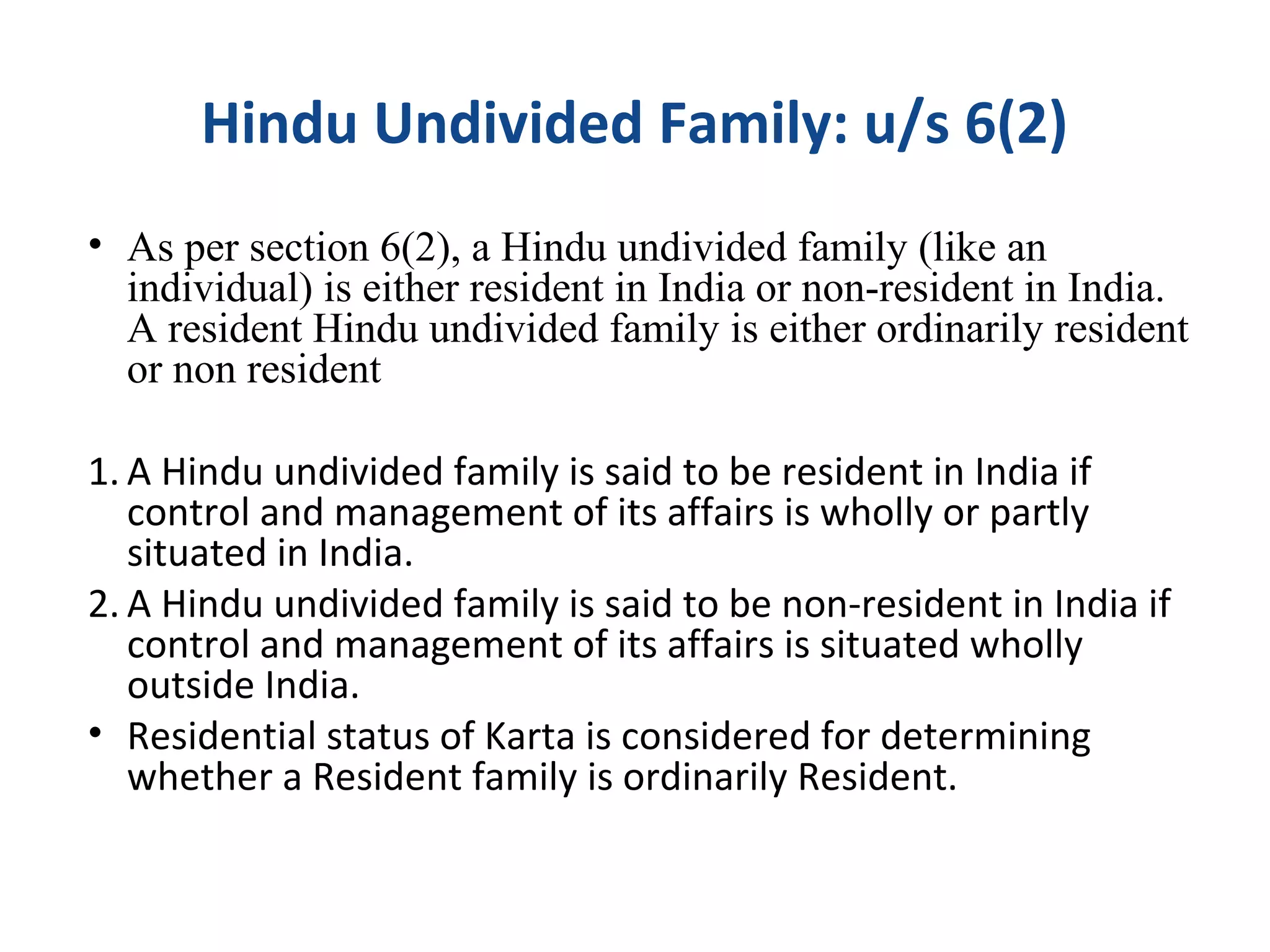
Hindu Undivided Family: u/s 6(2) 
• As per section 6(2), a Hindu undivided family (like an 
individual) is either resident in India or non-resident in India. 
A resident Hindu undivided family is either ordinarily resident 
or non resident 
1. A Hindu undivided family is said to be resident in India if 
control and management of its affairs is wholly or partly 
situated in India. 
2. A Hindu undivided family is said to be non-resident in India if 
control and management of its affairs is situated wholly 
outside India. 
• Residential status of Karta is considered for determining 
whether a Resident family is ordinarily Resident.
Hindu Undivided Family: u/s 6(2) 
• HUF- When ordinarily resident in India 
A resident Hindu undivided family is an ordinarily resident in 
India if the karta or manager of the family (including successive 
kartas) satisfies the following two additional conditions as laid 
down by section 6(6)(b): 
• Additional condition (i)Karta has been resident in India in at least 
2 out of 10previous years immediately preceding the relevant 
previous year. 
Additional condition (ii)Karta has been present in India for a period 
of 730 days or more during 7 years immediately preceding the 
previous year. 
If the Karta or manager of a resident Hindu undivided family does 
not satisfy the two additional conditions, the family is treated as 
resident but not ordinarily resident in India
Firm and Association of Person.: u/s 6(2) 
• A partnership firm and a association of persons are 
said to be resident in India if control and 
management of their affairs are wholly or partly 
situated within India during the relevant previous 
year. 
• They are, however, treated as Non Resident in India 
if control and management of their affairs are 
situated wholly outside India.
Company u/s 6 (3) 
• Indian company is always resident in India. 
• Foreign company is resident in India only if, during 
the previous year, control and management of its 
affairs is situated wholly in India. 
• Foreign company is Non resident in India only if, 
during the previous year, control and management 
of its affairs wholly or partly situated out of India.
Residential Status of Every Other Person 
• Every Other person is said to be resident in 
India if control and management of his affairs 
are wholly or partly situated within India 
during the relevant previous year. 
• However they are treated as Non Resident in 
India if control and management of their 
affairs are situated wholly outside India.
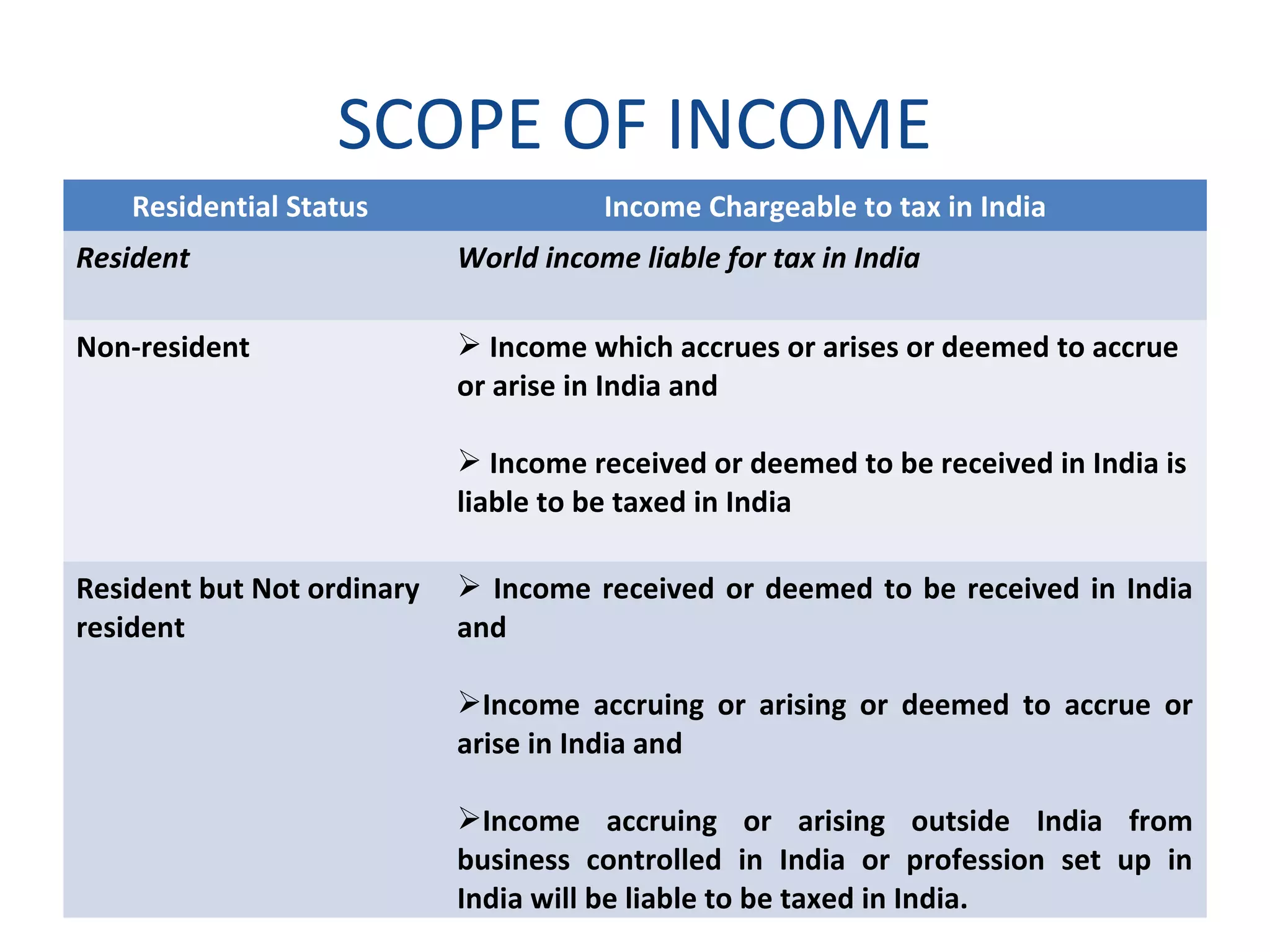
SCOPE OF INCOME 
Residential Status Income Chargeable to tax in India 
Resident World income liable for tax in India 
Non-resident  Income which accrues or arises or deemed to accrue 
or arise in India and 
 Income received or deemed to be received in India is 
liable to be taxed in India 
Resident but Not ordinary 
resident 
 Income received or deemed to be received in India 
and 
Income accruing or arising or deemed to accrue or 
arise in India and 
Income accruing or arising outside India from 
business controlled in India or profession set up in 
India will be liable to be taxed in India.
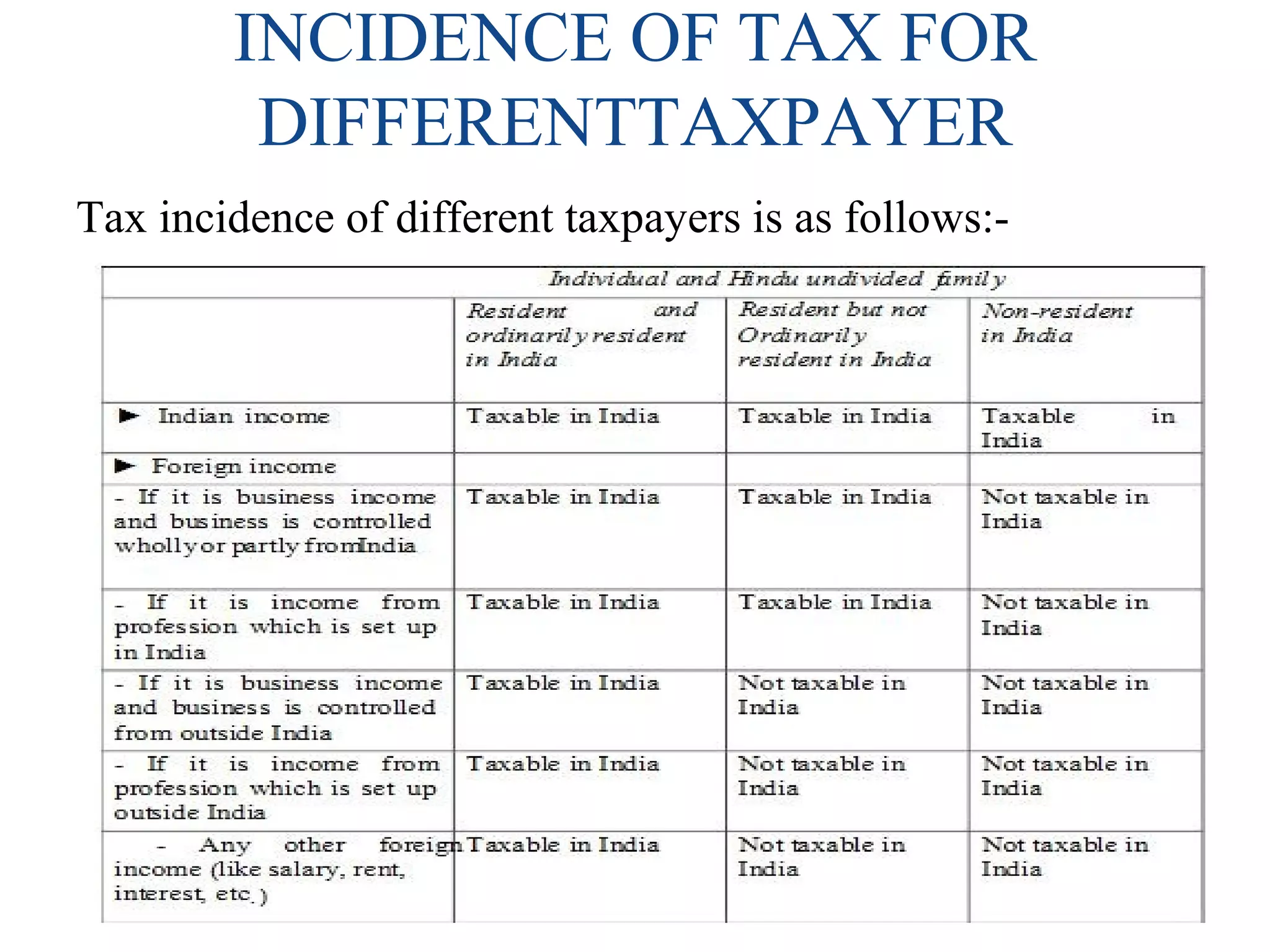
INCIDENCE OF TAX FOR 
DIFFERENTTAXPAYER 
Tax incidence of different taxpayers is as follows:-
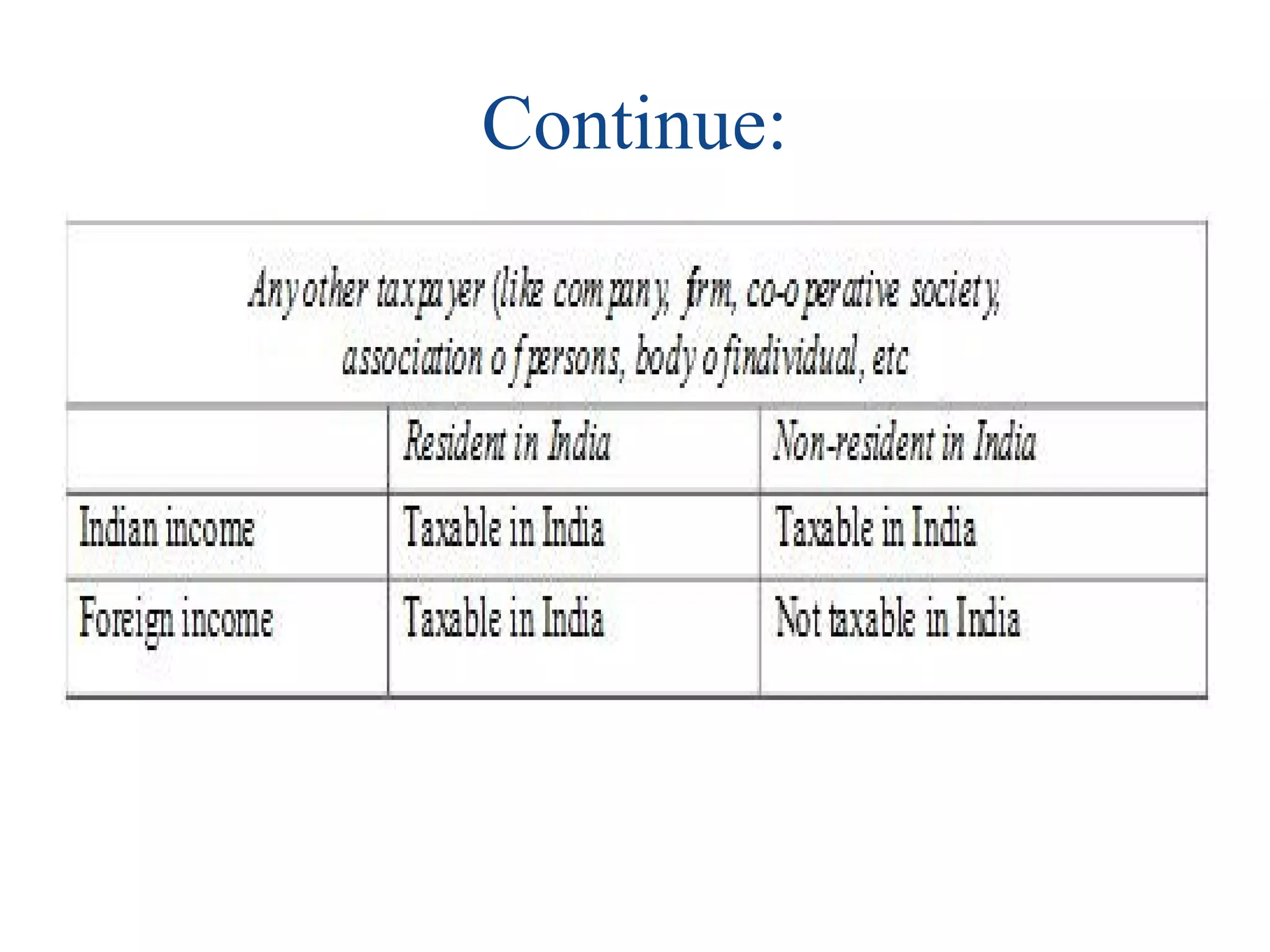
Continue:
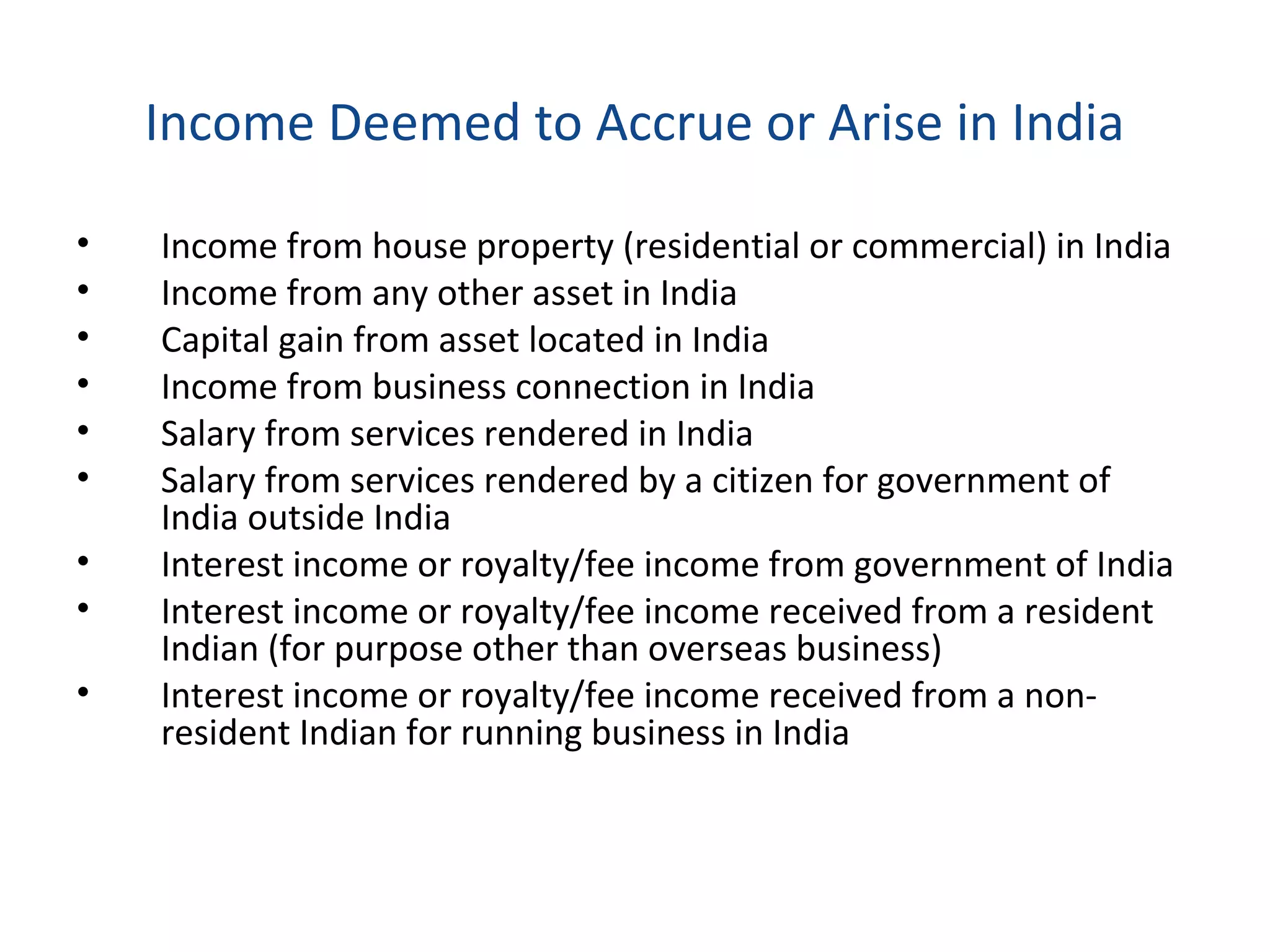
Income Deemed to Accrue or Arise in India 
• Income from house property (residential or commercial) in India 
• Income from any other asset in India 
• Capital gain from asset located in India 
• Income from business connection in India 
• Salary from services rendered in India 
• Salary from services rendered by a citizen for government of 
India outside India 
• Interest income or royalty/fee income from government of India 
• Interest income or royalty/fee income received from a resident 
Indian (for purpose other than overseas business) 
• Interest income or royalty/fee income received from a non-resident 
Indian for running business in India
Thank You

Lecture 2 resident status

  • 1.
  • 2.
    Why Study ResidentialStatus • Tax incidence on an assesse depends on his residential status. • E.g. An income, accrued to an individual outside India, is taxable in India, depends upon the residential status of the individual in India • Income earned by a foreign national in India or outside India is taxable in India depends on the residential status of the individual in India, rather than the citizenship.
  • 3.
    Different taxable entities All taxable entities are divided in the following categories for the purpose of determining residential status: a. An individual; b. A Hindu undivided family; c. A firm or an association of persons; d. A joint stock company; and e. Any other person.
  • 4.
    Categorization of theentities • Individual / HUF - Resident = Ordinary/ Non Ordinary - Non Resident • Others included in definition of “Person”  Resident = Ordinary/ Non Ordinary  Non Resident
  • 5.
    RESIDENTIAL STATUS OFAN INDIVIDUAL • As per section 6, an individual may be (a)resident and ordinarily resident in India, (b)resident but not ordinarily resident in India, (c)non-resident in India. • RESIDENT AND ORDINARILY RESIDENT As per section 6(1), in order to find out whether an individual is “resident and ordinarily resident” in India, one has to proceed as follows: • Step 1 First find out whether such individual is “resident” in India. • Step 2 If such individual is “resident” in India, then find out whether he is “ordinarily resident” in India. However, if such individual is a “non-resident” in India, then no further investigation is necessary
  • 6.
    WHO IS A‘RESIDENT’ FOR TAX PURPOSES • INDIVIDUAL • Basic Conditions Sec 6 (1 ) –An individual is considered as a ‘resident’ if he is • in India for 182 days or more in a previous year OR • in India for 365 days or more in 4 years immediately preceding a previous year and 60 days or more in a previous year .
  • 7.
    Exception to conditions(2) • Period 60 Days is extended to 182 days in the following cases. i) An Indian citizen who leaves India during the previous year for the purpose of employment outside India ii) Indian citizen who leaves India during the previous year as a member of crew of Indian ship. iii) Indian citizen or person of Indian origin who comes on a visit to India during the previous year.
  • 8.
    • A personis deemed to be of Indian origin if he, or either of his parents or any of his grand-parents was born in undivided India.
  • 9.
    Resident and OrdinarilyResident – u/s 6(6) • Individual is treated as Resident and Ordinarily Resident in India if he satisfies the following additional conditions: i) He has been resident in India in at lest 2 out of 10 previous year immediately preceding the previous year. ii) He has been in India for a period of 730 days or more during 7 years immediately preceding the relevant previous year.
  • 10.
    RESIDENT BUT NOTORDINARILY RESIDENT  As per section 6(1), an individual who satisfies at least one of the basic conditions[Basic condition (a)He is in India in the previous year for a period of 182 days or more. Basic condition (b)He is in India for a period of 60 days or more during the previous year and 365 days or more during 4 years immediately preceding the previous year] but does not satisfy the two additional conditions 1.An Indian citizen who leaves India during the previous year for the purpose of taking employment outside India or an Indian citizen leaving India during the previous year as a member of the crew of an Indian ship. 2. An Indian citizen or a person of Indian origin who comes on visit to India during the previous year (a person is said to be of Indian origin if either their any of his parents or any of his grand parents was born in undivided India)], is treated as a resident but not ordinarily resident in India.
  • 11.
    Resident and NotOrdinarily Resident – u/s 6(6) • Individual who satisfies at least one of the basic conditions u/s 6 (1) but does not satisfy the additional conditions under u/s 6 (6)
  • 12.
    Non Resident NonResident •Individual who does not satisfy at least one of the basic conditions u/s 6 (1).
  • 13.
    Hindu Undivided Family:u/s 6(2) • As per section 6(2), a Hindu undivided family (like an individual) is either resident in India or non-resident in India. A resident Hindu undivided family is either ordinarily resident or non resident 1. A Hindu undivided family is said to be resident in India if control and management of its affairs is wholly or partly situated in India. 2. A Hindu undivided family is said to be non-resident in India if control and management of its affairs is situated wholly outside India. • Residential status of Karta is considered for determining whether a Resident family is ordinarily Resident.
  • 14.
    Hindu Undivided Family:u/s 6(2) • HUF- When ordinarily resident in India A resident Hindu undivided family is an ordinarily resident in India if the karta or manager of the family (including successive kartas) satisfies the following two additional conditions as laid down by section 6(6)(b): • Additional condition (i)Karta has been resident in India in at least 2 out of 10previous years immediately preceding the relevant previous year. Additional condition (ii)Karta has been present in India for a period of 730 days or more during 7 years immediately preceding the previous year. If the Karta or manager of a resident Hindu undivided family does not satisfy the two additional conditions, the family is treated as resident but not ordinarily resident in India
  • 15.
    Firm and Associationof Person.: u/s 6(2) • A partnership firm and a association of persons are said to be resident in India if control and management of their affairs are wholly or partly situated within India during the relevant previous year. • They are, however, treated as Non Resident in India if control and management of their affairs are situated wholly outside India.
  • 16.
    Company u/s 6(3) • Indian company is always resident in India. • Foreign company is resident in India only if, during the previous year, control and management of its affairs is situated wholly in India. • Foreign company is Non resident in India only if, during the previous year, control and management of its affairs wholly or partly situated out of India.
  • 17.
    Residential Status ofEvery Other Person • Every Other person is said to be resident in India if control and management of his affairs are wholly or partly situated within India during the relevant previous year. • However they are treated as Non Resident in India if control and management of their affairs are situated wholly outside India.
  • 18.
    SCOPE OF INCOME Residential Status Income Chargeable to tax in India Resident World income liable for tax in India Non-resident  Income which accrues or arises or deemed to accrue or arise in India and  Income received or deemed to be received in India is liable to be taxed in India Resident but Not ordinary resident  Income received or deemed to be received in India and Income accruing or arising or deemed to accrue or arise in India and Income accruing or arising outside India from business controlled in India or profession set up in India will be liable to be taxed in India.
  • 19.
    INCIDENCE OF TAXFOR DIFFERENTTAXPAYER Tax incidence of different taxpayers is as follows:-
  • 20.
  • 21.
    Income Deemed toAccrue or Arise in India • Income from house property (residential or commercial) in India • Income from any other asset in India • Capital gain from asset located in India • Income from business connection in India • Salary from services rendered in India • Salary from services rendered by a citizen for government of India outside India • Interest income or royalty/fee income from government of India • Interest income or royalty/fee income received from a resident Indian (for purpose other than overseas business) • Interest income or royalty/fee income received from a non-resident Indian for running business in India
  • 22.