RESIDENTIAL STATUS AND ITS TAX EFFECT 
Tax incidence on an assessee depends on his residential status. For 
instance, whether an income, accrued to an individual outside India, is 
taxable in India depends upon the residential status of the individual in 
India. Similarly, whether an income earned by a foreign national in India 
(or outside India) is taxable in India depends on the residential status of 
the individual, rather than on his citizenship. Therefore, the determination 
of the residential status of a person is very significant in order to find out 
his tax liability. 
Different Taxable Entity: 
1. Individual 
2. Hindu Undivided Family 
3. A firm or an association of persons 
4. a joint stock company 
5. every other person 
Residential status: 
1. Resident and ordinary resident in India 
2. Resident but not ordinary resident in India 
3. Non-resident in India. 
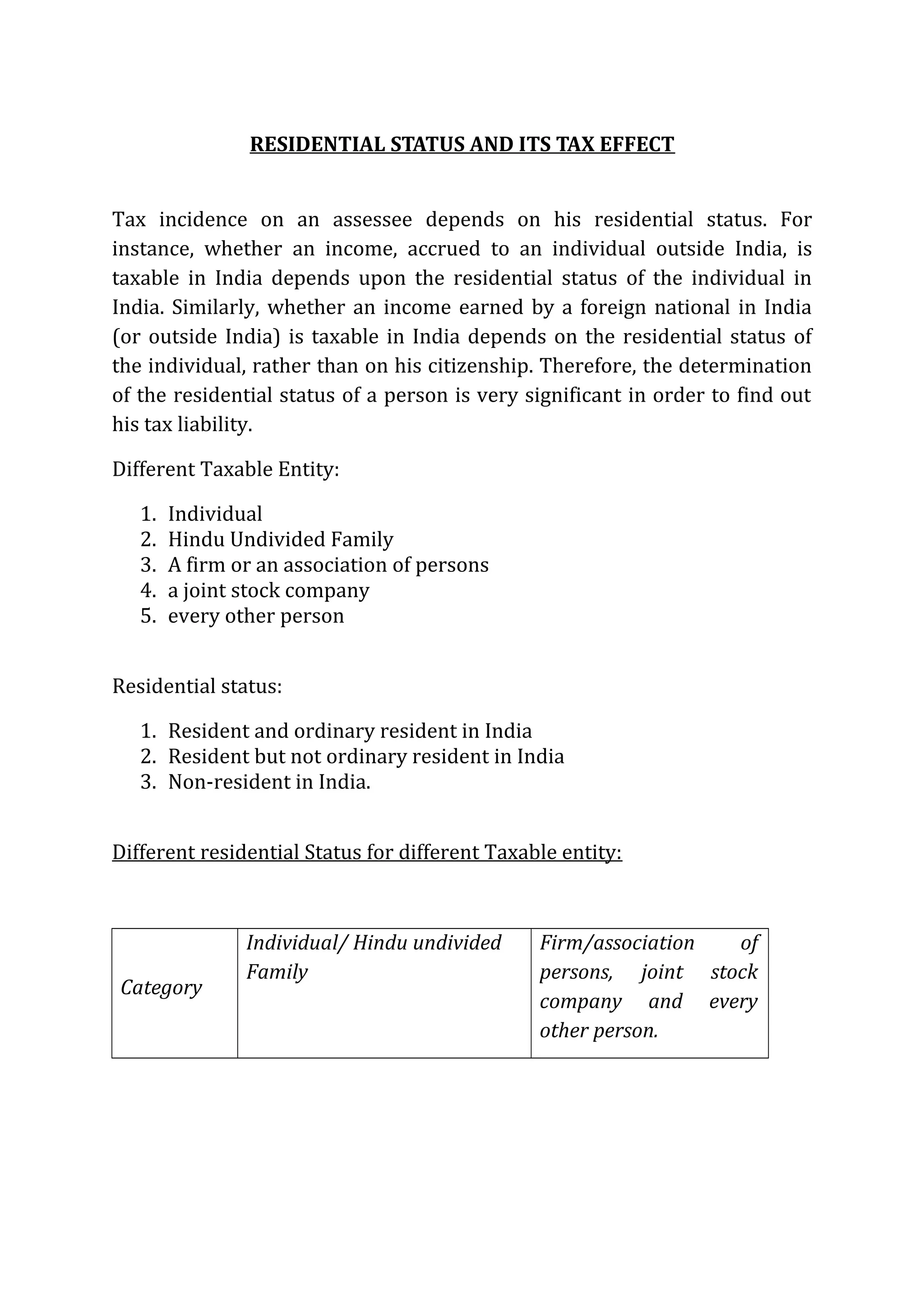
Different residential Status for different Taxable entity: 
Category 
Individual/ Hindu undivided 
Family 
Firm/association of 
persons, joint stock 
company and every 
other person.
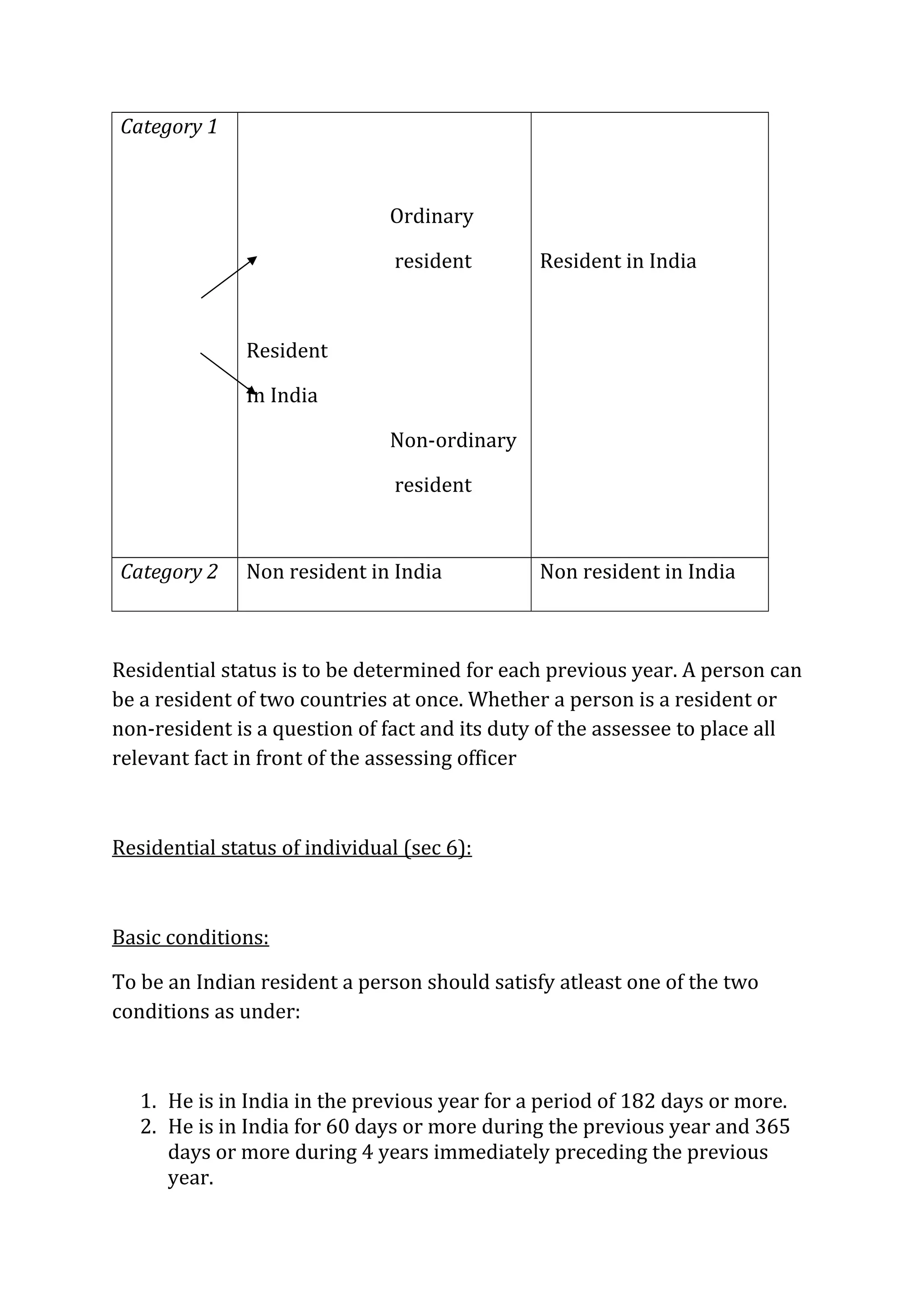
Category 1 
Ordinary 
resident 
Resident 
In India 
Non-ordinary 
resident 
Resident in India 
Category 2 Non resident in India Non resident in India 
Residential status is to be determined for each previous year. A person can 
be a resident of two countries at once. Whether a person is a resident or 
non-resident is a question of fact and its duty of the assessee to place all 
relevant fact in front of the assessing officer 
Residential status of individual (sec 6): 
Basic conditions: 
To be an Indian resident a person should satisfy atleast one of the two 
conditions as under: 
1. He is in India in the previous year for a period of 182 days or more. 
2. He is in India for 60 days or more during the previous year and 365 
days or more during 4 years immediately preceding the previous 
year.
Exceptions: 
In the following two cases a person will be a resident if he satisfies only the 
first condition, the second condition is not applicable. 
1. In case of an Indian citizen who leaves India for the purpose of 
employment or as a member of the crew of an Indian ship. 
2. In the case of an Indian citizen or a person of Indian origin who 
comes on a visit to India in the previous year. 
Additional Conditions: 
For a resident to be classified as an ordinary resident the following two 
additional conditions should be fulfilled. In case any one of them is not 
fulfilled then the person will be under the category of resident but not an 
ordinary resident. 
1. He should be resident in India for at least 2 years out of the preceding 
10 years. 
2. He should be in India for at least 730 days out of the immediately 
preceding 7 years. 
RESIDENT BUT NOT ORDINARILY RESIDENT 
• As per section 6(1), an individual who satisfies at least one of the 
basic conditions[Basic condition (a)He is in India in the previous year 
for a period of 182days or more. Basic condition (b)He is in India for 
a period of 60 days or more during the previous year and 365 days or 
more during 4 years immediately preceding the previous year] but 
does not satisfy the two additional conditions
1.An Indian citizen who leaves India during the previous year for the 
purpose of taking employment outside India or an Indian citizen leaving 
India during the previous year as a member of the crew of an Indian ship. 
2.An Indian citizen or a person of Indian origin who comes on visit to India 
during the previous year (a person is said to be of Indian origin if either 
their any of his parents or any of his grand parents was born in 
undivided India)], is treated as a resident but not ordinarily resident in 
India. 
Resident and Not Ordinarily Resident – u/s 6(6) 
• Individual who satisfies at least one of the basic conditions u/s 6 (1) 
but does not satisfy the additional conditions under u/s 6 (6) 
Non Resident 
• Individual who does not satisfy at least one of the basic conditions 
u/s 6 (1). 
Residential Status of a Hindu undivided Family sec 6(2): 
HUF is classified as a resident and non resident according to its control and 
management status. Control and management means the de facto control 
and management and not just the right to control and manage. 
Place of control 
Residential 
status of HUF 
Ordinary 
resident or 
not 
Control and management is wholly 
in India 
Resident Next table 
Control and management is wholly 
outside India 
Non-resident -- 
Control and management is partly 
in India and partly outside India 
Resident Next table
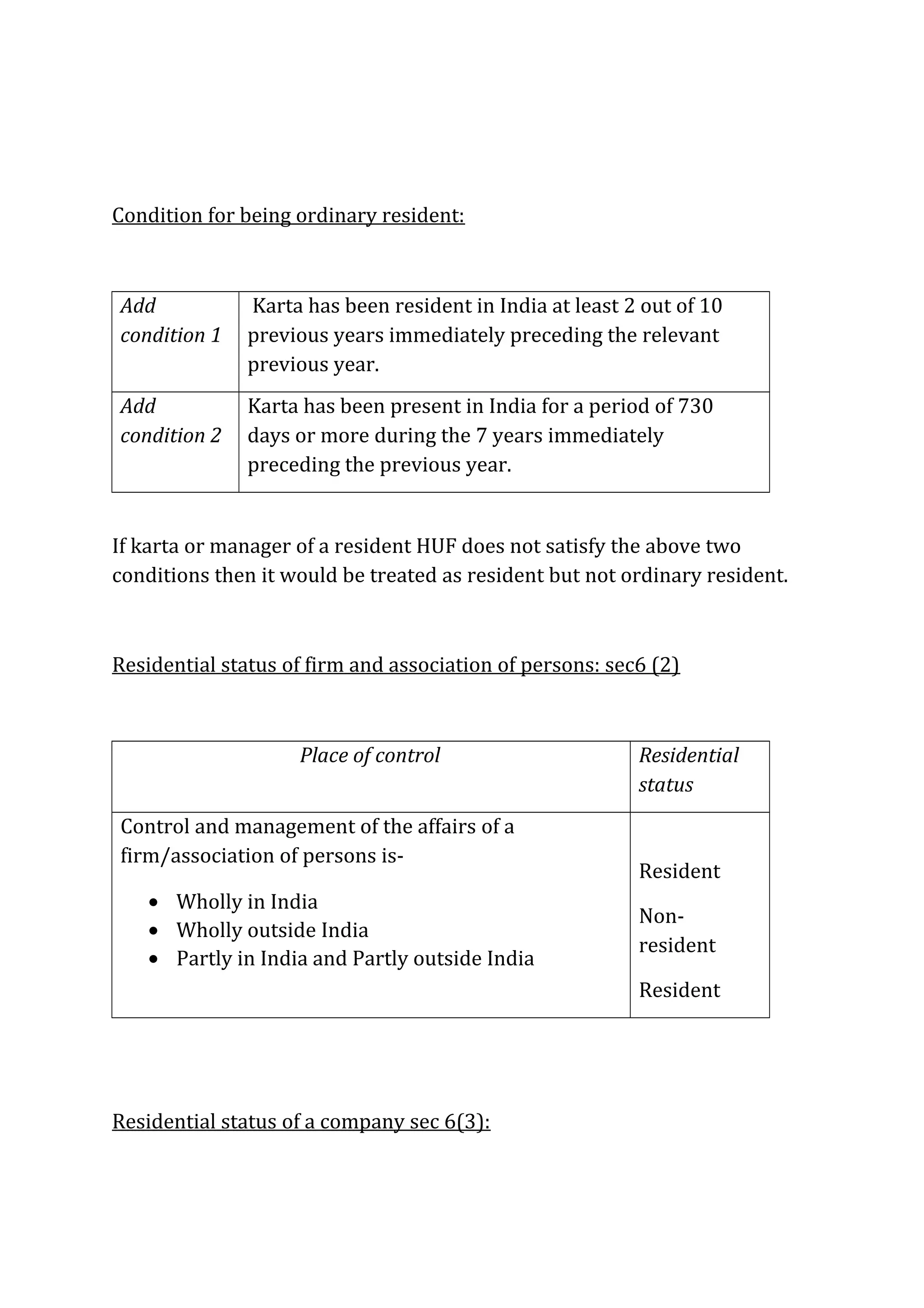
Condition for being ordinary resident: 
Add 
condition 1 
Karta has been resident in India at least 2 out of 10 
previous years immediately preceding the relevant 
previous year. 
Add 
condition 2 
Karta has been present in India for a period of 730 
days or more during the 7 years immediately 
preceding the previous year. 
If karta or manager of a resident HUF does not satisfy the above two 
conditions then it would be treated as resident but not ordinary resident. 
Residential status of firm and association of persons: sec6 (2) 
Place of control Residential 
status 
Control and management of the affairs of a 
firm/association of persons is- 
· Wholly in India 
· Wholly outside India 
· Partly in India and Partly outside India 
Resident 
Non-resident 
Resident 
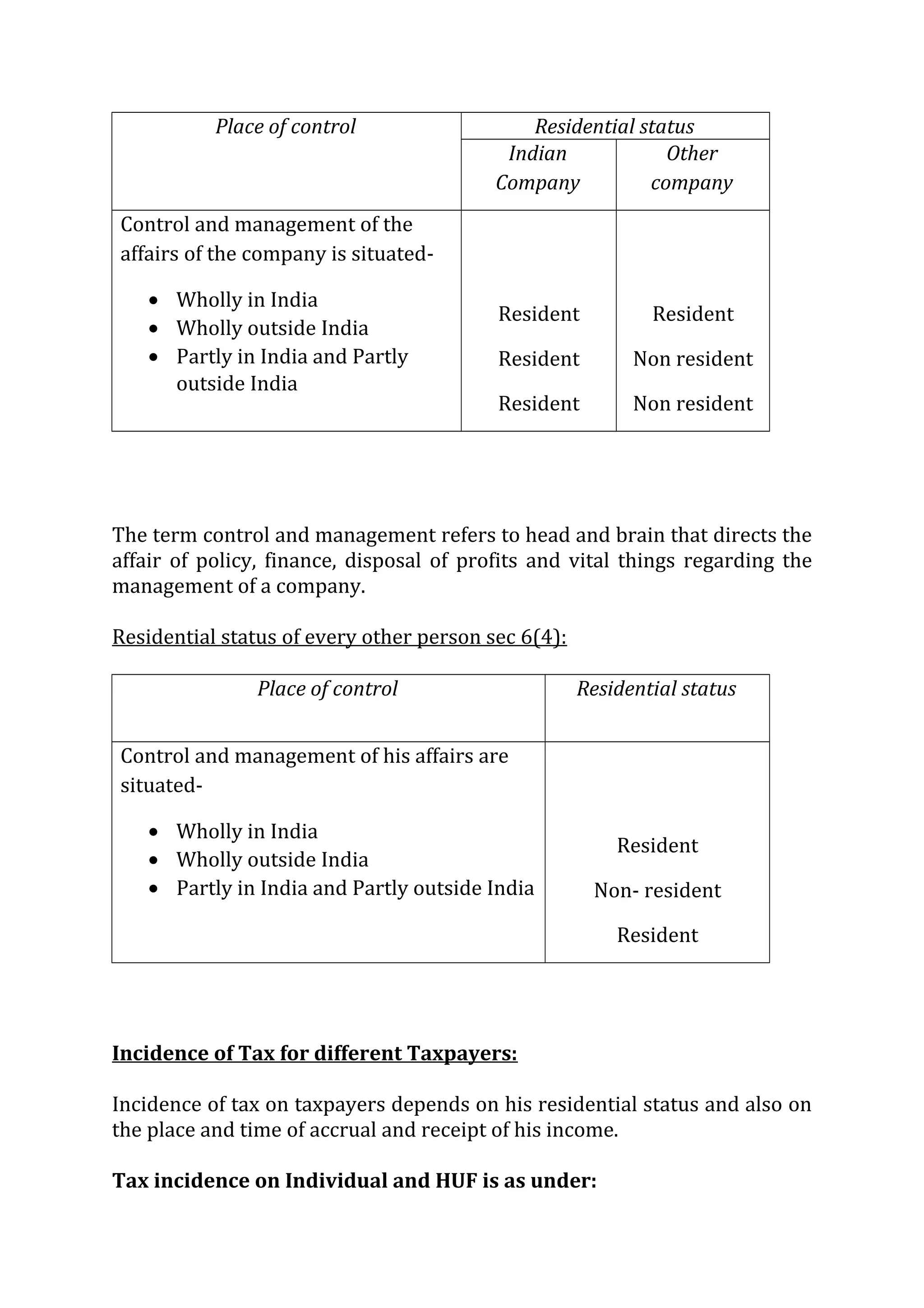
Residential status of a company sec 6(3):
Place of control Residential status 
Indian 
Company 
Other 
company 
Control and management of the 
affairs of the company is situated- 
· Wholly in India 
· Wholly outside India 
· Partly in India and Partly 
outside India 
Resident 
Resident 
Resident 
Resident 
Non resident 
Non resident 
The term control and management refers to head and brain that directs the 
affair of policy, finance, disposal of profits and vital things regarding the 
management of a company. 
Residential status of every other person sec 6(4): 
Place of control Residential status 
Control and management of his affairs are 
situated- 
· Wholly in India 
· Wholly outside India 
· Partly in India and Partly outside India 
Resident 
Non- resident 
Resident 
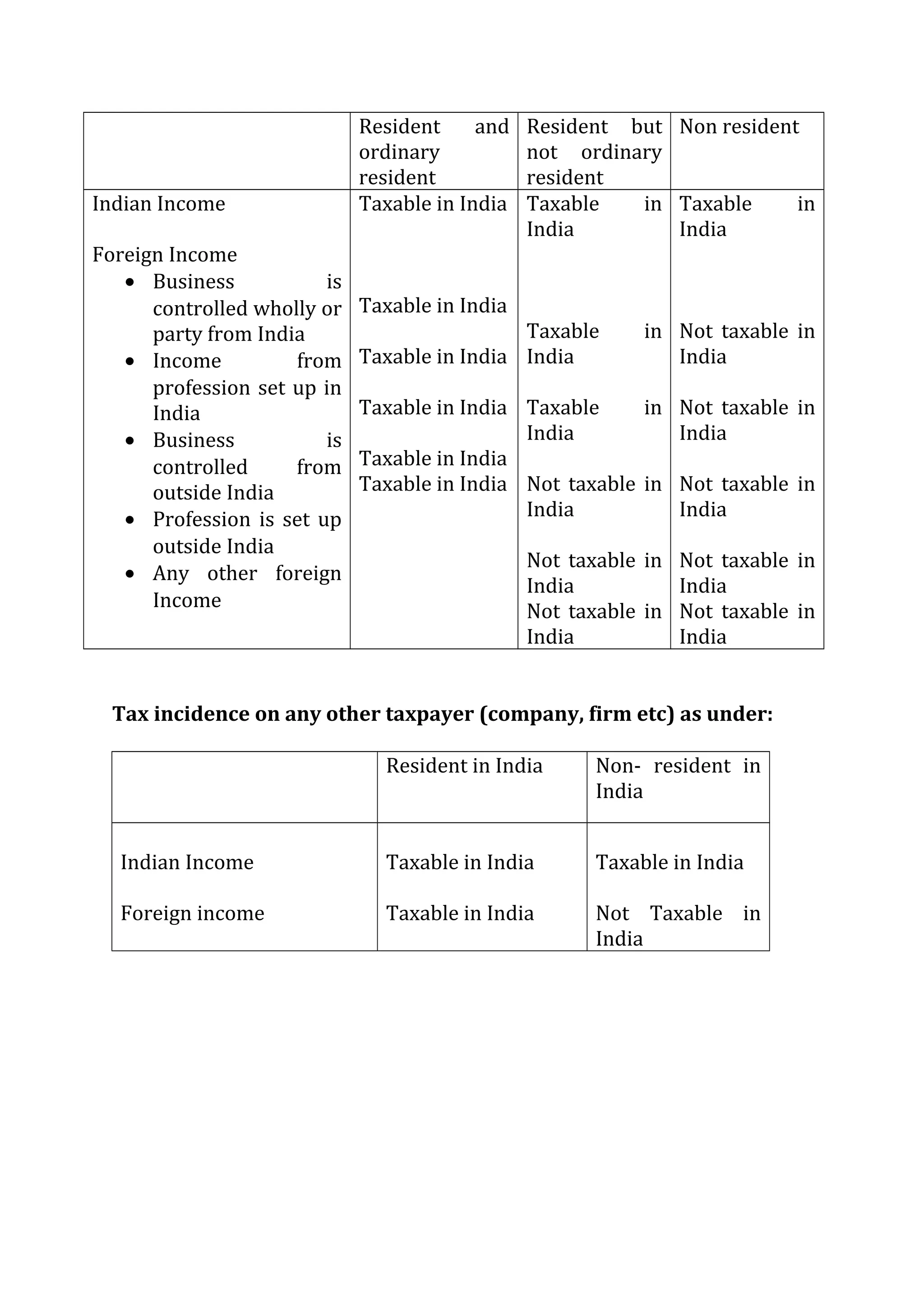
Incidence of Tax for different Taxpayers: 
Incidence of tax on taxpayers depends on his residential status and also on 
the place and time of accrual and receipt of his income. 
Tax incidence on Individual and HUF is as under:
Resident and 
ordinary 
resident 
Resident but 
not ordinary 
resident 
Non resident 
Indian Income 
Foreign Income 
· Business is 
controlled wholly or 
party from India 
· Income from 
profession set up in 
India 
· Business is 
controlled from 
outside India 
· Profession is set up 
outside India 
· Any other foreign 
Income 
Taxable in India 
Taxable in India 
Taxable in India 
Taxable in India 
Taxable in India 
Taxable in India 
Taxable in 
India 
Taxable in 
India 
Taxable in 
India 
Not taxable in 
India 
Not taxable in 
India 
Not taxable in 
India 
Taxable in 
India 
Not taxable in 
India 
Not taxable in 
India 
Not taxable in 
India 
Not taxable in 
India 
Not taxable in 
India 
Tax incidence on any other taxpayer (company, firm etc) as under: 
Resident in India Non- resident in 
India 
Indian Income 
Foreign income 
Taxable in India 
Taxable in India 
Taxable in India 
Not Taxable in 
India

Lecture 2 resident status

  • 1.
    RESIDENTIAL STATUS ANDITS TAX EFFECT Tax incidence on an assessee depends on his residential status. For instance, whether an income, accrued to an individual outside India, is taxable in India depends upon the residential status of the individual in India. Similarly, whether an income earned by a foreign national in India (or outside India) is taxable in India depends on the residential status of the individual, rather than on his citizenship. Therefore, the determination of the residential status of a person is very significant in order to find out his tax liability. Different Taxable Entity: 1. Individual 2. Hindu Undivided Family 3. A firm or an association of persons 4. a joint stock company 5. every other person Residential status: 1. Resident and ordinary resident in India 2. Resident but not ordinary resident in India 3. Non-resident in India. Different residential Status for different Taxable entity: Category Individual/ Hindu undivided Family Firm/association of persons, joint stock company and every other person.
  • 2.
    Category 1 Ordinary resident Resident In India Non-ordinary resident Resident in India Category 2 Non resident in India Non resident in India Residential status is to be determined for each previous year. A person can be a resident of two countries at once. Whether a person is a resident or non-resident is a question of fact and its duty of the assessee to place all relevant fact in front of the assessing officer Residential status of individual (sec 6): Basic conditions: To be an Indian resident a person should satisfy atleast one of the two conditions as under: 1. He is in India in the previous year for a period of 182 days or more. 2. He is in India for 60 days or more during the previous year and 365 days or more during 4 years immediately preceding the previous year.
  • 3.
    Exceptions: In thefollowing two cases a person will be a resident if he satisfies only the first condition, the second condition is not applicable. 1. In case of an Indian citizen who leaves India for the purpose of employment or as a member of the crew of an Indian ship. 2. In the case of an Indian citizen or a person of Indian origin who comes on a visit to India in the previous year. Additional Conditions: For a resident to be classified as an ordinary resident the following two additional conditions should be fulfilled. In case any one of them is not fulfilled then the person will be under the category of resident but not an ordinary resident. 1. He should be resident in India for at least 2 years out of the preceding 10 years. 2. He should be in India for at least 730 days out of the immediately preceding 7 years. RESIDENT BUT NOT ORDINARILY RESIDENT • As per section 6(1), an individual who satisfies at least one of the basic conditions[Basic condition (a)He is in India in the previous year for a period of 182days or more. Basic condition (b)He is in India for a period of 60 days or more during the previous year and 365 days or more during 4 years immediately preceding the previous year] but does not satisfy the two additional conditions
  • 4.
    1.An Indian citizenwho leaves India during the previous year for the purpose of taking employment outside India or an Indian citizen leaving India during the previous year as a member of the crew of an Indian ship. 2.An Indian citizen or a person of Indian origin who comes on visit to India during the previous year (a person is said to be of Indian origin if either their any of his parents or any of his grand parents was born in undivided India)], is treated as a resident but not ordinarily resident in India. Resident and Not Ordinarily Resident – u/s 6(6) • Individual who satisfies at least one of the basic conditions u/s 6 (1) but does not satisfy the additional conditions under u/s 6 (6) Non Resident • Individual who does not satisfy at least one of the basic conditions u/s 6 (1). Residential Status of a Hindu undivided Family sec 6(2): HUF is classified as a resident and non resident according to its control and management status. Control and management means the de facto control and management and not just the right to control and manage. Place of control Residential status of HUF Ordinary resident or not Control and management is wholly in India Resident Next table Control and management is wholly outside India Non-resident -- Control and management is partly in India and partly outside India Resident Next table
  • 5.
    Condition for beingordinary resident: Add condition 1 Karta has been resident in India at least 2 out of 10 previous years immediately preceding the relevant previous year. Add condition 2 Karta has been present in India for a period of 730 days or more during the 7 years immediately preceding the previous year. If karta or manager of a resident HUF does not satisfy the above two conditions then it would be treated as resident but not ordinary resident. Residential status of firm and association of persons: sec6 (2) Place of control Residential status Control and management of the affairs of a firm/association of persons is- · Wholly in India · Wholly outside India · Partly in India and Partly outside India Resident Non-resident Resident Residential status of a company sec 6(3):
  • 6.
    Place of controlResidential status Indian Company Other company Control and management of the affairs of the company is situated- · Wholly in India · Wholly outside India · Partly in India and Partly outside India Resident Resident Resident Resident Non resident Non resident The term control and management refers to head and brain that directs the affair of policy, finance, disposal of profits and vital things regarding the management of a company. Residential status of every other person sec 6(4): Place of control Residential status Control and management of his affairs are situated- · Wholly in India · Wholly outside India · Partly in India and Partly outside India Resident Non- resident Resident Incidence of Tax for different Taxpayers: Incidence of tax on taxpayers depends on his residential status and also on the place and time of accrual and receipt of his income. Tax incidence on Individual and HUF is as under:
  • 7.
    Resident and ordinary resident Resident but not ordinary resident Non resident Indian Income Foreign Income · Business is controlled wholly or party from India · Income from profession set up in India · Business is controlled from outside India · Profession is set up outside India · Any other foreign Income Taxable in India Taxable in India Taxable in India Taxable in India Taxable in India Taxable in India Taxable in India Taxable in India Taxable in India Not taxable in India Not taxable in India Not taxable in India Taxable in India Not taxable in India Not taxable in India Not taxable in India Not taxable in India Not taxable in India Tax incidence on any other taxpayer (company, firm etc) as under: Resident in India Non- resident in India Indian Income Foreign income Taxable in India Taxable in India Taxable in India Not Taxable in India