

CROSS-CULTURAL MANAGEMENT
      BY:- DAVID C. THOMAS


     PRESENTER: RAI (NEPAL)
      DEPARTMENT OF IDC
         28th Oct. 2010
“Culture is the widening of the mind and of the spirit”
                                                - Jawaharlal Neharu
               REVIEW OF CHAPTER 6

       THE MANAGER AS NEGOTIATOR

Communicating and Negotiating Across Cultures

What is cross-cultural communication?
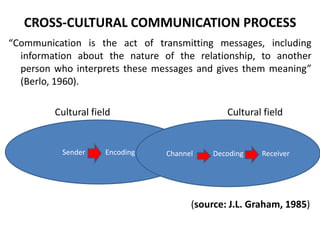
CROSS-CULTURAL COMMUNICATION PROCESS
“Communication is the act of transmitting messages, including
  information about the nature of the relationship, to another
  person who interprets these messages and gives them meaning”
  (Berlo, 1960).

         Cultural field                       Cultural field


           Sender    Encoding   Channel   Decoding    Receiver


                                      (source: J.L. Graham, 1985)
WAYS OF CROSS-CULTURAL COMMUNICATION

      Language
 Symbolic code consisting of a set of sounds with
  understood meanings and a set of rules for constructing
  messages.

        Importance of Language
-   Negotiate issues related to International business
-   Recognize and understanding of cultural diversity
-   Tools to share thoughts and ideas
-   Represents of a fundamental expression of social identity.
Communication pictures (Source: Himalayan White House College
                  www.whitehouse.edu.np)
Contd. Source: World Bank Conference, (5 September 2000)
          www.worldbank.org/conference/php5
Communication Style
     Explicit Vs Implicit Communication
- High context communication (HC) ~ Implicit
(Japan, China, Arab)

In high context cultures, the words convey only a small part of the
   message

- Low context communication (LC) ~ Explicit
(German, Swiss, Scandinavian, French, English, Italian)

In low-context cultures, the message is conveyed largely by the words
    spoken
Direct Vs Indirect Communication
   DIRECT (linear) “What you see is what you get” More verbal and
  explicit Clarity of communication.

• Directness is associated with individualist cultures, which has
  freedom from control.

• Direct communication expresses truth

    INDIRECT (circular) “What you get is what you manage to see”
  More attention to situation Not much talk, more non-verbal
• Indirectness is associated with Collectivists cultures.

• In collectivist culture , politeness and desire to avoid
  embarrassment often take precedence over truth.
Silence & Verbal Overkill

• Cultural difference exist in how silence is used in communication.


• Collectivist culture value silence as way of controlling the
  communication interaction.


e.g. Japanese negotiators
    Finland people
Use of Praise


• Stylistic element that has a systematic relationship to culture is
  the use of praise and response to the praise (Triandis, 1978).
Other Language Considerations

  Slang & Jargon - informal language consisting of words
and expressions

  Euphemisms – Less direct expression


  Idioms – unique ways of combining words to express a
particular thought.


   Proverbs & Maxims – Short sayings express that obviously
true
Language Pragmatics


  Language Accommodation – shifting one’s speech
patterns to achieve greater language similarity.


  Stylistic accommodation – Idea that adapting one’s
communication style to that of others.


 Language fluency
CONCLUSION

Effective communication is an important and obvious mean in
   multicultural environment. For the management of the
   multicultural work force, Globalization of market in
   International Business, Technological advancement and
   conflict management that occur due to the cultural
   differences, there should be effective negotiation which
   Managers can do, so as to call managers are Negotiator.
CRITICAL ISSUES

1. Recent days, To be competitive in an increasingly
   globalized market sector, Some organizations
   trying to hire employees from overseas who has
   totally different cultural backgrounds.

- What problems will emerge due to the cultural
  variation ?

Communicating and Negotiating Across Cultures

  • 1.
    CROSS-CULTURAL MANAGEMENT BY:- DAVID C. THOMAS PRESENTER: RAI (NEPAL) DEPARTMENT OF IDC 28th Oct. 2010
  • 2.
    “Culture is thewidening of the mind and of the spirit” - Jawaharlal Neharu REVIEW OF CHAPTER 6 THE MANAGER AS NEGOTIATOR Communicating and Negotiating Across Cultures What is cross-cultural communication?
  • 3.
    CROSS-CULTURAL COMMUNICATION PROCESS “Communicationis the act of transmitting messages, including information about the nature of the relationship, to another person who interprets these messages and gives them meaning” (Berlo, 1960). Cultural field Cultural field Sender Encoding Channel Decoding Receiver (source: J.L. Graham, 1985)
  • 4.
    WAYS OF CROSS-CULTURALCOMMUNICATION Language  Symbolic code consisting of a set of sounds with understood meanings and a set of rules for constructing messages. Importance of Language - Negotiate issues related to International business - Recognize and understanding of cultural diversity - Tools to share thoughts and ideas - Represents of a fundamental expression of social identity.
  • 5.
    Communication pictures (Source:Himalayan White House College www.whitehouse.edu.np)
  • 6.
    Contd. Source: WorldBank Conference, (5 September 2000) www.worldbank.org/conference/php5
  • 7.
    Communication Style Explicit Vs Implicit Communication - High context communication (HC) ~ Implicit (Japan, China, Arab) In high context cultures, the words convey only a small part of the message - Low context communication (LC) ~ Explicit (German, Swiss, Scandinavian, French, English, Italian) In low-context cultures, the message is conveyed largely by the words spoken
  • 8.
    Direct Vs IndirectCommunication DIRECT (linear) “What you see is what you get” More verbal and explicit Clarity of communication. • Directness is associated with individualist cultures, which has freedom from control. • Direct communication expresses truth INDIRECT (circular) “What you get is what you manage to see” More attention to situation Not much talk, more non-verbal • Indirectness is associated with Collectivists cultures. • In collectivist culture , politeness and desire to avoid embarrassment often take precedence over truth.
  • 9.
    Silence & VerbalOverkill • Cultural difference exist in how silence is used in communication. • Collectivist culture value silence as way of controlling the communication interaction. e.g. Japanese negotiators Finland people
  • 10.
    Use of Praise •Stylistic element that has a systematic relationship to culture is the use of praise and response to the praise (Triandis, 1978).
  • 11.
    Other Language Considerations Slang & Jargon - informal language consisting of words and expressions Euphemisms – Less direct expression Idioms – unique ways of combining words to express a particular thought. Proverbs & Maxims – Short sayings express that obviously true
  • 12.
    Language Pragmatics Language Accommodation – shifting one’s speech patterns to achieve greater language similarity. Stylistic accommodation – Idea that adapting one’s communication style to that of others. Language fluency
  • 13.
    CONCLUSION Effective communication isan important and obvious mean in multicultural environment. For the management of the multicultural work force, Globalization of market in International Business, Technological advancement and conflict management that occur due to the cultural differences, there should be effective negotiation which Managers can do, so as to call managers are Negotiator.
  • 14.
    CRITICAL ISSUES 1. Recentdays, To be competitive in an increasingly globalized market sector, Some organizations trying to hire employees from overseas who has totally different cultural backgrounds. - What problems will emerge due to the cultural variation ?