Customer Relationship Management Peer Group:
Summary Notes
Peer Group Approaches to CRM
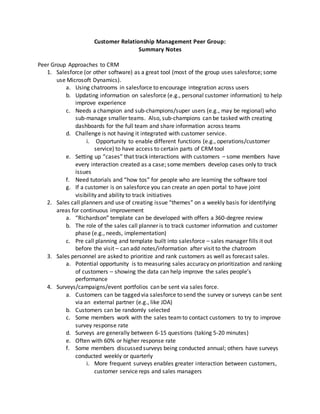
1. Salesforce (or other software) as a great tool (most of the group uses salesforce; some
use Microsoft Dynamics).
a. Using chatrooms in salesforce to encourage integration across users
b. Updating information on salesforce (e.g., personal customer information) to help
improve experience
c. Needs a champion and sub-champions/super users (e.g., may be regional) who
sub-manage smaller teams. Also, sub-champions can be tasked with creating
dashboards for the full team and share information across teams
d. Challenge is not having it integrated with customer service.
i. Opportunity to enable different functions (e.g., operations/customer
service) to have access to certain parts of CRMtool
e. Setting up “cases” that track interactions with customers – some members have
every interaction created as a case; some members develop cases only to track
issues
f. Need tutorials and “how tos” for people who are learning the software tool
g. If a customer is on salesforce you can create an open portal to have joint
visibility and ability to track initiatives
2. Sales call planners and use of creating issue “themes” on a weekly basis for identifying
areas for continuous improvement
a. “Richardson” template can be developed with offers a 360-degree review
b. The role of the sales call planner is to track customer information and customer
phase (e.g., needs, implementation)
c. Pre call planning and template built into salesforce – sales manager fills it out
before the visit – can add notes/information after visit to the chatroom
3. Sales personnel are asked to prioritize and rank customers as well as forecast sales.
a. Potential opportunity is to measuring sales accuracy on prioritization and ranking
of customers – showing the data can help improve the sales people’s
performance
4. Surveys/campaigns/event portfolios can be sent via sales force.
a. Customers can be tagged via salesforce to send the survey or surveys can be sent
via an external partner (e.g., like JDA)
b. Customers can be randomly selected
c. Some members work with the sales teamto contact customers to try to improve
survey response rate
d. Surveys are generally between 6-15 questions (taking 5-20 minutes)
e. Often with 60% or higher response rate
f. Some members discussed surveys being conducted annual; others have surveys
conducted weekly or quarterly
i. More frequent surveys enables greater interaction between customers,
customer service reps and sales managers
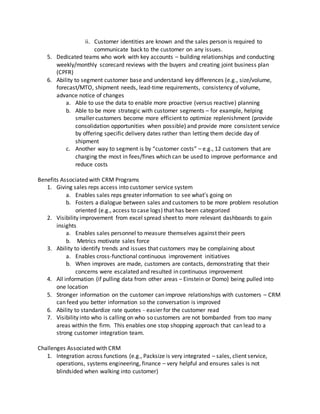
ii. Customer identities are known and the sales person is required to
communicate back to the customer on any issues.
5. Dedicated teams who work with key accounts – building relationships and conducting
weekly/monthly scorecard reviews with the buyers and creating joint business plan
(CPFR)
6. Ability to segment customer base and understand key differences (e.g., size/volume,
forecast/MTO, shipment needs, lead-time requirements, consistency of volume,
advance notice of changes
a. Able to use the data to enable more proactive (versus reactive) planning
b. Able to be more strategic with customer segments – for example, helping
smaller customers become more efficient to optimize replenishment (provide
consolidation opportunities when possible) and provide more consistent service
by offering specific delivery dates rather than letting them decide day of
shipment
c. Another way to segment is by “customer costs” – e.g., 12 customers that are
charging the most in fees/fines which can be used to improve performance and
reduce costs
Benefits Associated with CRM Programs
1. Giving sales reps access into customer service system
a. Enables sales reps greater information to see what’s going on
b. Fosters a dialogue between sales and customers to be more problem resolution
oriented (e.g., access to case logs) that has been categorized
2. Visibility improvement from excel spread sheet to more relevant dashboards to gain
insights
a. Enables sales personnel to measure themselves against their peers
b. Metrics motivate sales force
3. Ability to identify trends and issues that customers may be complaining about
a. Enables cross-functional continuous improvement initiatives
b. When improves are made, customers are contacts, demonstrating that their
concerns were escalated and resulted in continuous improvement
4. All information (if pulling data from other areas – Einstein or Domo) being pulled into
one location
5. Stronger information on the customer can improve relationships with customers – CRM
can feed you better information so the conversation is improved
6. Ability to standardize rate quotes - easier for the customer read
7. Visibility into who is calling on who so customers are not bombarded from too many
areas within the firm. This enables one stop shopping approach that can lead to a
strong customer integration team.
Challenges Associated with CRM
1. Integration across functions (e.g., Packsize is very integrated – sales, client service,
operations, systems engineering, finance – very helpful and ensures sales is not
blindsided when walking into customer)
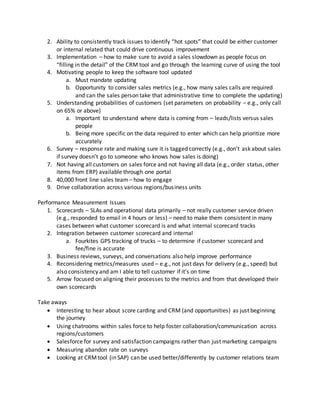
2. Ability to consistently track issues to identify “hot spots” that could be either customer
or internal related that could drive continuous improvement
3. Implementation – how to make sure to avoid a sales slowdown as people focus on
“filling in the detail” of the CRM tool and go through the learning curve of using the tool
4. Motivating people to keep the software tool updated
a. Must mandate updating
b. Opportunity to consider sales metrics (e.g., how many sales calls are required
and can the sales person take that administrative time to complete the updating)
5. Understanding probabilities of customers (set parameters on probability – e.g., only call
on 65% or above)
a. Important to understand where data is coming from – leads/lists versus sales
people
b. Being more specific on the data required to enter which can help prioritize more
accurately
6. Survey – response rate and making sure it is tagged correctly (e.g., don’t ask about sales
if survey doesn’t go to someone who knows how sales is doing)
7. Not having all customers on sales force and not having all data (e.g., order status, other
items from ERP) available through one portal
8. 40,000 front line sales team – how to engage
9. Drive collaboration across various regions/business units
Performance Measurement Issues
1. Scorecards – SLAs and operational data primarily – not really customer service driven
(e.g., responded to email in 4 hours or less) – need to make them consistent in many
cases between what customer scorecard is and what internal scorecard tracks
2. Integration between customer scorecard and internal
a. Fourkites GPS tracking of trucks – to determine if customer scorecard and
fee/fine is accurate
3. Business reviews, surveys, and conversations also help improve performance
4. Reconsidering metrics/measures used – e.g., not just days for delivery (e.g., speed) but
also consistency and am I able to tell customer if it’s on time
5. Arrow focused on aligning their processes to the metrics and from that developed their
own scorecards
Take aways
 Interesting to hear about score carding and CRM (and opportunities) as just beginning
the journey
 Using chatrooms within sales force to help foster collaboration/communication across
regions/customers
 Salesforce for survey and satisfaction campaigns rather than just marketing campaigns
 Measuring abandon rate on surveys
 Looking at CRMtool (in SAP) can be used better/differently by customer relations team
 Survey and customer satisfaction and perhaps rethinking tagging and segmentation for
who gets the survey
 At the beginning of implementation of CRM tool – who is the customer within company
is very different – how to segment and connect to prioritized customers/stakeholders
 Most people are measuring internal operations
 Opportunities for visibility improvements
 Operations getting access to salesforce and sharing information, especially survey
feedback
 Thinking about how this will contribute to transforming the company and how
information can be translated across the global (e.g., language, culture, and other
issues)
 Figuring out how to get people to use it – including chatroom and super-users
 Integrating operational data better and using in scorecarding
 How much information can be put into tool and how it can be used more strategically to
move from tactic to explicit knowledge
 Einstein
 CRM is very siloed in sales so how do we use it better across the organization
 Move from annual “big surveys” to more frequent to get results in more real time where
you can react to it.
 Per General Halstead’s “cheeseburger” story – give customers what they asked for
rather than what they wanted – how to focus more on understanding what they want
 End of the day – customer is king, so CRMcan provide an opportunity to gain insight
into demand so we can react between as well as share information internally to link the
supply chain
 Analytics offer great opportunity
Summary of Take-Aways and Future Opportunities
1. Integration across the enterprise to utilize CRM information for strategically and
effectively
2. Using customer surveys more effectively to drive continuous improvement
3. Scorecarding customers to segment customer base to understand it better and to
identify risks and mitigate fines
4. Using customer scorecards/segments to determine customer profitability
5. Customer empowerment (e.g., self service)

Crm notes

  • 1.
    Customer Relationship ManagementPeer Group: Summary Notes Peer Group Approaches to CRM 1. Salesforce (or other software) as a great tool (most of the group uses salesforce; some use Microsoft Dynamics). a. Using chatrooms in salesforce to encourage integration across users b. Updating information on salesforce (e.g., personal customer information) to help improve experience c. Needs a champion and sub-champions/super users (e.g., may be regional) who sub-manage smaller teams. Also, sub-champions can be tasked with creating dashboards for the full team and share information across teams d. Challenge is not having it integrated with customer service. i. Opportunity to enable different functions (e.g., operations/customer service) to have access to certain parts of CRMtool e. Setting up “cases” that track interactions with customers – some members have every interaction created as a case; some members develop cases only to track issues f. Need tutorials and “how tos” for people who are learning the software tool g. If a customer is on salesforce you can create an open portal to have joint visibility and ability to track initiatives 2. Sales call planners and use of creating issue “themes” on a weekly basis for identifying areas for continuous improvement a. “Richardson” template can be developed with offers a 360-degree review b. The role of the sales call planner is to track customer information and customer phase (e.g., needs, implementation) c. Pre call planning and template built into salesforce – sales manager fills it out before the visit – can add notes/information after visit to the chatroom 3. Sales personnel are asked to prioritize and rank customers as well as forecast sales. a. Potential opportunity is to measuring sales accuracy on prioritization and ranking of customers – showing the data can help improve the sales people’s performance 4. Surveys/campaigns/event portfolios can be sent via sales force. a. Customers can be tagged via salesforce to send the survey or surveys can be sent via an external partner (e.g., like JDA) b. Customers can be randomly selected c. Some members work with the sales teamto contact customers to try to improve survey response rate d. Surveys are generally between 6-15 questions (taking 5-20 minutes) e. Often with 60% or higher response rate f. Some members discussed surveys being conducted annual; others have surveys conducted weekly or quarterly i. More frequent surveys enables greater interaction between customers, customer service reps and sales managers
  • 2.
    ii. Customer identitiesare known and the sales person is required to communicate back to the customer on any issues. 5. Dedicated teams who work with key accounts – building relationships and conducting weekly/monthly scorecard reviews with the buyers and creating joint business plan (CPFR) 6. Ability to segment customer base and understand key differences (e.g., size/volume, forecast/MTO, shipment needs, lead-time requirements, consistency of volume, advance notice of changes a. Able to use the data to enable more proactive (versus reactive) planning b. Able to be more strategic with customer segments – for example, helping smaller customers become more efficient to optimize replenishment (provide consolidation opportunities when possible) and provide more consistent service by offering specific delivery dates rather than letting them decide day of shipment c. Another way to segment is by “customer costs” – e.g., 12 customers that are charging the most in fees/fines which can be used to improve performance and reduce costs Benefits Associated with CRM Programs 1. Giving sales reps access into customer service system a. Enables sales reps greater information to see what’s going on b. Fosters a dialogue between sales and customers to be more problem resolution oriented (e.g., access to case logs) that has been categorized 2. Visibility improvement from excel spread sheet to more relevant dashboards to gain insights a. Enables sales personnel to measure themselves against their peers b. Metrics motivate sales force 3. Ability to identify trends and issues that customers may be complaining about a. Enables cross-functional continuous improvement initiatives b. When improves are made, customers are contacts, demonstrating that their concerns were escalated and resulted in continuous improvement 4. All information (if pulling data from other areas – Einstein or Domo) being pulled into one location 5. Stronger information on the customer can improve relationships with customers – CRM can feed you better information so the conversation is improved 6. Ability to standardize rate quotes - easier for the customer read 7. Visibility into who is calling on who so customers are not bombarded from too many areas within the firm. This enables one stop shopping approach that can lead to a strong customer integration team. Challenges Associated with CRM 1. Integration across functions (e.g., Packsize is very integrated – sales, client service, operations, systems engineering, finance – very helpful and ensures sales is not blindsided when walking into customer)
  • 3.
    2. Ability toconsistently track issues to identify “hot spots” that could be either customer or internal related that could drive continuous improvement 3. Implementation – how to make sure to avoid a sales slowdown as people focus on “filling in the detail” of the CRM tool and go through the learning curve of using the tool 4. Motivating people to keep the software tool updated a. Must mandate updating b. Opportunity to consider sales metrics (e.g., how many sales calls are required and can the sales person take that administrative time to complete the updating) 5. Understanding probabilities of customers (set parameters on probability – e.g., only call on 65% or above) a. Important to understand where data is coming from – leads/lists versus sales people b. Being more specific on the data required to enter which can help prioritize more accurately 6. Survey – response rate and making sure it is tagged correctly (e.g., don’t ask about sales if survey doesn’t go to someone who knows how sales is doing) 7. Not having all customers on sales force and not having all data (e.g., order status, other items from ERP) available through one portal 8. 40,000 front line sales team – how to engage 9. Drive collaboration across various regions/business units Performance Measurement Issues 1. Scorecards – SLAs and operational data primarily – not really customer service driven (e.g., responded to email in 4 hours or less) – need to make them consistent in many cases between what customer scorecard is and what internal scorecard tracks 2. Integration between customer scorecard and internal a. Fourkites GPS tracking of trucks – to determine if customer scorecard and fee/fine is accurate 3. Business reviews, surveys, and conversations also help improve performance 4. Reconsidering metrics/measures used – e.g., not just days for delivery (e.g., speed) but also consistency and am I able to tell customer if it’s on time 5. Arrow focused on aligning their processes to the metrics and from that developed their own scorecards Take aways  Interesting to hear about score carding and CRM (and opportunities) as just beginning the journey  Using chatrooms within sales force to help foster collaboration/communication across regions/customers  Salesforce for survey and satisfaction campaigns rather than just marketing campaigns  Measuring abandon rate on surveys  Looking at CRMtool (in SAP) can be used better/differently by customer relations team
  • 4.
     Survey andcustomer satisfaction and perhaps rethinking tagging and segmentation for who gets the survey  At the beginning of implementation of CRM tool – who is the customer within company is very different – how to segment and connect to prioritized customers/stakeholders  Most people are measuring internal operations  Opportunities for visibility improvements  Operations getting access to salesforce and sharing information, especially survey feedback  Thinking about how this will contribute to transforming the company and how information can be translated across the global (e.g., language, culture, and other issues)  Figuring out how to get people to use it – including chatroom and super-users  Integrating operational data better and using in scorecarding  How much information can be put into tool and how it can be used more strategically to move from tactic to explicit knowledge  Einstein  CRM is very siloed in sales so how do we use it better across the organization  Move from annual “big surveys” to more frequent to get results in more real time where you can react to it.  Per General Halstead’s “cheeseburger” story – give customers what they asked for rather than what they wanted – how to focus more on understanding what they want  End of the day – customer is king, so CRMcan provide an opportunity to gain insight into demand so we can react between as well as share information internally to link the supply chain  Analytics offer great opportunity Summary of Take-Aways and Future Opportunities 1. Integration across the enterprise to utilize CRM information for strategically and effectively 2. Using customer surveys more effectively to drive continuous improvement 3. Scorecarding customers to segment customer base to understand it better and to identify risks and mitigate fines 4. Using customer scorecards/segments to determine customer profitability 5. Customer empowerment (e.g., self service)