CRRM
                                          UNIT –I


Introduction :- Till now majority of marketers focused on traditional mode of
                 marketing.

   • Due to which they acquire few customers by targeting limited segment.
   • They use tools & techniques developed for mass marketing in industrial era.
   • But in present competitive era this proving to be highly ineffective.


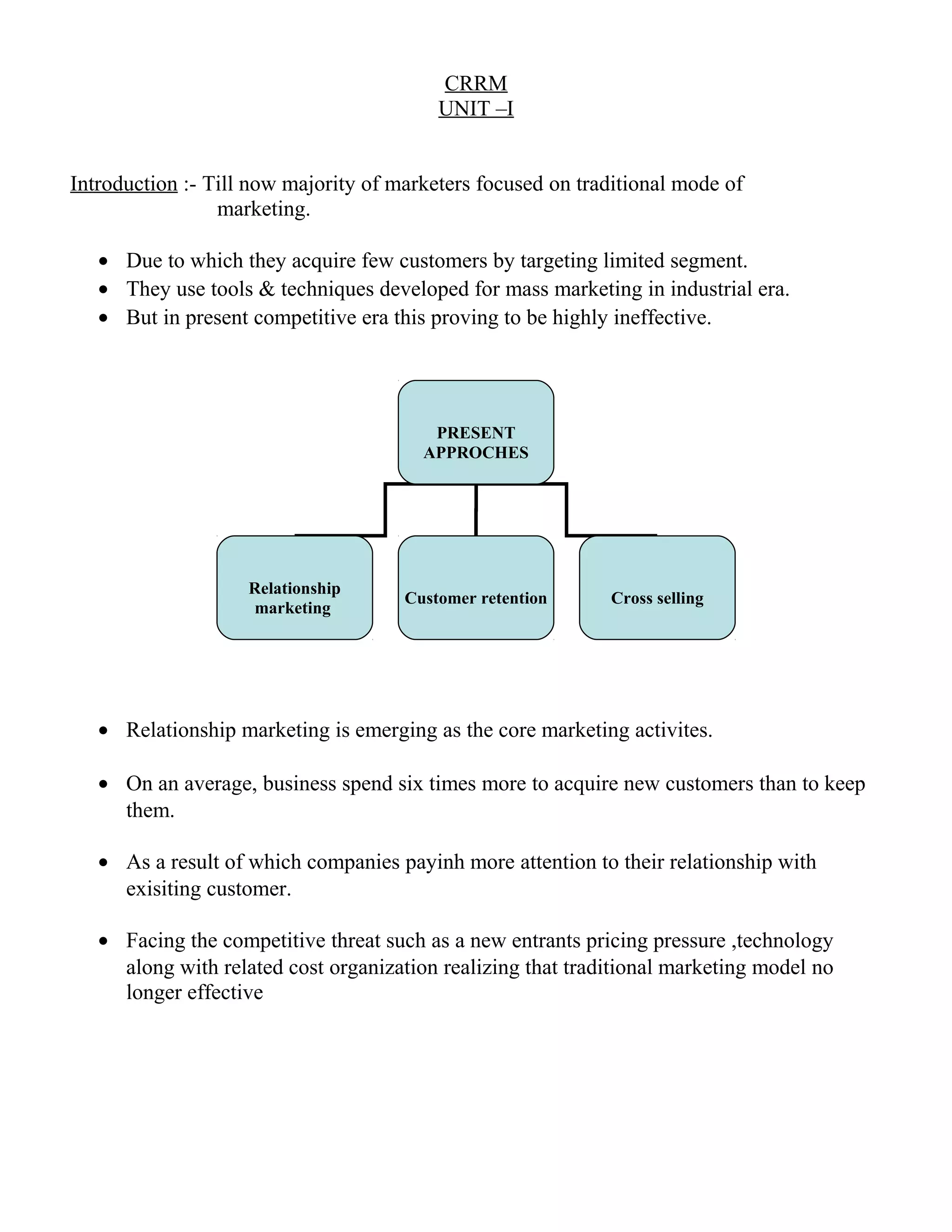
                                         PRESENT
                                        APPROCHES


                    Relationship
                                      Customer retention     Cross selling
                    marketing


   • Relationship marketing is emerging as the core marketing activites.

   • On an average, business spend six times more to acquire new customers than to keep
     them.

   • As a result of which companies payinh more attention to their relationship with
     exisiting customer.

   • Facing the competitive threat such as a new entrants pricing pressure ,technology
     along with related cost organization realizing that traditional marketing model no
     longer effective
BENEFITS OF CRM:

   • Help to retain customer.
   • RM creates intelligent opportunities for cross selling.
   • Opens up the possibility of rapid introduction of new brands & product.
   • Organization must be able to customize their product offering, optimize price,
     integrated products.
   • Service & deliver the service as promised & demanded by customer base.


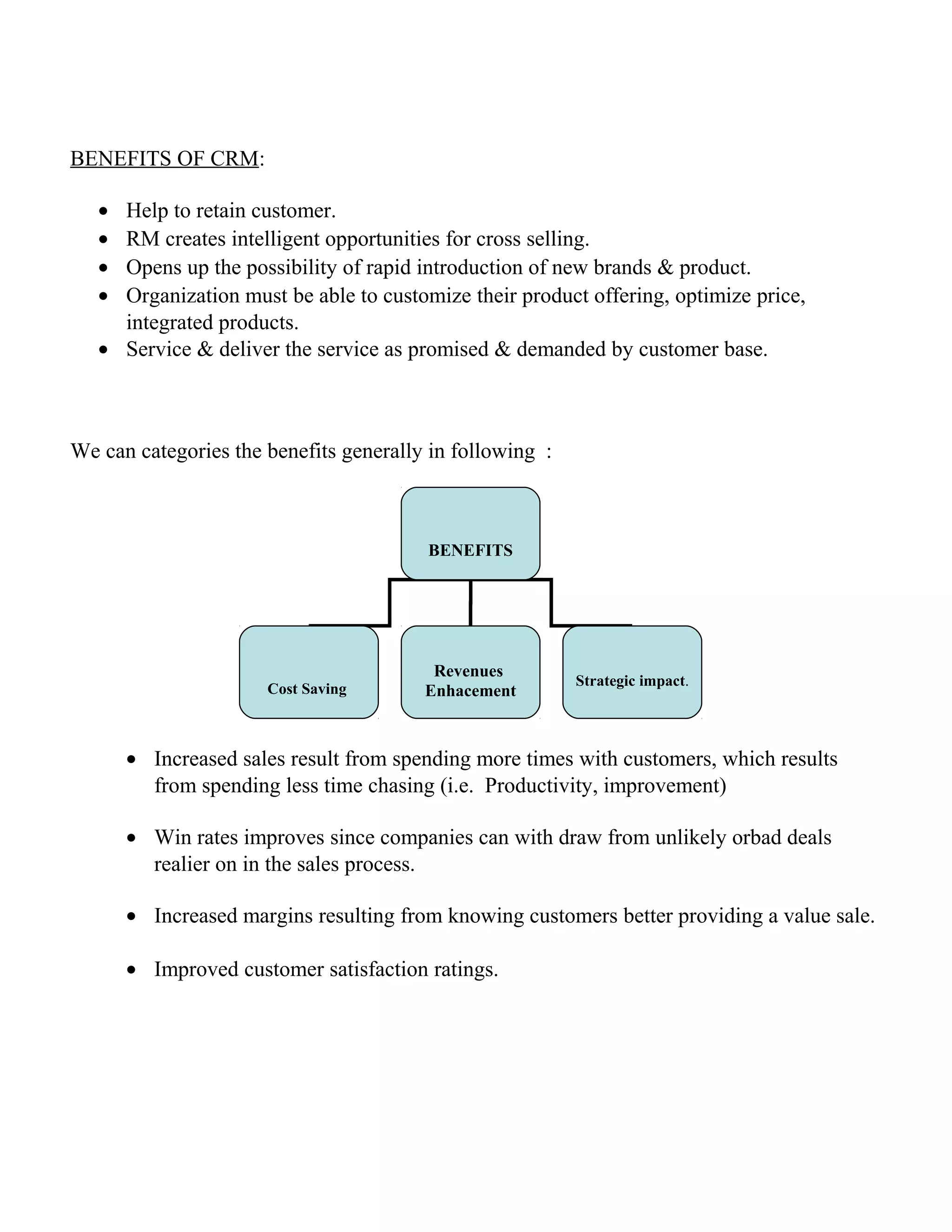
We can categories the benefits generally in following :


                                        BENEFITS


                                         Revenues
                                                          Strategic impact.
                      Cost Saving       Enhacement


       • Increased sales result from spending more times with customers, which results
         from spending less time chasing (i.e. Productivity, improvement)

       • Win rates improves since companies can with draw from unlikely orbad deals
         realier on in the sales process.

       • Increased margins resulting from knowing customers better providing a value sale.

       • Improved customer satisfaction ratings.
CRM Challenges:

     • CRM is long term approaches that have to be adopted at strategic level.
     • Communicating customers at right time.
     • Breaking competitor’s relationship with customers.


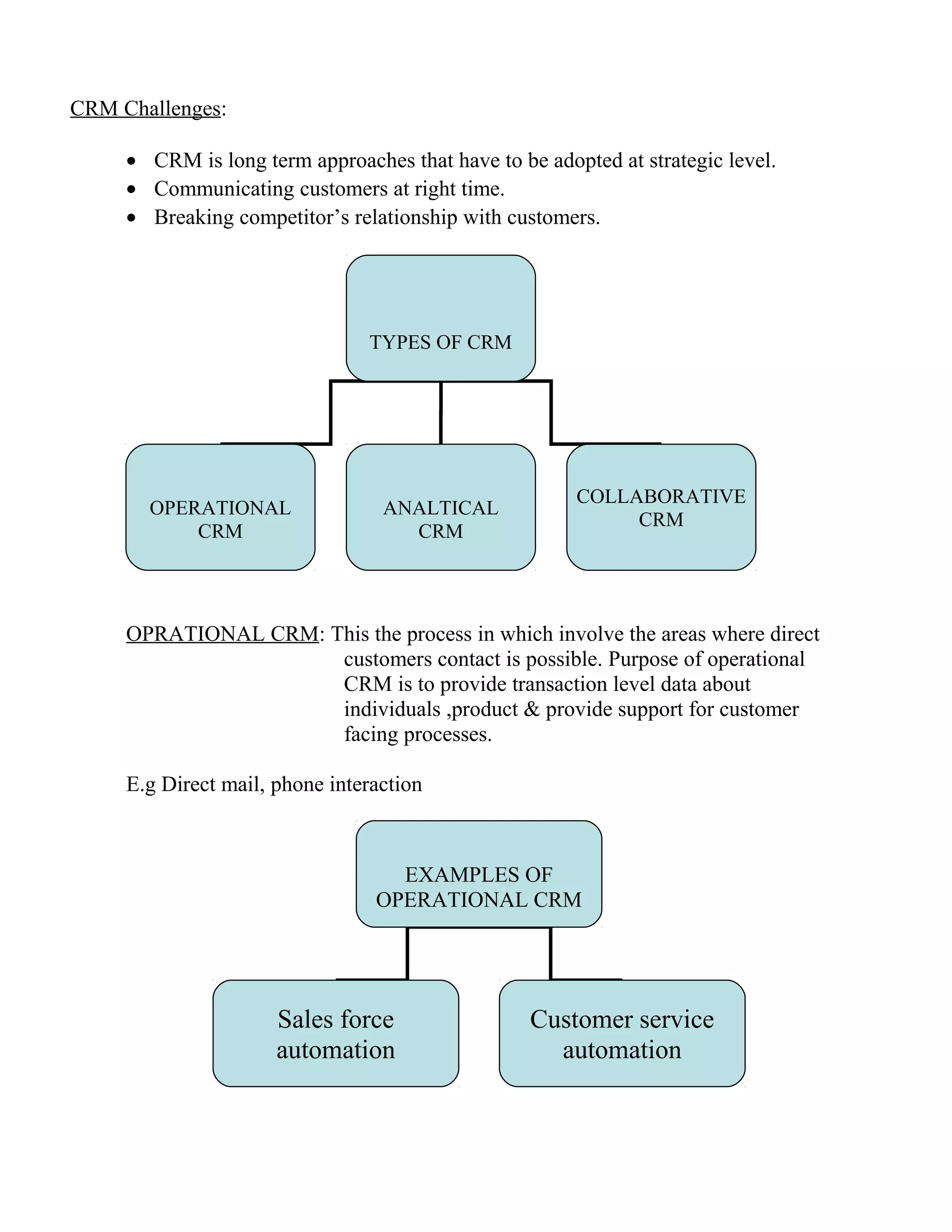
                                TYPES OF CRM


                                                       COLLABORATIVE
       OPERATIONAL                ANALTICAL
                                                            CRM
           CRM                      CRM


     OPRATIONAL CRM: This the process in which involve the areas where direct
                      customers contact is possible. Purpose of operational
                      CRM is to provide transaction level data about
                      individuals ,product & provide support for customer
                      facing processes.

     E.g Direct mail, phone interaction


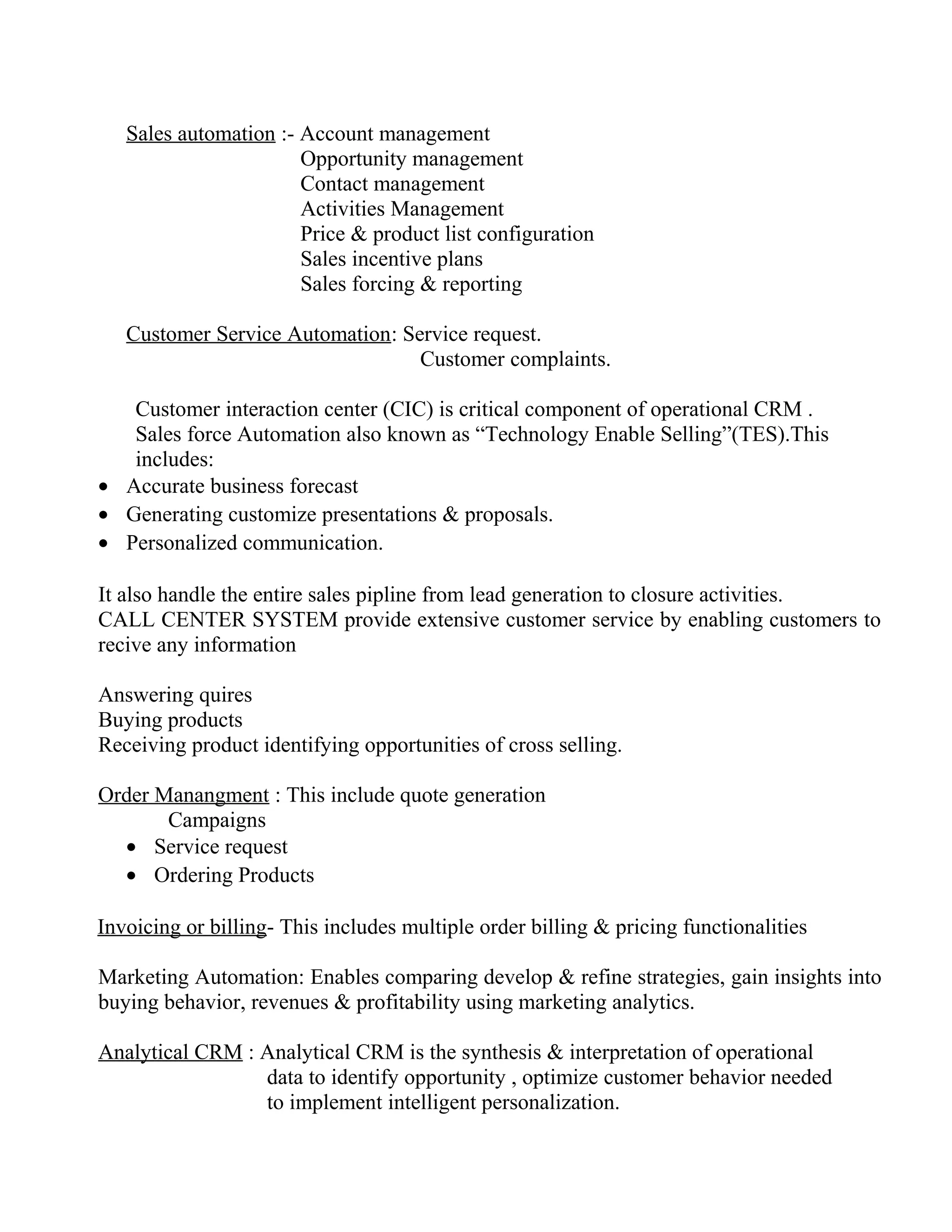
                                   EXAMPLES OF
                                 OPERATIONAL CRM


                      Sales force                 Customer service
                      automation                    automation
Sales automation :- Account management
                       Opportunity management
                       Contact management
                       Activities Management
                       Price & product list configuration
                       Sales incentive plans
                       Sales forcing & reporting

   Customer Service Automation: Service request.
                                  Customer complaints.

   Customer interaction center (CIC) is critical component of operational CRM .
   Sales force Automation also known as “Technology Enable Selling”(TES).This
   includes:
• Accurate business forecast
• Generating customize presentations & proposals.
• Personalized communication.

It also handle the entire sales pipline from lead generation to closure activities.
CALL CENTER SYSTEM provide extensive customer service by enabling customers to
recive any information

Answering quires
Buying products
Receiving product identifying opportunities of cross selling.

Order Manangment : This include quote generation
       Campaigns
  • Service request
  • Ordering Products

Invoicing or billing- This includes multiple order billing & pricing functionalities

Marketing Automation: Enables comparing develop & refine strategies, gain insights into
buying behavior, revenues & profitability using marketing analytics.

Analytical CRM : Analytical CRM is the synthesis & interpretation of operational
                 data to identify opportunity , optimize customer behavior needed
                 to implement intelligent personalization.
Analytics involve the capture, storage , extraction processing ,interpretation & reporting
of customer data.

COMPARISON BETWEEN OPERTAIONAL CRM & ANALYTICAL CRM:

   • Data gathered at operational sides is analyses at analytical CRM to improve
     business performance management.

   • Data at operation CRM level gathered so diligently & analysis at analytical CRM
     level provide insight includes

DATA WAREHOUSING: It is system of storing & delivering massive quantities of
                           data aids in analysis & decision making
  • Classify data
  • Co ordination
  • Identify relationships between information gathered.

   DATA MARTS:-These are subjects specific data warehousing

      • Marketing automation
      • Campaign management
      • Database marketing

      Optimizes profitability revenue & customer satisfaction analysis
        • To know buying pattern
        • Identification of most profitable customer/products/services
        • Customer
        • Competition
        • Customer categories
        • Cross selling of products
        • Fraud analysis

         ANALYTICAL CRM FUNCTIONS:
           • Create a comprehensive customer knowledge base while ensuring
             privacy.
           • Capturing all relevant customer information from different sources,
             channels ,touch points.
• Data guarded with utmost care so that customer right to privacy is never
       compromised in any way.
     • Customer behavior : This expressed through customer preference ,
       priorities & activates


     Customer value: This expressed in terms of customer profitability’s,
     potential.
     Customer portfolio: learn understanding of composition of customer
     portfolio.
     Optimizing cross selling Opportunities

Integrate customer value into strategies enterprise management to improve
share holder value.

Crrm unit i

  • 1.
    CRRM UNIT –I Introduction :- Till now majority of marketers focused on traditional mode of marketing. • Due to which they acquire few customers by targeting limited segment. • They use tools & techniques developed for mass marketing in industrial era. • But in present competitive era this proving to be highly ineffective. PRESENT APPROCHES Relationship Customer retention Cross selling marketing • Relationship marketing is emerging as the core marketing activites. • On an average, business spend six times more to acquire new customers than to keep them. • As a result of which companies payinh more attention to their relationship with exisiting customer. • Facing the competitive threat such as a new entrants pricing pressure ,technology along with related cost organization realizing that traditional marketing model no longer effective
  • 2.
    BENEFITS OF CRM: • Help to retain customer. • RM creates intelligent opportunities for cross selling. • Opens up the possibility of rapid introduction of new brands & product. • Organization must be able to customize their product offering, optimize price, integrated products. • Service & deliver the service as promised & demanded by customer base. We can categories the benefits generally in following : BENEFITS Revenues Strategic impact. Cost Saving Enhacement • Increased sales result from spending more times with customers, which results from spending less time chasing (i.e. Productivity, improvement) • Win rates improves since companies can with draw from unlikely orbad deals realier on in the sales process. • Increased margins resulting from knowing customers better providing a value sale. • Improved customer satisfaction ratings.
  • 3.
    CRM Challenges: • CRM is long term approaches that have to be adopted at strategic level. • Communicating customers at right time. • Breaking competitor’s relationship with customers. TYPES OF CRM COLLABORATIVE OPERATIONAL ANALTICAL CRM CRM CRM OPRATIONAL CRM: This the process in which involve the areas where direct customers contact is possible. Purpose of operational CRM is to provide transaction level data about individuals ,product & provide support for customer facing processes. E.g Direct mail, phone interaction EXAMPLES OF OPERATIONAL CRM Sales force Customer service automation automation
  • 4.
    Sales automation :-Account management Opportunity management Contact management Activities Management Price & product list configuration Sales incentive plans Sales forcing & reporting Customer Service Automation: Service request. Customer complaints. Customer interaction center (CIC) is critical component of operational CRM . Sales force Automation also known as “Technology Enable Selling”(TES).This includes: • Accurate business forecast • Generating customize presentations & proposals. • Personalized communication. It also handle the entire sales pipline from lead generation to closure activities. CALL CENTER SYSTEM provide extensive customer service by enabling customers to recive any information Answering quires Buying products Receiving product identifying opportunities of cross selling. Order Manangment : This include quote generation Campaigns • Service request • Ordering Products Invoicing or billing- This includes multiple order billing & pricing functionalities Marketing Automation: Enables comparing develop & refine strategies, gain insights into buying behavior, revenues & profitability using marketing analytics. Analytical CRM : Analytical CRM is the synthesis & interpretation of operational data to identify opportunity , optimize customer behavior needed to implement intelligent personalization.
  • 5.
    Analytics involve thecapture, storage , extraction processing ,interpretation & reporting of customer data. COMPARISON BETWEEN OPERTAIONAL CRM & ANALYTICAL CRM: • Data gathered at operational sides is analyses at analytical CRM to improve business performance management. • Data at operation CRM level gathered so diligently & analysis at analytical CRM level provide insight includes DATA WAREHOUSING: It is system of storing & delivering massive quantities of data aids in analysis & decision making • Classify data • Co ordination • Identify relationships between information gathered. DATA MARTS:-These are subjects specific data warehousing • Marketing automation • Campaign management • Database marketing Optimizes profitability revenue & customer satisfaction analysis • To know buying pattern • Identification of most profitable customer/products/services • Customer • Competition • Customer categories • Cross selling of products • Fraud analysis ANALYTICAL CRM FUNCTIONS: • Create a comprehensive customer knowledge base while ensuring privacy. • Capturing all relevant customer information from different sources, channels ,touch points.
  • 6.
    • Data guardedwith utmost care so that customer right to privacy is never compromised in any way. • Customer behavior : This expressed through customer preference , priorities & activates Customer value: This expressed in terms of customer profitability’s, potential. Customer portfolio: learn understanding of composition of customer portfolio. Optimizing cross selling Opportunities Integrate customer value into strategies enterprise management to improve share holder value.