
THE EFFECT OF CRM ON
   BANKING PROFIT
Not everything that can be counted counts,
and not everything that counts can be
counted (Albert Einstein 1879-1955)
Make all of your customers love you and buy more of
your stuff.


Customer relationship management or CRM, is yet another one of
those popular three letter programs that have been implemented
by most large corporations over the last decade that has failed to
live up to its expectations.
The definition of CRM for banks


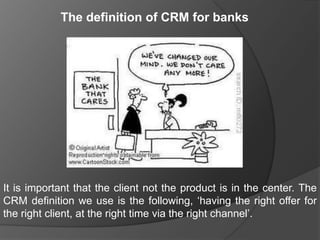
It is important that the client not the product is in the center. The
CRM definition we use is the following, „having the right offer for
the right client, at the right time via the right channel‟.
The definition of CRM for banks


CRM is much more than a technological solution. It is a strategy
integrated in the business model of the banks and clearly
oriented to value generation
The definition of CRM for banks


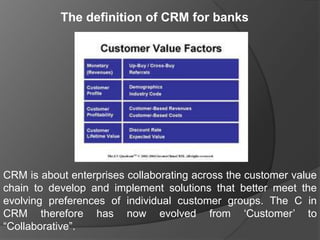
CRM is about enterprises collaborating across the customer value
chain to develop and implement solutions that better meet the
evolving preferences of individual customer groups. The C in
CRM therefore has now evolved from „Customer‟ to
“Collaborative”.
The importance of CRM for banks


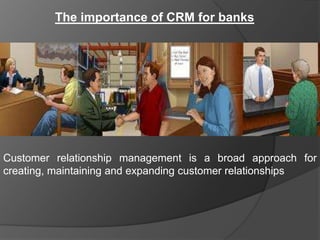
Customer relationship management is a broad approach for
creating, maintaining and expanding customer relationships
The importance of CRM for banks

CRM      is    the     business      strategy   that aims    to
understand, anticipate, manage and personalize the needs of an
organization‟s current and potential customers.
The importance of CRM for banks

CRM is the business strategy that aims to understand, anticipate,
manage and personalize the needs of an organization‟s current
and potential customers.

At the heart of a perfect strategy is the creation of mutual value for
all parties involved in the business process.
The importance of CRM for banks

CRM      is    the     business      strategy   that aims    to
understand, anticipate, manage and personalize the needs of an
organization‟s current and potential customers.

At the heart of a perfect strategy is the creation of mutual value for
all parties involved in the business process.

It is about creating a sustainable competitive advantage by being
the best at understanding, communicating, and delivering and
developing existing customer relationships in addition to creating
and keeping new customers
The importance of CRM for banks

CRM      is    the     business      strategy   that aims    to
understand, anticipate, manage and personalize the needs of an
organization‟s current and potential customers.

At the heart of a perfect strategy is the creation of mutual value for
all parties involved in the business process.

It is about creating a sustainable competitive advantage by being
the best at understanding, communicating, and delivering and
developing existing customer relationships in addition to creating
and keeping new customers
The importance of CRM for banks


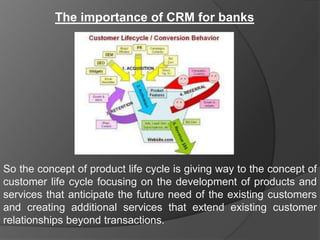
So the concept of product life cycle is giving way to the concept of
customer life cycle focusing on the development of products and
services that anticipate the future need of the existing customers
and creating additional services that extend existing customer
relationships beyond transactions.
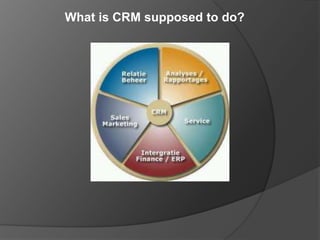
What is CRM supposed to do?


The theory behind CRM is that if companies take a systematic
approach to building relationships with important customers, this
will result in greater levels of customer satisfaction, increased
revenue from those customers, and greater loyalty.
CRM is based on faulty assumptions

Faulty assumption # 1: Building a relationship requires a ystematic
process and management system.
CRM is based on faulty assumptions
                         Faulty assumption # 1

Building a relationship requires a systematic process and
management system.

Anyone who has ever had a job in sales knows that you can‟t take to same
approach to sales as you can with engineering a product or landing a plane.
You can follow the exact same series of behaviors with one prospect, and
she does not buy a thing.
CRM is based on faulty assumptions
                          Faulty assumption # 2

CRM software provides the data needed to improve your
ability to build relationships with customers


Most CRM data bases include all sorts of information about accounts and
individual customers. There is information in there about the org. structure
and who has the real authority, decision making matrices, and personal
information about customers such as their previous jobs, buying
history, spouse‟s names, kid‟s ages and names, hobbies, interests, golf
scores, favorite vacation spots, etc.
CRM is based on faulty assumptions
                           Faulty assumption # 3:

It will be easy for the salespeople to use the CRM software
and they will love it when they see how it helps them sell
more.

a lot of friends and clients in sales jobs: pharmaceuticals, insurance, financial
services, medical devices, copiers, and a host of other products and
services. One thing you hear from all of them is that they hate their
company‟s stupid CRM systems. It‟s common for salespeople to spend 2-4
hours a day with their lap top, typing in reports of conversations with
customers and prospects, entering data, and preparing account status
reports.
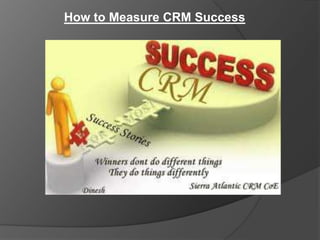
How to Measure CRM Success


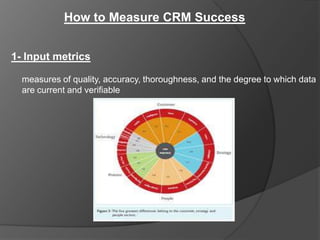
1- Input metrics

  measures of quality, accuracy, thoroughness, and the degree to which data
  are current and verifiable
How to Measure CRM Success


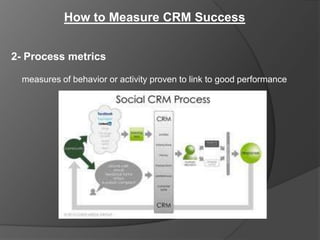
2- Process metrics

  measures of behavior or activity proven to link to good performance
How to Measure CRM Success


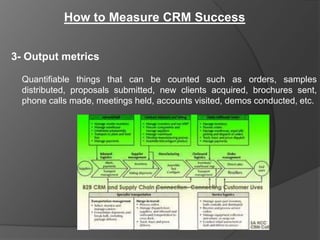
3- Output metrics

  Quantifiable things that can be counted such as orders, samples
  distributed, proposals submitted, new clients acquired, brochures sent,
  phone calls made, meetings held, accounts visited, demos conducted, etc.
How to Measure CRM Success


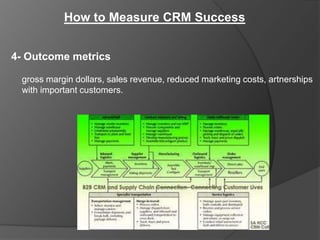
4- Outcome metrics

 gross margin dollars, sales revenue, reduced marketing costs, artnerships
 with important customers.
What benefits can banks hope to achieve through
          deploying CRM solutions?
What benefits can banks hope to achieve through
            deploying CRM solutions?

It depends on the positioning and focus of a bank. If operational excellence is
your key-focus and not customer intimacy, the choices you make in terms of
investments in CRM will be completely different. In strategic terms, ABN AMRO
has a strong ambition to create value for our clients (especially the "midmarket"
which we define as mass-affluent/ private client consumers and mid-sized
businesses) by offering high-quality financial solutions that best meet their
current needs and long-term goals.
Present and Future of CRM in banking


Bank merely an organization it accepts deposits and lends money to the needy
persons, but banking is the process associated with the activities of banks. It
includes issuance of cheque and cards, monthly statements, timely
announcement of new services, helping the customers to avail online and
mobile banking etc. Huge growth of customer relationship management is
predicted in the banking sector over the next few years.
Steps to follow


- Identification of proper CRM initiatives
Steps to follow


- Identification of proper CRM initiatives

- Implementing adequate technologies in order to assist CRM initiative
Steps to follow


- Identification of proper CRM initiatives

- Implementing adequate technologies in order to assist CRM initiative

- Setting standards (targets) for each initiative and each person involved
  in that circle
Steps to follow


- Identification of proper CRM initiatives

- Implementing adequate technologies in order to assist CRM initiative

- Setting standards (targets) for each initiative and each person involved
  in that circle

- Evaluating actual performance with the standard or benchmark
Steps to follow


- Identification of proper CRM initiatives.

- Implementing adequate technologies in order to assist CRM initiative.

- Setting standards (targets) for each initiative and each person involved
  in that circle.

- Evaluating actual performance with the standard or benchmark.

- Taking corrective actions to improve deviations, if any.
Conclusion
Conclusion


Customers are the backbone of any kind of business activities, maintaining
relationship with them yield better result
Conclusion


Customers are the backbone of any kind of business activities, maintaining
relationship with them yield better result

Working with Luxoft helped the client to understand the issues of the current
system and to improve the business process flow within the bank
Conclusion


Customers are the backbone of any kind of business activities, maintaining
relationship with them yield better result

Working with Luxoft helped the client to understand the issues of the current
system and to improve the business process flow within the bank


As a result of the implementation of the new CRM system, the time taken for
data entry within the bank has been significantly reduced
Conclusion


Customers are the backbone of any kind of business activities, maintaining
relationship with them yield better result

Working with Luxoft helped the client to understand the issues of the current
system and to improve the business process flow within the bank


As a result of the implementation of the new CRM system, the time taken for
data entry within the bank has been significantly reduced

The new CRM system provides a single point of access to corporate clients‟
data to all the parties and brought together sales, global relationship managers
and senior investment bankers across the client organization
The effect of CRM

The effect of CRM

  • 1.
    THE EFFECT OFCRM ON BANKING PROFIT
  • 2.
    Not everything thatcan be counted counts, and not everything that counts can be counted (Albert Einstein 1879-1955)
  • 3.
    Make all ofyour customers love you and buy more of your stuff. Customer relationship management or CRM, is yet another one of those popular three letter programs that have been implemented by most large corporations over the last decade that has failed to live up to its expectations.
  • 4.
    The definition ofCRM for banks It is important that the client not the product is in the center. The CRM definition we use is the following, „having the right offer for the right client, at the right time via the right channel‟.
  • 5.
    The definition ofCRM for banks CRM is much more than a technological solution. It is a strategy integrated in the business model of the banks and clearly oriented to value generation
  • 6.
    The definition ofCRM for banks CRM is about enterprises collaborating across the customer value chain to develop and implement solutions that better meet the evolving preferences of individual customer groups. The C in CRM therefore has now evolved from „Customer‟ to “Collaborative”.
  • 7.
    The importance ofCRM for banks Customer relationship management is a broad approach for creating, maintaining and expanding customer relationships
  • 8.
    The importance ofCRM for banks CRM is the business strategy that aims to understand, anticipate, manage and personalize the needs of an organization‟s current and potential customers.
  • 9.
    The importance ofCRM for banks CRM is the business strategy that aims to understand, anticipate, manage and personalize the needs of an organization‟s current and potential customers. At the heart of a perfect strategy is the creation of mutual value for all parties involved in the business process.
  • 10.
    The importance ofCRM for banks CRM is the business strategy that aims to understand, anticipate, manage and personalize the needs of an organization‟s current and potential customers. At the heart of a perfect strategy is the creation of mutual value for all parties involved in the business process. It is about creating a sustainable competitive advantage by being the best at understanding, communicating, and delivering and developing existing customer relationships in addition to creating and keeping new customers
  • 11.
    The importance ofCRM for banks CRM is the business strategy that aims to understand, anticipate, manage and personalize the needs of an organization‟s current and potential customers. At the heart of a perfect strategy is the creation of mutual value for all parties involved in the business process. It is about creating a sustainable competitive advantage by being the best at understanding, communicating, and delivering and developing existing customer relationships in addition to creating and keeping new customers
  • 12.
    The importance ofCRM for banks So the concept of product life cycle is giving way to the concept of customer life cycle focusing on the development of products and services that anticipate the future need of the existing customers and creating additional services that extend existing customer relationships beyond transactions.
  • 13.
    What is CRMsupposed to do?
  • 14.
    What is CRMsupposed to do? The theory behind CRM is that if companies take a systematic approach to building relationships with important customers, this will result in greater levels of customer satisfaction, increased revenue from those customers, and greater loyalty.
  • 15.
    CRM is basedon faulty assumptions Faulty assumption # 1: Building a relationship requires a ystematic process and management system.
  • 16.
    CRM is basedon faulty assumptions Faulty assumption # 1 Building a relationship requires a systematic process and management system. Anyone who has ever had a job in sales knows that you can‟t take to same approach to sales as you can with engineering a product or landing a plane. You can follow the exact same series of behaviors with one prospect, and she does not buy a thing.
  • 17.
    CRM is basedon faulty assumptions Faulty assumption # 2 CRM software provides the data needed to improve your ability to build relationships with customers Most CRM data bases include all sorts of information about accounts and individual customers. There is information in there about the org. structure and who has the real authority, decision making matrices, and personal information about customers such as their previous jobs, buying history, spouse‟s names, kid‟s ages and names, hobbies, interests, golf scores, favorite vacation spots, etc.
  • 18.
    CRM is basedon faulty assumptions Faulty assumption # 3: It will be easy for the salespeople to use the CRM software and they will love it when they see how it helps them sell more. a lot of friends and clients in sales jobs: pharmaceuticals, insurance, financial services, medical devices, copiers, and a host of other products and services. One thing you hear from all of them is that they hate their company‟s stupid CRM systems. It‟s common for salespeople to spend 2-4 hours a day with their lap top, typing in reports of conversations with customers and prospects, entering data, and preparing account status reports.
  • 19.
    How to MeasureCRM Success
  • 20.
    How to MeasureCRM Success 1- Input metrics measures of quality, accuracy, thoroughness, and the degree to which data are current and verifiable
  • 21.
    How to MeasureCRM Success 2- Process metrics measures of behavior or activity proven to link to good performance
  • 22.
    How to MeasureCRM Success 3- Output metrics Quantifiable things that can be counted such as orders, samples distributed, proposals submitted, new clients acquired, brochures sent, phone calls made, meetings held, accounts visited, demos conducted, etc.
  • 23.
    How to MeasureCRM Success 4- Outcome metrics gross margin dollars, sales revenue, reduced marketing costs, artnerships with important customers.
  • 24.
    What benefits canbanks hope to achieve through deploying CRM solutions?
  • 25.
    What benefits canbanks hope to achieve through deploying CRM solutions? It depends on the positioning and focus of a bank. If operational excellence is your key-focus and not customer intimacy, the choices you make in terms of investments in CRM will be completely different. In strategic terms, ABN AMRO has a strong ambition to create value for our clients (especially the "midmarket" which we define as mass-affluent/ private client consumers and mid-sized businesses) by offering high-quality financial solutions that best meet their current needs and long-term goals.
  • 26.
    Present and Futureof CRM in banking
  • 27.
    Present and Futureof CRM in banking Bank merely an organization it accepts deposits and lends money to the needy persons, but banking is the process associated with the activities of banks. It includes issuance of cheque and cards, monthly statements, timely announcement of new services, helping the customers to avail online and mobile banking etc. Huge growth of customer relationship management is predicted in the banking sector over the next few years.
  • 28.
    Steps to follow -Identification of proper CRM initiatives
  • 29.
    Steps to follow -Identification of proper CRM initiatives - Implementing adequate technologies in order to assist CRM initiative
  • 30.
    Steps to follow -Identification of proper CRM initiatives - Implementing adequate technologies in order to assist CRM initiative - Setting standards (targets) for each initiative and each person involved in that circle
  • 31.
    Steps to follow -Identification of proper CRM initiatives - Implementing adequate technologies in order to assist CRM initiative - Setting standards (targets) for each initiative and each person involved in that circle - Evaluating actual performance with the standard or benchmark
  • 32.
    Steps to follow -Identification of proper CRM initiatives. - Implementing adequate technologies in order to assist CRM initiative. - Setting standards (targets) for each initiative and each person involved in that circle. - Evaluating actual performance with the standard or benchmark. - Taking corrective actions to improve deviations, if any.
  • 33.
  • 34.
    Conclusion Customers are thebackbone of any kind of business activities, maintaining relationship with them yield better result
  • 35.
    Conclusion Customers are thebackbone of any kind of business activities, maintaining relationship with them yield better result Working with Luxoft helped the client to understand the issues of the current system and to improve the business process flow within the bank
  • 36.
    Conclusion Customers are thebackbone of any kind of business activities, maintaining relationship with them yield better result Working with Luxoft helped the client to understand the issues of the current system and to improve the business process flow within the bank As a result of the implementation of the new CRM system, the time taken for data entry within the bank has been significantly reduced
  • 37.
    Conclusion Customers are thebackbone of any kind of business activities, maintaining relationship with them yield better result Working with Luxoft helped the client to understand the issues of the current system and to improve the business process flow within the bank As a result of the implementation of the new CRM system, the time taken for data entry within the bank has been significantly reduced The new CRM system provides a single point of access to corporate clients‟ data to all the parties and brought together sales, global relationship managers and senior investment bankers across the client organization