DISCOVER . LEARN . EMPOWER
CRM Strategy Planning and
Parameters
INSTITUTE: University School of
Business
DEPARTMENT ..Management..
Masters of Business Administration
Subject Name: Customer Relationship Management
Code: BAB-754
1
Customer
Relationship
Management
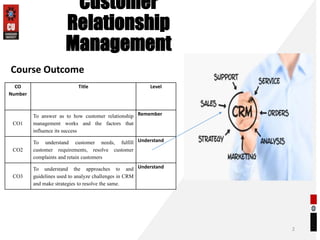
CO
Number
Title Level
CO1
To answer as to how customer relationship
management works and the factors that
influence its success
Remember
CO2
To understand customer needs, fulfill
customer requirements, resolve customer
complaints and retain customers
Understand
CO3
To understand the approaches to and
guidelines used to analyze challenges in CRM
and make strategies to resolve the same.
Understand
Course Outcome
Will be covered in
this lecture
2
Part 1
CRM Strategy
CRM…
CRM Strategy & Implementation
• Customer (Constituents/ Stakeholders) – The heart of your organisation
• Relationship – The key to growing your company through engagement with
your prospects, customers and stakeholders
• Management – Managing these stakeholder relationships to increase
lifetime value
Three small letters, with three core concepts:
“CRM is a business strategy whose outcomes
optimize profitability, revenue and customer
satisfaction by implementing customer-centric
processes” (Gartner)
CRM Strategy
CRM Strategy & Implementation
ACRM strategy cannot be developed in isolation.
It must be relevant and linked to the overall corporate strategy.
Why is it important?
CRM Strategy & Implementation
• Help better understand the needs of every individual customer
• Reduce customer churn - eg: lower selling costs
• Increase leads - eg: referrals
• Increase revenue per customer - eg: cross sell, upsell
• Help deliver a consistent experience every time
Successful CRM strategy will:
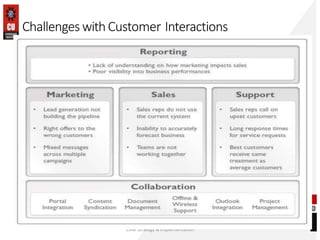
Challenges withCustomer Interactions
CRM Strategy & Implementation
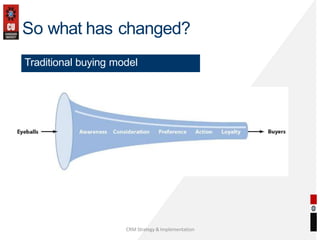
So what has changed?
Traditional buying model
CRM Strategy & Implementation
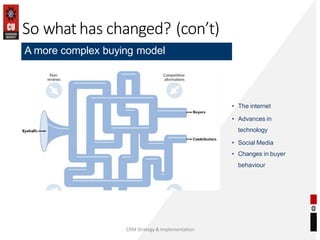
So whathas changed? (con’t)
CRM Strategy & Implementation
A more complex buying model
• The internet
• Advances in
technology
• Social Media
• Changes in buyer
behaviour
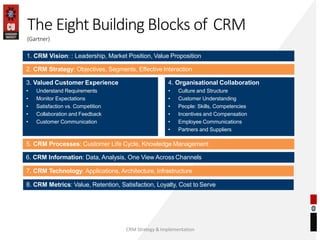
The EightBuilding Blocks of CRM
(Gartner)
CRM Strategy & Implementation
1. CRM Vision: : Leadership, Market Position, Value Proposition
2. CRM Strategy: Objectives, Segments, Effective Interaction
3. Valued Customer Experience
• Understand Requirements
• Monitor Expectations
• Satisfaction vs. Competition
• Collaboration and Feedback
• Customer Communication
4. Organisational Collaboration
• Culture and Structure
• Customer Understanding
• People: Skills, Competencies
• Incentives and Compensation
• Employee Communications
• Partners and Suppliers
5. CRM Processes: Customer Life Cycle, Knowledge Management
6. CRM Information: Data, Analysis, One View Across Channels
7. CRM Technology: Applications, Architecture, Infrastructure
8. CRM Metrics: Value, Retention, Satisfaction, Loyalty, Cost to Serve
1. “Understand the guiding principles of successful
customer-centric strategies to help them develop a
vision of what their organization wants to deliver to
customers.”
In order to effectively build a vision, a company must
achieve the following objectives (among others):
• Understand what CRM and a CRM vision are
• Establish their organization’s personality
• Foster a culture that supports the CRM vision
• Communicate the CRM vision to employees
2. Strategy
Once you have a vision in place, the next building
block, “strategy,” can help you to actually implement
that vision.
• Create your strategy in conjunction with your entire
organization; don’t simply impose a management-
mandated plan from above.
• Remember that your organization’s goals will vary
depending on your customers. You must always
keep that customer base in mind in order for the
strategy to prove effective.
3. Customer Experience
“Customer experience” is a building block that is
going to vary greatly between enterprise businesses
simply due to the differences in of the number of
customers and the types of experiences they will
have with a company.
Thus, you can focus more intensely on those contact
points to create and refine a truly excellent
customer experience that will give customers the
personal touch they may be specifically hoping for
from a smaller business.
4. “Many organizations fail to realize that CRM is a
cross-functional initiative that requires collaboration,
which leads to poor project execution and poor
results.”
Responsibility and accountability must become part
of the entire organizational culture, and not just lie in
the hands of a few specific stakeholders.
5. In large companies, the solution is for the IT team
to focus on how CRM is implemented throughout the
business, rather than just at the individual
departmental level.
6. Information and Insight
“Creating, maintaining and leveraging a single view of
the customer is hard to achieve internally,” and
businesses “struggle to apply relevant customer
information and insight to deliver appropriate customer
experiences.”
It is crucially important for businesses of any size to
collect data about customers. In regard to CRM, it is
equally important to use that data to create a customer
profile that allows you to manage the engagement
experience in a way that is going to create the highest
number of conversions.
7. Choosing a vendor can be difficult, especially
without an IT department for guidance, which is why
we here at Software Advice have compiled a number
of resources to help you pick a CRM system that will
best fulfill your needs and help you achieve your
goals.
• 8. “Use high-level metrics to drive process change,
not just to measure effectiveness.”
• As we mentioned when discussing “information
and insight,” businesses both large and small rely
upon data to create and refine the CRM
experience, and the same is true when it comes to
the metrics used to analyze that data.
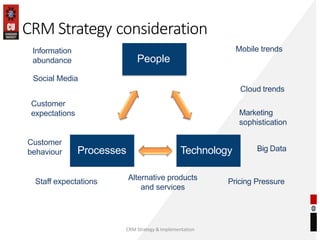
CRM Strategy consideration
CRM Strategy & Implementation
Customer
expectations
Cloud trends
Information
abundance
Social Media
Mobile trends
Staff expectations
Alternative products
and services
Pricing Pressure
Marketing
sophistication
People
Technology
Processes Big Data
Customer
behaviour
People
CRM Strategy & Implementation
• Communicate vision
• Recognise customer-centric behaviour
• Train staff on Customer Service and customer dispute resolution
• Make customers front and centre for all key business decisions
• Measure and report
o Surveys (written or face to face)
o Social media monitoring
o Mystery Shopping
Processes
CRM Strategy & Implementation
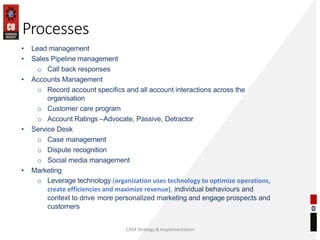
• Lead management
• Sales Pipeline management
o Call back responses
• Accounts Management
o Record account specifics and all account interactions across the
organisation
o Customer care program
o Account Ratings –Advocate, Passive, Detractor
• Service Desk
o Case management
o Dispute recognition
o Social media management
• Marketing
o Leverage technology (organization uses technology to optimize operations,
create efficiencies and maximize revenue), individual behaviours and
context to drive more personalized marketing and engage prospects and
customers
Technology
CRM Strategy & Implementation
• Implement a CRM System
o Use CRM to strengthen your process
o Make CRM central source of truth
• Integrate your CRM system
o Content Management System (CMS)
o eCommerce platform
o Marketing Automation software
o Learning Management System
o ERP
o Accounting software
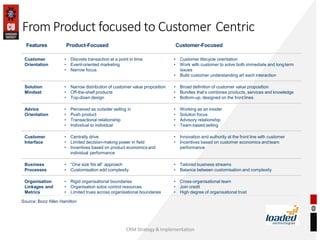
Features Product-Focused Customer-Focused
Customer
Orientation
• Discrete transaction at a point in time
• Event-oriented marketing
• Narrow focus
• Customer lifecycle orientation
• Work with customer to solve both immediate and longterm
issues
• Build customer understanding art each interaction
Solution
Mindset
• Narrow distribution of customer value proposition
• Off-the-shelf products
• Top-down design
• Broad definition of customer value proposition
• Bundles that’s combines products, services and knowledge
• Bottom-up, designed on the front lines
Advice
Orientation
• Perceived as outsider selling in
• Push product
• Transactional relationship
• Individual to individual
• Working as an insider
• Solution focus
• Advisory relationship
• Team-based selling
Customer
Interface
• Centrally drive
• Limited decision-making power in field
• Incentives based on product economics and
individual performance
• Innovation and authority at the front line with customer
• Incentives based on customer economics andteam
performance
Business
Processes
• “One size fits all” approach
• Customisation add complexity
• Tailored business streams
• Balance between customisation and complexity
Organisation
Linkages and
Metrics
• Rigid organisational boundaries
• Organisation solos control resources
• Limited trues across organisational boundaries
• Cross-organisational team
• Join credit
• High degree of organisational trust
From Product focused to Customer Centric
CRM Strategy & Implementation
Source: Booz Allen Hamilton
CRM adoption
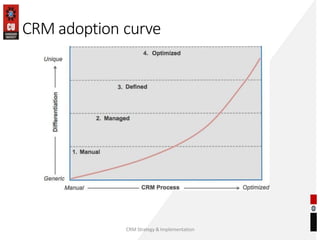
Achieving CRM success takes organizational focus and an
understanding of what to expect while putting your
company on the path to that success.
The first step in your CRM journey is to recognize the
chaos and lack of visibility that happens in your business
when you don’t invest in CRM processes and tools.
The second step is all about centralizing your customer
information into one system and defining repeatable
processes for interacting with your customers.
The third step is where you really start getting leverage
from automated customer processes and better
collaboration across your different customer-facing
teams.
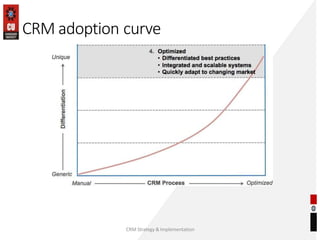
• The fourth, and not-so-final, stage is the
“Optimized Stage”. This stage is all about
continuous process improvement. This is the
ultimate goal of a customer-centric company. You
now have a dedicated team focused on continuous
CRM improvement which is driving marked growth
in the company.
CRM adoption curve
CRM Strategy & Implementation
CRM adoption curve
CRM Strategy & Implementation
CRM adoption curve
CRM Strategy & Implementation
CRM adoption curve
CRM Strategy & Implementation
CRM adoption curve
CRM Strategy & Implementation
References
1. Bardicchia, Marco (2020). Digital CRM: Strategies and Emerging
Trends: Building Customer Relationship in the Digital Era. p. 12.
2. "Management Tools - Customer Relationship Management - Bain
& Company". www.bain.com. Retrieved 23 November 2015.
3. Shaw, Robert (1991). Computer Aided Marketing & Selling.
Butterworth Heinemann. ISBN 978-0-7506-1707-9.
4. "CRM History: The Evolution Of Better Customer
Service". www.streetdirectory.com. Retrieved 24 May 2020.
5. "How Context Sits at Intersection of CRM, ACD". Retrieved 8
June2017.
6. "SAP R/3 SD Wiki". Retrieved 7 January 2019.
7. "Navision 3.0". Retrieved 7 January 2019.
8. Jump up to:a b c "History of CRM Software". comparecamp.com.
Retrieved 8 February 2017.
9. Lakshman Jha (2008). Customer Relationship Management: A
Strategic Approach. ISBN 9788190721127. Retrieved 8 June 2017.
10. "Gartner Announces Customer Relationship Management Summit
2009". gartner.com. 5 August 2009. Retrieved 8 February 2017.
31
References
1. "Industry Specific/Vertical Market CRM Solutions". smallbizcrm.com.
Retrieved 8 February 2017.
2. The Forrester Wave: CRM Suites For Enterprise Organizations, Q4
2016, Forrester, 21 November 2016, retrieved 13 September 2017
3. Buttle, Francis; Maklan, Stan (11 February 2015). Customer
Relationship Management: Concepts and
Technologies. ISBN 9781317654766.
4. Feiz, Ghotbabadi,Khalifah, (2016-01) Customer Lifetime Value in
Organisations
5. Jump up to:a b c d "Types of CRM and Examples | CRM
Software". www.crmsoftware.com. Retrieved 22 November 2015.
6. Jump up to:a b "What is sales force automation (SFA)? - Definition
from WhatIs.com". WhatIs.com. Retrieved 26 November 2015.
7. Buttle, Francis (2003). Customer relationship management. London:
Routledge. ISBN 9781136412578.
8. Jump up to:a b c d "What is customer relationship management
(CRM) ? - Definition from WhatIs.com". SearchCRM. Retrieved 22
November2015.
THANK YOU
For queries you can reach me on Email:
bhupinder.chahal@cumail.in

CRM Strategy Planning.pptx

  • 1.
    DISCOVER . LEARN. EMPOWER CRM Strategy Planning and Parameters INSTITUTE: University School of Business DEPARTMENT ..Management.. Masters of Business Administration Subject Name: Customer Relationship Management Code: BAB-754 1
  • 2.
    Customer Relationship Management CO Number Title Level CO1 To answeras to how customer relationship management works and the factors that influence its success Remember CO2 To understand customer needs, fulfill customer requirements, resolve customer complaints and retain customers Understand CO3 To understand the approaches to and guidelines used to analyze challenges in CRM and make strategies to resolve the same. Understand Course Outcome Will be covered in this lecture 2
  • 3.
  • 4.
    CRM… CRM Strategy &Implementation • Customer (Constituents/ Stakeholders) – The heart of your organisation • Relationship – The key to growing your company through engagement with your prospects, customers and stakeholders • Management – Managing these stakeholder relationships to increase lifetime value Three small letters, with three core concepts:
  • 5.
    “CRM is abusiness strategy whose outcomes optimize profitability, revenue and customer satisfaction by implementing customer-centric processes” (Gartner) CRM Strategy CRM Strategy & Implementation ACRM strategy cannot be developed in isolation. It must be relevant and linked to the overall corporate strategy.
  • 6.
    Why is itimportant? CRM Strategy & Implementation • Help better understand the needs of every individual customer • Reduce customer churn - eg: lower selling costs • Increase leads - eg: referrals • Increase revenue per customer - eg: cross sell, upsell • Help deliver a consistent experience every time Successful CRM strategy will:
  • 7.
  • 8.
    So what haschanged? Traditional buying model CRM Strategy & Implementation
  • 9.
    So whathas changed?(con’t) CRM Strategy & Implementation A more complex buying model • The internet • Advances in technology • Social Media • Changes in buyer behaviour
  • 10.
    The EightBuilding Blocksof CRM (Gartner) CRM Strategy & Implementation 1. CRM Vision: : Leadership, Market Position, Value Proposition 2. CRM Strategy: Objectives, Segments, Effective Interaction 3. Valued Customer Experience • Understand Requirements • Monitor Expectations • Satisfaction vs. Competition • Collaboration and Feedback • Customer Communication 4. Organisational Collaboration • Culture and Structure • Customer Understanding • People: Skills, Competencies • Incentives and Compensation • Employee Communications • Partners and Suppliers 5. CRM Processes: Customer Life Cycle, Knowledge Management 6. CRM Information: Data, Analysis, One View Across Channels 7. CRM Technology: Applications, Architecture, Infrastructure 8. CRM Metrics: Value, Retention, Satisfaction, Loyalty, Cost to Serve
  • 11.
    1. “Understand theguiding principles of successful customer-centric strategies to help them develop a vision of what their organization wants to deliver to customers.” In order to effectively build a vision, a company must achieve the following objectives (among others): • Understand what CRM and a CRM vision are • Establish their organization’s personality • Foster a culture that supports the CRM vision • Communicate the CRM vision to employees
  • 12.
    2. Strategy Once youhave a vision in place, the next building block, “strategy,” can help you to actually implement that vision. • Create your strategy in conjunction with your entire organization; don’t simply impose a management- mandated plan from above. • Remember that your organization’s goals will vary depending on your customers. You must always keep that customer base in mind in order for the strategy to prove effective.
  • 13.
    3. Customer Experience “Customerexperience” is a building block that is going to vary greatly between enterprise businesses simply due to the differences in of the number of customers and the types of experiences they will have with a company. Thus, you can focus more intensely on those contact points to create and refine a truly excellent customer experience that will give customers the personal touch they may be specifically hoping for from a smaller business.
  • 14.
    4. “Many organizationsfail to realize that CRM is a cross-functional initiative that requires collaboration, which leads to poor project execution and poor results.” Responsibility and accountability must become part of the entire organizational culture, and not just lie in the hands of a few specific stakeholders.
  • 15.
    5. In largecompanies, the solution is for the IT team to focus on how CRM is implemented throughout the business, rather than just at the individual departmental level.
  • 16.
    6. Information andInsight “Creating, maintaining and leveraging a single view of the customer is hard to achieve internally,” and businesses “struggle to apply relevant customer information and insight to deliver appropriate customer experiences.” It is crucially important for businesses of any size to collect data about customers. In regard to CRM, it is equally important to use that data to create a customer profile that allows you to manage the engagement experience in a way that is going to create the highest number of conversions.
  • 17.
    7. Choosing avendor can be difficult, especially without an IT department for guidance, which is why we here at Software Advice have compiled a number of resources to help you pick a CRM system that will best fulfill your needs and help you achieve your goals.
  • 18.
    • 8. “Usehigh-level metrics to drive process change, not just to measure effectiveness.” • As we mentioned when discussing “information and insight,” businesses both large and small rely upon data to create and refine the CRM experience, and the same is true when it comes to the metrics used to analyze that data.
  • 19.
    CRM Strategy consideration CRMStrategy & Implementation Customer expectations Cloud trends Information abundance Social Media Mobile trends Staff expectations Alternative products and services Pricing Pressure Marketing sophistication People Technology Processes Big Data Customer behaviour
  • 20.
    People CRM Strategy &Implementation • Communicate vision • Recognise customer-centric behaviour • Train staff on Customer Service and customer dispute resolution • Make customers front and centre for all key business decisions • Measure and report o Surveys (written or face to face) o Social media monitoring o Mystery Shopping
  • 21.
    Processes CRM Strategy &Implementation • Lead management • Sales Pipeline management o Call back responses • Accounts Management o Record account specifics and all account interactions across the organisation o Customer care program o Account Ratings –Advocate, Passive, Detractor • Service Desk o Case management o Dispute recognition o Social media management • Marketing o Leverage technology (organization uses technology to optimize operations, create efficiencies and maximize revenue), individual behaviours and context to drive more personalized marketing and engage prospects and customers
  • 22.
    Technology CRM Strategy &Implementation • Implement a CRM System o Use CRM to strengthen your process o Make CRM central source of truth • Integrate your CRM system o Content Management System (CMS) o eCommerce platform o Marketing Automation software o Learning Management System o ERP o Accounting software
  • 23.
    Features Product-Focused Customer-Focused Customer Orientation •Discrete transaction at a point in time • Event-oriented marketing • Narrow focus • Customer lifecycle orientation • Work with customer to solve both immediate and longterm issues • Build customer understanding art each interaction Solution Mindset • Narrow distribution of customer value proposition • Off-the-shelf products • Top-down design • Broad definition of customer value proposition • Bundles that’s combines products, services and knowledge • Bottom-up, designed on the front lines Advice Orientation • Perceived as outsider selling in • Push product • Transactional relationship • Individual to individual • Working as an insider • Solution focus • Advisory relationship • Team-based selling Customer Interface • Centrally drive • Limited decision-making power in field • Incentives based on product economics and individual performance • Innovation and authority at the front line with customer • Incentives based on customer economics andteam performance Business Processes • “One size fits all” approach • Customisation add complexity • Tailored business streams • Balance between customisation and complexity Organisation Linkages and Metrics • Rigid organisational boundaries • Organisation solos control resources • Limited trues across organisational boundaries • Cross-organisational team • Join credit • High degree of organisational trust From Product focused to Customer Centric CRM Strategy & Implementation Source: Booz Allen Hamilton
  • 24.
    CRM adoption Achieving CRMsuccess takes organizational focus and an understanding of what to expect while putting your company on the path to that success. The first step in your CRM journey is to recognize the chaos and lack of visibility that happens in your business when you don’t invest in CRM processes and tools. The second step is all about centralizing your customer information into one system and defining repeatable processes for interacting with your customers. The third step is where you really start getting leverage from automated customer processes and better collaboration across your different customer-facing teams.
  • 25.
    • The fourth,and not-so-final, stage is the “Optimized Stage”. This stage is all about continuous process improvement. This is the ultimate goal of a customer-centric company. You now have a dedicated team focused on continuous CRM improvement which is driving marked growth in the company.
  • 26.
    CRM adoption curve CRMStrategy & Implementation
  • 27.
    CRM adoption curve CRMStrategy & Implementation
  • 28.
    CRM adoption curve CRMStrategy & Implementation
  • 29.
    CRM adoption curve CRMStrategy & Implementation
  • 30.
    CRM adoption curve CRMStrategy & Implementation
  • 31.
    References 1. Bardicchia, Marco(2020). Digital CRM: Strategies and Emerging Trends: Building Customer Relationship in the Digital Era. p. 12. 2. "Management Tools - Customer Relationship Management - Bain & Company". www.bain.com. Retrieved 23 November 2015. 3. Shaw, Robert (1991). Computer Aided Marketing & Selling. Butterworth Heinemann. ISBN 978-0-7506-1707-9. 4. "CRM History: The Evolution Of Better Customer Service". www.streetdirectory.com. Retrieved 24 May 2020. 5. "How Context Sits at Intersection of CRM, ACD". Retrieved 8 June2017. 6. "SAP R/3 SD Wiki". Retrieved 7 January 2019. 7. "Navision 3.0". Retrieved 7 January 2019. 8. Jump up to:a b c "History of CRM Software". comparecamp.com. Retrieved 8 February 2017. 9. Lakshman Jha (2008). Customer Relationship Management: A Strategic Approach. ISBN 9788190721127. Retrieved 8 June 2017. 10. "Gartner Announces Customer Relationship Management Summit 2009". gartner.com. 5 August 2009. Retrieved 8 February 2017. 31
  • 32.
    References 1. "Industry Specific/VerticalMarket CRM Solutions". smallbizcrm.com. Retrieved 8 February 2017. 2. The Forrester Wave: CRM Suites For Enterprise Organizations, Q4 2016, Forrester, 21 November 2016, retrieved 13 September 2017 3. Buttle, Francis; Maklan, Stan (11 February 2015). Customer Relationship Management: Concepts and Technologies. ISBN 9781317654766. 4. Feiz, Ghotbabadi,Khalifah, (2016-01) Customer Lifetime Value in Organisations 5. Jump up to:a b c d "Types of CRM and Examples | CRM Software". www.crmsoftware.com. Retrieved 22 November 2015. 6. Jump up to:a b "What is sales force automation (SFA)? - Definition from WhatIs.com". WhatIs.com. Retrieved 26 November 2015. 7. Buttle, Francis (2003). Customer relationship management. London: Routledge. ISBN 9781136412578. 8. Jump up to:a b c d "What is customer relationship management (CRM) ? - Definition from WhatIs.com". SearchCRM. Retrieved 22 November2015.
  • 33.
    THANK YOU For queriesyou can reach me on Email: bhupinder.chahal@cumail.in