Critical Appraisal 
Jamalludin Ab Rahman MD MPH 
Department of Community Medicine
Evidence Based Medicine 
“Evidence based medicine is the conscientious, explicit, and judicious 
use of current best evidence in making decisions about the care of 
individual patients.” 
“Good doctors use both individual clinical expertise and the best 
available external evidence, and neither alone is enough.” 
“External clinical evidence can inform, but can never replace, 
individual clinical expertise…” 
www.iium.edu.my 15 September 2014 
2 
Sackett, D. L., Rosenberg, W. M. C., Gray, J. A. M., Haynes, R. 
B., & Richardson, W. S. (1996). Evidence based medicine: 
what it is and what it isn't (Vol. 312).
The origin of EBM 
 1975, Dr David L Sackett discovered that the factor that 
determine the prescription for hypertension is the 
graduating years of the doctors. 
 1990, Dr Gordon Guyatt coined the term Evidence 
Based Medicine for a new Internal Medicine residency 
programme known as “Scientific Medicine” 
www.iium.edu.my 15 September 2014 
3 
Kowalski, E., & Chung, K. C. (2013). The outcomes movement and 
evidence-based medicine in plastic surgery. Clin Plast Surg, 40(2), 241- 
247. doi: 10.1016/j.cps.2012.10.001
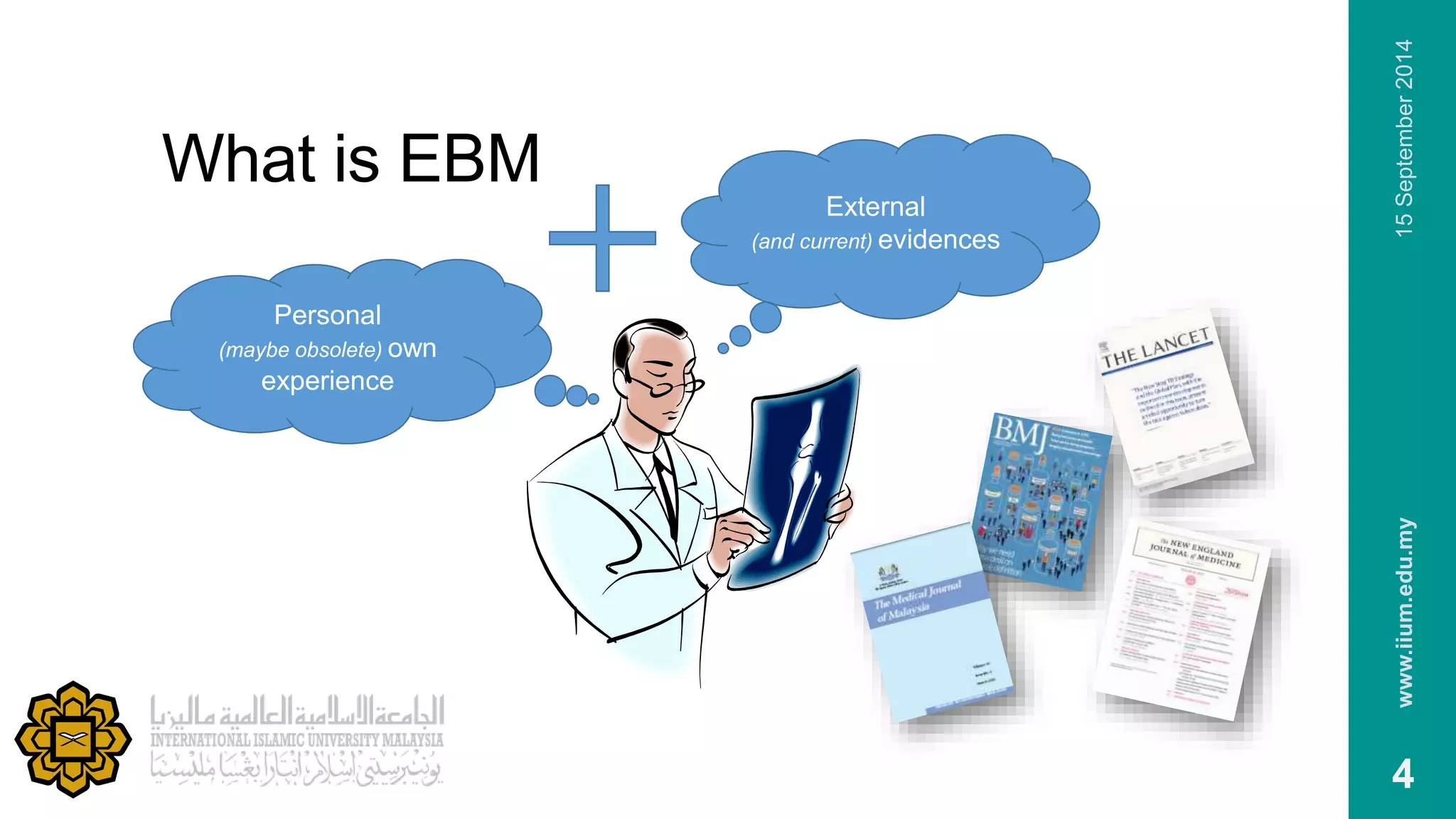
What is EBM 
www.iium.edu.my 15 September 2014 
4 
Personal 
(maybe obsolete) own 
experience 
External 
(and current) evidences
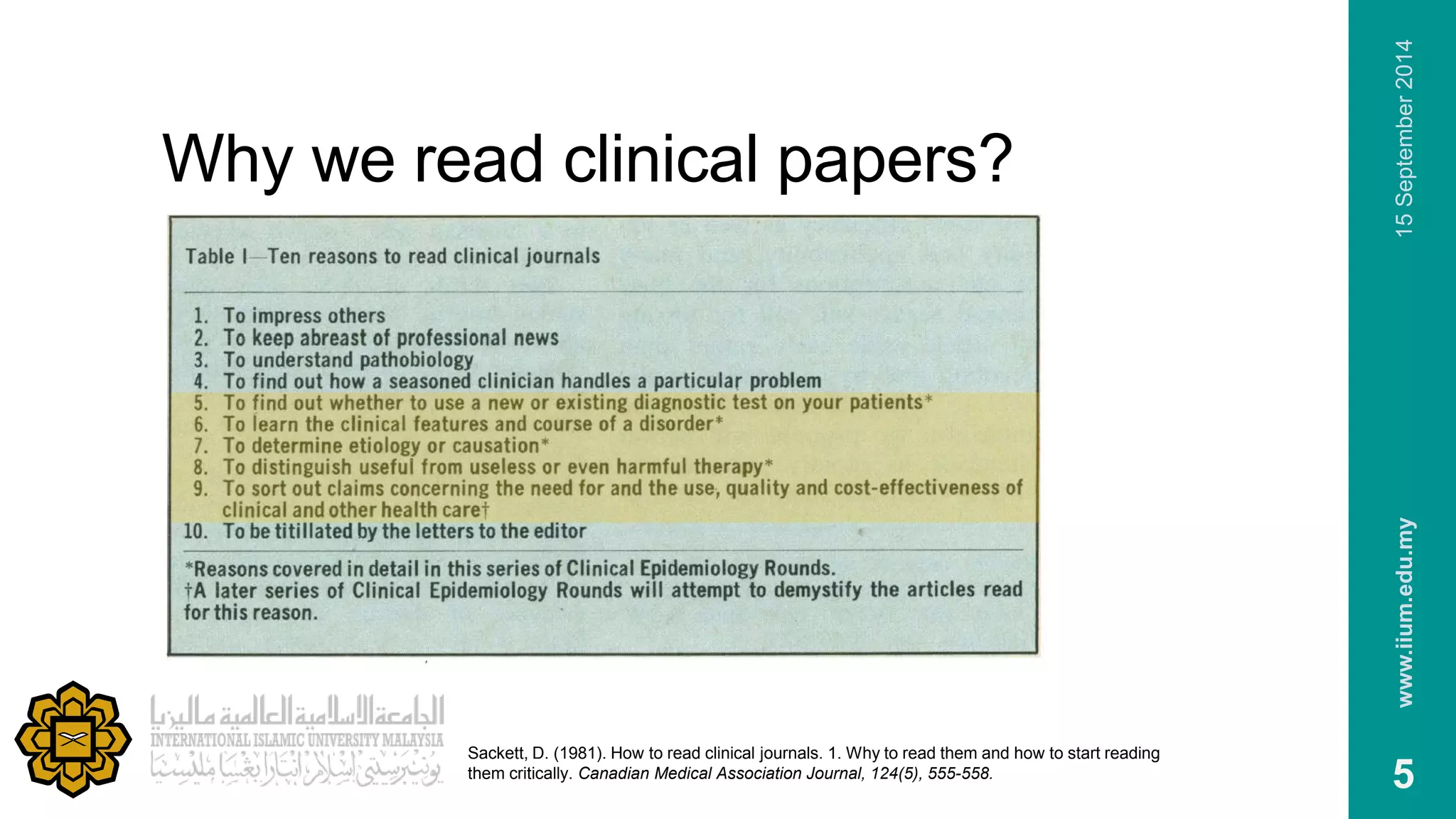
Why we read clinical papers? 
www.iium.edu.my 15 September 2014 
5 
Sackett, D. (1981). How to read clinical journals. 1. Why to read them and how to start reading 
them critically. Canadian Medical Association Journal, 124(5), 555-558.
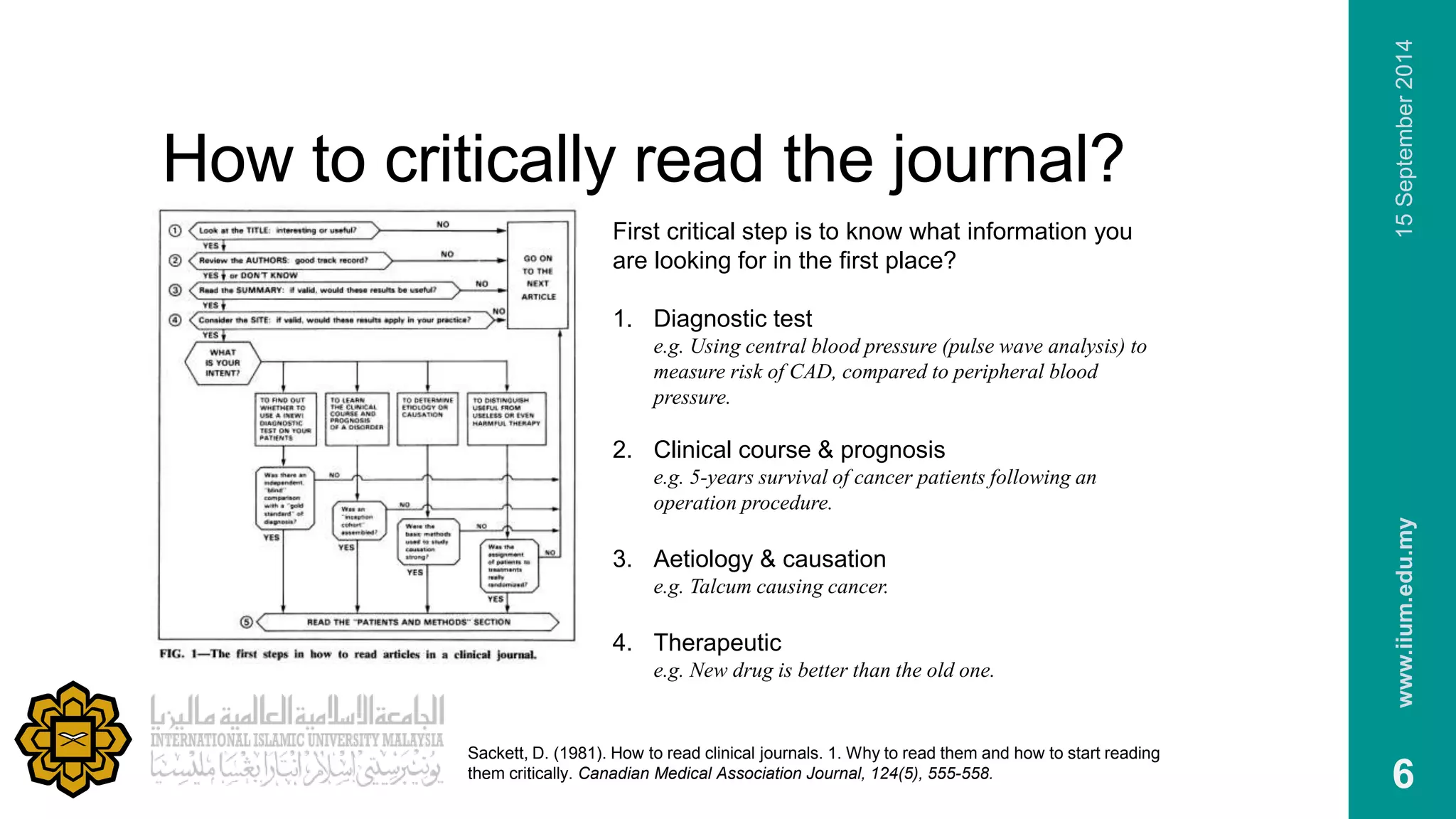
How to critically read the journal? 
www.iium.edu.my 15 September 2014 
6 
First critical step is to know what information you 
are looking for in the first place? 
1. Diagnostic test 
e.g. Using central blood pressure (pulse wave analysis) to 
measure risk of CAD, compared to peripheral blood 
pressure. 
2. Clinical course & prognosis 
e.g. 5-years survival of cancer patients following an 
operation procedure. 
3. Aetiology & causation 
e.g. Talcum causing cancer. 
4. Therapeutic 
e.g. New drug is better than the old one. 
Sackett, D. (1981). How to read clinical journals. 1. Why to read them and how to start reading 
them critically. Canadian Medical Association Journal, 124(5), 555-558.
Diagnostic 
 Evaluate new diagnostic test 
 Compare to GOLD standard 
www.iium.edu.my 15 September 2014 
7
www.iium.edu.my 15 September 2014 
8 
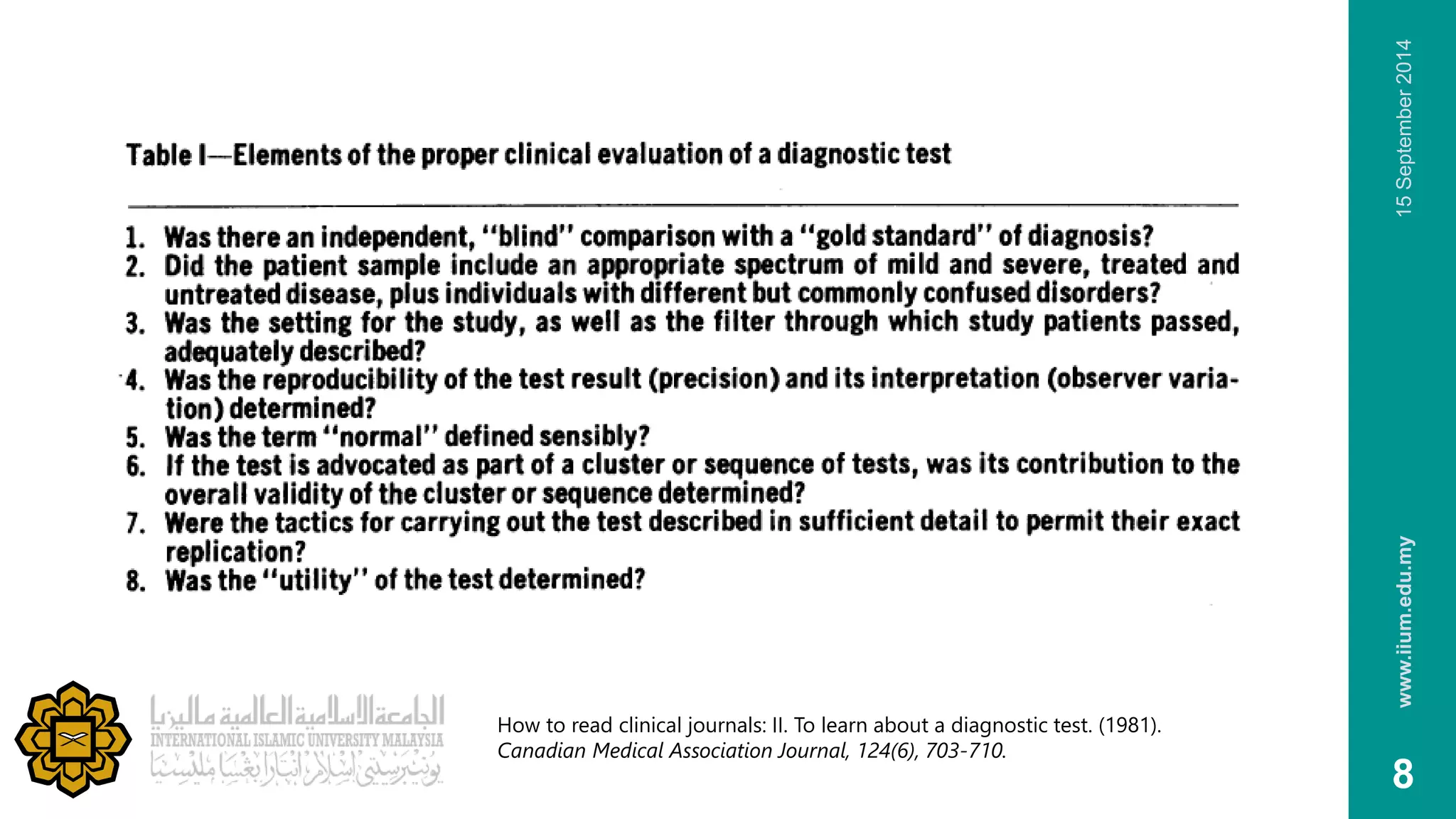
How to read clinical journals: II. To learn about a diagnostic test. (1981). 
Canadian Medical Association Journal, 124(6), 703-710.
Prognosis 
 Clinical course of a disease – e.g. Recurrence rate, 3- 
year survival, reinfection etc. 
www.iium.edu.my 15 September 2014 
9
www.iium.edu.my 15 September 2014 
10 
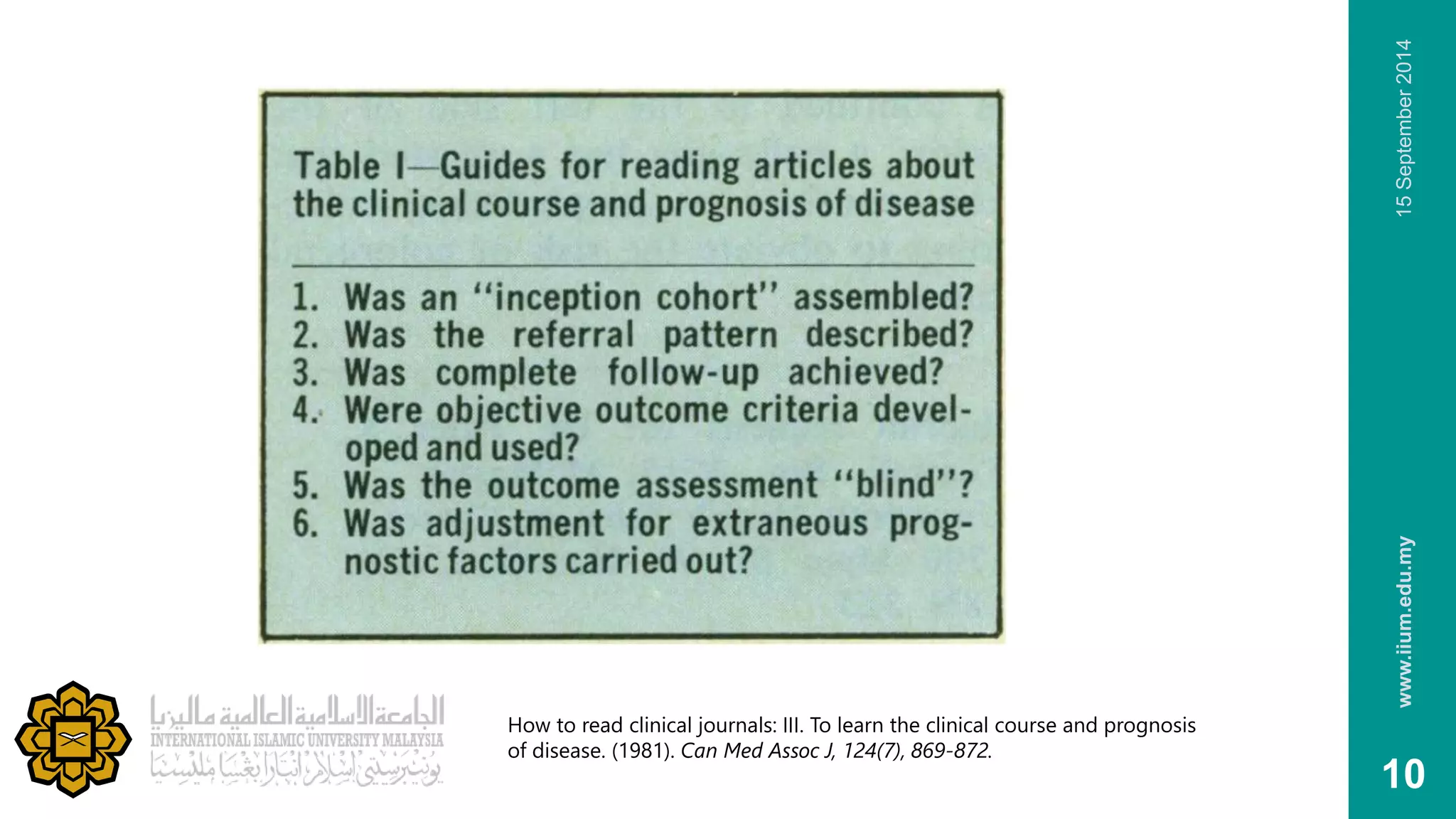
How to read clinical journals: III. To learn the clinical course and prognosis 
of disease. (1981). Can Med Assoc J, 124(7), 869-872.
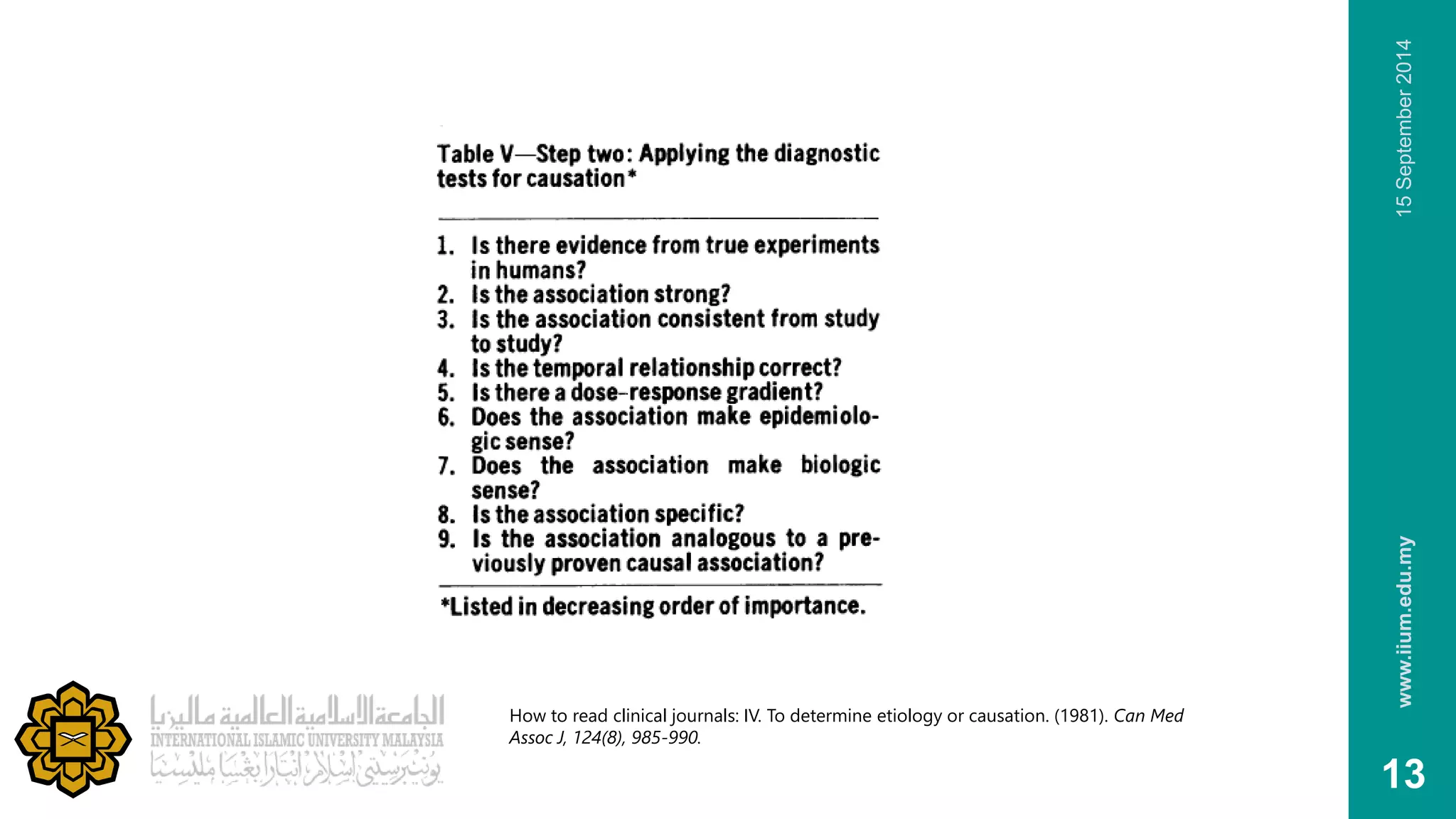
Causation 
 About one causing the other e.g. smoking causing lung 
cancer 
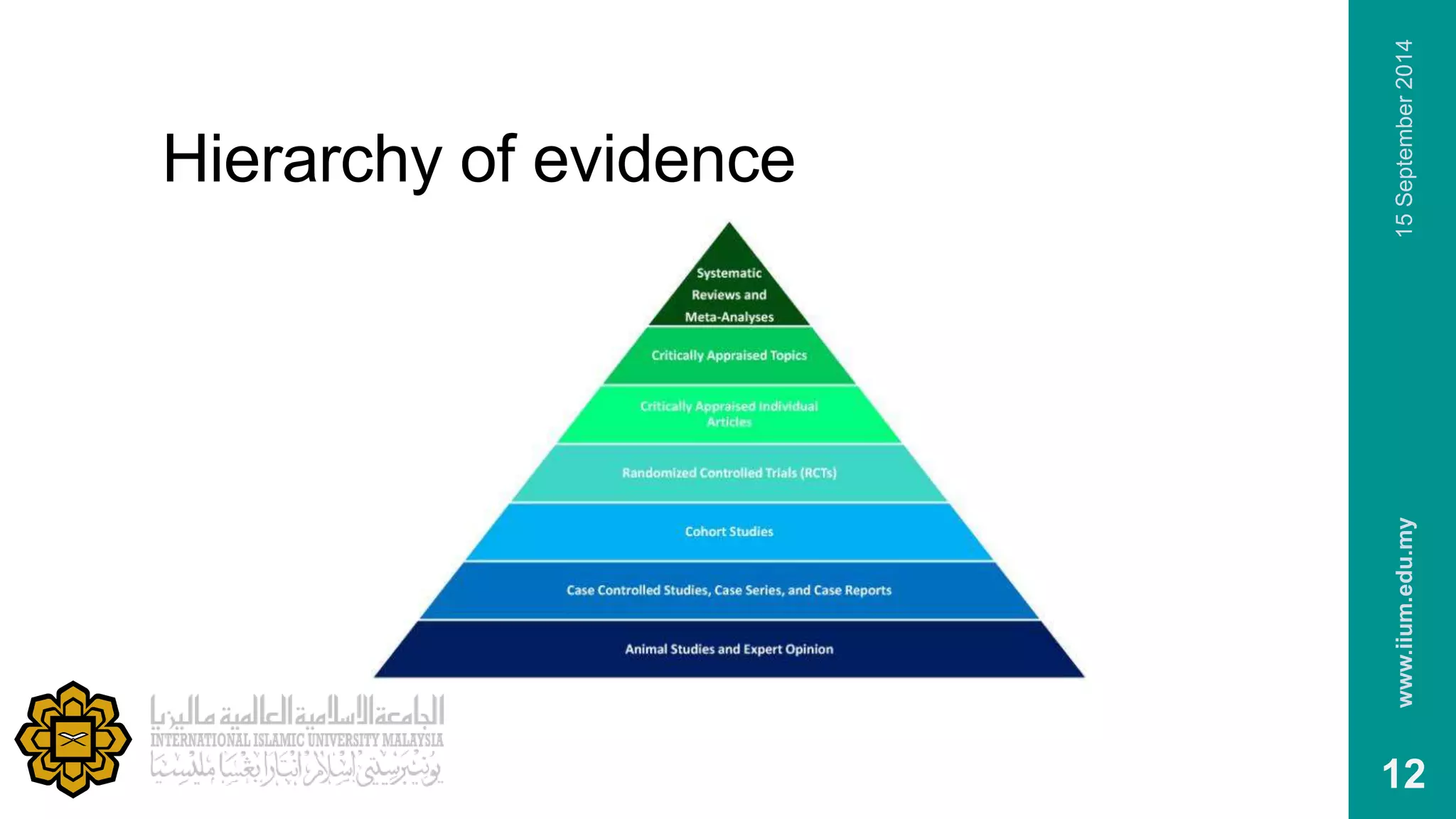
 Hierarchy of evidence 
www.iium.edu.my 15 September 2014 
11
Hierarchy of evidence 
www.iium.edu.my 15 September 2014 
12
www.iium.edu.my 15 September 2014 
13 
How to read clinical journals: IV. To determine etiology or causation. (1981). Can Med 
Assoc J, 124(8), 985-990.
Therapy 
 How useful or harmful of a therapy e.g. prescribe high 
dose vitamin C for cancer patient; low dose aspirin for all 
hypertensive patients 
www.iium.edu.my 15 September 2014 
14
www.iium.edu.my 15 September 2014 
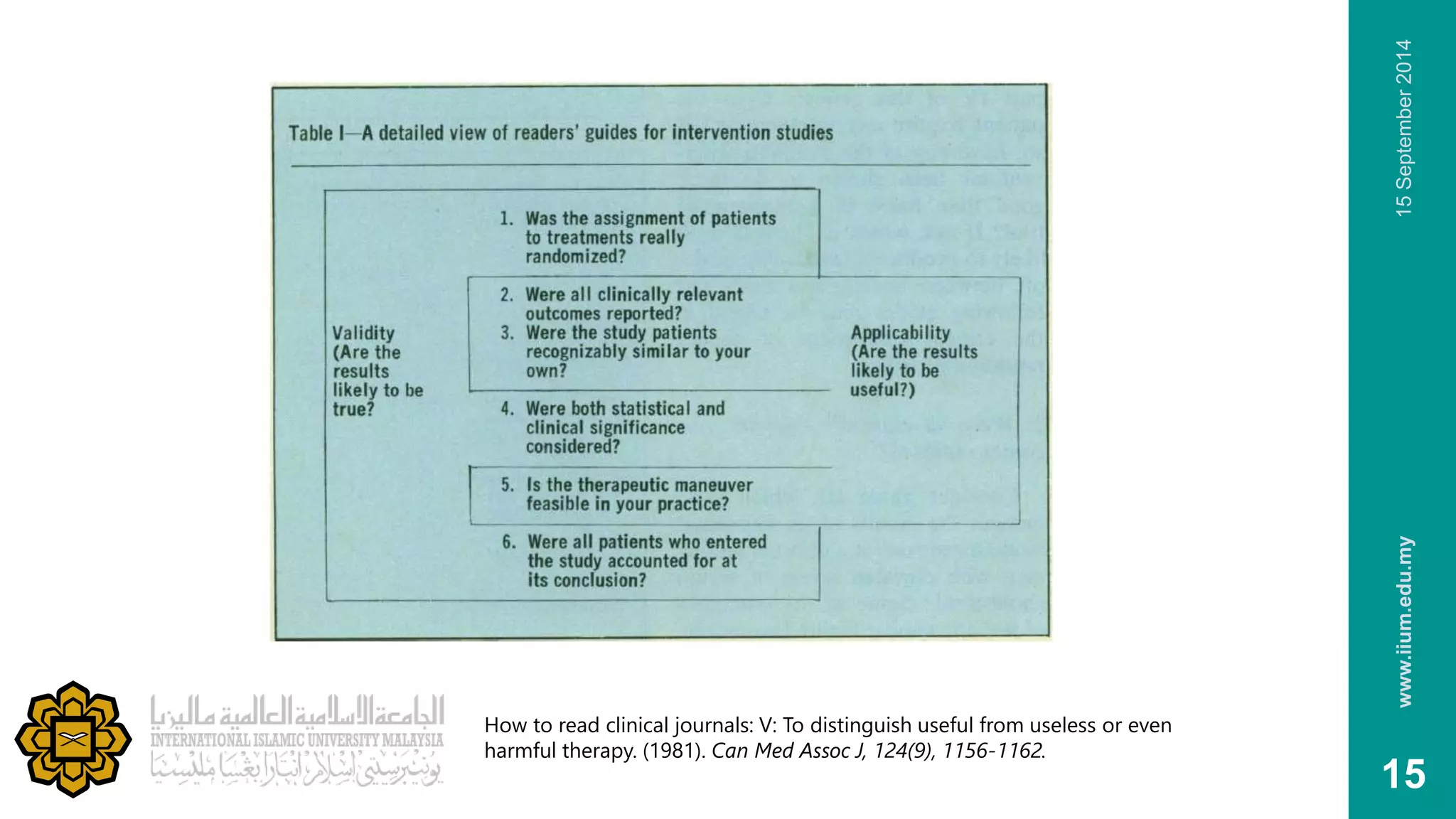
15 
How to read clinical journals: V: To distinguish useful from useless or even 
harmful therapy. (1981). Can Med Assoc J, 124(9), 1156-1162.
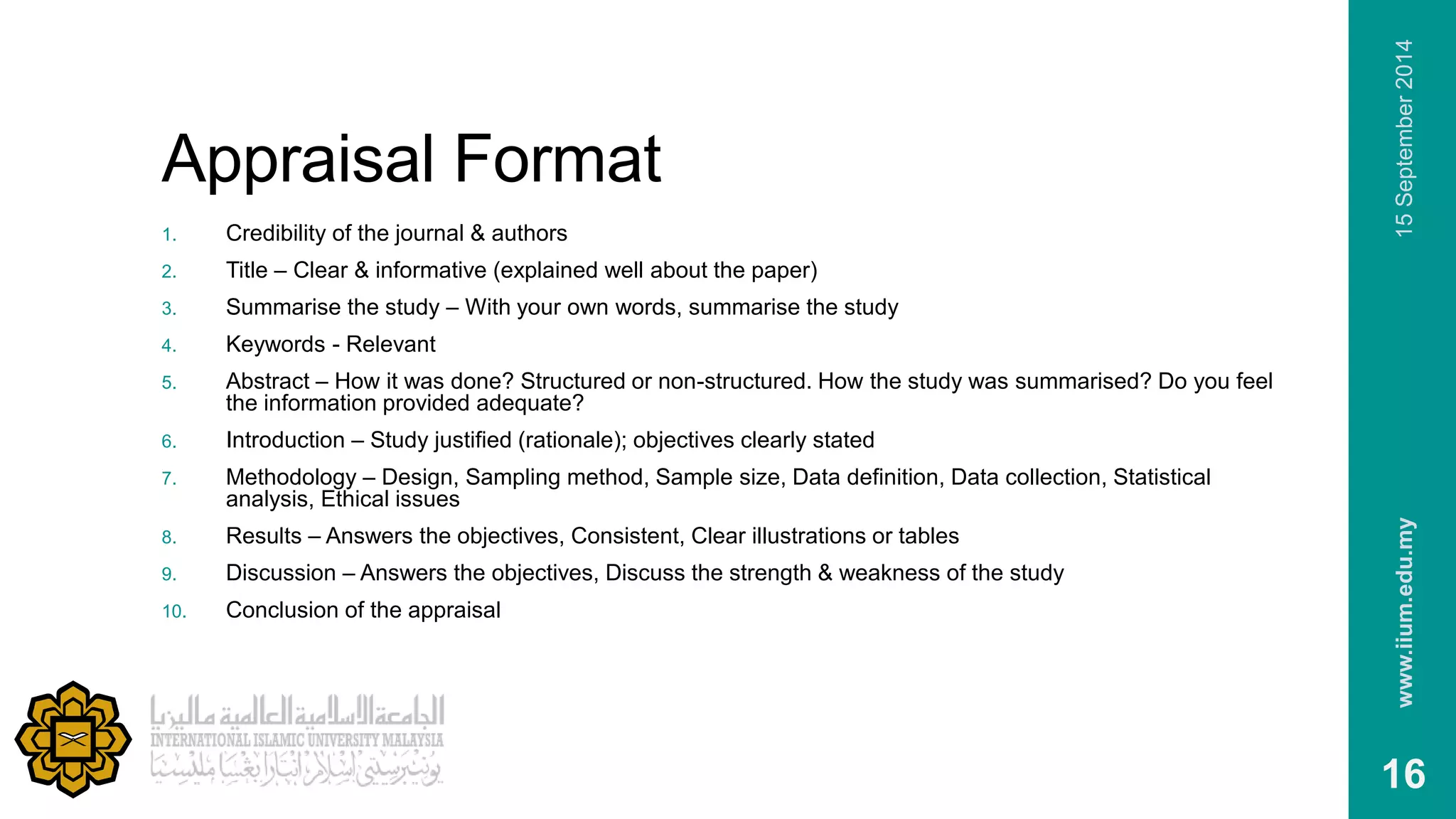
Appraisal Format 
1. Credibility of the journal & authors 
2. Title – Clear & informative (explained well about the paper) 
3. Summarise the study – With your own words, summarise the study 
4. Keywords - Relevant 
5. Abstract – How it was done? Structured or non-structured. How the study was summarised? Do you feel 
the information provided adequate? 
6. Introduction – Study justified (rationale); objectives clearly stated 
7. Methodology – Design, Sampling method, Sample size, Data definition, Data collection, Statistical 
analysis, Ethical issues 
8. Results – Answers the objectives, Consistent, Clear illustrations or tables 
9. Discussion – Answers the objectives, Discuss the strength & weakness of the study 
10. Conclusion of the appraisal 
www.iium.edu.my 15 September 2014 
16
Don’t forget to tell about the study 
 Don’t just write all about your comments 
 Must include what is the study is all about 
www.iium.edu.my 15 September 2014 
17
EBM is a guide 
 …and will always be just a guide 
 Horses for courses 
 Cross sectional studies still have important place in 
research, esp. evidence based policy 
www.iium.edu.my 15 September 2014 
18
Main references 
 Fowkes, F. G., & Fulton, P. M. (1991). Critical appraisal of published research: introductory guidelines (Vol. 
302). 
 How to read clinical journals: II. To learn about a diagnostic test. (1981). Canadian Medical Association 
Journal, 124(6), 703-710. 
 How to read clinical journals: III. To learn the clinical course and prognosis of disease. (1981). Can Med 
Assoc J, 124(7), 869-872. 
 How to read clinical journals: IV. To determine etiology or causation. (1981). Can Med Assoc J, 124(8), 
985-990. 
 How to read clinical journals: V: To distinguish useful from useless or even harmful therapy. (1981). Can 
Med Assoc J, 124(9), 1156-1162. 
 Greenhalgh, T. (1997). How to read a paper. Getting your bearings (deciding what the paper is about). 
Bmj, 315(7102), 243-246. 
 Sackett, D. (1981). How to read clinical journals. 1. Why to read them and how to start reading them 
critically. Canadian Medical Association Journal, 124(5), 555-558. 
www.iium.edu.my 15 September 2014 
19

Critical appraisal guideline

  • 1.
    Critical Appraisal JamalludinAb Rahman MD MPH Department of Community Medicine
  • 2.
    Evidence Based Medicine “Evidence based medicine is the conscientious, explicit, and judicious use of current best evidence in making decisions about the care of individual patients.” “Good doctors use both individual clinical expertise and the best available external evidence, and neither alone is enough.” “External clinical evidence can inform, but can never replace, individual clinical expertise…” www.iium.edu.my 15 September 2014 2 Sackett, D. L., Rosenberg, W. M. C., Gray, J. A. M., Haynes, R. B., & Richardson, W. S. (1996). Evidence based medicine: what it is and what it isn't (Vol. 312).
  • 3.
    The origin ofEBM  1975, Dr David L Sackett discovered that the factor that determine the prescription for hypertension is the graduating years of the doctors.  1990, Dr Gordon Guyatt coined the term Evidence Based Medicine for a new Internal Medicine residency programme known as “Scientific Medicine” www.iium.edu.my 15 September 2014 3 Kowalski, E., & Chung, K. C. (2013). The outcomes movement and evidence-based medicine in plastic surgery. Clin Plast Surg, 40(2), 241- 247. doi: 10.1016/j.cps.2012.10.001
  • 4.
    What is EBM www.iium.edu.my 15 September 2014 4 Personal (maybe obsolete) own experience External (and current) evidences
  • 5.
    Why we readclinical papers? www.iium.edu.my 15 September 2014 5 Sackett, D. (1981). How to read clinical journals. 1. Why to read them and how to start reading them critically. Canadian Medical Association Journal, 124(5), 555-558.
  • 6.
    How to criticallyread the journal? www.iium.edu.my 15 September 2014 6 First critical step is to know what information you are looking for in the first place? 1. Diagnostic test e.g. Using central blood pressure (pulse wave analysis) to measure risk of CAD, compared to peripheral blood pressure. 2. Clinical course & prognosis e.g. 5-years survival of cancer patients following an operation procedure. 3. Aetiology & causation e.g. Talcum causing cancer. 4. Therapeutic e.g. New drug is better than the old one. Sackett, D. (1981). How to read clinical journals. 1. Why to read them and how to start reading them critically. Canadian Medical Association Journal, 124(5), 555-558.
  • 7.
    Diagnostic  Evaluatenew diagnostic test  Compare to GOLD standard www.iium.edu.my 15 September 2014 7
  • 8.
    www.iium.edu.my 15 September2014 8 How to read clinical journals: II. To learn about a diagnostic test. (1981). Canadian Medical Association Journal, 124(6), 703-710.
  • 9.
    Prognosis  Clinicalcourse of a disease – e.g. Recurrence rate, 3- year survival, reinfection etc. www.iium.edu.my 15 September 2014 9
  • 10.
    www.iium.edu.my 15 September2014 10 How to read clinical journals: III. To learn the clinical course and prognosis of disease. (1981). Can Med Assoc J, 124(7), 869-872.
  • 11.
    Causation  Aboutone causing the other e.g. smoking causing lung cancer  Hierarchy of evidence www.iium.edu.my 15 September 2014 11
  • 12.
    Hierarchy of evidence www.iium.edu.my 15 September 2014 12
  • 13.
    www.iium.edu.my 15 September2014 13 How to read clinical journals: IV. To determine etiology or causation. (1981). Can Med Assoc J, 124(8), 985-990.
  • 14.
    Therapy  Howuseful or harmful of a therapy e.g. prescribe high dose vitamin C for cancer patient; low dose aspirin for all hypertensive patients www.iium.edu.my 15 September 2014 14
  • 15.
    www.iium.edu.my 15 September2014 15 How to read clinical journals: V: To distinguish useful from useless or even harmful therapy. (1981). Can Med Assoc J, 124(9), 1156-1162.
  • 16.
    Appraisal Format 1.Credibility of the journal & authors 2. Title – Clear & informative (explained well about the paper) 3. Summarise the study – With your own words, summarise the study 4. Keywords - Relevant 5. Abstract – How it was done? Structured or non-structured. How the study was summarised? Do you feel the information provided adequate? 6. Introduction – Study justified (rationale); objectives clearly stated 7. Methodology – Design, Sampling method, Sample size, Data definition, Data collection, Statistical analysis, Ethical issues 8. Results – Answers the objectives, Consistent, Clear illustrations or tables 9. Discussion – Answers the objectives, Discuss the strength & weakness of the study 10. Conclusion of the appraisal www.iium.edu.my 15 September 2014 16
  • 17.
    Don’t forget totell about the study  Don’t just write all about your comments  Must include what is the study is all about www.iium.edu.my 15 September 2014 17
  • 18.
    EBM is aguide  …and will always be just a guide  Horses for courses  Cross sectional studies still have important place in research, esp. evidence based policy www.iium.edu.my 15 September 2014 18
  • 19.
    Main references Fowkes, F. G., & Fulton, P. M. (1991). Critical appraisal of published research: introductory guidelines (Vol. 302).  How to read clinical journals: II. To learn about a diagnostic test. (1981). Canadian Medical Association Journal, 124(6), 703-710.  How to read clinical journals: III. To learn the clinical course and prognosis of disease. (1981). Can Med Assoc J, 124(7), 869-872.  How to read clinical journals: IV. To determine etiology or causation. (1981). Can Med Assoc J, 124(8), 985-990.  How to read clinical journals: V: To distinguish useful from useless or even harmful therapy. (1981). Can Med Assoc J, 124(9), 1156-1162.  Greenhalgh, T. (1997). How to read a paper. Getting your bearings (deciding what the paper is about). Bmj, 315(7102), 243-246.  Sackett, D. (1981). How to read clinical journals. 1. Why to read them and how to start reading them critically. Canadian Medical Association Journal, 124(5), 555-558. www.iium.edu.my 15 September 2014 19