Division of Institutional Advancement
Office of Grants and Sponsored Programs (OGSP)
Patrick Lynch, Director
(305) 899-3072
plynch@mail.barry.edu
Overview
 Barry’s grants profile;
 Types of grants and what they fund;
 Who makes grant awards?;
 Where to find grant opportunities;
 How to review/interpret grant announcements;
 Deciding if a specific grant is right for you;
 The importance of partnerships;
 Planning to prepare a grant application;
 The narrative components;
 The budget components;
 “Fatal Flaws;”
 Introduction to the National Institutes of Health;
 Questions
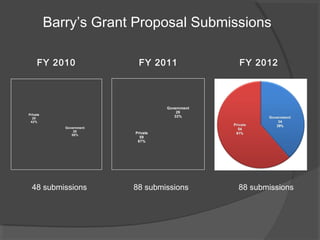
Barry’s Grant Proposal Submissions
48 submissions 88 submissions
FY 2010 FY 2011
Government
28
58%
Private
20
42%
Government
29
33%
Private
59
67%
FY 2012
88 submissions
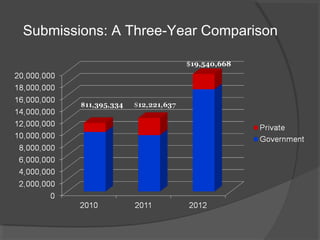
Submissions: A Three-Year Comparison
$19,540,668
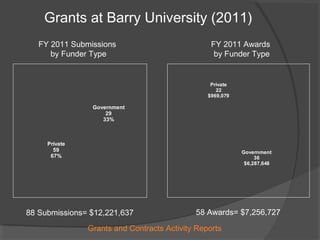
Government
29
33%
Private
59
67%
Government
36
$6,287,648
Private
22
$969,079
Grants at Barry University (2011)
FY 2011 Submissions
by Funder Type
FY 2011 Awards
by Funder Type
88 Submissions= $12,221,637 58 Awards= $7,256,727
Grants and Contracts Activity Reports
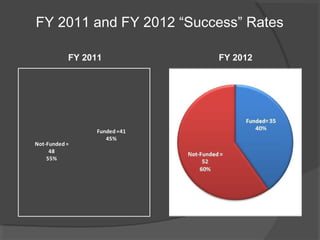
FY 2011 and FY 2012 “Success” Rates
Funded =41
45%
Not-Funded =
48
55%
FY 2011 FY 2012
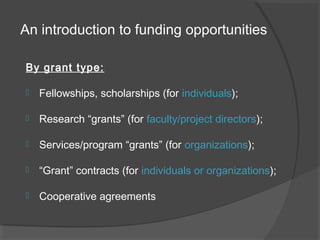
An introduction to funding opportunities
By grant type:
 Fellowships, scholarships (for individuals);
 Research “grants” (for faculty/project directors);
 Services/program “grants” (for organizations);
 “Grant” contracts (for individuals or organizations);
 Cooperative agreements
What gets grant-funded?
 Research
 Training
 Curriculum Development
 Construction/Renovation
 Equipment
 Service
Who makes grant awards?
By grantor type:
 GOVERNMENTAL (federal, state, local)
o e.g. – National Institutes of Health (US), FL Dept. of
Education (State), Miami Dade County (Local)
 PRIVATE (foundations, corporations, individuals,
associations)
o e.g. – Robert Wood Johnson Foundation (national),
W.K. Kellogg Foundation (national), American Nurses
Foundation (national), The Children’s Trust (local
Miami), The Miami Foundation(local Miami)
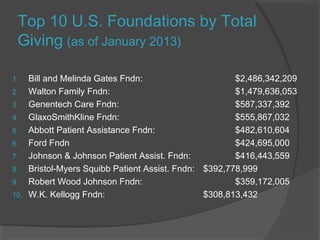
Top 10 U.S. Foundations by Total
Giving (as of January 2013)
1. Bill and Melinda Gates Fndn: $2,486,342,209
2. Walton Family Fndn: $1,479,636,053
3. Genentech Care Fndn: $587,337,392
4. GlaxoSmithKline Fndn: $555,867,032
5. Abbott Patient Assistance Fndn: $482,610,604
6. Ford Fndn $424,695,000
7. Johnson & Johnson Patient Assist. Fndn: $416,443,559
8. Bristol-Myers Squibb Patient Assist. Fndn: $392,778,999
9. Robert Wood Johnson Fndn: $359,172,005
10. W.K. Kellogg Fndn: $308,813,432
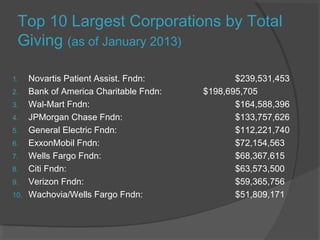
Top 10 Largest Corporations by Total
Giving (as of January 2013)
1. Novartis Patient Assist. Fndn: $239,531,453
2. Bank of America Charitable Fndn: $198,695,705
3. Wal-Mart Fndn: $164,588,396
4. JPMorgan Chase Fndn: $133,757,626
5. General Electric Fndn: $112,221,740
6. ExxonMobil Fndn: $72,154,563
7. Wells Fargo Fndn: $68,367,615
8. Citi Fndn: $63,573,500
9. Verizon Fndn: $59,365,756
10. Wachovia/Wells Fargo Fndn: $51,809,171
Finding funding
opportunities
Existing grant locator resources
□ Grants.gov (federal): http://www.grants.gov/
□ Private Foundation Services (some cost)
o Chronicle of Philanthropy, Foundation Center Online (
http://foundationcenter.org/findfunders/), Guidestar, general web
□ Agency-specific sites (NIH, DOE, etc)
□ Miami Dade County - http://www.miamidade.gov/grants
□ Academic Associations
Selected Grant Funding Sources for
Nursing Projects
 National League for Nursing (NLN)
 American Nurses Association (ANA)
 American Nurses Foundation (ANF)
 Florida Nurses Foundation (FNF)
 Florida Nurses Association (FNA)
 Sigma Theta Tau International Honor
Society of Nursing
 Robert Wood Johnson Foundation
 American Holistic Nurses Association
 National Institutes of Health (NINR)
Reviewing grant announcements
If you find an announcement of funds available:
1. Check the due date
2. Make sure you (organization) are eligible
3. Research the funder to determine your chances
of success
4. Look at special requirements like “match”,
partnerships, evidence-based practices (EBP)
5. Carefully review application elements
Exercise- Raskob Foundation
 Is Barry eligible to apply?
 When is the due date?
 Is a match required?
 Is a budget required?
 How much can we request?
 If denied, can we re-apply for the same
project?
 Are there any other important notes?
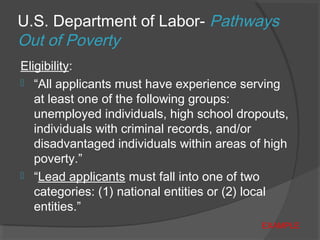
U.S. Department of Labor- Pathways
Out of Poverty
Eligibility:
 “All applicants must have experience serving
at least one of the following groups:
unemployed individuals, high school dropouts,
individuals with criminal records, and/or
disadvantaged individuals within areas of high
poverty.”
 “Lead applicants must fall into one of two
categories: (1) national entities or (2) local
entities.”
EXAMPLE
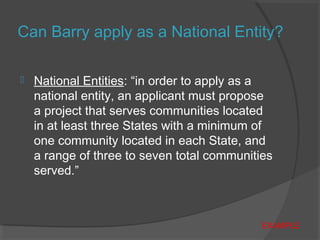
 National Entities: “in order to apply as a
national entity, an applicant must propose
a project that serves communities located
in at least three States with a minimum of
one community located in each State, and
a range of three to seven total communities
served.”
Can Barry apply as a National Entity?
EXAMPLE
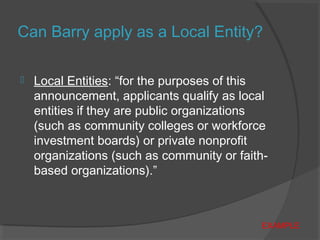
 Local Entities: “for the purposes of this
announcement, applicants qualify as local
entities if they are public organizations
(such as community colleges or workforce
investment boards) or private nonprofit
organizations (such as community or faith-
based organizations).”
Can Barry apply as a Local Entity?
EXAMPLE
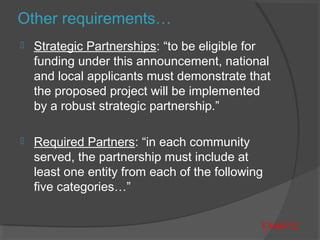
 Strategic Partnerships: “to be eligible for
funding under this announcement, national
and local applicants must demonstrate that
the proposed project will be implemented
by a robust strategic partnership.”
 Required Partners: “in each community
served, the partnership must include at
least one entity from each of the following
five categories…”
Other requirements…
EXAMPLE
 1. Nonprofit organizations, such as
community or faith-based organizations;
 2. The public workforce investment system;
 3. The education and training community,
which includes community and technical
colleges and four-year colleges and
universities;
 4. Public and private employers and
industry-related organizations;
 5. Labor organizations
EXAMPLE
Reviewing application instructions
 Sometimes contained in the Funding
Announcement
o Announcement/Instructions are one
document
 Other times contained in multiple documents
o National Institutes of Health (solicitation +
general guidance)
Applying for a grant
 Contact “Program Officers” if unsure about
something;
 Make sure you have the buy-in of your
administration and leadership before writing;
 Understand internal grant policies and
procedures;
 Find out if the activities are feasible. . . (Do you
have the staff, organizational capacity,
knowledge, certification/accreditation required to
implement the proposed project?)
 Is there the infrastructure to support an award?
(Physical space? Admin support?)
Applying for a grant
 Familiarize yourself with standard forms
and attachments early on in the process
 Know submission process (electronic vs.
paper)
 Know the institution’s authorized signatory
requirements
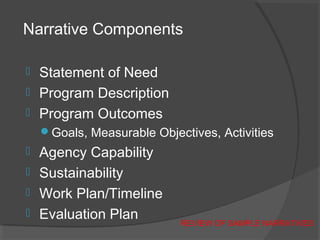
Narrative Components
 Statement of Need
 Program Description
 Program Outcomes
Goals, Measurable Objectives, Activities
 Agency Capability
 Sustainability
 Work Plan/Timeline
 Evaluation Plan
REVIEW OF SAMPLE NARRATIVES
Exercise-
Creating a Narrative Outline
20 minutes
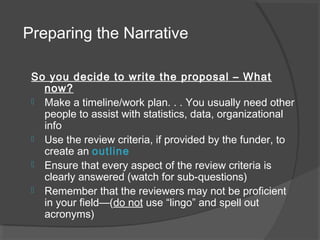
Preparing the Narrative
So you decide to write the proposal – What
now?
 Make a timeline/work plan. . . You usually need other
people to assist with statistics, data, organizational
info
 Use the review criteria, if provided by the funder, to
create an outline
 Ensure that every aspect of the review criteria is
clearly answered (watch for sub-questions)
 Remember that the reviewers may not be proficient
in your field—(do not use “lingo” and spell out
acronyms)
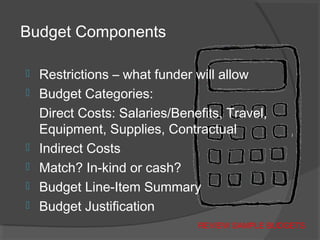
Budget Components
 Restrictions – what funder will allow
 Budget Categories:
Direct Costs: Salaries/Benefits, Travel,
Equipment, Supplies, Contractual
 Indirect Costs
 Match? In-kind or cash?
 Budget Line-Item Summary
 Budget Justification
REVIEW SAMPLE BUDGETS
Budget Notes
 Make a reasonable funding request
 Justify each item of the budget
 Get bids/quotes/estimates – back up for
travel, equipment, supplies, etc.
 Confirm request corresponds directly to the
narrative and the scope of work
 Check and re-check figures
Review Your Own Proposal
 Re-Read Instructions
 Create a Self Review Tool to check against
review criteria for sufficiency (rate/score if
possible)
 Review the Application Yourself
 Ask Others to Review the Application
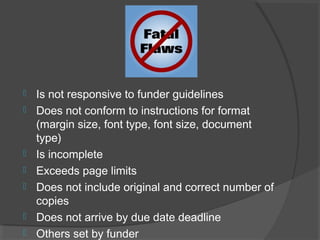
 Is not responsive to funder guidelines
 Does not conform to instructions for format
(margin size, font type, font size, document
type)
 Is incomplete
 Exceeds page limits
 Does not include original and correct number of
copies
 Does not arrive by due date deadline
 Others set by funder
Submission
SUBMIT EARLY!
Follow-Up
 Always follow-up on any rejection/denials
from grant funders.
Examples:
○ 2011 U.S. Department of Justice (OVW)
application;
○ The Children’s Trust;
○ 2012 Institute for Museum and Library
Science application.
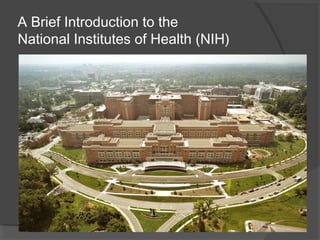
A Brief Introduction to the
National Institutes of Health (NIH)
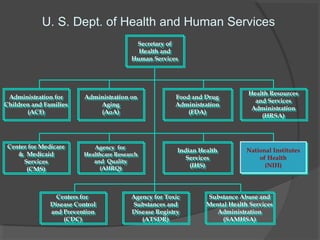
U. S. Dept. of Health and Human Services
Administration for
Children and Families
(ACF)
Administration for
Children and Families
(ACF)
Food and Drug
Administration
(FDA)
Food and Drug
Administration
(FDA)
Health Resources
and Services
Administration
(HRSA)
Health Resources
and Services
Administration
(HRSA)
Secretary of
Health and
Human Services
Secretary of
Health and
Human Services
Administration on
Aging
(AoA)
Administration on
Aging
(AoA)
Center for Medicare
& Medicaid
Services
(CMS)
Center for Medicare
& Medicaid
Services
(CMS)
Indian Health
Services
(IHS)
Indian Health
Services
(IHS)
National Institutes
of Health
(NIH)
National Institutes
of Health
(NIH)
Centers for
Disease Control
and Prevention
(CDC)
Centers for
Disease Control
and Prevention
(CDC)
Substance Abuse and
Mental Health Services
Administration
(SAMHSA)
Substance Abuse and
Mental Health Services
Administration
(SAMHSA)
Agency for Toxic
Substances and
Disease Registry
(ATSDR)
Agency for Toxic
Substances and
Disease Registry
(ATSDR)
Agency for
Healthcare Research
and Quality
(AHRQ)
Agency for
Healthcare Research
and Quality
(AHRQ)
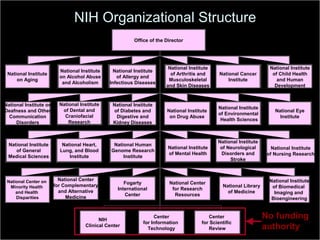
NIH Organizational Structure
National Institute
on Alcohol Abuse
and Alcoholism
National Institute
of Arthritis and
Musculoskeletal
and Skin Diseases
National Cancer
Institute
National Institute
on Aging
National Institute
of Child Health
and Human
Development
National Institute
of Allergy and
Infectious Diseases
National Institute
of Diabetes and
Digestive and
Kidney Diseases
National Institute
of Dental and
Craniofacial
Research
National Institute
on Drug Abuse
National Institute
of Environmental
Health Sciences
National Institute on
Deafness and Other
Communication
Disorders
National Eye
Institute
National Human
Genome Research
Institute
National Heart,
Lung, and Blood
Institute
National Institute
of Mental Health
National Institute
of Neurological
Disorders and
Stroke
National Institute
of General
Medical Sciences
National Institute
of Nursing Research
National Library
of Medicine
National Center
for Complementary
and Alternative
Medicine
Fogarty
International
Center
National Center
for Research
Resources
National Institute
of Biomedical
Imaging and
Bioengineering
No funding
authority
NIH
Clinical Center
Center
for Information
Technology
Center
for Scientific
Review
National Center on
Minority Health
and Health
Disparities
Office of the Director
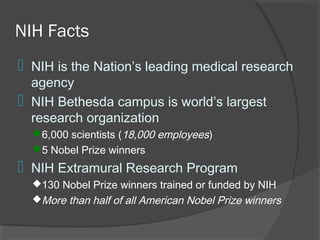
NIH Facts
 NIH is the Nation’s leading medical research
agency
 NIH Bethesda campus is world’s largest
research organization
6,000 scientists (18,000 employees)
5 Nobel Prize winners
 NIH Extramural Research Program
130 Nobel Prize winners trained or funded by NIH
More than half of all American Nobel Prize winners
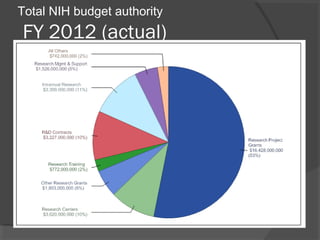
Total NIH budget authority
FY 2012 (actual)
NIH Grant Statistics
 More than 80% of the NIH's funding is
awarded through almost 50,000 competitive
grants to more than 300,000 researchers at
more than 2,500 universities, medical schools,
and other research institutions in every state
and around the world.
Grant Mechanisms
 Program Projects and Centers
 Training Grants
 Career Development Awards
 Research Projects (R01, R21, R03)
NIH- Research Project Grants
 Basic Components:
Research Plan:
○ Specific Aims (one page summary of goals, expected
outcomes)
○ Research Strategy (Significance, Innovation, Approach)
Budget (Research & Related vs. Modular)
Bibliography
Biosketch
Other attachments
NIH Videos
NIH Tips for Applicants (4:38)
NIH Peer Review Revealed (14:52)
Final Thoughts…

Nursing class 5 20-13- no notes

  • 2.
    Division of InstitutionalAdvancement Office of Grants and Sponsored Programs (OGSP) Patrick Lynch, Director (305) 899-3072 plynch@mail.barry.edu
  • 3.
    Overview  Barry’s grantsprofile;  Types of grants and what they fund;  Who makes grant awards?;  Where to find grant opportunities;  How to review/interpret grant announcements;  Deciding if a specific grant is right for you;  The importance of partnerships;  Planning to prepare a grant application;  The narrative components;  The budget components;  “Fatal Flaws;”  Introduction to the National Institutes of Health;  Questions
  • 4.
    Barry’s Grant ProposalSubmissions 48 submissions 88 submissions FY 2010 FY 2011 Government 28 58% Private 20 42% Government 29 33% Private 59 67% FY 2012 88 submissions
  • 5.
    Submissions: A Three-YearComparison $19,540,668
  • 6.
    Government 29 33% Private 59 67% Government 36 $6,287,648 Private 22 $969,079 Grants at BarryUniversity (2011) FY 2011 Submissions by Funder Type FY 2011 Awards by Funder Type 88 Submissions= $12,221,637 58 Awards= $7,256,727 Grants and Contracts Activity Reports
  • 7.
    FY 2011 andFY 2012 “Success” Rates Funded =41 45% Not-Funded = 48 55% FY 2011 FY 2012
  • 8.
    An introduction tofunding opportunities By grant type:  Fellowships, scholarships (for individuals);  Research “grants” (for faculty/project directors);  Services/program “grants” (for organizations);  “Grant” contracts (for individuals or organizations);  Cooperative agreements
  • 9.
    What gets grant-funded? Research  Training  Curriculum Development  Construction/Renovation  Equipment  Service
  • 10.
    Who makes grantawards? By grantor type:  GOVERNMENTAL (federal, state, local) o e.g. – National Institutes of Health (US), FL Dept. of Education (State), Miami Dade County (Local)  PRIVATE (foundations, corporations, individuals, associations) o e.g. – Robert Wood Johnson Foundation (national), W.K. Kellogg Foundation (national), American Nurses Foundation (national), The Children’s Trust (local Miami), The Miami Foundation(local Miami)
  • 11.
    Top 10 U.S.Foundations by Total Giving (as of January 2013) 1. Bill and Melinda Gates Fndn: $2,486,342,209 2. Walton Family Fndn: $1,479,636,053 3. Genentech Care Fndn: $587,337,392 4. GlaxoSmithKline Fndn: $555,867,032 5. Abbott Patient Assistance Fndn: $482,610,604 6. Ford Fndn $424,695,000 7. Johnson & Johnson Patient Assist. Fndn: $416,443,559 8. Bristol-Myers Squibb Patient Assist. Fndn: $392,778,999 9. Robert Wood Johnson Fndn: $359,172,005 10. W.K. Kellogg Fndn: $308,813,432
  • 12.
    Top 10 LargestCorporations by Total Giving (as of January 2013) 1. Novartis Patient Assist. Fndn: $239,531,453 2. Bank of America Charitable Fndn: $198,695,705 3. Wal-Mart Fndn: $164,588,396 4. JPMorgan Chase Fndn: $133,757,626 5. General Electric Fndn: $112,221,740 6. ExxonMobil Fndn: $72,154,563 7. Wells Fargo Fndn: $68,367,615 8. Citi Fndn: $63,573,500 9. Verizon Fndn: $59,365,756 10. Wachovia/Wells Fargo Fndn: $51,809,171
  • 13.
    Finding funding opportunities Existing grantlocator resources □ Grants.gov (federal): http://www.grants.gov/ □ Private Foundation Services (some cost) o Chronicle of Philanthropy, Foundation Center Online ( http://foundationcenter.org/findfunders/), Guidestar, general web □ Agency-specific sites (NIH, DOE, etc) □ Miami Dade County - http://www.miamidade.gov/grants □ Academic Associations
  • 14.
    Selected Grant FundingSources for Nursing Projects  National League for Nursing (NLN)  American Nurses Association (ANA)  American Nurses Foundation (ANF)  Florida Nurses Foundation (FNF)  Florida Nurses Association (FNA)  Sigma Theta Tau International Honor Society of Nursing  Robert Wood Johnson Foundation  American Holistic Nurses Association  National Institutes of Health (NINR)
  • 15.
    Reviewing grant announcements Ifyou find an announcement of funds available: 1. Check the due date 2. Make sure you (organization) are eligible 3. Research the funder to determine your chances of success 4. Look at special requirements like “match”, partnerships, evidence-based practices (EBP) 5. Carefully review application elements
  • 16.
    Exercise- Raskob Foundation Is Barry eligible to apply?  When is the due date?  Is a match required?  Is a budget required?  How much can we request?  If denied, can we re-apply for the same project?  Are there any other important notes?
  • 17.
    U.S. Department ofLabor- Pathways Out of Poverty Eligibility:  “All applicants must have experience serving at least one of the following groups: unemployed individuals, high school dropouts, individuals with criminal records, and/or disadvantaged individuals within areas of high poverty.”  “Lead applicants must fall into one of two categories: (1) national entities or (2) local entities.” EXAMPLE
  • 18.
     National Entities:“in order to apply as a national entity, an applicant must propose a project that serves communities located in at least three States with a minimum of one community located in each State, and a range of three to seven total communities served.” Can Barry apply as a National Entity? EXAMPLE
  • 19.
     Local Entities:“for the purposes of this announcement, applicants qualify as local entities if they are public organizations (such as community colleges or workforce investment boards) or private nonprofit organizations (such as community or faith- based organizations).” Can Barry apply as a Local Entity? EXAMPLE
  • 20.
     Strategic Partnerships:“to be eligible for funding under this announcement, national and local applicants must demonstrate that the proposed project will be implemented by a robust strategic partnership.”  Required Partners: “in each community served, the partnership must include at least one entity from each of the following five categories…” Other requirements… EXAMPLE
  • 21.
     1. Nonprofitorganizations, such as community or faith-based organizations;  2. The public workforce investment system;  3. The education and training community, which includes community and technical colleges and four-year colleges and universities;  4. Public and private employers and industry-related organizations;  5. Labor organizations EXAMPLE
  • 22.
    Reviewing application instructions Sometimes contained in the Funding Announcement o Announcement/Instructions are one document  Other times contained in multiple documents o National Institutes of Health (solicitation + general guidance)
  • 23.
    Applying for agrant  Contact “Program Officers” if unsure about something;  Make sure you have the buy-in of your administration and leadership before writing;  Understand internal grant policies and procedures;  Find out if the activities are feasible. . . (Do you have the staff, organizational capacity, knowledge, certification/accreditation required to implement the proposed project?)  Is there the infrastructure to support an award? (Physical space? Admin support?)
  • 24.
    Applying for agrant  Familiarize yourself with standard forms and attachments early on in the process  Know submission process (electronic vs. paper)  Know the institution’s authorized signatory requirements
  • 25.
    Narrative Components  Statementof Need  Program Description  Program Outcomes Goals, Measurable Objectives, Activities  Agency Capability  Sustainability  Work Plan/Timeline  Evaluation Plan REVIEW OF SAMPLE NARRATIVES
  • 26.
  • 27.
    Preparing the Narrative Soyou decide to write the proposal – What now?  Make a timeline/work plan. . . You usually need other people to assist with statistics, data, organizational info  Use the review criteria, if provided by the funder, to create an outline  Ensure that every aspect of the review criteria is clearly answered (watch for sub-questions)  Remember that the reviewers may not be proficient in your field—(do not use “lingo” and spell out acronyms)
  • 28.
    Budget Components  Restrictions– what funder will allow  Budget Categories: Direct Costs: Salaries/Benefits, Travel, Equipment, Supplies, Contractual  Indirect Costs  Match? In-kind or cash?  Budget Line-Item Summary  Budget Justification REVIEW SAMPLE BUDGETS
  • 29.
    Budget Notes  Makea reasonable funding request  Justify each item of the budget  Get bids/quotes/estimates – back up for travel, equipment, supplies, etc.  Confirm request corresponds directly to the narrative and the scope of work  Check and re-check figures
  • 30.
    Review Your OwnProposal  Re-Read Instructions  Create a Self Review Tool to check against review criteria for sufficiency (rate/score if possible)  Review the Application Yourself  Ask Others to Review the Application
  • 31.
     Is notresponsive to funder guidelines  Does not conform to instructions for format (margin size, font type, font size, document type)  Is incomplete  Exceeds page limits  Does not include original and correct number of copies  Does not arrive by due date deadline  Others set by funder
  • 32.
  • 33.
    Follow-Up  Always follow-upon any rejection/denials from grant funders. Examples: ○ 2011 U.S. Department of Justice (OVW) application; ○ The Children’s Trust; ○ 2012 Institute for Museum and Library Science application.
  • 34.
    A Brief Introductionto the National Institutes of Health (NIH)
  • 35.
    U. S. Dept.of Health and Human Services Administration for Children and Families (ACF) Administration for Children and Families (ACF) Food and Drug Administration (FDA) Food and Drug Administration (FDA) Health Resources and Services Administration (HRSA) Health Resources and Services Administration (HRSA) Secretary of Health and Human Services Secretary of Health and Human Services Administration on Aging (AoA) Administration on Aging (AoA) Center for Medicare & Medicaid Services (CMS) Center for Medicare & Medicaid Services (CMS) Indian Health Services (IHS) Indian Health Services (IHS) National Institutes of Health (NIH) National Institutes of Health (NIH) Centers for Disease Control and Prevention (CDC) Centers for Disease Control and Prevention (CDC) Substance Abuse and Mental Health Services Administration (SAMHSA) Substance Abuse and Mental Health Services Administration (SAMHSA) Agency for Toxic Substances and Disease Registry (ATSDR) Agency for Toxic Substances and Disease Registry (ATSDR) Agency for Healthcare Research and Quality (AHRQ) Agency for Healthcare Research and Quality (AHRQ)
  • 36.
    NIH Organizational Structure NationalInstitute on Alcohol Abuse and Alcoholism National Institute of Arthritis and Musculoskeletal and Skin Diseases National Cancer Institute National Institute on Aging National Institute of Child Health and Human Development National Institute of Allergy and Infectious Diseases National Institute of Diabetes and Digestive and Kidney Diseases National Institute of Dental and Craniofacial Research National Institute on Drug Abuse National Institute of Environmental Health Sciences National Institute on Deafness and Other Communication Disorders National Eye Institute National Human Genome Research Institute National Heart, Lung, and Blood Institute National Institute of Mental Health National Institute of Neurological Disorders and Stroke National Institute of General Medical Sciences National Institute of Nursing Research National Library of Medicine National Center for Complementary and Alternative Medicine Fogarty International Center National Center for Research Resources National Institute of Biomedical Imaging and Bioengineering No funding authority NIH Clinical Center Center for Information Technology Center for Scientific Review National Center on Minority Health and Health Disparities Office of the Director
  • 37.
    NIH Facts  NIHis the Nation’s leading medical research agency  NIH Bethesda campus is world’s largest research organization 6,000 scientists (18,000 employees) 5 Nobel Prize winners  NIH Extramural Research Program 130 Nobel Prize winners trained or funded by NIH More than half of all American Nobel Prize winners
  • 38.
    Total NIH budgetauthority FY 2012 (actual)
  • 39.
    NIH Grant Statistics More than 80% of the NIH's funding is awarded through almost 50,000 competitive grants to more than 300,000 researchers at more than 2,500 universities, medical schools, and other research institutions in every state and around the world.
  • 40.
    Grant Mechanisms  ProgramProjects and Centers  Training Grants  Career Development Awards  Research Projects (R01, R21, R03)
  • 41.
    NIH- Research ProjectGrants  Basic Components: Research Plan: ○ Specific Aims (one page summary of goals, expected outcomes) ○ Research Strategy (Significance, Innovation, Approach) Budget (Research & Related vs. Modular) Bibliography Biosketch Other attachments
  • 42.
    NIH Videos NIH Tipsfor Applicants (4:38) NIH Peer Review Revealed (14:52)
  • 43.