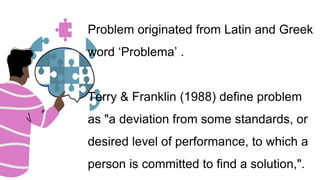
Problem originated from Latin and Greek
word ‘Problema’ .
Terry & Franklin (1988) define problem
as "a deviation from some standards, or
desired level of performance, to which a
person is committed to find a solution,".
Problems are the unmet basic needs, barriers in
normal human responses, health status or self-care
deficits. These may be the actual or potential threats to
enjoying sense of wellbeing.
What is problem solving?
● Trying to find a solution to a problem is known as problem
solving.
● Problem solving is a lifelong skill developed from birth through
adulthood.
● Considered as the most complex of all intellectual functions .
● It is an active process that starts with a problem and ends with
a solution.
● Nurses address multiple needs and problems of patients
on a daily basis.
● Some problems are uncomplicated and require one simple
solution.
● Other problems may be complex and require more
analysis by the nurse.
● Problem solving approach is meaningful, developmental,
and sequential based on the discovery of generalization. It
involves the thought process that involves a doubt or a
problem.
● Problem solving ability enables the person to find
appropriate solutions to problems, which confront him.
DEFINITION
● Problem solving is an orderly manner process to finding
solutions to a problem.
● Problem solving is a cognitive processing directed at achieving
a goal where no solution method is obvious to the problem solver.
IMPORTANT FACTS OF PROBLEM SOLVING
 It is goal directed and continuous.
 Person makes a number of attempts and actions
to solve the problem.
 Process stops after achieving the goal.
 Every person expresses his individual differences
which is important in problem solving.
 It takes a long time to solve the problem for the first
time while later on the time taken to solve the problem
is reduced consciously.
 Problem solving is a special form or set of thinking,
reasoning whether simple or complex.
PURPOSES
● To train in act of reasoning.
● To give practical knowledge.
● To discover new knowledge.
● To solve puzzling problem.
● To improve knowledge.
● To help to overcome the obstacle or interferences in
attainment of objective.
● To help in the progress of an individual as well as
society.
FACTORS AFFECTING PROBLEM SOLVING
 Size of the problem.
 Complexity of the problem.
 Structure of the problem.
 Motive of solution seeker.
 How extensive the process of the problem solving is.
 Previous experience and practice of the person solving the
problem.
 Similarities are the problem situation and the solution
of problem.
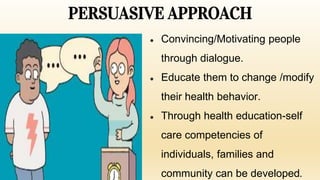
PERSUASIVE APPROACH
● Convincing/Motivating people
through dialogue.
● Educate them to change /modify
their health behavior.
● Through health education-self
care competencies of
individuals, families and
community can be developed.
● Community health nurse makes use of this approach in all
types of nursing interventions related to health promotion
and specific protection, early recognition, diagnosis and
treatment and disability limitation and rehabilitation.
● It is through education that self-care competencies of
individual family and community can be developed which
is essential to achieve the goal of health for all.
ENFORCEMENT APPROACH
Use of coercive measures
such as use of legislation and
the use of authority to do
certain things especially when
it is a question of life and
death.
● For example prohibition of drug abuse, child abuse,
giving strict instructions or orders during emergency
situations such as child labor, acute
bronchopneumonia etc.
● Community health nurses make use of such
measures in life threatening emergency situations.
TEAM APPROACH
A team approach is very
necessary to deal with varied
and complex health needs and
problems at large.
● It is just not possible for any one profession or discipline to provide
care .
● Community health nurses along with auxiliary nurses and female
health supervisors help to meet nursing needs of the
community as a whole.
● Other members of the team include physicians, clinical specialists,
public health engineers, health statisticians, epidemiologists, health
educationalists, counselors’ workers, clinical psychologists,
pharmacologists, lab technicians, village health workers.
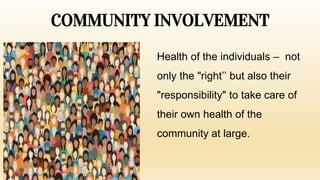
COMMUNITY INVOLVEMENT
Health of the individuals – not
only the "right’’ but also their
"responsibility" to take care of
their own health of the
community at large.
● Without people’s help, participation or cooperation, it is
neither possible to make health care services accessible &
acceptable to them nor it is feasible to achieve community
health goals and aims.
● It is recognized as one of the crucial supportive approaches
for successful implementation of community health care
services
● The extent of community involvement may vary from one
community to another.
● It may depend upon their socioeconomic &cultural aspects,
health attitude, health knowledge etc.
● It ranges from true or active participation to passive recipient of
care provided i.e., the major responsibility of community
involvement lies with health personnel who directly deal with
people at the community level.
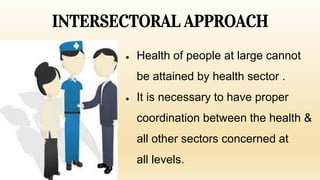
INTERSECTORAL APPROACH
● Health of people at large cannot
be attained by health sector .
● It is necessary to have proper
coordination between the health &
all other sectors concerned at
all levels.
● For example : food production and distribution, water,
sanitation, housing, environmental protection and education
etc. each one is dealt by separate sector and socio-economic
development & health.
● Identification and coordination of desired sectors done by
community health nurse.
● It serve as entry points for the development &implementation
for primary care services.
Community health nurses can also
educate on nutritional status of the
family, food storage through programs
in the agriculture & health economics
,proper use and maintenance of houses
and the areas surrounding them
through respective programs etc.
Problem solving
process
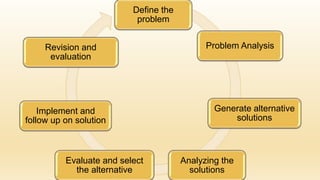
Define the
problem
Problem Analysis
Generate alternative
solutions
Analyzing the
solutions
Evaluate and select
the alternative
Implement and
follow up on solution
Revision and
evaluation
1. Define the Problem
● In the first step, write down what exactly the problem
entails, which helps to identify what the real problem that
is under study and needs an immediate solution.
● Diagnosing the situation so that the focus is on the
problem, not just on its symptoms.
2. Problem analysis
 To analyse how the problem affects the current
situation & other people involved in the situation.
 The gravity of the problem & all the factors that are
contributing to the problem are determined.
3. Generate alternative solutions
● Focus must be on identifying & generating all
possible solutions for a problem.
● Each potential idea for solution of a problem must be
considered without discarding it through value
judgment.
4.Analyzing the solutions
● Various factors about each of the potential solutions are
investigated, where all the positive & negative aspects of each
solution are analyzed.
● Postpone the selection of one solution until several problem-
solving alternatives have been proposed.
● Brainstorming and team problem-solving techniques are both
useful tools in this stage of problem solving.
● Many alternative solutions to the problem should be generated
before final evaluation.
A common mistake in problem solving is that alternatives are
evaluated as they are proposed, so the first acceptable
solution is chosen, even if it’s not the best fit.
If we focus on trying to get the results we want, we miss the
potential for learning something new that will allow for real
improvement in the problem-solving process
5. Evaluate and select an alternative
Comparing the available solutions, and the best solutions is
selected based on the careful judgment.
Skilled problem solvers use a series of considerations when
selecting the best alternative. They consider the extent to which:
 A particular alternative will solve the problem without causing
other unanticipated problems.
 All the individuals involved will accept the alternative.
 Implementation of the alternative is likely.
 The alternative fits within the organizational constraints.
6. Implement and follow up on the solutions
● The final step of the problem-solving process is to practically
solve the problem by implementing the selected solutions.
● Leaders may be called upon to direct others to implement the
solution, "sell" the solution, or facilitate the implementation
with the help of others.
● Involving others in the implementation is an effective way to
gain buy-in and support and minimize resistance to
subsequent changes.
● Regardless of how the solution is rolled out, feedback
channels should be built into the implementation.
● This allows for continuous monitoring and testing of actual
events against expectations.
● Problem solving, and the techniques used to gain clarity, are
most effective if the solution remains in place and is updated to
respond to future changes.
7. Revision and evaluation
● After implementation of the most potential solution, an
evaluation is made to judge the effectiveness of the solution in
resolving the problem.
● It also helps to redefine the problem & revise the problem-
solving process in case the initial solution fails to manage the
problem effectively.
Problem solving.pptx

Problem solving.pptx

  • 3.
    Problem originated fromLatin and Greek word ‘Problema’ . Terry & Franklin (1988) define problem as "a deviation from some standards, or desired level of performance, to which a person is committed to find a solution,".
  • 4.
    Problems are theunmet basic needs, barriers in normal human responses, health status or self-care deficits. These may be the actual or potential threats to enjoying sense of wellbeing.
  • 5.
    What is problemsolving? ● Trying to find a solution to a problem is known as problem solving. ● Problem solving is a lifelong skill developed from birth through adulthood. ● Considered as the most complex of all intellectual functions . ● It is an active process that starts with a problem and ends with a solution.
  • 6.
    ● Nurses addressmultiple needs and problems of patients on a daily basis. ● Some problems are uncomplicated and require one simple solution. ● Other problems may be complex and require more analysis by the nurse.
  • 7.
    ● Problem solvingapproach is meaningful, developmental, and sequential based on the discovery of generalization. It involves the thought process that involves a doubt or a problem. ● Problem solving ability enables the person to find appropriate solutions to problems, which confront him.
  • 8.
    DEFINITION ● Problem solvingis an orderly manner process to finding solutions to a problem. ● Problem solving is a cognitive processing directed at achieving a goal where no solution method is obvious to the problem solver.
  • 9.
    IMPORTANT FACTS OFPROBLEM SOLVING  It is goal directed and continuous.  Person makes a number of attempts and actions to solve the problem.  Process stops after achieving the goal.
  • 10.
     Every personexpresses his individual differences which is important in problem solving.  It takes a long time to solve the problem for the first time while later on the time taken to solve the problem is reduced consciously.  Problem solving is a special form or set of thinking, reasoning whether simple or complex.
  • 11.
    PURPOSES ● To trainin act of reasoning. ● To give practical knowledge. ● To discover new knowledge. ● To solve puzzling problem.
  • 12.
    ● To improveknowledge. ● To help to overcome the obstacle or interferences in attainment of objective. ● To help in the progress of an individual as well as society.
  • 13.
    FACTORS AFFECTING PROBLEMSOLVING  Size of the problem.  Complexity of the problem.  Structure of the problem.  Motive of solution seeker.  How extensive the process of the problem solving is.  Previous experience and practice of the person solving the problem.  Similarities are the problem situation and the solution of problem.
  • 14.
    PERSUASIVE APPROACH ● Convincing/Motivatingpeople through dialogue. ● Educate them to change /modify their health behavior. ● Through health education-self care competencies of individuals, families and community can be developed.
  • 15.
    ● Community healthnurse makes use of this approach in all types of nursing interventions related to health promotion and specific protection, early recognition, diagnosis and treatment and disability limitation and rehabilitation. ● It is through education that self-care competencies of individual family and community can be developed which is essential to achieve the goal of health for all.
  • 16.
    ENFORCEMENT APPROACH Use ofcoercive measures such as use of legislation and the use of authority to do certain things especially when it is a question of life and death.
  • 17.
    ● For exampleprohibition of drug abuse, child abuse, giving strict instructions or orders during emergency situations such as child labor, acute bronchopneumonia etc. ● Community health nurses make use of such measures in life threatening emergency situations.
  • 18.
    TEAM APPROACH A teamapproach is very necessary to deal with varied and complex health needs and problems at large.
  • 19.
    ● It isjust not possible for any one profession or discipline to provide care . ● Community health nurses along with auxiliary nurses and female health supervisors help to meet nursing needs of the community as a whole. ● Other members of the team include physicians, clinical specialists, public health engineers, health statisticians, epidemiologists, health educationalists, counselors’ workers, clinical psychologists, pharmacologists, lab technicians, village health workers.
  • 20.
    COMMUNITY INVOLVEMENT Health ofthe individuals – not only the "right’’ but also their "responsibility" to take care of their own health of the community at large.
  • 21.
    ● Without people’shelp, participation or cooperation, it is neither possible to make health care services accessible & acceptable to them nor it is feasible to achieve community health goals and aims. ● It is recognized as one of the crucial supportive approaches for successful implementation of community health care services
  • 22.
    ● The extentof community involvement may vary from one community to another. ● It may depend upon their socioeconomic &cultural aspects, health attitude, health knowledge etc. ● It ranges from true or active participation to passive recipient of care provided i.e., the major responsibility of community involvement lies with health personnel who directly deal with people at the community level.
  • 23.
    INTERSECTORAL APPROACH ● Healthof people at large cannot be attained by health sector . ● It is necessary to have proper coordination between the health & all other sectors concerned at all levels.
  • 24.
    ● For example: food production and distribution, water, sanitation, housing, environmental protection and education etc. each one is dealt by separate sector and socio-economic development & health. ● Identification and coordination of desired sectors done by community health nurse. ● It serve as entry points for the development &implementation for primary care services.
  • 25.
    Community health nursescan also educate on nutritional status of the family, food storage through programs in the agriculture & health economics ,proper use and maintenance of houses and the areas surrounding them through respective programs etc.
  • 26.
  • 27.
    Define the problem Problem Analysis Generatealternative solutions Analyzing the solutions Evaluate and select the alternative Implement and follow up on solution Revision and evaluation
  • 28.
    1. Define theProblem ● In the first step, write down what exactly the problem entails, which helps to identify what the real problem that is under study and needs an immediate solution. ● Diagnosing the situation so that the focus is on the problem, not just on its symptoms.
  • 29.
    2. Problem analysis To analyse how the problem affects the current situation & other people involved in the situation.  The gravity of the problem & all the factors that are contributing to the problem are determined.
  • 30.
    3. Generate alternativesolutions ● Focus must be on identifying & generating all possible solutions for a problem. ● Each potential idea for solution of a problem must be considered without discarding it through value judgment.
  • 31.
    4.Analyzing the solutions ●Various factors about each of the potential solutions are investigated, where all the positive & negative aspects of each solution are analyzed. ● Postpone the selection of one solution until several problem- solving alternatives have been proposed. ● Brainstorming and team problem-solving techniques are both useful tools in this stage of problem solving. ● Many alternative solutions to the problem should be generated before final evaluation.
  • 32.
    A common mistakein problem solving is that alternatives are evaluated as they are proposed, so the first acceptable solution is chosen, even if it’s not the best fit. If we focus on trying to get the results we want, we miss the potential for learning something new that will allow for real improvement in the problem-solving process
  • 33.
    5. Evaluate andselect an alternative Comparing the available solutions, and the best solutions is selected based on the careful judgment. Skilled problem solvers use a series of considerations when selecting the best alternative. They consider the extent to which:  A particular alternative will solve the problem without causing other unanticipated problems.  All the individuals involved will accept the alternative.  Implementation of the alternative is likely.  The alternative fits within the organizational constraints.
  • 34.
    6. Implement andfollow up on the solutions ● The final step of the problem-solving process is to practically solve the problem by implementing the selected solutions. ● Leaders may be called upon to direct others to implement the solution, "sell" the solution, or facilitate the implementation with the help of others. ● Involving others in the implementation is an effective way to gain buy-in and support and minimize resistance to subsequent changes.
  • 35.
    ● Regardless ofhow the solution is rolled out, feedback channels should be built into the implementation. ● This allows for continuous monitoring and testing of actual events against expectations. ● Problem solving, and the techniques used to gain clarity, are most effective if the solution remains in place and is updated to respond to future changes.

  • 36.
    7. Revision andevaluation ● After implementation of the most potential solution, an evaluation is made to judge the effectiveness of the solution in resolving the problem. ● It also helps to redefine the problem & revise the problem- solving process in case the initial solution fails to manage the problem effectively.