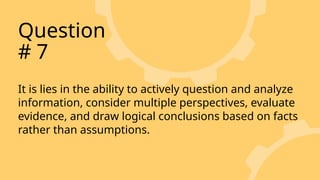
The foundation ofcritical thinking lies in the
ability to actively question and analyze
information, considering multiple
perspectives, evaluating evidence, and
drawing logical conclusions based on facts
rather than assumptions; essentially, it's
about approaching information with a
skeptical mindset and a commitment to
seeking truth through rigorous reasoning.
4.
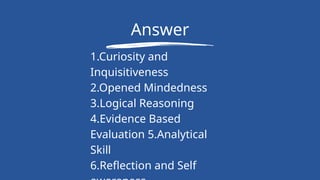
KEY ELEMENTS OFTHIS
FOUNDATION
• Curiosity and Inquisitiveness
• Opened Mindedness
• Logical Reasoning
• Evidence Based Evaluation
• Analytical Skills
• Reflection and Self-
Awareness
5.
Critical Thinking
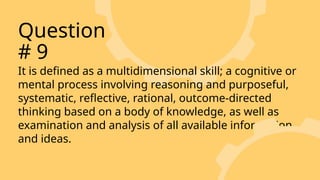
Critical thinkingis a multidimensional skill, a
cognitive or mental process or set of procedures. It
involves reasoning and purposeful, systematic,
reflective, rational, outcome-directed thinking based
on a body of knowledge, as well as examination and
analysis of all available information and ideas.
6.
CRITICAL THINKING INNURSING PRACTICE
Using Nurses must use critical thinking skills in all
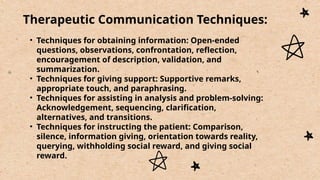
practice settings—acute care, ambulatory care, extended
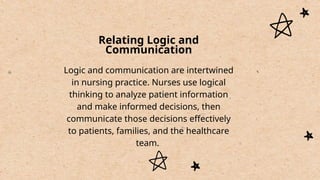
care, and in the home and community. Regardless of the
setting, each patient situation is viewed as unique and
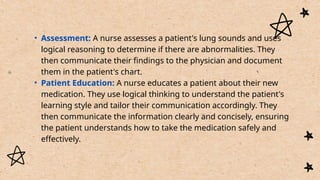
dynamic. The unique factors that the patient and nurse
bring to the health care situation are considered, studied,
analyzed, and interpreted. Interpretation of the
information presented then allows the nurse to focus on
those factors that are most relevant and most significant
to the clinical situation. Decisions about what to do and
how to do it are then developed into a plan of action.
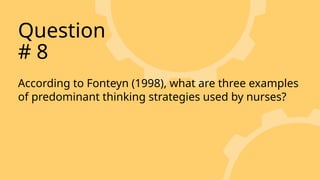
Fonteyn (1998) identified 12 predominant thinking
strategies used by nurses, regardless of their area of
7.
• Recognizing apattern
• Setting priorities
• Searching for information
• Generating hypotheses
• Making predictions
• Forming relationships
• Stating a proposition (“if–then”)
• Asserting a practice rule
• Making choices (alternative actions) • Judging the value
• Drawing conclusions
• Providing explanations
8.
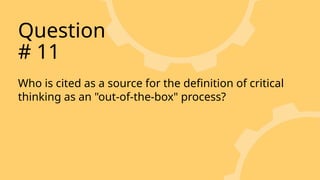
Critical thinking requiresgoing beyond basic problem
solving into a realm of inquisitive exploration, looking for
all relevant factors that affect the issue, and being an
“out-of-the-box” thinker. It includes questioning all
findings until a comprehensive picture emerges that
explains the phenomenon, possible solutions, and
creative methods for proceeding (Wilkinson, 2001).
9.
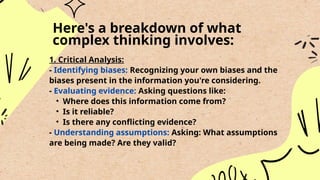
1. Critical Analysis:
-Identifying biases: Recognizing your own biases and the
biases present in the information you're considering.
- Evaluating evidence: Asking questions like:
• Where does this information come from?
• Is it reliable?
• Is there any conflicting evidence?
- Understanding assumptions: Asking: What assumptions
are being made? Are they valid?
Here's a breakdown of what
complex thinking involves:
10.
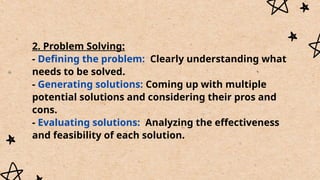
2. Problem Solving:
-Defining the problem: Clearly understanding what
needs to be solved.
- Generating solutions: Coming up with multiple
potential solutions and considering their pros and
cons.
- Evaluating solutions: Analyzing the effectiveness
and feasibility of each solution.
11.
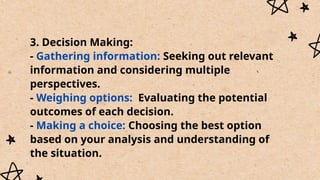
3. Decision Making:
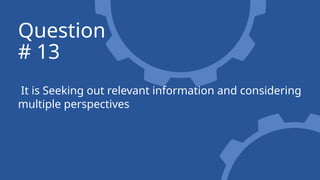
-Gathering information: Seeking out relevant
information and considering multiple
perspectives.
- Weighing options: Evaluating the potential
outcomes of each decision.
- Making a choice: Choosing the best option
based on your analysis and understanding of
the situation.
12.
4. Abstract Thinking:
-Understanding concepts: Grasping the meaning
of abstract ideas and principles.
- Applying knowledge: Using your understanding
of these concepts to analyze new situations and
solve problems.
- Making connections: Seeing relationships
between seemingly unrelated ideas.
13.
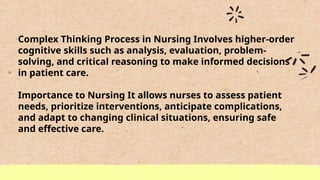
Complex Thinking Processin Nursing Involves higher-order
cognitive skills such as analysis, evaluation, problem-
solving, and critical reasoning to make informed decisions
in patient care.
Importance to Nursing It allows nurses to assess patient
needs, prioritize interventions, anticipate complications,
and adapt to changing clinical situations, ensuring safe
and effective care.
14.
1.Decision Making inNursing It is the process of
selecting the best course of action from
multiple options based on clinical knowledge,
patient needs, and available resources.
Example : A nurse is caring for two patients: one
needs pain medication, medication, while
another is experiencing difficulty breathing.
The nurse decides to prioritize the patient with
breathing difficulty, as airway concerns are
more critical.
15.
2.Ethical Decision Makingin Nursing It involves
choosing the best action while considering
moral principles such as autonomy,
beneficence, non-maleficence, and justice.
Example: A patient with advanced dementia
refuses to take their prescribed medication. The
nurse must decide whether to respect the
patient’s refusal or administer the medication
covertly to ensure their well-being . The nurse
consults the healthcare team and follows
ethical guidelines to make an appropriate
decision.
16.
How Complex ThinkingPatient Outcomes
-Accurate Assessment and Diagnosis: Nurses
with strong cognitive skills can analyze patient
data, identify patterns, and make accurate
assessments. This leads to earlier identification
of problems and more effective treatment
plans.
-Effective Problem Solving: Complex thinking
allows nurses to consider multiple perspectives,
weigh potential risks and benefits, and develop
creative solutions to patient challenges. This
17.
- Enhanced Communication:Nurses who think
critically can communicate effectively with
patients, families, and other healthcare
professionals. This promotes understanding,
builds trust, and improves patient satisfaction.
-Improved Patient Safety: Complex thinking
helps nurses anticipate potential complications,
identify safety risks, and implement preventive
measures. This contributes to a safer
environment for patients.
18.
-Evidence-Based Practice: Nurseswith strong
cognitive skills are better equipped to evaluate
research findings and apply evidence to their
practice. This ensures that patient care is
informed by the latest scientific knowledge.
19.
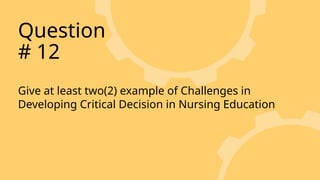
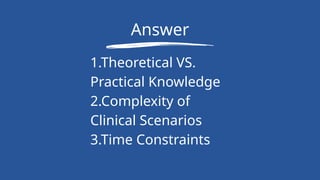
CHALLENGES IN DEVELOPINGCRITICAL
DECISIONS IN NURSING EDUCATION
• THEORETICAL VS. PRACTICAL KNOWLEDGE
-Challenge: Nursing education often
emphasizes theoretical concepts but decision-
making is best developed through real-world
experience.
20.
• COMPLEXITY OFCLINICAL SCENARIOS
-Challenge: Critical decision-making requires
nurses to navigate complex, multifaceted
clinical situations that may not have clear cut
answers.
• TIME CONSTRAINTS
-Challenge: Nurses often need to make quick
decisions in fast-paced,high-pressure
environments.
21.
LOGIC AND
COMMUNICATION
.
Logic andcommunication are related because logic is
a way of thinking that can help people communicate
more clearly and effectively. Logic is the study of
reasoning and argumentation, and it can help people
organize their thoughts and make connections
between them.
In nursing, both logic and effective communication
are vital for patient care, with logic enabling sound
clinical reasoning and judgment, while
communication facilitates accurate information
exchange and builds trust.
22.
Roles of Logicin Nursing
• Foundation of Clinical Reasoning: Logic is the bedrock of
clinical reasoning, enabling nurses to analyze patient data,
identify problems, and formulate appropriate interventions
• Essential for Critical Thinking: Logic is integral to critical
thinking, a skill that empowers nurses to evaluate
information objectively, differentiate between relevant and
irrelevant data, and make sound clinical decisions.
• Assessment and Diagnosis: Nurses use logical thinking to
assess patient conditions, identify potential problems, and
formulate nursing diagnoses
• Evidence-Based Practice:This involves logically evaluating
23.
• Prioritization andTime Management: Logical thinking helps
them prioritize tasks, allocate resources effectively, and
manage their time efficiently.
• Problem-Solving and Decision-Making: Logic provides a
framework for problem-solving, enabling nurses to assess
options, predict outcomes, and choose the most effective
course of action.
• Avoiding Errors: By applying logic, nurses can minimize
mistakes and ensure patient safety.
• Enhancing Patient Care: By making informed decisions based
on sound reasoning, nurses can provide effective, safe, and
patient-centered care.
Logic is indispensable in nursing, providing the foundation for
24.
Roles of Communicationin Nursing
Patient Interaction: Effective communication is essential for
building rapport with patients, understanding their concerns, and
providing emotional support.
Interprofessional Collaboration: Nurses work as part of a
healthcare team, requiring effective communication with
physicians, therapists, and other healthcare professionals
Patient Education: Nurses educate patients about their conditions,
treatments, and self-care strategies
Documentation: Accurate and detailed documentation is crucial for
continuity of care
Advocacy: Nurses act as advocates for their patients,
communicating their needs and preferences to the healthcare
team
25.
Principles of Communication:
•Communication is a dynamic process.
• Communication is complex and involves the total
personality.
• Communication is irreversible and cannot be
taken back.
Communication Process:
• Linear Model
• Interactive Model
• Transactional Model
26.
• To conveyinformation or opinion
• To request information or opinion
• To give social acknowledgement
Purpose of
Communication:
27.
Types of Communication:
•Verbal communication: This involves spoken
words, essential for communication
between nurses, patients, and families.
• Non-verbal communication: This involves
body language, facial expressions, and other
non-verbal cues. The document emphasizes
that non-verbal communication can carry
stronger signals than verbal messages.
28.
• Language barrier
•Cultural differences
• Conflict
• Care setting
• Internal noise
• Perception
• Difficulty with speech and hearing
• Medication
• Noise
Barriers to Effective
Communication:
29.
• Active listening
•Using understandable language
• Being respectful and empathetic
• Tailoring the message
• Validating interpretation
Improving
Communication
30.
• Techniques forobtaining information: Open-ended
questions, observations, confrontation, reflection,
encouragement of description, validation, and
summarization.
• Techniques for giving support: Supportive remarks,
appropriate touch, and paraphrasing.
• Techniques for assisting in analysis and problem-solving:
Acknowledgement, sequencing, clarification,
alternatives, and transitions.
• Techniques for instructing the patient: Comparison,
silence, information giving, orientation towards reality,
querying, withholding social reward, and giving social
reward.
Therapeutic Communication Techniques:
Relating Logic and
Communication
Logicand communication are intertwined
in nursing practice. Nurses use logical
thinking to analyze patient information
and make informed decisions, then
communicate those decisions effectively
to patients, families, and the healthcare
team.
33.
• Assessment: Anurse assesses a patient's lung sounds and uses
logical reasoning to determine if there are abnormalities. They
then communicate their findings to the physician and document
them in the patient's chart.
• Patient Education: A nurse educates a patient about their new
medication. They use logical thinking to understand the patient's
learning style and tailor their communication accordingly. They
then communicate the information clearly and concisely, ensuring
the patient understands how to take the medication safely and
effectively.
34.
Emergency Situation: Apatient experiences a sudden
change in condition. The nurse uses logical thinking to
quickly assess the situation, identify the problem, and
determine the best course of action. They then
communicate the situation to the healthcare team,
ensuring everyone is informed and prepared to act.
35.
Logic and communicationare essential skills for
nurses, impacting every aspect of their practice. By
combining these skills effectively, nurses can provide
safe, effective, and patient-centered care.
Quiz Guidelines
This isa group quiz
You will complete the quiz on the slides by
writing your answers on a sheet of paper and
raise it when done
You have 40 seconds to answer each question
39.
It is arole of logic in nursing where nurses use logical
thinking to assess patient conditions, identify
potential problems, and formulate nursing diagnoses.
Question
# 1
Nurses rely onresearch and evidence to guide their
practice. This involves logically evaluating the quality
of research studies, interpreting findings, and
applying them to patient care.
Question
# 2
It is liesin the ability to actively question and analyze
information, consider multiple perspectives, evaluate
evidence, and draw logical conclusions based on facts
rather than assumptions.
Question
# 7
It is definedas a multidimensional skill; a cognitive or
mental process involving reasoning and purposeful,
systematic, reflective, rational, outcome-directed
thinking based on a body of knowledge, as well as
examination and analysis of all available information
and ideas.
Question
# 9