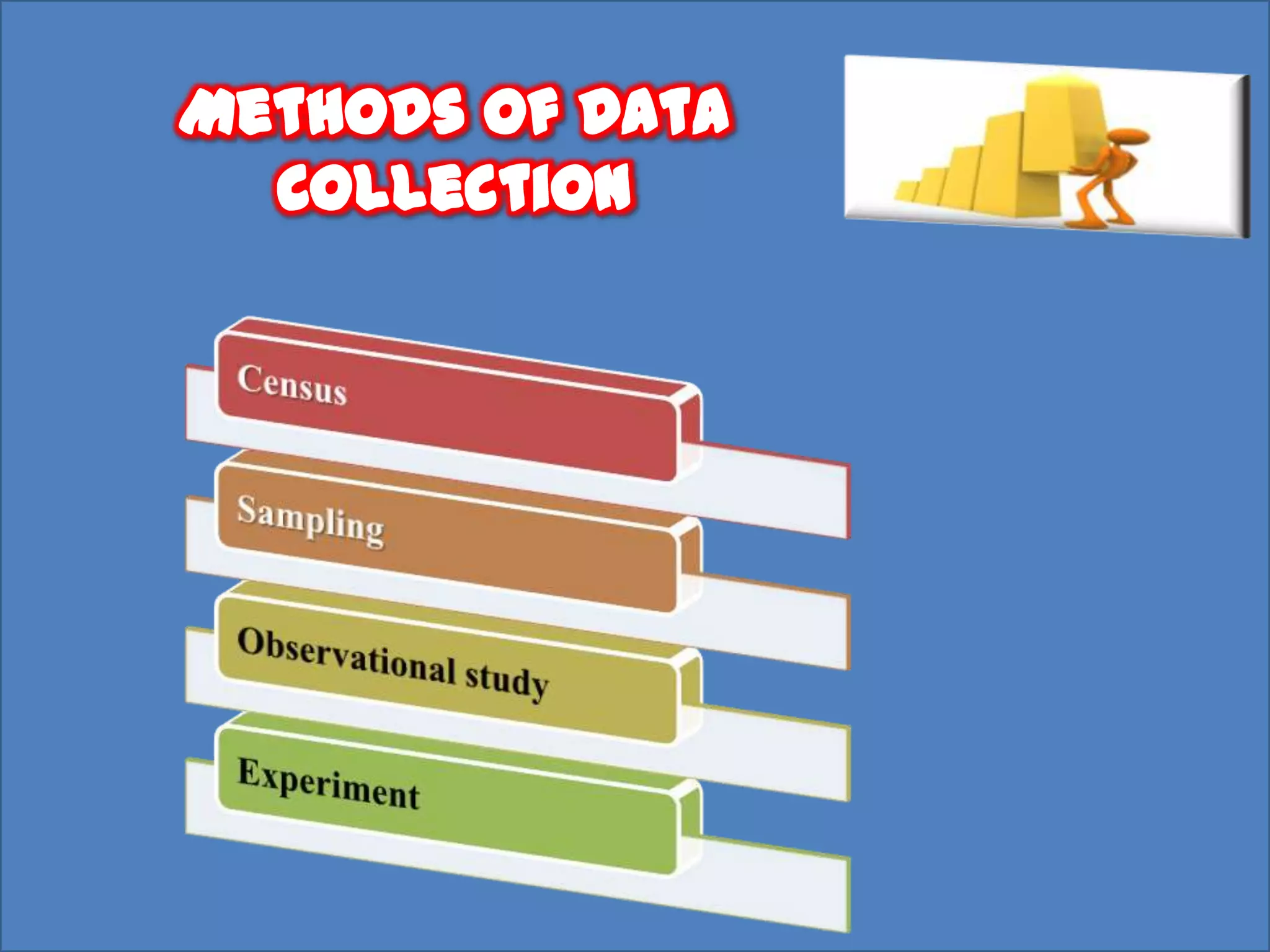
Methods of Data
Collection
Methods of Data Collection
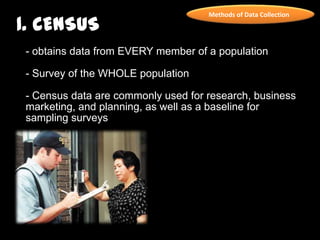
- obtains data from EVERY member of a population
- Survey of the WHOLE population
- Census data are commonly used for research, business
marketing, and planning, as well as a baseline for
sampling surveys
1. CENSUS
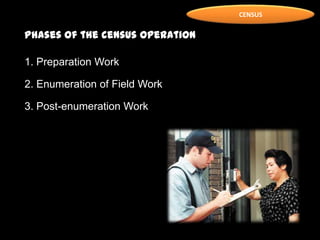
CENSUS
1. Preparation Work
2. Enumeration of Field Work
3. Post-enumeration Work
Phases of the census operation
Methods of Data Collection
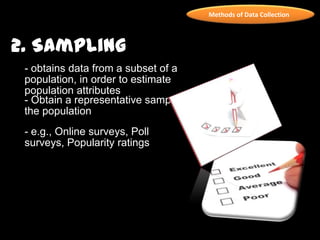
- obtains data from a subset of a
population, in order to estimate
population attributes
- Obtain a representative sample of
the population
- e.g., Online surveys, Poll
surveys, Popularity ratings
2. Sampling
Methods of Data Collection
3. Observational study
- Basically, a researcher goes out into the world and looks for variables
that are associated with one another
EXAMPLE: Charles Darwin based his explanation of evolution entirely
on observations he made
- The researcher do not determine which subjects are to be in control
and which is treatment.
EXAMPLE: In a study on
smoking, the SMOKERS form
the treatment group and the
NONSMOKERS are the control
group
Observational Study
A control group is a baseline group that receives no
treatment or a neutral treatment.
For example, when examining test tubes for catalytic
reactions of enzymes when added to a specific
substrate, the control test tube would be identical to all
other test tubes with the exception of lacking the
enzyme.
The treatment group is the item or subject that is
manipulated.
Observational Study
ADVANTAGES
• They put the researcher
directly in touch with the
behaviors in question
• They involved real-time
data, describing behavior
occurring in the present
rather than the past
• They are adapting in that
they can be modified
depending on what is being
observed
DISADVANTAGES
• Difficulties interpreting the
meaning underlying the
observations.
• Observers must decide
which to observe; choose
time periods, territory and
events
Methods of Data Collection
4. Experiment
- the researcher controls:
a) how subjects are assigned to
groups
b) which treatments each group
receives
- a scientific test carried out in order to discover whether a theory or
hypothesis is correct or what the results of a particular course of action would
be
- most clearly shows cause-and-effect because it isolates and manipulates a
single variable, in order to clearly show its effect
Experiment
Types of Experiment
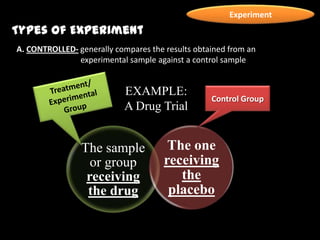
A. CONTROLLED- generally compares the results obtained from an
experimental sample against a control sample
The sample
or group
receiving
the drug
The one
receiving
the
placebo
Control Group
EXAMPLE:
A Drug Trial
Experiment
Types of Experiment
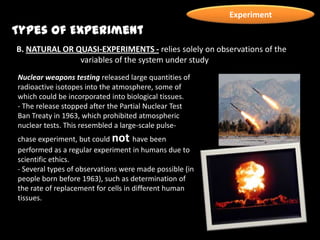
B. NATURAL OR QUASI-EXPERIMENTS - relies solely on observations of the
variables of the system under study
Nuclear weapons testing released large quantities of
radioactive isotopes into the atmosphere, some of
which could be incorporated into biological tissues.
- The release stopped after the Partial Nuclear Test
Ban Treaty in 1963, which prohibited atmospheric
nuclear tests. This resembled a large-scale pulse-
chase experiment, but could not have been
performed as a regular experiment in humans due to
scientific ethics.
- Several types of observations were made possible (in
people born before 1963), such as determination of
the rate of replacement for cells in different human
tissues.
Experiment
Types of Experiment
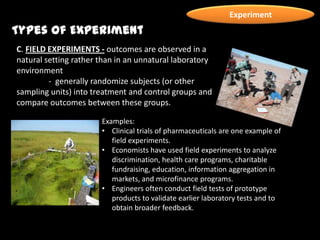
C. FIELD EXPERIMENTS - outcomes are observed in a
natural setting rather than in an unnatural laboratory
environment
- generally randomize subjects (or other
sampling units) into treatment and control groups and
compare outcomes between these groups.
Examples:
• Clinical trials of pharmaceuticals are one example of
field experiments.
• Economists have used field experiments to analyze
discrimination, health care programs, charitable
fundraising, education, information aggregation in
markets, and microfinance programs.
• Engineers often conduct field tests of prototype
products to validate earlier laboratory tests and to
obtain broader feedback.
Pros and Cons
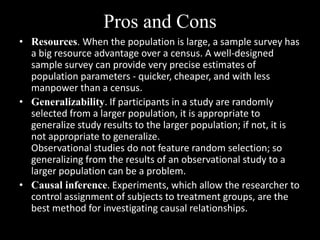
• Resources. When the population is large, a sample survey has
a big resource advantage over a census. A well-designed
sample survey can provide very precise estimates of
population parameters - quicker, cheaper, and with less
manpower than a census.
• Generalizability. If participants in a study are randomly
selected from a larger population, it is appropriate to
generalize study results to the larger population; if not, it is
not appropriate to generalize.
Observational studies do not feature random selection; so
generalizing from the results of an observational study to a
larger population can be a problem.
• Causal inference. Experiments, which allow the researcher to
control assignment of subjects to treatment groups, are the
best method for investigating causal relationships.
REFERENCES
http://en.wikibooks.org
http://images.google.com
http://en.wikipedia.org
http://stattrek.com
http://www.ncsu.edu
Elementary Statistics, Neil A. Weiss, Addison-Wesley Publishing Company,
1989
Microsoft® Encarta® 2009. © 1993-2008 Microsoft Corporation.

Methods of Data Collection in Statistics

  • 1.
  • 2.
    Methods of DataCollection - obtains data from EVERY member of a population - Survey of the WHOLE population - Census data are commonly used for research, business marketing, and planning, as well as a baseline for sampling surveys 1. CENSUS
  • 3.
    CENSUS 1. Preparation Work 2.Enumeration of Field Work 3. Post-enumeration Work Phases of the census operation
  • 4.
    Methods of DataCollection - obtains data from a subset of a population, in order to estimate population attributes - Obtain a representative sample of the population - e.g., Online surveys, Poll surveys, Popularity ratings 2. Sampling
  • 5.
    Methods of DataCollection 3. Observational study - Basically, a researcher goes out into the world and looks for variables that are associated with one another EXAMPLE: Charles Darwin based his explanation of evolution entirely on observations he made - The researcher do not determine which subjects are to be in control and which is treatment. EXAMPLE: In a study on smoking, the SMOKERS form the treatment group and the NONSMOKERS are the control group
  • 6.
    Observational Study A controlgroup is a baseline group that receives no treatment or a neutral treatment. For example, when examining test tubes for catalytic reactions of enzymes when added to a specific substrate, the control test tube would be identical to all other test tubes with the exception of lacking the enzyme. The treatment group is the item or subject that is manipulated.
  • 7.
    Observational Study ADVANTAGES • Theyput the researcher directly in touch with the behaviors in question • They involved real-time data, describing behavior occurring in the present rather than the past • They are adapting in that they can be modified depending on what is being observed DISADVANTAGES • Difficulties interpreting the meaning underlying the observations. • Observers must decide which to observe; choose time periods, territory and events
  • 8.
    Methods of DataCollection 4. Experiment - the researcher controls: a) how subjects are assigned to groups b) which treatments each group receives - a scientific test carried out in order to discover whether a theory or hypothesis is correct or what the results of a particular course of action would be - most clearly shows cause-and-effect because it isolates and manipulates a single variable, in order to clearly show its effect
  • 9.
    Experiment Types of Experiment A.CONTROLLED- generally compares the results obtained from an experimental sample against a control sample The sample or group receiving the drug The one receiving the placebo Control Group EXAMPLE: A Drug Trial
  • 10.
    Experiment Types of Experiment B.NATURAL OR QUASI-EXPERIMENTS - relies solely on observations of the variables of the system under study Nuclear weapons testing released large quantities of radioactive isotopes into the atmosphere, some of which could be incorporated into biological tissues. - The release stopped after the Partial Nuclear Test Ban Treaty in 1963, which prohibited atmospheric nuclear tests. This resembled a large-scale pulse- chase experiment, but could not have been performed as a regular experiment in humans due to scientific ethics. - Several types of observations were made possible (in people born before 1963), such as determination of the rate of replacement for cells in different human tissues.
  • 11.
    Experiment Types of Experiment C.FIELD EXPERIMENTS - outcomes are observed in a natural setting rather than in an unnatural laboratory environment - generally randomize subjects (or other sampling units) into treatment and control groups and compare outcomes between these groups. Examples: • Clinical trials of pharmaceuticals are one example of field experiments. • Economists have used field experiments to analyze discrimination, health care programs, charitable fundraising, education, information aggregation in markets, and microfinance programs. • Engineers often conduct field tests of prototype products to validate earlier laboratory tests and to obtain broader feedback.
  • 12.
    Pros and Cons •Resources. When the population is large, a sample survey has a big resource advantage over a census. A well-designed sample survey can provide very precise estimates of population parameters - quicker, cheaper, and with less manpower than a census. • Generalizability. If participants in a study are randomly selected from a larger population, it is appropriate to generalize study results to the larger population; if not, it is not appropriate to generalize. Observational studies do not feature random selection; so generalizing from the results of an observational study to a larger population can be a problem. • Causal inference. Experiments, which allow the researcher to control assignment of subjects to treatment groups, are the best method for investigating causal relationships.
  • 13.
    REFERENCES http://en.wikibooks.org http://images.google.com http://en.wikipedia.org http://stattrek.com http://www.ncsu.edu Elementary Statistics, NeilA. Weiss, Addison-Wesley Publishing Company, 1989 Microsoft® Encarta® 2009. © 1993-2008 Microsoft Corporation.