CHCICS301A Skin Assessment & Care
Skin Assessment May be informal or formal Occurs on an ongoing basis May be overall – giving information about general state of health May be specific – in response to a defined problem or change in skin
Skin Assessment Collection of  subjective data,  via client interview and questioning Collection of  objective data , mainly via inspection (looking) and palpation (feeling or touching)
What to assess? Skin colour Temperature Moisture Texture  Thickness  Oedema  (swelling)
Turgor  (elasticity) Bruising Skin hygiene Presence of lesions  (any exudate?)
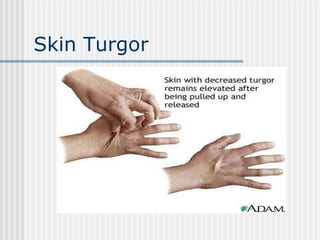
Skin Turgor
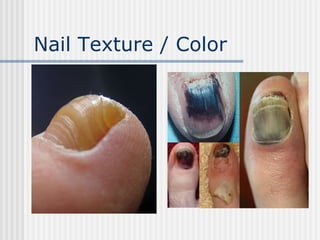
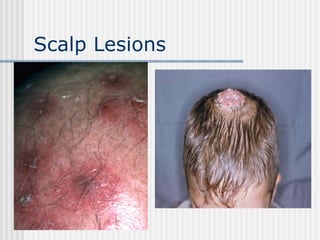
Other assessment areas Associated with skin assessment is : Hair and scalp – assessment of colour, texture, distribution, loss, scalp lesions Nails – shape and contour, texture, consistency, colour
Nail Texture / Color
Scalp Lesions
Throughout skin assessment, need to relate findings to the individual client being assessed  In many situations, findings are different, even if the skin is healthy
General care of a client with a skin disorder Providing comfort, relief of pruritus Topical applications – soothing creams, substances to add to bath water, dressings  Prevention of infection Fluid and nutritional balance Providing psychologic support Client education
General care of older skin Check / monitor skin changes – moles etc Use sunscreen Avoid drying agents Eat / drink well Provide constant temperature
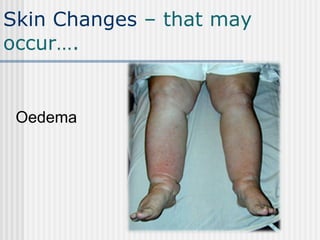
Skin Changes   – that may occur…. Oedema
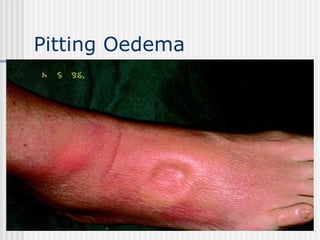
Pitting Oedema
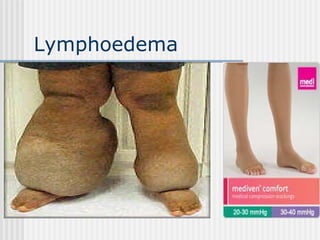
Lymphoedema
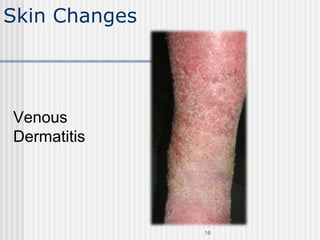
Skin Changes   Venous Dermatitis
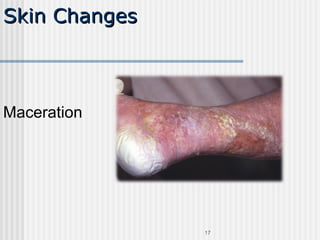
Skin Changes   Maceration

Skin care

  • 1.
  • 2.
    Skin Assessment Maybe informal or formal Occurs on an ongoing basis May be overall – giving information about general state of health May be specific – in response to a defined problem or change in skin
  • 3.
    Skin Assessment Collectionof subjective data, via client interview and questioning Collection of objective data , mainly via inspection (looking) and palpation (feeling or touching)
  • 4.
    What to assess?Skin colour Temperature Moisture Texture Thickness Oedema (swelling)
  • 5.
    Turgor (elasticity)Bruising Skin hygiene Presence of lesions (any exudate?)
  • 6.
  • 7.
    Other assessment areasAssociated with skin assessment is : Hair and scalp – assessment of colour, texture, distribution, loss, scalp lesions Nails – shape and contour, texture, consistency, colour
  • 8.
  • 9.
  • 10.
    Throughout skin assessment,need to relate findings to the individual client being assessed In many situations, findings are different, even if the skin is healthy
  • 11.
    General care ofa client with a skin disorder Providing comfort, relief of pruritus Topical applications – soothing creams, substances to add to bath water, dressings Prevention of infection Fluid and nutritional balance Providing psychologic support Client education
  • 12.
    General care ofolder skin Check / monitor skin changes – moles etc Use sunscreen Avoid drying agents Eat / drink well Provide constant temperature
  • 13.
    Skin Changes – that may occur…. Oedema
  • 14.
  • 15.
  • 16.
    Skin Changes Venous Dermatitis
  • 17.
    Skin Changes Maceration