Stress and coping
By
Rubina Yasmin
Nursing Instructor
CON, FJMU.
CONCEPT OF STRESS
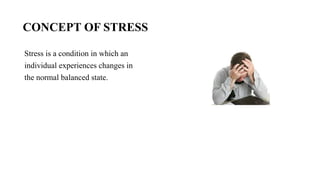
Stress is a condition in which an
individual experiences changes in
the normal balanced state.
Stressor
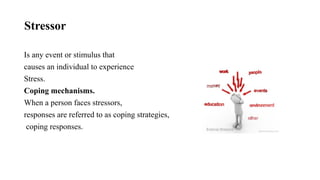
Is any event or stimulus that
causes an individual to experience
Stress.
Coping mechanisms.
When a person faces stressors,
responses are referred to as coping strategies,
coping responses.
Sources of Stress
• Internal stressors
• External stressors
• Developmental stressors
• Situational stressors
Internal stressors
Originate within a person,
For example,
• Infection or
• Feelings of depression.
External stressors
Originate outside the individual,
For example,
• A move to another city,
• A death in the family,
• Or pressure from peers.
Developmental stressors
Occur at predictable times
Throughout an individual’s
life
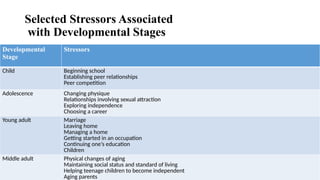
Selected Stressors Associated
with Developmental Stages
Developmental
Stage
Stressors
Child Beginning school
Establishing peer relationships
Peer competition
Adolescence Changing physique
Relationships involving sexual attraction
Exploring independence
Choosing a career
Young adult Marriage
Leaving home
Managing a home
Getting started in an occupation
Continuing one’s education
Children
Middle adult Physical changes of aging
Maintaining social status and standard of living
Helping teenage children to become independent
Aging parents
Situational stressors
• Unpredictable and may occur at any time during life.
• May be positive or negative.
• Examples:
• Death of a family member
• Marriage or divorce
• Birth of a child
• New job
• Illness.
Effects of Stress
• Physical
• Emotional
• Intellectual
• Social
• Spiritual
MODELS OF STRESS
• Stimulus based models
• Response based model
• Transaction based model
• Stimulus based models
Is defined as a stimulus, a life event,
or a set of circumstances that arouses
physiological and/or psychological reactions
that may increase the individual’s vulnerability
to illness.
Response-Based Models
• Stress may also be considered
as a response.
• The non specific response
of the body to any kind of
demand made upon it.
• Transaction based model
Model encompasses a set of cognitive, affective & adaptive (coping) responses that
arise out of person-environment transactions.
General adaptation syndrome
(GAS)
This response of the body, the
stress syndrome or GAS, occurs
with the release of certain adaptive
hormones and subsequent changes
in the structure and chemical composition
of the body.
Local adaptation syndrome
(LAS).
Body reacts locally to stress
One organ or a part of the
body reacts alone to stress
e.g. inflammation.
3 stages of GAS & LAS
• Alarm reaction
• Resistance
• Exhaustion
Alarm Reaction
• Initial reaction of the body
Alerts the body’s defenses.
Classification into 2 phases
• Shock phase
• Counter shock phase
Shock phase
Stressors stimulate the sympathetic
nervous system,
Stimulates adrenal medulla to
Secrete epinephrine & norepinephrine
Fight or flight response
• Increased myocardial contractility, which increases cardiac output
and blood flow to active muscles
• 2. Bronchial dilation, which allows increased oxygen intake
• 3. Increased blood clotting
• 4. Increased cellular metabolism
Counter shock phase
The changes produced in the body
during the shock phase are reversed.
Stage of Resistance
If the stressor persist, it becomes
necessary to attempt some means of
coping with the stress. In this stage
The body keeps making continuous efforts
To cope with stress.
Stage of Exhaustion
The adaptation that the body made
during the second stage cannot be
maintained.
• This means that the ways used to cope
with the stressor have been exhausted.
• Result:
• Rest and return to normal
• Death
Physiological Indicators
• The physiological signs and symptoms
of stress result from activation of the sympathetic
and neuroendocrine systems of the body.
Psychological Indicators
• Anxiety
• Fear
• Anger
• Depression
• Unconscious Ego mechanisms
Anxiety
A common reaction to stress is, a state
of mental uneasiness, apprehension, dread,
or a feeling of helplessness related to an
impending or anticipated unidentified threat
to self or significant relationships.
Levels of anxiety
• Mild anxiety
• Moderate anxiety
• Severe anxiety
Mild anxiety
produces a slight arousal that
enhances perception, learning,
and productive abilities.
Moderate anxiety
Increases the arousal to a point
where the person expresses feelings
of tension, nervousness, or concern.
Perceptual abilities are narrowed.
Severe anxiety:
Consumes most of the person’s
energies and requires intervention.
Perception is further decreased.
The person, unable to focus on
what is really happening,
Fear:
An emotion or feeling of apprehension
aroused by impending or seeming danger,
pain, or another perceived threat.
Anger:
An emotional state consisting
of a subjective feeling of animosity
or strong displeasure.
Depression:
A common reaction to events that
seem overwhelming or negative.
An extreme feeling of sadness, despair,
rejection, lack of worth, or emptiness.
Cognitive Indicators:
• Problem solving
• Structuring
• Self control/self discipline
• Suppression
• fantasy
Problem solving:
Involves thinking through the
threatening situation, using specific
steps to arrive at a solution.
Structuring:
The arrangement or manipulation
of a situation so threatening events
do not occur.
Self control/self discipline:
Assuming a manner and facial
Expression that convey a sense
of being in control or in charge.
Suppression:
Consciously and willfully putting
a thought or feeling out of mind:
“I won’t deal with that today.
I’ll do it tomorrow.”
Fantasy or daydreaming:
To make-believe Unfulfilled
wishes and desires are imagined
as fulfilled, or a threatening experience
is reworked or replayed so it ends differently
from reality.
Ego defense mechanisms:
unconscious psychological adaptive
mechanisms or, according to Anna Freud (1967), mental mechanisms
that develop as the personality attempts to defend itself,
establish compromises among conflicting impulses, and calm inner
tensions.
Coping:
The cognitive and behavioral effort to
manage specific external and/or internal
demands that are appraised as taxing or
exceeding the resources of the person”
Coping strategy/coping mechanism:
A natural or learned way of responding
to a changing environment
or specific problem or situation.
Two types of coping strategies:
• Problem-focused coping
• Emotion focused coping
Problem-focused coping:
Refers to efforts
to improve a situation by making changes or taking action.
Emotion focused coping:
includes thoughts and actions that relieve emotional
distress. does not improve the situation, but
the person often feels better
Long-term coping strategies:
Can be constructive and practical.
Examples:
• Lifestyle patterns
• Short-term coping strategies
• can reduce stress to a tolerable limit
• temporarily but are ineffective ways to
• permanently deal with reality.
• They may even have a destructive or detrimental effect on the person.
Adaptive or maladaptive coping:
Adaptive coping
Helps the person to deal effectively
with stressful events and minimizes
distress associated with them.
(Effective coping)
Maladaptive coping:
Can cause unnecessary
distress for the person and others
associated with the person or
stressful event.
(Ineffective coping)
Caregiver burden:
Reaction to long term stress is
seen in family members who
undertake the care of a person
in the home for a long term period.
produces responses such as chronic fatigue,
sleeping difficulties, and high blood pressure
Crises:
• A crisis is an acute, time-limited state of disequilibrium resulting from the
interaction of an event with the individual’s or family’s coping mechanism, which
are inadequate to meet the demands of the situation.
Crisis Intervention
Is a technique used to help an
Individual or family to understand
and cope with the intense feelings that
are typical of a crises.
Aims of crises Crisis Intervention technique
• To provide a correct cognitive perception of the situation.
• To assist the individual in managing the intense and overwhelming feelings
associated with the crises.
Principles of crises intervention
1. Be specific, use concise statement and avoid over whelming the patient with
irrelevant questions or excessive detail.
2. Encourage the expression of feelings.
3. A calm, controlled presence reassures the person that the nurse can help.
4. Listen for facts and feelings: seeking clarification, paraphrasing and reflection
are effective strategies.
5. Allow sufficient time for the individuals involved to process information and
ask question.
6. Help patients legitimize feelings by letting them know that others in similar
situations have experienced comparable emotions.
Cont.
7. Clarify distortions by getting persons to look at the situation realistically.
8. Empower person by allowing them to make informed choices.
9. Assist the person in confronting reality.
10. Encourage the person to focus on one implication at a time.
References:
1. Erb, G. K. , B . (2015) Fundamental of Nursing: concepts, process
and practice (11th
ed.) Addison: Wesley.
2. Potter, P. A & Perry , A. G. (2016). Basic Nursing Essentials for
practice (9th
ed.) St. Louis: Mosby.
Stress and coping.pptx fundamental of nursing