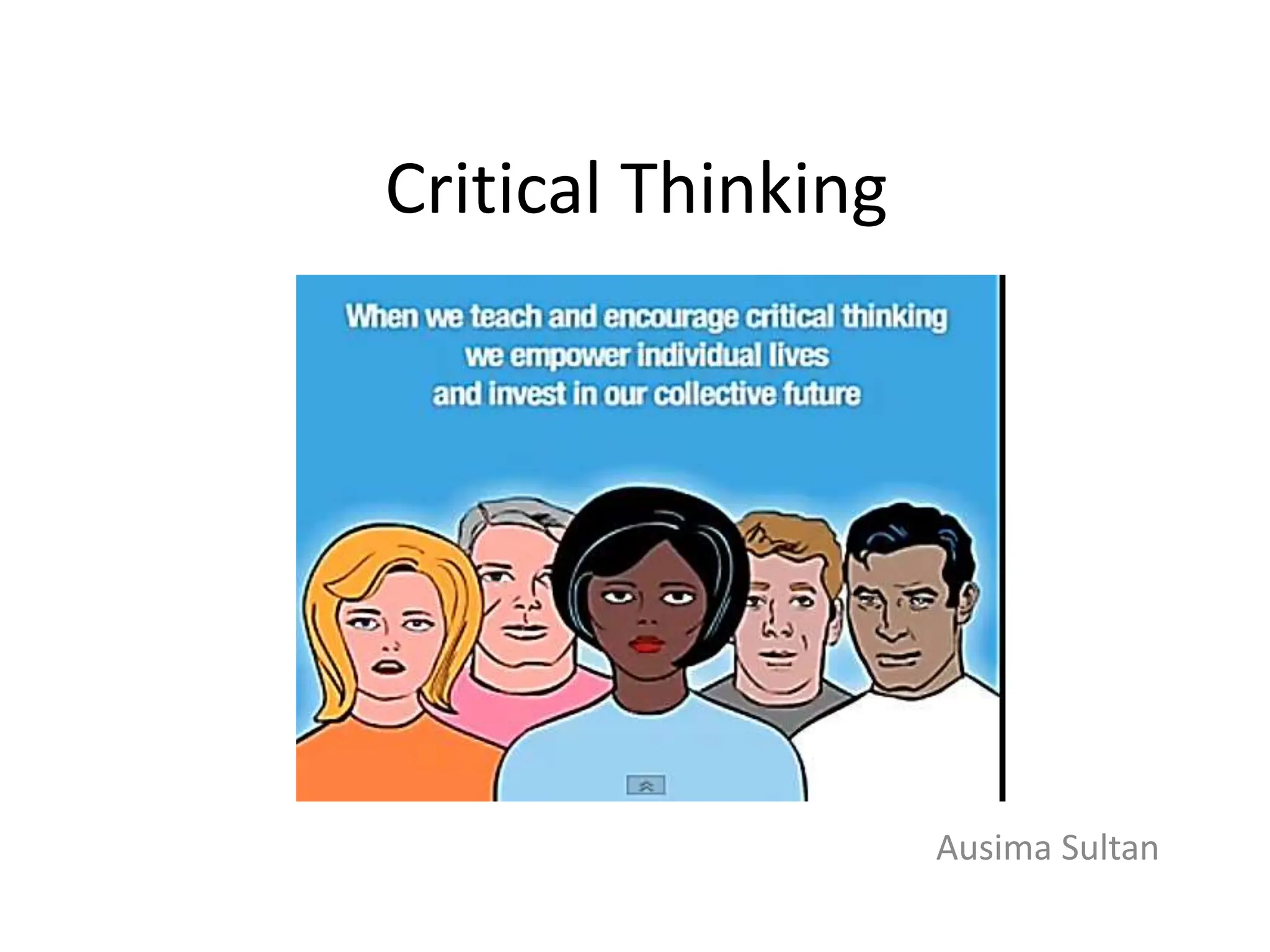
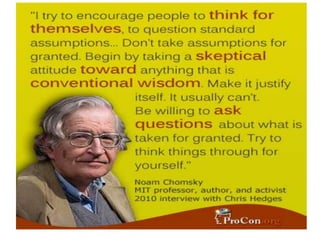
Critical Thinking
Ausima Sultan
What is Critical Thinking?
Critical thinking
• noun: critical thinking
1.the objective analysis and evaluation of an
issue in order to form a judgment.
2."professors often find it difficult to encourage
critical thinking among their students"
• No one always acts purely objectively and
rationally.
• We connive for selfish interests.
• We gossip, boast, exaggerate, and
equivocate.
• It is "only human" to wish to validate our prior
knowledge, to vindicate our prior decisions,
or to sustain our earlier beliefs.
• In the process of satisfying our ego, however,
we can often deny ourselves intellectual
growth and opportunity.
• We may not always want to apply critical
thinking skills, but we should have those skills
available to be employed when needed.
Critical Thinking as a Process
Critical thinking is a complex process of deliberation which involves a
wide range of skills and attitudes.
• Identifying other people’s positions; arguments and conclusions
• Evaluating the evidence for alternative points of view
• Weighing up opposing arguments and evidence fairly
• Being able to read between the lines, seeing behind surface, and
identifying false or unfair assumptions
• Recognizing techniques used to make certain positions more
appealing than others, such as false logic and persuasive devices
• Reflecting on issues in a structured way, bringing logic and insight to
bear
• Drawing conclusions about whether arguments are valid and
justifiable, based on good evidence and sensible argument
• Presenting a point of view in a structured, clear, well-reasoned way
that convinces others
Skepticism and Trust
• Ennis (1987): ranges of dispositions and abilities of Critical
thinking
These focus on:
• The ability to reflect skeptically
• The ability to think in a reasoned way
Skepticism: bringing an element of polite doubt. (maybe only
a part of the picture)
• Using skepticism and doubt constructively
• Helps you make better informed decisions: whether things
are true; effective or productive
Trust: in order to function in the world, we have to accept the
probability that at least some things are as they seem
• It is reasonable to be trusting
• And where it is useful to be skeptical
Critical Thinking and Argument
• Argument: a message that is being conveyed,
whether through speech, writing,
performance, or other media
• Critical thinking: helps identify the obvious
and the hidden messages more accurately,
and to understand the process by which an
argument is constructed
Reasoning
Knowing Our Own Reasons
• Critical thinking is associated with reasoning
or with our capacity for rational thought.
• “rational” means “using reasons” to solve
problems.
• Reasoning starts with ourselves:
– Having reasons for what we believe and to do, and
being aware of what these are
– Critically evaluating our own beliefs and actions
– Being able to present to others the reasons for our
beliefs and actions
Critical Analysis of Other People’s
Reasoning
• Identifying their reasons and conclusions
• Analyzing how they select, combine and order
reasons to construct a line of reasoning
• Evaluating whether their reasons support the
conclusions they draw
• Evaluating whether their reasons are well-
founded, based on good evidence
• Identifying flaws in their reasoning
Constructing and Presenting Reasons
• Reasoning involves analysing evidence and drawing
conclusions from them
• Evidence may then be presented to support the
conclusion
e.g. it is a cold day (we consider it a cold day)
Someone who disagrees may ask why we believe this
– We may use evidence such as thermometer reading and
observation of weather conditions
– Our reason may be that the temperature is low and there
is ice on the ground
We use basic examples of reasoning such as this everyday
Cont.
For professionals and academic work, we are
usually required to present such reasoning using
formal structures such as essays, or reports with
recommendations.
• Select and structure reasons to support a
conclusion
• Present an argument in a consistent way
• Use logical order
• Use language effectively to present the line of
reasoning
Why Develop Critical Thinking Skills?
• Improved attention and observation
• More focused reading
• Improved ability to identify the key points in a
text or other message rather than becoming
distracted by less important material
• Improved ability to respond to the appropriate
points in a message
• Knowledge of how to get your point across more
easily
• Skills of analysis that you can choose to apply in a
variety of situations
Benefits in Professional and Everyday
Life
• Bring precision to the way you think and work
• Helps to be more accurate and specific in
noting what is relevant and what is not
• Useful in problem solving
• In project management, bringing greater
precision and accuracy to different parts of
the task
Ancillary Skills
Critical thinking involves development of a range of
ancillary skills:
– Observation
– Reasoning
– Decision-making
– Analysis
– Judgment
– Persuasion
• The more advanced the level of study or the
professional area, the more refined these skills need to
be
• The better these skills are the more you are able to
take on complex problems and projects with
confidence of a successful outcome
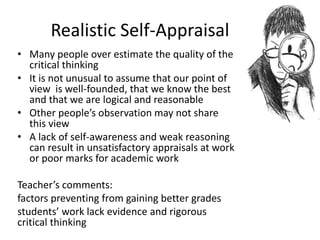
Realistic Self-Appraisal
• Many people over estimate the quality of the
critical thinking
• It is not unusual to assume that our point of
view is well-founded, that we know the best
and that we are logical and reasonable
• Other people’s observation may not share
this view
• A lack of self-awareness and weak reasoning
can result in unsatisfactory appraisals at work
or poor marks for academic work
Teacher’s comments:
factors preventing from gaining better grades
students’ work lack evidence and rigorous
critical thinking
Underlying Thinking Skills
Critical thinking assumes in a range of skills such
as:
• categorizing,
• selection and differentiation,
• comparing and contrasting
Knowledge and Research
• Good critical thinkers can often detect a
poor argument without a good knowledge
of the subject
• This results from good background research
– Finding out more about the subject helps you to
make a more informed judgment about whether
relevant facts, alternative explanations and
options have been covered sufficiently
Emotional Self-Management
Sounds like a dispassionate process but it can engage emotions
and even passionate responses (because reasoning requires to
consider opposing point of views)
• We may not like evidence that contradicts our opinions or
beliefs
• If the evidence points in a direction that is unexpected and
challenging, that can rouse unexpected feeling of anger,
frustration or anxiety
Academic world considers itself to be logical and immune to
emotions, so if feelings do emerge this can be especially difficult
• Being able to mange your emotions under such circumstances
is a useful skill
• If you remain calm, and present your reasons logically, you will
be better able to argue your point of view in a convincing way
Perseverance, Accuracy and Precision
• Attention to details: taking the time to note
small clues that throw greater light on the
overall issue
• Identifying trends and patterns: this may be
through careful mapping of information,
analysis of data, or identifying repetition and
similarities
• Repetition: going back over the same ground
several times to check that nothing has been
missed
Cont.
• Taking different perspectives: looking at the
same information from several points of view
• Objectivity: Putting your own likes, beliefs and
interests to one side with the aim of gaining the
most accurate outcome or a deeper
understanding
• Considering implications and distant
consequences: what appears to be a good idea in
the short term, for example, might have long
term effects that are less desirable
Reflection: emotional self-management
• For me emotions that are most difficult to
manage when others disagree with me are:
• I deal with these by:
Self-Awareness for Accurate Judgment
Our thinking may not be accurate if we are not fully
aware of the influences that affect us (e.g. our own
assumptions, misconceptions, bias, dislikes, beliefs,
things we take for granted as normal and accepted, and
all those about ourselves and our world that we have
never questioned)
Good Critical thinkers are self-aware:
• They reflect upon and evaluate their personal
motivations, interests, prejudices, expertise and gaps in
their knowledge
• They question their own point of view and check the
evidence used to support it.
• Becoming self-aware takes courage
• It can be unsettling to find out things about
ourselves we didn’t know )as most of us like to
think we know ourselves very well)
• It is also challenging to question our belief
system
• We think of these as part of our identity and it
can be unsettling if we feel our identity is
called into question
• The result of your critical thinking might place
you in a minority amongst your friends, family
or colleagues
• Nobody else might interpret the evidence in
the same way as you
• It takes courage to argue an alternative point
of view, especially when it is possible that you
might be wrong
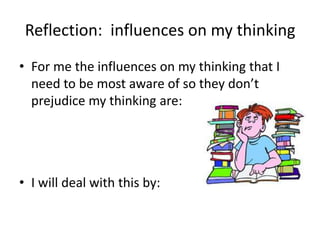
Reflection: influences on my thinking
• For me the influences on my thinking that I
need to be most aware of so they don’t
prejudice my thinking are:
• I will deal with this by:
Reflection: challenging opinions
• For me, the things most difficult about
challenging the opinions of other people are:
• I deal with these by:
Critical Thinking in Academic Context
• Students need to develop the ability to critically
evaluate the works of other
• Bodner (1988) describes chemistry students
“apply their knowledge outside the narrow
domain in which it was learnt. They “know”
without understanding”
• Instead of focusing primarily on standard
chemical calculations in books, students should
be looking for answers to questions such as
“how do we know….?” and “why do we
believe….?”
• Bodner’s description is likely to be just as true
of students in other subjects
• It is not unusual for students and for people
generally to rely unquestioningly on research
that is based on small sample of the
population, or that is based on faulty
reasoning, or that is now out of date
• Evidence from small or isolated projects is
often treated as if it were irrefutable proof of
a general principle, and is sometimes quoted
year after year as if it were an absolute truth
Reflection
Do you recognize anything of yourself in
Bodner’s description of students? What effect
would the approach, he suggests, have on your
learning and understanding?
Both Positives and Negatives
• Academic context: “criticism” – an analysis of
positive features as well as of negative ones
• Good critical analysis accounts for
– why something is good or poor
– Why it works or fails
• It is not enough merely to list good and bad
points
Comprehensive: nothing is excluded
• Students are expected to take a critical
approach to what they hear, see and read,
even when considering the theories of
respected academics
• Normally theory, perspective, data, area of
research or approach to discipline could be
subjected to critical analysis
The idea or the action, not the person
• A distinction is usually drawn between the idea, work,
text, theory or behavior, on the one hand
• On the other, the person associated with these
It is worth remembering that people identify themselves
with their work and may take criticism of it personally
• Tact and a constructive approach are needed
Giving difficult messages in a way other people can
accept is an important aspect of critical evaluation
Non-Dualistic
Is everything right or wrong, black or white
???
• In academic world, answers may occur at a point
on a continuum of possibilities
• One of the purposes of higher-level thinking is to
address questions which are more complicated
and sophisticated and which do not lend
themselves to straightforward responses
The more you know about a subject, the more
difficult it becomes to give answers
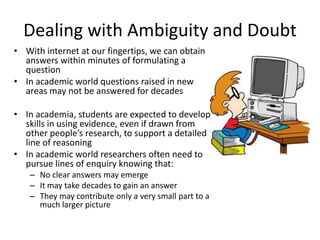
Dealing with Ambiguity and Doubt
• With internet at our fingertips, we can obtain
answers within minutes of formulating a
question
• In academic world questions raised in new
areas may not be answered for decades
• In academia, students are expected to develop
skills in using evidence, even if drawn from
other people’s research, to support a detailed
line of reasoning
• In academic world researchers often need to
pursue lines of enquiry knowing that:
– No clear answers may emerge
– It may take decades to gain an answer
– They may contribute only a very small part to a
much larger picture
Critical Thinking as a Student
means:
• Finding out where the best evidence
lies for the subject you are discussing
• Evaluating the strengths of the
evidence to support different
arguments
• Coming to an interim conclusion about
where the available evidence appears
to lead
Cont.
• Constructing a line of reasoning to guide your
audience through the evidence and lead them
towards your conclusion
• Selecting the best examples
• And providing evidence to illustrate your
argument
Barriers to Critical Thinking
Misunderstanding of what is meant by
criticism
• Assumption – criticism means “making negative
comments”
• Identifying positive as well as negative aspects, what works
well as well as what does not and weighing and considering
the information available.
• Critical evaluation is active, thoughtful examination of
what you read, hear and see to determine if the
information is accurate and reliable.
• Constructive criticism can clarify a situation and help a
person excel. Everyone needs feedback on how they can
improve
Example:
In response to your English essay, your professor
may write the following:
“What I liked most about your essay was the way
you described the characters in the novel. One way
you could improve the essay is by discussing the
significance of each character’s role in the novel.
One of your greatest strengths is your imaginative
and creative writing so this should assist you in
conveying your ideas about the character’s roles to
the readers of your essay."
Overestimating your reasoning abilities
• We often use automatic thinking, which
makes us more efficient in our everyday lives.
• Winning arguments does not necessarily
mean you have the best case or good
reasoning abilities. It may mean that your
opponents didn’t recognize a poor argument
or chose to yield the point to avoid conflict
Lack of methods, strategies or practice
• People do not know how to improve their
critical thinking skills
• Unaware of the strategies used for study at
school and in everyday situations are not
sufficiently rigorous for higher-level academic
thinking and professional work
• With practice most people can develop their
skills in critical thinking
Reluctance to Critique Experts
• Critical analysis is a typical and expected
activity
• Researchers and professors expect students to
question and challenge material. It is a typical
and expected activity in an academic
environment
Affective Reasons
• Letting emotions take the place of the reasoning and
evidence that could convince others can undermine an
argument. For example, if you feel strongly about the issue
of child abuse, then you might let your feelings about this
issue overrule evidence that supports arguments contrary
to your beliefs.
• Critical thinkers acknowledge their emotions and
understand how they can influence decisions. They take
control of whether emotions should become part of the
reasoning process.
• Critical thinking does not mean that you must abandon
beliefs that you feel strongly about; it means that you must
be willing to critically evaluate and challenge deeply held
beliefs and assumptions. When you avoid making
assumptions, you get all the information you need before
deciding anything.
Mistaking Information for Understanding
Memorizing facts and answers is not a skill that helps you to
make critical thinking judgments for yourself.
Critical evaluation is a process that involves developing
understanding and insight about the facts and answers you
learn.
Student: I want you (the expert) to give me answers to the
questions; I want to know the right answer.
Teachers: I want you to become critical thinkers, which means
I want you to challenge experts’ answers and pursue your own
answers through active questioning. This means lots of hard
work.
(Cowell et al. 1995)
Develop your mental Muscle
Insufficient Focus and Attention to Detail
“Critical thinking requires focus on the exact task at hand,
rather than becoming distracted by other interesting
tangents”
• It’s important to focus on details more than a general
overview of the subject matter in order to use critical
evaluation.
• When you critically evaluate argument, it is important
to remember that you can find an argument to be good
or effective even if you don’t agree with it
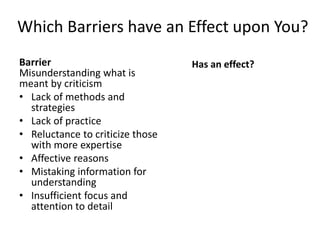
Which Barriers have an Effect upon You?
Barrier
Misunderstanding what is
meant by criticism
• Lack of methods and
strategies
• Lack of practice
• Reluctance to criticize those
with more expertise
• Affective reasons
• Mistaking information for
understanding
• Insufficient focus and
attention to detail
Has an effect?
Reflection
• Consider what you could do to manage these
barriers in the next few weeks
Critical Thinking: Knowledge, Skills and
Attitudes
• Self evaluation
• Questionnaire pg. 13
Priorities: Developing Critical Thinking
Abilities
• Pg. 14-15
In Sum….
• Critical thinkers are by nature skeptical. They
approach texts with the same skepticism and
suspicion as they approach spoken remarks.
• Critical thinkers are active, not passive. They
ask questions and analyze. They consciously
apply tactics and strategies to uncover meaning or
assure their understanding.
• Critical thinkers do not take an egotistical view of
the world. They are open to new ideas and
perspectives. They are willing to challenge their
beliefs and investigate competing evidence.
Critical Thinking. English composition.pptx

Critical Thinking. English composition.pptx

  • 1.
  • 2.
    What is CriticalThinking? Critical thinking • noun: critical thinking 1.the objective analysis and evaluation of an issue in order to form a judgment. 2."professors often find it difficult to encourage critical thinking among their students"
  • 4.
    • No onealways acts purely objectively and rationally. • We connive for selfish interests. • We gossip, boast, exaggerate, and equivocate. • It is "only human" to wish to validate our prior knowledge, to vindicate our prior decisions, or to sustain our earlier beliefs. • In the process of satisfying our ego, however, we can often deny ourselves intellectual growth and opportunity. • We may not always want to apply critical thinking skills, but we should have those skills available to be employed when needed.
  • 6.
    Critical Thinking asa Process Critical thinking is a complex process of deliberation which involves a wide range of skills and attitudes. • Identifying other people’s positions; arguments and conclusions • Evaluating the evidence for alternative points of view • Weighing up opposing arguments and evidence fairly • Being able to read between the lines, seeing behind surface, and identifying false or unfair assumptions • Recognizing techniques used to make certain positions more appealing than others, such as false logic and persuasive devices • Reflecting on issues in a structured way, bringing logic and insight to bear • Drawing conclusions about whether arguments are valid and justifiable, based on good evidence and sensible argument • Presenting a point of view in a structured, clear, well-reasoned way that convinces others
  • 8.
    Skepticism and Trust •Ennis (1987): ranges of dispositions and abilities of Critical thinking These focus on: • The ability to reflect skeptically • The ability to think in a reasoned way Skepticism: bringing an element of polite doubt. (maybe only a part of the picture) • Using skepticism and doubt constructively • Helps you make better informed decisions: whether things are true; effective or productive Trust: in order to function in the world, we have to accept the probability that at least some things are as they seem • It is reasonable to be trusting • And where it is useful to be skeptical
  • 9.
    Critical Thinking andArgument • Argument: a message that is being conveyed, whether through speech, writing, performance, or other media • Critical thinking: helps identify the obvious and the hidden messages more accurately, and to understand the process by which an argument is constructed
  • 10.
    Reasoning Knowing Our OwnReasons • Critical thinking is associated with reasoning or with our capacity for rational thought. • “rational” means “using reasons” to solve problems. • Reasoning starts with ourselves: – Having reasons for what we believe and to do, and being aware of what these are – Critically evaluating our own beliefs and actions – Being able to present to others the reasons for our beliefs and actions
  • 11.
    Critical Analysis ofOther People’s Reasoning • Identifying their reasons and conclusions • Analyzing how they select, combine and order reasons to construct a line of reasoning • Evaluating whether their reasons support the conclusions they draw • Evaluating whether their reasons are well- founded, based on good evidence • Identifying flaws in their reasoning
  • 12.
    Constructing and PresentingReasons • Reasoning involves analysing evidence and drawing conclusions from them • Evidence may then be presented to support the conclusion e.g. it is a cold day (we consider it a cold day) Someone who disagrees may ask why we believe this – We may use evidence such as thermometer reading and observation of weather conditions – Our reason may be that the temperature is low and there is ice on the ground We use basic examples of reasoning such as this everyday
  • 13.
    Cont. For professionals andacademic work, we are usually required to present such reasoning using formal structures such as essays, or reports with recommendations. • Select and structure reasons to support a conclusion • Present an argument in a consistent way • Use logical order • Use language effectively to present the line of reasoning
  • 14.
    Why Develop CriticalThinking Skills?
  • 15.
    • Improved attentionand observation • More focused reading • Improved ability to identify the key points in a text or other message rather than becoming distracted by less important material • Improved ability to respond to the appropriate points in a message • Knowledge of how to get your point across more easily • Skills of analysis that you can choose to apply in a variety of situations
  • 16.
    Benefits in Professionaland Everyday Life • Bring precision to the way you think and work • Helps to be more accurate and specific in noting what is relevant and what is not • Useful in problem solving • In project management, bringing greater precision and accuracy to different parts of the task
  • 17.
    Ancillary Skills Critical thinkinginvolves development of a range of ancillary skills: – Observation – Reasoning – Decision-making – Analysis – Judgment – Persuasion • The more advanced the level of study or the professional area, the more refined these skills need to be • The better these skills are the more you are able to take on complex problems and projects with confidence of a successful outcome
  • 18.
    Realistic Self-Appraisal • Manypeople over estimate the quality of the critical thinking • It is not unusual to assume that our point of view is well-founded, that we know the best and that we are logical and reasonable • Other people’s observation may not share this view • A lack of self-awareness and weak reasoning can result in unsatisfactory appraisals at work or poor marks for academic work Teacher’s comments: factors preventing from gaining better grades students’ work lack evidence and rigorous critical thinking
  • 19.
    Underlying Thinking Skills Criticalthinking assumes in a range of skills such as: • categorizing, • selection and differentiation, • comparing and contrasting
  • 20.
    Knowledge and Research •Good critical thinkers can often detect a poor argument without a good knowledge of the subject • This results from good background research – Finding out more about the subject helps you to make a more informed judgment about whether relevant facts, alternative explanations and options have been covered sufficiently
  • 21.
    Emotional Self-Management Sounds likea dispassionate process but it can engage emotions and even passionate responses (because reasoning requires to consider opposing point of views) • We may not like evidence that contradicts our opinions or beliefs • If the evidence points in a direction that is unexpected and challenging, that can rouse unexpected feeling of anger, frustration or anxiety Academic world considers itself to be logical and immune to emotions, so if feelings do emerge this can be especially difficult • Being able to mange your emotions under such circumstances is a useful skill • If you remain calm, and present your reasons logically, you will be better able to argue your point of view in a convincing way
  • 22.
    Perseverance, Accuracy andPrecision • Attention to details: taking the time to note small clues that throw greater light on the overall issue • Identifying trends and patterns: this may be through careful mapping of information, analysis of data, or identifying repetition and similarities • Repetition: going back over the same ground several times to check that nothing has been missed
  • 23.
    Cont. • Taking differentperspectives: looking at the same information from several points of view • Objectivity: Putting your own likes, beliefs and interests to one side with the aim of gaining the most accurate outcome or a deeper understanding • Considering implications and distant consequences: what appears to be a good idea in the short term, for example, might have long term effects that are less desirable
  • 24.
    Reflection: emotional self-management •For me emotions that are most difficult to manage when others disagree with me are: • I deal with these by:
  • 25.
    Self-Awareness for AccurateJudgment Our thinking may not be accurate if we are not fully aware of the influences that affect us (e.g. our own assumptions, misconceptions, bias, dislikes, beliefs, things we take for granted as normal and accepted, and all those about ourselves and our world that we have never questioned) Good Critical thinkers are self-aware: • They reflect upon and evaluate their personal motivations, interests, prejudices, expertise and gaps in their knowledge • They question their own point of view and check the evidence used to support it.
  • 26.
    • Becoming self-awaretakes courage • It can be unsettling to find out things about ourselves we didn’t know )as most of us like to think we know ourselves very well) • It is also challenging to question our belief system • We think of these as part of our identity and it can be unsettling if we feel our identity is called into question
  • 27.
    • The resultof your critical thinking might place you in a minority amongst your friends, family or colleagues • Nobody else might interpret the evidence in the same way as you • It takes courage to argue an alternative point of view, especially when it is possible that you might be wrong
  • 28.
    Reflection: influences onmy thinking • For me the influences on my thinking that I need to be most aware of so they don’t prejudice my thinking are: • I will deal with this by:
  • 29.
    Reflection: challenging opinions •For me, the things most difficult about challenging the opinions of other people are: • I deal with these by:
  • 30.
    Critical Thinking inAcademic Context • Students need to develop the ability to critically evaluate the works of other • Bodner (1988) describes chemistry students “apply their knowledge outside the narrow domain in which it was learnt. They “know” without understanding” • Instead of focusing primarily on standard chemical calculations in books, students should be looking for answers to questions such as “how do we know….?” and “why do we believe….?”
  • 31.
    • Bodner’s descriptionis likely to be just as true of students in other subjects • It is not unusual for students and for people generally to rely unquestioningly on research that is based on small sample of the population, or that is based on faulty reasoning, or that is now out of date • Evidence from small or isolated projects is often treated as if it were irrefutable proof of a general principle, and is sometimes quoted year after year as if it were an absolute truth
  • 32.
    Reflection Do you recognizeanything of yourself in Bodner’s description of students? What effect would the approach, he suggests, have on your learning and understanding?
  • 33.
    Both Positives andNegatives • Academic context: “criticism” – an analysis of positive features as well as of negative ones • Good critical analysis accounts for – why something is good or poor – Why it works or fails • It is not enough merely to list good and bad points
  • 34.
    Comprehensive: nothing isexcluded • Students are expected to take a critical approach to what they hear, see and read, even when considering the theories of respected academics • Normally theory, perspective, data, area of research or approach to discipline could be subjected to critical analysis
  • 35.
    The idea orthe action, not the person • A distinction is usually drawn between the idea, work, text, theory or behavior, on the one hand • On the other, the person associated with these It is worth remembering that people identify themselves with their work and may take criticism of it personally • Tact and a constructive approach are needed Giving difficult messages in a way other people can accept is an important aspect of critical evaluation
  • 36.
    Non-Dualistic Is everything rightor wrong, black or white ??? • In academic world, answers may occur at a point on a continuum of possibilities • One of the purposes of higher-level thinking is to address questions which are more complicated and sophisticated and which do not lend themselves to straightforward responses The more you know about a subject, the more difficult it becomes to give answers
  • 37.
    Dealing with Ambiguityand Doubt • With internet at our fingertips, we can obtain answers within minutes of formulating a question • In academic world questions raised in new areas may not be answered for decades • In academia, students are expected to develop skills in using evidence, even if drawn from other people’s research, to support a detailed line of reasoning • In academic world researchers often need to pursue lines of enquiry knowing that: – No clear answers may emerge – It may take decades to gain an answer – They may contribute only a very small part to a much larger picture
  • 38.
    Critical Thinking asa Student means: • Finding out where the best evidence lies for the subject you are discussing • Evaluating the strengths of the evidence to support different arguments • Coming to an interim conclusion about where the available evidence appears to lead
  • 39.
    Cont. • Constructing aline of reasoning to guide your audience through the evidence and lead them towards your conclusion • Selecting the best examples • And providing evidence to illustrate your argument
  • 40.
  • 41.
    Misunderstanding of whatis meant by criticism • Assumption – criticism means “making negative comments” • Identifying positive as well as negative aspects, what works well as well as what does not and weighing and considering the information available. • Critical evaluation is active, thoughtful examination of what you read, hear and see to determine if the information is accurate and reliable. • Constructive criticism can clarify a situation and help a person excel. Everyone needs feedback on how they can improve
  • 42.
    Example: In response toyour English essay, your professor may write the following: “What I liked most about your essay was the way you described the characters in the novel. One way you could improve the essay is by discussing the significance of each character’s role in the novel. One of your greatest strengths is your imaginative and creative writing so this should assist you in conveying your ideas about the character’s roles to the readers of your essay."
  • 43.
    Overestimating your reasoningabilities • We often use automatic thinking, which makes us more efficient in our everyday lives. • Winning arguments does not necessarily mean you have the best case or good reasoning abilities. It may mean that your opponents didn’t recognize a poor argument or chose to yield the point to avoid conflict
  • 44.
    Lack of methods,strategies or practice • People do not know how to improve their critical thinking skills • Unaware of the strategies used for study at school and in everyday situations are not sufficiently rigorous for higher-level academic thinking and professional work • With practice most people can develop their skills in critical thinking
  • 45.
    Reluctance to CritiqueExperts • Critical analysis is a typical and expected activity • Researchers and professors expect students to question and challenge material. It is a typical and expected activity in an academic environment
  • 46.
    Affective Reasons • Lettingemotions take the place of the reasoning and evidence that could convince others can undermine an argument. For example, if you feel strongly about the issue of child abuse, then you might let your feelings about this issue overrule evidence that supports arguments contrary to your beliefs. • Critical thinkers acknowledge their emotions and understand how they can influence decisions. They take control of whether emotions should become part of the reasoning process. • Critical thinking does not mean that you must abandon beliefs that you feel strongly about; it means that you must be willing to critically evaluate and challenge deeply held beliefs and assumptions. When you avoid making assumptions, you get all the information you need before deciding anything.
  • 47.
    Mistaking Information forUnderstanding Memorizing facts and answers is not a skill that helps you to make critical thinking judgments for yourself. Critical evaluation is a process that involves developing understanding and insight about the facts and answers you learn. Student: I want you (the expert) to give me answers to the questions; I want to know the right answer. Teachers: I want you to become critical thinkers, which means I want you to challenge experts’ answers and pursue your own answers through active questioning. This means lots of hard work. (Cowell et al. 1995) Develop your mental Muscle
  • 48.
    Insufficient Focus andAttention to Detail “Critical thinking requires focus on the exact task at hand, rather than becoming distracted by other interesting tangents” • It’s important to focus on details more than a general overview of the subject matter in order to use critical evaluation. • When you critically evaluate argument, it is important to remember that you can find an argument to be good or effective even if you don’t agree with it
  • 49.
    Which Barriers havean Effect upon You? Barrier Misunderstanding what is meant by criticism • Lack of methods and strategies • Lack of practice • Reluctance to criticize those with more expertise • Affective reasons • Mistaking information for understanding • Insufficient focus and attention to detail Has an effect?
  • 50.
    Reflection • Consider whatyou could do to manage these barriers in the next few weeks
  • 51.
    Critical Thinking: Knowledge,Skills and Attitudes • Self evaluation • Questionnaire pg. 13
  • 52.
    Priorities: Developing CriticalThinking Abilities • Pg. 14-15
  • 53.
    In Sum…. • Criticalthinkers are by nature skeptical. They approach texts with the same skepticism and suspicion as they approach spoken remarks. • Critical thinkers are active, not passive. They ask questions and analyze. They consciously apply tactics and strategies to uncover meaning or assure their understanding. • Critical thinkers do not take an egotistical view of the world. They are open to new ideas and perspectives. They are willing to challenge their beliefs and investigate competing evidence.