Socratic Method and Checking for
Understanding
PeerTutorTraining
Student Academic Resource Center
University of Central Florida
Made by Catherine Siew and Chelsea
Shoben
ICE BREAKER: WouldYou Rather…?
DIRECTIONS EXAMPLE
• Each tutor is going
to be asked the
same question and
must pick a side of
the room based on
their answer.
• Would you rather
skate with inline
skates or roller
skates? All for in line
go to the left and all
for roller skates go
to the right.
Objectives
• Tutors will be able to….
▫ Define and utilize the Socratic Method to assist tutees
in their sessions.
▫ Explain what it means to Check for Understanding and
the various ways to do so.
▫ Practice using the Socratic Method and Checking for
Understanding with the use of probing questions.
▫ Identify how these two methods benefit both tutor
and tutee.
Socratic Method: What is it?
http://www.youtube.com/watch?v=_CPLu3qCbSU
Steps to utilizing the Socratic Method
1. Start with good open-ended question
2. Ask follow-up and probing questions
3. Summarize everything together at the end
Overall Idea:
 Tutees come to conclusions on their own.
 Tutees independently make connections within the material.
 Tutor promotes this through specific and premeditated
questioning.
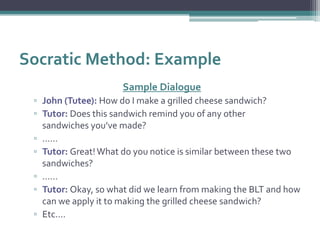
Socratic Method: Example
Sample Dialogue
▫ John (Tutee): How do I make a grilled cheese sandwich?
▫ Tutor: Does this sandwich remind you of any other
sandwiches you’ve made?
▫ ……
▫ Tutor: Great!What do you notice is similar between these two
sandwiches?
▫ ……
▫ Tutor: Okay, so what did we learn from making the BLT and how
can we apply it to making the grilled cheese sandwich?
▫ Etc….
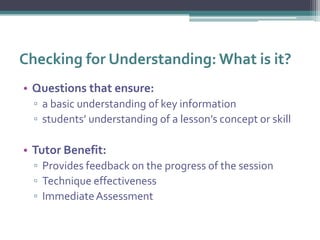
Checking for Understanding: What is it?
• Questions that ensure:
▫ a basic understanding of key information
▫ students’ understanding of a lesson’s concept or skill
• Tutor Benefit:
▫ Provides feedback on the progress of the session
▫ Technique effectiveness
▫ ImmediateAssessment
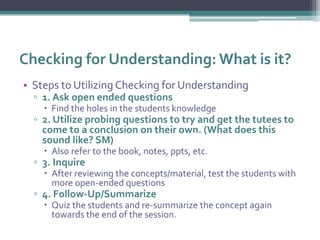
Checking for Understanding: What is it?
• Steps to Utilizing Checking for Understanding
▫ 1. Ask open ended questions
 Find the holes in the students knowledge
▫ 2. Utilize probing questions to try and get the tutees to
come to a conclusion on their own. (What does this
sound like? SM)
 Also refer to the book, notes, ppts, etc.
▫ 3. Inquire
 After reviewing the concepts/material, test the students with
more open-ended questions
▫ 4. Follow-Up/Summarize
 Quiz the students and re-summarize the concept again
towards the end of the session.
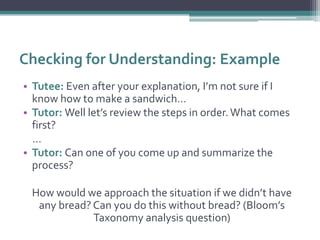
Checking for Understanding: Example
• Tutee: Even after your explanation, I’m not sure if I
know how to make a sandwich…
• Tutor: Well let’s review the steps in order.What comes
first?
…
• Tutor: Can one of you come up and summarize the
process?
How would we approach the situation if we didn’t have
any bread? Can you do this without bread? (Bloom’s
Taxonomy analysis question)
Quickwrite
Please pick one question below and write down your
response:
1. How might Socratic Method and Checking for
Understanding be related?
2. How would you define probing questions?
3. Why do you think we say the questions need to be specific
and/or premeditated?
How to Ask Probing Questions
• Begin with open-ended questions
▫ How,Why, Where,When,Who orWhat
▫ Examples
 How did you come to that answer?
 Why do you think this happened?
 What did you learn from reading this chapter?
• Think before you ask
▫ Ensure the question is relative and will ‘push’ the student
to make connections on their own.
▫ Make the questions challenging but also easy.
 We want to increase confidence (easy questions) but also
challenge them.
How to Ask Probing Questions cont.
• Follow-Up/Encourage
▫ Keep the probing going!
▫ Reassure the tutee to expand on the topic by
continuing to ask ‘Why?’ or ‘How?’.
• Re-test
▫ Ask open-ended questions on the topic again at the
end of the session to check if the students really
understood the first time around.
Socratic Method & Checking for
Understanding:TheWhy
• CriticalThinking
• Discussion within the Session
▫ Long term memory
▫ Group versus individual dynamic
▫ Engaging of more tutees
• Skills for independent learning
▫ Reinforces how a student should approach learning
 Taking responsibility for their learning.
• Feedback
▫ Tutor can evaluate if the methods they are using for
learning in their session are effective.
Socratic Method & Checking for
Understanding:Tutor’s Role
• Keep discussion focused.
• Re-summarize what questions have and have not
been resolved.
• Engage as many tutees as possible.
• Be curious
▫ Question, don’t assume, the tutee’s thought process
▫ Challenge the students for their benefit but also for
feedback.
Activity
• Work in pairs of 2-3 within your tutoring subject and
one person focuses on Socratic Method and the
other person tries to employ 1 of the Checking for
Understanding techniques (see document)(I think
this would be a good handout)
• Have them draw one Checking for Understanding
technique out of a hat
• Go over any that weren’t chosen
Checking for Understanding
Techniques/Share How ItWent
• EverybodyWrites -
• Evaluating other’s responses: Is it right?Wrong?
Why or why not?
• Class Sweep
• Practice Question – work together (GREAT for
mentoring sessions)
• Think – Pair – Share
• Choral Response –Yes/No so it’s not long

Checking for Understanding Using the Socratic Method

  • 1.
    Socratic Method andChecking for Understanding PeerTutorTraining Student Academic Resource Center University of Central Florida Made by Catherine Siew and Chelsea Shoben
  • 2.
    ICE BREAKER: WouldYouRather…? DIRECTIONS EXAMPLE • Each tutor is going to be asked the same question and must pick a side of the room based on their answer. • Would you rather skate with inline skates or roller skates? All for in line go to the left and all for roller skates go to the right.
  • 3.
    Objectives • Tutors willbe able to…. ▫ Define and utilize the Socratic Method to assist tutees in their sessions. ▫ Explain what it means to Check for Understanding and the various ways to do so. ▫ Practice using the Socratic Method and Checking for Understanding with the use of probing questions. ▫ Identify how these two methods benefit both tutor and tutee.
  • 4.
    Socratic Method: Whatis it? http://www.youtube.com/watch?v=_CPLu3qCbSU Steps to utilizing the Socratic Method 1. Start with good open-ended question 2. Ask follow-up and probing questions 3. Summarize everything together at the end Overall Idea:  Tutees come to conclusions on their own.  Tutees independently make connections within the material.  Tutor promotes this through specific and premeditated questioning.
  • 5.
    Socratic Method: Example SampleDialogue ▫ John (Tutee): How do I make a grilled cheese sandwich? ▫ Tutor: Does this sandwich remind you of any other sandwiches you’ve made? ▫ …… ▫ Tutor: Great!What do you notice is similar between these two sandwiches? ▫ …… ▫ Tutor: Okay, so what did we learn from making the BLT and how can we apply it to making the grilled cheese sandwich? ▫ Etc….
  • 6.
    Checking for Understanding:What is it? • Questions that ensure: ▫ a basic understanding of key information ▫ students’ understanding of a lesson’s concept or skill • Tutor Benefit: ▫ Provides feedback on the progress of the session ▫ Technique effectiveness ▫ ImmediateAssessment
  • 7.
    Checking for Understanding:What is it? • Steps to Utilizing Checking for Understanding ▫ 1. Ask open ended questions  Find the holes in the students knowledge ▫ 2. Utilize probing questions to try and get the tutees to come to a conclusion on their own. (What does this sound like? SM)  Also refer to the book, notes, ppts, etc. ▫ 3. Inquire  After reviewing the concepts/material, test the students with more open-ended questions ▫ 4. Follow-Up/Summarize  Quiz the students and re-summarize the concept again towards the end of the session.
  • 8.
    Checking for Understanding:Example • Tutee: Even after your explanation, I’m not sure if I know how to make a sandwich… • Tutor: Well let’s review the steps in order.What comes first? … • Tutor: Can one of you come up and summarize the process? How would we approach the situation if we didn’t have any bread? Can you do this without bread? (Bloom’s Taxonomy analysis question)
  • 9.
    Quickwrite Please pick onequestion below and write down your response: 1. How might Socratic Method and Checking for Understanding be related? 2. How would you define probing questions? 3. Why do you think we say the questions need to be specific and/or premeditated?
  • 10.
    How to AskProbing Questions • Begin with open-ended questions ▫ How,Why, Where,When,Who orWhat ▫ Examples  How did you come to that answer?  Why do you think this happened?  What did you learn from reading this chapter? • Think before you ask ▫ Ensure the question is relative and will ‘push’ the student to make connections on their own. ▫ Make the questions challenging but also easy.  We want to increase confidence (easy questions) but also challenge them.
  • 11.
    How to AskProbing Questions cont. • Follow-Up/Encourage ▫ Keep the probing going! ▫ Reassure the tutee to expand on the topic by continuing to ask ‘Why?’ or ‘How?’. • Re-test ▫ Ask open-ended questions on the topic again at the end of the session to check if the students really understood the first time around.
  • 12.
    Socratic Method &Checking for Understanding:TheWhy • CriticalThinking • Discussion within the Session ▫ Long term memory ▫ Group versus individual dynamic ▫ Engaging of more tutees • Skills for independent learning ▫ Reinforces how a student should approach learning  Taking responsibility for their learning. • Feedback ▫ Tutor can evaluate if the methods they are using for learning in their session are effective.
  • 13.
    Socratic Method &Checking for Understanding:Tutor’s Role • Keep discussion focused. • Re-summarize what questions have and have not been resolved. • Engage as many tutees as possible. • Be curious ▫ Question, don’t assume, the tutee’s thought process ▫ Challenge the students for their benefit but also for feedback.
  • 14.
    Activity • Work inpairs of 2-3 within your tutoring subject and one person focuses on Socratic Method and the other person tries to employ 1 of the Checking for Understanding techniques (see document)(I think this would be a good handout) • Have them draw one Checking for Understanding technique out of a hat • Go over any that weren’t chosen
  • 15.
    Checking for Understanding Techniques/ShareHow ItWent • EverybodyWrites - • Evaluating other’s responses: Is it right?Wrong? Why or why not? • Class Sweep • Practice Question – work together (GREAT for mentoring sessions) • Think – Pair – Share • Choral Response –Yes/No so it’s not long

Editor's Notes

  • #3 I think these questions should be on a cue card with Sofia and then she reads them off. • Visit the doctor or the dentist? • Eat broccoli or carrots? • Watch TV or listen to music? • Own a cat or a dog? • Have a beach holiday or a mountain holiday? • Be an apple or a banana? • Be invisible or be able to read minds? • Make headlines for saving somebody's life or winning a Nobel Prize? • Always be cold or always be hot? • Not hear or not see? • Eliminate hunger and disease or be able to bring lasting world peace? • Be stranded on a deserted island alone or with someone you don't like? • See the future or change the past? • Wrestle a lion or fight a shark? …. Or go home
  • #10 What is CFU???