

Chapter 4
Communication and
Intimacy
4-2
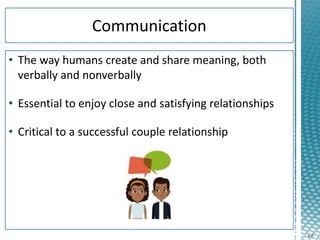
• The way humans create and share meaning, both
verbally and nonverbally
• Essential to enjoy close and satisfying relationships
• Critical to a successful couple relationship
4-3
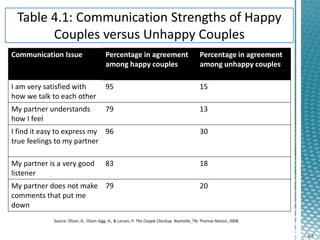
Communication Issue Percentage in agreement
among happy couples
Percentage in agreement
among unhappy couples
I am very satisfied with
how we talk to each other
95 15
My partner understands
how I feel
79 13
I find it easy to express my
true feelings to my partner
96 30
My partner is a very good
listener
83 18
My partner does not make
comments that put me
down
79 20
Source: Olson, D., Olson-Sigg, A., & Larson, P. The Couple Checkup. Nashville, TN: Thomas Nelson, 2008.
4-4
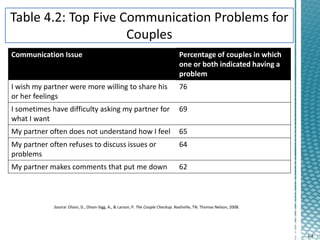
Communication Issue Percentage of couples in which
one or both indicated having a
problem
I wish my partner were more willing to share his
or her feelings
76
I sometimes have difficulty asking my partner for
what I want
69
My partner often does not understand how I feel 65
My partner often refuses to discuss issues or
problems
64
My partner makes comments that put me down 62
Source: Olson, D., Olson-Sigg, A., & Larson, P. The Couple Checkup. Nashville, TN: Thomas Nelson, 2008.
4-5
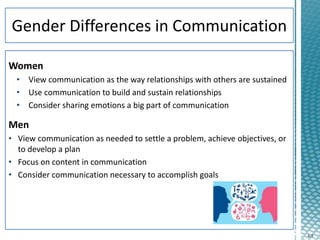
Women
• View communication as the way relationships with others are sustained
• Use communication to build and sustain relationships
• Consider sharing emotions a big part of communication
Men
• View communication as needed to settle a problem, achieve objectives, or
to develop a plan
• Focus on content in communication
• Consider communication necessary to accomplish goals
4-6
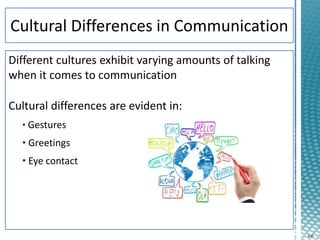
Different cultures exhibit varying amounts of talking
when it comes to communication
Cultural differences are evident in:
• Gestures
• Greetings
• Eye contact
4-7
• Internet is used to explore sexual identity and acts as the
most helpful resource in the coming-out process
• Less likely to ask family members for support
• Communicating with extended family members can be
complicated when same-sex couples move into a more
permanent relationship
• Communication can sometimes result in a positive reaction and
sometimes not
• Experience is likely to be different for same-sex couples than it is
for heterosexual couples
4-8
Good, positive communication is:
• The hallmark of successful close relationships
• Important in every stage of a close relationship
• Important across the family life cycle
• A complex process and understanding certain principles can
help improve interactions with others
4-9
Depends on both the skillful sending and the skillful
receiving of messages
Linear causality model: There is a direct, or linear,
relationship between cause and effect
• Interpersonal communication that reflects this model is usually
destructive rather than productive
4-10
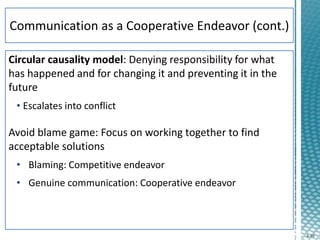
Circular causality model: Denying responsibility for what
has happened and for changing it and preventing it in the
future
• Escalates into conflict
Avoid blame game: Focus on working together to find
acceptable solutions
• Blaming: Competitive endeavor
• Genuine communication: Cooperative endeavor
4-11
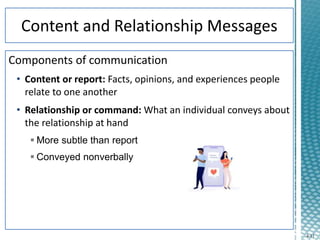
Components of communication
• Content or report: Facts, opinions, and experiences people
relate to one another
• Relationship or command: What an individual conveys about
the relationship at hand
 More subtle than report
 Conveyed nonverbally
4-12
Nonverbal aspects of spoken communication
• Tone of voice, volume, pitch, speed of speech, and rhythm of
speech
Nonverbal aspects of written communication
• Style of writing and the medium
Includes facial expressions, eye contact, gestures and
other body movements, and spatial behavior
• As difficult to interpret as verbal communication
4-13
Mixed messages: Discrepancy exists between verbal
and nonverbal components
• Barrier to real understanding
Double bind: Verbal and nonverbal messages relay
information that causes conflict about the relationship
between the speaker and the receiver
• Occurs if the relationship component is unclear
• Potential depends on the quality and mood of a
relationship
4-14
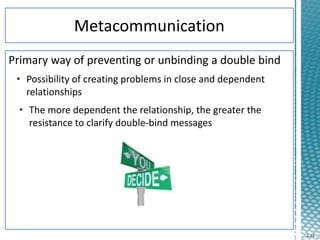
Primary way of preventing or unbinding a double bind
• Possibility of creating problems in close and dependent
relationships
• The more dependent the relationship, the greater the
resistance to clarify double-bind messages
4-15
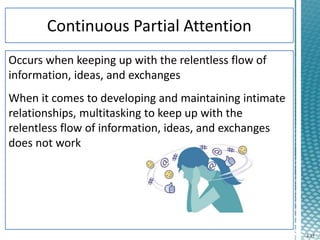
Occurs when keeping up with the relentless flow of
information, ideas, and exchanges
When it comes to developing and maintaining intimate
relationships, multitasking to keep up with the
relentless flow of information, ideas, and exchanges
does not work
4-16
Self-disclosure: Revealing some personal information or feelings
that others could not otherwise learn
Individual willingly discloses the information with forethought
Requires awareness of the information and a predisposition to
disclose it
Females receive more disclosures from others than men do
Helps build closeness and intimacy between people
4-17
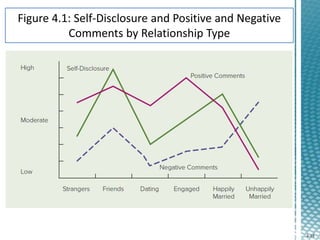
Self-disclosure and intimacy
• Self-disclosure varies with relationships
• Motivation for and frequency of disclosure are related to
relationship type
• Strangers engage in it in structured support groups
Self-disclosure in friendships and intimate
relationships
• May become intimate and personal as friends increase mutual
trust and exclusivity
• Mutual disclosure helps friendships develop more equally on
both sides
Jump to Self-Disclosure, Appendix
4-18
4-19
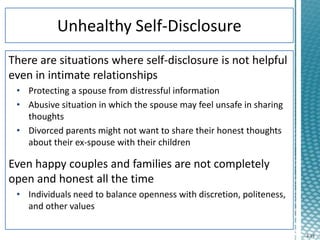
There are situations where self-disclosure is not helpful
even in intimate relationships
• Protecting a spouse from distressful information
• Abusive situation in which the spouse may feel unsafe in sharing
thoughts
• Divorced parents might not want to share their honest thoughts
about their ex-spouse with their children
Even happy couples and families are not completely
open and honest all the time
• Individuals need to balance openness with discretion, politeness,
and other values
4-20
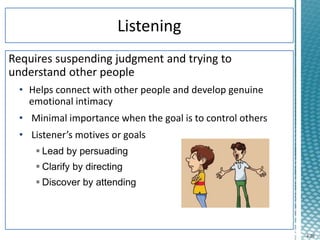
Requires suspending judgment and trying to
understand other people
• Helps connect with other people and develop genuine
emotional intimacy
• Minimal importance when the goal is to control others
• Listener’s motives or goals
 Lead by persuading
 Clarify by directing
 Discover by attending
4-21
Persuasive: Listener looks for ways to jump in and control the
conversation
Directive: Attempts to channel conversation and involves less
control than persuasive listening
• Advantage: Quickly focuses a conversation and allows the questioner to
take charge of the dialogue
• Disadvantage: In the interest of efficiency, crucial elements of the story
are lost
Attentive: Lets the speaker talk spontaneously without
interruption
• Builds trust and rapport
• People who practice this are usually described as good listeners
4-22
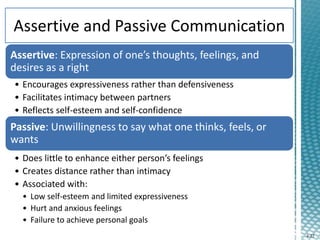
Assertive: Expression of one’s thoughts, feelings, and
desires as a right
• Encourages expressiveness rather than defensiveness
• Facilitates intimacy between partners
• Reflects self-esteem and self-confidence
Passive: Unwillingness to say what one thinks, feels, or
wants
• Does little to enhance either person’s feelings
• Creates distance rather than intimacy
• Associated with:
• Low self-esteem and limited expressiveness
• Hurt and anxious feelings
• Failure to achieve personal goals
4-23
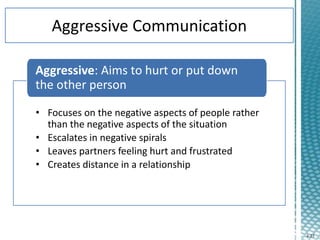
• Focuses on the negative aspects of people rather
than the negative aspects of the situation
• Escalates in negative spirals
• Leaves partners feeling hurt and frustrated
• Creates distance in a relationship
Aggressive: Aims to hurt or put down
the other person
4-24
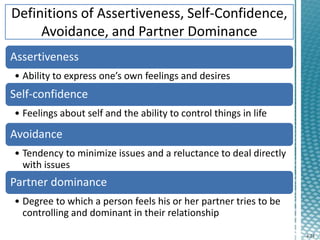
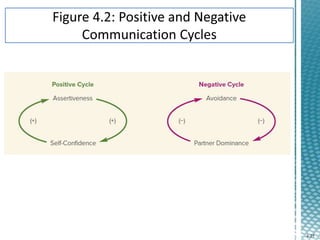
Assertiveness
• Ability to express one’s own feelings and desires
Self-confidence
• Feelings about self and the ability to control things in life
Avoidance
• Tendency to minimize issues and a reluctance to deal directly
with issues
Partner dominance
• Degree to which a person feels his or her partner tries to be
controlling and dominant in their relationship
4-25
4-26
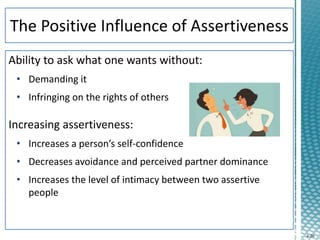
Ability to ask what one wants without:
• Demanding it
• Infringing on the rights of others
Increasing assertiveness:
• Increases a person’s self-confidence
• Decreases avoidance and perceived partner dominance
• Increases the level of intimacy between two assertive
people
4-27
Avoidance tends to be highest in people who are
passive or nonassertive
• Creates problems in close relationships
Avoidant couples:
• Minimize conflict by agreeing to disagree
• Use stonewalling: Shutting out the other person and not
responding to her or him
4-28
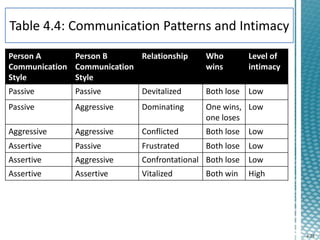
Person A
Communication
Style
Person B
Communication
Style
Relationship Who
wins
Level of
intimacy
Passive Passive Devitalized Both lose Low
Passive Aggressive Dominating One wins,
one loses
Low
Aggressive Aggressive Conflicted Both lose Low
Assertive Passive Frustrated Both lose Low
Assertive Aggressive Confrontational Both lose Low
Assertive Assertive Vitalized Both win High
Chapter 4
Communication and
Intimacy

CFD 163-Chapter 4-Communication and Intimacy

  • 1.
  • 2.
    4-2 • The wayhumans create and share meaning, both verbally and nonverbally • Essential to enjoy close and satisfying relationships • Critical to a successful couple relationship
  • 3.
    4-3 Communication Issue Percentagein agreement among happy couples Percentage in agreement among unhappy couples I am very satisfied with how we talk to each other 95 15 My partner understands how I feel 79 13 I find it easy to express my true feelings to my partner 96 30 My partner is a very good listener 83 18 My partner does not make comments that put me down 79 20 Source: Olson, D., Olson-Sigg, A., & Larson, P. The Couple Checkup. Nashville, TN: Thomas Nelson, 2008.
  • 4.
    4-4 Communication Issue Percentageof couples in which one or both indicated having a problem I wish my partner were more willing to share his or her feelings 76 I sometimes have difficulty asking my partner for what I want 69 My partner often does not understand how I feel 65 My partner often refuses to discuss issues or problems 64 My partner makes comments that put me down 62 Source: Olson, D., Olson-Sigg, A., & Larson, P. The Couple Checkup. Nashville, TN: Thomas Nelson, 2008.
  • 5.
    4-5 Women • View communicationas the way relationships with others are sustained • Use communication to build and sustain relationships • Consider sharing emotions a big part of communication Men • View communication as needed to settle a problem, achieve objectives, or to develop a plan • Focus on content in communication • Consider communication necessary to accomplish goals
  • 6.
    4-6 Different cultures exhibitvarying amounts of talking when it comes to communication Cultural differences are evident in: • Gestures • Greetings • Eye contact
  • 7.
    4-7 • Internet isused to explore sexual identity and acts as the most helpful resource in the coming-out process • Less likely to ask family members for support • Communicating with extended family members can be complicated when same-sex couples move into a more permanent relationship • Communication can sometimes result in a positive reaction and sometimes not • Experience is likely to be different for same-sex couples than it is for heterosexual couples
  • 8.
    4-8 Good, positive communicationis: • The hallmark of successful close relationships • Important in every stage of a close relationship • Important across the family life cycle • A complex process and understanding certain principles can help improve interactions with others
  • 9.
    4-9 Depends on boththe skillful sending and the skillful receiving of messages Linear causality model: There is a direct, or linear, relationship between cause and effect • Interpersonal communication that reflects this model is usually destructive rather than productive
  • 10.
    4-10 Circular causality model:Denying responsibility for what has happened and for changing it and preventing it in the future • Escalates into conflict Avoid blame game: Focus on working together to find acceptable solutions • Blaming: Competitive endeavor • Genuine communication: Cooperative endeavor
  • 11.
    4-11 Components of communication •Content or report: Facts, opinions, and experiences people relate to one another • Relationship or command: What an individual conveys about the relationship at hand  More subtle than report  Conveyed nonverbally
  • 12.
    4-12 Nonverbal aspects ofspoken communication • Tone of voice, volume, pitch, speed of speech, and rhythm of speech Nonverbal aspects of written communication • Style of writing and the medium Includes facial expressions, eye contact, gestures and other body movements, and spatial behavior • As difficult to interpret as verbal communication
  • 13.
    4-13 Mixed messages: Discrepancyexists between verbal and nonverbal components • Barrier to real understanding Double bind: Verbal and nonverbal messages relay information that causes conflict about the relationship between the speaker and the receiver • Occurs if the relationship component is unclear • Potential depends on the quality and mood of a relationship
  • 14.
    4-14 Primary way ofpreventing or unbinding a double bind • Possibility of creating problems in close and dependent relationships • The more dependent the relationship, the greater the resistance to clarify double-bind messages
  • 15.
    4-15 Occurs when keepingup with the relentless flow of information, ideas, and exchanges When it comes to developing and maintaining intimate relationships, multitasking to keep up with the relentless flow of information, ideas, and exchanges does not work
  • 16.
    4-16 Self-disclosure: Revealing somepersonal information or feelings that others could not otherwise learn Individual willingly discloses the information with forethought Requires awareness of the information and a predisposition to disclose it Females receive more disclosures from others than men do Helps build closeness and intimacy between people
  • 17.
    4-17 Self-disclosure and intimacy •Self-disclosure varies with relationships • Motivation for and frequency of disclosure are related to relationship type • Strangers engage in it in structured support groups Self-disclosure in friendships and intimate relationships • May become intimate and personal as friends increase mutual trust and exclusivity • Mutual disclosure helps friendships develop more equally on both sides Jump to Self-Disclosure, Appendix
  • 18.
  • 19.
    4-19 There are situationswhere self-disclosure is not helpful even in intimate relationships • Protecting a spouse from distressful information • Abusive situation in which the spouse may feel unsafe in sharing thoughts • Divorced parents might not want to share their honest thoughts about their ex-spouse with their children Even happy couples and families are not completely open and honest all the time • Individuals need to balance openness with discretion, politeness, and other values
  • 20.
    4-20 Requires suspending judgmentand trying to understand other people • Helps connect with other people and develop genuine emotional intimacy • Minimal importance when the goal is to control others • Listener’s motives or goals  Lead by persuading  Clarify by directing  Discover by attending
  • 21.
    4-21 Persuasive: Listener looksfor ways to jump in and control the conversation Directive: Attempts to channel conversation and involves less control than persuasive listening • Advantage: Quickly focuses a conversation and allows the questioner to take charge of the dialogue • Disadvantage: In the interest of efficiency, crucial elements of the story are lost Attentive: Lets the speaker talk spontaneously without interruption • Builds trust and rapport • People who practice this are usually described as good listeners
  • 22.
    4-22 Assertive: Expression ofone’s thoughts, feelings, and desires as a right • Encourages expressiveness rather than defensiveness • Facilitates intimacy between partners • Reflects self-esteem and self-confidence Passive: Unwillingness to say what one thinks, feels, or wants • Does little to enhance either person’s feelings • Creates distance rather than intimacy • Associated with: • Low self-esteem and limited expressiveness • Hurt and anxious feelings • Failure to achieve personal goals
  • 23.
    4-23 • Focuses onthe negative aspects of people rather than the negative aspects of the situation • Escalates in negative spirals • Leaves partners feeling hurt and frustrated • Creates distance in a relationship Aggressive: Aims to hurt or put down the other person
  • 24.
    4-24 Assertiveness • Ability toexpress one’s own feelings and desires Self-confidence • Feelings about self and the ability to control things in life Avoidance • Tendency to minimize issues and a reluctance to deal directly with issues Partner dominance • Degree to which a person feels his or her partner tries to be controlling and dominant in their relationship
  • 25.
  • 26.
    4-26 Ability to askwhat one wants without: • Demanding it • Infringing on the rights of others Increasing assertiveness: • Increases a person’s self-confidence • Decreases avoidance and perceived partner dominance • Increases the level of intimacy between two assertive people
  • 27.
    4-27 Avoidance tends tobe highest in people who are passive or nonassertive • Creates problems in close relationships Avoidant couples: • Minimize conflict by agreeing to disagree • Use stonewalling: Shutting out the other person and not responding to her or him
  • 28.
    4-28 Person A Communication Style Person B Communication Style RelationshipWho wins Level of intimacy Passive Passive Devitalized Both lose Low Passive Aggressive Dominating One wins, one loses Low Aggressive Aggressive Conflicted Both lose Low Assertive Passive Frustrated Both lose Low Assertive Aggressive Confrontational Both lose Low Assertive Assertive Vitalized Both win High
  • 29.