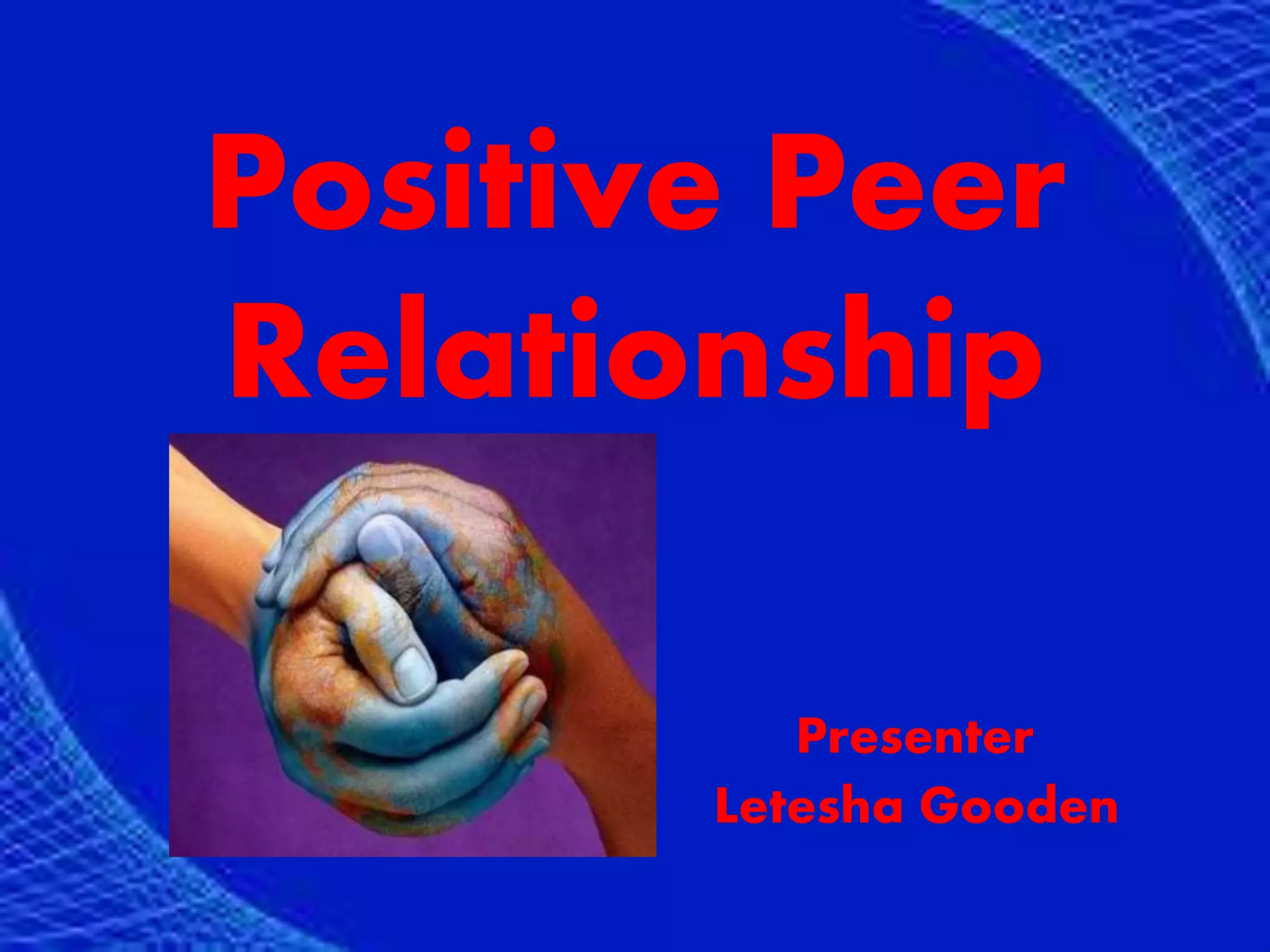
Positive Peer
Relationship
Presenter
Letesha Gooden
Introduction
Under optimal conditions, children learn core social-
emotional skills during the early childhood years that
enable them to establish and maintain their first
friendships, get along well as members of their peer
communities, and participate effectively in school.
Children who are delayed in their acquisition of these
social-emotional competencies are at heightened risk for
significant peer problems and behavioural
difficulties when they enter Primary schoolwhich
can escalate to more serious emotional
difficulties and antisocial behaviours in
adolescence. Hence, promoting social-emotional
development during the Early childhood years is a
priority.
Objectives
At the end of this class students should be
able to:
•Know who is a friend
•Identify the trait of a good friend and bad
friends
•Know the different types of friends
What is a peer relationship
A peer group is both a social group and
a primary group of people who have similar
interests, age, background, or social status. The
members of this group are likely to influence the
person’s beliefs and behaviour.[1] Peer groups
contain hierarchies and distinct patterns of
behavior.
The important of Positive peer
relationship
The importance of peer relationship is to help
in a healthy development. Theorist such as,
Vygotsky have stated that peer relationships
provide a unique context for cognitive, social,
and emotional development.
Types of Peer Relationship
Friendships
Casual
Close
Platonic
Cliques
Gang
Dating Relationships
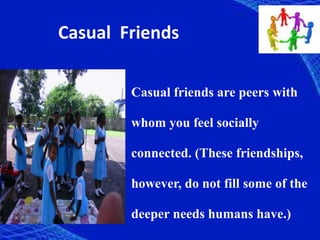
Casual Friends
Casual friends are peers with
whom you feel socially
connected. (These friendships,
however, do not fill some of the
deeper needs humans have.)
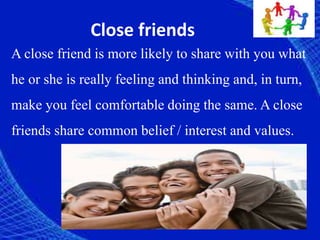
Close friends
A close friend is more likely to share with you what
he or she is really feeling and thinking and, in turn,
make you feel comfortable doing the same. A close
friends share common belief / interest and values.
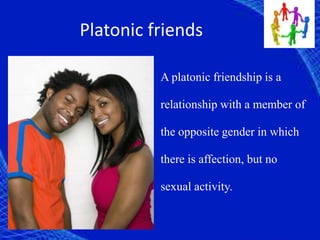
Platonic friends
A platonic friendship is a
relationship with a member of
the opposite gender in which
there is affection, but no
sexual activity.
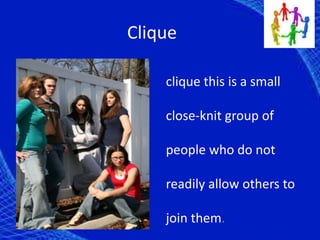
Clique
clique this is a small
close-knit group of
people who do not
readily allow others to
join them.
Gang
A gang is a group of
youngsters or adolescents who associate
closely, often exclusively, for social reasons, these
type of group normally engage in
delinquent behavior.
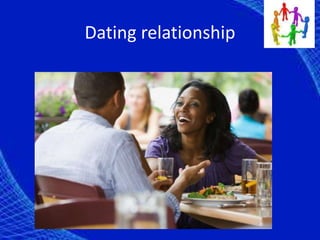
Dating relationship
A dating relationship is defined as a romantic or
intimate social relationship between two
individuals that is determined by the facts in
each case, such as the length of the relationship,
the type of the relationship, the frequency of
interaction between the two individuals
involved in the relationship.
Dating relationship
Negative sign of
Friendship
◦ Low self-esteem in adolescence is associated
with:
Poorer mental and physical health
Worse economic prospects
Higher levels of criminal behaviour
Negative sign of
Friendship
The Taker: The taker is a type of friend will try to
possess what you have and acquire your
achievements in order to satisfy his or her envy and
greed. This type of a person will try to sneak behind
your back to either steal money or your significant
other, and he or she will feel no remorse about doing
so. This type of person needs to be completely cut
off.
Negative sign of
Friendship
Stressor: If you have a friend who always stresses
you out with his or her actions or words, then
this is a sign of a bad friend. A true friend should
never make you feel stressed out. Stress also
includes the feeling that you always need to
please the other person because that person
makes you feel that way.
Negative sign of
Friendship
Chaotic: A friend who loves to cause chaos or
takes pleasure in seeing chaos with other people
is not a friend at all.
Negative sign of
Friendship
Gossip: A person who talk about other people behind
their backs. gossips to you about everyone will make
you believe that he or she is your best friend. Do not
be fooled. If this person gossips to you about others,
then he or she certainly gossips about you.
Negative sign of
Friendship
Bossy: A person who order you around, do not be
fooled by someone who bosses you around and tells
you what to do or how to do it. There are many
people who hang around bossy people and think that
they are their friends; this is wrong. A bossy person is
not a good friend
Negative Effects of
Friendship
• Low self esteem
• Abuse
mentally
physically
emotionally
• Negative peer pressure
Positive Signs of friendship
•They practice forgiveness
•They make the friendship a priority
•They support each other through their adversity
•They listen to each others
•They tell each other when they are wrong
Positive effects of friendship
High Self-Esteem
◦ Girls’ self-esteem tends to decline during
adolescence, while boys’ self-esteem increases
Self identity strengthen
Love and appreciate their self
Know when to say no
•Positive peer pressure
Parents roll in aiding
positive peer relationship
•Practice authorative (not authoritarian)
parenting
•Teach kids how to converse in a polite way
•Foster empathy and sympathetic concern for
others.
•Monitor kids’ social life
•Watch out for bullying
Teachers roll in aiding
positive peer relationship
Some ways to help children build
friendships and social skills include teaching
them to:
•be aware of the personal space of others.
•Practice making and maintaining eye
contact during conversations.
.
Teachers roll in aiding
positive peer relationship
•Try not to control the discussion.
•Think twice before speaking.
•Allow others to finish speaking before
beginning to talk.
•Always be courteous say please and thank
you.
Conclusion
It has seen where the importance of peer
relationship is evitable for the proper
development of a child. Theorist has also agree
the dept of how it can affect individual when
the absent of socialization take place. However
this can be foster by peers, parents and
teachers.
References
Gwen,D.(2014) parenting choice/ retrieved on
http://www.parentingscience.com/kids-
make-
friends.html
Probs (2014) probs, Teachers Help Students Build
Friendships and Social Skills. Retrieved on
https://www.ssdmo.org/rotate_features/10_13
/ soc ial_skills.html
Radwan,M.F.(2015) 2 know myself. retrieved on
://www.2knowmyself.com/how_c
an_friends_affect_your_life
Unknown (2015 ) self worth. retrieved on
http://www.selfgrowth.com/articles/ten-signs-of-
a-bad-friendship

Positive peer relationship

  • 1.
  • 2.
    Introduction Under optimal conditions,children learn core social- emotional skills during the early childhood years that enable them to establish and maintain their first friendships, get along well as members of their peer communities, and participate effectively in school. Children who are delayed in their acquisition of these social-emotional competencies are at heightened risk for significant peer problems and behavioural
  • 3.
    difficulties when theyenter Primary schoolwhich can escalate to more serious emotional difficulties and antisocial behaviours in adolescence. Hence, promoting social-emotional development during the Early childhood years is a priority.
  • 4.
    Objectives At the endof this class students should be able to: •Know who is a friend •Identify the trait of a good friend and bad friends •Know the different types of friends
  • 5.
    What is apeer relationship A peer group is both a social group and a primary group of people who have similar interests, age, background, or social status. The members of this group are likely to influence the person’s beliefs and behaviour.[1] Peer groups contain hierarchies and distinct patterns of behavior.
  • 6.
    The important ofPositive peer relationship The importance of peer relationship is to help in a healthy development. Theorist such as, Vygotsky have stated that peer relationships provide a unique context for cognitive, social, and emotional development.
  • 7.
    Types of PeerRelationship Friendships Casual Close Platonic Cliques Gang Dating Relationships
  • 8.
    Casual Friends Casual friendsare peers with whom you feel socially connected. (These friendships, however, do not fill some of the deeper needs humans have.)
  • 9.
    Close friends A closefriend is more likely to share with you what he or she is really feeling and thinking and, in turn, make you feel comfortable doing the same. A close friends share common belief / interest and values.
  • 10.
    Platonic friends A platonicfriendship is a relationship with a member of the opposite gender in which there is affection, but no sexual activity.
  • 11.
    Clique clique this isa small close-knit group of people who do not readily allow others to join them.
  • 12.
    Gang A gang isa group of youngsters or adolescents who associate closely, often exclusively, for social reasons, these type of group normally engage in delinquent behavior.
  • 13.
    Dating relationship A datingrelationship is defined as a romantic or intimate social relationship between two individuals that is determined by the facts in each case, such as the length of the relationship, the type of the relationship, the frequency of interaction between the two individuals involved in the relationship.
  • 14.
  • 15.
    Negative sign of Friendship ◦Low self-esteem in adolescence is associated with: Poorer mental and physical health Worse economic prospects Higher levels of criminal behaviour
  • 16.
    Negative sign of Friendship TheTaker: The taker is a type of friend will try to possess what you have and acquire your achievements in order to satisfy his or her envy and greed. This type of a person will try to sneak behind your back to either steal money or your significant other, and he or she will feel no remorse about doing so. This type of person needs to be completely cut off.
  • 17.
    Negative sign of Friendship Stressor:If you have a friend who always stresses you out with his or her actions or words, then this is a sign of a bad friend. A true friend should never make you feel stressed out. Stress also includes the feeling that you always need to please the other person because that person makes you feel that way.
  • 18.
    Negative sign of Friendship Chaotic:A friend who loves to cause chaos or takes pleasure in seeing chaos with other people is not a friend at all.
  • 19.
    Negative sign of Friendship Gossip:A person who talk about other people behind their backs. gossips to you about everyone will make you believe that he or she is your best friend. Do not be fooled. If this person gossips to you about others, then he or she certainly gossips about you.
  • 20.
    Negative sign of Friendship Bossy:A person who order you around, do not be fooled by someone who bosses you around and tells you what to do or how to do it. There are many people who hang around bossy people and think that they are their friends; this is wrong. A bossy person is not a good friend
  • 21.
    Negative Effects of Friendship •Low self esteem • Abuse mentally physically emotionally • Negative peer pressure
  • 22.
    Positive Signs offriendship •They practice forgiveness •They make the friendship a priority •They support each other through their adversity •They listen to each others •They tell each other when they are wrong
  • 23.
    Positive effects offriendship High Self-Esteem ◦ Girls’ self-esteem tends to decline during adolescence, while boys’ self-esteem increases Self identity strengthen Love and appreciate their self Know when to say no •Positive peer pressure
  • 24.
    Parents roll inaiding positive peer relationship •Practice authorative (not authoritarian) parenting •Teach kids how to converse in a polite way •Foster empathy and sympathetic concern for others. •Monitor kids’ social life •Watch out for bullying
  • 25.
    Teachers roll inaiding positive peer relationship Some ways to help children build friendships and social skills include teaching them to: •be aware of the personal space of others. •Practice making and maintaining eye contact during conversations. .
  • 26.
    Teachers roll inaiding positive peer relationship •Try not to control the discussion. •Think twice before speaking. •Allow others to finish speaking before beginning to talk. •Always be courteous say please and thank you.
  • 27.
    Conclusion It has seenwhere the importance of peer relationship is evitable for the proper development of a child. Theorist has also agree the dept of how it can affect individual when the absent of socialization take place. However this can be foster by peers, parents and teachers.
  • 28.
    References Gwen,D.(2014) parenting choice/retrieved on http://www.parentingscience.com/kids- make- friends.html Probs (2014) probs, Teachers Help Students Build Friendships and Social Skills. Retrieved on https://www.ssdmo.org/rotate_features/10_13 / soc ial_skills.html Radwan,M.F.(2015) 2 know myself. retrieved on ://www.2knowmyself.com/how_c an_friends_affect_your_life Unknown (2015 ) self worth. retrieved on http://www.selfgrowth.com/articles/ten-signs-of- a-bad-friendship