CHAPTER 7:
Relationships
Today’s Class:
• Types of Intimacy
• Meaningful Relationships
• Anger and Conflict in Relationships
• Dealing with Communication Barriers
• Intimate Partner Violence and Abuse
• Termination of a significant relationship
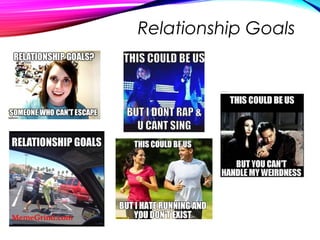
Relationship Goals
intimacy
• Intimate relationships are relatively long-lasting relationships in
which frequent interactions occur in various situations.
• Intimacy is a close emotional relationship characterized by a deep
level of caring for another person
• Types of intimacy shared with another person
• Emotional, intellectual, physical, spiritual, or any combination of
these
• Erikson
• Task of an emerging adult  being able form intimate
relationships
• Avoiding Intimacy – we deprive ourselves of relationships that can
potentially enrich our lives by caring deeply for others and savoring
the time spent with them
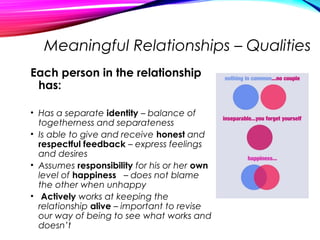
Meaningful Relationships – Qualities
Each person in the relationship
has:
• Has a separate identity – balance of
togetherness and separateness
• Is able to give and receive honest and
respectful feedback – express feelings
and desires
• Assumes responsibility for his or her own
level of happiness – does not blame
the other when unhappy
• Actively works at keeping the
relationship alive – important to revise
our way of being to see what works and
doesn’t
Meaningful Relationships – Qualities (cont.)
Each person in the relationship
• Enjoys being with the other and
is considered an equal
• Finds meaning and sources of
nourishment outside the
relationship
• Is growing and changing and
moving in a direction in life that is
personally meaningful
Meaningful Relationships – Qualities
(cont.)
Each person in the
relationship
• Encourages the other to
become all they are capable
of becoming rather than
being controlling
• Does not expect the other to
do for him or her what he or
she is capable of doing
• Has a commitment to the
other
Meaningful Relationships
• Relationships are more meaningful when they are dynamic
than fixed
• All of the guidelines/qualities can be applied to all
relationships
• Friendships
• Couples
• Parent-child
• Important for individuals to put forth effort and take
responsibility
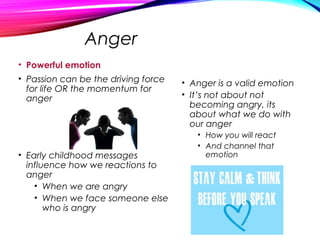
Anger
• Powerful emotion
• Passion can be the driving force
for life OR the momentum for
anger
• Early childhood messages
influence how we reactions to
anger
• When we are angry
• When we face someone else
who is angry
• Anger is a valid emotion
• It’s not about not
becoming angry, its
about what we do with
our anger
• How you will react
• And channel that
emotion
A few tips in dealing with anger:
• Value the recognition
and expression of
anger
• Express anger in a
way that does not
assassinate another’s
character
• Don’t hold on to
anger or nurse
grudges
• Recognize danger
signs when anger gets
in the way of
relationships
• Talk more about
yourself than about
what is wrong with the
other person
• Decide when it is
better not to express
anger
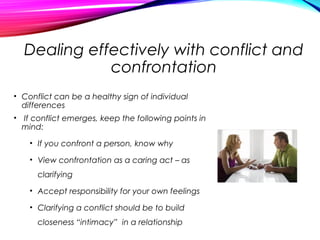
Dealing effectively with conflict and
confrontation
• Conflict can be a healthy sign of individual
differences
• If conflict emerges, keep the following points in
mind:
• If you confront a person, know why
• View confrontation as a caring act – as
clarifying
• Accept responsibility for your own feelings
• Clarifying a conflict should be to build
closeness “intimacy” in a relationship
If conflict emerges, keep the
following points in mind:
• Tell others how you are struggling with them
• Don’t walk away from conflict
• Be open to forgiving others who have hurt you
• Be willing to forgive yourself
• for your reactions, words, feelings
Communication Barriers
• Barriers
• Effective Personal Communication
Barriers to Effective
Communication
• Hearing only what you want to
hear
• Being overly concerned about
getting your
point across
• Silently rehearsing what you will
say as you are “listening”
• Becoming overly defensive
• Making assumptions about the
other person without checking
them out
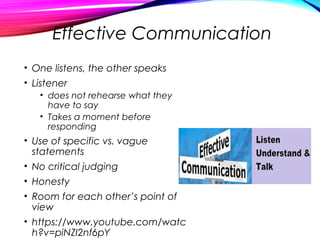
Effective Communication
• One listens, the other speaks
• Listener
• does not rehearse what they
have to say
• Takes a moment before
responding
• Use of specific vs. vague
statements
• No critical judging
• Honesty
• Room for each other’s point of
view
• https://www.youtube.com/watc
h?v=piNZI2nf6pY
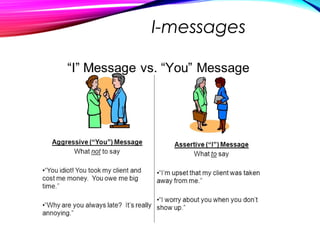
I-messages
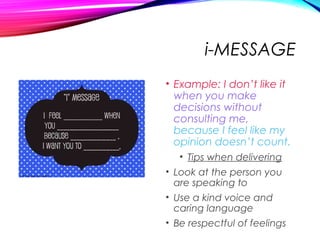
i-MESSAGE
• Example: I don’t like it
when you make
decisions without
consulting me,
because I feel like my
opinion doesn’t count.
• Tips when delivering
• Look at the person you
are speaking to
• Use a kind voice and
caring language
• Be respectful of feelings
Intimate Partner
Violence and Abuse
• Intimate partner violence or domestic abuse involves
exerting power and control over others
• It can take the form of physical, sexual, emotional,
psychological, or economic abuse
• Abusers use tactics to increase their victim’s dependence
on them
• If you believe you or someone you know, are in an abusive
relationship, exercise great caution in how you interact with
your partner.
Behaviors of an Abusive
PERSON
• Humiliating
• Criticizes
• Blames you for their behavior
• See you as property
• Very jealous
• Controlling
• Limits access to resources (money, car, phone)
• Explosive in their temper
Victims of domestic
violence
• Victims may rationalize their choice to stay by saying that
their situation is not so bad and is likely to improve
• Victims often excuse their partner’s behavior and find fault
with themselves for bringing about the abuse
• Victims may have legitimate concerns for their safety and
the safety of their loved ones if they leave
• College counseling centers, community agencies, and
hotlines offer services to assist victims of intimate partner
abuse
Gay and Lesbian
Relationships
• Sexual orientation refers to the gender or genders
that a person is attracted to physically, emotionally,
sexually, and romantically.
• Many people in same-sex orientation experience
discrimination and oppression
• Hate crimes often include physical assault and are
directed against a victim because he or she is of a certain
race, ethnic group, religion, or sexual orientation.
• Homophobia, the irrational fear of homosexual
people and strong negative attitudes about
homosexuality, sometimes leads to hate crimes
Coping with the Termination of a
Meaningful Relationship
• Allow yourself the
time to grieve
• Express your anger
without violence
• Take responsibility for
your own part in the
relationship
• Find a support
network
• Take care of other
aspects of your life
• Make use of writing in
your journal
• Be willing to forgive —
both yourself and the
other person
• Seek closure and
learn from the
experience
22

Psych 115 chapter 7

  • 1.
  • 2.
    Today’s Class: • Typesof Intimacy • Meaningful Relationships • Anger and Conflict in Relationships • Dealing with Communication Barriers • Intimate Partner Violence and Abuse • Termination of a significant relationship
  • 3.
  • 4.
    intimacy • Intimate relationshipsare relatively long-lasting relationships in which frequent interactions occur in various situations. • Intimacy is a close emotional relationship characterized by a deep level of caring for another person • Types of intimacy shared with another person • Emotional, intellectual, physical, spiritual, or any combination of these • Erikson • Task of an emerging adult  being able form intimate relationships • Avoiding Intimacy – we deprive ourselves of relationships that can potentially enrich our lives by caring deeply for others and savoring the time spent with them
  • 5.
    Meaningful Relationships –Qualities Each person in the relationship has: • Has a separate identity – balance of togetherness and separateness • Is able to give and receive honest and respectful feedback – express feelings and desires • Assumes responsibility for his or her own level of happiness – does not blame the other when unhappy • Actively works at keeping the relationship alive – important to revise our way of being to see what works and doesn’t
  • 6.
    Meaningful Relationships –Qualities (cont.) Each person in the relationship • Enjoys being with the other and is considered an equal • Finds meaning and sources of nourishment outside the relationship • Is growing and changing and moving in a direction in life that is personally meaningful
  • 7.
    Meaningful Relationships –Qualities (cont.) Each person in the relationship • Encourages the other to become all they are capable of becoming rather than being controlling • Does not expect the other to do for him or her what he or she is capable of doing • Has a commitment to the other
  • 8.
    Meaningful Relationships • Relationshipsare more meaningful when they are dynamic than fixed • All of the guidelines/qualities can be applied to all relationships • Friendships • Couples • Parent-child • Important for individuals to put forth effort and take responsibility
  • 9.
    Anger • Powerful emotion •Passion can be the driving force for life OR the momentum for anger • Early childhood messages influence how we reactions to anger • When we are angry • When we face someone else who is angry • Anger is a valid emotion • It’s not about not becoming angry, its about what we do with our anger • How you will react • And channel that emotion
  • 10.
    A few tipsin dealing with anger: • Value the recognition and expression of anger • Express anger in a way that does not assassinate another’s character • Don’t hold on to anger or nurse grudges • Recognize danger signs when anger gets in the way of relationships • Talk more about yourself than about what is wrong with the other person • Decide when it is better not to express anger
  • 11.
    Dealing effectively withconflict and confrontation • Conflict can be a healthy sign of individual differences • If conflict emerges, keep the following points in mind: • If you confront a person, know why • View confrontation as a caring act – as clarifying • Accept responsibility for your own feelings • Clarifying a conflict should be to build closeness “intimacy” in a relationship
  • 12.
    If conflict emerges,keep the following points in mind: • Tell others how you are struggling with them • Don’t walk away from conflict • Be open to forgiving others who have hurt you • Be willing to forgive yourself • for your reactions, words, feelings
  • 13.
    Communication Barriers • Barriers •Effective Personal Communication
  • 14.
    Barriers to Effective Communication •Hearing only what you want to hear • Being overly concerned about getting your point across • Silently rehearsing what you will say as you are “listening” • Becoming overly defensive • Making assumptions about the other person without checking them out
  • 15.
    Effective Communication • Onelistens, the other speaks • Listener • does not rehearse what they have to say • Takes a moment before responding • Use of specific vs. vague statements • No critical judging • Honesty • Room for each other’s point of view • https://www.youtube.com/watc h?v=piNZI2nf6pY
  • 16.
  • 17.
    i-MESSAGE • Example: Idon’t like it when you make decisions without consulting me, because I feel like my opinion doesn’t count. • Tips when delivering • Look at the person you are speaking to • Use a kind voice and caring language • Be respectful of feelings
  • 18.
    Intimate Partner Violence andAbuse • Intimate partner violence or domestic abuse involves exerting power and control over others • It can take the form of physical, sexual, emotional, psychological, or economic abuse • Abusers use tactics to increase their victim’s dependence on them • If you believe you or someone you know, are in an abusive relationship, exercise great caution in how you interact with your partner.
  • 19.
    Behaviors of anAbusive PERSON • Humiliating • Criticizes • Blames you for their behavior • See you as property • Very jealous • Controlling • Limits access to resources (money, car, phone) • Explosive in their temper
  • 20.
    Victims of domestic violence •Victims may rationalize their choice to stay by saying that their situation is not so bad and is likely to improve • Victims often excuse their partner’s behavior and find fault with themselves for bringing about the abuse • Victims may have legitimate concerns for their safety and the safety of their loved ones if they leave • College counseling centers, community agencies, and hotlines offer services to assist victims of intimate partner abuse
  • 21.
    Gay and Lesbian Relationships •Sexual orientation refers to the gender or genders that a person is attracted to physically, emotionally, sexually, and romantically. • Many people in same-sex orientation experience discrimination and oppression • Hate crimes often include physical assault and are directed against a victim because he or she is of a certain race, ethnic group, religion, or sexual orientation. • Homophobia, the irrational fear of homosexual people and strong negative attitudes about homosexuality, sometimes leads to hate crimes
  • 22.
    Coping with theTermination of a Meaningful Relationship • Allow yourself the time to grieve • Express your anger without violence • Take responsibility for your own part in the relationship • Find a support network • Take care of other aspects of your life • Make use of writing in your journal • Be willing to forgive — both yourself and the other person • Seek closure and learn from the experience 22

Editor's Notes