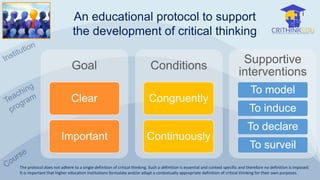
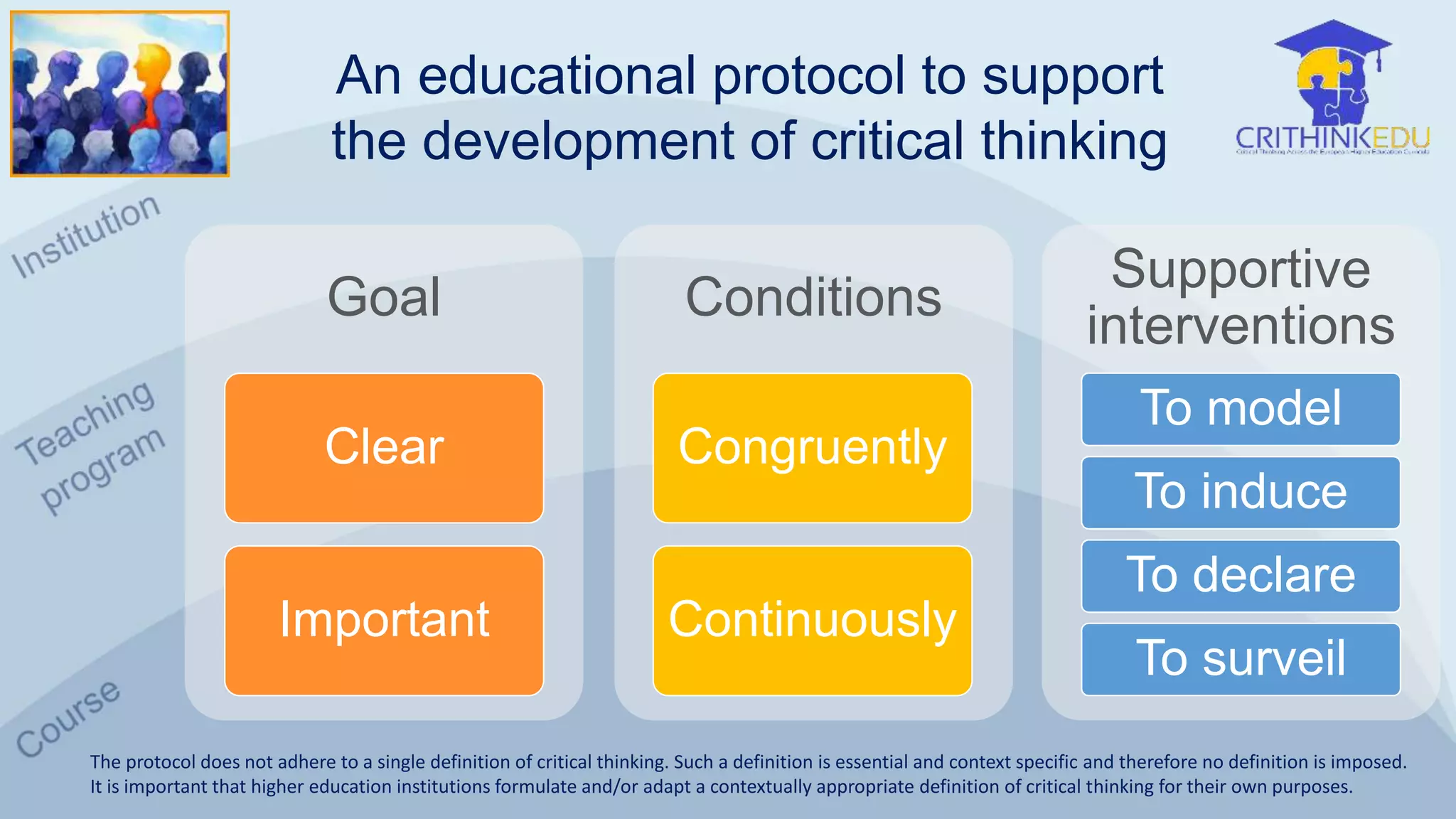
An educational protocol to support
the development of critical thinking
Goal
Clear
Important
Conditions
Congruently
Continuously
Supportive
interventions
To model
To induce
To declare
To surveil
The protocol does not adhere to a single definition of critical thinking. Such a definition is essential and context specific and therefore no definition is imposed.
It is important that higher education institutions formulate and/or adapt a contextually appropriate definition of critical thinking for their own purposes.
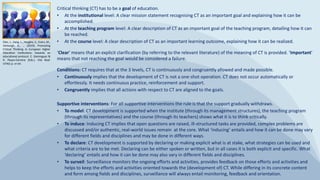
Critical thinking (CT) has to be a goal of education.
• At the institutional level: A clear mission statement recognising CT as an important goal and explaining how it can be
accomplished.
• At the teaching program level: A clear description of CT as an important goal of the teaching program, detailing how it can
be reached.
• At the course level: A clear description of CT as an important learning outcome, explaining how it can be realized.
‘Clear’ means that an explicit clarification (by referring to the relevant literature) of the meaning of CT is provided. ‘Important’
means that not reaching the goal would be considered a failure.
Conditions: CT requires that at the 3 levels, CT is continuously and congruently allowed and made possible.
• Continuously implies that the development of CT is not a one-shot operation. CT does not occur automatically or
effortlessly. It needs continuous practice, reinforcement and support.
• Congruently implies that all actions with respect to CT are aligned to the goals.
Supportive interventions: For all supportive interventions the rule is that the support gradually withdraws.
• To model: CT development is supported when the institute (through its management structures), the teaching program
(through its representatives) and the course (through its teachers) shows what it is to think critically.
• To induce: Inducing CT implies that open questions are raised, ill-structured tasks are provided, complex problems are
discussed and/or authentic, real-world issues remain at the core. What ‘inducing’ entails and how it can be done may vary
for different fields and disciplines and may be done in different ways.
• To declare: CT development is supported by declaring or making explicit what is at stake, what strategies can be used and
what criteria are to be met. Declaring can be either spoken or written, but in all cases it is both explicit and specific. What
‘declaring’ entails and how it can be done may also vary in different fields and disciplines.
• To surveil: Surveillance monitors the ongoing efforts and activities, provides feedback on those efforts and activities and
helps to keep the efforts and activities oriented towards the (development of) CT. While differing in its concrete content
and form among fields and disciplines, surveillance will always entail monitoring, feedback and orientation.
Elen, J., Jiang, L., Huyghe, S., Evers, M.,
Verburgh, A., … (2019). Promoting
Critical Thinking in European Higher
Education Institutions: towards an
educational protocol. C. Dominguez &
R. Payan-Carreira (Eds.). Vila Real:
UTAD; p. vi-viii.

CRITHINKEDU educational protocol for critical thinking development [short version]

  • 1.
    An educational protocolto support the development of critical thinking Goal Clear Important Conditions Congruently Continuously Supportive interventions To model To induce To declare To surveil The protocol does not adhere to a single definition of critical thinking. Such a definition is essential and context specific and therefore no definition is imposed. It is important that higher education institutions formulate and/or adapt a contextually appropriate definition of critical thinking for their own purposes.
  • 2.
    Critical thinking (CT)has to be a goal of education. • At the institutional level: A clear mission statement recognising CT as an important goal and explaining how it can be accomplished. • At the teaching program level: A clear description of CT as an important goal of the teaching program, detailing how it can be reached. • At the course level: A clear description of CT as an important learning outcome, explaining how it can be realized. ‘Clear’ means that an explicit clarification (by referring to the relevant literature) of the meaning of CT is provided. ‘Important’ means that not reaching the goal would be considered a failure. Conditions: CT requires that at the 3 levels, CT is continuously and congruently allowed and made possible. • Continuously implies that the development of CT is not a one-shot operation. CT does not occur automatically or effortlessly. It needs continuous practice, reinforcement and support. • Congruently implies that all actions with respect to CT are aligned to the goals. Supportive interventions: For all supportive interventions the rule is that the support gradually withdraws. • To model: CT development is supported when the institute (through its management structures), the teaching program (through its representatives) and the course (through its teachers) shows what it is to think critically. • To induce: Inducing CT implies that open questions are raised, ill-structured tasks are provided, complex problems are discussed and/or authentic, real-world issues remain at the core. What ‘inducing’ entails and how it can be done may vary for different fields and disciplines and may be done in different ways. • To declare: CT development is supported by declaring or making explicit what is at stake, what strategies can be used and what criteria are to be met. Declaring can be either spoken or written, but in all cases it is both explicit and specific. What ‘declaring’ entails and how it can be done may also vary in different fields and disciplines. • To surveil: Surveillance monitors the ongoing efforts and activities, provides feedback on those efforts and activities and helps to keep the efforts and activities oriented towards the (development of) CT. While differing in its concrete content and form among fields and disciplines, surveillance will always entail monitoring, feedback and orientation. Elen, J., Jiang, L., Huyghe, S., Evers, M., Verburgh, A., … (2019). Promoting Critical Thinking in European Higher Education Institutions: towards an educational protocol. C. Dominguez & R. Payan-Carreira (Eds.). Vila Real: UTAD; p. vi-viii.