Critical thinking and teaching
critical thinking
Assoc. Prof. Daniela Dumitru, PhD
University of Bucharest, Romania
OECD Meeting
Paris, 6th and 7th of September, 2018
Summary
• The concept of critical thinking. Definitions
• Teaching CT - pedagogical aspects
CT definition across time
• The Ancient Greece
• Plato’s Dialogues (e.g. The Republic, 2007), in which Socrates is the
main character. The Socratic Dialogue. Maeutics.
• Aristotle showed that anyone who wishes to deeply understand
reality, beyond the surface and the appearances that can be
deceiving, that person must think well, understand well and seek
the answers and solutions to the obstacles and counterexamples
that can be formulated by opponents.
• In the Middle Ages, in his famous work, Summa Theologica, Thomas
Aquinas (1981) wanted his reasoning to meet all the requirements of
the critical thinking, to be always systematically exposed and to
always answer the criticisms of the exposed ideas.
• In England, we have a few representatives of empiricism, just as
famous, who had the active idea of criticism and reflection in their
work. Therefore, we mention Francis Bacon (2008) who was
concerned with the way in which our mind gathered information
about the world.
• Fifty years later, in France, René Descartes wrote what could be called
the second book of critical thinking, a less known, incomplete and
posthumously published work, Regulae ad directione ingenii (Rules
for the Direction of the Natural Intelligence 1619-1628, 1998).
• In the 16th and 17th century, Thomas Hobbes and John Locke had a
critical attitude.
• Hobbes had a naturalistic vision of the world, where everything
needed to be explained in terms of proofs and reason.
• Locke supported the application of critical thinking at the level of the
common sense of life and everyday thinking. He was the one to lay
the foundation of the critical thinking applied to human’s
fundamental rights, involved in establishing the responsibilities of the
governments etc. Therefore, John Locke was the one who brought
into discussion and highlighted the necessity of critical thinking first
of all in a democracy and second of all in social life.
• Immanuel Kant (1999) wrote the Critique of pure reason, in which the
critical thinking turns to itself, to its powers and limitations.
• …and a jump the 20th century:
• Contemporary definition: starts with J. Dewey, How we think (1909,
as in Stoianovici 2005). He suggested the term of reflective thinking,
“a number of features that differentiate the superior use of the
humans’ rational faculty from its minimal and routine functioning”
(Dewey, 1909, as in Stoianovici 2005, 123).
• Edward Glaser is an author that followed the conceptual line opened
by Dewey.
• Critical thinking is an attitude according to which someone is willing
to take into consideration the facing problems in a reflective manner.
This feature is followed by the acknowledgment of investigation and
logical judgment methods and certain skills of operating and using
these methods. You also have to be willing to use them in everyday
situations.
• In 1989 Robert Ennis, one of the most important
representatives who decisively contributed to the
development of this domain, proposed probably the most
used definition today: critical thinking is reasonable and
reflective thinking focusing on deciding what to believe or do
(Norris and Ennis, 1989).
• Richard Paul (1993) added another feature in the definition
of critical thinking: metacognition. The way of thinking
about any subject, content, or problem, in which the thinker
improves the quality of his or her thinking by skillfully taking
charge of the inherent structures in thinking and imposing
intellectual standards on them.
Paul & Elder (2001)
• Alec Fisher (2001, p. 5) said that this definition drew the
attention on the fact that the only way to improve a person’s
critical thinking abilities consisted in that person’s conscious
participation in the improving process, having a model of
“good” thinking, an ideal model of thinking correctly, to
which the person can constantly relate.
• See also the work of H. Siegel, D. Halpern, R. Barnett, Bailin
and Battersby, R. Epstein.
The Delphi Project
• In 1988, the Delphi Project started. The official title of this project
was Critical Thinking: A Statement of Expert Consensus for Purposes of
Educational Assessment and Instruction.
• It was financed by the American Philosophical Association and
gathered an interdisciplinary team of specialists (philosopher,
teachers, psychologists, sociologists, critical thinking specialists,
assessment specialists, an economist, a computer science specialist, a
zoologist and a physicist).
• Its aim was to conceptualize “critical thinking”.
• Here is the entire Delphi definition: critical thinking is
purposeful, self-regulatory judgment, which results in
interpretation, analysis, evaluation, and inference, as well as
explanation of the evidential, conceptual, methodological,
criteriological, or contextual considerations upon which that
judgment is based. The definition continues with: critical
thinking is an essential tool of inquiry.
• The Delphi Project experts believe that the following set of cognitive
skills represents the main dimensions of critical thinking:
• Analysis
• Interpretation
• Evaluation
• Inference
• Explanation
• Self-regulation
• And seven dispositions:
• Truth-seeking
• Open-mindedness,
• Analyticity,
• Systematicity,
• Self-confidence,
• Inquisitiveness
• Cognitive maturity
• The panelists described the dispositions or characteristics of
a good critical thinker: he commits and encourages the
others to commit to critical judgment; he is capable of such
judgments in a wide area of contexts and a variety of
purposes (“The Delphi Report”, Executive Summary, 1990, p.
12).
• The experts make up a list of affective dispositions that
define a good critical thinker, divided into two categories:
• Affective dispositions regarding life and the quotidian in
general
• Affective dispositions regarding themes, matters and
specific questions
Critical thinking development. Cognitive values
• Deanna Kuhn (1999, 2003, 2004, 2007, 2008) describes a stage model
of the development of critical thinking.
• The author acknowledges four stages of the critical thinking
development that closely follow the Piagetian stages.
• The first stage, realism, corresponds to the preschool age and to the
preoperational stage.
• In this stage, assertions are copies of the external reality, the
knowledge comes from an external source and is certain and critical
thinking is unnecessary because there cannot be any dispute, since
everybody “sees” the same thing.
• The second stage, absolutist, corresponds to the school age and the
stage of concrete operations.
• This is the stage of an accumulation of some safe facts, assertions are
facts that are either correct or incorrect in their representation of
reality and the knowledge comes from an external source and is
certain, but not directly accessible, thus producing false beliefs.
• Critical thinking is a vehicle for comparing assertions about reality,
aiming to determine their truth or falsehood.
• The third stage, multiplism or relativism, corresponds to
adolescence. Assertions are freely chosen opinions and are seen as
personal goods and therefore, unavailable to discussions. In this
stage, knowledge is seen as generated by the human mind and that is
the reason why it is uncertain.
• Adolescents fall into a “whirlpool of doubt” (Chandler, 2003 apud.
Kuhn, 2003), from which they may never get out.
• The conclusion according to which everybody is right in their own way
and everybody is right in their own way from certain points of view
they agree more than others’, namely their opponents’ and that they
are free to believe whatever they want and in what they want is a
well-known picture of adolescence. However, in this picture, critical
thinking is irrelevant.
• Critical thinking development can continue with a fourth stage,
called the evaluativist stage.
• This stretches out over the age of the young adult and is
characterized by considering assertions as judgments that can be
evaluated and compared using the criteria of rationality,
demonstration and alternatives.
• In the evaluativist stage, knowledge is seen as being generated by the
human mind and therefore uncertain and can be susceptible to
evaluation.
• It is perfectly acceptable that some opinions are better than others,
meaning that some are better supported by proofs and arguments
and the justification of the opinions must be more than pure personal
preference.
• In the evaluativist stage, critical thinking is the vehicle that brings
valid assertions and enhances understanding.
• In her book Education for Thinking (2010), Deanna Kuhn presents the
results of a research conducted over three years and she shows that
there is a strong connection between the value attributed by family to
knowledge and a child’s school results.
• In other words, if the family thinks it is very important and positive
to know, to possess knowledge, then the child is highly motivated
and will make great efforts to gather as much knowledge as possible.
Teaching CT. Instructional approach
• Ennis (1989):
• the general approach: focuses on teaching critical thinking, on
developing critical thinking apart from the specific content of subject
matters;
• the infusion approach: presupposes the encouragement of students
to think critically within each subject matter in which the general
principles of critical thinking are explicitly formulated;
Teaching CT. Instructional approach
• the immersion approach: students are immersed in the respective
domain without being specifically referred to the principles of critical
thinking (Prawat, 1991);
• the mixed approach is a hybrid between the general approach and
one of the other two approaches presented above, immersion or the
infusion approach.
• McPeck criticizes the standard approach to critical thinking,
which says that CT is a universal and transferable capacity
(1990).
• Ennis’ answer is a nuanced one. He says that there are three
forms in which the specificity of the domain is defined.
• And any discussion about the transfer of critical thinking
skills has to begin from the vision on specificity that we
adopt.
The empirical domain specificity
When there is an empirical difference between the domains
in question we have to:
• (i) have background knowledge;
• (ii) have the capacity to transfer:
• (a) the simple transfer of critical thinking skills and dispositions form one
domain to another is impossible;
• (b) anyway, the transfer becomes feasible if: 1. there is sufficient practice in
several domains; 2. there is training concentrating on the transfer;
• (iii) have overall instruction.
Epistemological Specificity
It claims that credible arguments are domain dependent and that
critical thinking consequently varies from one domain to another.
• This boils down to the following:
• (i) knowledge in the domain: in order to be able to think critically
within one domain one has to have knowledge within that domain.
• (ii) interdisciplinary variability: good arguments are domain
dependent; they may vary from one domain to another;
• (iii) full understanding of the domain: this is a necessary condition if
one is to think critically within a domain.
Conceptual Specificity
• Ennis claims that certain concepts are common to several disciplines
and that the specificity of domains from this point of view is much
vaguer than in the case of the other specificity criteria.
• So conceptual specificity is much more problematic than the others.
• McPeck (1990) states that ‘thinking always comes down to thinking
about something’ and that the phrases ‘to teach thinking’ or
‘teaching someone how to think’ are meaningless.
• He states that if one is to consider formal logic as an example, which
is the most prone to transferability, this is irrelevant for some
domains in the sense that its usage is not an abstract capacity as the
domain of formal logic is, but a part of what we call “rational
thinking” in certain domains or disciplines.
• NB! Evans (1982) and Glaser (1984) have demonstrated through
experimental research that the transfer of logic abilities is as
problematic as any other transfer.
• Ennis contradicts McPeck:
• if one says “All As are Bs, which amounts to saying that if something is
not B that something is not A either”, where A and B are variables
which may be replaced with any concrete object, this statement is
about A and B without being related to a certain domain or topic or
object.
• One can teach and talk about a principle without relying on a certain
content.
• McPeck briefly answers that it involves “an A and a B, therefore this
thinking is about something”.
Hence…
• McPeck thinks that the forms of critical thinking are in direct
proportion with the topics, whereas Ennis believes that there is a
general ability called critical thinking just as Logic is universal.
• McPeck does not even accept that Logic is the one which governs
argumentation in specific domains, claiming that this falls under the
authority of Epistemology,
• He opt for a thinking that is natural, applied and contextualized to
objects of study or to topics of discussion.
• McPeck shows where the mistake in the standard vision on
critical thinking lies:
• there is a confusion between “logical subsuming” and
“psychological transfer”.
• In other words, if a sum of logical principles is found in each
domain and if the domains have to subject to these
principles, this does not mean that one has to infer that the
transfer is done on the basis of these logical principles,
because this transfer is psychological in its essence and not
logical.
• The fact that we accept the existence of domain organization
according to logical principles (whatever that might mean),
does not mean that once we have managed to isolate these
universal principles within a domain on which we are expert,
these principles will be automatically transferred to other
domains and to daily life.
• There has to be a way to render particular to a domain all
“principles”, which do not seem to be as psychologically
universal as they are theoretically and logically universal.
CT teaching strategies
• Ennis describes two basics teaching methods for promoting CT:
• Lecture-Discussion Teaching (LDT)
• Problem-Based Learning (PBL)
• They contrast with each other.
• LDT is the most common approach to college teaching.
Corollary. An instantiation of critical thinking
transfer: philosophers
• How can they discuss with the same acuteness about almost
anything?
• We might think that this is a success story of transfer.
• Actually, it might very well be that this case precisely has had
scholars assert that critical thinking is made up of universal
principles that may be transferred from one domain to
another.
• I believe this presupposition to be false.
• Philosophers’ job is to focus on argumentation, on
performing a critical exercise on anything.
• Philosophers look for the principles and the argumentative
construction of any speech.
• We cannot have the same expectations from any other
individual who has not been trained accordingly and who
does not have the necessary structural motivation to reflect,
to find principles and to assess their strength.
• A specialist on the domain or a student who is studying a
domain does not question the axioms of the discipline, nor
does he ask questions about the empirical, conceptual and
epistemological make-up of their domain.
• They do not actually know that there are such dimensions
concerning the specifics of a discipline. They simply function
within a space which they take for granted.
• Asking ourselves why philosophers can perform the transfer
is like asking why the tailors have scissors whereas the
mechanics have spanners.
• It is because this is what they do and we cannot extrapolate
this case of successful transfer to all domains.
Research example (Dumitru, 2013)
• The method
• The research method we employed was the quasi-experiment, pre-post
test of non-equivalent.
• Basic plan with one independent variable, the educational program (a
classical course of critical thinking or an integrated course of critical
thinking).
• Working hypotheses
• The general hypothesis of the study: integrated educational programs are
a developing factor of critical thinking. The students attending these
programs will exhibit a higher capacity for argumentation, reasoning,
research and critical judgement.
• The experimental group ended up by consisting of 33 subjects, while
the control group had 31.
• The ages of the subjects ranged between 20 and 34 years of age in
the control group and between 20 and 32 years of age in the
experimental group.
• The course was conceived of as a mix form, beginning with an
immersion into Critical Thinking by presenting the material or the
subject and carrying on with a Socratic dialogue where problems
were freely discussed; later on, when the students grasped the error,
the specific terminology, the principles or the explanations, and the
definitions were introduced.
• The control group had a traditional course of Argumentation and
Critical thinking, though this type of course is not that old in what the
educational offer in the universities is concerned.
• The term “traditional” should be understood as “more recurrent” in
the academic curriculum.
• The teaching method employed in this course was the lecture.
• The instruments
• LSAT (Law School Admission Test) test (Logical Reasoning)
• the essay test, designed by Robert Ennis and Eric Weir in 1985
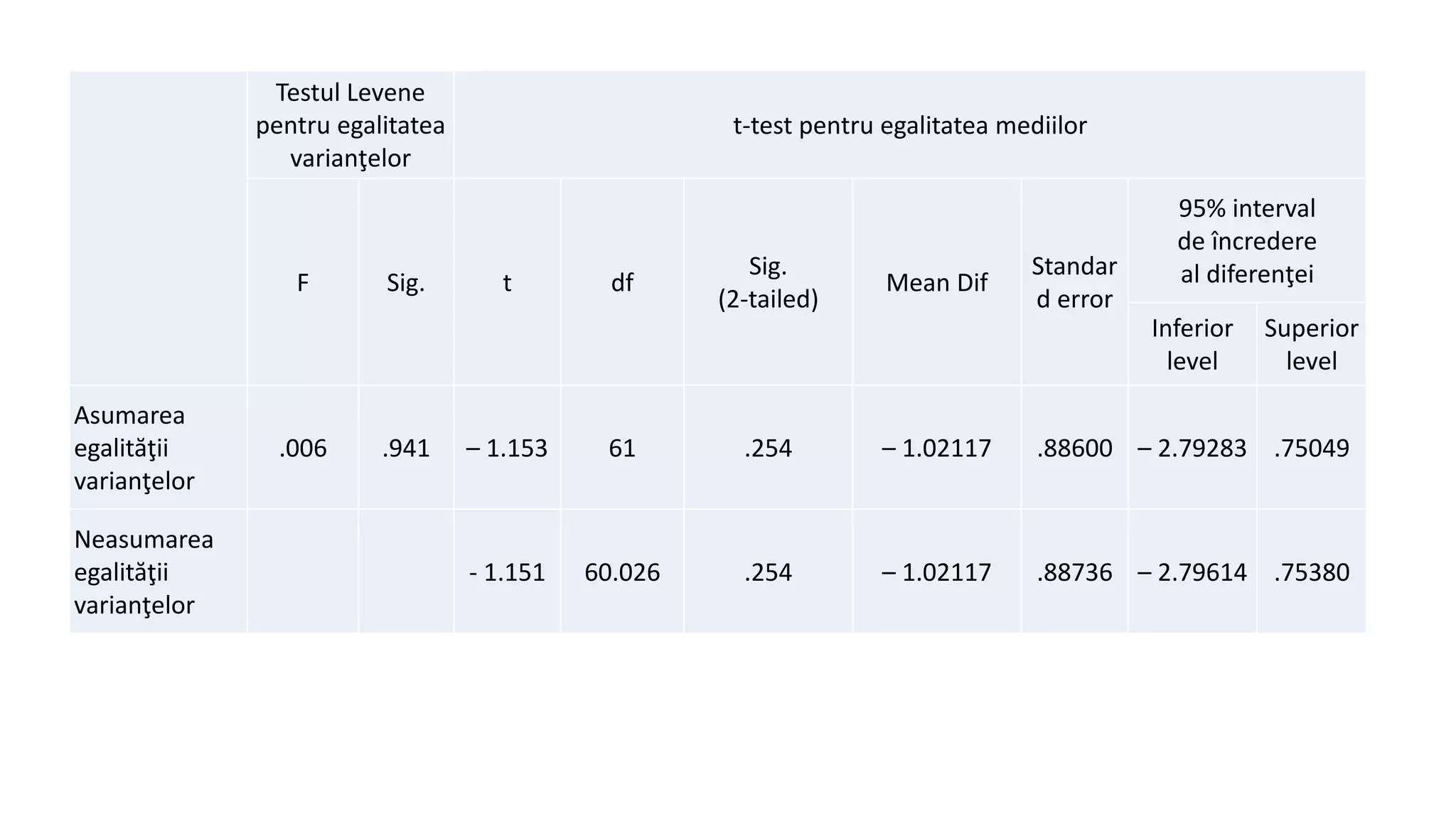
Testul Levene
pentru egalitatea
varianţelor
t-test pentru egalitatea mediilor
F Sig. t df
Sig.
(2-tailed)
Mean Dif
Standar
d error
95% interval
de încredere
al diferenţei
Inferior
level
Superior
level
Asumarea
egalităţii
varianţelor
.006 .941 – 1.153 61 .254 – 1.02117 .88600 – 2.79283 .75049
Neasumarea
egalităţii
varianţelor
- 1.151 60.026 .254 – 1.02117 .88736 – 2.79614 .75380
Testul Levene
pentru
egalitatea
varianţelor
t-test pentru egalitatea mediilor
F Sig. t df
Sig.
(2-tailed)
Diferenţa
dintre
medii
Eroarea
standard
a mediei
95% intervalul de încredere
al diferenţei
Limita
inferioară
Limita
superioară
Asumarea
egalităţii
varianţelor
3.260 .076 – 4.878 61 .0001 – 2.56855 .52658 – 3.62152 – 1.51558
Neasumarea
egalităţii
varianţelor
– 4.900 57.223 .0001 – 2.56855 .52414 – 3.61804 – 1.51906
• Effect size ω2 is 0.27, for pre-post Ennis-Wier test
• Effect size ω2 is 0.05, for pre-post LSAT test.
• Indicates a strong association between the results obtained at the
essay test and the group to which the subjects belonged.
Conclusions
• If one aims at employing the abilities of critical thinking in daily-life
situations, an integrated, trans-disciplinary or inter-disciplinary course
integrating the disciplines socially is by far more suitable than a classical
course in Critical Thinking, where the principles and the terminology that
are specific to this domain are presented.
• It is necessary that the actual use of critical thinking abilities take place
under the guidance of a professor/trainer and within a formal
environment; this aspect should not be ignored in the hope that the
student will know by herself how to think critically.
• It is acceptable to think that there are certain principles which we can
transfer, but which are few and which need to be checked through
experimental research cum grano salis.
• We cannot claim that CT skills are transferable base on philosophers case
or, broadly speaking, base on academics or researchers case.
• Thank you!

Critical thinking and teaching critical thinking

  • 1.
    Critical thinking andteaching critical thinking Assoc. Prof. Daniela Dumitru, PhD University of Bucharest, Romania OECD Meeting Paris, 6th and 7th of September, 2018
  • 2.
    Summary • The conceptof critical thinking. Definitions • Teaching CT - pedagogical aspects
  • 3.
    CT definition acrosstime • The Ancient Greece • Plato’s Dialogues (e.g. The Republic, 2007), in which Socrates is the main character. The Socratic Dialogue. Maeutics. • Aristotle showed that anyone who wishes to deeply understand reality, beyond the surface and the appearances that can be deceiving, that person must think well, understand well and seek the answers and solutions to the obstacles and counterexamples that can be formulated by opponents.
  • 4.
    • In theMiddle Ages, in his famous work, Summa Theologica, Thomas Aquinas (1981) wanted his reasoning to meet all the requirements of the critical thinking, to be always systematically exposed and to always answer the criticisms of the exposed ideas. • In England, we have a few representatives of empiricism, just as famous, who had the active idea of criticism and reflection in their work. Therefore, we mention Francis Bacon (2008) who was concerned with the way in which our mind gathered information about the world. • Fifty years later, in France, René Descartes wrote what could be called the second book of critical thinking, a less known, incomplete and posthumously published work, Regulae ad directione ingenii (Rules for the Direction of the Natural Intelligence 1619-1628, 1998).
  • 5.
    • In the16th and 17th century, Thomas Hobbes and John Locke had a critical attitude. • Hobbes had a naturalistic vision of the world, where everything needed to be explained in terms of proofs and reason. • Locke supported the application of critical thinking at the level of the common sense of life and everyday thinking. He was the one to lay the foundation of the critical thinking applied to human’s fundamental rights, involved in establishing the responsibilities of the governments etc. Therefore, John Locke was the one who brought into discussion and highlighted the necessity of critical thinking first of all in a democracy and second of all in social life.
  • 6.
    • Immanuel Kant(1999) wrote the Critique of pure reason, in which the critical thinking turns to itself, to its powers and limitations. • …and a jump the 20th century: • Contemporary definition: starts with J. Dewey, How we think (1909, as in Stoianovici 2005). He suggested the term of reflective thinking, “a number of features that differentiate the superior use of the humans’ rational faculty from its minimal and routine functioning” (Dewey, 1909, as in Stoianovici 2005, 123).
  • 7.
    • Edward Glaseris an author that followed the conceptual line opened by Dewey. • Critical thinking is an attitude according to which someone is willing to take into consideration the facing problems in a reflective manner. This feature is followed by the acknowledgment of investigation and logical judgment methods and certain skills of operating and using these methods. You also have to be willing to use them in everyday situations.
  • 8.
    • In 1989Robert Ennis, one of the most important representatives who decisively contributed to the development of this domain, proposed probably the most used definition today: critical thinking is reasonable and reflective thinking focusing on deciding what to believe or do (Norris and Ennis, 1989). • Richard Paul (1993) added another feature in the definition of critical thinking: metacognition. The way of thinking about any subject, content, or problem, in which the thinker improves the quality of his or her thinking by skillfully taking charge of the inherent structures in thinking and imposing intellectual standards on them.
  • 9.
  • 10.
    • Alec Fisher(2001, p. 5) said that this definition drew the attention on the fact that the only way to improve a person’s critical thinking abilities consisted in that person’s conscious participation in the improving process, having a model of “good” thinking, an ideal model of thinking correctly, to which the person can constantly relate. • See also the work of H. Siegel, D. Halpern, R. Barnett, Bailin and Battersby, R. Epstein.
  • 11.
    The Delphi Project •In 1988, the Delphi Project started. The official title of this project was Critical Thinking: A Statement of Expert Consensus for Purposes of Educational Assessment and Instruction. • It was financed by the American Philosophical Association and gathered an interdisciplinary team of specialists (philosopher, teachers, psychologists, sociologists, critical thinking specialists, assessment specialists, an economist, a computer science specialist, a zoologist and a physicist). • Its aim was to conceptualize “critical thinking”.
  • 12.
    • Here isthe entire Delphi definition: critical thinking is purposeful, self-regulatory judgment, which results in interpretation, analysis, evaluation, and inference, as well as explanation of the evidential, conceptual, methodological, criteriological, or contextual considerations upon which that judgment is based. The definition continues with: critical thinking is an essential tool of inquiry.
  • 13.
    • The DelphiProject experts believe that the following set of cognitive skills represents the main dimensions of critical thinking: • Analysis • Interpretation • Evaluation • Inference • Explanation • Self-regulation
  • 14.
    • And sevendispositions: • Truth-seeking • Open-mindedness, • Analyticity, • Systematicity, • Self-confidence, • Inquisitiveness • Cognitive maturity
  • 15.
    • The panelistsdescribed the dispositions or characteristics of a good critical thinker: he commits and encourages the others to commit to critical judgment; he is capable of such judgments in a wide area of contexts and a variety of purposes (“The Delphi Report”, Executive Summary, 1990, p. 12). • The experts make up a list of affective dispositions that define a good critical thinker, divided into two categories: • Affective dispositions regarding life and the quotidian in general • Affective dispositions regarding themes, matters and specific questions
  • 16.
    Critical thinking development.Cognitive values • Deanna Kuhn (1999, 2003, 2004, 2007, 2008) describes a stage model of the development of critical thinking. • The author acknowledges four stages of the critical thinking development that closely follow the Piagetian stages. • The first stage, realism, corresponds to the preschool age and to the preoperational stage. • In this stage, assertions are copies of the external reality, the knowledge comes from an external source and is certain and critical thinking is unnecessary because there cannot be any dispute, since everybody “sees” the same thing.
  • 17.
    • The secondstage, absolutist, corresponds to the school age and the stage of concrete operations. • This is the stage of an accumulation of some safe facts, assertions are facts that are either correct or incorrect in their representation of reality and the knowledge comes from an external source and is certain, but not directly accessible, thus producing false beliefs. • Critical thinking is a vehicle for comparing assertions about reality, aiming to determine their truth or falsehood.
  • 18.
    • The thirdstage, multiplism or relativism, corresponds to adolescence. Assertions are freely chosen opinions and are seen as personal goods and therefore, unavailable to discussions. In this stage, knowledge is seen as generated by the human mind and that is the reason why it is uncertain. • Adolescents fall into a “whirlpool of doubt” (Chandler, 2003 apud. Kuhn, 2003), from which they may never get out. • The conclusion according to which everybody is right in their own way and everybody is right in their own way from certain points of view they agree more than others’, namely their opponents’ and that they are free to believe whatever they want and in what they want is a well-known picture of adolescence. However, in this picture, critical thinking is irrelevant.
  • 19.
    • Critical thinkingdevelopment can continue with a fourth stage, called the evaluativist stage. • This stretches out over the age of the young adult and is characterized by considering assertions as judgments that can be evaluated and compared using the criteria of rationality, demonstration and alternatives. • In the evaluativist stage, knowledge is seen as being generated by the human mind and therefore uncertain and can be susceptible to evaluation.
  • 20.
    • It isperfectly acceptable that some opinions are better than others, meaning that some are better supported by proofs and arguments and the justification of the opinions must be more than pure personal preference. • In the evaluativist stage, critical thinking is the vehicle that brings valid assertions and enhances understanding.
  • 21.
    • In herbook Education for Thinking (2010), Deanna Kuhn presents the results of a research conducted over three years and she shows that there is a strong connection between the value attributed by family to knowledge and a child’s school results. • In other words, if the family thinks it is very important and positive to know, to possess knowledge, then the child is highly motivated and will make great efforts to gather as much knowledge as possible.
  • 22.
    Teaching CT. Instructionalapproach • Ennis (1989): • the general approach: focuses on teaching critical thinking, on developing critical thinking apart from the specific content of subject matters; • the infusion approach: presupposes the encouragement of students to think critically within each subject matter in which the general principles of critical thinking are explicitly formulated;
  • 23.
    Teaching CT. Instructionalapproach • the immersion approach: students are immersed in the respective domain without being specifically referred to the principles of critical thinking (Prawat, 1991); • the mixed approach is a hybrid between the general approach and one of the other two approaches presented above, immersion or the infusion approach.
  • 24.
    • McPeck criticizesthe standard approach to critical thinking, which says that CT is a universal and transferable capacity (1990). • Ennis’ answer is a nuanced one. He says that there are three forms in which the specificity of the domain is defined. • And any discussion about the transfer of critical thinking skills has to begin from the vision on specificity that we adopt.
  • 25.
    The empirical domainspecificity When there is an empirical difference between the domains in question we have to: • (i) have background knowledge; • (ii) have the capacity to transfer: • (a) the simple transfer of critical thinking skills and dispositions form one domain to another is impossible; • (b) anyway, the transfer becomes feasible if: 1. there is sufficient practice in several domains; 2. there is training concentrating on the transfer; • (iii) have overall instruction.
  • 26.
    Epistemological Specificity It claimsthat credible arguments are domain dependent and that critical thinking consequently varies from one domain to another. • This boils down to the following: • (i) knowledge in the domain: in order to be able to think critically within one domain one has to have knowledge within that domain. • (ii) interdisciplinary variability: good arguments are domain dependent; they may vary from one domain to another; • (iii) full understanding of the domain: this is a necessary condition if one is to think critically within a domain.
  • 27.
    Conceptual Specificity • Ennisclaims that certain concepts are common to several disciplines and that the specificity of domains from this point of view is much vaguer than in the case of the other specificity criteria. • So conceptual specificity is much more problematic than the others.
  • 28.
    • McPeck (1990)states that ‘thinking always comes down to thinking about something’ and that the phrases ‘to teach thinking’ or ‘teaching someone how to think’ are meaningless. • He states that if one is to consider formal logic as an example, which is the most prone to transferability, this is irrelevant for some domains in the sense that its usage is not an abstract capacity as the domain of formal logic is, but a part of what we call “rational thinking” in certain domains or disciplines. • NB! Evans (1982) and Glaser (1984) have demonstrated through experimental research that the transfer of logic abilities is as problematic as any other transfer.
  • 29.
    • Ennis contradictsMcPeck: • if one says “All As are Bs, which amounts to saying that if something is not B that something is not A either”, where A and B are variables which may be replaced with any concrete object, this statement is about A and B without being related to a certain domain or topic or object. • One can teach and talk about a principle without relying on a certain content. • McPeck briefly answers that it involves “an A and a B, therefore this thinking is about something”.
  • 30.
    Hence… • McPeck thinksthat the forms of critical thinking are in direct proportion with the topics, whereas Ennis believes that there is a general ability called critical thinking just as Logic is universal. • McPeck does not even accept that Logic is the one which governs argumentation in specific domains, claiming that this falls under the authority of Epistemology, • He opt for a thinking that is natural, applied and contextualized to objects of study or to topics of discussion.
  • 31.
    • McPeck showswhere the mistake in the standard vision on critical thinking lies: • there is a confusion between “logical subsuming” and “psychological transfer”. • In other words, if a sum of logical principles is found in each domain and if the domains have to subject to these principles, this does not mean that one has to infer that the transfer is done on the basis of these logical principles, because this transfer is psychological in its essence and not logical.
  • 32.
    • The factthat we accept the existence of domain organization according to logical principles (whatever that might mean), does not mean that once we have managed to isolate these universal principles within a domain on which we are expert, these principles will be automatically transferred to other domains and to daily life. • There has to be a way to render particular to a domain all “principles”, which do not seem to be as psychologically universal as they are theoretically and logically universal.
  • 33.
    CT teaching strategies •Ennis describes two basics teaching methods for promoting CT: • Lecture-Discussion Teaching (LDT) • Problem-Based Learning (PBL) • They contrast with each other. • LDT is the most common approach to college teaching.
  • 34.
    Corollary. An instantiationof critical thinking transfer: philosophers • How can they discuss with the same acuteness about almost anything? • We might think that this is a success story of transfer. • Actually, it might very well be that this case precisely has had scholars assert that critical thinking is made up of universal principles that may be transferred from one domain to another.
  • 35.
    • I believethis presupposition to be false. • Philosophers’ job is to focus on argumentation, on performing a critical exercise on anything. • Philosophers look for the principles and the argumentative construction of any speech. • We cannot have the same expectations from any other individual who has not been trained accordingly and who does not have the necessary structural motivation to reflect, to find principles and to assess their strength.
  • 36.
    • A specialiston the domain or a student who is studying a domain does not question the axioms of the discipline, nor does he ask questions about the empirical, conceptual and epistemological make-up of their domain. • They do not actually know that there are such dimensions concerning the specifics of a discipline. They simply function within a space which they take for granted.
  • 37.
    • Asking ourselveswhy philosophers can perform the transfer is like asking why the tailors have scissors whereas the mechanics have spanners. • It is because this is what they do and we cannot extrapolate this case of successful transfer to all domains.
  • 38.
    Research example (Dumitru,2013) • The method • The research method we employed was the quasi-experiment, pre-post test of non-equivalent. • Basic plan with one independent variable, the educational program (a classical course of critical thinking or an integrated course of critical thinking). • Working hypotheses • The general hypothesis of the study: integrated educational programs are a developing factor of critical thinking. The students attending these programs will exhibit a higher capacity for argumentation, reasoning, research and critical judgement.
  • 39.
    • The experimentalgroup ended up by consisting of 33 subjects, while the control group had 31. • The ages of the subjects ranged between 20 and 34 years of age in the control group and between 20 and 32 years of age in the experimental group. • The course was conceived of as a mix form, beginning with an immersion into Critical Thinking by presenting the material or the subject and carrying on with a Socratic dialogue where problems were freely discussed; later on, when the students grasped the error, the specific terminology, the principles or the explanations, and the definitions were introduced.
  • 40.
    • The controlgroup had a traditional course of Argumentation and Critical thinking, though this type of course is not that old in what the educational offer in the universities is concerned. • The term “traditional” should be understood as “more recurrent” in the academic curriculum. • The teaching method employed in this course was the lecture.
  • 41.
    • The instruments •LSAT (Law School Admission Test) test (Logical Reasoning) • the essay test, designed by Robert Ennis and Eric Weir in 1985
  • 43.
    Testul Levene pentru egalitatea varianţelor t-testpentru egalitatea mediilor F Sig. t df Sig. (2-tailed) Mean Dif Standar d error 95% interval de încredere al diferenţei Inferior level Superior level Asumarea egalităţii varianţelor .006 .941 – 1.153 61 .254 – 1.02117 .88600 – 2.79283 .75049 Neasumarea egalităţii varianţelor - 1.151 60.026 .254 – 1.02117 .88736 – 2.79614 .75380
  • 44.
    Testul Levene pentru egalitatea varianţelor t-test pentruegalitatea mediilor F Sig. t df Sig. (2-tailed) Diferenţa dintre medii Eroarea standard a mediei 95% intervalul de încredere al diferenţei Limita inferioară Limita superioară Asumarea egalităţii varianţelor 3.260 .076 – 4.878 61 .0001 – 2.56855 .52658 – 3.62152 – 1.51558 Neasumarea egalităţii varianţelor – 4.900 57.223 .0001 – 2.56855 .52414 – 3.61804 – 1.51906
  • 45.
    • Effect sizeω2 is 0.27, for pre-post Ennis-Wier test • Effect size ω2 is 0.05, for pre-post LSAT test. • Indicates a strong association between the results obtained at the essay test and the group to which the subjects belonged.
  • 46.
    Conclusions • If oneaims at employing the abilities of critical thinking in daily-life situations, an integrated, trans-disciplinary or inter-disciplinary course integrating the disciplines socially is by far more suitable than a classical course in Critical Thinking, where the principles and the terminology that are specific to this domain are presented. • It is necessary that the actual use of critical thinking abilities take place under the guidance of a professor/trainer and within a formal environment; this aspect should not be ignored in the hope that the student will know by herself how to think critically. • It is acceptable to think that there are certain principles which we can transfer, but which are few and which need to be checked through experimental research cum grano salis. • We cannot claim that CT skills are transferable base on philosophers case or, broadly speaking, base on academics or researchers case.
  • 47.