Criteria for selecting a good
research problem
By- Salman khan
Lecturer
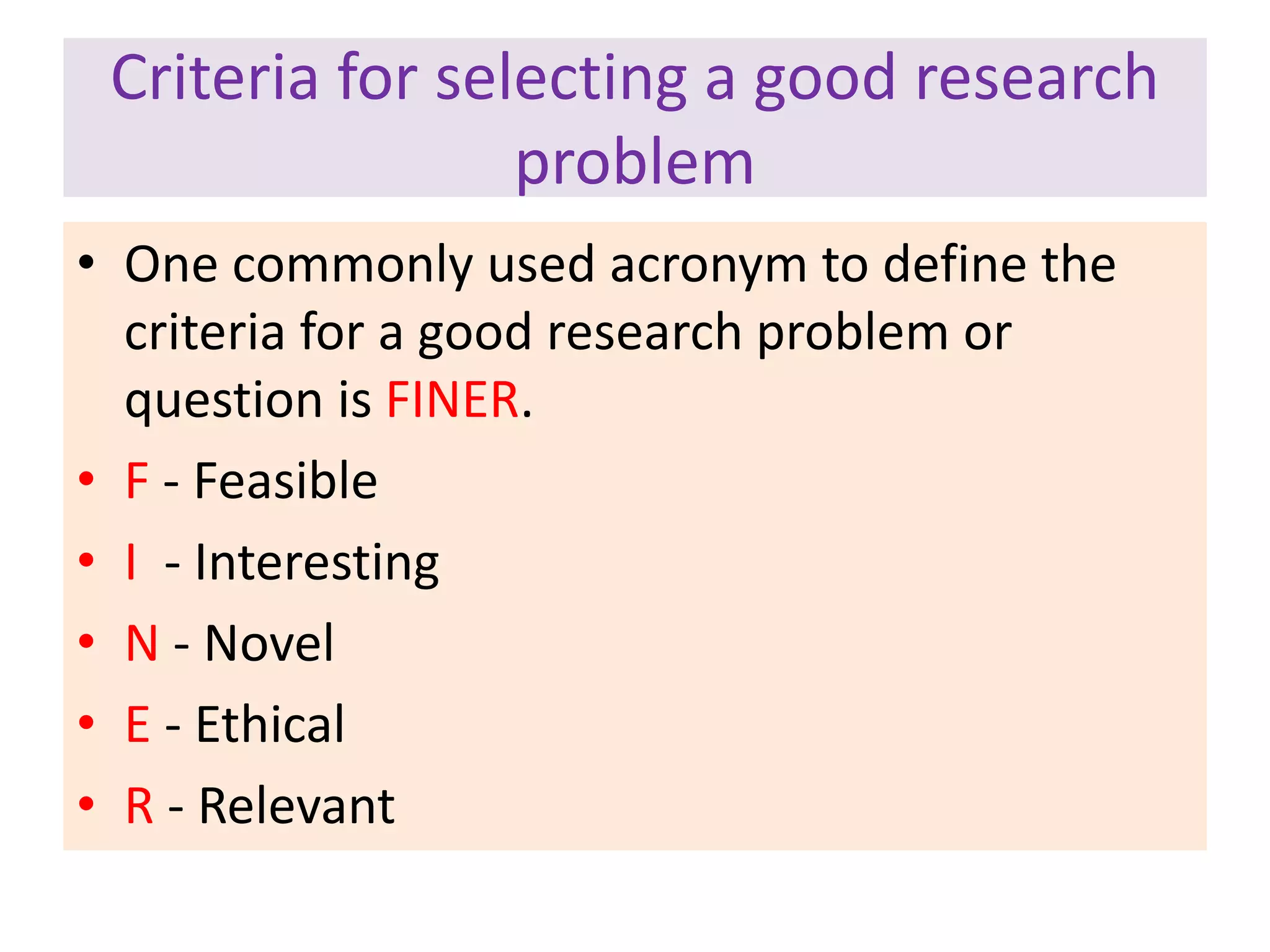
Criteria for selecting a good research
problem
• One commonly used acronym to define the
criteria for a good research problem or
question is FINER.
• F - Feasible
• I - Interesting
• N - Novel
• E - Ethical
• R - Relevant
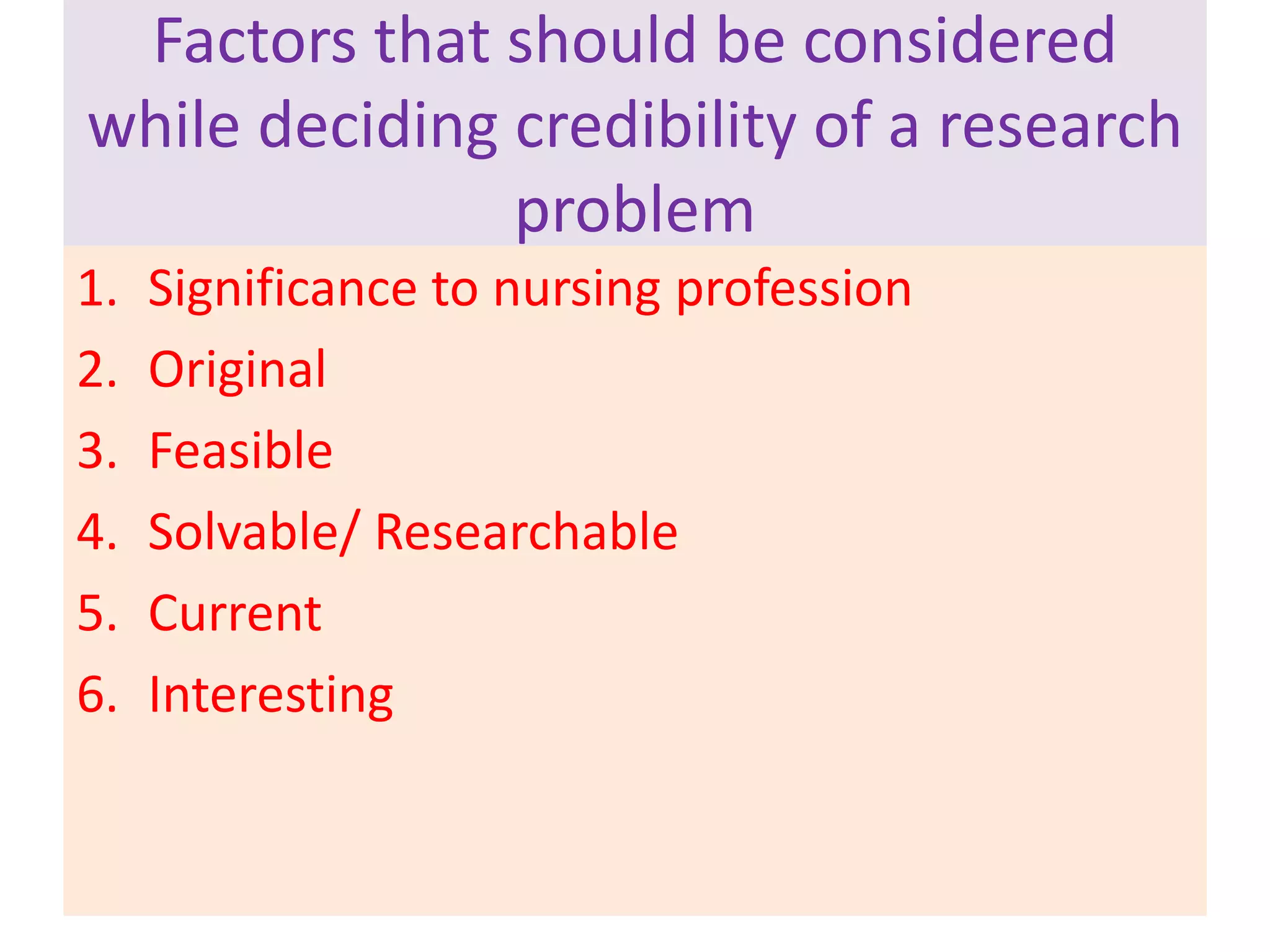
Factors that should be considered
while deciding credibility of a research
problem
1. Significance to nursing profession
2. Original
3. Feasible
4. Solvable/ Researchable
5. Current
6. Interesting
1. Significance to nursing profession
• A problem that a researcher is selecting
should have significance to nursing profession
or it will not serve any purpose.
• A research problem significant for nursing
profession when it is directed to develop or
refine the body of professional knowledge.
Continued…
• A research problem could be considered significant
for nursing profession if it fulfills the following
criteria:
• Benefits nursing profession & patients, nurses &
health care fraternity through the study.
• Improves clinical nursing practices through the
results.
• Promotes nursing theory development or testing.
• Provides solutions of current nursing practice needs.
• Generates information to get practical implications
for nursing profession.
2. Original
• It is fundamentally considered that every
research problem should be new and unique
in itself.
• Therefore, it is the key responsibility of a
researcher that an innovative knowledge is
used for selecting a research problem, so as to
extend the growth of existing body of
knowledge in a profession.
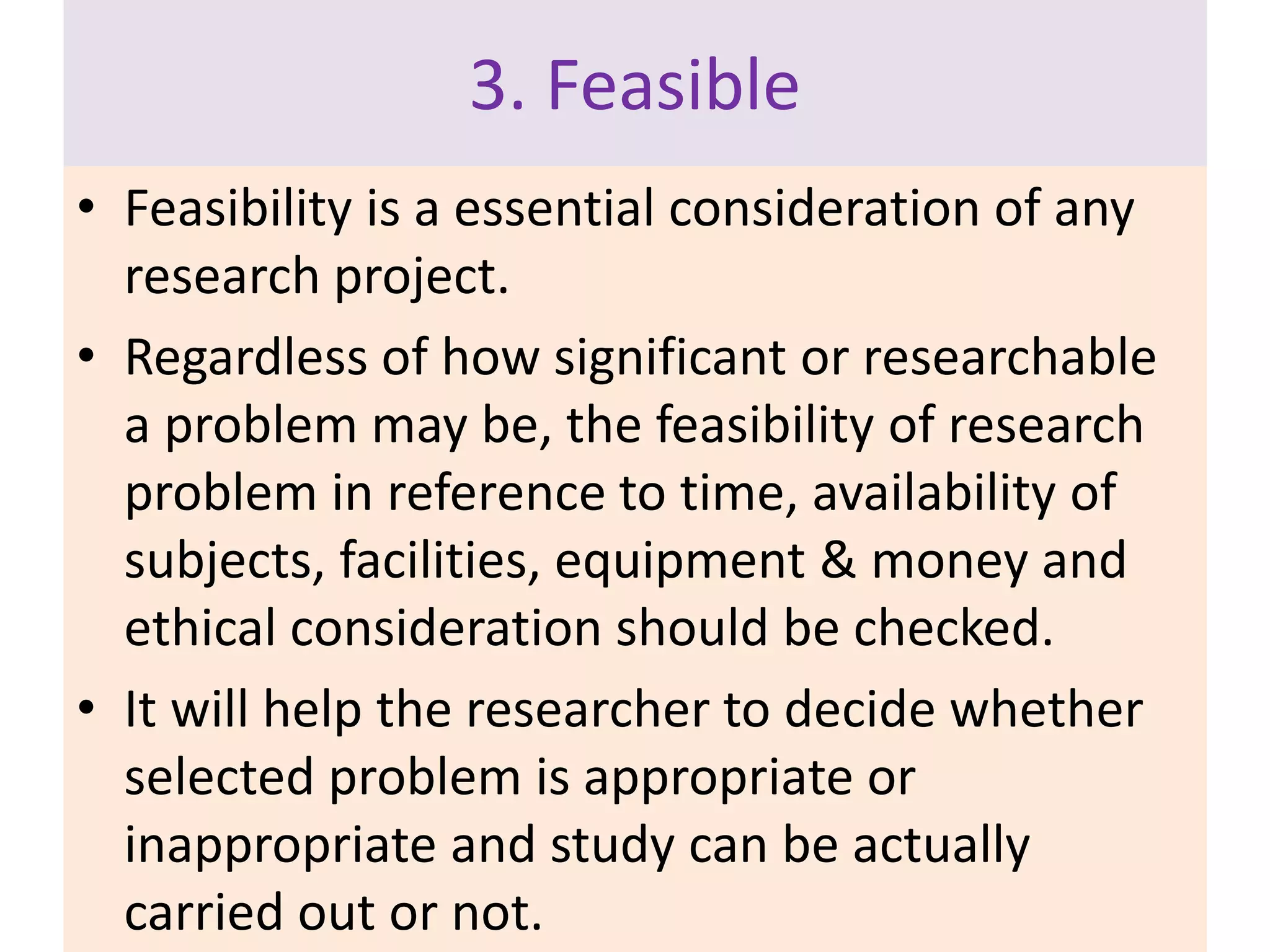
3. Feasible
• Feasibility is a essential consideration of any
research project.
• Regardless of how significant or researchable
a problem may be, the feasibility of research
problem in reference to time, availability of
subjects, facilities, equipment & money and
ethical consideration should be checked.
• It will help the researcher to decide whether
selected problem is appropriate or
inappropriate and study can be actually
carried out or not.
(a) Time
• A nurse might be interested in studying sibling
relationships among quintuplets.
• Knowledge of the incidence of quintuplet
births would certainly discourage anyone
considering research on this particular
population unless the researcher plans to
make this a lifetime project.
• So, time is always a factor to be considered.
• It is wise to allow more time than seems to be
needed because unexpected delays frequently
occur.
(b) Cost
• All research projects cost money; some
studies are much more expensive than others.
• The researcher must consider realistically the
financial resources available.
(c) Equipment & supplies
• All research projects require some type of
resources.
• Therefore, before making the final decision to
conduct a study, an accurate determination of
the needed equipment and supplies should be
ensured.
Some questions should be answered
before beginning a research project
include:
• What is the equipment that will be needed?
• Is this equipment available and in proper working
order?
• Is there a qualified operator of the equipment?
• Are the necessary supplies available or can they be
obtained?
If the researcher takes into consideration equipment
& supplies in the early phases of a research project,
there are less chances of the project to be revised or
discarded later because of equipment or supply
problems.
(d) Administrative support
• Many research projects require administrative
support.
• The nurse researcher may find it very difficult
to conduct research independently.
• Financial as well as psychological support from
administration is very helpful.
• Knowing that your superiors support your
research efforts can be a very powerful
motivating force.
(e) Peer Support
• Many research ideas have never been
developed because potential researchers
received no support from their peers.
• One of the best ways to determine a
researchable problem is through interactions
& discussions with other nurses.
• A climate of shared interest in nursing
research is essential among the members of
the nursing profession.
(f) Availability of subjects
• A researcher may believe that study subjects
are readily available for the study.
• But this may not be the case.
• Potential subjects may not meet the study
criteria, may be unwilling to participate, or
may already be participating in other studies.
• Therefore, availability of subjects must be
ensured well in advance.
(g) Researcher’s competence
• A researcher problem can only be feasible if it
is in accordance with researcher’s
competence, where researcher is capable to
handle a given research problem.
(h) Ethical considerations
• A researcher must ensure that the research
problem can be considered by the ethical
committee without undue hurdles.
• A very important topic of research cannot be
considered feasible unit unless it is in
accordance with ethical guidelines.
4. Solvable/ Researchable
• Problem selected is considered good only if it
is solvable so that chances of insolvability of
problem should be minimized.
• Thus, it will enhance relevant results.
• Ex- A researcher selects a research problem to
know the existence of God in this universe.
• These sorts of problems are ambiguous and
impossible to solve .
• Therefore, the researcher must ensure that a
research problem selected for the study is
solvable.
5. Current
• A good research problem must be based on
the current problems and needs of a
profession, so that results generated will be of
more use.
• Furthermore, more number of the
professionals will be interested in the research
conducted on the current issues of their
profession.
6. Interesting
• A research problem can only be considered
good if it is in accordance with researcher’s
field of interest.
• A research problem must be as per the
motivation of the researcher and should be
fascinating to the researcher, so that the
research is conducted with full enthusiasm
and not merely for its accomplishment.
Criteria_for_selecting_a_good_research_problem.pptx

Criteria_for_selecting_a_good_research_problem.pptx

  • 1.
    Criteria for selectinga good research problem By- Salman khan Lecturer
  • 2.
    Criteria for selectinga good research problem • One commonly used acronym to define the criteria for a good research problem or question is FINER. • F - Feasible • I - Interesting • N - Novel • E - Ethical • R - Relevant
  • 3.
    Factors that shouldbe considered while deciding credibility of a research problem 1. Significance to nursing profession 2. Original 3. Feasible 4. Solvable/ Researchable 5. Current 6. Interesting
  • 4.
    1. Significance tonursing profession • A problem that a researcher is selecting should have significance to nursing profession or it will not serve any purpose. • A research problem significant for nursing profession when it is directed to develop or refine the body of professional knowledge.
  • 5.
    Continued… • A researchproblem could be considered significant for nursing profession if it fulfills the following criteria: • Benefits nursing profession & patients, nurses & health care fraternity through the study. • Improves clinical nursing practices through the results. • Promotes nursing theory development or testing. • Provides solutions of current nursing practice needs. • Generates information to get practical implications for nursing profession.
  • 6.
    2. Original • Itis fundamentally considered that every research problem should be new and unique in itself. • Therefore, it is the key responsibility of a researcher that an innovative knowledge is used for selecting a research problem, so as to extend the growth of existing body of knowledge in a profession.
  • 7.
    3. Feasible • Feasibilityis a essential consideration of any research project. • Regardless of how significant or researchable a problem may be, the feasibility of research problem in reference to time, availability of subjects, facilities, equipment & money and ethical consideration should be checked. • It will help the researcher to decide whether selected problem is appropriate or inappropriate and study can be actually carried out or not.
  • 8.
    (a) Time • Anurse might be interested in studying sibling relationships among quintuplets. • Knowledge of the incidence of quintuplet births would certainly discourage anyone considering research on this particular population unless the researcher plans to make this a lifetime project. • So, time is always a factor to be considered. • It is wise to allow more time than seems to be needed because unexpected delays frequently occur.
  • 9.
    (b) Cost • Allresearch projects cost money; some studies are much more expensive than others. • The researcher must consider realistically the financial resources available.
  • 10.
    (c) Equipment &supplies • All research projects require some type of resources. • Therefore, before making the final decision to conduct a study, an accurate determination of the needed equipment and supplies should be ensured.
  • 11.
    Some questions shouldbe answered before beginning a research project include: • What is the equipment that will be needed? • Is this equipment available and in proper working order? • Is there a qualified operator of the equipment? • Are the necessary supplies available or can they be obtained? If the researcher takes into consideration equipment & supplies in the early phases of a research project, there are less chances of the project to be revised or discarded later because of equipment or supply problems.
  • 12.
    (d) Administrative support •Many research projects require administrative support. • The nurse researcher may find it very difficult to conduct research independently. • Financial as well as psychological support from administration is very helpful. • Knowing that your superiors support your research efforts can be a very powerful motivating force.
  • 13.
    (e) Peer Support •Many research ideas have never been developed because potential researchers received no support from their peers. • One of the best ways to determine a researchable problem is through interactions & discussions with other nurses. • A climate of shared interest in nursing research is essential among the members of the nursing profession.
  • 14.
    (f) Availability ofsubjects • A researcher may believe that study subjects are readily available for the study. • But this may not be the case. • Potential subjects may not meet the study criteria, may be unwilling to participate, or may already be participating in other studies. • Therefore, availability of subjects must be ensured well in advance.
  • 15.
    (g) Researcher’s competence •A researcher problem can only be feasible if it is in accordance with researcher’s competence, where researcher is capable to handle a given research problem.
  • 16.
    (h) Ethical considerations •A researcher must ensure that the research problem can be considered by the ethical committee without undue hurdles. • A very important topic of research cannot be considered feasible unit unless it is in accordance with ethical guidelines.
  • 17.
    4. Solvable/ Researchable •Problem selected is considered good only if it is solvable so that chances of insolvability of problem should be minimized. • Thus, it will enhance relevant results. • Ex- A researcher selects a research problem to know the existence of God in this universe. • These sorts of problems are ambiguous and impossible to solve . • Therefore, the researcher must ensure that a research problem selected for the study is solvable.
  • 18.
    5. Current • Agood research problem must be based on the current problems and needs of a profession, so that results generated will be of more use. • Furthermore, more number of the professionals will be interested in the research conducted on the current issues of their profession.
  • 19.
    6. Interesting • Aresearch problem can only be considered good if it is in accordance with researcher’s field of interest. • A research problem must be as per the motivation of the researcher and should be fascinating to the researcher, so that the research is conducted with full enthusiasm and not merely for its accomplishment.