RESEARCH
PROBLEM/QUESTION
-JOMILY JOYSON
LECTURER (OBG)
INTRODUCTION
Research is a systematic investigative process employed to increase or
revise current knowledge by discovering new facts.
The first and most important step in any research is to identify and
delineate the research problem: that is, what the researcher wants to
solve and what questions he/she wishes to answer.
A statement of the problem is used in research work as a claim that
outlines the problem addressed by a study. The statement of the problem
briefly addresses the question
RESEARCH PROBLEM
A research question is 'a question that a research project sets out to
answer’.
Choosing a research question is an essential element of both quantitative
and qualitative research. Investigation will require data collection and
analysis, and the methodology for this will vary widely.
PROBLEM STATEMENT
According to Kerlinger
“A problem is an interrogative sentence or statement that asks
what relation exists between two or more variable.”
“a research problem is an area of concern where there is a gap in the
knowledgebase needed for professional practices”
CHARACTERISTICS OF GOOD
RESEARCH PROBLEM
A good research problem should have the following characteristics:
It should address a gap in knowledge.
It should be significant enough to contribute to the existing body of
research
It should lead to further research
The problem should render itself to investigation through collection of
data
It should be of interest to the researcher and suit his/her skills, time, and
resources
The approach towards solving the problem should be ethical
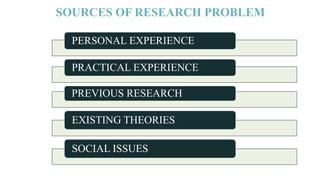
SOURCES OF RESEARCH PROBLEM
PERSONAL EXPERIENCE
PRACTICAL EXPERIENCE
PREVIOUS RESEARCH
EXISTING THEORIES
SOCIAL ISSUES
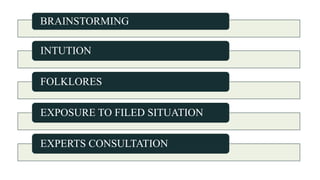
BRAINSTORMING
INTUTION
FOLKLORES
EXPOSURE TO FILED SITUATION
EXPERTS CONSULTATION
PERSONAL EXPERIENCES:
Day-to-day personal experience of a research may serve as good source of ideas to
formulate a research problem.
For example, a researcher have observed violence done, suffered by children while
child labor. This experience may provide ideas to identify several research problems
related to violence against children. There may be so many such life experiences.
PRACTICAL EXPERIENCES:
Researchers get ideas to formulate research problems from their clinical experiences.
Every curious nurse has several questions to be answered which are encountered
during clinical experience.
PREVIOUS RESEARCH:
Previous researches done on the same problem area becomes the base for the further
researches to be conducted. Nursing profession needs research who are willing to
replicate or repeat other studies on different samples & settings where all the essential
elements of the original study are held intact.
EXISTING THEORIES
Research is a process of theory development & theory testing. Nurses use many
theories from other disciplines in their practices. It an existing theory is used in
developing a researchable problem, a specific statement from the theory must be
isolated. Generally, a part of parts of the theory are subjected to testing in the clinical
situation.
SOCIAL ISSUES:
Sometimes, topics are suggested by more global contemporary social or political
issues of relevance to the health care community. For example, HIV/AIDS, female
feticide, sexual harassment, domestic violence, & gender equality in health care & in
research are some of the current social & political issues of concern for health care
professionals.
BRAINSTORMING:
Brainstorming sessions are good techniques to find new questions, where an
intensified discussion among interested people of the profession is conducted to find
more ideas to formulate a good research problem. For example, ideas for studies may
emerge from reviewing research priorities by having brainstorming session with other
nurses, researchers, or nursing faculties.
INTUITION:
Traditionally institutions are considered good sources of knowledge as well as
sources to find new research problems. It is believed that reflective mind is good
sources of ideas, which may be used to formulate a good research problem.
FOLKLORES:
Common beliefs could be right or wrong. For examples, it is generally believed that
studying just before the test decrease the score. We believe we should not study just
before test to relax our mind. Researchers can conduct a research study on whether
one should study before the test or not.
EXPOSURE TO FIELD SITUATIONS:
During field exposure, researchers get variety of experiences, which may provide
plenty of ideas to formulate research problems. For example, while working in field a
researcher observed a specific traditional practice for cure of disease condition, which
can be used as research problem to investigate its efficacy.
CONSULTATION WITH EXPERTS:
Experts are believed to have sound experience of their respective field, which may
suggest a significance problem to be studied. In addition, expert may help in finding a
current problem of discipline to be solve, which may serves basis for formulation of
research problem.
CRITERION OF SELECTINGA
RESEARCH PROBLEM
There are two factors in the selection of topic
1. External : External criteria involves how the topic is important for the field,
availability of both data and data collection methods and the administration is
cooperative or not.
2. Personal. Personal Criteria means researcher own interest, time and cost. Criteria
for selection of research problem depends on the following characteristics.
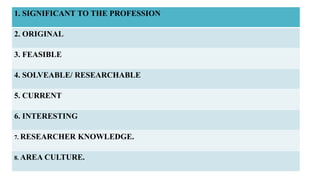
1. SIGNIFICANT TO THE PROFESSION
2. ORIGINAL
3. FEASIBLE
4. SOLVEABLE/ RESEARCHABLE
5. CURRENT
6. INTERESTING
7. RESEARCHER KNOWLEDGE.
8. AREA CULTURE.
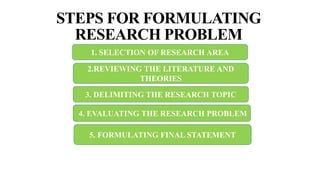
STEPS FOR FORMULATING
RESEARCH PROBLEM
1. SELECTION OF RESEARCH AREA
2.REVIEWING THE LITERATURE AND
THEORIES
3. DELIMITING THE RESEARCH TOPIC
4. EVALUATING THE RESEARCH PROBLEM
5. FORMULATING FINAL STATEMENT
1. Selection of a research area:
Formulate of a research problem statement begins with selection of a broad
research topic from personal experience, literature, previous research, & theories in
which researcher is interested and has significance for profession.
2. Reviewing literature & theories:
After getting an idea for research, researcher needs to review the nursing literature
and theories.
Literature is reviewed to know what has already done in this selected areas of
research.
3.Delimiting the research topic:
In this step, researcher proceeds from a general area of interest to more specific
topic of research to conduct a study.
4. EVALUATING THE RESEARCH PROBLEM:
In this step the researcher evaluates and finds out if the selected problem is
following the criteria of a good research, if the selected topic is relevant and useful
for further continuation of studies in the field.
5. FORMULATING FINAL STATEMENT:
After establishing the significance, and feasibility, the researcher finally formulates
a final statement of a research problem. A statement of research problem could be in
declarative or interrogative format
Research problem or question

Research problem or question

  • 1.
  • 2.
    INTRODUCTION Research is asystematic investigative process employed to increase or revise current knowledge by discovering new facts. The first and most important step in any research is to identify and delineate the research problem: that is, what the researcher wants to solve and what questions he/she wishes to answer. A statement of the problem is used in research work as a claim that outlines the problem addressed by a study. The statement of the problem briefly addresses the question
  • 3.
    RESEARCH PROBLEM A researchquestion is 'a question that a research project sets out to answer’. Choosing a research question is an essential element of both quantitative and qualitative research. Investigation will require data collection and analysis, and the methodology for this will vary widely.
  • 4.
    PROBLEM STATEMENT According toKerlinger “A problem is an interrogative sentence or statement that asks what relation exists between two or more variable.” “a research problem is an area of concern where there is a gap in the knowledgebase needed for professional practices”
  • 5.
    CHARACTERISTICS OF GOOD RESEARCHPROBLEM A good research problem should have the following characteristics: It should address a gap in knowledge. It should be significant enough to contribute to the existing body of research It should lead to further research The problem should render itself to investigation through collection of data It should be of interest to the researcher and suit his/her skills, time, and resources The approach towards solving the problem should be ethical
  • 6.
    SOURCES OF RESEARCHPROBLEM PERSONAL EXPERIENCE PRACTICAL EXPERIENCE PREVIOUS RESEARCH EXISTING THEORIES SOCIAL ISSUES
  • 7.
  • 8.
    PERSONAL EXPERIENCES: Day-to-day personalexperience of a research may serve as good source of ideas to formulate a research problem. For example, a researcher have observed violence done, suffered by children while child labor. This experience may provide ideas to identify several research problems related to violence against children. There may be so many such life experiences. PRACTICAL EXPERIENCES: Researchers get ideas to formulate research problems from their clinical experiences. Every curious nurse has several questions to be answered which are encountered during clinical experience. PREVIOUS RESEARCH: Previous researches done on the same problem area becomes the base for the further researches to be conducted. Nursing profession needs research who are willing to replicate or repeat other studies on different samples & settings where all the essential elements of the original study are held intact.
  • 9.
    EXISTING THEORIES Research isa process of theory development & theory testing. Nurses use many theories from other disciplines in their practices. It an existing theory is used in developing a researchable problem, a specific statement from the theory must be isolated. Generally, a part of parts of the theory are subjected to testing in the clinical situation. SOCIAL ISSUES: Sometimes, topics are suggested by more global contemporary social or political issues of relevance to the health care community. For example, HIV/AIDS, female feticide, sexual harassment, domestic violence, & gender equality in health care & in research are some of the current social & political issues of concern for health care professionals. BRAINSTORMING: Brainstorming sessions are good techniques to find new questions, where an intensified discussion among interested people of the profession is conducted to find more ideas to formulate a good research problem. For example, ideas for studies may emerge from reviewing research priorities by having brainstorming session with other nurses, researchers, or nursing faculties.
  • 10.
    INTUITION: Traditionally institutions areconsidered good sources of knowledge as well as sources to find new research problems. It is believed that reflective mind is good sources of ideas, which may be used to formulate a good research problem. FOLKLORES: Common beliefs could be right or wrong. For examples, it is generally believed that studying just before the test decrease the score. We believe we should not study just before test to relax our mind. Researchers can conduct a research study on whether one should study before the test or not. EXPOSURE TO FIELD SITUATIONS: During field exposure, researchers get variety of experiences, which may provide plenty of ideas to formulate research problems. For example, while working in field a researcher observed a specific traditional practice for cure of disease condition, which can be used as research problem to investigate its efficacy.
  • 11.
    CONSULTATION WITH EXPERTS: Expertsare believed to have sound experience of their respective field, which may suggest a significance problem to be studied. In addition, expert may help in finding a current problem of discipline to be solve, which may serves basis for formulation of research problem.
  • 12.
    CRITERION OF SELECTINGA RESEARCHPROBLEM There are two factors in the selection of topic 1. External : External criteria involves how the topic is important for the field, availability of both data and data collection methods and the administration is cooperative or not. 2. Personal. Personal Criteria means researcher own interest, time and cost. Criteria for selection of research problem depends on the following characteristics.
  • 13.
    1. SIGNIFICANT TOTHE PROFESSION 2. ORIGINAL 3. FEASIBLE 4. SOLVEABLE/ RESEARCHABLE 5. CURRENT 6. INTERESTING 7. RESEARCHER KNOWLEDGE. 8. AREA CULTURE.
  • 14.
    STEPS FOR FORMULATING RESEARCHPROBLEM 1. SELECTION OF RESEARCH AREA 2.REVIEWING THE LITERATURE AND THEORIES 3. DELIMITING THE RESEARCH TOPIC 4. EVALUATING THE RESEARCH PROBLEM 5. FORMULATING FINAL STATEMENT
  • 15.
    1. Selection ofa research area: Formulate of a research problem statement begins with selection of a broad research topic from personal experience, literature, previous research, & theories in which researcher is interested and has significance for profession. 2. Reviewing literature & theories: After getting an idea for research, researcher needs to review the nursing literature and theories. Literature is reviewed to know what has already done in this selected areas of research. 3.Delimiting the research topic: In this step, researcher proceeds from a general area of interest to more specific topic of research to conduct a study.
  • 16.
    4. EVALUATING THERESEARCH PROBLEM: In this step the researcher evaluates and finds out if the selected problem is following the criteria of a good research, if the selected topic is relevant and useful for further continuation of studies in the field. 5. FORMULATING FINAL STATEMENT: After establishing the significance, and feasibility, the researcher finally formulates a final statement of a research problem. A statement of research problem could be in declarative or interrogative format