Types and Statistics
Property Crime Violent Crime Business Crime Organized Crime
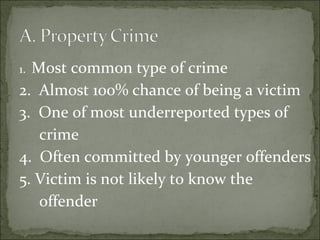
1.  Most common type of crime 2.  Almost 100% chance of being a victim 3.  One of most underreported types of  crime 4.  Often committed by younger offenders 5. Victim is not likely to know the  offender
1.  Most publicized type of crime 2.  Usually adult offenders; juvenile  violence on the rise 3.  “Crimes of Passion”—when emotion  overwhelms reason 4.  Victims usually know their attacker a.  Family violence extremely  common
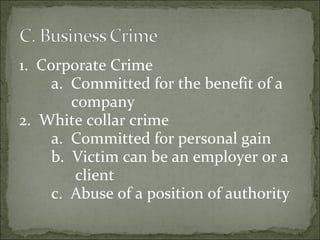
1.  Corporate Crime a.  Committed for the benefit of a  company 2.  White collar crime a.  Committed for personal gain b.  Victim can be an employer or a  client c.  Abuse of a position of authority
1.  Most commonly known form is the  “ Mafia” 2.  Involved in legal and illegal activities 3.  Operates like most other legitimate  businesses.
A. US crime rates have dropped in the last few years 1. Still one of the most violent countries in the world.  2. Each year enough people are murdered in the US to fill a small city about the size of Albert Lea.  (Around 17,000)
1. The murder rate is 6 for every 100,000 people (2005) 2. Only 43% had known relation to assailant, 14% were strangers, and 43% had unknown relationship. (2002) 3. Over half (55%) of homicides were committed with a handgun. (2005) 4. 45% of victims are 20-34 years old. (2005) 5. Blacks are 49% of murder victims, but only 13% of overall population. (2005)
C. Crime in the US causes more death, injury, and property loss each year than all natural disasters combined. D. More women are injured each year in domestic assaults than the total of women injured in car accidents, rapes and muggings.
1. Residence a. Urban residents are most vulnerable to crime; rural are the least. 2. Age a. After age 34, people become less likely to be victims of crime 3. Race a. Minorities are more likely to be victims of crime 4. Sex a. Males experience higher victimization for all violent crimes except rape/assault 5. Income a. People living in households earning less than $7500 experience robbery and assault at significantly higher levels than other households.
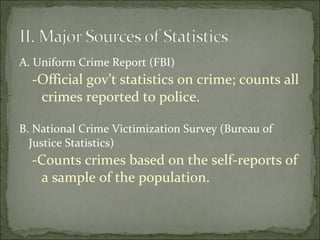
A. Uniform Crime Report (FBI) -Official gov’t statistics on crime; counts all crimes reported to police. B. National Crime Victimization Survey (Bureau of Justice Statistics) -Counts crimes based on the self-reports of a sample of the population.

Crime Unit

  • 1.
  • 2.
    Property Crime ViolentCrime Business Crime Organized Crime
  • 3.
    1. Mostcommon type of crime 2. Almost 100% chance of being a victim 3. One of most underreported types of crime 4. Often committed by younger offenders 5. Victim is not likely to know the offender
  • 4.
    1. Mostpublicized type of crime 2. Usually adult offenders; juvenile violence on the rise 3. “Crimes of Passion”—when emotion overwhelms reason 4. Victims usually know their attacker a. Family violence extremely common
  • 5.
    1. CorporateCrime a. Committed for the benefit of a company 2. White collar crime a. Committed for personal gain b. Victim can be an employer or a client c. Abuse of a position of authority
  • 6.
    1. Mostcommonly known form is the “ Mafia” 2. Involved in legal and illegal activities 3. Operates like most other legitimate businesses.
  • 7.
    A. US crimerates have dropped in the last few years 1. Still one of the most violent countries in the world. 2. Each year enough people are murdered in the US to fill a small city about the size of Albert Lea. (Around 17,000)
  • 8.
    1. The murderrate is 6 for every 100,000 people (2005) 2. Only 43% had known relation to assailant, 14% were strangers, and 43% had unknown relationship. (2002) 3. Over half (55%) of homicides were committed with a handgun. (2005) 4. 45% of victims are 20-34 years old. (2005) 5. Blacks are 49% of murder victims, but only 13% of overall population. (2005)
  • 9.
    C. Crime inthe US causes more death, injury, and property loss each year than all natural disasters combined. D. More women are injured each year in domestic assaults than the total of women injured in car accidents, rapes and muggings.
  • 10.
    1. Residence a.Urban residents are most vulnerable to crime; rural are the least. 2. Age a. After age 34, people become less likely to be victims of crime 3. Race a. Minorities are more likely to be victims of crime 4. Sex a. Males experience higher victimization for all violent crimes except rape/assault 5. Income a. People living in households earning less than $7500 experience robbery and assault at significantly higher levels than other households.
  • 11.
    A. Uniform CrimeReport (FBI) -Official gov’t statistics on crime; counts all crimes reported to police. B. National Crime Victimization Survey (Bureau of Justice Statistics) -Counts crimes based on the self-reports of a sample of the population.