Introduction to
Crime:
Definition,
Causation, and
Elements
Contents
• Crime-Definition
• Elements of Crime
• Corpus Delicti
• Modus Operandi
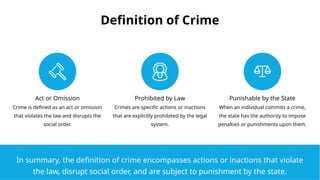
Definition of Crime
Act or Omission
Crime is defined as an act or omission
that violates the law and disrupts the
social order.
Prohibited by Law
Crimes are specific actions or inactions
that are explicitly prohibited by the legal
system.
Punishable by the State
When an individual commits a crime,
the state has the authority to impose
penalties or punishments upon them.
In summary, the definition of crime encompasses actions or inactions that violate
the law, disrupt social order, and are subject to punishment by the state.
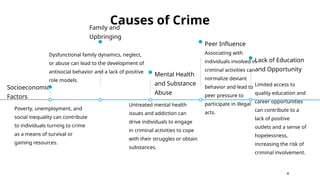
Causes of Crime
Socioeconomic
Factors
Poverty, unemployment, and
social inequality can contribute
to individuals turning to crime
as a means of survival or
gaining resources.
Family and
Upbringing
Dysfunctional family dynamics, neglect,
or abuse can lead to the development of
antisocial behavior and a lack of positive
role models.
Mental Health
and Substance
Abuse
Untreated mental health
issues and addiction can
drive individuals to engage
in criminal activities to cope
with their struggles or obtain
substances.
Peer Influence
Associating with
individuals involved in
criminal activities can
normalize deviant
behavior and lead to
peer pressure to
participate in illegal
acts.
Lack of Education
and Opportunity
Limited access to
quality education and
career opportunities
can contribute to a
lack of positive
outlets and a sense of
hopelessness,
increasing the risk of
criminal involvement.
4
“Criminals are born, not
made, and have distinct
physical
characteristics.”
CESARE LOMBROSO
5
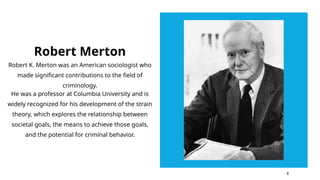
Robert Merton
Robert K. Merton was an American sociologist who
made significant contributions to the field of
criminology.
He was a professor at Columbia University and is
widely recognized for his development of the strain
theory, which explores the relationship between
societal goals, the means to achieve those goals,
and the potential for criminal behavior.
6
The Elements of Crime
• Actus Reus
The criminal act or external conduct required for
a crime to be committed, such as killing,
stealing, or assaulting.
• Mens Rea
The guilty mental state or intent required for a
crime, such as purposely, knowingly, recklessly,
or negligently committing the criminal act.
• Concurrence
The simultaneous occurrence of the criminal act
and the guilty mental state, meaning the act
and the intent must coincide for a crime to be
complete.
7
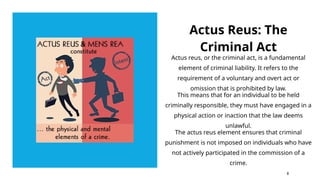
Actus Reus: The
Criminal Act
Actus reus, or the criminal act, is a fundamental
element of criminal liability. It refers to the
requirement of a voluntary and overt act or
omission that is prohibited by law.
This means that for an individual to be held
criminally responsible, they must have engaged in a
physical action or inaction that the law deems
unlawful.
The actus reus element ensures that criminal
punishment is not imposed on individuals who have
not actively participated in the commission of a
crime.
8
Mens Rea: The Guilty Mind
Intent
The highest level of mens rea, where the individual
purposefully committed the criminal act with the desire
to bring about the result.
Knowledge
The individual knew that their actions would result in
the criminal outcome, even if they did not desire that
outcome.
Recklessness
The individual was aware of the risk of their actions
leading to the criminal outcome, but consciously
disregarded that risk.
Negligence
The individual failed to recognize a substantial and
unjustifiable risk of their actions leading to the criminal
outcome, a breach of the standard of care that a
reasonable person would have observed.
9
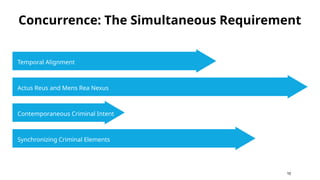
Concurrence: The Simultaneous Requirement
Temporal Alignment
Actus Reus and Mens Rea Nexus
Contemporaneous Criminal Intent
Synchronizing Criminal Elements
10
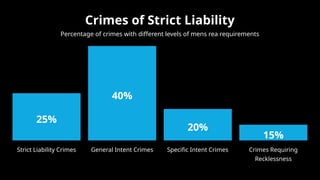
Crimes of Strict Liability
Percentage of crimes with different levels of mens rea requirements
Strict Liability Crimes
25%
General Intent Crimes
40%
Specific Intent Crimes
20%
Crimes Requiring
Recklessness
15%
11
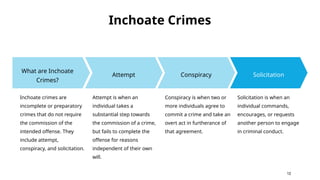
Inchoate Crimes
What are Inchoate
Crimes?
Inchoate crimes are
incomplete or preparatory
crimes that do not require
the commission of the
intended offense. They
include attempt,
conspiracy, and solicitation.
Attempt
Attempt is when an
individual takes a
substantial step towards
the commission of a crime,
but fails to complete the
offense for reasons
independent of their own
will.
Conspiracy
Conspiracy is when two or
more individuals agree to
commit a crime and take an
overt act in furtherance of
that agreement.
Solicitation
Solicitation is when an
individual commands,
encourages, or requests
another person to engage
in criminal conduct.
12
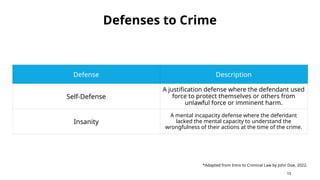
Defenses to Crime
Defense Description
Self-Defense
A justification defense where the defendant used
force to protect themselves or others from
unlawful force or imminent harm.
Insanity
A mental incapacity defense where the defendant
lacked the mental capacity to understand the
wrongfulness of their actions at the time of the crime.
*Adapted from Intro to Criminal Law by John Doe, 2022.
13
Conclusion
Definition of Crime
Crime is an act or omission that
violates the law and is punishable by
the state.
Causes of Crime
Factors contributing to criminal behavior,
such as social, economic, and
psychological influences.
Elements of Criminal Liability
Key requirements for an act to be
considered criminal, including actus
reus (guilty act) and mens rea (guilty
mind).
Corpus Delicti and Modus
Operandi
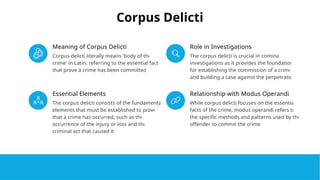
Corpus Delicti
Meaning of Corpus Delicti
Corpus delicti literally means 'body of the
crime' in Latin, referring to the essential facts
that prove a crime has been committed.
Essential Elements
The corpus delicti consists of the fundamental
elements that must be established to prove
that a crime has occurred, such as the
occurrence of the injury or loss and the
criminal act that caused it.
Role in Investigations
The corpus delicti is crucial in criminal
investigations as it provides the foundation
for establishing the commission of a crime
and building a case against the perpetrator.
Relationship with Modus Operandi
While corpus delicti focuses on the essential
facts of the crime, modus operandi refers to
the specific methods and patterns used by the
offender to commit the crime.
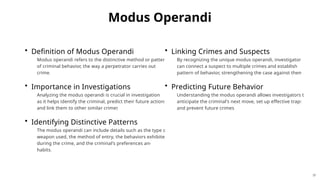
Modus Operandi
• Definition of Modus Operandi
Modus operandi refers to the distinctive method or pattern
of criminal behavior, the way a perpetrator carries out a
crime.
• Importance in Investigations
Analyzing the modus operandi is crucial in investigations
as it helps identify the criminal, predict their future actions,
and link them to other similar crimes.
• Identifying Distinctive Patterns
The modus operandi can include details such as the type of
weapon used, the method of entry, the behaviors exhibited
during the crime, and the criminal's preferences and
habits.
• Linking Crimes and Suspects
By recognizing the unique modus operandi, investigators
can connect a suspect to multiple crimes and establish a
pattern of behavior, strengthening the case against them.
• Predicting Future Behavior
Understanding the modus operandi allows investigators to
anticipate the criminal's next move, set up effective traps,
and prevent future crimes.
17
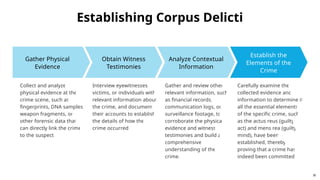
Establishing Corpus Delicti
Gather Physical
Evidence
Collect and analyze
physical evidence at the
crime scene, such as
fingerprints, DNA samples,
weapon fragments, or
other forensic data that
can directly link the crime
to the suspect.
Obtain Witness
Testimonies
Interview eyewitnesses,
victims, or individuals with
relevant information about
the crime, and document
their accounts to establish
the details of how the
crime occurred.
Analyze Contextual
Information
Gather and review other
relevant information, such
as financial records,
communication logs, or
surveillance footage, to
corroborate the physical
evidence and witness
testimonies and build a
comprehensive
understanding of the
crime.
Establish the
Elements of the
Crime
Carefully examine the
collected evidence and
information to determine if
all the essential elements
of the specific crime, such
as the actus reus (guilty
act) and mens rea (guilty
mind), have been
established, thereby
proving that a crime has
indeed been committed.
18
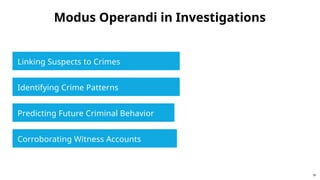
Modus Operandi in Investigations
Linking Suspects to Crimes
Identifying Crime Patterns
Predicting Future Criminal Behavior
Corroborating Witness Accounts
19
Analyzing Modus
Operandi
• Modus operandi, or the specific details of
how a crime was committed, plays a crucial
role in criminal investigations.

• Analyzing the offender's mode of operation
can provide valuable insights into their
habits, preferences, and potentially their
identity.
• Investigators carefully examine the crime
scene, evidence, and witness accounts to
establish the offender's modus operandi,
which can then be used to link them to
similar crimes and build a stronger case.
20
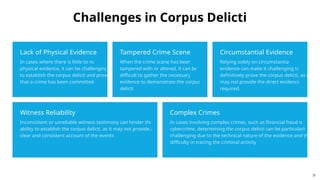
Challenges in Corpus Delicti
Lack of Physical Evidence
In cases where there is little to no
physical evidence, it can be challenging
to establish the corpus delicti and prove
that a crime has been committed.
Tampered Crime Scene
When the crime scene has been
tampered with or altered, it can be
difficult to gather the necessary
evidence to demonstrate the corpus
delicti.
Circumstantial Evidence
Relying solely on circumstantial
evidence can make it challenging to
definitively prove the corpus delicti, as it
may not provide the direct evidence
required.
Witness Reliability
Inconsistent or unreliable witness testimony can hinder the
ability to establish the corpus delicti, as it may not provide a
clear and consistent account of the events.
Complex Crimes
In cases involving complex crimes, such as financial fraud or
cybercrime, determining the corpus delicti can be particularly
challenging due to the technical nature of the evidence and the
difficulty in tracing the criminal activity.
21
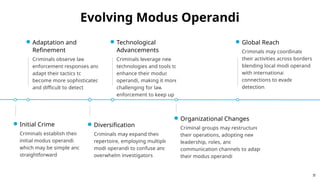
Evolving Modus Operandi
Initial Crime
Criminals establish their
initial modus operandi,
which may be simple and
straightforward.
Adaptation and
Refinement
Criminals observe law
enforcement responses and
adapt their tactics to
become more sophisticated
and difficult to detect.
Diversification
Criminals may expand their
repertoire, employing multiple
modi operandi to confuse and
overwhelm investigators.
Technological
Advancements
Criminals leverage new
technologies and tools to
enhance their modus
operandi, making it more
challenging for law
enforcement to keep up.
Organizational Changes
Criminal groups may restructure
their operations, adopting new
leadership, roles, and
communication channels to adapt
their modus operandi.
Global Reach
Criminals may coordinate
their activities across borders,
blending local modi operandi
with international
connections to evade
detection.
22
Introduction to Crime Definition, Causation, and Elements.pptx

Introduction to Crime Definition, Causation, and Elements.pptx

  • 1.
  • 2.
    Contents • Crime-Definition • Elementsof Crime • Corpus Delicti • Modus Operandi
  • 3.
    Definition of Crime Actor Omission Crime is defined as an act or omission that violates the law and disrupts the social order. Prohibited by Law Crimes are specific actions or inactions that are explicitly prohibited by the legal system. Punishable by the State When an individual commits a crime, the state has the authority to impose penalties or punishments upon them. In summary, the definition of crime encompasses actions or inactions that violate the law, disrupt social order, and are subject to punishment by the state.
  • 4.
    Causes of Crime Socioeconomic Factors Poverty,unemployment, and social inequality can contribute to individuals turning to crime as a means of survival or gaining resources. Family and Upbringing Dysfunctional family dynamics, neglect, or abuse can lead to the development of antisocial behavior and a lack of positive role models. Mental Health and Substance Abuse Untreated mental health issues and addiction can drive individuals to engage in criminal activities to cope with their struggles or obtain substances. Peer Influence Associating with individuals involved in criminal activities can normalize deviant behavior and lead to peer pressure to participate in illegal acts. Lack of Education and Opportunity Limited access to quality education and career opportunities can contribute to a lack of positive outlets and a sense of hopelessness, increasing the risk of criminal involvement. 4
  • 5.
    “Criminals are born,not made, and have distinct physical characteristics.” CESARE LOMBROSO 5
  • 6.
    Robert Merton Robert K.Merton was an American sociologist who made significant contributions to the field of criminology. He was a professor at Columbia University and is widely recognized for his development of the strain theory, which explores the relationship between societal goals, the means to achieve those goals, and the potential for criminal behavior. 6
  • 7.
    The Elements ofCrime • Actus Reus The criminal act or external conduct required for a crime to be committed, such as killing, stealing, or assaulting. • Mens Rea The guilty mental state or intent required for a crime, such as purposely, knowingly, recklessly, or negligently committing the criminal act. • Concurrence The simultaneous occurrence of the criminal act and the guilty mental state, meaning the act and the intent must coincide for a crime to be complete. 7
  • 8.
    Actus Reus: The CriminalAct Actus reus, or the criminal act, is a fundamental element of criminal liability. It refers to the requirement of a voluntary and overt act or omission that is prohibited by law. This means that for an individual to be held criminally responsible, they must have engaged in a physical action or inaction that the law deems unlawful. The actus reus element ensures that criminal punishment is not imposed on individuals who have not actively participated in the commission of a crime. 8
  • 9.
    Mens Rea: TheGuilty Mind Intent The highest level of mens rea, where the individual purposefully committed the criminal act with the desire to bring about the result. Knowledge The individual knew that their actions would result in the criminal outcome, even if they did not desire that outcome. Recklessness The individual was aware of the risk of their actions leading to the criminal outcome, but consciously disregarded that risk. Negligence The individual failed to recognize a substantial and unjustifiable risk of their actions leading to the criminal outcome, a breach of the standard of care that a reasonable person would have observed. 9
  • 10.
    Concurrence: The SimultaneousRequirement Temporal Alignment Actus Reus and Mens Rea Nexus Contemporaneous Criminal Intent Synchronizing Criminal Elements 10
  • 11.
    Crimes of StrictLiability Percentage of crimes with different levels of mens rea requirements Strict Liability Crimes 25% General Intent Crimes 40% Specific Intent Crimes 20% Crimes Requiring Recklessness 15% 11
  • 12.
    Inchoate Crimes What areInchoate Crimes? Inchoate crimes are incomplete or preparatory crimes that do not require the commission of the intended offense. They include attempt, conspiracy, and solicitation. Attempt Attempt is when an individual takes a substantial step towards the commission of a crime, but fails to complete the offense for reasons independent of their own will. Conspiracy Conspiracy is when two or more individuals agree to commit a crime and take an overt act in furtherance of that agreement. Solicitation Solicitation is when an individual commands, encourages, or requests another person to engage in criminal conduct. 12
  • 13.
    Defenses to Crime DefenseDescription Self-Defense A justification defense where the defendant used force to protect themselves or others from unlawful force or imminent harm. Insanity A mental incapacity defense where the defendant lacked the mental capacity to understand the wrongfulness of their actions at the time of the crime. *Adapted from Intro to Criminal Law by John Doe, 2022. 13
  • 14.
    Conclusion Definition of Crime Crimeis an act or omission that violates the law and is punishable by the state. Causes of Crime Factors contributing to criminal behavior, such as social, economic, and psychological influences. Elements of Criminal Liability Key requirements for an act to be considered criminal, including actus reus (guilty act) and mens rea (guilty mind).
  • 15.
    Corpus Delicti andModus Operandi
  • 16.
    Corpus Delicti Meaning ofCorpus Delicti Corpus delicti literally means 'body of the crime' in Latin, referring to the essential facts that prove a crime has been committed. Essential Elements The corpus delicti consists of the fundamental elements that must be established to prove that a crime has occurred, such as the occurrence of the injury or loss and the criminal act that caused it. Role in Investigations The corpus delicti is crucial in criminal investigations as it provides the foundation for establishing the commission of a crime and building a case against the perpetrator. Relationship with Modus Operandi While corpus delicti focuses on the essential facts of the crime, modus operandi refers to the specific methods and patterns used by the offender to commit the crime.
  • 17.
    Modus Operandi • Definitionof Modus Operandi Modus operandi refers to the distinctive method or pattern of criminal behavior, the way a perpetrator carries out a crime. • Importance in Investigations Analyzing the modus operandi is crucial in investigations as it helps identify the criminal, predict their future actions, and link them to other similar crimes. • Identifying Distinctive Patterns The modus operandi can include details such as the type of weapon used, the method of entry, the behaviors exhibited during the crime, and the criminal's preferences and habits. • Linking Crimes and Suspects By recognizing the unique modus operandi, investigators can connect a suspect to multiple crimes and establish a pattern of behavior, strengthening the case against them. • Predicting Future Behavior Understanding the modus operandi allows investigators to anticipate the criminal's next move, set up effective traps, and prevent future crimes. 17
  • 18.
    Establishing Corpus Delicti GatherPhysical Evidence Collect and analyze physical evidence at the crime scene, such as fingerprints, DNA samples, weapon fragments, or other forensic data that can directly link the crime to the suspect. Obtain Witness Testimonies Interview eyewitnesses, victims, or individuals with relevant information about the crime, and document their accounts to establish the details of how the crime occurred. Analyze Contextual Information Gather and review other relevant information, such as financial records, communication logs, or surveillance footage, to corroborate the physical evidence and witness testimonies and build a comprehensive understanding of the crime. Establish the Elements of the Crime Carefully examine the collected evidence and information to determine if all the essential elements of the specific crime, such as the actus reus (guilty act) and mens rea (guilty mind), have been established, thereby proving that a crime has indeed been committed. 18
  • 19.
    Modus Operandi inInvestigations Linking Suspects to Crimes Identifying Crime Patterns Predicting Future Criminal Behavior Corroborating Witness Accounts 19
  • 20.
    Analyzing Modus Operandi • Modusoperandi, or the specific details of how a crime was committed, plays a crucial role in criminal investigations. • Analyzing the offender's mode of operation can provide valuable insights into their habits, preferences, and potentially their identity. • Investigators carefully examine the crime scene, evidence, and witness accounts to establish the offender's modus operandi, which can then be used to link them to similar crimes and build a stronger case. 20
  • 21.
    Challenges in CorpusDelicti Lack of Physical Evidence In cases where there is little to no physical evidence, it can be challenging to establish the corpus delicti and prove that a crime has been committed. Tampered Crime Scene When the crime scene has been tampered with or altered, it can be difficult to gather the necessary evidence to demonstrate the corpus delicti. Circumstantial Evidence Relying solely on circumstantial evidence can make it challenging to definitively prove the corpus delicti, as it may not provide the direct evidence required. Witness Reliability Inconsistent or unreliable witness testimony can hinder the ability to establish the corpus delicti, as it may not provide a clear and consistent account of the events. Complex Crimes In cases involving complex crimes, such as financial fraud or cybercrime, determining the corpus delicti can be particularly challenging due to the technical nature of the evidence and the difficulty in tracing the criminal activity. 21
  • 22.
    Evolving Modus Operandi InitialCrime Criminals establish their initial modus operandi, which may be simple and straightforward. Adaptation and Refinement Criminals observe law enforcement responses and adapt their tactics to become more sophisticated and difficult to detect. Diversification Criminals may expand their repertoire, employing multiple modi operandi to confuse and overwhelm investigators. Technological Advancements Criminals leverage new technologies and tools to enhance their modus operandi, making it more challenging for law enforcement to keep up. Organizational Changes Criminal groups may restructure their operations, adopting new leadership, roles, and communication channels to adapt their modus operandi. Global Reach Criminals may coordinate their activities across borders, blending local modi operandi with international connections to evade detection. 22