CRIME
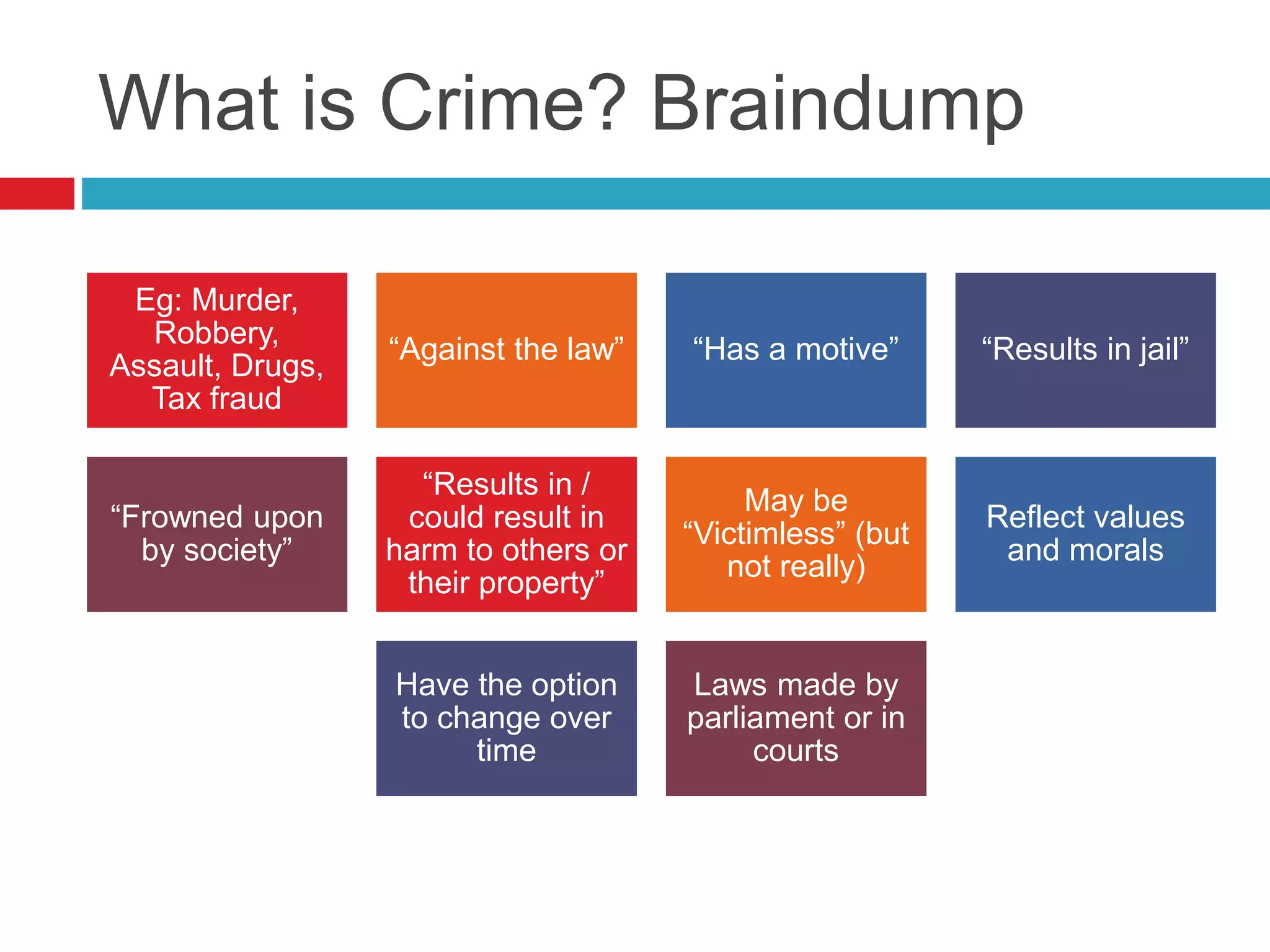
What is Crime? Braindump
Eg: Murder,
Robbery,
Assault, Drugs,
Tax fraud
“Against the law” “Has a motive” “Results in jail”
“Frowned upon
by society”
“Results in /
could result in
harm to others or
their property”
May be
“Victimless” (but
not really)
Reflect values
and morals
Have the option
to change over
time
Laws made by
parliament or in
courts
Define: crime
 An act or omission committed against the
community at large that is punishable by the
state
 Omission – failure to act, neglecting to do
something
 Community at large – most of the
community/most of society
 The state – a government and the people that it
governs
 Crimes vary from nation to nation (state to
state or jurisdiction to jurisdiction), because
they reflect the values of each society.
 What is considered a crime can be influenced
by:
 Values and morals
 Religion
 Culture
 History
 Legal traditions
Law Reform
 Sometimes, archaic, outdated crimes remain,
despite societal changes – there’s no
automatic process to remove laws which are
no longer necessary. (Eg: homosexuality)
 Sometimes, new crimes must be created to
accommodate changes in society. (Eg:
computer crime)
Features of criminal law
 To protect society (crime is “offence against
society”)
 Crimes against a person, the state, and/or
property
 The State takes action against the offender
 The Police make the decision to prosecute in
court
 Burden of Proof is: Beyond a Reasonable
Doubt
 Aim is: to protect the community & provide

1.1 what is crime

  • 1.
  • 2.
    What is Crime?Braindump Eg: Murder, Robbery, Assault, Drugs, Tax fraud “Against the law” “Has a motive” “Results in jail” “Frowned upon by society” “Results in / could result in harm to others or their property” May be “Victimless” (but not really) Reflect values and morals Have the option to change over time Laws made by parliament or in courts
  • 3.
    Define: crime  Anact or omission committed against the community at large that is punishable by the state  Omission – failure to act, neglecting to do something  Community at large – most of the community/most of society  The state – a government and the people that it governs
  • 4.
     Crimes varyfrom nation to nation (state to state or jurisdiction to jurisdiction), because they reflect the values of each society.  What is considered a crime can be influenced by:  Values and morals  Religion  Culture  History  Legal traditions
  • 5.
    Law Reform  Sometimes,archaic, outdated crimes remain, despite societal changes – there’s no automatic process to remove laws which are no longer necessary. (Eg: homosexuality)  Sometimes, new crimes must be created to accommodate changes in society. (Eg: computer crime)
  • 6.
    Features of criminallaw  To protect society (crime is “offence against society”)  Crimes against a person, the state, and/or property  The State takes action against the offender  The Police make the decision to prosecute in court  Burden of Proof is: Beyond a Reasonable Doubt  Aim is: to protect the community & provide