3
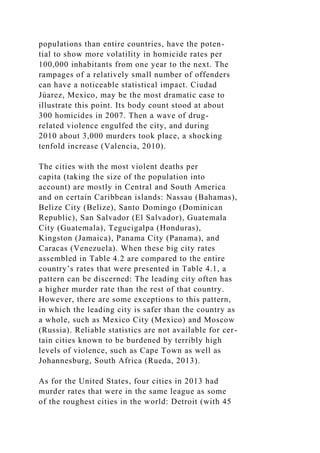
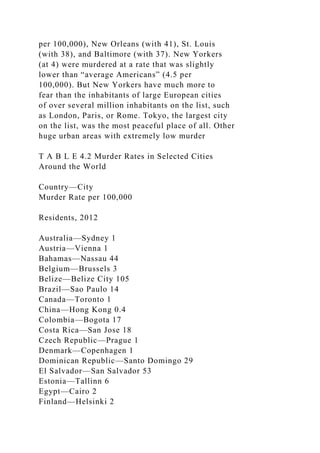
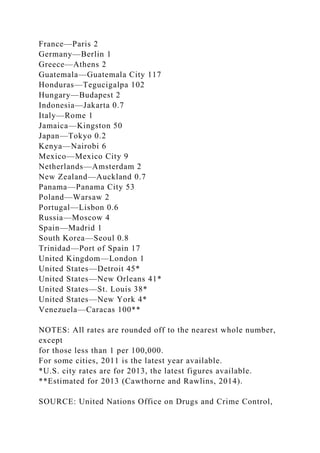
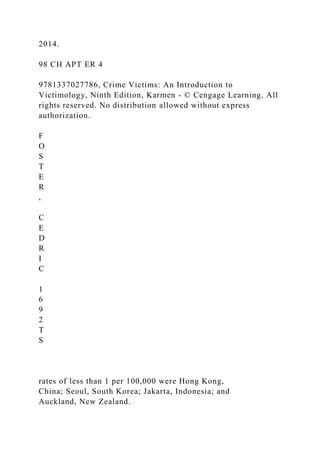
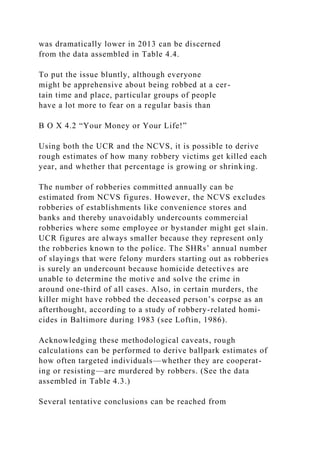
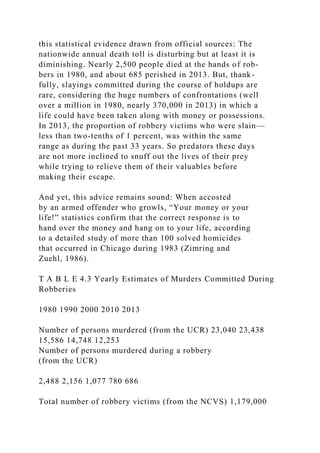
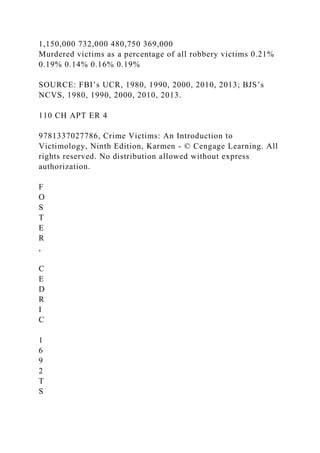
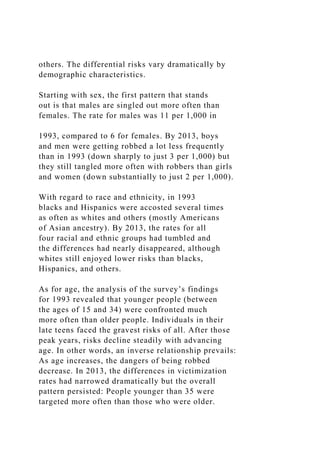
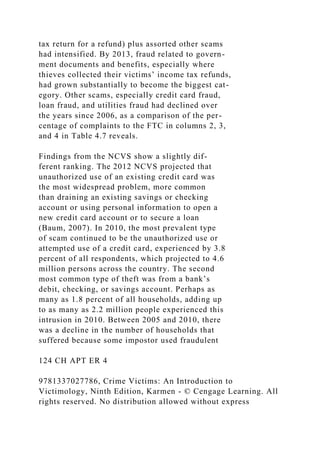
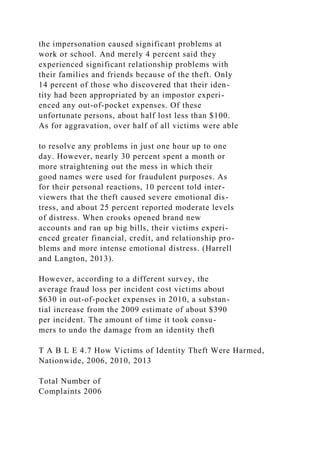
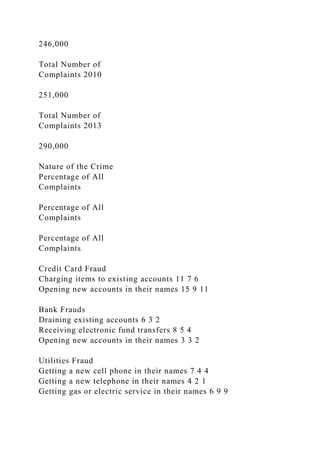
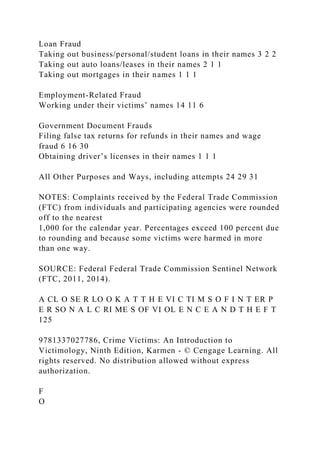
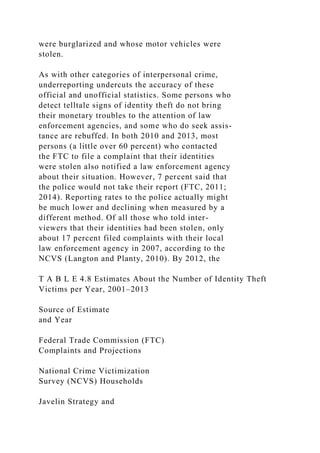
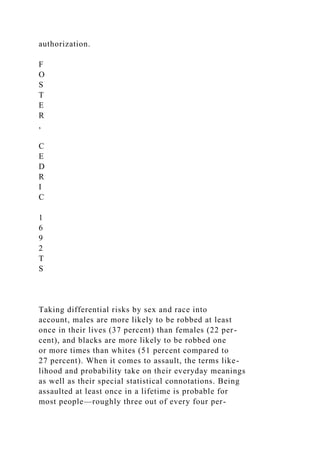
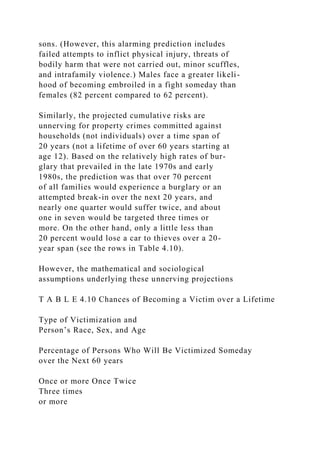
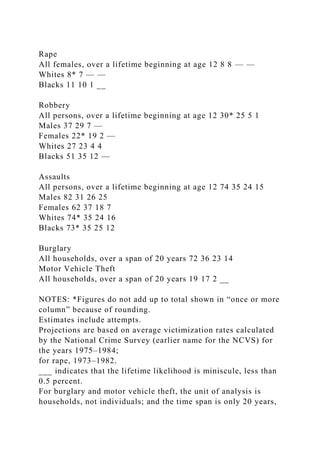
Victimization in
the United States:
An Overview
CHAPTER OUTLINE
Victimization Across the Nation: The Big Picture
Making Sense of Statistics
The Two Official Sources of Data
Facts and Figures in the Federal Bureau of Investiga-
tion’s Uniform Crime Report (UCR)
Facts and Figures in the Bureau of Justice Statistics’
National Crime Victimization Survey (NCVS)
Comparing the UCR and the NCVS
A First Glance at the Big Picture: Estimates of the
Number of New Crime Victims Each Year
A Second Look at the Big Picture: Watching the FBI’s
Crime Clock
Delving Deeper into the Big Picture: Examining Vic-
timization Rates
Tapping into the UCR and the NCVS to Fill in the
Details of the Big Picture
Searching for Changes in the Big Picture: Detecting
Trends in Interpersonal Violence and Theft
Taking a Longer View: Murders in the United States
over the Past Century
The Rise and Fall of Murder Rates Since 1900
Putting Crime into Perspective: The Chances of Dying
Violently—or from Other Causes
Summary
Key Terms Defined in the Glossary
Questions for Discussion and Debate
Critical Thinking Questions
Suggested Research Projects
LEARNING OBJECTIVES
To appreciate how statistics can be used to answer
important questions.
To become aware of the ways statistics can be used to
persuade and mislead.
To find out what information about crime victims is
collected routinely by the federal government’s
Department of Justice.
To become familiar with the ways that victimologists use
this data to estimate how many people were harmed by
criminalactivitiesandwhatinjuriesandlossestheysuffered.
continued
66
9781337027786, Crime Victims: An Introduction to
Victimology, Ninth Edition, Karmen - © Cengage Learning. All
rights reserved. No distribution allowed without express
authorization.
F
O
S
T
E
R
,
C
E
D
R
I
C
1
6
9
2
T
S
VICTIMIZATION ACROSS THE NATION:
THE BIG PICTURE
Victimologists gather and interpret data to answer
crucial questions such as: How many people are
harmed by criminals each year? Is victimization
becoming more of a problem or is it subsiding as
time goes by? And which groups are targeted the
most and the least often? Researchers want to find
out where and when the majority of incidents
occur, whether predators on the prowl intimidate
and subjugate their prey with their bare hands or
use weapons, and if so, what kinds? It is also impor-
tant to determine whether individuals are attacked
by complete strangers or people they know, and
how these intended targets act when confronted
by assailants. What proportion try to escape or
fight back, how many are injured, what percentage
need to be hospitalized, and how much money do
they typically lose in an incident?
The answers to specific questions like these
yield statistical portraits of crime victims, the pat-
terns that persist over the years, and the trends
that unfold as time passes; when taken together,
they constitute what can be termed the big picture
—an overview of what is really happening across
the entire United States during the twenty-first
century. The big picture serves as an antidote to
impressions based on direct but limited personal
experiences, as well as self-serving reports circulated
by organizations with vested interests, misleading
media images, crude stereotypes, and widely held
myths. But putting together the big picture is not
easy. Compiling an accurate portrayal requires care-
ful planning, formulation of the right questions,
proper data collection techniques, and insightful
analyses.
The big picture is constructed by making sys-
tematic observations and accurate measurements on
the local level. Then, these village, city, and county
reports must be aggregated so victimologists and
criminologists are able to characterize the situation
in an entire state, region of the country, and ulti-
mately the nation as a whole. (Sociologists would
call this process as going from an up-close and per-
sonal micro level up to a more institutional and
systemwide macro level of analysis.) An alternative
path to follow is to assemble a randomly selected
nationwide sample and then ask those people to
share their experiences about what offenders did
to them during the past year. If the sample is rep-
resentative and large enough, then the findings
from this survey can be generalized to project esti-
mates about what is happening in the country as a
whole. Once the big picture is assembled, it
becomes possible to make comparisons between
the situation in the United States and other post-
industrial societies around the world. The similari-
ties are increasing and cultural differences are
diminishing as globalization is fostering a modern
way of life, which involves seeking higher educa-
tion, commuting over congested highways to
work, shopping in malls, watching cable TV pro-
gramming, using the Internet, and calling the police
LEARNING OBJECTIVES
continued
To explore the kinds of information about victims that
can be found in the Federal Bureau of Investigation’s
annual Uniform Crime Report.
To learn how the FBI’s National Incident-Based Reporting
System is extracting more information drawn from
police files about victims.
To appreciate the strengths and weaknesses of this source
of official statistics.
To discover what data about victims and their plight can
be found in the federal government’s alternative source
of information, the Bureau of Justice Statistics’ National
Crime Victimization Survey.
To recognize the strengths and weaknesses of this alter-
native source of government statistics.
To assemble official statistics to spot trends, and especially
whether the problem of criminal victimization has
been intensifying or diminishing over recent decades.
To develop a feel for historical trends in the level of
violence in the United States.
To be able to weigh the threat of crime against other
perils by understanding comparative risks.
V I C TI M I Z A TI ON I N T H E U N I T ED S T A T ES : A
N O V E R V I E W 67
9781337027786, Crime Victims: An Introduction to
Victimology, Ninth Edition, Karmen - © Cengage Learning. All
rights reserved. No distribution allowed without express
authorization.
F
O
S
T
E
R
,
C
E
D
R
I
C
1
6
9
2
T
S
on smartphones for help, that has spread to even the
most remote regions of the planet.
Until the 1970s, few efforts were made to rou-
tinely monitor and systematically measure various
indicators of the plight of the nation’s victims. By
the 1980s, a great many social scientists and agencies
were conducting the research needed to bring the
big picture into focus. Also, all sorts of special-
interest groups began keeping count and dissemi-
nating their own estimates about the suffering of a
wide variety of victims, including youngsters
wounded at school, college students hurt or killed
on campus, children reported missing by their par-
ents, and people singled out by assailants who hate
their “kind.”
The statistics presented in this chapter come
from official sources and shed light on the big
picture concerning “street crimes” involving inter-
personal violence and theft.
Making Sense of Statistics
Statistics are meaningful numbers that reveal impor-
tant information. Statistics are of crucial importance to
social scientists, policy analysts, and decision makers
because they replace vague adjectives such as
“many,” “most,” and “few” with precise numbers.
Both victimologists and criminologists gather
their own data to make their own calculations, or
they scrutinize official statistics, which are com-
piled and published by government agencies. Why
do they pore over these numbers? By collecting,
computing, and analyzing statistics, researchers can
answer intriguing questions. Accurate and credible
statistics about crimes and victims are vital because
they can shed light on these important matters:
■ Statistics can be calculated to estimate
victimization rates, which are realistic
assessments of threat levels that criminal activ-
ities pose to particular individuals and groups.
What are the odds various categories of people
face of getting robbed or even murdered dur-
ing a certain time period? Counts (such as
death tolls) answer the question “How many?”
Better yet, rates (number of persons who get
robbed out of every 100,000 people in a year)
can provide relative estimates about these
disturbing questions.
■ Statistics can expose patterns of criminal
activity. Patterns reflect predictable relation-
ships or regular occurrences that show up
during an analysis of the data year after year.
For instance, a search for patterns could answer
these questions: Is it true that murders generally
occur at a higher rate in urban neighborhoods
than in suburban and rural areas? Are robberies
committed more often against men than
women, or vice versa?
■ Statistical trends can demonstrate how situa-
tions have changed over the years. Is the bur-
den of victimization intensifying or subsiding as
time goes by? Are the dangers of getting killed
by robbers increasing or decreasing?
■ Statistics can provide estimates of the costs and
losses imposed by illegal behavior. Estimates
based on accurate records can be important for
commercial purposes. For example, insurance
companies can determine what premiums to
charge their customers this year based on
actuarial calculations of the typical financial
expenses suffered by policyholders who were
hospitalized last year after being wounded by
robbers.
■ Statistics can be used for planning purposes to
project a rough or “ballpark figure” of next
year’s workload. Law enforcement agencies,
service providers, and insurance companies can
anticipate the approximate size of their case-
loads for the following year if they know how
many people were harmed the previous year.
■ Statistics also can be computed to evaluate the
effectiveness of criminal justice policies and to
assess the impact of prevention strategies. Are
battered women likely to lead safer lives after
their violent mates are arrested, or will they be
in greater danger? Do gun buyback programs
actually save lives or is their impact on the local
murder rate negligible?
■ Finally, statistical profiles can be assembled to
yield an impression of what is usual or typical
68 CH APT ER 3
9781337027786, Crime Victims: An Introduction to
Victimology, Ninth Edition, Karmen - © Cengage Learning. All
rights reserved. No distribution allowed without express
authorization.
F
O
S
T
E
R
,
C
E
D
R
I
C
1
6
9
2
T
S
about victims in terms of their characteristics
such as sex, age, and race/ethnicity. For
example, is the widely held belief accurate that
most of the people who die violently are young
men from troubled families living in poverty-
stricken, big-city neighborhoods? Portraits
based on data can also provide a reality check
to help ground theories that purport to explain
why some groups experience higher rates of
predation than others. For example, if it turns
out that the frail elderly are robbed far less
often than teenagers, then any theory that
emphasizes only the physical vulnerability of
robbers’ targets will be totally off-base or at best
incomplete as an explanation of which groups
suffer the most, and why.
However, statistics might not only be used,
they can also be abused. Statistics never speak for
themselves. Sometimes, statistics can be circulated
to mislead or deceive. The same numbers can be
interpreted quite differently, depending on what
spin commentators give them—what is stressed
and what is downplayed. Cynics joke that statistics
can be used by a special-interest group just like a
lamppost is used by a drunkard—for support rather
than for illumination.
Officials, agencies, and organizations with
their own particular agendas may selectively
release statistics to influence decision makers or
shape public opinion. For example, law enforce-
ment agencies might circulate alarming figures
showing a rise in murders and robberies at budget
hearings to support their arguments that they need
more money for personnel and equipment to bet-
ter protect and serve the community. Or these
same agencies might cite data showing a declining
number of victimizations in order to take credit for
improving public safety. Their argument could be
that those in charge are doing their jobs so well,
such as hunting down murderers or preventing
robberies, that they should be given even more
funding next year to further drive down the rate
of violent crime. Statistics also might serve as
evidence to argue that existing laws and policies
are having the intended desirable effects or,
conversely, to persuade people that the old meth-
ods are not working and new approaches are
necessary.
Interpretations of mathematical findings can
be given a spin that may be questionable or
debatable—for example, emphasizing that a shelter
for battered women is “half empty” rather than
“half full,” or stressing how much public safety
has improved, as opposed to how much more prog-
ress is needed before street crime can be considered
under control. As useful and necessary as statistics
are, they should always be viewed with a healthy
dose of scientific skepticism.
Although some mistakes are honest and
unavoidable, it is easy to “lie” with statistics by
using impressive and scientific-sounding numbers
to manipulate or mislead. Whenever statistics are
presented to underscore or clinch some point in
an argument, their origin and interpretation must
be questioned, and certain methodological issues
must be raised. What was the origin of the data,
and does this source have a vested interest in shap-
ing public opinion? Are different estimates available
from other sources? What kinds of biases and inac-
curacies could have crept into the collection and
analysis of the data? How valid and precise were
the measurements? How were key variables
operationalized—defined and measured? What
was counted and what was excluded, and why?
Victimologists committed to objectivity must
point out the shortcomings and limitations of data
collection systems run by the government. They try
to interpret statistics without injecting any particular
spin into their conclusions because (it is hoped) they
have no “axe to grind” other than enlightening
people about the myths and realities surrounding
the crime problem.
THE TWO OFFICIAL SOURCES OF DATA
As early as the 1800s, public officials began keeping
records about lawbreaking to gauge the “moral
health” of society. Then, as now, high rates of inter-
personal violence and theft were taken as signs of
social pathology—indications that something was
V I C TI M I Z A TI ON I N T H E U N I T ED S T A T ES : A
N O V E R V I E W 69
9781337027786, Crime Victims: An Introduction to
Victimology, Ninth Edition, Karmen - © Cengage Learning. All
rights reserved. No distribution allowed without express
authorization.
F
O
S
T
E
R
,
C
E
D
R
I
C
1
6
9
2
T
S
profoundly wrong with the way people generally
interacted in everyday life. Annual data sets were
compiled to determine whether illegal activities
were being brought under control as time passed.
Monitoring trends is even more important today
because many innovative but intrusive and expensive
criminal justice policies intended to curb crime have
been implemented.
Two government reports published each year
contain statistical data that enable victimologists to
keep track of what is happening out on the streets.
Both of these official sources of facts and figures
are disseminated each year by the U.S. Depart-
ment of Justice in Washington, D.C. Each of
these government data collection systems has its
own strengths and weaknesses in terms of provid-
ing the information victimologists and criminolo-
gists are seeking to answer their research questions.
The Federal Bureau of Investigation’s Uniform
Crime Report (UCR): Crime in the United States
is a massive compilation of all incidents “known”
to local, county, and state police departments
across the country. The FBI’s UCR is a virtual
“bible” of crime statistics based on victims’ com-
plaints and direct observations made by officers. It
is older and better known than the other official
source, the Bureau of Justice Statistics’ National
Crime Victimization Survey (NCVS): Criminal
Victimization in the United States. The BJS’s
NCVS provides projections for various regions
and for the entire country based on incidents vol-
untarily disclosed to interviewers by a huge
national sample drawn from the general public.
Facts and Figures in the Federal Bureau of
Investigation’s Uniform Crime Report (UCR)
The UCR was established in 1927 by a committee
set up by the International Association of Chiefs of
Police. The goal was to develop a uniform set of
definitions and reporting formats for gathering
crime statistics. Since 1930, the FBI has published
crime data in the UCR that was forwarded volun-
tarily to Washington by police departments across
the United States. In recent years, more than
18,000 village, town, tribal, college, municipal,
county, and state police departments and sheriff’s
departments in all 50 states, the District of
Columbia, and several territories that serve about
97 percent of the more than 300 million inhabit-
ants of the United States participate in the data
collection process, usually by sending periodic
reports to state criminal justice clearinghouses.
Several federal law enforcement agencies now
contribute data as well (FBI, 2014).
The FBI divides up the crimes it tracks into
two listings. Unfortunately, both Part I and Part II
of the UCR have been of limited value to those
interested in studying the actual flesh-and-blood
victims rather than the incidents known to police
departments or the characteristics of the persons
arrested for allegedly committing them.
Part I of the UCR focuses on eight index
crimes, the illegal acts most people readily think
about when they hear the term “street crime.”
Four index crimes count violent attacks directed
“against persons”: murder, forcible rape, robbery,
and aggravated assault. The other four monitor
crimes “against property”: burglary, larceny (thefts
of all kinds), motor vehicle theft, and arson. (The
category of arson was added in 1979 at the request
of Congress when poor neighborhoods in big cities
experienced many blazes of suspicious origin.
However, incidents of arson are still unreliably
measured because intentionally set fires might
remain classified by fire marshals as being “of
unknown origin.”) These eight crimes (in actual
practice, seven) are termed index crimes because
the FBI adds all the known incidents of each one
of these categories together to compute a “crime
index” that can be used for year-to-year and
place-to-place comparisons to gauge the seriousness
of the problem. (But note that this grand total is
unweighted; that means a murder is counted as
just one index crime event, the same as an
attempted car theft. So the grand total [like “com-
paring apples and oranges”] is a huge composite
that is difficult to interpret.)
The UCR presents the number of acts of vio-
lence and theft known to the authorities for cities,
counties, states, regions of the country, and even
many college campuses (since the mid-1990s; see
70 CH APT ER 3
9781337027786, Crime Victims: An Introduction to
Victimology, Ninth Edition, Karmen - © Cengage Learning. All
rights reserved. No distribution allowed without express
authorization.
F
O
S
T
E
R
,
C
E
D
R
I
C
1
6
9
2
T
S
Chapter 11). For each crime, the FBI compiles
information about the number of incidents reported
to the police, the total estimated losses in billions
of dollars due to property crimes, the proportion of
cases that were solved, and some characteristics of
the suspects arrested (age, sex, race)—but, unfortu-
nately for victimologists, nothing about the people
who suffered harm and filed the complaints.
In Part II, the UCR only provides counts of
the number of people arrested for 21 assorted
offenses (but no estimates of the total number of
these illegal acts committed nationwide). Some
Part II crimes that lead to arrests do cause injuries
to individuals, such as “offenses against women and
children,” as well as “sex offenses” other than forc-
ible rape and prostitution. Others do not have
clearly identifiable victims, such as counterfeiting,
prostitution, gambling, drunkenness, disorderly
conduct, weapons possession, and drug offenses.
Still other Part II arrests could have arisen from
incidents that directly harm identifiable individuals,
including embezzlement, fraud, vandalism, and
buying/receiving/possessing stolen property.
The Uniform Crime Reporting Division fur-
nishes data in separate annual publications about
how many hate crimes were reported to police
departments (see Chapter 11). It also issues a yearly
analysis of how many law enforcement officers
were feloniously assaulted and slain in the line of
duty, the weapons used against them, and the
assignments they were carrying out when they
were injured or killed (also analyzed in Chapter 11).
From a victimologist’s point of view, the
UCR’s method of data collection suffers from sev-
eral shortcomings that undermine its accuracy and
usefulness (see Savitz, 1982; and O’Brien, 1985).
First of all, underreporting remains an intractable
problem. Because many victims do not inform
their local law enforcement agencies about illegal
acts committed against them and their possessions
(see Chapter 6), the FBI’s compilation of “crimes
known to the police” is unavoidably incomplete.
The annual figures about the number of reported
crimes recorded as committed inevitably are lower
than the actual (but unknown) number of crimes
that really were carried out. Second, the UCR
focuses on accused offenders (keeping track of the
age, sex, and race) but does not provide any infor-
mation about the complainants who reported the
incidents. Only information about murder victims
(their age, sex, and race) is collected routinely (see
Chapter 4). Third, the UCR lumps together reports
of attempted crimes (usually not as serious for vic-
tims) with completed crimes (in which offenders
achieved their goals). Fourth, when computing
crime rates for cities, counties, and states, the FBI
counts incidents directed against all kinds of targets,
adding together crimes against impersonal entities
(such as businesses and government agencies) on the
one hand, and individuals and households on the
other. For example, the totals for robberies include
bank holdups as well as muggings; statistics about bur-
glaries combine attempted break-ins of offices with
the ransacking of homes; figures for larcenies include
goods shoplifted from department stores in addition
to thefts of items swiped from parked cars.
Another shortcoming is that the FBI instructs
local police departments to observe the hierarchy
rule when reporting incidents: List the event under
the heading of the most serious crime that took
place. The ranking in the hierarchy from most ter-
rible to less serious runs from murder to forcible
rape, robbery, aggravated assault, burglary, vehicle
theft, and finally larceny. For instance, if an armed
intruder breaks into a home and finds a woman
alone, rapes her, steals her jewelry, and drives off
in her car, the entire incident will be counted for
record-keeping purposes only as a forcible rape
(the worst crime she endured). The fact that this
person suffered other offenses at the hands of
the criminal isn’t reflected in the yearly totals of
known incidents. If the rapist is caught, he could
also be charged with armed robbery, burglary,
motor vehicle theft, possession of a deadly weapon,
and possession of stolen property, even though
these lesser offenses are not added to the UCR’s
compilations.
Phasing in a National Incident-Based Reporting
System Fortunately, the UCR is being overhauled
and is becoming a much more useful source of
information about individuals who are harmed
V I C TI M I Z A TI ON I N T H E U N I T ED S T A T ES : A
N O V E R V I E W 71
9781337027786, Crime Victims: An Introduction to
Victimology, Ninth Edition, Karmen - © Cengage Learning. All
rights reserved. No distribution allowed without express
authorization.
F
O
S
T
E
R
,
C
E
D
R
I
C
1
6
9
2
T
S
by lawbreakers. The FBI is converting its data col-
lection format to a National Incident-Based Reporting
System (NIBRS).
Law enforcement officials began to call for a
more extensive record-keeping system during the
late 1970s. The police force in Austin, Texas, was
the first to switch to this comprehensive data
collection and reporting system. However, other
big-city police departments that deal with a huge
volume of crime reports have had trouble meeting
NIBRS goals and timetables, so complete imple-
mentation has been postponed repeatedly. North
Dakota and South Carolina were the first two states
to adopt NIBRS formatting in 1991. As of 2008,
NIBRS data collection was taking place in 32 states
and the District of Columbia, covering 25 percent
of the nation’s population, 26 percent of its
reported crimes, and 37 percent of its law enforce-
ment agencies (IBR Resource Center, 2011). But
the switchover seems to be proceeding very slowly.
A 2012 NIBRS national report compiled figures
submitted by 6,115 law enforcement agencies
(only 33 percent of the over 18,000 participating
departments) in 32 states that covered about 30 per-
cent of the nation’s population and 28 percent of all
crimes known to police departments across the
country (FBI, 2014b).
One major change is the abandonment of the
hierarchy rule of reporting only the worst offense
that happened during a sequence of closely related
events. Preserving a great many details makes it pos-
sible to determine how often one crime evolves into
another, such as a carjacking escalating into a kidnap-
ping, or a robbery intensifying into a life-threatening
shooting. For the incident cited above that was cate-
gorized as a forcible rape under the hierarchy rule,
this new record-keeping system also would retain
information about the initial burglary; the resulting
robbery; the vehicle theft; other property stolen
from the victim and its value; other injuries sus-
tained; the woman’s age, sex, and race; whether
there was a previous relationship between her and
the intruder; and the date, time, and location of
the incident. Until the advent of the NIBRS com-
puter database, only in cases of homicide were some
of these facts extracted from police files and retained.
Another significant aspect of the overhaul is
that the NIBRS provides expanded coverage of
additional illegal activities. Instead of just eight
closely watched UCR index offenses, FBI compu-
ters are now prepared to keep track of 46 Group A
offenses derived from 22 categories of crimes. In
addition to the four “crimes against persons” and
the four “against property” of the UCR’s Part I,
the new Group A monitors offenses that formerly
had been listed in Part II or just not collected at all.
Victim-oriented data are becoming available for
simple assault (including intimidation), vandalism
(property damage and destruction), blackmail
(extortion), fraud (swindles and con games), forcible
sex crimes (sodomy, sexual assault with an object,
and fondling), nonforcible sex offenses (statutory
rape and incest), kidnapping (including parental
abductions), and the nonpunishable act of justifiable
homicide. The data collected about a victim of a
Group A offense include these variables: sex, age,
race and ethnicity, area of residence, type of injury,
any prior relationship to the offender, and the
circumstances surrounding the attack in cases of
aggravated assault and murder. If items were stolen,
the details preserved about them include the types
of possession taken and their value, and in cases of
motor vehicle theft, whether the car was recovered.
Also, the NIBRS makes a distinction between
attempted and successfully completed acts (from
the criminal’s point of view) (IBR Resource
Center, 2011).
Already, some data mining studies based exclu-
sively on the NIBRS archives from selected states
and cities address some intriguing issues. For exam-
ple, an analysis of roughly 1,200 cases of abductions
in the 12 states that had switched over to NIBRS by
1997 shed light on a previously overlooked subcat-
egory of “holding of a person against his or her
will,” called acquaintance kidnapping. This newly
recognized offense includes situations such as when
a teenage boy isolates his former girlfriend to punish
her for spurning him, to pressure her to return to
him, to compel her to submit sexually, or to evade
her parents’ efforts to break them up. Also included
are incidents in which street gang members spirit off
rivals to intimidate them, retaliate against them, or
72 CH APT ER 3
9781337027786, Crime Victims: An Introduction to
Victimology, Ninth Edition, Karmen - © Cengage Learning. All
rights reserved. No distribution allowed without express
authorization.
F
O
S
T
E
R
,
C
E
D
R
I
C
1
6
9
2
T
S
even recruit them. In these types of hostage takings,
the perpetrators tend to be juveniles just like their
teenage targets, the abductions often take place
in homes as opposed to public places, and the cap-
tives are more likely to be assaulted (Finkelhor and
Ormrod, 2000).
Several studies using NIBRS data from certain
jurisdictions have revealed important findings about
various types of murders. In general, elderly men
are murdered at twice the rate as elderly women
(Chu and Kraus, 2004). Specifically, older white
males are the most frequent victims of “eldercide”;
they are killed predominantly by offenders who are
below the age of 45 and tend to be complete stran-
gers. Female senior citizens are more likely to be
slain by assailants who are older than 45 and are
often either a spouse or grown child (Krienert and
Walsh, 2010). Murders of intimate partners tend to
be committed late at night, during weekends, and
in the midst of certain holidays more often than at
other times (Vazquez, Stohr, and Purkiss, 2005).
Also, the higher homicide rate in Southern cities
actually may not be due to a presumed subculture
of violence or “code of honor” that supposedly
compels individuals likely to lose fights and suffer
beatings to nevertheless stand up to the aggressors
to save face (Chilton, 2004).
Facts and Figures in the Bureau of Justice
Statistics’ National Crime Victimization
Survey (NCVS)
Victimologists and criminologists have reservations
about the accuracy of the official records kept by
police departments that form the basis of the FBI’s
UCR as well as its NIBRS. Tallies maintained by
local law enforcement agencies surely are incom-
plete due to victim nonreporting. Also, on occa-
sion, these closely watched statistics may be
distorted by police officials as a result of political
pressures to either downplay or inflate the total
number of incidents in their jurisdiction in order
to manipulate public opinion about the seriousness
of the local crime problem or the effectiveness of
their crime-fighting strategies (for example, see
Eterno and Silverman, 2012).
Dissatisfaction with official record-keeping
practices has led criminologists to collect their
own data. The first method used was the self-
report survey. Small samples of people were
promised anonymity and confidentiality if they
would “confess” on questionnaires about the crimes
they had committed. This line of inquiry consis-
tently revealed greater volumes of illegal acts than
were indicated by official statistics in government
reports. Self-report surveys confirmed the hypothe-
sis that large numbers of people broke the law
(especially during their teens and twenties), but
most were never investigated, arrested, or con-
victed, especially if they were members of middle-
or upper-class families. But self-reports about
offending did not shed any light on those who
were on the receiving end of these illegal acts.
After establishing the usefulness of self-report
surveys about offenses, the next logical step for
researchers was to query people from all walks of
life about any street crimes that may have been
committed against them rather than by them. These
self-report studies originally were called “victim
surveys.” But that label was somewhat misleading
because most respondents answered that they were
not victims—they had not been harmed by street
crimes during the time period in question.
The first national survey about victimization
(based on a random sample of 10,000 households)
was carried out in 1966 for the President’s Com-
mission on Law Enforcement and the Administra-
tion of Justice. It immediately confirmed one
suspicion: A sizable percentage of individuals in
the sample who told interviewers that they had suf-
fered losses and/or sustained injuries acknowledged
that they had not reported the incident to the
police. This proof of the existence of what was
termed the “dark figure” (meaning a murky, mys-
terious, imprecise number) of unreported crimes
further undercut confidence in the accuracy of the
FBI’s UCR statistics for all offenses except murder.
Confirming the existence of unreported crime also
underscored the importance of continuing this
alternative way of measuring victimization rates
and trends by directly asking members of the gen-
eral public about their recent experiences.
V I C TI M I Z A TI ON I N T H E U N I T ED S T A T ES : A
N O V E R V I E W 73
9781337027786, Crime Victims: An Introduction to
Victimology, Ninth Edition, Karmen - © Cengage Learning. All
rights reserved. No distribution allowed without express
authorization.
F
O
S
T
E
R
,
C
E
D
R
I
C
1
6
9
2
T
S
In 1972, the federal government initiated a
yearly survey of businesses as well as residents in
26 large cities, but the project was discontinued in
1976. In 1973, the Census Bureau began interview-
ing members of a huge, randomly selected, nation-
wide, stratified, multistage sample of households
(clustered by geographic counties). Until 1992,
the undertaking was known as the National Crime
Survey (NCS). After some revisions, it was retitled
the National Crime Victimization Survey (NCVS).
The Aspects of Victimization That It
Measures NCVS respondents answer questions
from a survey that runs more than 20 pages. They
are interviewed every six months for three years.
The questioning begins with a series of screening
items, such as, “During the last six months did any-
one break into your home?” If the respondent
answers yes, follow-up questions are asked to col-
lect details about the incident.
When completed, the survey provides a great
deal of data about the number of violent and prop-
erty crimes committed against the respondents, the
extent of any physical injuries or financial losses
they sustained, and the location and time of the
incidents. It also keeps track of the age, sex, race/
ethnicity, marital status, income level, and place of
residence of the people disclosing their misfortunes
to survey interviewers. The survey records the vic-
tims’ perceptions about the perpetrators (in terms of
whether they seemed to have been drinking and if
they appeared to be members of a gang), whether
they used weapons, and what self-protective
measures—if any—the respondents took before,
during, and after the attack. Additional questions
probe into any prior relationships between them,
as well as the reasons why they did or did not report
the crime to the police.
The survey is person-centered. It is geared
toward uncovering the suffering of individuals 12
years of age or older and the losses experienced by
entire households (but not of workplaces, such as
burglaries of offices or robberies of banks). The
questionnaire focuses on crimes of violence (forc-
ible rape, robbery, and aggravated assault) just like
the UCR, plus simple assault, but not murder.
It also inquires about two kinds of thefts from indi-
viduals (personal larceny with contact like purse
snatching and pickpocketing, and without any
direct contact), and three types of stealing directed
at the common property of households—burglary,
larceny, and motor vehicle theft—again, just like
the UCR (except that crimes against collectivities
like organizations and commercial enterprises are
not included in the NCVS but are counted in the
UCR). Identity theft is now examined, but the list
of possible offenses is far from exhaustive. For
example, respondents are not quizzed about
instances of kidnapping, swindling, blackmail,
extortion, and property damage due to vandalism
or arson.
The benefit of survey research is that it elimi-
nates the futility of attempting the impossible: inter-
viewing every person (of the nearly 265 million
people 12 years old or older residing in the entire
United States in 2013) to find out how he or she
fared in the past year. The combined experiences of
just about 160,000 individuals over the age of 11
living in roughly 90,000 households randomly
selected to be in the national sample in 2013 can
be projected to derive estimates of the total number
of people throughout the country who were
robbed, raped, or beaten, and of households that
suffered burglaries, larcenies, or car thefts (Truman
and Langton, 2014).
Shortcomings of the Data At the survey’s incep-
tion, the idea of asking people about their recent
misfortunes was hailed as a major breakthrough that
would provide more accurate statistics than those
found in the UCR. But, for a number of reasons,
the technique has not turned out to be the fool-
proof method for measuring the “actual” amount of
interpersonal violence and theft that some victimol-
ogists had hoped it would be. (For more extensive
critiques of the methodology, see Levine, 1976;
Garofalo, 1981; Skogan, 1981b, 1986; Lehnen
and Skogan, 1981; Reiss, 1981, 1986; Schneider,
1981; O’Brien, 1985; Mayhew and Hough, 1988;
Fattah, 1991; and Lynch and Addington, 2007).
First, the findings of this survey, like any other,
are reliable only to the extent that the national
74 CH APT ER 3
9781337027786, Crime Victims: An Introduction to
Victimology, Ninth Edition, Karmen - © Cengage Learning. All
rights reserved. No distribution allowed without express
authorization.
F
O
S
T
E
R
,
C
E
D
R
I
C
1
6
9
2
T
S
sample is truly representative of the population of
the whole country. If the sample is biased (in terms
of factors connected to victimization, such as age,
gender, race, class, and geographical location), then
the projections made about the experiences of the
roughly 250 million people who actually were not
questioned in 2013 will be either too high or too
low. Because the NCVS is household based, it
might fail to fully capture the experiences of tran-
sients (such as homeless persons and inmates) or
people who wish to keep a low profile (such as
“illegal” immigrants or fugitives).
Second, the credibility of what people tell poll-
sters is a constant subject of debate and a matter of
continuing concern in this survey. Underreporting
remains a problem because communication barriers
can inhibit respondents from disclosing details
about certain crimes committed against them (inci-
dents that they also probably refused to bring to the
attention of the police). Any systematic suppression
of the facts, such as the unwillingness of wives to
reveal that their husbands beat them, of teenage
girls to divulge that they suffered date rapes, or of
young men to admit that they were robbed while
trying to buy illicit drugs or a prostitute’s sexual
services, will throw off the survey’s projection of
the true state of affairs. Furthermore, crimes com-
mitted against children under 12 are not probed (so
no information is forthcoming about physical and
sexual abuse by caretakers, or molestations or kid-
nappings by acquaintances or strangers). Memory
decay (forgetting about incidents) also results in
information losses, especially about minor offenses
that did not involve serious injuries or expenses.
But overreporting can occur as well. Some
respondents may exaggerate or deliberately lie for
a host of personal motives. Experienced detectives
filter out any accounts by complainants that do not
sound believable. They deem the charges to be
“unfounded” and decide that no further investiga-
tion is warranted (see Chapter 6). But there is no
such quality control over what people tell NCVS
interviewers. The police don’t accept all reports of
crimes at face value, but pollsters must. “Stolen”
objects actually may have been misplaced, and an
accidentally shattered window may be mistaken as
evidence of an attempted break-in. Also, no verifi-
cation of assertions takes place. If a person in the
sample discusses a crime that was supposedly
reported to the local police, there is no attempt to
double-check to see if the respondent’s recollec-
tions coincide with the information in the depart-
ment’s case files. Forward telescoping is the
tendency to vividly remember traumatic events
and therefore believe that a serious crime occurred
more recently than it actually did (within the sur-
vey’s reference period of “the previous six
months”). It contributes to overreporting because
respondents think a crime should be counted,
when actually it was committed long before and
ought to be excluded.
Because being targeted within the previous six
months is a relatively rare event, tens of thousands
of people must be polled to find a sufficient number
of individuals with incidents worthy of discussion to
meet the requirements for statistical soundness. For
example, about 1,000 people must be interviewed
in order to locate just a handful who were recently
robbed. Estimates derived from small subsamples
(such as robbery victims who are elderly and
female) have large margins of error. The NCVS
therefore requires a huge sample and becomes
very expensive to carry out.
Even with a relatively large number of partici-
pants, the findings of the survey can only describe
the situation in the nation as a whole. The serious-
ness of the crime problem in a particular city,
county, or state cannot be accurately determined
because the national sample is not large enough to
break down into local subgroups of sufficient size
for statistical analysis (with a few exceptions). Fur-
thermore, the projected absolute number of inci-
dents (offenses committed and victims harmed)
and the relative rates (victims per 1,000 people
per year) are really estimates at the midpoint of a
range (what statisticians call a confidence inter-
val). Therefore, NCVS rates always must be
regarded as approximate, plus or minus a certain
correction factor (margin of error) that depends
mostly on the size of the entire sample (all respon-
dents) and becomes statistically questionable for a
very small specific subsample, such as low-income
V I C TI M I Z A TI ON I N T H E U N I T ED S T A T ES : A
N O V E R V I E W 75
9781337027786, Crime Victims: An Introduction to
Victimology, Ninth Edition, Karmen - © Cengage Learning. All
rights reserved. No distribution allowed without express
authorization.
F
O
S
T
E
R
,
C
E
D
R
I
C
1
6
9
2
T
S
young men, living in cities, who were robbed
within the last six months.
The NCVS has improved over the years as
better ways have been devised to draw representa-
tive samples, to determine which incidents coincide
with or don’t fit the FBI’s uniform crime definition,
and to jog respondents’ memories (Taylor, 1989).
In particular, more explicit questions were added
about sexual assaults (involving unwanted or
coerced sexual contact) that fell short of the legal
definition of forcible rape and about instances of
domestic violence (simple assaults) (Hoover, 1994;
and Kindermann, Lynch, and Cantor, 1997).
Over its four decades, the survey’s questions
have been refocused, clarified, and improved. But
the accuracy of the NCVS has suffered because of
waves of budget cuts. To save money, the sample
size has been trimmed repeatedly. Over the dec-
ades, expensive “paper and pencil interviews”
(PAPI) carried out at people’s homes have been
replaced by follow-up phone calls (computer-
assisted telephone interviews [CATI]) and mail-in
questionnaires. The response rate for individuals
who were invited to participate has held steady at
about 88 percent; in other words, 12 percent of the
people chosen for the study declined to answer
questions in 2010 as well as in 2013 (Truman,
2011; and Truman and Langton, 2014).
Comparing the UCR and the NCVS
For victimologists, the greater variety of statistics
published in the NCVS offer many more possibili-
ties for analysis and interpretation than the much
more limited data in the UCR. But both official
sources have their advantages, and the two can be
considered to complement each other.
The UCR, not the NCVS, is the source to turn
to for information about murder victims because
questions about homicide don’t appear on the
BJS’s survey. (However, two other valuable,
detailed, and accurate databases for studying homi-
cide victims are death certificates as well as public
health records maintained by local coroners’ and
medical examiners’ offices. These files may contain
information about the slain person’s sex, age, race/
ethnicity, ancestry, birthplace, occupation, educa-
tional attainment, and zip code of last known
address [for examples of how this non-UCR data
can be analyzed, see Karmen, 2006]).
The UCR is also the publication that presents
information about officers slain in the line of duty,
college students harmed on campuses, and hate
crimes directed against various groups. The UCR
is the place to go for geographically based statistics;
it provides data about the crimes reported to law
enforcement agencies in different towns and cities,
entire metropolitan areas, and counties, states, and
regions of the country. NCVS figures are calculated
for the whole country, four geographic regions, and
urban/suburban/rural areas, but are not available
for specific cities, counties, or states (because the
subsamples would be too small to analyze). The
UCR, but not the NCVS, calculates the overall
proportion of reported crimes that are solved by
police departments. Incidents counted in the
UCR can be considered as having passed through
two sets of authenticity filters: Victims felt what
happened was serious enough to notify the author-
ities shortly afterward, and officers who filled out
the reports believed that the complainants were
telling the truth as supported by some evidence.
Although limited information about arrestees is
provided in the UCR, this annual report doesn’t
provide any descriptions of the persons harmed by
those accused rapists, robbers, assailants, burglars,
and other thieves (until the NIBRS replaces current
record-keeping formats).
NCVS interviewers collect a great deal of
information about the respondents who claim
they were harmed by street crimes. The NCVS is
the source to turn to for a more inclusive account-
ing of what happened during a given year because it
contains information about incidents that were but
also were not reported to the police. The yearly
surveys are not affected by any changes in the degree
of cooperation—or level of tension—between com-
munity residents and their local police, by improve-
ments in record-keeping by law enforcement
agencies, or by temporary crackdowns in which
all incidents are taken more seriously. But the
NCVS interviewers must accept at face value the
76 CH APT ER 3
9781337027786, Crime Victims: An Introduction to
Victimology, Ninth Edition, Karmen - © Cengage Learning. All
rights reserved. No distribution allowed without express
authorization.
F
O
S
T
E
R
,
C
E
D
R
I
C
1
6
9
2
T
S
accounts respondents describe. Also, the NCVS
annual report has nothing to offer about murders,
line-of-duty assaults and deaths of police officers,
offenses committed against children under 12,
robberies and burglaries directed at commercial
establishments, and injuries and losses from inten-
tionally set fires.
Even when both of these official sources col-
lect data about the same crimes, the findings might
not be strictly comparable. First of all, the defini-
tions of certain offenses (such as rape) can vary, so
the numerators may not count the same incidents.
The UCR kept track only of rapes of women and
girls (sexual assaults against boys and men were
considered as “forcible sodomy”) until a gender-
neutral definition that explicitly described all forms
of intrusive bodily invasions was adopted in 2011.
The NCVS counts sexual assaults against males as
well as females. Similarly, the definitions of rob-
bery and burglary are not the same in the two
official record-keeping sources. For example, the
UCR includes robberies of commercial establish-
ments and burglaries of offices, but the NCVS
does not.
In addition, the denominators differ. While the
FBI computes incidents of violence “per 100,000
people,” the BJS calculates incidents “per 1,000
people age 12 or older.” For property crimes, the
NCVS denominator is “per 1,000 households,” not
individuals (the average household has between
two and three people living in it).
Therefore, it is difficult to make direct compar-
isons between the findings of the UCR and the
NCVS. The best way to take full advantage of
these two official sources of data from the federal
government is to focus on the unique information
provided by each data collection system.
Even when the new and improved NIBRS
data storage system is taken into account, several
important variables are not tracked by any of
these government monitoring systems. For exam-
ple, information about the victims’ education, occu-
pation, ancestry, birthplace, and rap sheet is not
collected by the UCR, the NIBRS, or the NCVS.
Yet these background variables could be crucial to
investigate certain issues (like robbers preying on
recent immigrants or murders of persons known to
be involved in the drug scene).
A First Glance at the Big Picture:
Estimates of the Number of New Crime
Victims Each Year
To start to bring the big picture in focus, a first step
would be to look up how many Americans reveal
that they were victims of street crimes each year.
The absolute numbers are staggering: Police
forces across the nation learned about nearly 1.25
million acts of “violence against persons” during
2013, according to the FBI’s (2014) annual Uniform
Crime Reports. In addition, over 9 million thefts
were reported to the police (however, some were
carried out against stores or offices, not individuals
or families). The situation was even worse, accord-
ing to the BJS’ National Crime Victimization Survey.
It projected that people 12 years old and over suf-
fered an estimated 6.1 million acts of violence, and
households experienced close to 16.8 million thefts
during 2013 (Truman and Langton, 2014).
Some individuals and households are victim-
ized more than once in a year, so the number of
incidents might be greater than the number of peo-
ple. Then again, in some incidents, more than one
person might be harmed, so the number of people
could be larger than the number of criminal events.
Either way, it is obvious that each year, millions of
Americans are initiated into a group that they did
not want to be part of: They join the ranks of those
who know what it is like from firsthand experience
to endure crime-inflicted injuries and losses.
A Second Look at the Big Picture:
Watching the FBI’s Crime Clock
Consider another set of statistics intended to sum-
marize the big picture that are issued yearly by the
FBI in its authoritative UCR. This set is called the
Crime Clock, and it dramatizes the fact that as
time passes—each and every second, minute,
hour, and day—the toll keeps mounting, as more
and more people join the ranks of crime victims
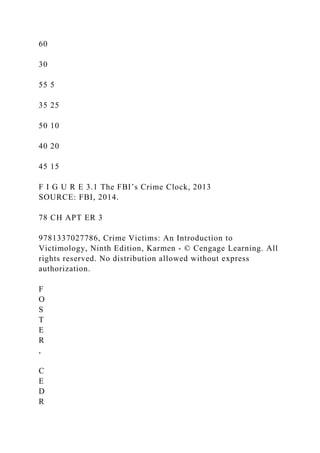
(see Figure 3.1).
V I C TI M I Z A TI ON I N T H E U N I T ED S T A T ES : A
N O V E R V I E W 77
9781337027786, Crime Victims: An Introduction to
Victimology, Ninth Edition, Karmen - © Cengage Learning. All
rights reserved. No distribution allowed without express
authorization.
F
O
S
T
E
R
,
C
E
D
R
I
C
1
6
9
2
T
S
The Crime Clock’s statistics are calculated in a
straightforward manner. The total number of inci-
dents of each kind of crime that were reported to all
the nation’s 18,000 plus police departments is
divided into the number of seconds (60 � 60 �
24 � 365 ¼ 31,536,000) or minutes (60 � 24 �
365 ¼ 525,600) in a year. For instance, about
14,200 people were slain in the United States in
2013. The calculation (525,600/14,200 ¼ 37) indi-
cates that every 37 minutes another American was
murdered that year (FBI, 2014).
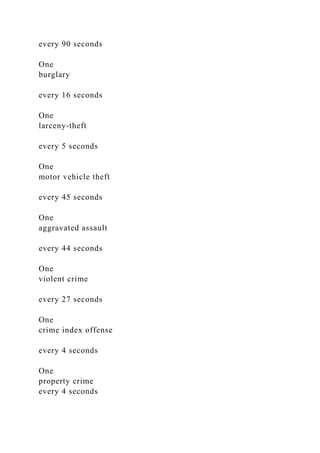
Just a glance at this chart alerts even the casual
reader to its chilling message. The big picture it
portrays is that crimes of violence (one every 27
seconds) and theft (one every 4 seconds) are all
too common. As the Crime Clock ticks away, a
steady stream of casualties flows into morgues,
hospital emergency rooms, and police stations
throughout the nation. At practically every
moment, someone somewhere in the United States
is experiencing what it feels like to be harmed by a
criminal. These grim reminders give the impression
that becoming a victim someday is virtually inevi-
table. It seems to be just a matter of time before
one’s “number is called” and disaster strikes. Sooner
or later, it will be every American’s “turn”—or so it
appears.
Furthermore, it can be argued that these alarm-
ing figures revealed by the Crime Clock are actually
underestimates of how dangerous the streets of the
United States really are, due to a shortcoming in the
report’s methodology. The big picture is really
One
murder
every 37 minutes
One
forcible rape
every 7 minutes
One
robbery
every 90 seconds
One
burglary
every 16 seconds
One
larceny-theft
every 5 seconds
One
motor vehicle theft
every 45 seconds
One
aggravated assault
every 44 seconds
One
violent crime
every 27 seconds
One
crime index offense
every 4 seconds
One
property crime
every 4 seconds
60
30
55 5
35 25
50 10
40 20
45 15
F I G U R E 3.1 The FBI’s Crime Clock, 2013
SOURCE: FBI, 2014.
78 CH APT ER 3
9781337027786, Crime Victims: An Introduction to
Victimology, Ninth Edition, Karmen - © Cengage Learning. All
rights reserved. No distribution allowed without express
authorization.
F
O
S
T
E
R
,
C
E
D
R
I
C
1
6
9
2
T
S
much worse. The FBI’s calculations are based solely
upon crimes known to police forces across the
country. But, of course, not all illegal acts are
brought to the attention of the authorities. The
police find out about only a fraction of all the inci-
dents of violence and an even smaller proportion of
the thefts that occur because many victims do not
share their personal troubles with the uniformed
officers or detectives of their local police depart-
ments. The reporting rate varies from crime to
crime, place to place, year to year, and group to
group (see Chapter 6 for more details about victim
reporting rates). Hence, one way to look at these
Crime Clock statistics is to assume that they repre-
sent the tip of the iceberg: The actual number of
people harmed by offenders in these various ways
must be considerably higher.
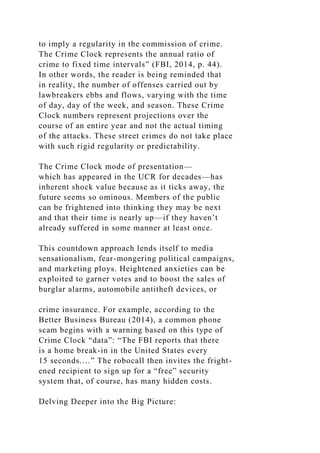
However, the only disclaimer the FBI offers is
this: “The Crime Clock should be viewed with
care. The most aggregate representation of UCR
data, it conveys the annual reported crime experi-
ence by showing a relative frequency of occurrence
of the Part I index offenses. It should not be taken
to imply a regularity in the commission of crime.
The Crime Clock represents the annual ratio of
crime to fixed time intervals” (FBI, 2014, p. 44).
In other words, the reader is being reminded that
in reality, the number of offenses carried out by
lawbreakers ebbs and flows, varying with the time
of day, day of the week, and season. These Crime
Clock numbers represent projections over the
course of an entire year and not the actual timing
of the attacks. These street crimes do not take place
with such rigid regularity or predictability.
The Crime Clock mode of presentation—
which has appeared in the UCR for decades—has
inherent shock value because as it ticks away, the
future seems so ominous. Members of the public
can be frightened into thinking they may be next
and that their time is nearly up—if they haven’t
already suffered in some manner at least once.
This countdown approach lends itself to media
sensationalism, fear-mongering political campaigns,
and marketing ploys. Heightened anxieties can be
exploited to garner votes and to boost the sales of
burglar alarms, automobile antitheft devices, or
crime insurance. For example, according to the
Better Business Bureau (2014), a common phone
scam begins with a warning based on this type of
Crime Clock “data”: “The FBI reports that there
is a home break-in in the United States every
15 seconds.…” The robocall then invites the fright-
ened recipient to sign up for a “free” security
system that, of course, has many hidden costs.
Delving Deeper into the Big Picture:
Examining Victimization Rates
Statistics always must be scrutinized carefully,
double-checked, and then put into perspective
with some context. Victimologists and criminolo-
gists look at both raw numbers and rates. Raw
numbers reveal the actual numbers of victims.
For example, the body count or the death toll is a
raw number indicating how many people were dis-
patched by murderers. Rates are the appropriate
measurements to use when comparing the inci-
dence of crime in populations of unequal size,
such as the seriousness of the violence problem in
different cities or countries, or at different periods of
time.
The UCR could offer another disclaimer—but
doesn’t—that the Crime Clock’s figures are unnec-
essarily alarming because they lack an important
measurement of risk—the recognition that there
are millions of potential targets throughout the
nation. The ticking away of the Crime Clock is
an unduly frightening way of depicting the big pic-
ture because it uses seconds, minutes, hours, or days
as the denominator of the fraction. An alternative
formulation could be used in the calculation: one
that places the reported number of victimizations in
the numerator of the fraction and the (huge) num-
ber of people or possessions who are in danger of
being singled out by criminals into the denomina-
tor. Because there are so many hundreds of millions
of residents, homes, and automobiles that could be
selected by predators on the prowl, the actual
chances of any given individual experiencing an
incident during the course of a year may not be
so high or so worrisome at all. This denominator
provides some context.
V I C TI M I Z A TI ON I N T H E U N I T ED S T A T ES : A
N O V E R V I E W 79
9781337027786, Crime Victims: An Introduction to
Victimology, Ninth Edition, Karmen - © Cengage Learning. All
rights reserved. No distribution allowed without express
authorization.
F
O
S
T
E
R
,
C
E
D
R
I
C
1
6
9
2
T
S
This alternative calculation—using a large
denominator, “per 100,000 persons per year”—
puts the problem in perspective and can yield a
very different impression. In fact, the UCR does
present these “crime rates”—which also could be
called “victimization rates”—right after the Crime
Clock in every yearly report. It seems to make a
world of difference in terms of context. The
implicit message when rates are calculated is almost
the opposite: Don’t worry so much about being
targeted. These misfortunes will probably burden
someone else.
Indeed, the UCR’s yearly findings seem rel-
atively reassuring, suggesting that the odds of
being harmed are not at all as ominous as the
Crime Clock implies. For example, the Crime
Clock warned that a violent crime took place
about every 27 seconds during 2013. That
understandably sounds frightening because vio-
lence is the part of the street crime problem
that the public worries about the most. How-
ever, when the UCR findings are presented
with a huge denominator as a rate (per 100,000
persons per year), the figure seems less worri-
some. For every 100,000 Americans, only 368
were subjected to a violent attack during 2013.
Another way of expressing that same rate is that
99,632 out of every 100,000 persons made it
through the year unscathed. Put still another
way, only about 0.4 percent (far less than 1 per-
cent) of the public complained to the police that
they had been raped, robbed, or assaulted that
year (or they were murdered). (Remember,
however, that not all acts of violence are
reported; some robberies were of stores or
banks, or other commercial enterprises or offices;
and also, some individuals face much higher or
much lower risks of being targeted, as will be
explained in Chapter 4.)
As described above, victimization rates also
are computed and disseminated by another
branch of the U.S. Department of Justice, the
BJS. Its estimates about the chances of being
harmed come from a different source—not
police files, but a nationwide survey of the pop-
ulation: the NCVS. The survey’s findings are
presented as rates per 1,000 persons per year for
violent crimes, and per 1,000 households per
year for property crimes (in contrast to the
UCR’s per 100,000 per year; to compare the
two sets of statistics, just move the NCVS fig-
ure’s decimal point two places to the right to
indicate the rate per 100,000). The NCVS’s find-
ings indicated that 23.2 out of every 1,000 resi-
dents age 12 and over in the United States (or
2,320 per 100,000, or 2.3 percent) were on the
receiving end of an act of violence during 2013.
(This estimate is substantially greater than the
UCR figure because it includes those incidents
that were not reported to the police but were
disclosed to the interviewers; and it counts a
huge number of less serious simple assaults
while the UCR only counts more serious aggra-
vated assaults—for definitions, see Box 3.1
below.) Furthermore, the NCVS supplies some
reassuring details that are not available from the
UCR: The rate of injury was about 6 per 1,000
(Truman and Langton, 2014). In other words,
the victim was not physically wounded in
about three quarters of the confrontations.
Accentuating the positive (interpreting these sta-
tistics with an “upbeat” spin), despite widespread
public concern, for every 1,000 residents of the
United States (over the age of 11), 977 were
never confronted and 994 were not wounded
during 2013.
In sum, the two sources of data—the UCR and
the NCVS—published by separate agencies in the
federal government strive to be reasonably accurate
and trustworthy. What differs is the way the statis-
tics are collected and presented. Each format lends
itself to a particular interpretation or spin. The
UCR’s Crime Clock calculations focus on the
number of persons harmed per hour, minute, or
even second. But stripped of context, these figures
are unduly alarming because they give the impres-
sion that being targeted is commonplace. They
ignore the fact that the overwhelming majority of
80 CH APT ER 3
9781337027786, Crime Victims: An Introduction to
Victimology, Ninth Edition, Karmen - © Cengage Learning. All
rights reserved. No distribution allowed without express
authorization.
F
O
S
T
E
R
,
C
E
D
R
I
C
1
6
9
2
T
S
Americans went about their daily lives throughout
the year without interference from criminals. The
rates per 100,000 published in the UCR and per
1,000 in the NCVS juxtapose the small numbers
who were preyed upon against the huge numbers
who got away unscathed in any given year. This
mode of presenting the same facts yields a very dif-
ferent impression: a rather reassuring message that
being targeted is a relatively unusual event.
Tapping into the UCR and the NCVS to Fill
in the Details of the Big Picture
The two official sources of government statistics
can yield useful information that answers impor-
tant questions about everyday life, such as, “How
often does interpersonal violence break out?”
(Note that when working with statistics and
rounding off numbers such as body counts and
murder rates, it is easy to forget that each death
represents a terrible tragedy for the real people
whose lives were prematurely terminated, and a
devastating loss for their families.)
The BJS’s definitions that are used by NCVS
interviewers appear side by side in Table 3.1 with
the FBI’s definitions that are followed by police
departments transmitting their figures to the
UCR. Also shown are the estimated numbers of
incidents and victimization rates for 2013 derived
from both data collecting programs.
Glancing at the data from the UCR and the
NCVS presented in Table 3.1, the big picture
takes shape. Note that the numbers of incidents
and the victimization rates from the NCVS are
often higher than the UCR figures for each type
of offense. The main reason is that the NCVS num-
bers include crimes not reported to the police, and
therefore not forwarded to FBI headquarters for
inclusion in the UCR.
Both sources of data expose a widely
believed myth. Contrary to any false impressions
gained from news media coverage and television
or movie plots, people suffer from violent crimes
much less frequently than from property crimes.
Every year, larceny (thefts of all kinds, a broad
catch-all category) is the most common crime of
all. Burglary is the second most widespread form
of victimization, and motor vehicle theft ranks
third. According to NCVS findings, thefts of
possessions—the stealing of items left unattended
outdoors plus property or cash taken by someone
invited into the home, such as a cleaning person
or guest—touched an estimated 10,050 out of
every 100,000 households, or roughly 10 per-
cent, in 2013. Fortunately, this kind of victimi-
zation turns out to be the least serious; most of
these thefts would be classified as petty larcenies
because the dollar amount stolen was less than
some threshold specified by state laws, such as
$1,000). The NCVS finding about how common
thefts are each year is confirmed by the UCR.
Larcenies of all kinds (including shoplifting
from stores in the UCR definition) vastly out-
number all other types of crimes reported to
police departments.
As for violent crimes, fortunately a similar pat-
tern emerges: The most common is the least serious
type. Simple assaults (punching, kicking, shoving,
and slapping) are far more likely to be inflicted

than aggravated assaults, robberies, rapes, or mur-
ders. Aggravated assaults, which are intended to
seriously wound or kill, ranked second in frequency
on the NCVS. According to the UCR, aggravated
or “felonious assaults” were the most common type
of violent offense reported to the police, but that is
because the UCR doesn’t monitor the number of
simple assaults committed. Only the number of
arrests for simple assaults, not the number of inci-
dents, appears in Part II of the UCR; the NIBRS
keeps track of statistics for both simple and aggra-
vated assaults but a nationwide tally is not yet
possible.
Because so many complicated situations can
arise, interviewers for the NCVS receive instruc-
tions about how to categorize the incidents victims
disclose to them. Similarly, the FBI publishes a
manual for police departments to follow when
V I C TI M I Z A TI ON I N T H E U N I T ED S T A T ES : A
N O V E R V I E W 81
9781337027786, Crime Victims: An Introduction to
Victimology, Ninth Edition, Karmen - © Cengage Learning. All
rights reserved. No distribution allowed without express
authorization.
F
O
S
T
E
R
,
C
E
D
R
I
C
1
6
9
2
T
S
T A B L E 3.1 Estimated Nationwide Victimization Rates from
the UCR and the NCVS, 2013
Crime Definition Incidents Rate (per 100,000)
FBI’s UCR Definitions
Murder The willful (nonnegligent) killing of one human being
by another;
includes manslaughter and deaths due to recklessness; excludes
deaths due to accidents, suicides, and justifiable homicides.
14,200 4.5
Forcible Rape The carnal knowledge of a female forcibly and
against her will;
includes attempts; excludes other sexual assaults and statutory
rape.
80,000 25
Robbery The taking of or attempting to take anything of value
from the care, cus-
tody, or control of a person or persons by force or threat of
force; includes
commercial establishments and carjackings, armed and
unarmed.
345,000 109
Aggravated Assault The unlawful attacking of one person by
another for the purpose of
inflicting severe bodily injury, often by using a deadly weapon;
includes attempted murder and severe beatings of family
members;
excludes simple, unarmed, minor assaults.
724,000 229
Simple Assault No weapon used, minor wounds inflicted Not
measured Not computed
Burglary The unlawful entry of a structure to commit a felony
or theft;
includes unlawful entry without applying force to residences
and
commercial and government premises.
1,928,000 610
Larceny-Theft The unlawful taking, carrying, leading, or riding
away of property
from the possession of another; includes purse snatching, pocket
picking, thefts from vehicles, thefts of parts of vehicles, and
sho-
plifting; excludes the use of force or fraud to obtain
possessions.
6,004,000 1,900
Motor Vehicle Theft The theft or attempted driving away of
vehicle; includes automobiles,
trucks, buses, motorcycles, snowmobiles, and commercially
owned
vehicles; excludes farm machinery and boats and planes.
700,000 221
BJS’s NCVS Definitions
Murder Not included in the survey Not measured Not computed
Rape/Sexual
Assault
Rape is the unlawful penetration of a male or female through
the use of
force or threats of violence; includes all bodily orifices, the use
of objects,
and attempts as well as verbal threats. Sexual assaults are
unwanted sex-
ual contacts, such as grabbing or fondling; includes attempts
and may not
involve force; excludes molestations of children under 12.
174,000 110
Robbery The taking directly from a person of property or cash
by force or
threat of force, with or without a weapon; includes attempts;
excludes hold-ups of commercial establishments.
369,000 240
Aggravated Assault The attacking of person with a weapon,
regardless of whether an
injury is sustained; includes attempts as well as physical
assaults
without a weapon that result in serious injuries; excludes severe
physical abuse of children under 12.
633,000 380
Simple Assault The attacking of person without a weapon
resulting in minor wounds
or no physical injury; includes attempts and intrafamily
violence.
2,047,000 1,580
Household Burglary The unlawful entry of residence, garage, or
shed, usually but not
always, for the purpose of theft; includes attempts; excludes
commercial or governmental premises.
2,458,000 2,570 (per 100,000
households)
Theft The theft of property or cash without contact; includes
attempts to
take possessions and stealing by persons invited inside.
9,071,000 10,050 (per 100,000
households)
Motor Vehicle Theft The driving away or taking without
authorization of any household’s
motorized vehicle; includes attempts.
556,000 520 (per 100,000
households)
NOTES: All UCR and NCVS figures for incidents were rounded
off to the nearest 1,000, except for murder, which is rounded off
to the nearest 100.
All NCVS rates were multiplied by 100 to make them
comparable to UCR rates.
The FBI definition of rape is the old narrow one, referred to as
the “legacy” definition, not the new expanded one.
SOURCES: FBI’s UCR, 2013; BJS’s NCVS, 2013 (Truman and
Langton, 2014).
82 CH APT ER 3
9781337027786, Crime Victims: An Introduction to
Victimology, Ninth Edition, Karmen - © Cengage Learning. All
rights reserved. No distribution allowed without express
authorization.
F
O
S
T
E
R
,
C
E
D
R
I
C
1
6
9
2
T
S
they submit records to the UCR about the crimes
they are aware of that were committed in their
jurisdiction. These guidelines are intended to insure
that the annual crime reports are genuinely
“uniform”—in the sense that the same definitions
and standards are used by each of the roughly
18,000 participating law enforcement agencies.
For example, all police and sheriffs’ departments
are supposed to exclude from their body count of
murders all cases of vehicular homicides caused by
drunk and impaired drivers; accidental deaths; justi-
fiable homicides carried out by officers of the law or
by civilians acting in self-defense; and suicides. But
some very complex situations may arise on rare
occasions and need to be clarified, so guidelines
for scoring them on the UCR are disseminated by
the FBI. Some of these instructions appear in
Box 3.1 below. (Note that local prosecutors might
view these crimes differently.)
Poring over “details” like the precise wording
of definitions and arguing over what should and
should not be included and counted, or excluded
and not monitored, may seem like a rather dry
technical exercise and even a “boring” waste of
time. However, definitions and the statistics derived
from them can really matter. For example, consider
the implications of this issue:
Police officials and women’s groups …
applauded a recommendation by the Federal
Bureau of Investigation subcommittee that the
definition of rape used by the agency be
revised. The definition, written more than
80 years ago, has been criticized as too narrow,
resulting in thousands of rapes being excluded
from the FBI’s Uniform Crime Report. The
subcommittee recommends a broader defini-
tion, to include anal and oral rape as well as
rapes involving male victims. (Goode, 2011).
What would be the consequence of adopting
the more inclusive definition? Initially, forcible
rape rates as monitored by this government source
would rise, reflecting a more comprehensive and
accurate count of the actual amount of sexual
violence in the United States. That larger statistic
could result in the allocation of additional federal,
state, and local resources to fund efforts to catch
and prosecute more rapists, and to provide support
and assistance to a greater number of victims
(Goode, 2011).
Searching for Changes in the Big Picture:
Detecting Trends in Interpersonal Violence
and Theft
The data in the annual UCR as well as the NCVS
represent the situation in the streets and homes
of America after a particular year has drawn to a
close. These yearly reports can be likened to a snap-
shot at a certain point in time. But what about a
movie or video that reveals changes over time? To
make the big picture more useful, a crucial question
that must be answered is whether street crime is
becoming more or less of a problem as the years
roll by.
Sharp increases in rates over several consecutive
years are commonly known as crime waves.
Downward trends indicating reduced levels of
criminal activity can take place as well. Ironically,
there isn’t a good term to describe a sudden yet
sustained improvement in public safety. Perhaps
the term crime crash (see Karmen, 2006) captures
the essence of such a largely unexpected, year-
after-year downturn (just as a quick plunge in the
price of shares on the stock market is called a crash,
except that a “crime crash” goes on for years before
it is noticeable, and then is welcomed).
During the late 1960s, a major crime wave
engulfed the country, according to the FBI’s UCR,
which was the only annual source of nationwide
data during that decade. Since 1973, the findings of
the Bureau of Justice Statistics’ (BJS) NCVS have
provided an additional set of figures to monitor the
upward and downward drifts in victimization rates.
The establishment of a second, independent report-
ing system to measure the amount of street crime in
contemporary American society initially appeared to
be a major breakthrough in terms of bringing the big
picture into sharper focus. In theory, the federal gov-
ernment’s two monitoring systems should support
and confirm each other’s findings, lending greater
credence to all official statistics shared with the
V I C TI M I Z A TI ON I N T H E U N I T ED S T A T ES : A
N O V E R V I E W 83
9781337027786, Crime Victims: An Introduction to
Victimology, Ninth Edition, Karmen - © Cengage Learning. All
rights reserved. No distribution allowed without express
authorization.
F
O
S
T
E
R
,
C
E
D
R
I
C
1
6
9
2
T
S
public. But in practice, estimates from the UCR and
the NCVS have diverged for particular categories of
offenses during certain brief stretches of time, cloud-
ing the big picture about national trends (Rand &
Rennison, 2002).
The UCR measures the violent crime rate by
adding together all the known cases of murder,
forcible rape, aggravated assault, and robbery. The
NCVS doesn’t ask about murder (a relatively small
number) but it does inquire about simple assaults (a
huge number). The BJS then combines all disclosed
cases of simple and aggravated assault, all sexual
assaults (of males as well as females), and some rob-
beries (only of people, not banks or stores) into its
violent crime rate. Other differences in data collec-
tion methodology plus divergent definitions that
B O X 3.1 The FBI’s Instructions About How to Classify
Certain Complicated
Crimes: Guidelines from the Uniform Crime Reporting
Handbook
Part A. Does the death of the victim fall into the category
of a murder?
What if the victim…:
SITUATION 1) …is confronted by a robber or other assailant
and suffers a heart attack and dies?
ANSWER: Do not count this as a murder, but simply as a
robbery or as an assault (because it is not a “willful
killing”).
SITUATION 2) …is a woman in the ninth month of pregnancy
who is stabbed in the stomach; she survives, but
the fetus dies?
ANSWER: Do not categorize this as a murder. Score this as
an aggravated assault against the woman
(because the definition of murder excludes
deaths of unborn fetuses).
SITUATION 3) …is a firefighter or a police officer who enters
a
burning building and dies; later it is determined
that the blaze was intentionally set by an
arsonist?
ANSWER: Do not count this as a murder because it is under-
stood that firefighting and police work is hazard-
ous and requires taking grave risks.
SITUATION 4) …is a motorist embroiled in a road rage
incident
who dies because his adversary intentionally
crashes his vehicle into the motorist’s car?
ANSWER: Score this as a murder. If the victim survives,
then consider the incident to be an aggravated
assault (the vehicle is the deadly weapon), no
matter how minor the injury to the person or the
damage to the car.
Part B. Is it a rape?
What if the victim…
SITUATION 1) …is slipped a date-rape drug in her drink by a
man who is after her, but he is unable to lure her
away from her friends?
ANSWER: Count this as an attempted forcible rape, since he
intended to have intercourse with her against
her will (she would be incapable of giving con-
sent because of her temporary mental or physical
incapacity) but was thwarted by his inability to
get her alone.
SITUATION 2) …is married to a man who beats her until she
submits to intercourse?
ANSWER: Count this as a forcible rape. Ever since marital
rape was recognized as a crime, the law no longer
permits a husband to be exempt from arrest for
forcing himself on his wife.
Part C. Is the incident an armed robbery?
What if the victim…
SITUATION 1) …is a cashier in a store who is ordered to hand
over money by a man who claims to have a
weapon in his pocket but does not brandish it,
so the cashier does not actually see it?
ANSWER: Score this as an armed robbery, since the robber
claimed to have a weapon (or perhaps had a fake
knife or gun).
SITUATION 2) …returns home and surprises a burglar, who
then assaults him with a crowbar, steals valu-
ables, and escapes out the door?
ANSWER: Score this as an armed robbery, since the resident
was confronted and attacked by the intruder.
SOURCE: Adapted and reworded from Uniform Crime
Reporting System Guidelines (FBI, 2009).
84 CH APT ER 3
9781337027786, Crime Victims: An Introduction to
Victimology, Ninth Edition, Karmen - © Cengage Learning. All
rights reserved. No distribution allowed without express
authorization.
F
O
S
T
E
R
,
C
E
D
R
I
C
1
6
9
2
T
S
were discussed above may help explain some of the
inconsistent results in the years between 1973 and
the start of the 1990s, when the two trend lines
were not in synch. But one finding clearly emerges:
According to both of these monitoring systems,
violent crime rates “crashed” during the 1990s
and have continued to drift downward, as the
graph in Figure 3.2 demonstrates.
A parallel set of problems and findings arise
when the changes over time in property crime
rates are graphed. The UCR defines property
crime to include burglary, motor vehicle theft,
and larcenies against persons and households but
also against commercial enterprises, government
offices, and nonprofit entities. The NCVS counts
burglaries, vehicle thefts, and larcenies but only if
they are directed against individuals and their
households. Once again, despite differing signals
during the first 20 years, the takeaway message of
the graph in Figure 3.3 echoes that of Figure 3.2:
Property crime rates “crashed” during the 1990s
and have fallen farther during the twenty-first
century.
In sum, both the FBI’s UCR and the BJS’s
NCVS confirm that diminishing numbers of resi-
dents of the 50 states are being affected by the social
problems of violence and theft. In other words,
even though each year millions of new individuals
join the ranks of crime victims, the rate of growth
has been slowing down for about two decades. This
substantial decline in victimization rates since the
early 1990s is certainly good news. But how
much longer will this crime crash continue? Few
social scientists, politicians, or journalists would
dare declare that the “war on crime” has been
won. And since the experts can’t agree about the
reasons why this substantial improvement in public
safety took place, if someday there is a return to the
0
10
20
30
40
50
60
U
C
R
R
a
te
(
p
e
r
1
0
0
,0
0
0
i
n
h
a
b
it
a
n
ts
)
Year
19
73
19
74
19
75
19
76
19
78
19
80
19
77
19
79
19
81
19
82
19
83
19
84
19
85
19
86
19
87
19
88
19
89
19
90
19
91
19
92
19
93
19
94
19
95
19
96
19
97
19
98
19
99
20
00
20
02
20
04
20
06
20
08
20
01
20
03
20
05
20
07
20
09
20
10
20
11
20
12
20
13
NCVS violent crime rate
UCR violent crime rate
0
100
200
300
400
500
600
N
C
V
S
R
a
te
(
p
e
r
1
,0
0
0
p
e
rs
o
n
s)
F I G U R E 3.2 Trends in Violent Victimization Rates, United
States, 1973–2013
SOURCES: FBI’s UCRs 1973–2013; BJS’s NCVSs 1973–2013.
V I C TI M I Z A TI ON I N T H E U N I T ED S T A T ES : A
N O V E R V I E W 85
9781337027786, Crime Victims: An Introduction to
Victimology, Ninth Edition, Karmen - © Cengage Learning. All
rights reserved. No distribution allowed without express
authorization.
F
O
S
T
E
R
,
C
E
D
R
I
C
1
6
9
2
T
S
“bad old days” of much higher rates of victimiza-
tion, the causes of this reversal will be the subject of
bitter debate (see Karmen, 2006).
TAKING A LONGER VIEW: MURDERS
IN THE UNITED STATES OVER THE
PAST CENTURY
Another aspect of the big picture involves getting a
feel for historical trends. Is the level of criminal
violence in the United States today far worse or
much better than in the distant past? Is the United
States becoming a safer place to live or a more dan-
gerous society as the decades pass by? Today’s crime
problem needs to be seen in a broader context.
Historians write about the carnage of the past,
especially when the first European settlers arrived,
and then during the time period of the Thirteen
Colonies, the American Revolution, the centuries
of slavery, the Civil War, Reconstruction, and the
frontier days of the “Wild West.” But accurate
records are hard to find before industrialization
took place, cities sprang up, and urban police forces
began to guard local residents on a daily basis.
Graphs are particularly useful for spotting his-
torical trends at a glance. Trends in homicide rates
can be traced further back than changes over time
for the other interpersonal crimes.
Murder is the most terrible crime of all because it
inflicts the ultimate harm, and the damage cannot be
undone. The irreparable loss is also felt by the departed
person’s loved ones. But the social reaction to the
taking of a person’s life varies dramatically. It is deter-
mined by a number of factors: the state’s laws, the
offender’s state of mind, the deceased’s possible con-
tribution to the escalation of hostilities, the social
0
1000
2000
3000
4000
5000
6000
Year
19
73
19
74
19
75
19
76
19
78
19
80
19
77
19
79
19
81
19
82
19
83
19
84
19
85
19
86
19
87
19
88
19
89
19
90
19
91
19
92
19
93
19
94
19
95
19
96
19
97
19
98
19
99
20
00
20
02
20
04
20
06
20
08
20
01
20
03
20
05
20
07
20
09
20
10
20
11
20
12
20
13
NCVS property crime rate
UCR property crime rate
0
100
200
300
400
500
600
N
C
V
S
R
a
te
(
p
e
r
1
,0
0
0
p
e
rs
o
n
s)
F I G U R E 3.3 Trends in Property Crime Rates, United States,
1973–2013
SOURCES: FBI’s UCRs 1973–2013; BJS’s NCVSs 1973–2013.
86 CH APT ER 3
9781337027786, Crime Victims: An Introduction to
Victimology, Ninth Edition, Karmen - © Cengage Learning. All
rights reserved. No distribution allowed without express
authorization.
F
O
S
T
E
R
,
C
E
D
R
I
C
1
6
9
2
T
S
standing of each party, where the crime was commit-
ted, how the person was dispatched, and whether the
slaying attracted media coverage and public outcry.
Some murders make headlines, while others slip by
virtually unnoticed except by the next of kin. Some
killings lead to the execution of the perpetrator; others
ruled to be justifiable homicides result in no penalty
and possibly even widespread approval.
Homicide is broadly defined as the killing of one
human being by another. Not all homicides are pun-
ishable murders. All murders are socially defined:
How to handle a specific killing is determined by
legislators, police officers, and detectives; prosecutors
and defense attorneys; judges and juries; and even
the media and the public’s reaction to someone’s
demise. Deaths caused by carelessness and accidents
are not classified as murders (although if the damage
was foreseeable, they might be prosecuted as man-
slaughters). Acts involving the legitimate use of
deadly force in self-defense whether carried out
against felons by police officers or by private citizens
under attack (see Chapter 13) are also excluded from
the body counts, as are court-sanctioned executions.
The law takes into account whether a killing was
carried out intentionally (with “express malice”), in a
rational state of mind (“deliberate”), and with advance
planning (“premeditation”). These defining charac-
teristics of first-degree murders carry the most severe
punishments, including (depending on the state) exe-
cution or life imprisonment without parole. Killing
certain people—police officers, corrections officers,
judges, witnesses, and victims during rapes, kidnap-
pings, or robberies—may also be capital offenses.
A homicide committed with intent to inflict
grievous bodily injury (but no intent to kill) or
with extreme recklessness (“depraved heart”) is
prosecuted as a second-degree murder. A murder
in the second degree is not a capital crime and can-
not lead to the death penalty.
A homicide committed in the “sudden heat of
passion” as a result of the victim’s provocations is con-
sidered a “voluntary” (or first-degree) manslaughter.
The classic example is the “husband who comes home
to find his wife in bed with another man and kills
him.” Offenders convicted of manslaughter are pun-
ished less severely than those convicted of murder.
A loss of life due to gross negligence usually is
handled as an “involuntary” (second-degree) man-
slaughter, or it may not be subjected to criminal
prosecution at all. Involuntary manslaughter in
most states occurs when a person acts recklessly,
or appreciates the risk but does not use reasonable
care to perform a legal act, or commits an unlawful
act that is not a felony and yet a death results.
Some types of slayings have special names (see
Holmes, 1994): infanticide (of a newborn by a par-
ent), filicide (of a child by a parent or stepparent),
parricide (of a parent by a child), eldercide (of an
older person), intimate partner homicide (of a
spouse or lover), serial killing (several or more vic-
tims dispatched one at a time over an extended
period), mass murder (several people slaughtered
at the same time and place), felony murder (com-
mitted during another serious crime, like robbery,
kidnapping, or rape), and contract killing (a profes-
sional “hit” for an agreed-upon fee).
The UCR has been monitoring murder (com-
bined with manslaughter) rates since the beginning
of the 1930s, but in the beginning only big-city
police departments forwarded their records to FBI
headquarters. Fortunately, another source of data is
available that is drawn from death certificates
(maintained by coroner’s offices, which are called
medical examiners offices in some jurisdictions)
that list the cause of death. This database, compiled
by the National Center for Health Statistics, can be
tapped to reconstruct what happened during the
earliest years of the twentieth century up to the
present. Graphing this data facilitates the identifica-
tion of crime waves and spikes but also sharp drops
and deep “crashes” in the homicide rate over the
decades. Long-term trends can then be considered
in context (against a backdrop of major historical
events affecting the nation as a whole).
The Rise and Fall of Murder Rates Since 1900
It is possible to look back over more than a century
to note how the homicide rate has surged and ebbed
in America during various historical periods.
As the trend line in Figure 3.4 indicates, homi-
cide rates appeared to rise at the outset of the 1900s
V I C TI M I Z A TI ON I N T H E U N I T ED S T A T ES : A
N O V E R V I E W 87
9781337027786, Crime Victims: An Introduction to
Victimology, Ninth Edition, Karmen - © Cengage Learning. All
rights reserved. No distribution allowed without express
authorization.
F
O
S
T
E
R
,
C
E
D
R
I
C
1
6
9
2
T
S
as states’ coroners’ offices joined the statistical report-
ing system. From 1903 through the period of World
War I, which was followed by the prosperous
“Roaring Twenties” until the stock market “crash”
of 1929, the murder rate soared. It rose even further
for a few more years until it peaked in 1933. So
during the first 33 years of the twentieth century,
the homicide rate skyrocketed from less than 1
American killed out of every 100,000 each year to
nearly 10 per 100,000 annually.
The number of violent deaths plummeted after
Prohibition—the war on alcohol—ended in 1933,
even though the economic hardships of the Great
Depression persisted throughout the 1930s. During
the years of World War II, when many young men
were drafted to fight overseas against formidable
enemies trying to conquer the world, only 5 slayings
took place for every 100,000 inhabitants. A brief surge
in killings broke out as most of the soldiers returned
home from World War II, but then interpersonal
violence continued to decline during the 1950s,
reaching a low of about 4.5 slayings for every
100,000 people by 1958.
During the turbulent years from the early 1960s
to the middle 1970s, the number of deadly confron-
tations shot up, doubling the homicide rate. This
crime wave reflected the demographic impact of
the unusually large baby-boom generation passing
through its most crime-prone teenage and young-
adult years, as well as the bitter conflicts surrounding
the sweeping changes in everyday life brought about
by social protest movements that arose during the
1960s and lasted well into the 1970s. The level of
lethal violence during the twentieth century reached
its all-time high in 1980, when the homicide rate hit
10.2 deaths per 100,000 inhabitants. After that peak,
murder rates dropped for several years until the
second half of the 1980s, when the crack epidemic
0
2
4
6
8
10
12
Year
H
o
m
ic
id
e
s
p
e
r
1
0
0
,0
0
0
i
n
h
a
b
it
a
n
ts
19
00
19
05
19
15
19
25
19
35
19
45
19
55
19
65
19
75
19
85
19
95
20
05
19
10
19
20
19
30
19
40
19
50
19
60
19
70
19
80
19
90
20
00
20
10
20
15
F I G U R E 3.4 An Historical Overview of Homicide Rates,
United States, 1900–2013
88 CH APT ER 3
9781337027786, Crime Victims: An Introduction to
Victimology, Ninth Edition, Karmen - © Cengage Learning. All
rights reserved. No distribution allowed without express
authorization.
F
O
S
T
E
R
,
C
E
D
R
I
C
1
6
9
2
T
S
touched off another escalation of bloodshed. By the
start of the 1990s, murder rates once again were close
to their highest levels for the century. But as that
decade progressed, the fad of smoking crack, selling
drugs, and toting guns waned; the economy
improved; the proportion of the male population
between 18 and 24 years old dwindled; and conse-
quently, the murder rate tumbled (see Fox and
Zawitz, 2002; and Karmen, 2006). The death toll
has continued to drift downward throughout the
twenty-first century, even during the hard times of
the Great Recession that set in after the subprime
mortgage meltdown, stock market crash, and
corporate bailouts of 2008, as Figure 3.4 shows.
Returning to the UCR database, the impressive
improvement in public safety became strikingly
evident in 2013, when the body count declined
to about 14,200, about 10,500 fewer victims than
in 1991, when the death toll had reached an
all-time record of close to 24,700. Taking popula-
tion growth into account, the U.S. murder rate in
2013 stood at 4.5 killings per 100,000 inhabitants,
an overall “crash” of about 50 percent since 1991
(Cooper and Smith, 2011). The U.S. murder rate
hadn’t been as low as 4.5 since 1958.
PUTTING CRIME INTO PERSPECTIVE:
THE CHANCES OF DYING
VIOLENTLY—OR FROM OTHER
CAUSES
One final way to grasp the big picture involves
weighing the relative threats posed by different types
of misfortunes. The chance of being harmed by a
criminal needs to be compared to the odds of being
hurt in an accident or of contracting a serious illness.
The study of comparative risks rests on estimates
of the likelihood of experiencing various negative
life events. One purpose of studying comparative
risks is to determine what kinds of threats (crimes,
accidents, or diseases) merit greater precautionary
measures by both individuals and government-
sponsored campaigns. (A list of calamities could
be expanded to include plagues, fires, and natural
disasters such as floods, tornadoes, earthquakes, and
hurricanes.) Once the chances of being stricken by
dreaded events are expressed in a standardized way,
such as rates per 100,000 people, the dangers can be
compared or ranked, as they are in Table 3.2. The
data is derived from death certificates filed in all 50
states and the District of Columbia. It is collated by
the National Center for Health Statistics into a
National Vital Statistics System (Xu et al., 2014).
The nationwide data assembled in the first column
of Table 3.2 pertains to people of all ages, both sexes,
and varying backgrounds. The statistics in column 2
indicate that overall, about 800 out of every 100,000
Americans died in 2010. That year, the number of
deaths from natural causes (diseases) greatly exceeded
losses of life from external causes (accidents, suicides,
and homicides). In particular, heart disease, cancer, and
stroke were by far the leading causes of death in
the United States at the end of the first decade of
the twenty-first century. As for other untimely
demises, more people died from accidents (including
car crashes) than from homicide (murders plus deaths
by “legal intervention”—justifiable homicides by
police officers as well as executions of death row
prisoners). In fact, more people took their own lives
through suicides than lost them due to violence
unleashed by others (homicide was added to the
bottom of the list and did not rank in the top 10 leading
causes of death). Tentatively, it can be concluded that
most people worry too much about being murdered
and ought to focus more of their energies toward their
health, eating habits, and lifestyles instead.
However, this inspection of comparative risks
surely doesn’t seem right to some readers. For exam-
ple, dying from Alzheimer’s disease might be a very
real and scary prospect to aging baby boomers, but it is
off the radar screen for most millennials. The useful-
ness of comparing the mortality rates assembled in the
second column of Table 3.2 to each other is limited.
The reason is simple: The data in the second column
of the table ignores the key factor of age. Column 2’s
figures about the causes of death describe the dangers
faced by the “average” American, a social construct
that each person resembles to some extent. But the
actual odds a specific individual faces may differ
tremendously from this fictitious composite norm.
V I C TI M I Z A TI ON I N T H E U N I T ED S T A T ES : A
N O V E R V I E W 89
9781337027786, Crime Victims: An Introduction to
Victimology, Ninth Edition, Karmen - © Cengage Learning. All
rights reserved. No distribution allowed without express
authorization.
F
O
S
T
E
R
,
C
E
D
R
I
C
1
6
9
2
T
S
Besides age, the most important determinants
of mortality rates are sex, race/ethnicity, social
class, and place of residence. To make more mean-
ingful comparisons, some of these key variables,
especially age, must be controlled, or held constant
(see Fingerhut, Ingram, and Feldman, 1992). Death
rates for young adults appear in the third column of
Table 3.2.
Comparing the rates in column 3 to those in
column 2 reveals some sharp differences. For exam-
ple, of all Americans between the ages of 20 and 24
(of both sexes and all races), only 87, not 800, out
of every 100,000 died in 2010. For people in their
early twenties, homicide was a real threat—the
third leading cause of death—after accidents (espe-
cially involving motor vehicles) and suicides. Few
young adults died from heart attacks, cancer,
strokes, influenza, or other diseases like HIV/
AIDS (NCHS, 2013). Also, although this is not
shown in the table, within every age group, being
murdered loomed as a greater danger to boys and
men than to girls and women, and to racial minori-
ties as compared to members of the white majority.
These observations raise an important issue. Besides
comparative risks, victimologists have to also study
differential risks. The perils facing different
groups (in terms of age, sex, race/ethnicity, social
class, and other factors) can vary dramatically. Dif-
ferential risks will be scrutinized in the next chapter.
Another problem with risk comparisons is that
the ranking represents a snapshot image of a fluid
situation. Thus, Table 3.2 captures a moment fro-
zen in time—the relative standing of dangers of
accidents, diseases, and lethal violence in 2010.
But it cannot indicate underlying trends. The
chances of something terrible ending a life can
change for everyone substantially over the years.
That is why yearly data must be assembled into
tables and graphs in order to spot trends.
For example, an encouraging downward trend in
fatal accidents took place during the 1980s. Deaths
due to plane crashes, falls, drownings, fires, and poi-
sonings all dropped during that decade, probably as a
result of greater safety consciousness, new devices
such as smoke detectors and car seats for children,
and new policies such as mandatory seat belt laws
and tougher penalties for drunk driving. By 1990,
the risk of dying in a car crash had fallen to its lowest
level since the 1920s, according to a study by the
National Safety Council (Hall, 1990). During the
T A B L E 3.2 Comparing the Risks of Death Posed by Crime,
Accidents, and Certain Diseases, 2010 and 2012
Cause of Death
Death Rate
per 100,000,
All Americans, 2010
Death Rate
per 100,000,
20–24 years olds, 2010
Death Rate
per 100,000,
All Americans, 2012
All causes 800 87 733
1) Heart problems (cardiovascular disease) 194 3 171
2) Cancers (malignant neoplasms) 186 5 167
3) Lung problems (pulmonary and respiratory
diseases)
45 Fewer than 1 42
4) Strokes (cerebrovascular disease) 42 Fewer than 1 37
5) Accidents (unintentional injuries) 39 36 39
6) Alzheimer’s disease 27 Fewer than 1 24
7) Diabetes 22 Fewer than 1 21
8) Kidney problems (nephritis) 16 Fewer than 1 13
9) Influenza and pneumonia 16 1 14
10) Suicides (intentional self-harm) 12 14 13
Homicides (including legal intervention) (assault) 6 13 5*
All other causes 194 12
NOTE: Homicide rate for 2012 is estimated from the FBI’s UCR
for 2012.
SOURCE: Centers for Disease Control and Prevention’s (CDC)
National Center for Health Statistics, National Vital Statistics
Report, 2013; Yu et al.,
2014 (column 5)
90 CH APT ER 3
9781337027786, Crime Victims: An Introduction to
Victimology, Ninth Edition, Karmen - © Cengage Learning. All
rights reserved. No distribution allowed without express
authorization.
F
O
S
T
E
R
,
C
E
D
R
I
C
1
6
9
2
T
S
1990s, the chances of being murdered diminished
impressively, as did the odds of perishing shortly
after contracting full-blown HIV/AIDS. As the
chances of dying from a particular disease, a terrible
accident, or a fatal assault rise or fall over time, list-
ings of comparative risks must undergo periodic
revision (CDC, 1999).
Column 4 in Table 3.2 shows that mortality rates
did change somewhat over a time span of just two
years. In general, the trends were in the desirable
direction. The death rate for the diseases listed in
Table 3.2 all declined, which means the life expec-
tancy of the average American increased. The only
disappointing trend was a small rise in the suicide
rate. Accidental deaths remained at the same level in
2012 as in 2010.
To further complicate the picture, occupation
must be taken into account when comparing the
risks of becoming a homicide victim to the risk of
suffering a fatal injury at work. Risks are closely tied
to tasks; some jobs are far more dangerous than
others. Focusing on deaths in the workplace, studies
conducted by the National Institute for Safety and
Health and by the federal government’s Bureau of
Labor Statistics established that fatal accidents take
place most often in jobs related to construction, farm-
ing and forestry, and transportation. Putting accidents
aside, researchers discovered that certain lines of work,
such as law enforcement and cab driving, carry much
greater risks of being murdered on the job. (See
Chapters 4 and 11 for a discussion of homicides at
workplaces.)
In sum, individuals face widely varying risks of
being murdered, depending on which groups they
fall into (who they are, where they live, and what
they do on a daily basis).
Now that the big picture has been studied from
a number of angles—nationally, historically, and
comparatively—it is time to zoom in on specific
crimes. The analysis of the big picture has revealed
that the most terrible of all violent crimes—
homicide—is also the least likely to take place.
Data from official sources will help reveal what
suffering it inflicts on the population of the United
States. In addition to murders, aggravated assaults as
well as robberies (two crimes that potentially could
escalate into slayings) will be the focus of the next
chapter.
SUMMARY
Statistics can convey important information about
crimes and their victims, but consumers of numerical
data must ascertain exactly what was counted, how
accurate the measurements are, and whether vested
interests are promoting particular interpretations.
The two leading sources of data about crime victims
published annually by the U.S. Department of Jus-
tice are the FBI’s Uniform Crime Report and the BJS’s
National Crime Victimization Survey. The UCR draws
on police files and is useful to victimologists who
want to study murders, but it is of limited value for
research into other kinds of victimizations until the
National Incident-Based Reporting System is completely
phased in and replaces it. The NCVS contains infor-
mation about interpersonal violence as well as prop-
erty crimes and gathers data directly from members
of a large national sample who answer questions
about their misfortunes over the past six months.
Victimization rates are expressed per 1,000 in the
NCVS or per 100,000 in the UCR in order to facili-
tate fair comparisons between groups, cities, or
countries of different sizes.
According to both the NCVS and the UCR,
the twin problems of interpersonal violence and
theft have subsided so substantially since the early
1990s up to the present that these crime rates can be
said to have “crashed.” The homicide rate in 2013
was just about the same as in the late 1950s, before
“crime in the streets” became a matter of great pub-
lic concern.
Comparative risks reveal which kinds of mis-
fortunes are more or less likely than others: Homi-
cide is not the leading cause of death for any group.
Comparative risks show how crime is often not as
great a threat to well-being as injuries and deaths
from accidents and diseases.
V I C TI M I Z A TI ON I N T H E U N I T ED S T A T ES : A
N O V E R V I E W 91
9781337027786, Crime Victims: An Introduction to
Victimology, Ninth Edition, Karmen - © Cengage Learning. All
rights reserved. No distribution allowed without express
authorization.
F
O
S
T
E
R
,
C
E
D
R
I
C
1
6
9
2
T
S
KEY TERMS DEFINED IN THE GLOSSARY
big picture, 67
comparative risks, 89
coroner’s offices, 87
Crime Clock, 77
crime crash, 83
crime waves, 83
differential risks, 90
forward telescoping, 75
hierarchy rule, 71
index, 70
medical examiners, 87
memory decay, 75
National Crime
Victimization Survey
(NCVS), 70
official statistics, 68
Part I crimes, 70
Part II crimes, 71
patterns, 68
profiles, 68
range (confidence
interval), 75
rates, 79
raw numbers, 79
self-report survey, 73
spin, 69
statistics, 68
trends, 68
Uniform Crime Report
(UCR), 70
victimization rates, 68
QUESTIONS FOR DISCUSSION AND DEBATE
1. Choose some statistics presented in this chapter
and interpret them in two ways: First, make
them seem as alarming as possible; and second,
portray them as reassuringly as possible.
2. What kinds of information about victims of
interpersonal violence and theft can be found
in the FBI’s annual Uniform Crime Reports?
What are the sources of inaccuracies in these
statistics?
3. What kinds of information about victims of
interpersonal violence and theft can be found
in the BJS’s annual National Crime Victimization
Survey? What are the sources of inaccuracies in
these statistics?
CRITICAL THINKING QUESTIONS
1. What information about the people who get
injured or killed by offenders is not systemati-
cally collected by the UCR and the NCVS, or
even the NIBRS? Why would this additional
information be important? How could it be
used and what issues could it shed light on?
2. Make up some hypothetical scenarios in which
people with a vested interest in convincing the
public that victimization rates are either going
up or going down could “shop around” for
UCR or NCVS statistics about robberies or
burglaries to support their claim.
SUGGESTED RESEARCH PROJECTS
1. Find out the latest rates per 100,000 people
for the seven index crimes for your home
state by searching the FBI website where the
UCR statistics are posted. What crime rates
are substantially higher or lower in your state
than for the entire United States (as shown in
Table 3.1)?
2. Find out the definitions and the precise wording
of the questions that are asked in the NCVS by
downloading the survey instrument from the
BJS website. Discuss how the inquiries about
aggravated assault, rape, and other sexual assaults are
phrased, and why respondents might be confused
or unclear about how to answer these questions.
92 CH APT ER 3
9781337027786, Crime Victims: An Introduction to
Victimology, Ninth Edition, Karmen - © Cengage Learning. All
rights reserved. No distribution allowed without express
authorization.
F
O
S
T
E
R
,
C
E
D
R
I
C
1
6
9
2
T
S
4
A Closer Look at the Victims
of Interpersonal Crimes
of Violence and Theft
CHAPTER OUTLINE
Addressing Some Troubling Questions
Identifying Differential Risks: Which Groups Suffer
More Often Than Others?
Focusing on Murders
Where It Is Safer or More Dangerous: Making
International Comparisons
The Geographic Distribution of Violent Deaths in the
United States
Who Gets Killed by Whom? How, Where, and Why?
Who Faces the Gravest Threats of Being Murdered?
Changes over Time in Near Death Experiences:
Trends in Aggravated Assault Rates
Focusing on Robberies
Robbers and the People They Prey Upon
Robberies: Who, How Often, How, Where, When
Changes over Time in Robbery Rates
Checking Out Whether More Robberies Are Turning into
Murders
Differential Risks: Which Groups Get Robbed the Most
and the Least Often?
Focusing on Burglaries
Trends and Patterns in Burglaries
Focusing on Motor Vehicle Theft
Stealing Cars for Fun and Profit
Trends in Motor Vehicle Theft
Which Motorists Should Be Most Concerned
When Parking?
Focusing on Individuals Whose Identities Were Stolen
The Nature of the Problem and How Many People
Experience Its Aggravations
Losses and Suffering
Is the Problem Growing or Subsiding?
Who Faces the Greatest Risks?
Predicting the Chances of Becoming a Victim
Someday: Projecting Cumulative Risks
Summary
Key Terms Defined in the Glossary
Questions for Discussion and Debate
Critical Thinking Questions
Suggested Research Projects
93
9781337027786, Crime Victims: An Introduction to
Victimology, Ninth Edition, Karmen - © Cengage Learning. All
rights reserved. No distribution allowed without express
authorization.
F
O
S
T
E
R
,
C
E
D
R
I
C
1
6
9
2
T
S
ADDRESSING SOME TROUBLING
QUESTIONS
The previous chapter painted the “big picture”
about all forms of victimization in the entire country
in recent years. This chapter focuses on certain inter-
personal crimes of violence and theft in greater
depth. People attacked by murderers, other danger-
ous assailants, and robbers are examined first. Indivi-
duals and households whose homes are burglarized,
whose cars are driven off by thieves, and whose
identities are stolen by impostors are investigated
later in the chapter. (The plight of abused children
is examined in Chapter 8; the dilemma faced by
intimate partners who are beaten by batterers is
explored in Chapter 9; and the suffering imposed
by rapists is examined in Chapter 10.)
Victimologists gather and interpret data to
answer disturbing questions such as: How many
people are robbed, wounded, and even murdered
by criminals each year? How rapidly are the ranks
of people who have suffered these misfortunes
growing? Researchers want to find out where and
when the majority of crimes occur, and, in the age
of globalization, where in the world are the streets
much more dangerous and where are they dramat-
ically safer?
A matter of particular concern is which groups
are targeted the most and the least often.
Specifically, which groups are at a higher risk of
getting slain, shot, stabbed, or robbed? Data from
the UCR and the NCVS will be used to answer a
set of unsettling questions:
■ What are the odds of being attacked during any
given year? Incidence rates measure the
number of new victims per 1,000 or per
100,000 persons annually and thereby reveal
the risks people face.
■ How many people know what it is like to be
confronted by a robber who growls, “Your
money or your life!” Prevalence rates esti-
mate the proportion of people per 1,000 or per
100,000 who have ever experienced some
misfortune.
■ What are the chances that a person will be
harmed by a violence-prone opponent at least
once during his or her entire life (not just in a
single year) [incidence rate], or during previ-
ous years [prevalence rate]? Cumulative risks
estimate these lifetime likelihoods by project-
ing current situations into the future.
■ Is violence a growing problem in American
society, or is it subsiding? Trend analysis
provides the answer by focusing on changes
over time.
■ Does violent crime burden all communities
and groups equally, or are some categories
of people more likely than others to be
held up, physically injured, and killed?
Differential risks indicate the odds of an
unwanted event taking place for members of
one social demographic group as compared
to another.
LEARNING OBJECTIVES
To understand the meaning of differential risks.
To appreciate the complications of making international
comparisons.
To discover which countries and which cities across the
globe have the highest and lowest homicide rates.
To use official statistics to spot national trends in murders,
aggravated assaults, and robberies in recent decades.
To discover the profile of the typical victim in order to
determine which demographic groups face the highest
and lowest chances of getting murdered and also of
being robbed.
To appreciate the strengths and weaknesses of statistical
projections about the risk any given individual faces
of being on the receiving end of violence.
To grasp the meaning of cumulative risks.
To become acquainted with the suffering of people
whose homes are burglarized.
To become knowledgeable about the situation of people
whose cars are stolen.
To become familiar with the aggravation arising from
identity theft.
94 CH APT ER 4
9781337027786, Crime Victims: An Introduction to
Victimology, Ninth Edition, Karmen - © Cengage Learning. All
rights reserved. No distribution allowed without express
authorization.
F
O
S
T
E
R
,
C
E
D
R
I
C
1
6
9
2
T
S
Identifying Differential Risks: Which
Groups Suffer More Often Than Others?
The first step in a victim-centered analysis addresses
the issue, “Which groups sustain the greatest
casualties? Which groups face lesser threats of
harm?
Victimization rates for the entire population
indicate how frequently murders, rapes, robberies,
and assaults are committed against “average”
Americans and how often “typical” households
suffer burglaries, motor vehicle thefts, and identity
theft. It is reasonable to suspect that the chance of
becoming a victim is not uniform for everyone but
is more likely for some types and less likely for
others.
The discussion about comparative risks at the
conclusion of Chapter 3 revealed that different
age groupings of people do not all face the same
odds of getting killed accidentally—say, from a
skiing mishap—or of dying from a particular dis-
ease, such as cancer. People with attributes in
common such as age or sex may be affected by
crime much more or much less often than others.
If these suspicions can be documented, then any
overall rate that projects a risk for all Americans
might mask important variations within sub-
groups. In other words, it is necessary to “disag-
gregate” or “deconstruct” or break down
victimization rates into their component pieces
in order to reveal the differential risks faced by
particular categories of people.
A pattern within a victimization rate is recog-
nizable when one category suffers significantly
more than another. The most obvious example is
the incidence of rape: Females are much more
likely to be sexually violated than are males. Search-
ing for patterns means looking for regularities
within a seemingly chaotic mass of information
and finding predictability in what at first appear to
be random events.
The differential risks derived from patterns
identified in the data will be investigated in this
chapter for the violent crimes of murder and rob-
bery and for the property crimes of burglary, motor
vehicle theft, and identity theft.
FOCUSING ON MURDERS
Where It Is Safer or More Dangerous:
Making International Comparisons
In order to bring the big picture into sharper focus
during the era of globalization, it is important to
remember that victimization rates vary dramati-
cally not only from time to time but also from
one place to another. The greatest variations can
be found by comparing one society to another.
Cross-national comparisons reveal the magnitude
of the crime problem in different countries at one
point in time.
The main source of data about victimization
rates in other countries is a branch of the United
Nations—its Office on Drugs and Crime Control–
which periodically surveys its members’ law
enforcement agencies. Also, the European Union
(EU) collects data from the criminal justice systems
of its member states and publishes an annual
European Sourcebook of Crime and Criminal
Justice Statistics. In the past, the International Police
Organization (Interpol) also publicly posted data.
Since 1989, most European countries have
participated in an International Crime Victim Sur-
vey that generates statistics that are considered more
reliable than data from police departments. Police
in the various countries use different definitions for
common crimes like rape, burglary, and robbery.
Also, some police forces are more scrupulous
about recording incidents and forwarding their
data to headquarters than others. Differences in
record-keeping practices can make comparisons dif-
ficult too (for example, some countries do not fol-
low the “hierarchy rule”), and, of course, the
willingness of victims to reveal their troubles to
the authorities varies dramatically from place to
place (Van Dijk et al. 2007; and Loftus, 2011).
Making international comparisons of victimiza-
tion rates continues to be difficult, and hasty con-
clusions can be misleading. Some governments do
not routinely disclose reliable and up-to-date data
about their crime rates, or they publish figures that
seem unrealistically low, probably because their
regimes fear that high rates will damage their
A CL O SE R LO O K A T T H E VI C TI M S O F I N T ER P
E R SO N A L C RI ME S OF VI OL E N C E A N D T H E F T
95
9781337027786, Crime Victims: An Introduction to
Victimology, Ninth Edition, Karmen - © Cengage Learning. All
rights reserved. No distribution allowed without express
authorization.
F
O
S
T
E
R
,
C
E
D
R
I
C
1
6
9
2
T
S
nations’ public images and scare off potential
tourists and investors.
Researchers who studied cross-national crime
data decades ago came to these conclusions: Com-
pared to other nations providing trustworthy statis-
tics, U.S. victimization rates for violent crimes were
very high, for auto theft were fairly high, and for
burglary were near the middle of the range (Kalish,
1988). Violence is more of a problem in the United
States than in many other highly developed socie-
ties, but theft is not (Zimring and Hawkins, 1997).
Narrowing the focus strictly to the number of
murders in various societies still requires careful
attention to methodological issues. Each country’s
definitions of intentional, wrongful, punishable kill-
ings reflect laws and local customs that govern the
way deaths are classified. For international compar-
isons to be valid, definitions of killings that consti-
tute murder must be consistent. For example, not
all countries consider infanticides as murders. Also,
certain countries may count attempted murders as
intentional homicides, but in the United States
(and most other societies) cases in which wounded
people survive are classified as aggravated assaults.
Other inconsistencies result if a nation’s body
count includes deaths from legal interventions
(such as the use of deadly force by police officers
and court-ordered executions), totally uninten-
tional deaths (like negligent manslaughter and
vehicular homicides), and assisted suicides.
The United Nations asks its member states
about their crime problems and promotes the use
of definitions that are as consistent as possible.
These official statistics have been assembled in
Table 4.1 in order to present a picture of the varia-
tions in murder rates across the globe.
What very important factor do Austria, China,
Denmark, the Czech Republic, France, Germany,
Hungary, Ireland, Indonesia, Japan, the Netherlands,
Poland, Saudi Arabia, Spain, South Korea, and
Switzerland have in common? They are among
the most peaceful societies on the planet, with a
murder rate close to just one slaying per 100,000
inhabitants. As for the English-speaking advanced
industrial countries, citizens of the United States
have a lot more to worry about in terms of
succumbing to lethal interpersonal violence
than people who reside in the United Kingdom,
Australia, New Zealand, and Canada. Most of the
countries in the EU have very low murder rates.
Some of the developing nations of Asia, Africa, and
Latin America report that they experience levels of
lethal violence that are lower than those in the
United States: Morocco, Turkey, Liberia, Egypt,
Vietnam, Chile, and Cuba.
Table 4.1 reveals that the people who suffer the
greatest casualties tend to live in Central and South
America and the offshore island nations in the
Caribbean Sea, especially Honduras and Venezuela,
but also Belize, Guatemala, El Salvador, Jamaica,
the Dominican Republic, Colombia, Trinidad and
Tobago, the Bahamas, the U.S. Commonwealth of
Puerto Rico, Brazil, Mexico, and Panama. South
Africa, despite the dismantling of apartheid several
decades ago, also is still burdened by disturbingly
high levels of bloodshed.
Note that some of the killings that boost the
body count in strife-torn societies across the globe
are not the outgrowth of ordinary street crime
but are the result of intense political polarization,
expressed as vigilantism (including slayings by
death squads), terrorism, and low-intensity guerrilla
warfare waged against governments by insurgent
groups and drug trafficking cartels. War-torn coun-
tries like Iraq, Syria, and Afghanistan were excluded
from Table 4.1.
Some countries are strikingly different from
others in terms of their economies, criminal justice
systems, cultural traditions, and age distributions
(for example, many developing societies have
huge populations of young people and relatively
few old people). Therefore, it might make more
sense to limit comparisons of murder rates to fairly
similar, highly industrialized nations. Because a key
determinant of the murder rate in any country is
simply the proportion of the population that falls
into the highest risk group (young males), one
way to deal with variations would be to calculate
the homicide rate for every 100,000 teenage boys
and young men in each society. Following this pro-
cedure and then restricting the comparison only to
other highly industrialized societies, the United
96 CH APT ER 4
9781337027786, Crime Victims: An Introduction to
Victimology, Ninth Edition, Karmen - © Cengage Learning. All
rights reserved. No distribution allowed without express
authorization.
F
O
S
T
E
R
,
C
E
D
R
I
C
1
6
9
2
T
S
States stood out as having the worst murder rate
during the late 1980s (Deane, 1987; Rosenthal,
1990). Another way to take the substantial demo-
graphic differences from country to country into
account is to calculate the murder rate of a popula-
tion and then adjust that number to reflect a stan-
dardized age distribution in order to improve
comparability over time and between countries.
When 1980s murder rates in different nations
were analyzed, higher rates tended to be associated
with great economic inequality (huge gaps between
the wealthy and the poor), limited government
funding of social programs for the disadvantaged,
cultural supports for legitimate violence by govern-
ment officials and agencies (frequent executions and
few restraints on the use of force by the police),
family breakdown (high divorce rates), high rates
of female participation in the labor force, and ethnic
heterogeneity (see Gartner, 1990).
Clearly, geographic location—in which society
a person resides—is a major factor that determines
murder risks around the globe. Substantial varia-
tions also can be anticipated between different cities
in foreign countries. The wide range in murder
T A B L E 4.1 Murder Rates Across the Globe: Selected
Countries, 2012
Country
Murder Rate per 100,000
Inhabitants Country
Murder Rate per 100,000
Inhabitants
Australia 1 Italy 1
Austria 1 Jamaica 39
Bahamas 30 Japan 0.3
Belgium 2 Liberia 3
Belize 45 Mexico 22
Bolivia 12 Morocco 2
Brazil 25 Netherlands 1
Canada 2 New Zealand 1
Chile 3 Nicaragua 11
China 1 Nigeria 20
Colombia 31 Pakistan 8
Costa Rica 9 Panama 17
Cuba 4 Peru 10
Czech Republic 1 Philippines 9
Denmark 1 Puerto Rico (U.S.) 27
Dominican Republic 22 Poland 1
Egypt 3 Russian Federation 9
El Salvador 41 Saudi Arabia 1
Estonia 5 South Africa 31
Finland 2 South Korea 1
France 1 Spain 1
Germany 1 Switzerland 1
Greece 2 Thailand 5
Guatemala 40 Trinidad/Tobago 28
Honduras 90 Turkey 3
Hungary 1 United Kingdom (England and Wales) 1
Ireland 1 Ukraine 4
Israel 2 United States 5
India 4 Venezuela 54
Indonesia 1 Vietnam 3
Iran 4
NOTES: All rates are rounded off to the nearest whole number,
except for those less than 1 per 100,000.
The latest figures available for a few of the countries are from
2011, not 2013.
The Commonwealth of Puerto Rico is a U.S. territory.
SOURCE: United Nations Office on Drugs and Crime Control,
2014.
A CL O SE R LO O K A T T H E VI C TI M S O F I N T ER P
E R SO N A L C RI ME S OF VI OL E N C E A N D T H E F T
97
9781337027786, Crime Victims: An Introduction to
Victimology, Ninth Edition, Karmen - © Cengage Learning. All
rights reserved. No distribution allowed without express
authorization.
F
O
S
T
E
R
,
C
E
D
R
I
C
1
6
9
2
T
S
rates in the world’s leading cities is evident in Table
4.2. Note that cities, which have much smaller
populations than entire countries, have the poten-
tial to show more volatility in homicide rates per
100,000 inhabitants from one year to the next. The
rampages of a relatively small number of offenders
can have a noticeable statistical impact. Ciudad
Júarez, Mexico, may be the most dramatic case to
illustrate this point. Its body count stood at about
300 homicides in 2007. Then a wave of drug-
related violence engulfed the city, and during
2010 about 3,000 murders took place, a shocking
tenfold increase (Valencia, 2010).
The cities with the most violent deaths per
capita (taking the size of the population into
account) are mostly in Central and South America
and on certain Caribbean islands: Nassau (Bahamas),
Belize City (Belize), Santo Domingo (Dominican
Republic), San Salvador (El Salvador), Guatemala
City (Guatemala), Tegucigalpa (Honduras),
Kingston (Jamaica), Panama City (Panama), and
Caracas (Venezuela). When these big city rates
assembled in Table 4.2 are compared to the entire
country’s rates that were presented in Table 4.1, a
pattern can be discerned: The leading city often has
a higher murder rate than the rest of that country.
However, there are some exceptions to this pattern,
in which the leading city is safer than the country as
a whole, such as Mexico City (Mexico) and Moscow
(Russia). Reliable statistics are not available for cer-
tain cities known to be burdened by terribly high
levels of violence, such as Cape Town as well as
Johannesburg, South Africa (Rueda, 2013).
As for the United States, four cities in 2013 had
murder rates that were in the same league as some
of the roughest cities in the world: Detroit (with 45
per 100,000), New Orleans (with 41), St. Louis
(with 38), and Baltimore (with 37). New Yorkers
(at 4) were murdered at a rate that was slightly
lower than “average Americans” (4.5 per
100,000). But New Yorkers have much more to
fear than the inhabitants of large European cities
of over several million inhabitants on the list, such
as London, Paris, or Rome. Tokyo, the largest city
on the list, was the most peaceful place of all. Other
huge urban areas with extremely low murder
T A B L E 4.2 Murder Rates in Selected Cities
Around the World
Country—City
Murder Rate per 100,000
Residents, 2012
Australia—Sydney 1
Austria—Vienna 1
Bahamas—Nassau 44
Belgium—Brussels 3
Belize—Belize City 105
Brazil—Sao Paulo 14
Canada—Toronto 1
China—Hong Kong 0.4
Colombia—Bogota 17
Costa Rica—San Jose 18
Czech Republic—Prague 1
Denmark—Copenhagen 1
Dominican Republic—Santo Domingo 29
El Salvador—San Salvador 53
Estonia—Tallinn 6
Egypt—Cairo 2
Finland—Helsinki 2
France—Paris 2
Germany—Berlin 1
Greece—Athens 2
Guatemala—Guatemala City 117
Honduras—Tegucigalpa 102
Hungary—Budapest 2
Indonesia—Jakarta 0.7
Italy—Rome 1
Jamaica—Kingston 50
Japan—Tokyo 0.2
Kenya—Nairobi 6
Mexico—Mexico City 9
Netherlands—Amsterdam 2
New Zealand—Auckland 0.7
Panama—Panama City 53
Poland—Warsaw 2
Portugal—Lisbon 0.6
Russia—Moscow 4
Spain—Madrid 1
South Korea—Seoul 0.8
Trinidad—Port of Spain 17
United Kingdom—London 1
United States—Detroit 45*
United States—New Orleans 41*
United States—St. Louis 38*
United States—New York 4*
Venezuela—Caracas 100**
NOTES: All rates are rounded off to the nearest whole number,
except
for those less than 1 per 100,000.
For some cities, 2011 is the latest year available.
*U.S. city rates are for 2013, the latest figures available.
**Estimated for 2013 (Cawthorne and Rawlins, 2014).
SOURCE: United Nations Office on Drugs and Crime Control,
2014.
98 CH APT ER 4
9781337027786, Crime Victims: An Introduction to
Victimology, Ninth Edition, Karmen - © Cengage Learning. All
rights reserved. No distribution allowed without express
authorization.
F
O
S
T
E
R
,
C
E
D
R
I
C
1
6
9
2
T
S
rates of less than 1 per 100,000 were Hong Kong,
China; Seoul, South Korea; Jakarta, Indonesia; and
Auckland, New Zealand.
The above examination of international compar-
isons has revealed a crucial risk factor: where a person
lives (and by extension, the people one interacts with
on a daily basis) has a major impact on the chance of
being murdered. People who reside in certain foreign
countries and certain cities face much graver dangers
of dying violently than inhabitants of other places. So
“location” is a substantial determinant of differential
risks of becoming a victim of homicide.
Those who lose their lives tend to be perma-
nent residents of a city. Tourists, business travelers,
conventioneers, and other visitors rarely get caught
up in deadly showdowns far from home, according
to a detailed analysis of murders in New York City
(see Karmen, 2006).
The Geographic Distribution of Violent
Deaths in the United States
Now that the murder rates in different countries and
their biggest cities have been analyzed, the next logical
step is to zoom in on the United States. The interna-
tional comparisons in Tables 4.1 and 4.2 highlight the
well-known fact that some parts of the world are much
more violent—or much more peaceful—than others.
But what about the spatial distribution of lethal vio-
lence within the United States? Are there striking dif-
ferences in the murder rate for different parts of the
country, for different cities, and even for various neigh-
borhoods within cities?
The answer, as everyone knows, is of course
“yes!” A number of geographic factors strongly
influence differential risks. As for the four sections
of the country, historically the highest homicide
rates have been recorded in the South (with 5.3
per 100,000 in 2013); the lowest have been in the
Northeast (at 3.5 per 100,000) and the West (at
4.0). The rates in the Midwest generally have fallen
in-between (at 4.5). Residents of metropolitan areas
(urban centers rather than suburbs) face higher risks
of violent death than do inhabitants of rural coun-
ties or of small cities beyond the fringe of metro-
politan areas.
Geography-based risks can even be further
fine-tuned by calculating murder rates for U.S.
cities. A closer look at the FBI’s data from munic-
ipal police departments confirms that some urban
centers were much more dangerous places to
dwell in than others. The map in Figure 4.1
shows vertical bars that depict the number of resi-
dents who were murdered out of every 100,000
inhabitants of that city (taking size into account is
the only sound way to make such comparisons).
The map indicates that among the largest cit-
ies, Detroit had the dubious distinction of being
the homicide capital of the country in 2013.
(When Detroit had to declare fiscal bankruptcy
in 2013, it was a more dangerous place, with a
murder rate of 45 per 100,000 residents, than it
was in 2010, when its murder rate was 34 per
100,000.) The most well-known medium-size
city with some of country’s roughest neighbor-
hoods is New Orleans (which became even more
dangerous after the floods caused by Hurricane
Katrina but then improved substantially, as its
murder rate tumbled from a sky-high level of
95 per 100,000 residents in 2007 down to still
intolerable level of 41 in 2013). In fact, as far as
trends go, outbursts of lethal violence diminished
in nearly all big U.S. cities from the 1990s up to
2013. Despite the nationwide decline in murder
rates, the risks facing residents remain much higher
in Detroit, Philadelphia, Washington D.C.,
Atlanta, and Miami than in Denver, San Francisco,
San Jose, San Antonio, Los Angeles, and New
York. The nation’s safest big cities were Seattle
and San Diego (see Figure 4.1).
According to researchers, the disparities are
not simply a function of size but seem to be deter-
mined by conditions such as population density,
the local economy (poverty and unemployment
rates, wage scales, and the gap between rich and
poor), special problems (the easy availability of
illegal handguns, the extent of drug trafficking,
and the ineffectiveness of police strategies), tradi-
tions and customs (including the persistence of a
subculture that condones violence), and demo-
graphic factors (especially divorce rates and the
proportion of the population that is poor, male,
A CL O SE R LO O K A T T H E VI C TI M S O F I N T ER P
E R SO N A L C RI ME S OF VI OL E N C E A N D T H E F T
99
9781337027786, Crime Victims: An Introduction to
Victimology, Ninth Edition, Karmen - © Cengage Learning. All
rights reserved. No distribution allowed without express
authorization.
F
O
S
T
E
R
,
C
E
D
R
I
C
1
6
9
2
T
S
young, and of a marginalized minority group) (see
Tardiff, Gross, and Messner, 1986; Chilton, 1987;
Land, McCall, and Cohen, 1990; Messner and
Golden, 1992; and Karmen, 2006).
To complicate matters further, murder rates
vary dramatically within the confines of a city’s lim-
its. Upscale urban neighborhoods are rarely crime
scenes while the mean streets on the “wrong side of
the tracks” are virtual battlefields between rival
street gangs, drug dealing crews, or hostile factions
of organized crime. Also, neighborhood homicide
rates can flare up or die down substantially over a
span of just a few years as local conditions deterio-
rate or improve (see Karmen, 2006).
Who Gets Killed by Whom? How, Where,
and Why?
Now that some patterns in the level of lethal vio-
lence have been spotted, it is time to focus more
closely on some common threads that run through
thousands of slayings, and what has been pieced
together about the relationships between victims
and their killers in recent years. Did the victims
know their offenders? How did they perish?
What caused the confrontations that led to their
untimely deaths? To answer these questions, it is
necessary to derive a profile or statistical portrait
of the “typical” murder, victim, and killer.
NCVS interviewers ask no questions about
murders of household members, and coroners’
records only maintain information about the
deceased but not about the killer or the crime, so
the UCR is the only source of detailed data
that links the individual who perished to the mur-
derer. UCR guidelines urge police officials to fill out
a Supplementary Homicide Report (SHR)
about each killing in their jurisdiction. The resulting
SHR database provides information about the age,
sex, and race of the victim and—if detectives solved
the case and made an arrest—the accused person’s
age, sex, race, weapon, possible motive, and his or
her prior relationship–if any–with the slain person.
The first question that can be answered with the
help of data from the SHRs is, “How many murders
involved just a single killer and a lone victim.” Nearly
Milwaukee, WI
17Minneapolis,
MN
9
Cleveland,
OH
14
Baltimore
Murders per 100,000 residents per year
San Francisco
San Jose
Las Vegas
Los Angeles
Phoenix
Albuquerque,
NM
San Diego
San
Antonio
Miami
Denver
Houston
Dallas
New
Orleans
Atlanta
Boston
New York
Chicago
Detroit Philadelphia
Washington,
DC
Memphis
St. Louis
Seattle
3
3
6
6
6
6
6
11
37
4
5
8
7
10
44 19
17
38
15
45
16
16
19
11
Jacksonville
4
F I G U R E 4.1 Murder Rates In Major Cities, United States,
2013
©
Ce
ng
ag
e
Le
ar
ni
ng
20
13
100 CH APT ER 4
9781337027786, Crime Victims: An Introduction to
Victimology, Ninth Edition, Karmen - © Cengage Learning. All
rights reserved. No distribution allowed without express
authorization.
F
O
S
T
E
R
,
C
E
D
R
I
C
1
6
9
2
T
S
one half of all the homicides in which the police
were able to figure out what happened were simply
confrontations between two people. The remainder
were either unknown or involved more than one
attacker and/or more than one person who perished,
according to the 2013 UCR.
Another issue that can be readily addressed is
“How were the victims killed?” For decades, the
majority of killers have dispatched their adversaries
with firearms. Sometimes murderers use rifles and
shotguns, but usually they prefer handguns (revolvers
and pistols account for about two-thirds of all gun
deaths). The proportion of victims who expired
from bullet wounds rose from 64 percent in 1990
to just about 70 percent in 1993, before subsiding
to 65 percent in 1998, lurching back up to 70 percent
in 2004, and staying just about at that level (69 per-
cent) in 2013. Knives and other sharp instruments ran
a distant second as the weapons of choice, accounting
for 12 percent of all deaths. The rest were slain by
blunt instruments; fists and feet; hands (largely via
strangulation and smothering); and by various other
ways (explosions, arson, poisons, by being pushed,
and other less frequent means).
Another issue that can be addressed with data
from the SHRs is, “By whom? Did the victim
know the killer?” Recall that this is the kind of
issue that intrigued the founders of victimology.
They were criminologists who wanted to study
the interaction between victims and offenders.
They were especially interested in uncovering any
prior relationships between the two parties in cases
of lethal interpersonal violence. For example, they
wondered whether the killer and the mortally
wounded person previously had known each
other (as intimates, adversaries, or casual acquain-
tances). To shed light on this pattern within
slayings, victim–offender relationships need to be
broadly categorized. Perhaps the two were com-
plete strangers brought together by fate. Maybe
both were members of the same family (nuclear
or extended). The third possibility is that the killer
and his target were acquaintances, neighbors, or
friends (including girlfriend or boyfriend). Accord-
ing to data in the SHRs derived from police inves-
tigations from the 1990s up to 2013, in the most
common situation (ranging from 29 percent to 38
percent) the offender was a friend or acquaintance.
Killings of one family member by another added
up to an additional 12 percent to 14 percent each
year. Slayings by strangers accounted for about
12 percent to 16 percent of cases for which the
relationship could be surmised by detectives.
Unfortunately for researchers, unsolved homicides
of “unknown relationship” (at the time the SHRs
were submitted) made up the largest category, hov-
ering between 35 and 45 percent in recent decades
(36 percent in 2013) (FBI, 2014).
If detectives could determine the victim–
offender relationship in this residual grouping
(which presumably contains many difficult-to-solve
slayings by complete strangers), the percentages due
to family quarrels and conflicts with friends and
acquaintances probably would be much smaller.
Nevertheless, looking only at solved cases, the old
adage remains true: A person is more likely to be
killed by someone he or she knows than by a com-
plete stranger. In 45 percent of all solved murders in
2013, the killer was an acquaintance or even a
former friend. Family members killed each other in
25 percent of all solved cases. Strangers were deemed
to be the killers in nearly 20 percent of all solved
cases. Because so many slayings remain unsolved, it
is difficult to determine if the proportion of murders
committed by strangers is rising. It remains an
important issue for further research because it is
more difficult to anticipate and guard against attacks
by unknown assailants (see Riedel, 1987). (SHRs are
filled out shortly after killings take place. Police
departments usually do not send updated reports to
the UCR for “cold cases” that they solve months or
years later. Some departments do not submit SHRs
to the UCR for each killing, as they are supposed to
do in this voluntary reporting system.)
A third question that can be answered is,
“Why? What were these sudden violent outbursts
all about?” The reasons for the confrontations that
claimed lives are called the “circumstances” by
police departments and the FBI. The SHRs expose
some widely held myths arising from TV shows and
movies. Of the 6,681 murders committed during
2013 whose circumstances were known, in only
A CL O SE R LO O K A T T H E VI C TI M S O F I N T ER P
E R SO N A L C RI ME S OF VI OL E N C E A N D T H E F T
101
9781337027786, Crime Victims: An Introduction to
Victimology, Ninth Edition, Karmen - © Cengage Learning. All
rights reserved. No distribution allowed without express
authorization.
F
O
S
T
E
R
,
C
E
D
R
I
C
1
6
9
2
T
S
13 were the deceased categorized as engaged in
prostitution. Gangland killings of mobsters claimed
138 lives (up from 78 in 2007) but amounted to just
2 percent of all murders across the country that
year. Drug dealers’ turf battles (386) and drug-
fueled brawls (59) added up to another 7 percent.
Killings arising from clashes between rival juvenile
street gangs (584) accounted for nearly 9 percent of
all murders in which the motive was known.
Although this nationwide gang death toll dropped
from about 670 in 2010 to nearly 585 in 2013, gang
membership remained a risky activity in many
urban neighborhoods. Robbers stole around 685
lives, about 10 percent of the 2013 body count
(FBI, 2014b).
However, the largest category was “other
arguments—not specified” (more than 25 percent
of all cases solved during 2013). This miscellaneous
grouping of heated disputes includes some that
were trivial or based on misunderstandings and
others that must have seemed to be matters
worth killing for and dying over to the participants
at the time. If this vague grouping is added to
“unknown reasons” surrounding cases the police
couldn’t solve then the motives for around half
of all the 2013 killings remain a mystery and
can’t be meaningfully analyzed. In sum, the avail-
able data does not provide definitive answers to
the key concern, “what brought about their
deadly showdown?”
Who Faces the Gravest Threats of Being
Murdered?
The 2013 U.S. murder rate of 4.5 means that out of
every collection of 100,000 people, nearly 5 people
were killed and 99,995 survived. Who were these
unfortunate few that were marked for death? This
statistic captures the odds of being slain for fictitious
“average” Americans of all backgrounds, which is a
useful social construct for certain purposes (for exam-
ple, as shown above, to compare the perils faced by
U.S. residents to the dangers confronting the average
Canadian or Mexican). But this composite statistic
conceals as much as it reveals. When the SHRs are
used to deconstruct the body count, differential risks
of getting killed become evident. These findings
should be especially alarming for those who fall
into some or all of the high-risk categories and
should be somewhat reassuring for members of
other groups. The odds of suddenly expiring vary
greatly from place to place: by region of the country,
area of residence (urban, suburban, or rural), and
specific location (which city) as was shown above.
Hence, differential risks already have been uncov-
ered in terms of geography: where people reside. It
should come as no surprise that three other impor-
tant factors are sex, age, and race or ethnicity.
SHR statistics indicate that a person’s sex is a
crucial determinant of risks. Men die violently
much more frequently than women. Year after
year, at least three-quarters of the corpses are of
boys and men (almost 78 percent in 2013). This
proportion has remained roughly the same since
the early 1960s. Expressed as rates, boys and men
are killed at least three and during some years four
times as often as girls and women. Also, over recent
decades, about 9 out of 10 of the known offenders
were teenage boys or men (roughly 90 percent of
the arrestees were males in 2013). Therefore, most
murders can be categorized as male-on-male.
When females get killed, the murderers usually
turn out to be males (91 percent of all girls and
women were slain by boys and men in 2013). On
infrequent occasions when females kill, they tend to
slay their own small children or the men in their
lives rather than other women.
As for the race of those whose lives were
snuffed out prematurely, the UCR recognizes
only these categories: white, black, and other
(Asians) plus undetermined or unknown. (Note
that most Hispanics were counted as whites on the
SHRs.) During 2013, roughly half (51 percent) of
all those who perished were black, a little less than
half were white (45 percent), and the small remain-
der (3 percent) were of other races (mostly Asians)
or of unknown origin (1 percent). Because half of
all those who were killed were black, but only
about 13 percent of the population identified them-
selves as people of African descent according to the
U.S. Census Bureau, these UCR calculations con-
firm that black communities across the country
102 CH APT ER 4
9781337027786, Crime Victims: An Introduction to
Victimology, Ninth Edition, Karmen - © Cengage Learning. All
rights reserved. No distribution allowed without express
authorization.
F
O
S
T
E
R
,
C
E
D
R
I
C
1
6
9
2
T
S
suffer from disproportionately high rates of lethal
violence. Whites, who comprise 78 percent of the
population but only 45 percent of the departed,
experience disproportionately low risks. Put another
way, the dangers of getting murdered are dispropor-
tionately higher for blacks than for whites or others.
As for ethnicity, the SHRs indicated that 18 percent
of all those who were murdered were Hispanic,
which is in line with the proportion of the population
that was classified as Latino or Hispanic (17 percent)
by the Census Bureau (see Harrell, 2007).
As for victim–offender relationships, most
slayings turn out to be intraracial, not interracial, a
longstanding pattern according to decades of
record-keeping (see Wood, 1990). Focusing solely
upon lone-offender/single-victim killings carried
out during 2013, the UCR’s SHRs documented
that 90 percent of black victims were slain by
black offenders, and 83 percent of white victims
were killed by white perpetrators.
Besides sharp differences in risks by sex and race,
murder rates also have varied dramatically by age, a
pattern that was discerned decades ago (see Akiyama,
1981). Children between 9 and 12 years old are the
least likely age group to be slain. The risks of being
murdered rise during the teenage years and peak
during the early twenties, between ages 20 and 24.
After age 25, the body count drops substantially with
each passing year, indicating an inverse relationship:
As a person grows older, risks decline smoothly. The
typical victims were in their late teens, twenties, and
thirties when they were killed. Almost two-thirds
(62 percent in 2014) of those who died way before
their time were between the ages of 17 and 39. An
even higher proportion of perpetrators fall into this
age range. As a result, most murders can be charac-
terized as young adults slaying other relatively young
persons.
So far, this listing of differential risks has been
based on the 2013 UCR. But what about the recent
past? A statistical portrait of all the people who were
slain and all the persons arrested for murder and
manslaughter between the years 1980 and 2008
appears in Box 4.1. The picture that emerged
from this comprehensive analysis of the FBI’s
SHRs shows that the differential risks detected in
2013 are consistent with the patterns that prevailed
over almost three decades.
From this review of the demographic factors
that are correlated with murder rates, a profile can
be drawn indicating which groups of people run the
greatest risks of suddenly dying from an act of vio-
lence. They are Southerners, urban residents, males,
teenagers, and young adults between 18 and 24, and
African-Americans. Those who fall into the opposite
groups face the lowest risks of all: Northeasterners,
residents of small towns in rural areas, females, chil-
dren and the elderly, whites, and Asians.
One additional factor profoundly influences the
dangers of becoming embroiled in lethal showdowns:
financial status. Lower income people fall into the
high-risk group while affluent persons enjoy life in
the low-risk group. But this pattern cannot be
unearthed from the SHRs because police files and
FBI compilations do not collect information about
the social class of the deceased. However, an analysis
of New York City murders determined from death
certificates that the overwhelming majority of the
victims had never been to college and that the zip
code of their last known address often indicated
they had resided in a low-income neighborhood.
Furthermore, of the persons arrested for these homi-
cides, about 85 percent qualified as “indigent” in
court and were provided with an attorney at no cost
by the government. Furthermore, the majority of
crime scenes were located in precincts in poverty-
stricken neighbors. These findings underscore the
connection between violence and economic stand-
ing: Being poor is a major risk factor for getting killed
as well as for committing murder. Many murders can
be characterized as “poor on poor” (Karmen, 2006).
It seems that the attitudes and behaviors of
entire groups—such as males, young adults, low-
income earners, and city dwellers—determine, to
some degree, their fate.
Changes over Time in Near Death Experiences:
Trends in Aggravated Assault Rates
Murder and robbery are the two violent crimes that
are the main focus of this chapter, but at this point a
look at trends in aggravated assaults also would be
A CL O SE R LO O K A T T H E VI C TI M S O F I N T ER P
E R SO N A L C RI ME S OF VI OL E N C E A N D T H E F T
103
9781337027786, Crime Victims: An Introduction to
Victimology, Ninth Edition, Karmen - © Cengage Learning. All
rights reserved. No distribution allowed without express
authorization.
F
O
S
T
E
R
,
C
E
D
R
I
C
1
6
9
2
T
S
appropriate. Aggravated or felonious assaults are the
most frequent category, outnumbering the other
serious interpersonal crimes of violence (murder,
rape, robbery) monitored by the UCR every year.
By definition, aggravated assaults result in seri-
ous wounds or involve attacks (or threats of harm)
with a deadly weapon. Therefore, some aggravated
assaults are attempted murders in which the injured
B O X 4.1 A Statistical Picture of Murders in the United States,
1980–2008
An analysis of a massive database of hundreds of thousands of
SHRs containing details about homicides committed over a
span of 28 years established that the perpetrators and their
victims were not a representative cross-section of all
Americans.
On the contrary, murderers and the people they killed were
more likely to be male, young, and black, in terms of their
demographic characteristics.
By Sex:
Males were disproportionately involved as the accused
perpetrators (nearly 90 percent of all arrestees) and as their
targets
(over 75 percent of the deceased), although males comprise only
about 50 percent of the population. Their rate of offending
was about 15 for every 100,000 American boys and men, but for
females it was less than 2 arrests per 100,000 girls and
women per year. The victimization rate for males was close to
12 per 100,000, but for females it was much lower, close to
3 per 100,000 per year. Clearly, the typical murder was male-
on-male.
Males mostly killed other males, but also killed females.
Females rarely killed, and when they did, they usually killed
males.
By Age:
Americans 18–24 years old made up nearly 11 percent of the
population but accounted for more than one-third (38 percent)
of all the accused killers and about one-quarter (24 percent) of
the deceased. Eighteen- to 24-year olds had the highest rates
of offending (29 per 100,000 per year) and of dying violently
(17 per 100,000) of any age group. Twenty-five- to 34-
year-olds suffered the second highest rate of involvement as
offenders as well as victims. Nearly two-thirds of all victims
and
more than three-quarters of all arrestees were under 35 years of
age. Therefore, the typical murder involved young adults
killing other young adults.
By Race:
Americans of African descent were overrepresented as both
victims and offenders. The victimization rate for blacks was 28
per 100,000 per year while for whites it was less than 5 per
100,000. The offending rate for blacks was over 34 per 100,000
while for whites it was less than 5. People identifying
themselves as black comprised about 13 percent of the
population
but made up nearly half (47 percent) of all those who died
violently and a little more than half (53 percent) who were
arrested for manslaughter and murder. The typical murder was
intraracial. Eighty-four percent of whites were slain by whites,
and 93 percent of blacks were killed by blacks.
Victim–offender relationships:
Strangers were responsible for about one-fifth (22 percent) of
all homicides in which the police could determine the victim–
offender relationship.
Of the remaining 78 percent of killings carried out by
nonstrangers, the victim was a spouse in 10 percent of the cases,
another family member in 12 percent, and a boyfriend or
girlfriend in 6 percent. The remaining half (49 percent)
involved
other types of acquaintances.
Circumstances:
Arguments over all kinds of miscellaneous matters (other than
issues surrounding street gangs and drugs, which are separate
categories) made up the largest heading each year.
Homicides involving members of juvenile or adult gangs
increased from 220 deaths (about 1 percent of all killings)
in 1980 to 960 (about 6 percent) in 2008.
The majority of drug-related and gang-related killings took
place in large cities.
SOURCE: Cooper and Smith, 2011.
104 CH APT ER 4
9781337027786, Crime Victims: An Introduction to
Victimology, Ninth Edition, Karmen - © Cengage Learning. All
rights reserved. No distribution allowed without express
authorization.
F
O
S
T
E
R
,
C
E
D
R
I
C
1
6
9
2
T
S
parties barely survived (a bullet missed its mark, a
stabbing was not fatal, and a severe beating almost
claimed a life). To put it differently, homicides are
aggravated assaults in which victims do not recover
from the wounds inflicted by their adversaries. With
some bad luck or poor timing or ineffective medical
care, an aggravated assault easily could wind up as a
murder. Conversely, with good fortune, a tragedy
might be averted by ambulance crews, paramedics,
and hospital emergency room personnel, and a
vicious act of violence that would have added to
the body count remains a near death experience
and is officially recorded as an aggravated assault.
Whether a victim of an aggravated assault lives or
dies depends on several factors, including the weapon
used, the severity of the wound, the injured party’s
preexisting health condition, and the quality of medi-
cal care received. According to a nationwide study that
analyzed the caliber of various trauma care systems in
selected counties across the country, a continuous drop
in the lethality of assaults since 1960 can be primarily
attributed to advances in emergency medicine (Harris,
Thomas, Fischer, and Hirsch, 2002). The policy impli-
cation is that the most important way to drive the
murder rate down is to help critically wounded people
stay alive by having competent ER doctors, nurses,
and EMTs on call, ready to spring into action.
Both the UCR and the NCVS keep records of
the annual number of aggravated assaults. Because
two sources of official data can be tapped, a graph
depicting changes over time in the rates of assaults
with a deadly weapon or serious attacks can have
two trend lines: one according to the UCR and the
other according to the NCVS. The graph shown in
Figure 4.2 displays the estimated rates for aggra-
vated assaults committed across the United States
from 1973 to 2013.
The NCVS trend line shows that close calls and
near death experiences of people shot or stabbed
declined slightly in frequency from the early 1970s
until the early 1990s. Then the NCVS was rede-
signed; the rate of aggravated assaults jumped in
part because of the new measurement methods.
However, by the end of the 1990s and for several
years into the new century, a dramatic improvement
in the level of serious interpersonal violence became
evident from NCVS estimates. Between 1993 (when
the survey was redesigned and the rate hit a peak) and
2009, aggravated assaults disclosed to NCVS inter-
viewers plummeted about 60 percent. By 2013, the
rate had leveled off a bit above its lowest point in 40
years, at a little less than 4 persons per 1,000, way down
from its peak in the early 1990s at 12 per 1,000.
UCR data shows a somewhat different pattern
up to the early 1990s. After years of rising numbers
of reports about serious attacks, complaints to the
police about felonious assaults peaked in 1993 at
about 430 per 100,000 people. From that high
point, the level of violence subsided substantially
during the second half of the 1990s and continued
to diminish gradually through the twenty-first cen-
tury, which is the same downward drift indicated
by the NCVS line on the graph. The UCR rates
combining shootings, stabbings, and other felonious
assaults in 2013 were way down at about 230 per
100,000. But unlike the NCVS data points, they
still had not quite fallen to their lowest levels in
40 years.
But the good news about this very positive
trend must be tempered by a recognition that a
growing number of totally innocent persons are
sustaining aggravated assaults from gun violence
that comes out of the blue.
During 2013, President Obama signed into law
the Investigative Assistance for Violent Crimes Act.
It authorized the U.S. Department of Justice to look
into attempted mass killings in places of public use in
order to provide federal, state, and local law enforce-
ment agencies with data that will help them to better
understand how to prepare for, prevent, respond to,
and recover from these violent outbursts. The FBI
began in 2014 to report about the casualties of
“active shooter” incidents, in which an offender
attempts to kill people in a confined and populated
area such as a school, workplace, shopping center,
house of worship, transportation hub, or some
other gathering place like a movie theater. The
monitoring system does not count all mass killings
(of three or more persons) or all mass shootings (for
example, gang fights and turf battles between rival
drug dealing crews are excluded). It focused on 160
active shooter incidents that broke out between
A CL O SE R LO O K A T T H E VI C TI M S O F I N T ER P
E R SO N A L C RI ME S OF VI OL E N C E A N D T H E F T
105
9781337027786, Crime Victims: An Introduction to
Victimology, Ninth Edition, Karmen - © Cengage Learning. All
rights reserved. No distribution allowed without express
authorization.
F
O
S
T
E
R
,
C
E
D
R
I
C
1
6
9
2
T
S
2000 and 2013. The gunmen collectively inflicted
1,043 casualties on the general public, murdering
486 people and wounding 557. The median number
of people slain per incident was 2, with another 2
injured. During the first seven years from 2000 to
2006, an average of around six incidents broke out
each year. During the next seven-year interval up to
2013, more than 16 outbreaks took place annually;
so the trend, unfortunately, is upward. The gunfire
erupted in 40 of the 50 states, and 60 percent of the
attacks were over before the local police could arrive
to save lives. Most of the shootings lasted five min-
utes or less. Even when the police arrived at the
scene in time to intervene, the victims still had to
make desperate life-and-death decisions. The worst
bloodshed took place at an elementary school, a col-
lege campus, an army base, and a movie theater. The
year with the highest number of casualties (a total of
90 murdered and 118 victims of aggravated assaults)
was 2012; during 2000, only seven people were
killed or injured in these kinds of armed attacks.
Ten percent of the shooters went after women with
whom they had or formerly had a romantic relation-
ship. In 12 of these 16 incidents, these women were
killed; an additional 42 innocent onlookers were
murdered, and another 28 were wounded. In 13 per-
cent of all the incidents (21 of 160), the gunfire
stopped after unarmed bystanders and victims coura-
geously, safely, and successfully restrained the shooter.
The FBI concluded that the study supports the impor-
tance of training ordinary citizens (including members
of the college campus community) as well as law
enforcement officers by holding what-to-do-if exer-
cises (FBI, 2014c).
FOCUSING ON ROBBERIES
Robbers are usually complete strangers on the prowl
for suitable prey. Therefore, they are among the most
feared and hated of all street criminals. The offense
combines stealing with extortion or outright violence
0
2
4
6
8
10
14
12
Year
N
C
V
S
R
a
te
(
p
e
r
1
,0
0
0
p
e
rs
o
n
s)
U
C
R
R
a
te
(
p
e
r
1
0
0
,0
0
0
i
n
h
a
b
it
a
n
ts
)
19
73
19
74
19
75
19
76
19
77
19
78
19
79
19
80
19
81
19
82
19
83
19
84
19
85
19
86
19
87
19
88
19
89
19
90
19
91
19
92
19
93
19
94
19
95
19
96
19
97
19
98
19
99
20
00
20
01
20
02
20
03
20
04
20
05
20
06
20
07
20
08
20
09
20
10
20
11
20
12
20
13
0
50
100
200
250
150
300
350
400
450
500
NCVS aggravated assault rate
UCR aggravated assault rate
F I G U R E 4.2 Trends in Aggravated Assaults, United States,
1973–2013
©
20
16
Ce
ng
ag
e
Le
ar
ni
ng
®
106 CH APT ER 4
9781337027786, Crime Victims: An Introduction to
Victimology, Ninth Edition, Karmen - © Cengage Learning. All
rights reserved. No distribution allowed without express
authorization.
F
O
S
T
E
R
,
C
E
D
R
I
C
1
6
9
2
T
S
(often including the use of weapons), so it carries
some of the stiffest prison sentences permissible
under law. And yet, throughout history, bandits
were considered much more interesting than their
victims, and their exploits were often romanticized.
The highwaymen of Robin Hood’s band, pirates
who plundered ships laden with treasure, frontier out-
laws who ambushed stagecoaches and trains, and
gangsters who held up banks during the Great
Depression—all were the subjects of stories and
songs sympathetic to, or at least understanding of,
the impulses that drove their dramatic deeds. But the
glitter has largely faded and in its place is the image
of the mugger or gunman as a vicious thug, a cruel
predator, and an exploiter of weakness—one whose
random violence casts a shadow over everyday life.
This reversal in the imagery of robbers has sparked
renewed concern for their victims.
Robbers and the People They Prey Upon
Completed robberies are face-to-face confrontations
in which perpetrators take something of value directly
from victims against their will, either by force or
by threats of violence. Whether the holdup is
completed or just attempted, the law considers
armed robberies more serious than unarmed ones
(strong-arm robberies, muggings, or yokings).
Robberies: Who, How Often, How,
Where, When
Because nearly all robbery victims live to tell
about their experiences, more details can be gath-
ered about them than about people who were
murdered. Some limited information about rob-
beries that were reported to and solved by local
police departments appears annually in the FBI’s
UCR.The data indicates the number of incidents
and describe the people who were arrested—but
not the people who were accosted. The NCVS—
not the UCR—is the source to tap to find out
“how often, who, how, where, when,” plus
information concerning losses, injuries, stolen
property recovery rates, and reactions during the
confrontations (Harlow, 1987).
Respondents in the sample who confided that
they had been robbed within the past six months
provided NCVS interviewers with a wealth of data.
They described the assailants who robbed them and
the weapons used against them, and they disclosed
whether the robbers got what they were after,
where and when the crimes took place, if they
resisted, whether they got hurt, and if so, how
seriously. The answers from these unfortunate indivi-
duals in the sample were used to derive projections
about the experiences of all Americans over the age
of 11 who were robbed. To simplify matters, only
single-victim/single-offender incidents will be
analyzed (Harrell, 2005; 2007).
Nearly 370,000 people were robbed during
2013, according to projections derived from the
NCVS sample. That translated to a rate of a little
more than 2 per 1,000 persons over the age of 11.
In a little more than half of the face-to-face confron-
tations, the robbers were unarmed, but in 17 percent
they brandished a firearm (almost always a handgun)
and in 14 percent they pulled out a knife. Almost 45
percent of the victims (but especially the males) said
the offenders were complete strangers, but a surpris-
ing proportion, 17 percent (almost exclusively
the female victims), characterized the robber as an
“intimate” and another 11 percent recognized the
offender as a relative. Most of the rest (22 percent)
were described as acquaintances, either casual or
even well-known. Over 67 percent of the indivi-
duals who were robbed that year informed the police
about their harrowing experiences, according to the
BJS analysis tool customized report (BJS, 2014).
The primary motive behind robbery is theft.
But offenders did not always get what they wanted.
About one-quarter (27 percent) of robberies ended
up as unsuccessful attempts to steal cash and valu-
ables. The typical victim lost about $150. Most
often, they were relieved of personal effects such
as portable electronic or photographic gear, and
jewelry, followed by purses and wallets containing
credit cards and cash. Most robbery victims never
recovered any of these valuables on their own or
after an investigation by the police in 2008, the last
year that such detailed analyses were available
(NCVS, 2011).
A CL O SE R LO O K A T T H E VI C TI M S O F I N T ER P
E R SO N A L C RI ME S OF VI OL E N C E A N D T H E F T
107
9781337027786, Crime Victims: An Introduction to
Victimology, Ninth Edition, Karmen - © Cengage Learning. All
rights reserved. No distribution allowed without express
authorization.
F
O
S
T
E
R
,
C
E
D
R
I
C
1
6
9
2
T
S
Robbers, armed or not, hurt their victims for
a number of reasons. They may do so initially to
intimidate the target into submission. They may
become violent during the holdup in reaction to
resistance, lack of cooperation, or stalling. Offen-
ders may relish taking advantage of a helpless per-
son or may seize the opportunity to show off to
accomplices. Injuring their targets may be a sign of
panic, disappointment in the haul, anger, scorn,
contempt, sadism, or loss of self-control. Unleash-
ing violence may also be instrumental: Wounding
individuals can render them incapable of later
identifying the robbers, pursuing them, or even
calling for help. Explosive outbursts at the end
of the transaction may be intended to shock,
stun, or preoccupy victims, their associates, and
any bystanders so that they will hesitate to sum-
mon the police.
Despite all these possible motives for inflict-
ing injuries, most robbers didn’t wound their
victims. Only a little more than one-third (37
percent) of those who suffered either completed
or attempted robberies were wounded. How-
ever, some who escaped injuries were grabbed,
shoved, and otherwise roughed up. Among the
wounded, most victims experienced minor inju-
ries, such as cuts, scratches, bruises, and swel-
lings. A small proportion suffered serious
injuries, such as broken bones, lost teeth, loss
of consciousness, or gunshot wounds that
required medical care in a hospital emergency
room. About 8 percent of robbery victims in
2008 incurred medical expenses, usually from
visiting a hospital emergency room (BJS,
2011). Similarly, in 2013 about 40 percent of
the people who were accosted told interviewers
they were injured in the incident, but most of
them (62 percent) did not need any medical
treatment for their wounds, according to the
customized table generated by the BJS analysis
tool.
Changes over Time in Robbery Rates
Robbery is often cited as the offense most people
worry about when they express their fears about
street crime. Robbery is a confrontational crime
in which force is used, or violence is threatened
(…“or else”). Figure 4.3 displays the trends in rob-
bery rates according to UCR and NCVS data. The
UCR trend line shows that robberies soared after
1977, peaked in 1981, plunged until 1985, and
then shot up again to record levels in the early
1990s. After that, reports of muggings and holdups
plummeted impressively until 2001. Known cases
of robberies largely continued to drift downward
during the first decade of the twenty-first century
(bottoming out in 2010), and then ending up in
2013 a little above their lowest level in 40 years
(FBI, 2014b).
The NCVS trend line tells a very similar, but
not identical, story. It indicates that the robbery rate
fell between 1974 and 1978, rebounded until 1981
when it hit an all-time high, dropped sharply dur-
ing the early 1980s, but then climbed back up from
1985 until 1994. The robbery rate then tumbled an
impressive 65 percent between 1993 and 2002
before creeping back up a little. By 2013, disclo-
sures to interviewers about robberies had reached
their lowest levels since the NCVS surveys began
40 years earlier.
Checking Out Whether More Robberies
Are Turning into Murders
One bit of good news about robbery is often over-
looked: Most victims are not injured, and of those
who are, most don’t need medical attention in an
emergency room. And yet, because robbery is
such a potentially devastating crime, a troubling
question ought to arise: How often do robberies
escalate into murders? In other words, what are the
chances of being killed by a robber? Robbers may
wound their victims (and perhaps inadvertently
kill them) to quell resistance or to prevent them
from calling for help and reporting the crime or to
intimidate them from pressing charges and testify-
ing in court.
On occasion, claims are made that robbers
these days are more viciously violent than ever
before. The impression that robbers kill more
readily “these days” than in the past is part of a
108 CH APT ER 4
9781337027786, Crime Victims: An Introduction to
Victimology, Ninth Edition, Karmen - © Cengage Learning. All
rights reserved. No distribution allowed without express
authorization.
F
O
S
T
E
R
,
C
E
D
R
I
C
1
6
9
2
T
S
gloomy larger perception that American society is
falling apart, that civilization is collapsing, and that
predators today are more depraved than ever
before. In the aftermath of a particularly gruesome
slaying, journalists sometimes play up this theme.
But this is nothing new.
For example, during the “good old days” of the
1940s and 1950s, when street crime was not a major
issue in electoral campaigns because it wasn’t per-
ceived to be a pressing problem, some people feared
robbers would kill them even if they surrendered
without a fight and cooperated. A reporter at the
time (Whitman, 1951, p. 5) wrote: “The hoodlum
will bash in your head with a brick for a dollar and
ninety-eight cents. The police records of our cities
are spotted with cases of ‘murder for peanuts’ in
which the victims, both men and women, have
been slugged, stabbed, hit with iron pipes, hammers,
or axes, and in a few cases kicked to death—the loot
being no more than the carfare a woman carried in
her purse or the small change in a man’s pocket.”
Several decades later, a newsmagazine’s cover
story (Press et al., 1981, p. 48) titled “The Plague of
Violent Crime” observed: “Another frightening
difference in the crime picture is that life is now
pitifully cheap. Law enforcement officials think they
have witnessed a shift toward gratuitous slaughter. ‘It
used to be Your money or your life,’says a Bronx
assistant district attorney.… ‘Now it’s Your money and
your life.’”
So a journalist had the impression at the start
of the 1950s that robbers were becoming more
vicious. The same assertion was made by a
journalist at the start of the 1980s. Were these fright-
ening media images based on facts? Is it true, as some
people fear, that more and more robberies are esca-
lating into murders (see Cook, 1985, 1987)?
Researchers must undertake a fine grained analysis.
Victimologists can combine UCR statistics on mur-
ders and NCVS findings about robberies to shed
some light on this grisly question (see the data assem-
bled in Table 4.3 inside Box 4.2).
0
2
3
5
4
6
7
1
8
Year
N
C
V
S
R
a
te
(
p
e
r
1
,0
0
0
p
e
rs
o
n
s)
U
C
R
R
a
te
(
p
e
r
1
0
0
,0
0
0
i
n
h
a
b
it
a
n
ts
)
19
73
19
74
19
75
19
76
19
77
19
78
19
79
19
80
19
81
19
82
19
83
19
84
19
85
19
86
19
87
19
88
19
89
19
90
19
91
19
92
19
93
19
94
19
95
19
96
19
97
19
98
19
99
20
00
20
01
20
02
20
03
20
04
20
05
20
06
20
07
20
08
20
09
20
10
20
11
20
12
20
13
0
50
100
150
200
250
300
NCVS rate
UCR rate
F I G U R E 4.3 Trends in Robberies, United States, 1973–2013
©
20
16
Ce
ng
ag
e
Le
ar
ni
ng
®
A CL O SE R LO O K A T T H E VI C TI M S O F I N T ER P
E R SO N A L C RI ME S OF VI OL E N C E A N D T H E F T
109
9781337027786, Crime Victims: An Introduction to
Victimology, Ninth Edition, Karmen - © Cengage Learning. All
rights reserved. No distribution allowed without express
authorization.
F
O
S
T
E
R
,
C
E
D
R
I
C
1
6
9
2
T
S
Differential Risks: Which Groups Get
Robbed the Most and the Least Often?
To discover patterns in robberies, researchers must
sort through data collected each year about various
groupings of people and households that participated
in the NCVS survey. According to the NCVS for
2013, the robbery rate was 2.4 per 1,000. That
means just about 2 individuals out of every 1,000
residents over the age of 11 got robbed that year.
But, just as with murder rates, sharp differences in
robbery risks become evident when the odds facing
the average American are disaggregated or decon-
structed. Breaking down the NCVS sample into
subcategories, certain demographic groupings were
robbed much more often than others. Patterns that
prevailed when robbery was a huge problem in 1993
and patterns that still persisted when the robbery rate
was dramatically lower in 2013 can be discerned
from the data assembled in Table 4.4.
To put the issue bluntly, although everyone
might be apprehensive about being robbed at a cer-
tain time and place, particular groups of people
have a lot more to fear on a regular basis than
B O X 4.2 “Your Money or Your Life!”
Using both the UCR and the NCVS, it is possible to derive
rough estimates of how many robbery victims get killed each
year, and whether that percentage is growing or shrinking.
The number of robberies committed annually can be
estimated from NCVS figures. However, the NCVS excludes
robberies of establishments like convenience stores and
banks and thereby unavoidably undercounts commercial
robberies where some employee or bystander might get slain.
UCR figures are always smaller because they represent only
the robberies known to the police. The SHRs’ annual number
of slayings that were felony murders starting out as robberies
is surely an undercount because homicide detectives are
unable to determine the motive and solve the crime in
around one-third of all cases. Also, in certain murders, the
killer might have robbed the deceased person’s corpse as an
afterthought, according to a study of robbery-related homi-
cides in Baltimore during 1983 (see Loftin, 1986).
Acknowledging these methodological caveats, rough
calculations can be performed to derive ballpark estimates of
how often targeted individuals—whether they are cooperat-
ing or resisting—are murdered by robbers. (See the data
assembled in Table 4.3.)
Several tentative conclusions can be reached from
this statistical evidence drawn from official sources: The
nationwide annual death toll is disturbing but at least it is
diminishing. Nearly 2,500 people died at the hands of rob-
bers in 1980, and about 685 perished in 2013. But, thank-
fully, slayings committed during the course of holdups are
rare, considering the huge numbers of confrontations (well
over a million in 1980, nearly 370,000 in 2013) in which a
life could have been taken along with money or possessions.
In 2013, the proportion of robbery victims who were slain—
less than two-tenths of 1 percent, was within the same
range as during the past 33 years. So predators these days
are not more inclined to snuff out the lives of their prey
while trying to relieve them of their valuables before
making their escape.
And yet, this advice remains sound: When accosted
by an armed offender who growls, “Your money or your
life!” statistics confirm that the correct response is to
hand over the money and hang on to your life, according
to a detailed study of more than 100 solved homicides
that occurred in Chicago during 1983 (Zimring and
Zuehl, 1986).
T A B L E 4.3 Yearly Estimates of Murders Committed During
Robberies
1980 1990 2000 2010 2013
Number of persons murdered (from the UCR) 23,040 23,438
15,586 14,748 12,253
Number of persons murdered during a robbery
(from the UCR)
2,488 2,156 1,077 780 686
Total number of robbery victims (from the NCVS) 1,179,000
1,150,000 732,000 480,750 369,000
Murdered victims as a percentage of all robbery victims 0.21%
0.19% 0.14% 0.16% 0.19%
SOURCE: FBI’s UCR, 1980, 1990, 2000, 2010, 2013; BJS’s
NCVS, 1980, 1990, 2000, 2010, 2013.
110 CH APT ER 4
9781337027786, Crime Victims: An Introduction to
Victimology, Ninth Edition, Karmen - © Cengage Learning. All
rights reserved. No distribution allowed without express
authorization.
F
O
S
T
E
R
,
C
E
D
R
I
C
1
6
9
2
T
S
others. The differential risks vary dramatically by
demographic characteristics.
Starting with sex, the first pattern that stands
out is that males are singled out more often than
females. The rate for males was 11 per 1,000 in
1993, compared to 6 for females. By 2013, boys
and men were getting robbed a lot less frequently
than in 1993 (down sharply to just 3 per 1,000) but
they still tangled more often with robbers than girls
and women (down substantially to just 2 per 1,000).
With regard to race and ethnicity, in 1993
blacks and Hispanics were accosted several times
as often as whites and others (mostly Americans
of Asian ancestry). By 2013, the rates for all
four racial and ethnic groups had tumbled and
the differences had nearly disappeared, although
whites still enjoyed lower risks than blacks,
Hispanics, and others.
As for age, the analysis of the survey’s findings
for 1993 revealed that younger people (between
the ages of 15 and 34) were confronted much
more often than older people. Individuals in their
late teens faced the gravest risks of all. After those
peak years, risks decline steadily with advancing
age. In other words, an inverse relationship prevails:
As age increases, the dangers of being robbed
decrease. In 2013, the differences in victimization
rates had narrowed dramatically but the overall
pattern persisted: People younger than 35 were
targeted more often than those who were older.
Contrary to the impression that robbers prefer to
prey upon the elderly and frail, the statistics dem-
onstrate that senior citizens are singled out the least
often of any age group.
Family income also appeared to be negatively
correlated with robbery rates. As income
increased, the chances of being robbed generally
decreased, with just one exception. In 1993, the
differences between the lowest and highest
income groups were dramatic. Twenty years
later, the gap had narrowed considerably, but the
pattern persisted: The desperately poor were
robbed of their meager possessions much more
often than others with higher household incomes.
Clearly, robbers are no Robin Hoods.
Robbery is thought to be a big-city problem,
and that perception is supported by the data.
In 1993, residents of urban areas were targeted
much more often than suburbanites, while inhabi-
tants of small towns and rural areas led safer lives.
Inhabitants of the largest cities with populations of
T A B L E 4.4 Robbery Rates for Various Groups,
1993 and 2013
Victim Characteristics 1993 Rate 2013 Rate
Overall rate 8 per 1,000 2 per 1,000
Sex
Male 11 3
Female 6 2
Race and Ethnicity
White 7 2
Black 21 3
Other 9 4*
Hispanic 14 3
Age
15–17 13 3*
18–20 16 3*
21–24 11 4
25–34 11 4
35–49 6 2
50–64 2 2
65 and older 2 0.4*
Family income**
Less than $7,500 15 10
$7,500–$14,999 12 8
$15,000–$24,999 10 5
$25,000–$34,999 6 2
$35,000–$49,999 6 3
$50,000–$74,999 7 1
$75,000 or more 5 0.6
Location of the Incident
Urban 15 3
Cities with more than
1 million residents
34** 4
Suburban 7 2
Rural 4 2*
Marital status**
Married 3 0.8
Widowed 2 3*
Divorced 12 4
Separated 19 9*
Never married 17 4
NOTES: Rates are per 1,000 people with these characteristics
per year.
All rates are rounded off to the nearest whole number, except
for
those smaller than 1.0.
*Estimate is based on very few cases and could be unreliable.
**Figure is for 1995, not 1993.
SOURCE: BJS’s Victimization Analysis Tool, 2014.
A CL O SE R LO O K A T T H E VI C TI M S O F I N T ER P
E R SO N A L C RI ME S OF VI OL E N C E A N D T H E F T
111
9781337027786, Crime Victims: An Introduction to
Victimology, Ninth Edition, Karmen - © Cengage Learning. All
rights reserved. No distribution allowed without express
authorization.
F
O
S
T
E
R
,
C
E
D
R
I
C
1
6
9
2
T
S
over 1,000,000 suffered a shockingly high victimi-
zation rate of 33 per 100,000. Two decades later,
city people still faced higher risks and country peo-
ple still enjoyed lower odds, but the dangers of get-
ting robbed in all areas had tumbled, especially in
the nation’s largest cities.
In addition to sex, age, race and ethnicity,
income, and area of residence, marital status made
a big difference: In 1993, individuals who had never
been married or who were separated or divorced
endured much higher robbery rates than either
married or widowed people (who generally were
older and tended to be female). By 2013, risks
were lower for all groups (except for the widowed,
but that statistic was based on very few cases), but
the pattern persisted: Those who were not married
were more likely to find themselves in trouble.
Chances are that most robbers don’t check for wed-
ding rings before striking; lifestyle choices may
explain the disparate rates. This pattern provides
an important clue that will be cited later to explain
differential risks.
To sum up the patterns gleaned from Table 4.5,
in both the early 1990s and on the safer streets dur-
ing 2013, higher robbery risks were faced by men
rather than women; minorities than whites; younger
people than middle-aged or elderly people; single
individuals than married couples; poor people than
those who are better off financially; and city residents
than those living in suburbs or small towns. Com-
bining these factors, the profile of the person facing
the gravest dangers of all is an impoverished, young,
black or Hispanic man living in an inner-city neigh-
borhood. Affluent, elderly white ladies living in rural
areas lead the safest lives.
Unfortunately, the NCVS does not calculate a
victimization rate for comparison purposes for an
individual who falls into all of the high-risk or all
of the low-risk subcategories. However, the sur-
vey findings cited in Table 4.4 indicated that black
teenage boys living in low-income families and
residing in the biggest cities (thereby falling into
all five of the high-risk categories) must have suf-
fered a robbery victimization rate in the “bad old
days” of the early 1990s that was off the charts
compared with persons from other backgrounds.
However, two decades later, people falling into
this highest risk grouping faced dramatically
improved odds of avoiding a sharply reduced
number of robbers on the prowl.
One additional variable is worthy of
consideration—occupation. Robbery rates differ
substantially depending on the nature of a person’s
work. Statistics from the NCVS indicated that peo-
ple holding the following (generally less desirable)
jobs were much more likely to be robbed: taxi dri-
vers, gardeners, busboys, dishwashers, carnival and
amusement park workers, car wash attendants, mes-
sengers, newspaper carriers, peddlers, and certain
construction workers. However, musicians and
composers, painters and sculptors, and photogra-
phers also were victimized at above-average rates.
Least likely to be accosted were inspectors, line
workers, bank tellers, opticians, farmers, profes-
sional athletes, elementary school teachers, engi-
neers, and psychologists (Block, Felson, and
Block, 1985). Another study determined that retail
sales workers, especially clerks at convenience stores
and liquor stores, were robbed the most, along with
cab drivers. College professors faced the lowest risks
of being accosted (Warchol, 1998).
Differential risks also show up clearly when a
particular kind of robbery—carjacking—is the focus
of attention. Some people are more likely than
others to have their vehicles taken from them by
robbers, as the information assembled from official
sources in Box 4.3 indicates.
In general, it appears that the daily activities of
individuals as well as the behavior patterns of entire
groups—such as poor young men living in cities—
determine, to some degree, whether or not robbers
will single them out as possible prey.
The takeaway message in the graphs depicted
in Figures 4.2 and 4.3 confirm that the rates of these
three violent crimes have fallen dramatically, even
crashed, from their historically high levels that were
socially as well as politically intolerable. In general,
Americans have been getting along much better
with each other since the early 1990s, even during
the hard times of the Great Recession that devel-
oped during 2008 and persisted for several years.
The dramatic downward trends in murders,
112 CH APT ER 4
9781337027786, Crime Victims: An Introduction to
Victimology, Ninth Edition, Karmen - © Cengage Learning. All
rights reserved. No distribution allowed without express
authorization.
F
O
S
T
E
R
,
C
E
D
R
I
C
1
6
9
2
T
S
aggravated assaults, and robberies (see above)
through 2013 indicate that even the nation’s mean-
est streets have become substantially safer. But to
conclude from these very positive developments
that began during the early 1990s that the “worst
is over” might be overly optimistic. No criminolo-
gist or victimologist knows for sure why crime rates
rise and fall, or what the future holds. Predictions
about upcoming crime waves or crashes must be
based on projected changes in a number of
underlying variables. Developments in some of
these root causes are very hard to anticipate.
Another crime wave could break out, or the unan-
ticipated but much welcomed improvement in
America’s crime problem might continue for an
additional number of years. But it is safe to con-
clude that the ranks of victims were not growing
during the twenty-first century as rapidly as they
were during the 1960s, 1970s, 1980s, and 1990s,
when pessimists made dire predictions that violence
B O X 4.3 Carjacked Drivers
In the movies, as well as in real life, motorists are yanked
out of their cars and trucks by highwaymen who hop in
behind the wheel and make a quick getaway. In the early
1990s, the catchy term carjacking was coined to describe
the robbery of a motor vehicle directly from a driver, as
distinct from the theft of a parked car. Once the crime had a
name, the news media started to report the most outrageous
cases (such as the death of a woman who, while trying to
rescue her toddler from the back seat of her commandeered
BMW, became entangled in her seat belt and was dragged
more than a mile).
Police departments began to keep track of carjacking
incidents separately from the general category of “robberies
of all types,” and state legislatures began to impose stiffer
penalties for the crime. In 1993, Congress passed the Anti-Car
Theft Act, which made robberies of motorists carried out with
a firearm a federal offense, under the legal rationale that
vehicles and guns are involved in interstate commerce (see
Gibbs, 1993a). The 1994 Violent Crime Control and Law
Enforcement Act made killings arising from carjackings
punishable by death.
Although the probability of being robbed of an auto-
mobile, SUV, or truck is low, the potential for disastrous
consequences is high. With luck, occupants are forced out of
their vehicles and left standing at the roadside, shaken but
uninjured. However, this frightening type of confrontational
crime can easily escalate from a robbery into an aggravated
assault, abduction, rape, and even murder.
Because this combination of circumstances is relatively
uncommon, researchers had to merge the findings from a
number of years of NCVS surveys to assemble a sufficient
number of cases to analyze. During each of the 10 years
from 1993 to 2002, the NCVS projected that roughly 38,000
carjackings took place nationwide. That worked out to about
0.17 incidents (some involved more than one person)
per 1,000 people, or 17 per 100,000—making this kind of
robbery about three times more common than murder.
Almost 25 percent of these motorists were hurt; of these
casualties, about 9 percent suffered gunshot or knife wounds,
broken bones, or internal injuries.
Each year, up to 15 motorists were killed during car-
jackings, according to the FBI’s SHRs. As for trends, this kind
of holdup, like other varieties of robberies, tapered off after
the mid-1990s (Klaus, 2004).
Many of the differential risks surrounding carjackings
paralleled the patterns for other robberies. Male motorists
faced greater risks of being accosted than females. Cars
driven by people from households with incomes less than
$50,000 were seized more frequently than vehicles owned by
more affluent families (which probably also means that rob-
bers took less expensive cars more often than high-end
vehicles). Higher risks were faced by black and Hispanic
motorists, drivers between the ages of 25 and 49, people who
were not married, and city residents (Klaus, 1999a, 2004).
In the vast majority of the incidents, the driver was
alone; in almost half of all confrontations, the robber acted
alone. Males committed more than 90 percent of these
crimes and were armed in about 75 percent of the incidents
(45 percent wielded a gun).
Two-thirds of the drivers put up resistance. About one-
quarter used confrontational tactics, such as fighting back
against the assailant, trying to capture him, chasing him, or
threatening him. About one-third tried nonconfrontational
tactics like bolting out of the car and/or screaming for help.
Nearly all motorists (98 percent) reported their losses to the
police if the robber drove away with their vehicle, but only
58 percent of attempts were brought to the attention of law
enforcement agencies. About one-quarter of the owners
never recovered their vehicles, but about half suffered some
financial losses (Klaus, 1999a, 2004).
A CL O SE R LO O K A T T H E VI C TI M S O F I N T ER P
E R SO N A L C RI ME S OF VI OL E N C E A N D T H E F T
113
9781337027786, Crime Victims: An Introduction to
Victimology, Ninth Edition, Karmen - © Cengage Learning. All
rights reserved. No distribution allowed without express
authorization.
F
O
S
T
E
R
,
C
E
D
R
I
C
1
6
9
2
T
S
by superpredators soon would be getting out of
hand and spiraling out of control.
FOCUSING ON BURGLARIES
Burglaries are the most common of all serious
crimes tracked by the FBI. Larcenies, which are
thefts of all kinds, are more numerous, but more
than half were just petty larcenies resulting in
minor losses. Burglaries of residences resulted in
substantial losses, averaging over $2,100 in 2013,
according to the UCR (FBI, 2014a). Residential
burglaries are particularly upsetting because the
intruder violates one’s private and personal space,
and fears about the threat of a surprise return visit
can linger for a long time.
Single-family homes are more attractive to bur-
glars than apartments, condominiums, and other
multifamily residences because private houses have
more access points and are more difficult to secure,
and often contain greater rewards. However, pri-
vate homeowners can take their own initiatives to
protect their possessions and usually have both the
incentive and the resources to do so. Intrusions are
much more likely to occur during the day and on
weekdays when the premises are unoccupied than
on weekends and at night. Besides preferring to
strike when no one is at home, it appears that bur-
glars select targets that are familiar to them and
convenient (often close to their own homes), acces-
sible, easy to watch, and vulnerable (lacking security
devices). Specifically, the most likely targets are
located near potential offenders (in high-crime
urban neighborhoods or in the vicinity of transit
hubs, shopping centers, sports arenas, and places
where young men and drug abusers congregate),
either near busy thoroughfares or on the quiet
outskirts of neighborhoods. Houses vacant for
extended periods, homes without barking dogs,
and those on corners or bordering on alleys or in
secluded locations shrouded by shrubbery, walls, or
fences attract prowlers. Ironically, mansions with
expensive cars parked outside actually dampen
interest because they are more likely to remain
occupied or to be protected by sophisticated
security systems. Houses that were struck once are
more likely to be struck again because the features
that determine their attractiveness are difficult to
change, because the burglar returns to remove addi-
tional goods left behind during the first invasion, or
because the burglar has told others about the vul-
nerability of this target. Simple tools like screwdri-
vers and crowbars typically are used to pry open
locks, windows, and doors (Weisel, 2002).
Trends and Patterns in Burglaries
The changes in the burglary rate over a 30-year
span appear in Figure 4.4.
Residents of nearly 2.5 million households
told NCVS interviewers in 2013 that someone
had tried or had succeeded in entering their
home to steal things. This translates to a rate of
26 for every 1,000 households, or more than 2 per-
cent. That same year, over 1.9 million burglaries
were reported to police departments across the
nation, according to the UCR. (Roughly 25 per-
cent of those break-ins were of commercial
establishments and government agencies, not resi-
dences; on the other hand, many completed as
well as attempted residential burglaries were not
brought to the attention of the police.) Burglars
carted off an estimated $4.6 billion in stolen
goods, yielding an average loss of over $2,000
per incident in 2013 (FBI, 2014b).
NCVS findings can be used to reveal differen-
tial risks. Burglars, just like robbers, are the oppo-
site of Robin Hoods. They steal from the poor
much more than the rich. The dwellings of the
most poverty-stricken families in the NCVS,
those with an income of under $7,500, suffered
at a much higher rate (55 per 1,000 households,
which is over 5 percent) than any other financial
bracket on the survey in 2013. As for race and
ethnicity, white households experienced nearly
23 intrusions or attempted break-ins per 1,000
while black families suffered about 35, and
Hispanic families endured just about the same
rate, at 34 per 1,000. Family size seems to count.
Households of six or more people were burglar-
ized at a rate of 53 per 1,000, while individuals
114 CH APT ER 4
9781337027786, Crime Victims: An Introduction to
Victimology, Ninth Edition, Karmen - © Cengage Learning. All
rights reserved. No distribution allowed without express
authorization.
F
O
S
T
E
R
,
C
E
D
R
I
C
1
6
9
2
T
S
living alone came home to ransacked dwellings
much less often, at 30 per 1,000. As for where
the targeted home was located, a surprising change
has taken place over the years. Burglary used to be
a much bigger problem in large cities. In 1996, the
burglary rate for urban dwellers in cities with a
population of 1 million or more was a shocking
62 per 1,000 households. By 2013, that figure had
drifted downward to just 22 per 1,000. The 2013
burglary rate for suburban families also was 22,
while it was substantially higher in rural areas, at
30 per 1,000, according to the BJS’s Victimization
Analysis Tool. Hence, burglary had shifted from a
big city problem to a headache of country living.
It appears that a family’s financial status, deci-
sions about where to live, and everyday behaviors
determine, to some degree, whether a burglar
invades their personal space.
FOCUSING ON MOTOR VEHICLE THEFT
Stealing Cars for Fun and Profit
About 556,000 households suffered a vehicle theft
(or an attempted vehicle theft) during 2013, a
slight bump up from previous years, according to
the NCVS. That volume of incidents translated to
a rate of a little more than five vehicle thefts for
every 1,000 households. The UCR for 2013 indi-
cated that police departments across the country
received almost 700,000 complaints about com-
pleted or attempted thefts of cars, vans, trucks,
buses, motorcycles, and ATVs from households
(and also from businesses and agencies, which
explains why this figure is larger than the number
of vehicle thefts estimated by the NCVS), yielding
a rate of a bit over 220 thefts for every 100,000
inhabitants. Therefore, both official sources confirm
0
200
600
400
1000
800
1200
1400
1600
1800
Year
19
73
19
74
19
75
19
76
19
78
19
80
19
77
19
79
19
81
19
82
19
83
19
84
19
85
19
86
19
87
19
88
19
89
19
90
19
91
19
92
19
93
19
94
19
95
19
96
19
97
19
98
19
99
20
00
20
02
20
04
20
06
20
08
20
01
20
03
20
05
20
07
20
09
20
10
20
11
20
12
20
13
NCVS burglary rate
UCR burglary rate
0
20
40
60
80
100
120
N
C
V
S
R
a
te
(
p
e
r
1
,0
0
0
h
o
u
se
h
o
ld
s)
U
C
R
R
a
te
(
p
e
r
1
0
0
,0
0
0
i
n
h
a
b
it
a
n
ts
)
F I G U R E 4.4 Trends in Burglaries, United States, 1973–2013
NOTE: UCR figures include commercial and office burglaries.
SOURCES: FBI’s UCRs 1973–2013; BJS’s NCVSs 1973–2013.
A CL O SE R LO O K A T T H E VI C TI M S O F I N T ER P
E R SO N A L C RI ME S OF VI OL E N C E A N D T H E F T
115
9781337027786, Crime Victims: An Introduction to
Victimology, Ninth Edition, Karmen - © Cengage Learning. All
rights reserved. No distribution allowed without express
authorization.
F
O
S
T
E
R
,
C
E
D
R
I
C
1
6
9
2
T
S
that vehicle theft takes place much less often than
larceny or burglary but is much more common
than any of the serious violent crimes in the FBI’s
crime index.
Surprisingly, some commentators mistakenly
portrayed auto theft as the “happy crime” in
which no one loses and everyone gains (see Plate,
1975). Their argument proposes that the thief
makes money and that the owner is reimbursed
by the insurance company and then enjoys the
pleasure of shopping for a new car. Meanwhile,
the manufacturer gains a customer who wasn’t
due back in the showroom for another couple of
years, and the insurance company gets a chance to
raise comprehensive fire and theft loss premiums
and invest that money in profitable ventures.
But in actuality, most victims of auto theft are
quite upset for a number of reasons. Many motor-
ists devote a great deal of time, effort, and loving
care to keeping their vehicles in good shape. Sec-
ond, the shock of discovering that the vehicle van-
ished touches off a sense of violation and insecurity
that lingers for a long time. Third, not all owners
purchase theft coverage, usually because they can-
not afford it. Even those who are insured almost
always must suffer a hefty deductible out of their
own pockets, and they might owe more on the car
loan than the vehicle is worth, so the insurance
payoff does not cover the outstanding balance
they must repay. Personal items left in the vehicle
are gone, as are any expensive add-ons. The loss is
always unanticipated, necessitating time-wasting
emergency measures such as filing a complaint at
a police station, taking cabs, renting a car, and
canceling important appointments. Many end up
buying a more expensive replacement. Finally,
motorists who collect insurance reimbursement
might find that either their premiums are raised
or their policies cannot be renewed.
Collectively, vehicle thefts cost owners nearly
$4.1 billion, with losses averaging nearly $6,000
per stolen vehicle in 2013, the UCR reported
(FBI, 2014). Insurance coverage for comprehen-
sive fire and theft damages and losses cost the
average policyholder about $140 per year (III,
2011).
Victims of grand theft auto (also termed grand
larceny auto, or GLA) ought to notify the police
immediately, since the authorities will assume that
the owner was behind the wheel if that stolen
vehicle is involved in a crime, such as a hit-
and-run, or is used as a getaway car in a bank rob-
bery. Also, there is a chance of recovering it if the
police locate the vehicle after it is pulled over for a
traffic violation, parked, or abandoned. If it is
insured for comprehensive fire and theft damage
and loss, a case number from a law enforcement
agency will be necessary in order to receive
reimbursement.
Trends in Motor Vehicle Theft
Changes in motor vehicle theft rates over the past
few decades are shown in Figure 4.5. One trend
line, based on NCVS findings, portrays yearly rates
of thefts of noncommercial vehicles disclosed to
survey interviewers, whether successful comple-
tions or failed attempts, for every 1,000 house-
holds. The other trend line, from the UCR,
depicts yearly rates of completed or attempted
thefts of all motorized vehicles, per 100,000 peo-
ple, reported to police departments across the
country. Both of these sets of statistics indicate
that rates of auto theft rose during the late 1980s,
reached an all-time high at the start of the 1990s,
subsided as the twentieth century drew to a close,
and then dropped further during the first 13 years
of the twenty-first century (tumbling an impres-
sive 40 percent just from 2001 to 2010, according
to the UCR).
By contrast, however, thefts were climbing
after the late 1990s for one type of vehicle: motor-
cycles. In 1998, about 27,000 were stolen. That
number doubled to more than 55,000 by 2003,
then soared to around 71,000 in 2004 before drop-
ping back down to 56,000 in 2009 and 46,000 in
2012. As more motorcycles filled the roads and as
they became more expensive, their attractiveness to
thieves rose. Motorcyclists lavish great attention on
their cherished possessions by installing high-
performance engines and exhaust systems, chromed
parts, and specialized frames. The most often stolen
116 CH APT ER 4
9781337027786, Crime Victims: An Introduction to
Victimology, Ninth Edition, Karmen - © Cengage Learning. All
rights reserved. No distribution allowed without express
authorization.
F
O
S
T
E
R
,
C
E
D
R
I
C
1
6
9
2
T
S
brands were Honda, Yamaha, Suzuki, and
Kawasaki. Harley-Davidson, despite being the
most popular bike, ranked in fifth place, comprising
just 8 percent of all missing motorcycles. The high-
est theft rates burdened owners in California,
Florida, Texas, North Carolina, and Indiana. The
cities where a lot of the stealing took place were
New York, Las Vegas, San Diego, Indianapolis, and
Miami. Just like riding, stealing shows seasonal
variations: More thefts are carried out in the
summer than in the winter (Scafidi, 2013).
Which Motorists Should Be Most Concerned
When Parking?
A truck is stolen from the parking lot of a hotel.
Inside it are three presidential seals, three lecterns,
and $200,000 worth of electronic equipment,
including a teleprompter. The truck is recovered a
few hours later—it was abandoned in the parking
lot of another hotel and looted of a high-end
audio system. The Department of Defense investi-
gates the theft of the unguarded truck from the lot,
which was monitored by closed circuit TV, but is
unable to determine if this was just a crime
of opportunity or whether the equipment used by
President Obama to deliver speeches was specifically
targeted. (Geller, 2011).
The theft of a truck from the president’s entou-
rage is surely a rare occurrence, but it underscores
the fact that determined thieves can steal almost any
vehicle.
To begin an investigation into differential risks,
it is necessary to ask, “Which cars do thieves find
most attractive?” The chances of losing a vehicle
0
100
300
200
400
500
600
700
Year
19
73
19
74
19
75
19
76
19
78
19
80
19
77
19
79
19
81
19
82
19
83
19
84
19
85
19
86
19
87
19
88
19
89
19
90
19
91
19
92
19
93
19
94
19
95
19
96
19
97
19
98
19
99
20
00
20
02
20
04
20
06
20
08
20
01
20
03
20
05
20
07
20
09
20
10
20
11
20
12
20
13
NCVS rate
UCR rate
0
5
10
15
20
25
N
C
V
S
R
a
te
(
p
e
r
1
,0
0
0
h
o
u
se
h
o
ld
s)
U
C
R
R
a
te
(
p
e
r
1
0
0
,0
0
0
i
n
h
a
b
it
a
n
ts
)
F I G U R E 4.5 Trends in Motor Vehicle Thefts, United States,
1973–2013
NOTE: UCR figures include thefts of taxis, buses, trucks, and
other commercial vehicles.
SOURCES: FBI’s UCRs 1973–2013; BJS’s NCVSs 1973–2013.
A CL O SE R LO O K A T T H E VI C TI M S O F I N T ER P
E R SO N A L C RI ME S OF VI OL E N C E A N D T H E F T
117
9781337027786, Crime Victims: An Introduction to
Victimology, Ninth Edition, Karmen - © Cengage Learning. All
rights reserved. No distribution allowed without express
authorization.
F
O
S
T
E
R
,
C
E
D
R
I
C
1
6
9
2
T
S
depend upon its make, model, and year. A prime
consideration centers on the appeal or black market
value of the various cars, SUVs, vans, and pickup
trucks to those who make a living by repeatedly
fencing stolen parts. Professional thieves prowl the
streets looking for specific makes and models on
their shopping lists. Which parked cars do they
enter and drive away most often?
The answer, in the form of a ranking of vehi-
cles, should be fairly straightforward. Consumers
need to know this information when shopping
for used cars (brand new models do not yet have
track records) if they are concerned about the
chances of their vehicles spirited away or about
the costs of insuring them—premiums to cover
comprehensive theft and fire damage (coverage
for collisions and personal injuries is more impor-
tant and more expensive). In other words, crime-
conscious motorists ought to be aware of how
desirable or undesirable their prized possessions
are to thieves cruising around. But each year, the
answer to the question, “Which cars are stolen the
most” depends upon which organization is asked
and which criteria were used to compile the rank-
ing (see Gibson, 2004). Three distinct listings that
bear little resemblance to each other appear in
Table 4.5.
For vehicles stolen during 2013, the list in the
second column in Table 4.5 presents the ranking
derived by the National Insurance Crime Bureau
(NICB). The NICB analyzes police car theft reports
assembled in the database maintained by the FBI’s
National Crime Information Center (NCIC) each
year. During 2013, about half of all stolen vehicles
were made by domestic automakers and half were
produced by foreign manufacturers. What the rank-
ing does not show is that a high proportion of the
vehicles stolen during 2013 were very old. For
example, most of the nearly 54,000 Honda Accords
that were stolen across the nation during 2013 first
hit the road during the 1990s; relatively few
Accords manufactured after 1997 were taken from
their rightful owners (not shown in Table 4.5). This
pattern is surprising at first until it is realized that the
older cars are stolen to be stripped of their sheet
metal parts, which are then used to repair crash-
damaged newer cars—unless the manufacturer
changes the dimensions of the later models (Scafidi,
2014b).
But what about the theft of brand new cars? If
only 2013 makes and models that were stolen
somewhere within the United States during 2013
are the focus of attention, then an entirely different
list emerges. This ranking appears in the third
T A B L E 4.5 Which Vehicle Owners Suffered the Most Thefts?
Rank
All Vehicles Stolen During
2013 Make/Model NICB
Only New 2013 Models
Stolen During 2013 NICB
Theft Rate of 2011 Models
Stolen During 2011 NHTSA Rate per 1,000
1 Honda/Accord Nissan/Altima Dodge/Charger 5
2 Honda/Civic Ford/Fusion Mitsubishi/Galant 4
3 Chevrolet/Pickup Trucks Ford/Full Size Pickup Cadillac/STS
4
4 Ford/Pickup Trucks Toyota/Corolla Lamborghini/Gallardo 4
5 Toyota/Camry Chevrolet/Impala Hyundai/Accent 4
6 Dodge/Pickup Trucks Hyundai/Elantra Chevrolet/HHR 3
7 Dodge/Caravan Dodge/Charger Chevrolet/Aveo 3
8 Jeep/Cherokee Chevrolet/Malibu Chevrolet/Impala 3
9 Toyota/Corolla Chevrolet/Cruze Nissan/Infinity FX35 3
10 Nissan/Altima Ford/Focus Nissan/GT-R 1 3
NOTES: Column 1: NICB rankings are based on a grand total of
the number of thefts of a particular make and model
manufactured in previous years
that were stolen during 2013, according to the FBI’s NCIC
database.
Column 2: NICB rankings are based on the number of thefts of a
particular make and model manufactured in 2012–2013 that
were stolen during
2013, according to the FBI’s NCIC database.
Column 3: NHTSA rankings also are drawn from the FBI’s
NCIC as well as manufacturers’ production totals. Theft rate is
per 1,000 vehicles
manufactured and sold to the U.S. public during 2011 and is
rounded off to the nearest integer.
SOURCE: First list from NICB (Scafidi, 2014b), second list
from NICB (Stewart, 2014), third list from NHTSA (2014).
118 CH APT ER 4
9781337027786, Crime Victims: An Introduction to
Victimology, Ninth Edition, Karmen - © Cengage Learning. All
rights reserved. No distribution allowed without express
authorization.
F
O
S
T
E
R
,
C
E
D
R
I
C
1
6
9
2
T
S
column. It also was compiled by the NICB and is
derived from the FBI’s NCIC database.
A completely different ranking appears in the
fourth column. This list is based on a theft rate for
each vehicle that is calculated by taking into
account not only the number of cars of a given
make and model that are reported stolen to the
police (in 2011, the latest year available) but also
the number of these cars (not SUVs or trucks)
that were produced and sold during 2011. In
other words, this third and final ranking uses
“number owned by motorists” as its denominator.
The resulting rate is the number reported stolen
(during 2011) for every 1,000 cars of this type on
the road (during 2011). This list from the National
Highway Transportation and Safety Administration
(NHTSA) also is calculated from stolen car reports
in the FBI’s NCIC database. (No ranking system
uses insurance company files about vehicles reported
by their owners as stolen.) This ranking appears in
the fourth column of Table 4.5.
Obviously, Table 4.5 demonstrates that there
are no simple and direct answers to the crucial ques-
tions, “Which cars are most attractive to thieves?”
and “Which drivers should be most cautious about
where they park their cherished possession?” The
key risk factors appear to be the make, model, and
year of the car; its resale value; the demand for it by
chop shops that fence stolen parts; and how easy or
difficult it is to break into, start up, and drive away.
Insurance records confirm a counterintuitive pat-
tern: For several reasons, as cars age, they are
more likely to be targeted. If the model lines are
not substantially redesigned, then stolen sheet metal
crash parts from the older cars can be used by illicit
collision body shops to repair damaged newer ones.
Also, older cars are less likely to be equipped with
the latest state-of-the-art antitheft devices that
thieves have not yet learned how to defeat.
Another reason is that as cars wear out and depre-
ciate, their owners have less incentive to maintain
security devices in good working order and to vigi-
lantly observe precautions about where they park
their less valuable vehicles. Because most cars have
a life expectancy of 7–10 years, security experts
warn owners never to let their guard down (see
Clark and Harris, 1992; NICB Study, 1993; and
Krauss, 1994).
Finally, to make matters more complex, the
desirability of particular vehicles on the black
market varies around the country. For example,
thieves concentrated on Japanese models in Los
Angeles, pickup trucks in Dallas, and American
sedans in Chicago, reflecting the preferences of
consumers in those metropolitan areas (Sparkman,
2003). The insurance industry generates detailed
lists annually of the most frequently targeted cars
that are tailored for every state and even each large
city so that companies can maximize their profits
by fine-tuning premiums to reflect payouts to
their local customers for theft losses.
Differential risks are determined by a number
of factors besides the attractiveness of the target in
the stolen car market. Another set of determinants
of risk must be the number of professional thieves
and chop shops operating in a given area, as well as
the effectiveness of the efforts by local police
departments to put them out of business.
As for geography, where a vehicle is parked is a
key variable. Owners in the South and West suf-
fered substantially higher theft rates than in the
North and Midwest. Residents of urban areas
reported their cars stolen more often than suburba-
nites and people living in rural areas. The significance
of the geographic factor is illustrated in Table 4.6,
which demonstrates how important the location
where the car is parked is when it comes to vehicle
theft. This listing of vehicle theft rates for many of
the nation’s metropolitan areas is based on data from
police reports collected by the FBI and analyzed by
the NICB (Toups, 2014; and Scafidi, 2014a).
From a motorist’s point of view, this ranking
indicates that the meanest streets to park a car are in
California’s metropolitan areas. In general, drivers in
Western states have the most to worry about in terms
of their vehicles vanishing. Those who find parking
spaces in downtown areas of a metropolitan area usu-
ally have even more to fear than those who park in
that city’s nearby suburbs. Some cities that have a
reputation for being safe in terms of violence, such
as San Jose and San Diego, are not so safe for parked
cars; conversely, some places like New Orleans and
A CL O SE R LO O K A T T H E VI C TI M S O F I N T ER P
E R SO N A L C RI ME S OF VI OL E N C E A N D T H E F T
119
9781337027786, Crime Victims: An Introduction to
Victimology, Ninth Edition, Karmen - © Cengage Learning. All
rights reserved. No distribution allowed without express
authorization.
F
O
S
T
E
R
,
C
E
D
R
I
C
1
6
9
2
T
S
St. Louis that are known to be dangerous in terms of
being murdered are not so risky when it comes to
leaving vehicles unattended (refer back to Figure
4.1). Drivers who walk away from their cars in the
university towns of Madison, Wisconsin; Bingham-
ton, New York; and State College, Pennsylvania, can
rest assured (statistically speaking) that their vehicles
will still be there when they return.
Combining the findings displayed in Tables 4.7
and 4.8, it can be concluded that motorists who
drive vehicles that are on thieves’ hottest cars list
and who park them on the meanest streets of cer-
tain hot spot metropolitan areas face unusually high
odds of discovering that their prized possession has
disappeared.
Besides vehicle attractiveness and geographic
location, two other factors surely influence the
vulnerability of a parked car: the effectiveness of
factory-installed and after-market add-on antitheft
devices, and the immediate microenvironment—
such as traffic patterns, the presence or absence of
pedestrians, and the intensity of lighting at night in
the vicinity of the street, driveway, or lot where the
vehicle sits unguarded. These two factors are under
the control of individuals to some degree, except that
many motorists cannot afford secure but expensive
parking arrangements and costly antitheft hardware.
Once again, various categories of people face
either higher or lower levels of danger from
criminals. In terms of differential risks, those who
T A B L E 4.6 Vehicle Theft Rates in U.S. Metropolitan Areas,
2013
Metropolitan Area Rank
Vehicle Theft Rates
per 100,000
Residents Metropolitan Area Rank
Vehicle Theft Rates
per 100,000
Residents
Bakersfield, CA 1 725 Las Vegas, NV 27 395
Fresno, CA 2 710 Omaha, NE 28 390
Modesto, CA 3 680 Los Angeles/Long Beach, CA 29 385
San Francisco/Oakland, CA 4 650 Little Rock, AK 30 385
Stockton, CA 5 635 Houston, TX 35 365
Redding, CA 6 625 Atlanta, GA 48 315
Spokane, WA 7 600 Denver–Mesa, CO 50 310
Vallejo/Fairfield, CA 8 600 New Orleans, LA 51 305
San Jose/Santa Clara, CA 9 570 Cleveland, OH 52 300
Yuba City, CA 10 550 Portland, OR 54 300
Riverside/San Bernardino, CA 11 525 Milwaukee, WI 59 295
Odessa, TX 12 510 Miami-Fort Lauderdale, FL 65 280
Seattle/Tacoma, WA 13 500 Tucson, AZ 68 275
Merced, CA 14 495 Honolulu, HI 69 275
Visalia/Porterville, CA 15 490 Dallas-Fort Worth, TX 70 270
Salinas, CA 16 490 Chicago, IL, 82 255
Salt Lake City, UT 17 470 St. Louis, MO 93 235
Chico, CA 18 470 Minneapolis, MN–St. Paul, WI 131 185
Yakima, WA 19 465 Philadelphia, PA 138 180
Albuquerque, NM 20 445 Boston–Cambridge, MA 235 125
Grants Pass, OR 21 440 New York City, NY–Newark, NJ 242
120
Oklahoma City, OK 22 440 Pittsburgh, PA 310 80
Detroit/Dearborn, MI 23 430 Madison, WI 320 75
Sacramento, CA 24 410 Binghamton, NY 365 45
Wichita, KS 25 405 State College, PA 379 25
San Diego, CA 26 400
NOTES: The boundaries of metropolitan statistical areas are
defined by the U.S. Census and often include nearby counties
and suburban towns.
Rankings were calculated by the NICB based on UCR rates.
Rates are rounded to the nearest 5.
SOURCE: NICB, 2014b.
120 CH APT ER 4
9781337027786, Crime Victims: An Introduction to
Victimology, Ninth Edition, Karmen - © Cengage Learning. All
rights reserved. No distribution allowed without express
authorization.
F
O
S
T
E
R
,
C
E
D
R
I
C
1
6
9
2
T
S
faced the greatest odds of losing their cars were
apartment dwellers, residents of inner-city neighbor-
hoods, African-Americans and Hispanic-Americans,
low-income families, and households headed by
people under the age of 25. Those whose cars
were least likely to be stolen were residents of rural
areas, homeowners, and people over age 55, accord-
ing to an analysis of a database of more than 12
million attempted and completed vehicle thefts dis-
closed to NCVS interviewers between 1973 and
1985 (Harlow, 1988).
Decades later, the pattern was similar. Motorists
in big cities with a population of a million or more
lost their cars to thieves at a rate of 10 per 1,000
households per year. In rural areas, the theft rate
was only 3 per 1,000. White families living in the
suburbs experienced a vehicle theft rate of 2, while
black families living in cities suffered much more,
nearly 9 thefts per 1,000 households. Cars owned
by people between 20 and 34 years old disappeared
at a rate of 9 per 1,000 households, compared to
just 2 for motorists over 65, according to the BJS’s
Victimization Analysis Tool of NCVS 2013 data.
It seems that drivers’ decisions about where to
reside, spending priorities, and parking habits—in
other words, their attitudes and behaviors—
determine, to some degree, the fate of their vehicles.
FOCUSING ON INDIVIDUALS WHOSE
IDENTITIES WERE STOLEN
The crime of identity theft undermines the basic trust
on which our economy depends. When a person takes
out an insurance policy, or makes an online purchase
or opens a savings account, he or she must have
confidence that personal financial information will be
protected and treated with care. Identity theft harms
not only its direct victims, but also many businesses
and customers whose confidence is shaken. Like other
forms of stealing, identity theft leaves the victim poor
and feeling terribly violated.
PRESIDENT GEORGE BUSH, 2004 (REMARKS WHEN
SIGNING THE IDENTITY THEFT PENALTY ENHANCE-
MENT ACT)
The Nature of the Problem and How Many
People Experience Its Aggravations
Throughout history, people seeking to evade cap-
ture have used disguises, false papers, and aliases to
pass themselves off as someone else. Spies, sabo-
teurs, infiltrators, terrorists, and fugitives from jus-
tice used fictitious histories, documents, and
résumés to fool authorities. But now computer
databases and high-tech devices provide incen-
tives for impersonators for a different reason:
monetary gain.
The relatively new, increasingly sophisticated,
and surprisingly common white-collar crime of
identity theft arises from the illegal appropriation
of someone’s personal information—such as the
individual’s name, address, date of birth, Social
Security number, and mother’s maiden name.
Identity fraud is defined as the unauthorized use
of another individual’s personal information to
try to achieve illicit financial gain. Identity thefts
are measured as attempted as well as successful
misuses of these personal identifiers to loot an
existing account (for example, a bank savings or
checking account) or to open a new account (for
instance, with a telephone or credit card com-
pany), plus impersonations for other fraudulent
purposes (such as to collect undeserved govern-
ment benefits like someone else’s income tax
refund) (Javelin Strategy and Research, 2011; and
Langton and Planty, 2011).
Even though identity theft is a relatively new
type of offense, it draws upon traditional interper-
sonal crimes such as pickpocketing, thievery, rob-
bery, and burglary of wallets as well as established
white-collar crimes like forgery, counterfeiting,
fraud, and impersonation. For example, those who
steal cars might be able to parlay a vehicle theft into
an identity theft if the driver left a copy of the
license or registration in the glove compartment
and a laptop, smartphone, briefcase, or wallet in
the trunk (ITRC, 2014a). Cutting-edge criminals
increasingly commit their offenses online by
compromising other people’s existing Internet
accounts (such as Amazon, eBay, and PayPal).
These high-tech fraudsters also engage in account
A CL O SE R LO O K A T T H E VI C TI M S O F I N T ER P
E R SO N A L C RI ME S OF VI OL E N C E A N D T H E F T
121
9781337027786, Crime Victims: An Introduction to
Victimology, Ninth Edition, Karmen - © Cengage Learning. All
rights reserved. No distribution allowed without express
authorization.
F
O
S
T
E
R
,
C
E
D
R
I
C
1
6
9
2
T
S
takeovers in which they add new properties to
somebody else’s existing utility account (such as
for a smartphone) and run up huge unauthorized
charges for premium services (Javelin, 2014).
No one is immune from being preyed upon,
not even the most wealthy and privileged, as the
following example shows.
A purse, containing a checkbook and a Social
Security card, is swiped from the wife of the
chairman of the Federal Reserve Bank while
she is sitting in a coffee shop. Months later, a
woman is arrested who uses wigs to impersonate
her victims when cashing bad checks and
draining their accounts. It turns out that she is
part of a sophisticated ring that defrauded more
than $2 million from hundreds of people who
banked at 10 financial institutions. (Lucas and
Melago, 2009)
Victims of identity theft were discovered dur-
ing the 1990s when nearly all state legislatures
criminalized the unlawful possession of personal
identification information for the purposes of
committing fraud. Hearings held by congressional
committees during the 1990s revealed that police
departments usually did not view individuals
whose identities were appropriated by fraudsters
as actual victims, since the immediate monetary
losses usually were incurred by credit card compa-
nies, not account holders. In 1998, Congress
passed the Identity Theft and Assumption Deter-
rence Act. The legislation made it a federal crime
to knowingly transfer and use any name or num-
ber without lawful authority in order to commit
or aid and abet any illegal activity. The law not
only imposed stiff sentences and fines on those
who committed this new federal offense but also
stipulated that the impersonated individual was a
crime victim deserving of financial protection and
entitled to reimbursement via court-ordered resti-
tution obligations imposed on convicted thieves.
However, a persistent problem is that this crime
often goes unreported, uninvestigated, and/or
unsolved. In 2000, the International Association
of Chiefs of Police (IACP) urged police depart-
ments that were reluctant to accept complaints to
revise their policies and provide incident reports
and other forms of assistance to impersonated
individuals (Newman, 2004). A provision of the
Fair and Accurate Credit Transactions Act of
2003 enabled customers to get one free credit
report each year (from www.annualcreditreport
.com) so they can check for any suspicious activity
in their accounts at the three major companies.
Congress authorized the Department of Home-
land Security to get involved when it passed the
REAL ID act in 2005 (NCJRS, 2005; Kelleher,
2006; and President’s Task Force, 2007). State
laws require companies and agencies to notify
their customers and clients so that they can be
vigilant whenever the personal information in
their records is stolen by hackers.
Reports of ID thefts do not wind up in the
tallies of incidents known to the police in any
category of Part 1 of the FBI’s UCR. Although
the huge grouping entitled “larceny-theft”
includes all kinds of acts of stealing, whether
petty or grand larcenies, it specifically excludes
aspects of identity thefts that appear in Part 2
(but only if there is an arrest), such as embezzle-
ments, forgeries, check frauds, and confidence
games and other scams (Velasquez, 2013). In
other words, because of outdated definitions,
acts of stealing carried out by breaking a window
or snatching an unguarded purse are counted,
while incidents of stealing perpetrated by using a
skimmer, a keyboard, or a spyware program are
not counted as larceny-thefts.
Several problems continue to undermine the
effectiveness of efforts by law enforcement agencies
to come to the aid of identity theft victims. First,
many officers lack necessary training, and their
departments lack the needed resources to provide
an adequate response. Second, multijurisdictional
complications undercut an agency’s commitment
to follow through on a complaint. When a victim
in one city reports to a local police department that
a thief has stolen personal information and is carry-
ing out fraudulent financial transactions in another
city, state, or country, which law enforcement
agency bears primary responsibility for seeing the
investigation through to completion?
122 CH APT ER 4
9781337027786, Crime Victims: An Introduction to
Victimology, Ninth Edition, Karmen - © Cengage Learning. All
rights reserved. No distribution allowed without express
authorization.
F
O
S
T
E
R
,
C
E
D
R
I
C
1
6
9
2
T
S
If the authorities seem unsympathetic, betray
skepticism, and appear reluctant to officially file
their complaints and take action, victims under-
standably get upset. They sense that they are
being suspected of wrongdoing as they fill out
forms that must be notarized, telephone merchants
who are demanding payment, fend off collection
agencies, and write lengthy explanations to credit
rating bureaus. They bear the burden of proof and
are held financially responsible unless and until they
can establish their innocence and clear their names.
Because law enforcement countermeasures are
not yet effective, identity snatchers know that the
risks of apprehension, conviction, and punishment
are relatively low, while the returns are potentially
high. These crimes are difficult, time-consuming,
and expensive to investigate, especially when mul-
tiple jurisdictions are involved. In fact, offenders
exploit these problems by misusing the stolen infor-
mation far from the original crime scene, preferably
in another county, state, or country (Collins and
Hoffman, 2004).
Losses and Suffering
This potentially serious type of larceny can damage
a person’s finances, reputation, and credit history, as
well as cause great emotional distress that can trig-
ger relationship problems. A targeted individual
must undertake tasks that are confusing and infuri-
ating because the burden of proving innocence falls
to the victim.
Identity theft can be viewed as going through a
series of stages. People discover they have been
preyed upon when they get a call from a credit
card fraud division or when a purchase is declined
at the point of sale because a card’s limit has been
exceeded. Others find out when they are harassed
by a bill collector demanding payment on a delin-
quent account or when a monthly statement
marked “overdue” arrives in the mail. Others
notice unauthorized charges on credit card state-
ments, peculiar and costly long-distance calls on
phone bills, cashed or bounced checks they never
wrote, or suspicious withdrawals from their bank
accounts. In extreme cases, they discover they
have been targeted when the police take them
into custody as a fugitive on an outstanding war-
rant, and then it becomes clear that a lawbreaker
was released after showing false documents and
posting bail. It can take weeks, months, maybe
even years before individuals become aware that
they have been targeted because the crooks want
to get away with the charade for as long as possible.
Some don’t discover the extent of the damage until
they are denied new credit cards, turned down for
student loans, disconnected from utilities, or
charged extra high interest rates for mortgages and
car loans. Out-of-pocket expenses and time spent
on paperwork depend on how long it takes to dis-
cover the fraud (Collins and Hoffman, 2004). It
takes lower income and less educated people longer
to discover the impersonation and consequently
they suffer more, in terms of problems with their
accounts, harassment by debt collectors, and utility
cutoffs (Newman, 2004).
ID theft poses a special problem for military per-
sonnel, civilians working for defense contractors, and
employees of the criminal justice system who need
security clearances. A person who was defrauded
might be considered a security risk and could be
denied a clearance or might have the privilege of
access to classified information revoked if a back-
ground check turns up evidence of a maxed out
credit card, bounced checks, or an arrest that really
was the fault of an impersonator (Velasquez, 2014).
ID scams and swindles exact a serious toll on
society as a whole, adding up to billions of dollars in
losses annually. New account fraud is more costly
but less frequent. Depletion of existing accounts is
less common but more expensive to recover from.
Businesses sustain most of the financial losses
because individuals usually are not held responsible
for charges that turn out to be fraudulent. But indi-
viduals collectively spend billions in their efforts to
repair their credit worthiness. Individuals also suffer
indirect costs in the form of businesses’ expenses for
fraud prevention and lost revenue that are passed on
to them as higher fees; for legal bills to pay for civil
litigation initiated by creditors over disputed pur-
chases; and for time lost and aggravation they
endure while undoing the damage inflicted by the
A CL O SE R LO O K A T T H E VI C TI M S O F I N T ER P
E R SO N A L C RI ME S OF VI OL E N C E A N D T H E F T
123
9781337027786, Crime Victims: An Introduction to
Victimology, Ninth Edition, Karmen - © Cengage Learning. All
rights reserved. No distribution allowed without express
authorization.
F
O
S
T
E
R
,
C
E
D
R
I
C
1
6
9
2
T
S
impostor (President’s Task Force, 2007, p. 11).
Adding business losses to consumer expenses, each
incident might cost from $2,800 to $5,100 (Piquero,
Cohen, and Piquero, 2011).
Just as the different databases yield inconsistent
projections about general prevalence, yearly inci-
dence, and twenty-first-century trends, so too are
there varying estimates of the actual collective costs
of this white-collar crime, and whether overall
losses are increasing or decreasing.
Over $13 billion was lost due to identity thefts
that took place during 2010, and that figure nearly
doubled to $25 billion during 2012, according to
the NCVS self-report survey (Harrell and Langton,
2013). However, the impression that losses are
being brought under control emerges from the
findings of a financial services company’s annual
self-report survey that uses a broader definition
but a smaller sample. Identity frauds of all kinds
cost Americans $48 billion in 2008, rose to $56
billion in 2009, and then plunged to $37 billion
in 2010, further tumbled to $21 billion in 2012,
and added up to a mere $18 billion in 2013 (Javelin,
2011, 2014).
The next question to be answered is, “In what
ways can impersonators hurt their victims?”
Unscrupulous impostors can use identifiers to max
out existing charge accounts and obtain new credit
cards in their target’s name and then run up huge
bills that are ignored. ID thieves empty people’s
savings accounts and pass bad checks (another type
of account takeovers). They secure car loans that
will never be repaid based on another person’s
credit history and enjoy using gas heat, electricity,
cell phones, and landlines while disregarding the
costs and consequences of overdue bills. They
drive around and get tickets with a license that
has their picture but someone else’s name, apply
for government benefits and tax refunds they
didn’t earn, get hired for jobs by pretending to be
an applicant with better credentials, and may even
get arrested under an assumed name before jumping
bail and disappearing.
One peculiar aspect of identity theft is its para-
sitical nature: the offender, unless detected and put
out of action, often repeatedly feeds off the same
person in a variety of ways over a prolonged period
of time, by maxing out credit cards, emptying bank
accounts, and taking out loans that will never be
repaid.
Now that the range of possible swindles and
scams has been outlined, the question arises,
“How did impersonators actually harm their vic-
tims?” Table 4.7 shows the relative frequency of
each of these forms of fiscal exploitation as the per-
centage of all complainants to the FTC’s clearing-
house. Credit card fraud was the most common
category, afflicting about one-quarter of all victims;
loan fraud was the least likely swindle exposed dur-
ing 2006. As Table 4.7 reveals, by 2010, credit card
fraud, bank account fraud, loan fraud, employment
fraud, and cell phone/telephone fraud had dimin-
ished, while government benefits fraud (filing a false
tax return for a refund) plus assorted other scams
had intensified. By 2013, fraud related to govern-
ment documents and benefits, especially where
thieves collected their victims’ income tax refunds,
had grown substantially to become the biggest cat-
egory. Other scams, especially credit card fraud,
loan fraud, and utilities fraud had declined over
the years since 2006, as a comparison of the per-
centage of complaints to the FTC in columns 2, 3,
and 4 in Table 4.7 reveals.
Findings from the NCVS show a slightly dif-
ferent ranking. The 2012 NCVS projected that
unauthorized use of an existing credit card was
the most widespread problem, more common
than draining an existing savings or checking
account or using personal information to open a
new credit card account or to secure a loan
(Baum, 2007). In 2010, the most prevalent type
of scam continued to be the unauthorized use or
attempted use of a credit card, experienced by 3.8
percent of all respondents, which projected to 4.6
million persons across the country. The second
most common type of theft was from a bank’s
debit, checking, or savings account. Perhaps as
many as 1.8 percent of all households, adding up
to as many as 2.2 million people experienced this
intrusion in 2010. Between 2005 and 2010, there
was a decline in the number of households that
suffered because some impostor used fraudulent
124 CH APT ER 4
9781337027786, Crime Victims: An Introduction to
Victimology, Ninth Edition, Karmen - © Cengage Learning. All
rights reserved. No distribution allowed without express
authorization.
F
O
S
T
E
R
,
C
E
D
R
I
C
1
6
9
2
T
S
documents, such as to obtain undeserved medical
treatment charged to someone else’s health insur-
ance policy, or to pretend to be the victim when
stopped by the police for a traffic violation or a
more serious offense (Langton, 2011).
However, estimates and projections about the
actual amount of suffering varied dramatically
according to different sources. For example, only
1 percent told NCVS interviewers in 2012 that
the impersonation caused significant problems at
work or school. And merely 4 percent said they
experienced significant relationship problems with
their families and friends because of the theft. Only
14 percent of those who discovered that their iden-
tity had been appropriated by an impostor experi-
enced any out-of-pocket expenses. Of these
unfortunate persons, about half lost less than $100.
As for aggravation, over half of all victims were able
to resolve any problems in just one hour up to one
day. However, nearly 30 percent spent a month or
more straightening out the mess in which their
good names were used for fraudulent purposes. As
for their personal reactions, 10 percent told inter-
viewers that the theft caused severe emotional dis-
tress, and about 25 percent reported moderate levels
of distress. When crooks opened brand new
accounts and ran up big bills, their victims experi-
enced greater financial, credit, and relationship pro-
blems and more intense emotional distress. (Harrell
and Langton, 2013).
However, according to a different survey, the
average fraud loss per incident cost victims about
$630 in out-of-pocket expenses in 2010, a substan-
tial increase from the 2009 estimate of about $390
per incident. The amount of time it took consu-
mers to undo the damage from an identity theft
T A B L E 4.7 How Victims of Identity Theft Were Harmed,
Nationwide, 2006, 2010, 2013
Total Number of
Complaints 2006
246,000
Total Number of
Complaints 2010
251,000
Total Number of
Complaints 2013
290,000
Nature of the Crime
Percentage of All
Complaints
Percentage of All
Complaints
Percentage of All
Complaints
Credit Card Fraud
Charging items to existing accounts 11 7 6
Opening new accounts in their names 15 9 11
Bank Frauds
Draining existing accounts 6 3 2
Receiving electronic fund transfers 8 5 4
Opening new accounts in their names 3 3 2
Utilities Fraud
Getting a new cell phone in their names 7 4 4
Getting a new telephone in their names 4 2 1
Getting gas or electric service in their names 6 9 9
Loan Fraud
Taking out business/personal/student loans in their names 3 2 2
Taking out auto loans/leases in their names 2 1 1
Taking out mortgages in their names 1 1 1
Employment-Related Fraud
Working under their victims’ names 14 11 6
Government Document Frauds
Filing false tax returns for refunds in their names and wage
fraud 6 16 30
Obtaining driver’s licenses in their names 1 1 1
All Other Purposes and Ways, including attempts 24 29 31
NOTES: Complaints received by the Federal Trade Commission
(FTC) from individuals and participating agencies were rounded
off to the nearest
1,000 for the calendar year. Percentages exceed 100 percent due
to rounding and because some victims were harmed in more
than one way.
SOURCE: Federal Federal Trade Commission Sentinel Network
(FTC, 2011, 2014).
A CL O SE R LO O K A T T H E VI C TI M S O F I N T ER P
E R SO N A L C RI ME S OF VI OL E N C E A N D T H E F T
125
9781337027786, Crime Victims: An Introduction to
Victimology, Ninth Edition, Karmen - © Cengage Learning. All
rights reserved. No distribution allowed without express
authorization.
F
O
S
T
E
R
,
C
E
D
R
I
C
1
6
9
2
T
S
jumped to 33 hours from 21 hours in 2009 (Javelin,
2011).
In sum, reactions can range from a minor
annoyance and maybe even mild amusement (in
terms of what the thieves purchased using credit
cards) to fury about a complicated and costly
mess. As a result, a cottage industry has sprung up
over the past decade to address the public’s fears and
genuine concerns about preventing identity theft
and recovering from it. Companies sell protection
policies that pledge they will monitor their custo-
mers’ financial records for suspicious activities and
intercede to repair the damage if successful imper-
sonations take place. Whether the fees these com-
panies charge and the actual services they deliver are
really a wise investment and worth the expenses
have not yet been evaluated by victimologists.
The emotional toll of trying to restore their
financial reputation can cause some victims to
become highly suspicious of other people’s motives
and profoundly distrustful of officials and agencies
they had counted upon to help them. A wide range
of responses are possible, from denial to humiliation
to outrage. The level of distress is compounded if
the crime is never solved and the real name of the
thief never becomes known. Some feel over-
whelmed and powerless, as well as ashamed and
embarrassed for appearing to be spendthrifts and
deadbeats. Others join self-help groups that have
websites to share advice and facilitate mutual sup-
port with those who know firsthand what it is like
to repair a lifetime record of credit worthiness
(Busch-White, 2002; and Savage, 2003).
Is the Problem Growing or Subsiding?
How many people know what it is like to be
impersonated? How rapidly are their ranks increas-
ing? To address these concerns, it is necessary to ask
“What are the yearly incidence and longer term
prevalence rates?” A wide range of estimates can
be found because of variations in the definitions
used (what is included and excluded) and the meth-
ods of collecting data (complaints filed vs. survey
findings and subsequent projections to the entire
population). Inconsistencies about definitions of
the crime and its victims persist. Three databases
estimate the size of the problem and indicate how
its dimensions are changing over time. But the find-
ings of these three monitoring efforts do not always
match or coincide. The oft-repeated warning that
identity theft is America’s fastest growing crime
implies a steady upward trend that is difficult to
verify. Different impressions can be derived from
the data assembled in Table 4.8.
The NCVS is a valuable source of estimates
about the prevalence and incidence of identity
theft. Questions about identity theft were added
to the NCVS in 2004. The percentage of victim-
ized households rose between 2005 and 2009 from
5.5 to 7.3 percent but then declined a bit in 2010 to
7 percent. Figures for 2011 are not available, but in
2012 the proportion remained constant at 7 percent
of that year’s sample. Therefore, the proportion of
the sample that has experienced identity theft had
leveled out. In terms of sheer numbers, an esti-
mated 16.6 million persons experienced one or
more successful deceptions or attempts at imperson-
ation in 2012. Over 34 million people over the age
of 16 had experienced one or more incidents of
attempted or completed identity theft at some
point in their lives as of 2012, according to the
NCVS (Harrell and Langton, 2013) (see the third
column in Table 4.8).
The FTC operates an identity theft data
clearinghouse called the Consumer Sentinel
Network. It receives information from about 150
law enforcement agencies and collects details from
online complaint forms and calls to its hotline (877-
IDTHEFT). The FTC bases its estimates about
how many people have had their identities stolen
on unverified incident reports that have been pour-
ing in to this monitoring system since it was set up
in 1997 (FTC, 2011). From these complaints, the
FTC projected that as many as 8 million Americans
suffered from a brush with identify theft during
2008. That figure rose to an estimated 9 million
during 2010. As for the actual number of com-
plaints, they peaked in 2008 and then declined,
but bounced back to an all-time high in 2012
before slipping a bit in 2013 (FTC, 2014) (see the
second column in Table 4.8).
126 CH APT ER 4
9781337027786, Crime Victims: An Introduction to
Victimology, Ninth Edition, Karmen - © Cengage Learning. All
rights reserved. No distribution allowed without express
authorization.
F
O
S
T
E
R
,
C
E
D
R
I
C
1
6
9
2
T
S
But the number of identity theft victims
reached new heights in 2009 before dropping
back in 2010. The number of victims then rose
substantially for the next three years and in 2013
was not far below its all-time high, according to
an annual self-report survey sponsored by a financial
services company (Javelin, 2014) (see the last col-
umn in Table 4.8).
In sum, as of 2013, the problem of identity
theft had stabilized at an intolerably high level
that was bothersome to millions of people each
year, according to the Justice department’s self-
report survey, a private company’s annual survey,
and the federal government’s repository for con-
sumer complaints. Regardless of which of these
three sources of data is cited, two conclusions
must be drawn from Table 4.8. First, in terms of
trends, the problem of identity theft is no longer
steadily getting worse with each passing year. Sec-
ond, in terms of relative frequencies, the projected
estimates of many millions of individuals and
households afflicted by identity theft are much
greater each year than the total number suffering
from serious property crimes, as recorded by the
UCR as well as the NCVS. The ranks of those
who were impersonated by an impostor far out-
number the sum total of people whose homes
were burglarized and whose motor vehicles were
stolen.
As with other categories of interpersonal crime,
underreporting undercuts the accuracy of these
official and unofficial statistics. Some persons who
detect telltale signs of identity theft do not bring
their monetary troubles to the attention of law
enforcement agencies, and some who do seek assis-
tance are rebuffed. In both 2010 and 2013, most
persons (a little over 60 percent) who contacted
the FTC to file a complaint that their identities
were stolen also notified a law enforcement agency
about their situation. However, 7 percent said that
the police would not take their report (FTC, 2011;
2014). Reporting rates to the police actually might
be much lower and declining when measured by a
different method. Of all those who told inter-
viewers that their identities had been stolen, only
about 17 percent filed complaints with their local
law enforcement agency in 2007, according to the
NCVS (Langton and Planty, 2010). By 2012, the
T A B L E 4.8 Estimates About the Number of Identity Theft
Victims per Year, 2001–2013
Source of Estimate
and Year
Federal Trade Commission (FTC)
Complaints and Projections
National Crime Victimization
Survey (NCVS) Households
Javelin Strategy and
Research Survey
2001 86,000 not available not available
2002 162,000 not available not available
2003 215,000 15 Million ¼ 5% not available not available
2004 247,000 3.6 M ¼ 3.1% not available
2005 256,000 8.3 M ¼ 3.7% 6.4 M ¼ 5.5% not available
2006 246,000 7.9 M ¼ 6.7 % 10.6 M
2007 259,000 7.9 M ¼ 6.6% 10.2 M
2008 315,000 not available 12.5 M
2009 278,000 8.9 M ¼ 7.3% 13.9 M
2010 251,000 ¼ 9 M 8.6 M ¼ 7.0% 10.2 M
2011 279,000 not available 11.6 M
2012 369,000 17 M ¼ 7.0% 12.6 M
2013 290,000 not available 13.1 M ¼ 6.5%
NOTES: Figures for certain years are not available.
For the FTC, figures are for the number of complaints filed with
the ID Theft Clearinghouse, rounded to the nearest 1,000.
For the NCVS, the number refers to households with victimized
persons over the age of 16. The percentage refers to a projection
of all U.S. households.
For the Javelin survey, the numbers and percentages refer to all
adult U.S. residents.
SOURCES: FTC ¼ Sentinel annual reports, 2002–2013; BJS
NCVS ¼ Baum, 2006, 2007; Baum and Langton, 2010; Langton,
2011 Langton and Planty,
2011; Javelin, 2011; 2014).
A CL O SE R LO O K A T T H E VI C TI M S O F I N T ER P
E R SO N A L C RI ME S OF VI OL E N C E A N D T H E F T
127
9781337027786, Crime Victims: An Introduction to
Victimology, Ninth Edition, Karmen - © Cengage Learning. All
rights reserved. No distribution allowed without express
authorization.
F
O
S
T
E
R
,
C
E
D
R
I
C
1
6
9
2
T
S
reporting rate to the police had slipped to a mere
9 percent (although nearly 90 percent reported the
misuse to a credit card company or bank, 9 percent
contacted a credit bureau, and 6 percent contacted
one of the credit monitoring services [Harrell and
Langton, 2013]).
Who Faces the Greatest Risks?
Several obstacles hamper attempts to derive accu-
rate estimates of the frequency of these thefts and
the profile of those who are targeted most often.
First, some people do not yet know that impostors
have assumed their identities. Second, some victims
are not aware that the FTC has been designated as
the national clearinghouse for complaints. Third,
certain individuals and businesses are unwilling to
report their personal financial problems to law
enforcement agencies and government hotlines for
an assortment of reasons. For example, businesses
might fear that disclosures will harm their reputa-
tions, while individuals might decide that the time
it will take will not be worth their trouble.
One of the earlier attempts to derive a profile
of the average victim determined that the typical
age was 42, the place of residence was a large
metropolitan area, and the amount of time it took
the person to detect the fraud was 14 months.
Seniors were targeted less frequently, and African-
Americans tended to suffer more than other groups
from check fraud and from theft of utility and
telephone services (see Newman, 2004).
But more recent studies cast doubt on the con-
tinuing accuracy of this preliminary statistical portrait.
The NCVS provides more details about differential
risks. As for age, the two intervals that experienced
lower rates were those between 18 and 24, and also
those over 65. People between the ages of 35 and 49
suffered the most (8 percent per year in 2012). As for
race and ethnicity, whites experienced higher rates
and blacks and Hispanics lower rates. As for sex,
males and females were victimized at roughly the
same rate. When it comes to social class, the survey
found that families earning $75,000 or more were
targeted more often than those in lower income
brackets (Harrell and Langton, 2013).
As with other types of crimes, where people
live plays a major role in shaping differential risks.
Table 4.9 presents a ranking of the five worst states
and the five safest states in 2013. Many more reports
T A B L E 4.9 States Where Residents Faced the Highest and
Lowest Risks of Identity Theft, 2013
Rank 2013 State
Victimization Rate per 100,000
Inhabitants 2010
Victimization Rate per 100,000
Inhabitants 2013
1 Florida 115 193
2 Georgia 97 134
3 California 102 105
4 Michigan 70 97
5 Nevada 96 97
6 Maryland 83 96
7 Arizona 103 91
8 Texas 96 88
9 New York 85 87
10 Illinois Lowest risks 81 86
46 Iowa 38 40
47 Maine 32 39
48 Hawaii 43 38
49 South Dakota 25 33
50 North Dakota 30 32
NOTES: Based on complaints received by the FTC from
individuals and participating law enforcement agencies during
2010 and 2013.
Many incidents were not reported; complaints were not checked
for credibility.
SOURCE: Federal Trade Commission Sentinel Network (FTC,
2011, 2014).
128 CH APT ER 4
9781337027786, Crime Victims: An Introduction to
Victimology, Ninth Edition, Karmen - © Cengage Learning. All
rights reserved. No distribution allowed without express
authorization.
F
O
S
T
E
R
,
C
E
D
R
I
C
1
6
9
2
T
S
of being impersonated came from Florida, Georgia,
and California (over 100 per 100,000 residents)
than from other states. Risks were much lower,
about about 40 per 100,00 or even less than that,
in Iowa, Maine, Hawaii, and South and North
Dakota, according to the Sentinel Network admin-
istered by the FTC (2014).
The geographic factor can be fine-tuned further
by focusing on specific cities. The 10 metropolitan
areas where residents filed the most complaints and
therefore presumably faced the greatest dangers of
being impersonated were Miami–Fort Lauderdale–
West Palm Beach, Florida (with a sky-high rate of
more than 340 victims per 100,000 inhabitants);
Columbus, Georgia; Naples-Marcos Island,
Florida; Jonesboro, Arkansas; Tallahassee, Florida;
Cape Coral–Fort Myers, Florida; Atlanta, Georgia;
Port Saint Lucie, Florida; Beckley, West Virginia;
and Tampa–St. Petersburg, Florida. As for entire
regions, people living in the South and West
needed to be more vigilant than those residing
in the Northeast and Midwest, according to
the FTC’s (2014) state and city rankings, which
are volatile and can vary substantially from year
to year.
It appears that spending habits, lifestyle choices,
and decisions about where to reside—in other
words, attitudes and behaviors—determine, to
some degree, whether an individual’s identity will
be misappropriated by some thief or hacker.
PREDICTING THE CHANCES OF
BECOMING A VICTIM SOMEDAY:
PROJECTING CUMULATIVE RISKS
Yearly victimization rates might lull some people
into a false sense of security. Annual rates give the
impression that crime is a rare event. Only a hand-
ful of people out of every thousand fall prey to
offenders; most people get through a year
unscathed. But fears about victimization do not
conform to a January-to-December cycle. People
worry that they might be robbed, raped, or mur-
dered at some point during their lives. As the years
go by, the small annual rates can add up to a formi-
dable level for individuals who fall into several
high-risk categories.
Lifetime likelihoods are estimates of the
cumulative risks of victimization, viewed over a
span of 60 or more years (from age 12 into the
70s, the average life expectancy in the United States
today). These projections yield a very different pic-
ture of the seriousness of the contemporary crime
problem. What appears to be a rare event in any
given year looms as a real possibility over the course
of an entire lifetime (Koppel, 1987), according to
the gloomy projections in Table 4.10.
(Note the difference between lifetime likeli-
hoods and prevalence rates. A prevalence rate refers
to the proportion of the population that has already
experienced victimization. It adds together the cur-
rent year’s casualties to those who suffered during
previous years. Expressed as a fraction, the numera-
tor would be this year’s new cases plus a larger
number of old or preexisting cases from previous
years; the denominator would be the size of the
population. Lifetime likelihoods are estimates
about what the grand total might be in the years
ahead, calculated by projecting current rates into
the future.)
Over a span of about 60 years, nearly every-
body will experience at least one theft, and most
people may eventually suffer three or more thefts,
according to the projections made on the basis of
the relatively high rates of reported crimes that pre-
vailed during the late 1970s and early 1980s.
Although the chance that a girl or woman will be
forcibly raped in a given year is minuscule, it rises to
a lifetime threat of 80 per 1,000, or 8 percent
(about 1 female in every 12). For black females,
the risk is somewhat greater (at 11 percent, or
nearly one in nine) over a lifetime. (Note that
these projections don’t differentiate between date
rape, acquaintance rape, and attacks by strangers—
see Chapter 10.) Robbery is a more common
crime, so the projection is that about 30 percent
of the population will be robbed at least once
over a 60-year period. Of this group, 5 percent
will be robbed twice, and 1 percent will be robbed
three or more times.
A CL O SE R LO O K A T T H E VI C TI M S O F I N T ER P
E R SO N A L C RI ME S OF VI OL E N C E A N D T H E F T
129
9781337027786, Crime Victims: An Introduction to
Victimology, Ninth Edition, Karmen - © Cengage Learning. All
rights reserved. No distribution allowed without express
authorization.
F
O
S
T
E
R
,
C
E
D
R
I
C
1
6
9
2
T
S
Taking differential risks by sex and race into
account, males are more likely to be robbed at least
once in their lives (37 percent) than females (22 per-
cent), and blacks are more likely to be robbed one
or more times than whites (51 percent compared to
27 percent). When it comes to assault, the terms like-
lihood and probability take on their everyday meanings
as well as their special statistical connotations. Being
assaulted at least once in a lifetime is probable for
most people—roughly three out of every four per-
sons. (However, this alarming prediction includes
failed attempts to inflict physical injury, threats of
bodily harm that were not carried out, minor scuffles,
and intrafamily violence.) Males face a greater likeli-
hood of becoming embroiled in a fight someday than
females (82 percent compared to 62 percent).
Similarly, the projected cumulative risks are
unnerving for property crimes committed against
households (not individuals) over a time span of
20 years (not a lifetime of over 60 years starting at
age 12). Based on the relatively high rates of bur-
glary that prevailed in the late 1970s and early
1980s, the prediction was that over 70 percent
of all families would experience a burglary or an
attempted break-in over the next 20 years, and
nearly one quarter would suffer twice, and about
one in seven would be targeted three times or
more. On the other hand, only a little less than
20 percent would lose a car to thieves over a 20-
year span (see the rows in Table 4.10).
However, the mathematical and sociological
assumptions underlying these unnerving projections
T A B L E 4.10 Chances of Becoming a Victim over a Lifetime
Type of Victimization and
Person’s Race, Sex, and Age
Percentage of Persons Who Will Be Victimized Someday
over the Next 60 years
Once or more Once Twice
Three times
or more
Rape
All females, over a lifetime beginning at age 12 8 8 — —
Whites 8* 7 — —
Blacks 11 10 1 __
Robbery
All persons, over a lifetime beginning at age 12 30* 25 5 1
Males 37 29 7 —
Females 22* 19 2 —
Whites 27 23 4 4
Blacks 51 35 12 —
Assaults
All persons, over a lifetime beginning at age 12 74 35 24 15
Males 82 31 26 25
Females 62 37 18 7
Whites 74* 35 24 16
Blacks 73* 35 25 12
Burglary
All households, over a span of 20 years 72 36 23 14
Motor Vehicle Theft
All households, over a span of 20 years 19 17 2 __
NOTES: *Figures do not add up to total shown in “once or more
column” because of rounding.
Estimates include attempts.
Projections are based on average victimization rates calculated
by the National Crime Survey (earlier name for the NCVS) for
the years 1975–1984;
for rape, 1973–1982.
___ indicates that the lifetime likelihood is miniscule, less than
0.5 percent.
For burglary and motor vehicle theft, the unit of analysis is
households, not individuals; and the time span is only 20 years,
not 60 years or more.
SOURCE: Adapted from Koppel, 1987.
130 CH APT ER 4
9781337027786, Crime Victims: An Introduction to
Victimology, Ninth Edition, Karmen - © Cengage Learning. All
rights reserved. No distribution allowed without express
authorization.
F
O
S
T
E
R
,
C
E
D
R
I
C
1
6
9
2
T
S
are very complex and subject to challenge. The
calculations were based on estimates derived by
averaging victimization rates for the years 1975 to
1984, and then extrapolating these numbers into
the future (Koppel, 1987). If crime rates drop sub-
stantially over the next 40 years or so, as they
already have during the 1990s and 2000s, these pro-
jections will turn out to be overly pessimistic. Con-
versely, if the crime problem intensifies during the
next few decades of the twenty-first century, the
real odds will be much greater than the percentages
in Table 4.10.
Lifetime likelihoods of being murdered also
have been computed. Unlike the projections
above, which are based on NCVS findings, mur-
der risk estimates are derived from UCR data. Dif-
ferential cumulative risks can be presented as
ratios, such as “1 out of every x people will be
murdered.” All the remaining individuals (x � 1)
within this category are expected to die from
diseases and other natural causes, accidents, or
suicides. A small x indicates a grave danger. Over-
all, roughly 1 American out of every 200 will die a
violent death (based on the homicide levels of the
late 1990s). But the risks vary tremendously,
depending on personal attributes, especially sex
and race. In general, males are more likely to be
slain than females, and blacks are more likely than
whites. But when data for both sex and race is
included, black females turn out to be in greater
danger of being murdered (1 out of every 171)
than white males (1 out of every 241). White
females have the least to fear, relatively speaking,
of the four groupings (1 will be killed out of every
684). But the prospects facing black males are
frightening. If the rates of the late 1990s continue
over the decades, 1 out of every 35 black males
(about 3 percent) eventually will become a victim
of homicide (FBI, 1999). In the early 1980s, the
crime problem was more severe so the projected
threat was even greater: the prediction was that 1
out of every 21 black males (nearly 5 percent)
would die violently (Langan, 1985).
The recognition of differential risks touches off
another round of questions for victimologists to
grapple with as they analyze UCR and NCVS
data. Why does the burden of victimization fall so
heavily on some groups of people and not others?
Did crime victims do something “wrong” to jeop-
ardize their well-being, or were their misfortunes
basically due to bad luck or fate? What can each
person—who by definition is a potential target—
do to minimize risks? Are there policies the govern-
ment or society can implement to help all of its
members lead safer lives? To what degree is an indi-
vidual responsible for his or her own future, and to
what extent do forces beyond any individual’s abil-
ity to control determine the risks of becoming a
crime victim? These controversial issues are care-
fully investigated in the next chapter.
SUMMARY
This chapter focused on the people harmed by inter-
personal crimes, especially acts of violence by mur-
derers, assailants, and robbers; but also by stealing,
like burglary, motor vehicle theft, and identity theft.
Various groupings of people face different risks of
being harmed by criminals. International comparisons
demonstrate that societal conditions and traditions
greatly affect a country’s murder rates: The United
States stands out as suffering higher rates of violence
than similar advanced industrialized societies. Where
a person lives and interacts with others is a major
determinant of differential risks.
Trends capture changes in victimization rates
over time, while patterns indicate connections
between the attributes of victims and the frequency
with which they are targeted. Data from the UCR
and the NCVS indicates that many types of victi-
mizations are taking place far less frequently in
recent years than during their peak period of the
late 1980s and early 1990s.
Murders and serious assaults are down sharply
since the early 1990s. The gravest risks still are
faced by poor young men in urban settings.
Robberies take place much less frequently as
A CL O SE R LO O K A T T H E VI C TI M S O F I N T ER P
E R SO N A L C RI ME S OF VI OL E N C E A N D T H E F T
131
9781337027786, Crime Victims: An Introduction to
Victimology, Ninth Edition, Karmen - © Cengage Learning. All
rights reserved. No distribution allowed without express
authorization.
F
O
S
T
E
R
,
C
E
D
R
I
C
1
6
9
2
T
S
well, but the same categories of people—poor
young men in big cities—still are the most likely
targets.
The differential risks of experiencing a property
crime—burglary, motor vehicle theft, and a stolen
identity—vary substantially by location more so than
by the characteristics of the persons who are directly
affected. Whereas burglaries and vehicle thefts have
dropped sharply over the decades, identity theft has
mushroomed into a common aggravation—and for
some, a huge source of distress—during the twenty-
first century.
Cumulative risks indicate the odds of being vic-
timized over the course of a lifetime: suffering an
assault someday is a danger most people will endure;
and experiencing a burglary over a 20-year span is
likely for most households Studying the reasons for
differential risks yields theories that explain why cer-
tain groups are more vulnerable to attack than others.
This will be the focus of the next chapter.
KEY TERMS DEFINED IN THE GLOSSARY
carjacking, 113
Consumer Sentinel
Network, 126
cumulative risks, 94
differential risks, 94
identity theft, 121
incidence rates, 94
muggings, 107
prevalence rates, 94
profile, 100
statistical portrait, 100
strong-arm robberies,
107
Supplementary
Homicide Report, 100
trend analysis, 94
yokings, 107
QUESTIONS FOR DISCUSSION AND DEBATE
1. Describe some trends in interpersonal crimes of
violence and theft that became evident during
the 1990s. Which of these trends has continued
right up to the present?
2. Discuss the contention that property crime
really hasn’t subsided so much—it has just
shifted toward identity theft.
CRITICAL THINKING QUESTIONS
1. Try to explain why violent and property crime
rates are surprisingly stable and predictable from
one year to the next. Speculate as to why last
year’s rate for the entire United States was so
close to this year’s rate.
2. All the graphs presented in this chapter show
that victimization rates have dropped since the
early 1990s. Identify the factors that might
explain this much welcomed but largely
unexpected improvement in public safety
for the following crimes: murder, robbery,
burglary, and vehicle theft.
SUGGESTED RESEARCH PROJECTS
1. Make a list of some of the most dangerous
countries and cities in the world, based on their
murder rates. Ask some people you know if
they have ever visited these places and whether
they were aware of the statistically high rates of
violence while they were there.
132 CH APT ER 4
9781337027786, Crime Victims: An Introduction to
Victimology, Ninth Edition, Karmen - © Cengage Learning. All
rights reserved. No distribution allowed without express
authorization.
F
O
S
T
E
R
,
C
E
D
R
I
C
1
6
9
2
T
S
2. Monitor this year’s murders in your hometown
by carefully searching through local newspapers
for articles that provide the necessary details.
Assemble a database that includes profiles of the
victims and the offenders, breakdowns of the
victim–offender relationship, weapons used,
and circumstances categorizing of the killings.
How do these slayings compare statistically to
the national averages presented in this chapter?
3. Develop a table that lists the same cities from
the map in Figure 4.1. But instead of murder
rates, assemble robbery rates from the FBI’s
UCR. Does the ranking of these large U.S.
cities by robbery rates come out the same as for
murder rates?
4. Find out from insurance companies’ websites
the makes, models, and years of vehicles
stolen most often in your state and, if possi-
ble, in your nearest metropolitan area. See if
your vehicle is on the list of those most
wanted by thieves.
5. Find out from the FTC website the seriousness
of identity theft in your state and in the
metropolitan area nearest to where you live.
A CL O SE R LO O K A T T H E VI C TI M S O F I N T ER P
E R SO N A L C RI ME S OF VI OL E N C E A N D T H E F T
133
9781337027786, Crime Victims: An Introduction to
Victimology, Ninth Edition, Karmen - © Cengage Learning. All
rights reserved. No distribution allowed without express
authorization.
F
O
S
T
E
R
,
C
E
D
R
I
C
1
6
9
2
T
S
Crime_Victims_9e_Karmen_Ch03Crime_Victims_9e_Karmen_C
h04

3Victimization inthe United StatesAn OverviewCHAPTE.docx

  • 1.
    3 Victimization in the UnitedStates: An Overview CHAPTER OUTLINE Victimization Across the Nation: The Big Picture Making Sense of Statistics The Two Official Sources of Data Facts and Figures in the Federal Bureau of Investiga- tion’s Uniform Crime Report (UCR) Facts and Figures in the Bureau of Justice Statistics’ National Crime Victimization Survey (NCVS) Comparing the UCR and the NCVS A First Glance at the Big Picture: Estimates of the Number of New Crime Victims Each Year A Second Look at the Big Picture: Watching the FBI’s Crime Clock Delving Deeper into the Big Picture: Examining Vic- timization Rates Tapping into the UCR and the NCVS to Fill in the Details of the Big Picture Searching for Changes in the Big Picture: Detecting Trends in Interpersonal Violence and Theft
  • 2.
    Taking a LongerView: Murders in the United States over the Past Century The Rise and Fall of Murder Rates Since 1900 Putting Crime into Perspective: The Chances of Dying Violently—or from Other Causes Summary Key Terms Defined in the Glossary Questions for Discussion and Debate Critical Thinking Questions Suggested Research Projects LEARNING OBJECTIVES To appreciate how statistics can be used to answer important questions. To become aware of the ways statistics can be used to persuade and mislead. To find out what information about crime victims is collected routinely by the federal government’s Department of Justice. To become familiar with the ways that victimologists use this data to estimate how many people were harmed by criminalactivitiesandwhatinjuriesandlossestheysuffered. continued
  • 3.
    66 9781337027786, Crime Victims:An Introduction to Victimology, Ninth Edition, Karmen - © Cengage Learning. All rights reserved. No distribution allowed without express authorization. F O S T E R , C E D R I C 1 6 9 2 T S VICTIMIZATION ACROSS THE NATION: THE BIG PICTURE Victimologists gather and interpret data to answer
  • 4.
    crucial questions suchas: How many people are harmed by criminals each year? Is victimization becoming more of a problem or is it subsiding as time goes by? And which groups are targeted the most and the least often? Researchers want to find out where and when the majority of incidents occur, whether predators on the prowl intimidate and subjugate their prey with their bare hands or use weapons, and if so, what kinds? It is also impor- tant to determine whether individuals are attacked by complete strangers or people they know, and how these intended targets act when confronted by assailants. What proportion try to escape or fight back, how many are injured, what percentage need to be hospitalized, and how much money do they typically lose in an incident? The answers to specific questions like these yield statistical portraits of crime victims, the pat- terns that persist over the years, and the trends that unfold as time passes; when taken together, they constitute what can be termed the big picture —an overview of what is really happening across the entire United States during the twenty-first century. The big picture serves as an antidote to impressions based on direct but limited personal experiences, as well as self-serving reports circulated by organizations with vested interests, misleading media images, crude stereotypes, and widely held myths. But putting together the big picture is not easy. Compiling an accurate portrayal requires care- ful planning, formulation of the right questions, proper data collection techniques, and insightful analyses.
  • 5.
    The big pictureis constructed by making sys- tematic observations and accurate measurements on the local level. Then, these village, city, and county reports must be aggregated so victimologists and criminologists are able to characterize the situation in an entire state, region of the country, and ulti- mately the nation as a whole. (Sociologists would call this process as going from an up-close and per- sonal micro level up to a more institutional and systemwide macro level of analysis.) An alternative path to follow is to assemble a randomly selected nationwide sample and then ask those people to share their experiences about what offenders did to them during the past year. If the sample is rep- resentative and large enough, then the findings from this survey can be generalized to project esti- mates about what is happening in the country as a whole. Once the big picture is assembled, it becomes possible to make comparisons between the situation in the United States and other post- industrial societies around the world. The similari- ties are increasing and cultural differences are diminishing as globalization is fostering a modern way of life, which involves seeking higher educa- tion, commuting over congested highways to work, shopping in malls, watching cable TV pro- gramming, using the Internet, and calling the police LEARNING OBJECTIVES continued To explore the kinds of information about victims that can be found in the Federal Bureau of Investigation’s annual Uniform Crime Report. To learn how the FBI’s National Incident-Based Reporting
  • 6.
    System is extractingmore information drawn from police files about victims. To appreciate the strengths and weaknesses of this source of official statistics. To discover what data about victims and their plight can be found in the federal government’s alternative source of information, the Bureau of Justice Statistics’ National Crime Victimization Survey. To recognize the strengths and weaknesses of this alter- native source of government statistics. To assemble official statistics to spot trends, and especially whether the problem of criminal victimization has been intensifying or diminishing over recent decades. To develop a feel for historical trends in the level of violence in the United States. To be able to weigh the threat of crime against other perils by understanding comparative risks. V I C TI M I Z A TI ON I N T H E U N I T ED S T A T ES : A N O V E R V I E W 67 9781337027786, Crime Victims: An Introduction to Victimology, Ninth Edition, Karmen - © Cengage Learning. All rights reserved. No distribution allowed without express authorization. F O S T
  • 7.
    E R , C E D R I C 1 6 9 2 T S on smartphones forhelp, that has spread to even the most remote regions of the planet. Until the 1970s, few efforts were made to rou- tinely monitor and systematically measure various indicators of the plight of the nation’s victims. By the 1980s, a great many social scientists and agencies were conducting the research needed to bring the big picture into focus. Also, all sorts of special- interest groups began keeping count and dissemi- nating their own estimates about the suffering of a wide variety of victims, including youngsters wounded at school, college students hurt or killed on campus, children reported missing by their par- ents, and people singled out by assailants who hate their “kind.”
  • 8.
    The statistics presentedin this chapter come from official sources and shed light on the big picture concerning “street crimes” involving inter- personal violence and theft. Making Sense of Statistics Statistics are meaningful numbers that reveal impor- tant information. Statistics are of crucial importance to social scientists, policy analysts, and decision makers because they replace vague adjectives such as “many,” “most,” and “few” with precise numbers. Both victimologists and criminologists gather their own data to make their own calculations, or they scrutinize official statistics, which are com- piled and published by government agencies. Why do they pore over these numbers? By collecting, computing, and analyzing statistics, researchers can answer intriguing questions. Accurate and credible statistics about crimes and victims are vital because they can shed light on these important matters: ■ Statistics can be calculated to estimate victimization rates, which are realistic assessments of threat levels that criminal activ- ities pose to particular individuals and groups. What are the odds various categories of people face of getting robbed or even murdered dur- ing a certain time period? Counts (such as death tolls) answer the question “How many?” Better yet, rates (number of persons who get robbed out of every 100,000 people in a year) can provide relative estimates about these
  • 9.
    disturbing questions. ■ Statisticscan expose patterns of criminal activity. Patterns reflect predictable relation- ships or regular occurrences that show up during an analysis of the data year after year. For instance, a search for patterns could answer these questions: Is it true that murders generally occur at a higher rate in urban neighborhoods than in suburban and rural areas? Are robberies committed more often against men than women, or vice versa? ■ Statistical trends can demonstrate how situa- tions have changed over the years. Is the bur- den of victimization intensifying or subsiding as time goes by? Are the dangers of getting killed by robbers increasing or decreasing? ■ Statistics can provide estimates of the costs and losses imposed by illegal behavior. Estimates based on accurate records can be important for commercial purposes. For example, insurance companies can determine what premiums to charge their customers this year based on actuarial calculations of the typical financial expenses suffered by policyholders who were hospitalized last year after being wounded by robbers. ■ Statistics can be used for planning purposes to project a rough or “ballpark figure” of next year’s workload. Law enforcement agencies, service providers, and insurance companies can anticipate the approximate size of their case- loads for the following year if they know how
  • 10.
    many people wereharmed the previous year. ■ Statistics also can be computed to evaluate the effectiveness of criminal justice policies and to assess the impact of prevention strategies. Are battered women likely to lead safer lives after their violent mates are arrested, or will they be in greater danger? Do gun buyback programs actually save lives or is their impact on the local murder rate negligible? ■ Finally, statistical profiles can be assembled to yield an impression of what is usual or typical 68 CH APT ER 3 9781337027786, Crime Victims: An Introduction to Victimology, Ninth Edition, Karmen - © Cengage Learning. All rights reserved. No distribution allowed without express authorization. F O S T E R , C E D R I C
  • 11.
    1 6 9 2 T S about victims interms of their characteristics such as sex, age, and race/ethnicity. For example, is the widely held belief accurate that most of the people who die violently are young men from troubled families living in poverty- stricken, big-city neighborhoods? Portraits based on data can also provide a reality check to help ground theories that purport to explain why some groups experience higher rates of predation than others. For example, if it turns out that the frail elderly are robbed far less often than teenagers, then any theory that emphasizes only the physical vulnerability of robbers’ targets will be totally off-base or at best incomplete as an explanation of which groups suffer the most, and why. However, statistics might not only be used, they can also be abused. Statistics never speak for themselves. Sometimes, statistics can be circulated to mislead or deceive. The same numbers can be interpreted quite differently, depending on what spin commentators give them—what is stressed and what is downplayed. Cynics joke that statistics can be used by a special-interest group just like a lamppost is used by a drunkard—for support rather than for illumination.
  • 12.
    Officials, agencies, andorganizations with their own particular agendas may selectively release statistics to influence decision makers or shape public opinion. For example, law enforce- ment agencies might circulate alarming figures showing a rise in murders and robberies at budget hearings to support their arguments that they need more money for personnel and equipment to bet- ter protect and serve the community. Or these same agencies might cite data showing a declining number of victimizations in order to take credit for improving public safety. Their argument could be that those in charge are doing their jobs so well, such as hunting down murderers or preventing robberies, that they should be given even more funding next year to further drive down the rate of violent crime. Statistics also might serve as evidence to argue that existing laws and policies are having the intended desirable effects or, conversely, to persuade people that the old meth- ods are not working and new approaches are necessary. Interpretations of mathematical findings can be given a spin that may be questionable or debatable—for example, emphasizing that a shelter for battered women is “half empty” rather than “half full,” or stressing how much public safety has improved, as opposed to how much more prog- ress is needed before street crime can be considered under control. As useful and necessary as statistics are, they should always be viewed with a healthy dose of scientific skepticism.
  • 13.
    Although some mistakesare honest and unavoidable, it is easy to “lie” with statistics by using impressive and scientific-sounding numbers to manipulate or mislead. Whenever statistics are presented to underscore or clinch some point in an argument, their origin and interpretation must be questioned, and certain methodological issues must be raised. What was the origin of the data, and does this source have a vested interest in shap- ing public opinion? Are different estimates available from other sources? What kinds of biases and inac- curacies could have crept into the collection and analysis of the data? How valid and precise were the measurements? How were key variables operationalized—defined and measured? What was counted and what was excluded, and why? Victimologists committed to objectivity must point out the shortcomings and limitations of data collection systems run by the government. They try to interpret statistics without injecting any particular spin into their conclusions because (it is hoped) they have no “axe to grind” other than enlightening people about the myths and realities surrounding the crime problem. THE TWO OFFICIAL SOURCES OF DATA As early as the 1800s, public officials began keeping records about lawbreaking to gauge the “moral health” of society. Then, as now, high rates of inter- personal violence and theft were taken as signs of social pathology—indications that something was V I C TI M I Z A TI ON I N T H E U N I T ED S T A T ES : A N O V E R V I E W 69
  • 14.
    9781337027786, Crime Victims:An Introduction to Victimology, Ninth Edition, Karmen - © Cengage Learning. All rights reserved. No distribution allowed without express authorization. F O S T E R , C E D R I C 1 6 9 2 T S profoundly wrong with the way people generally interacted in everyday life. Annual data sets were compiled to determine whether illegal activities were being brought under control as time passed. Monitoring trends is even more important today because many innovative but intrusive and expensive
  • 15.
    criminal justice policiesintended to curb crime have been implemented. Two government reports published each year contain statistical data that enable victimologists to keep track of what is happening out on the streets. Both of these official sources of facts and figures are disseminated each year by the U.S. Depart- ment of Justice in Washington, D.C. Each of these government data collection systems has its own strengths and weaknesses in terms of provid- ing the information victimologists and criminolo- gists are seeking to answer their research questions. The Federal Bureau of Investigation’s Uniform Crime Report (UCR): Crime in the United States is a massive compilation of all incidents “known” to local, county, and state police departments across the country. The FBI’s UCR is a virtual “bible” of crime statistics based on victims’ com- plaints and direct observations made by officers. It is older and better known than the other official source, the Bureau of Justice Statistics’ National Crime Victimization Survey (NCVS): Criminal Victimization in the United States. The BJS’s NCVS provides projections for various regions and for the entire country based on incidents vol- untarily disclosed to interviewers by a huge national sample drawn from the general public. Facts and Figures in the Federal Bureau of Investigation’s Uniform Crime Report (UCR) The UCR was established in 1927 by a committee set up by the International Association of Chiefs of Police. The goal was to develop a uniform set of definitions and reporting formats for gathering
  • 16.
    crime statistics. Since1930, the FBI has published crime data in the UCR that was forwarded volun- tarily to Washington by police departments across the United States. In recent years, more than 18,000 village, town, tribal, college, municipal, county, and state police departments and sheriff’s departments in all 50 states, the District of Columbia, and several territories that serve about 97 percent of the more than 300 million inhabit- ants of the United States participate in the data collection process, usually by sending periodic reports to state criminal justice clearinghouses. Several federal law enforcement agencies now contribute data as well (FBI, 2014). The FBI divides up the crimes it tracks into two listings. Unfortunately, both Part I and Part II of the UCR have been of limited value to those interested in studying the actual flesh-and-blood victims rather than the incidents known to police departments or the characteristics of the persons arrested for allegedly committing them. Part I of the UCR focuses on eight index crimes, the illegal acts most people readily think about when they hear the term “street crime.” Four index crimes count violent attacks directed “against persons”: murder, forcible rape, robbery, and aggravated assault. The other four monitor crimes “against property”: burglary, larceny (thefts of all kinds), motor vehicle theft, and arson. (The category of arson was added in 1979 at the request of Congress when poor neighborhoods in big cities experienced many blazes of suspicious origin. However, incidents of arson are still unreliably
  • 17.
    measured because intentionallyset fires might remain classified by fire marshals as being “of unknown origin.”) These eight crimes (in actual practice, seven) are termed index crimes because the FBI adds all the known incidents of each one of these categories together to compute a “crime index” that can be used for year-to-year and place-to-place comparisons to gauge the seriousness of the problem. (But note that this grand total is unweighted; that means a murder is counted as just one index crime event, the same as an attempted car theft. So the grand total [like “com- paring apples and oranges”] is a huge composite that is difficult to interpret.) The UCR presents the number of acts of vio- lence and theft known to the authorities for cities, counties, states, regions of the country, and even many college campuses (since the mid-1990s; see 70 CH APT ER 3 9781337027786, Crime Victims: An Introduction to Victimology, Ninth Edition, Karmen - © Cengage Learning. All rights reserved. No distribution allowed without express authorization. F O S T E R , C
  • 18.
    E D R I C 1 6 9 2 T S Chapter 11). Foreach crime, the FBI compiles information about the number of incidents reported to the police, the total estimated losses in billions of dollars due to property crimes, the proportion of cases that were solved, and some characteristics of the suspects arrested (age, sex, race)—but, unfortu- nately for victimologists, nothing about the people who suffered harm and filed the complaints. In Part II, the UCR only provides counts of the number of people arrested for 21 assorted offenses (but no estimates of the total number of these illegal acts committed nationwide). Some Part II crimes that lead to arrests do cause injuries to individuals, such as “offenses against women and children,” as well as “sex offenses” other than forc- ible rape and prostitution. Others do not have clearly identifiable victims, such as counterfeiting, prostitution, gambling, drunkenness, disorderly conduct, weapons possession, and drug offenses. Still other Part II arrests could have arisen from
  • 19.
    incidents that directlyharm identifiable individuals, including embezzlement, fraud, vandalism, and buying/receiving/possessing stolen property. The Uniform Crime Reporting Division fur- nishes data in separate annual publications about how many hate crimes were reported to police departments (see Chapter 11). It also issues a yearly analysis of how many law enforcement officers were feloniously assaulted and slain in the line of duty, the weapons used against them, and the assignments they were carrying out when they were injured or killed (also analyzed in Chapter 11). From a victimologist’s point of view, the UCR’s method of data collection suffers from sev- eral shortcomings that undermine its accuracy and usefulness (see Savitz, 1982; and O’Brien, 1985). First of all, underreporting remains an intractable problem. Because many victims do not inform their local law enforcement agencies about illegal acts committed against them and their possessions (see Chapter 6), the FBI’s compilation of “crimes known to the police” is unavoidably incomplete. The annual figures about the number of reported crimes recorded as committed inevitably are lower than the actual (but unknown) number of crimes that really were carried out. Second, the UCR focuses on accused offenders (keeping track of the age, sex, and race) but does not provide any infor- mation about the complainants who reported the incidents. Only information about murder victims (their age, sex, and race) is collected routinely (see Chapter 4). Third, the UCR lumps together reports of attempted crimes (usually not as serious for vic-
  • 20.
    tims) with completedcrimes (in which offenders achieved their goals). Fourth, when computing crime rates for cities, counties, and states, the FBI counts incidents directed against all kinds of targets, adding together crimes against impersonal entities (such as businesses and government agencies) on the one hand, and individuals and households on the other. For example, the totals for robberies include bank holdups as well as muggings; statistics about bur- glaries combine attempted break-ins of offices with the ransacking of homes; figures for larcenies include goods shoplifted from department stores in addition to thefts of items swiped from parked cars. Another shortcoming is that the FBI instructs local police departments to observe the hierarchy rule when reporting incidents: List the event under the heading of the most serious crime that took place. The ranking in the hierarchy from most ter- rible to less serious runs from murder to forcible rape, robbery, aggravated assault, burglary, vehicle theft, and finally larceny. For instance, if an armed intruder breaks into a home and finds a woman alone, rapes her, steals her jewelry, and drives off in her car, the entire incident will be counted for record-keeping purposes only as a forcible rape (the worst crime she endured). The fact that this person suffered other offenses at the hands of the criminal isn’t reflected in the yearly totals of known incidents. If the rapist is caught, he could also be charged with armed robbery, burglary, motor vehicle theft, possession of a deadly weapon, and possession of stolen property, even though these lesser offenses are not added to the UCR’s compilations.
  • 21.
    Phasing in aNational Incident-Based Reporting System Fortunately, the UCR is being overhauled and is becoming a much more useful source of information about individuals who are harmed V I C TI M I Z A TI ON I N T H E U N I T ED S T A T ES : A N O V E R V I E W 71 9781337027786, Crime Victims: An Introduction to Victimology, Ninth Edition, Karmen - © Cengage Learning. All rights reserved. No distribution allowed without express authorization. F O S T E R , C E D R I C 1 6 9 2 T S
  • 22.
    by lawbreakers. TheFBI is converting its data col- lection format to a National Incident-Based Reporting System (NIBRS). Law enforcement officials began to call for a more extensive record-keeping system during the late 1970s. The police force in Austin, Texas, was the first to switch to this comprehensive data collection and reporting system. However, other big-city police departments that deal with a huge volume of crime reports have had trouble meeting NIBRS goals and timetables, so complete imple- mentation has been postponed repeatedly. North Dakota and South Carolina were the first two states to adopt NIBRS formatting in 1991. As of 2008, NIBRS data collection was taking place in 32 states and the District of Columbia, covering 25 percent of the nation’s population, 26 percent of its reported crimes, and 37 percent of its law enforce- ment agencies (IBR Resource Center, 2011). But the switchover seems to be proceeding very slowly. A 2012 NIBRS national report compiled figures submitted by 6,115 law enforcement agencies (only 33 percent of the over 18,000 participating departments) in 32 states that covered about 30 per- cent of the nation’s population and 28 percent of all crimes known to police departments across the country (FBI, 2014b). One major change is the abandonment of the hierarchy rule of reporting only the worst offense that happened during a sequence of closely related events. Preserving a great many details makes it pos- sible to determine how often one crime evolves into another, such as a carjacking escalating into a kidnap-
  • 23.
    ping, or arobbery intensifying into a life-threatening shooting. For the incident cited above that was cate- gorized as a forcible rape under the hierarchy rule, this new record-keeping system also would retain information about the initial burglary; the resulting robbery; the vehicle theft; other property stolen from the victim and its value; other injuries sus- tained; the woman’s age, sex, and race; whether there was a previous relationship between her and the intruder; and the date, time, and location of the incident. Until the advent of the NIBRS com- puter database, only in cases of homicide were some of these facts extracted from police files and retained. Another significant aspect of the overhaul is that the NIBRS provides expanded coverage of additional illegal activities. Instead of just eight closely watched UCR index offenses, FBI compu- ters are now prepared to keep track of 46 Group A offenses derived from 22 categories of crimes. In addition to the four “crimes against persons” and the four “against property” of the UCR’s Part I, the new Group A monitors offenses that formerly had been listed in Part II or just not collected at all. Victim-oriented data are becoming available for simple assault (including intimidation), vandalism (property damage and destruction), blackmail (extortion), fraud (swindles and con games), forcible sex crimes (sodomy, sexual assault with an object, and fondling), nonforcible sex offenses (statutory rape and incest), kidnapping (including parental abductions), and the nonpunishable act of justifiable homicide. The data collected about a victim of a Group A offense include these variables: sex, age, race and ethnicity, area of residence, type of injury, any prior relationship to the offender, and the
  • 24.
    circumstances surrounding theattack in cases of aggravated assault and murder. If items were stolen, the details preserved about them include the types of possession taken and their value, and in cases of motor vehicle theft, whether the car was recovered. Also, the NIBRS makes a distinction between attempted and successfully completed acts (from the criminal’s point of view) (IBR Resource Center, 2011). Already, some data mining studies based exclu- sively on the NIBRS archives from selected states and cities address some intriguing issues. For exam- ple, an analysis of roughly 1,200 cases of abductions in the 12 states that had switched over to NIBRS by 1997 shed light on a previously overlooked subcat- egory of “holding of a person against his or her will,” called acquaintance kidnapping. This newly recognized offense includes situations such as when a teenage boy isolates his former girlfriend to punish her for spurning him, to pressure her to return to him, to compel her to submit sexually, or to evade her parents’ efforts to break them up. Also included are incidents in which street gang members spirit off rivals to intimidate them, retaliate against them, or 72 CH APT ER 3 9781337027786, Crime Victims: An Introduction to Victimology, Ninth Edition, Karmen - © Cengage Learning. All rights reserved. No distribution allowed without express authorization. F O S
  • 25.
    T E R , C E D R I C 1 6 9 2 T S even recruit them.In these types of hostage takings, the perpetrators tend to be juveniles just like their teenage targets, the abductions often take place in homes as opposed to public places, and the cap- tives are more likely to be assaulted (Finkelhor and Ormrod, 2000). Several studies using NIBRS data from certain jurisdictions have revealed important findings about various types of murders. In general, elderly men are murdered at twice the rate as elderly women (Chu and Kraus, 2004). Specifically, older white males are the most frequent victims of “eldercide”; they are killed predominantly by offenders who are below the age of 45 and tend to be complete stran-
  • 26.
    gers. Female seniorcitizens are more likely to be slain by assailants who are older than 45 and are often either a spouse or grown child (Krienert and Walsh, 2010). Murders of intimate partners tend to be committed late at night, during weekends, and in the midst of certain holidays more often than at other times (Vazquez, Stohr, and Purkiss, 2005). Also, the higher homicide rate in Southern cities actually may not be due to a presumed subculture of violence or “code of honor” that supposedly compels individuals likely to lose fights and suffer beatings to nevertheless stand up to the aggressors to save face (Chilton, 2004). Facts and Figures in the Bureau of Justice Statistics’ National Crime Victimization Survey (NCVS) Victimologists and criminologists have reservations about the accuracy of the official records kept by police departments that form the basis of the FBI’s UCR as well as its NIBRS. Tallies maintained by local law enforcement agencies surely are incom- plete due to victim nonreporting. Also, on occa- sion, these closely watched statistics may be distorted by police officials as a result of political pressures to either downplay or inflate the total number of incidents in their jurisdiction in order to manipulate public opinion about the seriousness of the local crime problem or the effectiveness of their crime-fighting strategies (for example, see Eterno and Silverman, 2012). Dissatisfaction with official record-keeping practices has led criminologists to collect their own data. The first method used was the self-
  • 27.
    report survey. Smallsamples of people were promised anonymity and confidentiality if they would “confess” on questionnaires about the crimes they had committed. This line of inquiry consis- tently revealed greater volumes of illegal acts than were indicated by official statistics in government reports. Self-report surveys confirmed the hypothe- sis that large numbers of people broke the law (especially during their teens and twenties), but most were never investigated, arrested, or con- victed, especially if they were members of middle- or upper-class families. But self-reports about offending did not shed any light on those who were on the receiving end of these illegal acts. After establishing the usefulness of self-report surveys about offenses, the next logical step for researchers was to query people from all walks of life about any street crimes that may have been committed against them rather than by them. These self-report studies originally were called “victim surveys.” But that label was somewhat misleading because most respondents answered that they were not victims—they had not been harmed by street crimes during the time period in question. The first national survey about victimization (based on a random sample of 10,000 households) was carried out in 1966 for the President’s Com- mission on Law Enforcement and the Administra- tion of Justice. It immediately confirmed one suspicion: A sizable percentage of individuals in the sample who told interviewers that they had suf- fered losses and/or sustained injuries acknowledged that they had not reported the incident to the police. This proof of the existence of what was
  • 28.
    termed the “darkfigure” (meaning a murky, mys- terious, imprecise number) of unreported crimes further undercut confidence in the accuracy of the FBI’s UCR statistics for all offenses except murder. Confirming the existence of unreported crime also underscored the importance of continuing this alternative way of measuring victimization rates and trends by directly asking members of the gen- eral public about their recent experiences. V I C TI M I Z A TI ON I N T H E U N I T ED S T A T ES : A N O V E R V I E W 73 9781337027786, Crime Victims: An Introduction to Victimology, Ninth Edition, Karmen - © Cengage Learning. All rights reserved. No distribution allowed without express authorization. F O S T E R , C E D R I C 1 6 9
  • 29.
    2 T S In 1972, thefederal government initiated a yearly survey of businesses as well as residents in 26 large cities, but the project was discontinued in 1976. In 1973, the Census Bureau began interview- ing members of a huge, randomly selected, nation- wide, stratified, multistage sample of households (clustered by geographic counties). Until 1992, the undertaking was known as the National Crime Survey (NCS). After some revisions, it was retitled the National Crime Victimization Survey (NCVS). The Aspects of Victimization That It Measures NCVS respondents answer questions from a survey that runs more than 20 pages. They are interviewed every six months for three years. The questioning begins with a series of screening items, such as, “During the last six months did any- one break into your home?” If the respondent answers yes, follow-up questions are asked to col- lect details about the incident. When completed, the survey provides a great deal of data about the number of violent and prop- erty crimes committed against the respondents, the extent of any physical injuries or financial losses they sustained, and the location and time of the incidents. It also keeps track of the age, sex, race/ ethnicity, marital status, income level, and place of residence of the people disclosing their misfortunes to survey interviewers. The survey records the vic-
  • 30.
    tims’ perceptions aboutthe perpetrators (in terms of whether they seemed to have been drinking and if they appeared to be members of a gang), whether they used weapons, and what self-protective measures—if any—the respondents took before, during, and after the attack. Additional questions probe into any prior relationships between them, as well as the reasons why they did or did not report the crime to the police. The survey is person-centered. It is geared toward uncovering the suffering of individuals 12 years of age or older and the losses experienced by entire households (but not of workplaces, such as burglaries of offices or robberies of banks). The questionnaire focuses on crimes of violence (forc- ible rape, robbery, and aggravated assault) just like the UCR, plus simple assault, but not murder. It also inquires about two kinds of thefts from indi- viduals (personal larceny with contact like purse snatching and pickpocketing, and without any direct contact), and three types of stealing directed at the common property of households—burglary, larceny, and motor vehicle theft—again, just like the UCR (except that crimes against collectivities like organizations and commercial enterprises are not included in the NCVS but are counted in the UCR). Identity theft is now examined, but the list of possible offenses is far from exhaustive. For example, respondents are not quizzed about instances of kidnapping, swindling, blackmail, extortion, and property damage due to vandalism or arson. The benefit of survey research is that it elimi-
  • 31.
    nates the futilityof attempting the impossible: inter- viewing every person (of the nearly 265 million people 12 years old or older residing in the entire United States in 2013) to find out how he or she fared in the past year. The combined experiences of just about 160,000 individuals over the age of 11 living in roughly 90,000 households randomly selected to be in the national sample in 2013 can be projected to derive estimates of the total number of people throughout the country who were robbed, raped, or beaten, and of households that suffered burglaries, larcenies, or car thefts (Truman and Langton, 2014). Shortcomings of the Data At the survey’s incep- tion, the idea of asking people about their recent misfortunes was hailed as a major breakthrough that would provide more accurate statistics than those found in the UCR. But, for a number of reasons, the technique has not turned out to be the fool- proof method for measuring the “actual” amount of interpersonal violence and theft that some victimol- ogists had hoped it would be. (For more extensive critiques of the methodology, see Levine, 1976; Garofalo, 1981; Skogan, 1981b, 1986; Lehnen and Skogan, 1981; Reiss, 1981, 1986; Schneider, 1981; O’Brien, 1985; Mayhew and Hough, 1988; Fattah, 1991; and Lynch and Addington, 2007). First, the findings of this survey, like any other, are reliable only to the extent that the national 74 CH APT ER 3 9781337027786, Crime Victims: An Introduction to Victimology, Ninth Edition, Karmen - © Cengage Learning. All
  • 32.
    rights reserved. Nodistribution allowed without express authorization. F O S T E R , C E D R I C 1 6 9 2 T S sample is truly representative of the population of the whole country. If the sample is biased (in terms of factors connected to victimization, such as age, gender, race, class, and geographical location), then the projections made about the experiences of the roughly 250 million people who actually were not questioned in 2013 will be either too high or too low. Because the NCVS is household based, it might fail to fully capture the experiences of tran-
  • 33.
    sients (such ashomeless persons and inmates) or people who wish to keep a low profile (such as “illegal” immigrants or fugitives). Second, the credibility of what people tell poll- sters is a constant subject of debate and a matter of continuing concern in this survey. Underreporting remains a problem because communication barriers can inhibit respondents from disclosing details about certain crimes committed against them (inci- dents that they also probably refused to bring to the attention of the police). Any systematic suppression of the facts, such as the unwillingness of wives to reveal that their husbands beat them, of teenage girls to divulge that they suffered date rapes, or of young men to admit that they were robbed while trying to buy illicit drugs or a prostitute’s sexual services, will throw off the survey’s projection of the true state of affairs. Furthermore, crimes com- mitted against children under 12 are not probed (so no information is forthcoming about physical and sexual abuse by caretakers, or molestations or kid- nappings by acquaintances or strangers). Memory decay (forgetting about incidents) also results in information losses, especially about minor offenses that did not involve serious injuries or expenses. But overreporting can occur as well. Some respondents may exaggerate or deliberately lie for a host of personal motives. Experienced detectives filter out any accounts by complainants that do not sound believable. They deem the charges to be “unfounded” and decide that no further investiga- tion is warranted (see Chapter 6). But there is no such quality control over what people tell NCVS interviewers. The police don’t accept all reports of
  • 34.
    crimes at facevalue, but pollsters must. “Stolen” objects actually may have been misplaced, and an accidentally shattered window may be mistaken as evidence of an attempted break-in. Also, no verifi- cation of assertions takes place. If a person in the sample discusses a crime that was supposedly reported to the local police, there is no attempt to double-check to see if the respondent’s recollec- tions coincide with the information in the depart- ment’s case files. Forward telescoping is the tendency to vividly remember traumatic events and therefore believe that a serious crime occurred more recently than it actually did (within the sur- vey’s reference period of “the previous six months”). It contributes to overreporting because respondents think a crime should be counted, when actually it was committed long before and ought to be excluded. Because being targeted within the previous six months is a relatively rare event, tens of thousands of people must be polled to find a sufficient number of individuals with incidents worthy of discussion to meet the requirements for statistical soundness. For example, about 1,000 people must be interviewed in order to locate just a handful who were recently robbed. Estimates derived from small subsamples (such as robbery victims who are elderly and female) have large margins of error. The NCVS therefore requires a huge sample and becomes very expensive to carry out. Even with a relatively large number of partici- pants, the findings of the survey can only describe the situation in the nation as a whole. The serious-
  • 35.
    ness of thecrime problem in a particular city, county, or state cannot be accurately determined because the national sample is not large enough to break down into local subgroups of sufficient size for statistical analysis (with a few exceptions). Fur- thermore, the projected absolute number of inci- dents (offenses committed and victims harmed) and the relative rates (victims per 1,000 people per year) are really estimates at the midpoint of a range (what statisticians call a confidence inter- val). Therefore, NCVS rates always must be regarded as approximate, plus or minus a certain correction factor (margin of error) that depends mostly on the size of the entire sample (all respon- dents) and becomes statistically questionable for a very small specific subsample, such as low-income V I C TI M I Z A TI ON I N T H E U N I T ED S T A T ES : A N O V E R V I E W 75 9781337027786, Crime Victims: An Introduction to Victimology, Ninth Edition, Karmen - © Cengage Learning. All rights reserved. No distribution allowed without express authorization. F O S T E R , C E D
  • 36.
    R I C 1 6 9 2 T S young men, livingin cities, who were robbed within the last six months. The NCVS has improved over the years as better ways have been devised to draw representa- tive samples, to determine which incidents coincide with or don’t fit the FBI’s uniform crime definition, and to jog respondents’ memories (Taylor, 1989). In particular, more explicit questions were added about sexual assaults (involving unwanted or coerced sexual contact) that fell short of the legal definition of forcible rape and about instances of domestic violence (simple assaults) (Hoover, 1994; and Kindermann, Lynch, and Cantor, 1997). Over its four decades, the survey’s questions have been refocused, clarified, and improved. But the accuracy of the NCVS has suffered because of waves of budget cuts. To save money, the sample size has been trimmed repeatedly. Over the dec- ades, expensive “paper and pencil interviews” (PAPI) carried out at people’s homes have been replaced by follow-up phone calls (computer-
  • 37.
    assisted telephone interviews[CATI]) and mail-in questionnaires. The response rate for individuals who were invited to participate has held steady at about 88 percent; in other words, 12 percent of the people chosen for the study declined to answer questions in 2010 as well as in 2013 (Truman, 2011; and Truman and Langton, 2014). Comparing the UCR and the NCVS For victimologists, the greater variety of statistics published in the NCVS offer many more possibili- ties for analysis and interpretation than the much more limited data in the UCR. But both official sources have their advantages, and the two can be considered to complement each other. The UCR, not the NCVS, is the source to turn to for information about murder victims because questions about homicide don’t appear on the BJS’s survey. (However, two other valuable, detailed, and accurate databases for studying homi- cide victims are death certificates as well as public health records maintained by local coroners’ and medical examiners’ offices. These files may contain information about the slain person’s sex, age, race/ ethnicity, ancestry, birthplace, occupation, educa- tional attainment, and zip code of last known address [for examples of how this non-UCR data can be analyzed, see Karmen, 2006]). The UCR is also the publication that presents information about officers slain in the line of duty, college students harmed on campuses, and hate crimes directed against various groups. The UCR
  • 38.
    is the placeto go for geographically based statistics; it provides data about the crimes reported to law enforcement agencies in different towns and cities, entire metropolitan areas, and counties, states, and regions of the country. NCVS figures are calculated for the whole country, four geographic regions, and urban/suburban/rural areas, but are not available for specific cities, counties, or states (because the subsamples would be too small to analyze). The UCR, but not the NCVS, calculates the overall proportion of reported crimes that are solved by police departments. Incidents counted in the UCR can be considered as having passed through two sets of authenticity filters: Victims felt what happened was serious enough to notify the author- ities shortly afterward, and officers who filled out the reports believed that the complainants were telling the truth as supported by some evidence. Although limited information about arrestees is provided in the UCR, this annual report doesn’t provide any descriptions of the persons harmed by those accused rapists, robbers, assailants, burglars, and other thieves (until the NIBRS replaces current record-keeping formats). NCVS interviewers collect a great deal of information about the respondents who claim they were harmed by street crimes. The NCVS is the source to turn to for a more inclusive account- ing of what happened during a given year because it contains information about incidents that were but also were not reported to the police. The yearly surveys are not affected by any changes in the degree of cooperation—or level of tension—between com- munity residents and their local police, by improve- ments in record-keeping by law enforcement
  • 39.
    agencies, or bytemporary crackdowns in which all incidents are taken more seriously. But the NCVS interviewers must accept at face value the 76 CH APT ER 3 9781337027786, Crime Victims: An Introduction to Victimology, Ninth Edition, Karmen - © Cengage Learning. All rights reserved. No distribution allowed without express authorization. F O S T E R , C E D R I C 1 6 9 2 T S accounts respondents describe. Also, the NCVS
  • 40.
    annual report hasnothing to offer about murders, line-of-duty assaults and deaths of police officers, offenses committed against children under 12, robberies and burglaries directed at commercial establishments, and injuries and losses from inten- tionally set fires. Even when both of these official sources col- lect data about the same crimes, the findings might not be strictly comparable. First of all, the defini- tions of certain offenses (such as rape) can vary, so the numerators may not count the same incidents. The UCR kept track only of rapes of women and girls (sexual assaults against boys and men were considered as “forcible sodomy”) until a gender- neutral definition that explicitly described all forms of intrusive bodily invasions was adopted in 2011. The NCVS counts sexual assaults against males as well as females. Similarly, the definitions of rob- bery and burglary are not the same in the two official record-keeping sources. For example, the UCR includes robberies of commercial establish- ments and burglaries of offices, but the NCVS does not. In addition, the denominators differ. While the FBI computes incidents of violence “per 100,000 people,” the BJS calculates incidents “per 1,000 people age 12 or older.” For property crimes, the NCVS denominator is “per 1,000 households,” not individuals (the average household has between two and three people living in it). Therefore, it is difficult to make direct compar- isons between the findings of the UCR and the NCVS. The best way to take full advantage of
  • 41.
    these two officialsources of data from the federal government is to focus on the unique information provided by each data collection system. Even when the new and improved NIBRS data storage system is taken into account, several important variables are not tracked by any of these government monitoring systems. For exam- ple, information about the victims’ education, occu- pation, ancestry, birthplace, and rap sheet is not collected by the UCR, the NIBRS, or the NCVS. Yet these background variables could be crucial to investigate certain issues (like robbers preying on recent immigrants or murders of persons known to be involved in the drug scene). A First Glance at the Big Picture: Estimates of the Number of New Crime Victims Each Year To start to bring the big picture in focus, a first step would be to look up how many Americans reveal that they were victims of street crimes each year. The absolute numbers are staggering: Police forces across the nation learned about nearly 1.25 million acts of “violence against persons” during 2013, according to the FBI’s (2014) annual Uniform Crime Reports. In addition, over 9 million thefts were reported to the police (however, some were carried out against stores or offices, not individuals or families). The situation was even worse, accord- ing to the BJS’ National Crime Victimization Survey. It projected that people 12 years old and over suf- fered an estimated 6.1 million acts of violence, and
  • 42.
    households experienced closeto 16.8 million thefts during 2013 (Truman and Langton, 2014). Some individuals and households are victim- ized more than once in a year, so the number of incidents might be greater than the number of peo- ple. Then again, in some incidents, more than one person might be harmed, so the number of people could be larger than the number of criminal events. Either way, it is obvious that each year, millions of Americans are initiated into a group that they did not want to be part of: They join the ranks of those who know what it is like from firsthand experience to endure crime-inflicted injuries and losses. A Second Look at the Big Picture: Watching the FBI’s Crime Clock Consider another set of statistics intended to sum- marize the big picture that are issued yearly by the FBI in its authoritative UCR. This set is called the Crime Clock, and it dramatizes the fact that as time passes—each and every second, minute, hour, and day—the toll keeps mounting, as more and more people join the ranks of crime victims (see Figure 3.1). V I C TI M I Z A TI ON I N T H E U N I T ED S T A T ES : A N O V E R V I E W 77 9781337027786, Crime Victims: An Introduction to Victimology, Ninth Edition, Karmen - © Cengage Learning. All rights reserved. No distribution allowed without express authorization. F
  • 43.
    O S T E R , C E D R I C 1 6 9 2 T S The Crime Clock’sstatistics are calculated in a straightforward manner. The total number of inci- dents of each kind of crime that were reported to all the nation’s 18,000 plus police departments is divided into the number of seconds (60 � 60 � 24 � 365 ¼ 31,536,000) or minutes (60 � 24 � 365 ¼ 525,600) in a year. For instance, about 14,200 people were slain in the United States in 2013. The calculation (525,600/14,200 ¼ 37) indi- cates that every 37 minutes another American was murdered that year (FBI, 2014). Just a glance at this chart alerts even the casual
  • 44.
    reader to itschilling message. The big picture it portrays is that crimes of violence (one every 27 seconds) and theft (one every 4 seconds) are all too common. As the Crime Clock ticks away, a steady stream of casualties flows into morgues, hospital emergency rooms, and police stations throughout the nation. At practically every moment, someone somewhere in the United States is experiencing what it feels like to be harmed by a criminal. These grim reminders give the impression that becoming a victim someday is virtually inevi- table. It seems to be just a matter of time before one’s “number is called” and disaster strikes. Sooner or later, it will be every American’s “turn”—or so it appears. Furthermore, it can be argued that these alarm- ing figures revealed by the Crime Clock are actually underestimates of how dangerous the streets of the United States really are, due to a shortcoming in the report’s methodology. The big picture is really One murder every 37 minutes One forcible rape every 7 minutes One robbery
  • 45.
    every 90 seconds One burglary every16 seconds One larceny-theft every 5 seconds One motor vehicle theft every 45 seconds One aggravated assault every 44 seconds One violent crime every 27 seconds One crime index offense every 4 seconds One property crime every 4 seconds
  • 46.
    60 30 55 5 35 25 5010 40 20 45 15 F I G U R E 3.1 The FBI’s Crime Clock, 2013 SOURCE: FBI, 2014. 78 CH APT ER 3 9781337027786, Crime Victims: An Introduction to Victimology, Ninth Edition, Karmen - © Cengage Learning. All rights reserved. No distribution allowed without express authorization. F O S T E R , C E D R
  • 47.
    I C 1 6 9 2 T S much worse. TheFBI’s calculations are based solely upon crimes known to police forces across the country. But, of course, not all illegal acts are brought to the attention of the authorities. The police find out about only a fraction of all the inci- dents of violence and an even smaller proportion of the thefts that occur because many victims do not share their personal troubles with the uniformed officers or detectives of their local police depart- ments. The reporting rate varies from crime to crime, place to place, year to year, and group to group (see Chapter 6 for more details about victim reporting rates). Hence, one way to look at these Crime Clock statistics is to assume that they repre- sent the tip of the iceberg: The actual number of people harmed by offenders in these various ways must be considerably higher. However, the only disclaimer the FBI offers is this: “The Crime Clock should be viewed with care. The most aggregate representation of UCR data, it conveys the annual reported crime experi- ence by showing a relative frequency of occurrence of the Part I index offenses. It should not be taken
  • 48.
    to imply aregularity in the commission of crime. The Crime Clock represents the annual ratio of crime to fixed time intervals” (FBI, 2014, p. 44). In other words, the reader is being reminded that in reality, the number of offenses carried out by lawbreakers ebbs and flows, varying with the time of day, day of the week, and season. These Crime Clock numbers represent projections over the course of an entire year and not the actual timing of the attacks. These street crimes do not take place with such rigid regularity or predictability. The Crime Clock mode of presentation— which has appeared in the UCR for decades—has inherent shock value because as it ticks away, the future seems so ominous. Members of the public can be frightened into thinking they may be next and that their time is nearly up—if they haven’t already suffered in some manner at least once. This countdown approach lends itself to media sensationalism, fear-mongering political campaigns, and marketing ploys. Heightened anxieties can be exploited to garner votes and to boost the sales of burglar alarms, automobile antitheft devices, or crime insurance. For example, according to the Better Business Bureau (2014), a common phone scam begins with a warning based on this type of Crime Clock “data”: “The FBI reports that there is a home break-in in the United States every 15 seconds.…” The robocall then invites the fright- ened recipient to sign up for a “free” security system that, of course, has many hidden costs. Delving Deeper into the Big Picture:
  • 49.
    Examining Victimization Rates Statisticsalways must be scrutinized carefully, double-checked, and then put into perspective with some context. Victimologists and criminolo- gists look at both raw numbers and rates. Raw numbers reveal the actual numbers of victims. For example, the body count or the death toll is a raw number indicating how many people were dis- patched by murderers. Rates are the appropriate measurements to use when comparing the inci- dence of crime in populations of unequal size, such as the seriousness of the violence problem in different cities or countries, or at different periods of time. The UCR could offer another disclaimer—but doesn’t—that the Crime Clock’s figures are unnec- essarily alarming because they lack an important measurement of risk—the recognition that there are millions of potential targets throughout the nation. The ticking away of the Crime Clock is an unduly frightening way of depicting the big pic- ture because it uses seconds, minutes, hours, or days as the denominator of the fraction. An alternative formulation could be used in the calculation: one that places the reported number of victimizations in the numerator of the fraction and the (huge) num- ber of people or possessions who are in danger of being singled out by criminals into the denomina- tor. Because there are so many hundreds of millions of residents, homes, and automobiles that could be selected by predators on the prowl, the actual chances of any given individual experiencing an incident during the course of a year may not be so high or so worrisome at all. This denominator
  • 50.
    provides some context. VI C TI M I Z A TI ON I N T H E U N I T ED S T A T ES : A N O V E R V I E W 79 9781337027786, Crime Victims: An Introduction to Victimology, Ninth Edition, Karmen - © Cengage Learning. All rights reserved. No distribution allowed without express authorization. F O S T E R , C E D R I C 1 6 9 2 T S This alternative calculation—using a large denominator, “per 100,000 persons per year”—
  • 51.
    puts the problemin perspective and can yield a very different impression. In fact, the UCR does present these “crime rates”—which also could be called “victimization rates”—right after the Crime Clock in every yearly report. It seems to make a world of difference in terms of context. The implicit message when rates are calculated is almost the opposite: Don’t worry so much about being targeted. These misfortunes will probably burden someone else. Indeed, the UCR’s yearly findings seem rel- atively reassuring, suggesting that the odds of being harmed are not at all as ominous as the Crime Clock implies. For example, the Crime Clock warned that a violent crime took place about every 27 seconds during 2013. That understandably sounds frightening because vio- lence is the part of the street crime problem that the public worries about the most. How- ever, when the UCR findings are presented with a huge denominator as a rate (per 100,000 persons per year), the figure seems less worri- some. For every 100,000 Americans, only 368 were subjected to a violent attack during 2013. Another way of expressing that same rate is that 99,632 out of every 100,000 persons made it through the year unscathed. Put still another way, only about 0.4 percent (far less than 1 per- cent) of the public complained to the police that they had been raped, robbed, or assaulted that year (or they were murdered). (Remember, however, that not all acts of violence are reported; some robberies were of stores or banks, or other commercial enterprises or offices; and also, some individuals face much higher or
  • 52.
    much lower risksof being targeted, as will be explained in Chapter 4.) As described above, victimization rates also are computed and disseminated by another branch of the U.S. Department of Justice, the BJS. Its estimates about the chances of being harmed come from a different source—not police files, but a nationwide survey of the pop- ulation: the NCVS. The survey’s findings are presented as rates per 1,000 persons per year for violent crimes, and per 1,000 households per year for property crimes (in contrast to the UCR’s per 100,000 per year; to compare the two sets of statistics, just move the NCVS fig- ure’s decimal point two places to the right to indicate the rate per 100,000). The NCVS’s find- ings indicated that 23.2 out of every 1,000 resi- dents age 12 and over in the United States (or 2,320 per 100,000, or 2.3 percent) were on the receiving end of an act of violence during 2013. (This estimate is substantially greater than the UCR figure because it includes those incidents that were not reported to the police but were disclosed to the interviewers; and it counts a huge number of less serious simple assaults while the UCR only counts more serious aggra- vated assaults—for definitions, see Box 3.1 below.) Furthermore, the NCVS supplies some reassuring details that are not available from the UCR: The rate of injury was about 6 per 1,000 (Truman and Langton, 2014). In other words, the victim was not physically wounded in about three quarters of the confrontations. Accentuating the positive (interpreting these sta-
  • 53.
    tistics with an“upbeat” spin), despite widespread public concern, for every 1,000 residents of the United States (over the age of 11), 977 were never confronted and 994 were not wounded during 2013. In sum, the two sources of data—the UCR and the NCVS—published by separate agencies in the federal government strive to be reasonably accurate and trustworthy. What differs is the way the statis- tics are collected and presented. Each format lends itself to a particular interpretation or spin. The UCR’s Crime Clock calculations focus on the number of persons harmed per hour, minute, or even second. But stripped of context, these figures are unduly alarming because they give the impres- sion that being targeted is commonplace. They ignore the fact that the overwhelming majority of 80 CH APT ER 3 9781337027786, Crime Victims: An Introduction to Victimology, Ninth Edition, Karmen - © Cengage Learning. All rights reserved. No distribution allowed without express authorization. F O S T E R , C E
  • 54.
    D R I C 1 6 9 2 T S Americans went abouttheir daily lives throughout the year without interference from criminals. The rates per 100,000 published in the UCR and per 1,000 in the NCVS juxtapose the small numbers who were preyed upon against the huge numbers who got away unscathed in any given year. This mode of presenting the same facts yields a very dif- ferent impression: a rather reassuring message that being targeted is a relatively unusual event. Tapping into the UCR and the NCVS to Fill in the Details of the Big Picture The two official sources of government statistics can yield useful information that answers impor- tant questions about everyday life, such as, “How often does interpersonal violence break out?” (Note that when working with statistics and rounding off numbers such as body counts and murder rates, it is easy to forget that each death represents a terrible tragedy for the real people whose lives were prematurely terminated, and a
  • 55.
    devastating loss fortheir families.) The BJS’s definitions that are used by NCVS interviewers appear side by side in Table 3.1 with the FBI’s definitions that are followed by police departments transmitting their figures to the UCR. Also shown are the estimated numbers of incidents and victimization rates for 2013 derived from both data collecting programs. Glancing at the data from the UCR and the NCVS presented in Table 3.1, the big picture takes shape. Note that the numbers of incidents and the victimization rates from the NCVS are often higher than the UCR figures for each type of offense. The main reason is that the NCVS num- bers include crimes not reported to the police, and therefore not forwarded to FBI headquarters for inclusion in the UCR. Both sources of data expose a widely believed myth. Contrary to any false impressions gained from news media coverage and television or movie plots, people suffer from violent crimes much less frequently than from property crimes. Every year, larceny (thefts of all kinds, a broad catch-all category) is the most common crime of all. Burglary is the second most widespread form of victimization, and motor vehicle theft ranks third. According to NCVS findings, thefts of possessions—the stealing of items left unattended outdoors plus property or cash taken by someone invited into the home, such as a cleaning person or guest—touched an estimated 10,050 out of every 100,000 households, or roughly 10 per-
  • 56.
    cent, in 2013.Fortunately, this kind of victimi- zation turns out to be the least serious; most of these thefts would be classified as petty larcenies because the dollar amount stolen was less than some threshold specified by state laws, such as $1,000). The NCVS finding about how common thefts are each year is confirmed by the UCR. Larcenies of all kinds (including shoplifting from stores in the UCR definition) vastly out- number all other types of crimes reported to police departments. As for violent crimes, fortunately a similar pat- tern emerges: The most common is the least serious type. Simple assaults (punching, kicking, shoving, and slapping) are far more likely to be inflicted than aggravated assaults, robberies, rapes, or mur- ders. Aggravated assaults, which are intended to seriously wound or kill, ranked second in frequency on the NCVS. According to the UCR, aggravated or “felonious assaults” were the most common type of violent offense reported to the police, but that is because the UCR doesn’t monitor the number of simple assaults committed. Only the number of arrests for simple assaults, not the number of inci- dents, appears in Part II of the UCR; the NIBRS keeps track of statistics for both simple and aggra- vated assaults but a nationwide tally is not yet possible. Because so many complicated situations can arise, interviewers for the NCVS receive instruc- tions about how to categorize the incidents victims disclose to them. Similarly, the FBI publishes a manual for police departments to follow when
  • 57.
    V I CTI M I Z A TI ON I N T H E U N I T ED S T A T ES : A N O V E R V I E W 81 9781337027786, Crime Victims: An Introduction to Victimology, Ninth Edition, Karmen - © Cengage Learning. All rights reserved. No distribution allowed without express authorization. F O S T E R , C E D R I C 1 6 9 2 T S T A B L E 3.1 Estimated Nationwide Victimization Rates from the UCR and the NCVS, 2013 Crime Definition Incidents Rate (per 100,000)
  • 58.
    FBI’s UCR Definitions MurderThe willful (nonnegligent) killing of one human being by another; includes manslaughter and deaths due to recklessness; excludes deaths due to accidents, suicides, and justifiable homicides. 14,200 4.5 Forcible Rape The carnal knowledge of a female forcibly and against her will; includes attempts; excludes other sexual assaults and statutory rape. 80,000 25 Robbery The taking of or attempting to take anything of value from the care, cus- tody, or control of a person or persons by force or threat of force; includes commercial establishments and carjackings, armed and unarmed. 345,000 109 Aggravated Assault The unlawful attacking of one person by another for the purpose of inflicting severe bodily injury, often by using a deadly weapon; includes attempted murder and severe beatings of family members; excludes simple, unarmed, minor assaults. 724,000 229 Simple Assault No weapon used, minor wounds inflicted Not
  • 59.
    measured Not computed BurglaryThe unlawful entry of a structure to commit a felony or theft; includes unlawful entry without applying force to residences and commercial and government premises. 1,928,000 610 Larceny-Theft The unlawful taking, carrying, leading, or riding away of property from the possession of another; includes purse snatching, pocket picking, thefts from vehicles, thefts of parts of vehicles, and sho- plifting; excludes the use of force or fraud to obtain possessions. 6,004,000 1,900 Motor Vehicle Theft The theft or attempted driving away of vehicle; includes automobiles, trucks, buses, motorcycles, snowmobiles, and commercially owned vehicles; excludes farm machinery and boats and planes. 700,000 221 BJS’s NCVS Definitions Murder Not included in the survey Not measured Not computed Rape/Sexual Assault Rape is the unlawful penetration of a male or female through the use of
  • 60.
    force or threatsof violence; includes all bodily orifices, the use of objects, and attempts as well as verbal threats. Sexual assaults are unwanted sex- ual contacts, such as grabbing or fondling; includes attempts and may not involve force; excludes molestations of children under 12. 174,000 110 Robbery The taking directly from a person of property or cash by force or threat of force, with or without a weapon; includes attempts; excludes hold-ups of commercial establishments. 369,000 240 Aggravated Assault The attacking of person with a weapon, regardless of whether an injury is sustained; includes attempts as well as physical assaults without a weapon that result in serious injuries; excludes severe physical abuse of children under 12. 633,000 380 Simple Assault The attacking of person without a weapon resulting in minor wounds or no physical injury; includes attempts and intrafamily violence. 2,047,000 1,580 Household Burglary The unlawful entry of residence, garage, or shed, usually but not always, for the purpose of theft; includes attempts; excludes
  • 61.
    commercial or governmentalpremises. 2,458,000 2,570 (per 100,000 households) Theft The theft of property or cash without contact; includes attempts to take possessions and stealing by persons invited inside. 9,071,000 10,050 (per 100,000 households) Motor Vehicle Theft The driving away or taking without authorization of any household’s motorized vehicle; includes attempts. 556,000 520 (per 100,000 households) NOTES: All UCR and NCVS figures for incidents were rounded off to the nearest 1,000, except for murder, which is rounded off to the nearest 100. All NCVS rates were multiplied by 100 to make them comparable to UCR rates. The FBI definition of rape is the old narrow one, referred to as the “legacy” definition, not the new expanded one. SOURCES: FBI’s UCR, 2013; BJS’s NCVS, 2013 (Truman and Langton, 2014). 82 CH APT ER 3 9781337027786, Crime Victims: An Introduction to Victimology, Ninth Edition, Karmen - © Cengage Learning. All rights reserved. No distribution allowed without express authorization.
  • 62.
    F O S T E R , C E D R I C 1 6 9 2 T S they submit recordsto the UCR about the crimes they are aware of that were committed in their jurisdiction. These guidelines are intended to insure that the annual crime reports are genuinely “uniform”—in the sense that the same definitions and standards are used by each of the roughly 18,000 participating law enforcement agencies. For example, all police and sheriffs’ departments are supposed to exclude from their body count of murders all cases of vehicular homicides caused by drunk and impaired drivers; accidental deaths; justi-
  • 63.
    fiable homicides carriedout by officers of the law or by civilians acting in self-defense; and suicides. But some very complex situations may arise on rare occasions and need to be clarified, so guidelines for scoring them on the UCR are disseminated by the FBI. Some of these instructions appear in Box 3.1 below. (Note that local prosecutors might view these crimes differently.) Poring over “details” like the precise wording of definitions and arguing over what should and should not be included and counted, or excluded and not monitored, may seem like a rather dry technical exercise and even a “boring” waste of time. However, definitions and the statistics derived from them can really matter. For example, consider the implications of this issue: Police officials and women’s groups … applauded a recommendation by the Federal Bureau of Investigation subcommittee that the definition of rape used by the agency be revised. The definition, written more than 80 years ago, has been criticized as too narrow, resulting in thousands of rapes being excluded from the FBI’s Uniform Crime Report. The subcommittee recommends a broader defini- tion, to include anal and oral rape as well as rapes involving male victims. (Goode, 2011). What would be the consequence of adopting the more inclusive definition? Initially, forcible rape rates as monitored by this government source would rise, reflecting a more comprehensive and accurate count of the actual amount of sexual violence in the United States. That larger statistic
  • 64.
    could result inthe allocation of additional federal, state, and local resources to fund efforts to catch and prosecute more rapists, and to provide support and assistance to a greater number of victims (Goode, 2011). Searching for Changes in the Big Picture: Detecting Trends in Interpersonal Violence and Theft The data in the annual UCR as well as the NCVS represent the situation in the streets and homes of America after a particular year has drawn to a close. These yearly reports can be likened to a snap- shot at a certain point in time. But what about a movie or video that reveals changes over time? To make the big picture more useful, a crucial question that must be answered is whether street crime is becoming more or less of a problem as the years roll by. Sharp increases in rates over several consecutive years are commonly known as crime waves. Downward trends indicating reduced levels of criminal activity can take place as well. Ironically, there isn’t a good term to describe a sudden yet sustained improvement in public safety. Perhaps the term crime crash (see Karmen, 2006) captures the essence of such a largely unexpected, year- after-year downturn (just as a quick plunge in the price of shares on the stock market is called a crash, except that a “crime crash” goes on for years before it is noticeable, and then is welcomed). During the late 1960s, a major crime wave
  • 65.
    engulfed the country,according to the FBI’s UCR, which was the only annual source of nationwide data during that decade. Since 1973, the findings of the Bureau of Justice Statistics’ (BJS) NCVS have provided an additional set of figures to monitor the upward and downward drifts in victimization rates. The establishment of a second, independent report- ing system to measure the amount of street crime in contemporary American society initially appeared to be a major breakthrough in terms of bringing the big picture into sharper focus. In theory, the federal gov- ernment’s two monitoring systems should support and confirm each other’s findings, lending greater credence to all official statistics shared with the V I C TI M I Z A TI ON I N T H E U N I T ED S T A T ES : A N O V E R V I E W 83 9781337027786, Crime Victims: An Introduction to Victimology, Ninth Edition, Karmen - © Cengage Learning. All rights reserved. No distribution allowed without express authorization. F O S T E R , C E D R I
  • 66.
    C 1 6 9 2 T S public. But inpractice, estimates from the UCR and the NCVS have diverged for particular categories of offenses during certain brief stretches of time, cloud- ing the big picture about national trends (Rand & Rennison, 2002). The UCR measures the violent crime rate by adding together all the known cases of murder, forcible rape, aggravated assault, and robbery. The NCVS doesn’t ask about murder (a relatively small number) but it does inquire about simple assaults (a huge number). The BJS then combines all disclosed cases of simple and aggravated assault, all sexual assaults (of males as well as females), and some rob- beries (only of people, not banks or stores) into its violent crime rate. Other differences in data collec- tion methodology plus divergent definitions that B O X 3.1 The FBI’s Instructions About How to Classify Certain Complicated Crimes: Guidelines from the Uniform Crime Reporting Handbook Part A. Does the death of the victim fall into the category
  • 67.
    of a murder? Whatif the victim…: SITUATION 1) …is confronted by a robber or other assailant and suffers a heart attack and dies? ANSWER: Do not count this as a murder, but simply as a robbery or as an assault (because it is not a “willful killing”). SITUATION 2) …is a woman in the ninth month of pregnancy who is stabbed in the stomach; she survives, but the fetus dies? ANSWER: Do not categorize this as a murder. Score this as an aggravated assault against the woman (because the definition of murder excludes deaths of unborn fetuses). SITUATION 3) …is a firefighter or a police officer who enters a burning building and dies; later it is determined that the blaze was intentionally set by an arsonist? ANSWER: Do not count this as a murder because it is under- stood that firefighting and police work is hazard- ous and requires taking grave risks. SITUATION 4) …is a motorist embroiled in a road rage incident who dies because his adversary intentionally crashes his vehicle into the motorist’s car? ANSWER: Score this as a murder. If the victim survives,
  • 68.
    then consider theincident to be an aggravated assault (the vehicle is the deadly weapon), no matter how minor the injury to the person or the damage to the car. Part B. Is it a rape? What if the victim… SITUATION 1) …is slipped a date-rape drug in her drink by a man who is after her, but he is unable to lure her away from her friends? ANSWER: Count this as an attempted forcible rape, since he intended to have intercourse with her against her will (she would be incapable of giving con- sent because of her temporary mental or physical incapacity) but was thwarted by his inability to get her alone. SITUATION 2) …is married to a man who beats her until she submits to intercourse? ANSWER: Count this as a forcible rape. Ever since marital rape was recognized as a crime, the law no longer permits a husband to be exempt from arrest for forcing himself on his wife. Part C. Is the incident an armed robbery? What if the victim… SITUATION 1) …is a cashier in a store who is ordered to hand over money by a man who claims to have a weapon in his pocket but does not brandish it, so the cashier does not actually see it? ANSWER: Score this as an armed robbery, since the robber
  • 69.
    claimed to havea weapon (or perhaps had a fake knife or gun). SITUATION 2) …returns home and surprises a burglar, who then assaults him with a crowbar, steals valu- ables, and escapes out the door? ANSWER: Score this as an armed robbery, since the resident was confronted and attacked by the intruder. SOURCE: Adapted and reworded from Uniform Crime Reporting System Guidelines (FBI, 2009). 84 CH APT ER 3 9781337027786, Crime Victims: An Introduction to Victimology, Ninth Edition, Karmen - © Cengage Learning. All rights reserved. No distribution allowed without express authorization. F O S T E R , C E D R I C 1
  • 70.
    6 9 2 T S were discussed abovemay help explain some of the inconsistent results in the years between 1973 and the start of the 1990s, when the two trend lines were not in synch. But one finding clearly emerges: According to both of these monitoring systems, violent crime rates “crashed” during the 1990s and have continued to drift downward, as the graph in Figure 3.2 demonstrates. A parallel set of problems and findings arise when the changes over time in property crime rates are graphed. The UCR defines property crime to include burglary, motor vehicle theft, and larcenies against persons and households but also against commercial enterprises, government offices, and nonprofit entities. The NCVS counts burglaries, vehicle thefts, and larcenies but only if they are directed against individuals and their households. Once again, despite differing signals during the first 20 years, the takeaway message of the graph in Figure 3.3 echoes that of Figure 3.2: Property crime rates “crashed” during the 1990s and have fallen farther during the twenty-first century. In sum, both the FBI’s UCR and the BJS’s NCVS confirm that diminishing numbers of resi-
  • 71.
    dents of the50 states are being affected by the social problems of violence and theft. In other words, even though each year millions of new individuals join the ranks of crime victims, the rate of growth has been slowing down for about two decades. This substantial decline in victimization rates since the early 1990s is certainly good news. But how much longer will this crime crash continue? Few social scientists, politicians, or journalists would dare declare that the “war on crime” has been won. And since the experts can’t agree about the reasons why this substantial improvement in public safety took place, if someday there is a return to the 0 10 20 30 40 50 60 U C R R a te
  • 72.
  • 73.
  • 74.
  • 75.
  • 76.
    11 20 12 20 13 NCVS violent crimerate UCR violent crime rate 0 100 200 300 400 500 600 N C V S R a te (
  • 77.
    p e r 1 ,0 0 0 p e rs o n s) F I GU R E 3.2 Trends in Violent Victimization Rates, United States, 1973–2013 SOURCES: FBI’s UCRs 1973–2013; BJS’s NCVSs 1973–2013. V I C TI M I Z A TI ON I N T H E U N I T ED S T A T ES : A N O V E R V I E W 85 9781337027786, Crime Victims: An Introduction to Victimology, Ninth Edition, Karmen - © Cengage Learning. All rights reserved. No distribution allowed without express authorization. F O S T
  • 78.
    E R , C E D R I C 1 6 9 2 T S “bad old days”of much higher rates of victimiza- tion, the causes of this reversal will be the subject of bitter debate (see Karmen, 2006). TAKING A LONGER VIEW: MURDERS IN THE UNITED STATES OVER THE PAST CENTURY Another aspect of the big picture involves getting a feel for historical trends. Is the level of criminal violence in the United States today far worse or much better than in the distant past? Is the United States becoming a safer place to live or a more dan- gerous society as the decades pass by? Today’s crime problem needs to be seen in a broader context.
  • 79.
    Historians write aboutthe carnage of the past, especially when the first European settlers arrived, and then during the time period of the Thirteen Colonies, the American Revolution, the centuries of slavery, the Civil War, Reconstruction, and the frontier days of the “Wild West.” But accurate records are hard to find before industrialization took place, cities sprang up, and urban police forces began to guard local residents on a daily basis. Graphs are particularly useful for spotting his- torical trends at a glance. Trends in homicide rates can be traced further back than changes over time for the other interpersonal crimes. Murder is the most terrible crime of all because it inflicts the ultimate harm, and the damage cannot be undone. The irreparable loss is also felt by the departed person’s loved ones. But the social reaction to the taking of a person’s life varies dramatically. It is deter- mined by a number of factors: the state’s laws, the offender’s state of mind, the deceased’s possible con- tribution to the escalation of hostilities, the social 0 1000 2000 3000 4000 5000
  • 80.
  • 81.
  • 82.
  • 83.
    05 20 07 20 09 20 10 20 11 20 12 20 13 NCVS property crimerate UCR property crime rate 0 100 200 300 400 500
  • 84.
    600 N C V S R a te ( p e r 1 ,0 0 0 p e rs o n s) F I GU R E 3.3 Trends in Property Crime Rates, United States, 1973–2013 SOURCES: FBI’s UCRs 1973–2013; BJS’s NCVSs 1973–2013.
  • 85.
    86 CH APTER 3 9781337027786, Crime Victims: An Introduction to Victimology, Ninth Edition, Karmen - © Cengage Learning. All rights reserved. No distribution allowed without express authorization. F O S T E R , C E D R I C 1 6 9 2 T S standing of each party, where the crime was commit- ted, how the person was dispatched, and whether the slaying attracted media coverage and public outcry. Some murders make headlines, while others slip by virtually unnoticed except by the next of kin. Some
  • 86.
    killings lead tothe execution of the perpetrator; others ruled to be justifiable homicides result in no penalty and possibly even widespread approval. Homicide is broadly defined as the killing of one human being by another. Not all homicides are pun- ishable murders. All murders are socially defined: How to handle a specific killing is determined by legislators, police officers, and detectives; prosecutors and defense attorneys; judges and juries; and even the media and the public’s reaction to someone’s demise. Deaths caused by carelessness and accidents are not classified as murders (although if the damage was foreseeable, they might be prosecuted as man- slaughters). Acts involving the legitimate use of deadly force in self-defense whether carried out against felons by police officers or by private citizens under attack (see Chapter 13) are also excluded from the body counts, as are court-sanctioned executions. The law takes into account whether a killing was carried out intentionally (with “express malice”), in a rational state of mind (“deliberate”), and with advance planning (“premeditation”). These defining charac- teristics of first-degree murders carry the most severe punishments, including (depending on the state) exe- cution or life imprisonment without parole. Killing certain people—police officers, corrections officers, judges, witnesses, and victims during rapes, kidnap- pings, or robberies—may also be capital offenses. A homicide committed with intent to inflict grievous bodily injury (but no intent to kill) or with extreme recklessness (“depraved heart”) is prosecuted as a second-degree murder. A murder in the second degree is not a capital crime and can-
  • 87.
    not lead tothe death penalty. A homicide committed in the “sudden heat of passion” as a result of the victim’s provocations is con- sidered a “voluntary” (or first-degree) manslaughter. The classic example is the “husband who comes home to find his wife in bed with another man and kills him.” Offenders convicted of manslaughter are pun- ished less severely than those convicted of murder. A loss of life due to gross negligence usually is handled as an “involuntary” (second-degree) man- slaughter, or it may not be subjected to criminal prosecution at all. Involuntary manslaughter in most states occurs when a person acts recklessly, or appreciates the risk but does not use reasonable care to perform a legal act, or commits an unlawful act that is not a felony and yet a death results. Some types of slayings have special names (see Holmes, 1994): infanticide (of a newborn by a par- ent), filicide (of a child by a parent or stepparent), parricide (of a parent by a child), eldercide (of an older person), intimate partner homicide (of a spouse or lover), serial killing (several or more vic- tims dispatched one at a time over an extended period), mass murder (several people slaughtered at the same time and place), felony murder (com- mitted during another serious crime, like robbery, kidnapping, or rape), and contract killing (a profes- sional “hit” for an agreed-upon fee). The UCR has been monitoring murder (com- bined with manslaughter) rates since the beginning of the 1930s, but in the beginning only big-city police departments forwarded their records to FBI
  • 88.
    headquarters. Fortunately, anothersource of data is available that is drawn from death certificates (maintained by coroner’s offices, which are called medical examiners offices in some jurisdictions) that list the cause of death. This database, compiled by the National Center for Health Statistics, can be tapped to reconstruct what happened during the earliest years of the twentieth century up to the present. Graphing this data facilitates the identifica- tion of crime waves and spikes but also sharp drops and deep “crashes” in the homicide rate over the decades. Long-term trends can then be considered in context (against a backdrop of major historical events affecting the nation as a whole). The Rise and Fall of Murder Rates Since 1900 It is possible to look back over more than a century to note how the homicide rate has surged and ebbed in America during various historical periods. As the trend line in Figure 3.4 indicates, homi- cide rates appeared to rise at the outset of the 1900s V I C TI M I Z A TI ON I N T H E U N I T ED S T A T ES : A N O V E R V I E W 87 9781337027786, Crime Victims: An Introduction to Victimology, Ninth Edition, Karmen - © Cengage Learning. All rights reserved. No distribution allowed without express authorization. F O S T
  • 89.
    E R , C E D R I C 1 6 9 2 T S as states’ coroners’offices joined the statistical report- ing system. From 1903 through the period of World War I, which was followed by the prosperous “Roaring Twenties” until the stock market “crash” of 1929, the murder rate soared. It rose even further for a few more years until it peaked in 1933. So during the first 33 years of the twentieth century, the homicide rate skyrocketed from less than 1 American killed out of every 100,000 each year to nearly 10 per 100,000 annually. The number of violent deaths plummeted after Prohibition—the war on alcohol—ended in 1933, even though the economic hardships of the Great Depression persisted throughout the 1930s. During the years of World War II, when many young men
  • 90.
    were drafted tofight overseas against formidable enemies trying to conquer the world, only 5 slayings took place for every 100,000 inhabitants. A brief surge in killings broke out as most of the soldiers returned home from World War II, but then interpersonal violence continued to decline during the 1950s, reaching a low of about 4.5 slayings for every 100,000 people by 1958. During the turbulent years from the early 1960s to the middle 1970s, the number of deadly confron- tations shot up, doubling the homicide rate. This crime wave reflected the demographic impact of the unusually large baby-boom generation passing through its most crime-prone teenage and young- adult years, as well as the bitter conflicts surrounding the sweeping changes in everyday life brought about by social protest movements that arose during the 1960s and lasted well into the 1970s. The level of lethal violence during the twentieth century reached its all-time high in 1980, when the homicide rate hit 10.2 deaths per 100,000 inhabitants. After that peak, murder rates dropped for several years until the second half of the 1980s, when the crack epidemic 0 2 4 6 8
  • 91.
  • 92.
  • 93.
  • 94.
    10 20 15 F I GU R E 3.4 An Historical Overview of Homicide Rates, United States, 1900–2013 88 CH APT ER 3 9781337027786, Crime Victims: An Introduction to Victimology, Ninth Edition, Karmen - © Cengage Learning. All rights reserved. No distribution allowed without express authorization. F O S T E R , C E D R I C 1 6 9 2 T S
  • 95.
    touched off anotherescalation of bloodshed. By the start of the 1990s, murder rates once again were close to their highest levels for the century. But as that decade progressed, the fad of smoking crack, selling drugs, and toting guns waned; the economy improved; the proportion of the male population between 18 and 24 years old dwindled; and conse- quently, the murder rate tumbled (see Fox and Zawitz, 2002; and Karmen, 2006). The death toll has continued to drift downward throughout the twenty-first century, even during the hard times of the Great Recession that set in after the subprime mortgage meltdown, stock market crash, and corporate bailouts of 2008, as Figure 3.4 shows. Returning to the UCR database, the impressive improvement in public safety became strikingly evident in 2013, when the body count declined to about 14,200, about 10,500 fewer victims than in 1991, when the death toll had reached an all-time record of close to 24,700. Taking popula- tion growth into account, the U.S. murder rate in 2013 stood at 4.5 killings per 100,000 inhabitants, an overall “crash” of about 50 percent since 1991 (Cooper and Smith, 2011). The U.S. murder rate hadn’t been as low as 4.5 since 1958. PUTTING CRIME INTO PERSPECTIVE: THE CHANCES OF DYING VIOLENTLY—OR FROM OTHER CAUSES One final way to grasp the big picture involves
  • 96.
    weighing the relativethreats posed by different types of misfortunes. The chance of being harmed by a criminal needs to be compared to the odds of being hurt in an accident or of contracting a serious illness. The study of comparative risks rests on estimates of the likelihood of experiencing various negative life events. One purpose of studying comparative risks is to determine what kinds of threats (crimes, accidents, or diseases) merit greater precautionary measures by both individuals and government- sponsored campaigns. (A list of calamities could be expanded to include plagues, fires, and natural disasters such as floods, tornadoes, earthquakes, and hurricanes.) Once the chances of being stricken by dreaded events are expressed in a standardized way, such as rates per 100,000 people, the dangers can be compared or ranked, as they are in Table 3.2. The data is derived from death certificates filed in all 50 states and the District of Columbia. It is collated by the National Center for Health Statistics into a National Vital Statistics System (Xu et al., 2014). The nationwide data assembled in the first column of Table 3.2 pertains to people of all ages, both sexes, and varying backgrounds. The statistics in column 2 indicate that overall, about 800 out of every 100,000 Americans died in 2010. That year, the number of deaths from natural causes (diseases) greatly exceeded losses of life from external causes (accidents, suicides, and homicides). In particular, heart disease, cancer, and stroke were by far the leading causes of death in the United States at the end of the first decade of the twenty-first century. As for other untimely demises, more people died from accidents (including car crashes) than from homicide (murders plus deaths
  • 97.
    by “legal intervention”—justifiablehomicides by police officers as well as executions of death row prisoners). In fact, more people took their own lives through suicides than lost them due to violence unleashed by others (homicide was added to the bottom of the list and did not rank in the top 10 leading causes of death). Tentatively, it can be concluded that most people worry too much about being murdered and ought to focus more of their energies toward their health, eating habits, and lifestyles instead. However, this inspection of comparative risks surely doesn’t seem right to some readers. For exam- ple, dying from Alzheimer’s disease might be a very real and scary prospect to aging baby boomers, but it is off the radar screen for most millennials. The useful- ness of comparing the mortality rates assembled in the second column of Table 3.2 to each other is limited. The reason is simple: The data in the second column of the table ignores the key factor of age. Column 2’s figures about the causes of death describe the dangers faced by the “average” American, a social construct that each person resembles to some extent. But the actual odds a specific individual faces may differ tremendously from this fictitious composite norm. V I C TI M I Z A TI ON I N T H E U N I T ED S T A T ES : A N O V E R V I E W 89 9781337027786, Crime Victims: An Introduction to Victimology, Ninth Edition, Karmen - © Cengage Learning. All rights reserved. No distribution allowed without express authorization. F O
  • 98.
    S T E R , C E D R I C 1 6 9 2 T S Besides age, themost important determinants of mortality rates are sex, race/ethnicity, social class, and place of residence. To make more mean- ingful comparisons, some of these key variables, especially age, must be controlled, or held constant (see Fingerhut, Ingram, and Feldman, 1992). Death rates for young adults appear in the third column of Table 3.2. Comparing the rates in column 3 to those in column 2 reveals some sharp differences. For exam- ple, of all Americans between the ages of 20 and 24 (of both sexes and all races), only 87, not 800, out of every 100,000 died in 2010. For people in their
  • 99.
    early twenties, homicidewas a real threat—the third leading cause of death—after accidents (espe- cially involving motor vehicles) and suicides. Few young adults died from heart attacks, cancer, strokes, influenza, or other diseases like HIV/ AIDS (NCHS, 2013). Also, although this is not shown in the table, within every age group, being murdered loomed as a greater danger to boys and men than to girls and women, and to racial minori- ties as compared to members of the white majority. These observations raise an important issue. Besides comparative risks, victimologists have to also study differential risks. The perils facing different groups (in terms of age, sex, race/ethnicity, social class, and other factors) can vary dramatically. Dif- ferential risks will be scrutinized in the next chapter. Another problem with risk comparisons is that the ranking represents a snapshot image of a fluid situation. Thus, Table 3.2 captures a moment fro- zen in time—the relative standing of dangers of accidents, diseases, and lethal violence in 2010. But it cannot indicate underlying trends. The chances of something terrible ending a life can change for everyone substantially over the years. That is why yearly data must be assembled into tables and graphs in order to spot trends. For example, an encouraging downward trend in fatal accidents took place during the 1980s. Deaths due to plane crashes, falls, drownings, fires, and poi- sonings all dropped during that decade, probably as a result of greater safety consciousness, new devices such as smoke detectors and car seats for children, and new policies such as mandatory seat belt laws
  • 100.
    and tougher penaltiesfor drunk driving. By 1990, the risk of dying in a car crash had fallen to its lowest level since the 1920s, according to a study by the National Safety Council (Hall, 1990). During the T A B L E 3.2 Comparing the Risks of Death Posed by Crime, Accidents, and Certain Diseases, 2010 and 2012 Cause of Death Death Rate per 100,000, All Americans, 2010 Death Rate per 100,000, 20–24 years olds, 2010 Death Rate per 100,000, All Americans, 2012 All causes 800 87 733 1) Heart problems (cardiovascular disease) 194 3 171 2) Cancers (malignant neoplasms) 186 5 167 3) Lung problems (pulmonary and respiratory diseases) 45 Fewer than 1 42 4) Strokes (cerebrovascular disease) 42 Fewer than 1 37 5) Accidents (unintentional injuries) 39 36 39 6) Alzheimer’s disease 27 Fewer than 1 24
  • 101.
    7) Diabetes 22Fewer than 1 21 8) Kidney problems (nephritis) 16 Fewer than 1 13 9) Influenza and pneumonia 16 1 14 10) Suicides (intentional self-harm) 12 14 13 Homicides (including legal intervention) (assault) 6 13 5* All other causes 194 12 NOTE: Homicide rate for 2012 is estimated from the FBI’s UCR for 2012. SOURCE: Centers for Disease Control and Prevention’s (CDC) National Center for Health Statistics, National Vital Statistics Report, 2013; Yu et al., 2014 (column 5) 90 CH APT ER 3 9781337027786, Crime Victims: An Introduction to Victimology, Ninth Edition, Karmen - © Cengage Learning. All rights reserved. No distribution allowed without express authorization. F O S T E R , C E D R I
  • 102.
    C 1 6 9 2 T S 1990s, the chancesof being murdered diminished impressively, as did the odds of perishing shortly after contracting full-blown HIV/AIDS. As the chances of dying from a particular disease, a terrible accident, or a fatal assault rise or fall over time, list- ings of comparative risks must undergo periodic revision (CDC, 1999). Column 4 in Table 3.2 shows that mortality rates did change somewhat over a time span of just two years. In general, the trends were in the desirable direction. The death rate for the diseases listed in Table 3.2 all declined, which means the life expec- tancy of the average American increased. The only disappointing trend was a small rise in the suicide rate. Accidental deaths remained at the same level in 2012 as in 2010. To further complicate the picture, occupation must be taken into account when comparing the risks of becoming a homicide victim to the risk of suffering a fatal injury at work. Risks are closely tied to tasks; some jobs are far more dangerous than others. Focusing on deaths in the workplace, studies conducted by the National Institute for Safety and
  • 103.
    Health and bythe federal government’s Bureau of Labor Statistics established that fatal accidents take place most often in jobs related to construction, farm- ing and forestry, and transportation. Putting accidents aside, researchers discovered that certain lines of work, such as law enforcement and cab driving, carry much greater risks of being murdered on the job. (See Chapters 4 and 11 for a discussion of homicides at workplaces.) In sum, individuals face widely varying risks of being murdered, depending on which groups they fall into (who they are, where they live, and what they do on a daily basis). Now that the big picture has been studied from a number of angles—nationally, historically, and comparatively—it is time to zoom in on specific crimes. The analysis of the big picture has revealed that the most terrible of all violent crimes— homicide—is also the least likely to take place. Data from official sources will help reveal what suffering it inflicts on the population of the United States. In addition to murders, aggravated assaults as well as robberies (two crimes that potentially could escalate into slayings) will be the focus of the next chapter. SUMMARY Statistics can convey important information about crimes and their victims, but consumers of numerical data must ascertain exactly what was counted, how accurate the measurements are, and whether vested interests are promoting particular interpretations.
  • 104.
    The two leadingsources of data about crime victims published annually by the U.S. Department of Jus- tice are the FBI’s Uniform Crime Report and the BJS’s National Crime Victimization Survey. The UCR draws on police files and is useful to victimologists who want to study murders, but it is of limited value for research into other kinds of victimizations until the National Incident-Based Reporting System is completely phased in and replaces it. The NCVS contains infor- mation about interpersonal violence as well as prop- erty crimes and gathers data directly from members of a large national sample who answer questions about their misfortunes over the past six months. Victimization rates are expressed per 1,000 in the NCVS or per 100,000 in the UCR in order to facili- tate fair comparisons between groups, cities, or countries of different sizes. According to both the NCVS and the UCR, the twin problems of interpersonal violence and theft have subsided so substantially since the early 1990s up to the present that these crime rates can be said to have “crashed.” The homicide rate in 2013 was just about the same as in the late 1950s, before “crime in the streets” became a matter of great pub- lic concern. Comparative risks reveal which kinds of mis- fortunes are more or less likely than others: Homi- cide is not the leading cause of death for any group. Comparative risks show how crime is often not as great a threat to well-being as injuries and deaths from accidents and diseases. V I C TI M I Z A TI ON I N T H E U N I T ED S T A T ES : A
  • 105.
    N O VE R V I E W 91 9781337027786, Crime Victims: An Introduction to Victimology, Ninth Edition, Karmen - © Cengage Learning. All rights reserved. No distribution allowed without express authorization. F O S T E R , C E D R I C 1 6 9 2 T S KEY TERMS DEFINED IN THE GLOSSARY big picture, 67 comparative risks, 89
  • 106.
    coroner’s offices, 87 CrimeClock, 77 crime crash, 83 crime waves, 83 differential risks, 90 forward telescoping, 75 hierarchy rule, 71 index, 70 medical examiners, 87 memory decay, 75 National Crime Victimization Survey (NCVS), 70 official statistics, 68 Part I crimes, 70 Part II crimes, 71 patterns, 68 profiles, 68 range (confidence
  • 107.
    interval), 75 rates, 79 rawnumbers, 79 self-report survey, 73 spin, 69 statistics, 68 trends, 68 Uniform Crime Report (UCR), 70 victimization rates, 68 QUESTIONS FOR DISCUSSION AND DEBATE 1. Choose some statistics presented in this chapter and interpret them in two ways: First, make them seem as alarming as possible; and second, portray them as reassuringly as possible. 2. What kinds of information about victims of interpersonal violence and theft can be found in the FBI’s annual Uniform Crime Reports? What are the sources of inaccuracies in these statistics? 3. What kinds of information about victims of interpersonal violence and theft can be found in the BJS’s annual National Crime Victimization
  • 108.
    Survey? What arethe sources of inaccuracies in these statistics? CRITICAL THINKING QUESTIONS 1. What information about the people who get injured or killed by offenders is not systemati- cally collected by the UCR and the NCVS, or even the NIBRS? Why would this additional information be important? How could it be used and what issues could it shed light on? 2. Make up some hypothetical scenarios in which people with a vested interest in convincing the public that victimization rates are either going up or going down could “shop around” for UCR or NCVS statistics about robberies or burglaries to support their claim. SUGGESTED RESEARCH PROJECTS 1. Find out the latest rates per 100,000 people for the seven index crimes for your home state by searching the FBI website where the UCR statistics are posted. What crime rates are substantially higher or lower in your state than for the entire United States (as shown in Table 3.1)? 2. Find out the definitions and the precise wording of the questions that are asked in the NCVS by downloading the survey instrument from the BJS website. Discuss how the inquiries about aggravated assault, rape, and other sexual assaults are phrased, and why respondents might be confused or unclear about how to answer these questions.
  • 109.
    92 CH APTER 3 9781337027786, Crime Victims: An Introduction to Victimology, Ninth Edition, Karmen - © Cengage Learning. All rights reserved. No distribution allowed without express authorization. F O S T E R , C E D R I C 1 6 9 2 T S 4 A Closer Look at the Victims of Interpersonal Crimes of Violence and Theft
  • 110.
    CHAPTER OUTLINE Addressing SomeTroubling Questions Identifying Differential Risks: Which Groups Suffer More Often Than Others? Focusing on Murders Where It Is Safer or More Dangerous: Making International Comparisons The Geographic Distribution of Violent Deaths in the United States Who Gets Killed by Whom? How, Where, and Why? Who Faces the Gravest Threats of Being Murdered? Changes over Time in Near Death Experiences: Trends in Aggravated Assault Rates Focusing on Robberies Robbers and the People They Prey Upon Robberies: Who, How Often, How, Where, When Changes over Time in Robbery Rates Checking Out Whether More Robberies Are Turning into Murders Differential Risks: Which Groups Get Robbed the Most and the Least Often? Focusing on Burglaries Trends and Patterns in Burglaries Focusing on Motor Vehicle Theft
  • 111.
    Stealing Cars forFun and Profit Trends in Motor Vehicle Theft Which Motorists Should Be Most Concerned When Parking? Focusing on Individuals Whose Identities Were Stolen The Nature of the Problem and How Many People Experience Its Aggravations Losses and Suffering Is the Problem Growing or Subsiding? Who Faces the Greatest Risks? Predicting the Chances of Becoming a Victim Someday: Projecting Cumulative Risks Summary Key Terms Defined in the Glossary Questions for Discussion and Debate Critical Thinking Questions Suggested Research Projects 93 9781337027786, Crime Victims: An Introduction to Victimology, Ninth Edition, Karmen - © Cengage Learning. All rights reserved. No distribution allowed without express authorization. F
  • 112.
    O S T E R , C E D R I C 1 6 9 2 T S ADDRESSING SOME TROUBLING QUESTIONS Theprevious chapter painted the “big picture” about all forms of victimization in the entire country in recent years. This chapter focuses on certain inter- personal crimes of violence and theft in greater depth. People attacked by murderers, other danger- ous assailants, and robbers are examined first. Indivi- duals and households whose homes are burglarized, whose cars are driven off by thieves, and whose identities are stolen by impostors are investigated later in the chapter. (The plight of abused children
  • 113.
    is examined inChapter 8; the dilemma faced by intimate partners who are beaten by batterers is explored in Chapter 9; and the suffering imposed by rapists is examined in Chapter 10.) Victimologists gather and interpret data to answer disturbing questions such as: How many people are robbed, wounded, and even murdered by criminals each year? How rapidly are the ranks of people who have suffered these misfortunes growing? Researchers want to find out where and when the majority of crimes occur, and, in the age of globalization, where in the world are the streets much more dangerous and where are they dramat- ically safer? A matter of particular concern is which groups are targeted the most and the least often. Specifically, which groups are at a higher risk of getting slain, shot, stabbed, or robbed? Data from the UCR and the NCVS will be used to answer a set of unsettling questions: ■ What are the odds of being attacked during any given year? Incidence rates measure the number of new victims per 1,000 or per 100,000 persons annually and thereby reveal the risks people face. ■ How many people know what it is like to be confronted by a robber who growls, “Your money or your life!” Prevalence rates esti- mate the proportion of people per 1,000 or per 100,000 who have ever experienced some
  • 114.
    misfortune. ■ What arethe chances that a person will be harmed by a violence-prone opponent at least once during his or her entire life (not just in a single year) [incidence rate], or during previ- ous years [prevalence rate]? Cumulative risks estimate these lifetime likelihoods by project- ing current situations into the future. ■ Is violence a growing problem in American society, or is it subsiding? Trend analysis provides the answer by focusing on changes over time. ■ Does violent crime burden all communities and groups equally, or are some categories of people more likely than others to be held up, physically injured, and killed? Differential risks indicate the odds of an unwanted event taking place for members of one social demographic group as compared to another. LEARNING OBJECTIVES To understand the meaning of differential risks. To appreciate the complications of making international comparisons. To discover which countries and which cities across the globe have the highest and lowest homicide rates. To use official statistics to spot national trends in murders, aggravated assaults, and robberies in recent decades.
  • 115.
    To discover theprofile of the typical victim in order to determine which demographic groups face the highest and lowest chances of getting murdered and also of being robbed. To appreciate the strengths and weaknesses of statistical projections about the risk any given individual faces of being on the receiving end of violence. To grasp the meaning of cumulative risks. To become acquainted with the suffering of people whose homes are burglarized. To become knowledgeable about the situation of people whose cars are stolen. To become familiar with the aggravation arising from identity theft. 94 CH APT ER 4 9781337027786, Crime Victims: An Introduction to Victimology, Ninth Edition, Karmen - © Cengage Learning. All rights reserved. No distribution allowed without express authorization. F O S T E R , C
  • 116.
    E D R I C 1 6 9 2 T S Identifying Differential Risks:Which Groups Suffer More Often Than Others? The first step in a victim-centered analysis addresses the issue, “Which groups sustain the greatest casualties? Which groups face lesser threats of harm? Victimization rates for the entire population indicate how frequently murders, rapes, robberies, and assaults are committed against “average” Americans and how often “typical” households suffer burglaries, motor vehicle thefts, and identity theft. It is reasonable to suspect that the chance of becoming a victim is not uniform for everyone but is more likely for some types and less likely for others. The discussion about comparative risks at the conclusion of Chapter 3 revealed that different age groupings of people do not all face the same
  • 117.
    odds of gettingkilled accidentally—say, from a skiing mishap—or of dying from a particular dis- ease, such as cancer. People with attributes in common such as age or sex may be affected by crime much more or much less often than others. If these suspicions can be documented, then any overall rate that projects a risk for all Americans might mask important variations within sub- groups. In other words, it is necessary to “disag- gregate” or “deconstruct” or break down victimization rates into their component pieces in order to reveal the differential risks faced by particular categories of people. A pattern within a victimization rate is recog- nizable when one category suffers significantly more than another. The most obvious example is the incidence of rape: Females are much more likely to be sexually violated than are males. Search- ing for patterns means looking for regularities within a seemingly chaotic mass of information and finding predictability in what at first appear to be random events. The differential risks derived from patterns identified in the data will be investigated in this chapter for the violent crimes of murder and rob- bery and for the property crimes of burglary, motor vehicle theft, and identity theft. FOCUSING ON MURDERS Where It Is Safer or More Dangerous: Making International Comparisons In order to bring the big picture into sharper focus
  • 118.
    during the eraof globalization, it is important to remember that victimization rates vary dramati- cally not only from time to time but also from one place to another. The greatest variations can be found by comparing one society to another. Cross-national comparisons reveal the magnitude of the crime problem in different countries at one point in time. The main source of data about victimization rates in other countries is a branch of the United Nations—its Office on Drugs and Crime Control– which periodically surveys its members’ law enforcement agencies. Also, the European Union (EU) collects data from the criminal justice systems of its member states and publishes an annual European Sourcebook of Crime and Criminal Justice Statistics. In the past, the International Police Organization (Interpol) also publicly posted data. Since 1989, most European countries have participated in an International Crime Victim Sur- vey that generates statistics that are considered more reliable than data from police departments. Police in the various countries use different definitions for common crimes like rape, burglary, and robbery. Also, some police forces are more scrupulous about recording incidents and forwarding their data to headquarters than others. Differences in record-keeping practices can make comparisons dif- ficult too (for example, some countries do not fol- low the “hierarchy rule”), and, of course, the willingness of victims to reveal their troubles to the authorities varies dramatically from place to place (Van Dijk et al. 2007; and Loftus, 2011).
  • 119.
    Making international comparisonsof victimiza- tion rates continues to be difficult, and hasty con- clusions can be misleading. Some governments do not routinely disclose reliable and up-to-date data about their crime rates, or they publish figures that seem unrealistically low, probably because their regimes fear that high rates will damage their A CL O SE R LO O K A T T H E VI C TI M S O F I N T ER P E R SO N A L C RI ME S OF VI OL E N C E A N D T H E F T 95 9781337027786, Crime Victims: An Introduction to Victimology, Ninth Edition, Karmen - © Cengage Learning. All rights reserved. No distribution allowed without express authorization. F O S T E R , C E D R I C 1 6 9 2
  • 120.
    T S nations’ public imagesand scare off potential tourists and investors. Researchers who studied cross-national crime data decades ago came to these conclusions: Com- pared to other nations providing trustworthy statis- tics, U.S. victimization rates for violent crimes were very high, for auto theft were fairly high, and for burglary were near the middle of the range (Kalish, 1988). Violence is more of a problem in the United States than in many other highly developed socie- ties, but theft is not (Zimring and Hawkins, 1997). Narrowing the focus strictly to the number of murders in various societies still requires careful attention to methodological issues. Each country’s definitions of intentional, wrongful, punishable kill- ings reflect laws and local customs that govern the way deaths are classified. For international compar- isons to be valid, definitions of killings that consti- tute murder must be consistent. For example, not all countries consider infanticides as murders. Also, certain countries may count attempted murders as intentional homicides, but in the United States (and most other societies) cases in which wounded people survive are classified as aggravated assaults. Other inconsistencies result if a nation’s body count includes deaths from legal interventions (such as the use of deadly force by police officers and court-ordered executions), totally uninten- tional deaths (like negligent manslaughter and
  • 121.
    vehicular homicides), andassisted suicides. The United Nations asks its member states about their crime problems and promotes the use of definitions that are as consistent as possible. These official statistics have been assembled in Table 4.1 in order to present a picture of the varia- tions in murder rates across the globe. What very important factor do Austria, China, Denmark, the Czech Republic, France, Germany, Hungary, Ireland, Indonesia, Japan, the Netherlands, Poland, Saudi Arabia, Spain, South Korea, and Switzerland have in common? They are among the most peaceful societies on the planet, with a murder rate close to just one slaying per 100,000 inhabitants. As for the English-speaking advanced industrial countries, citizens of the United States have a lot more to worry about in terms of succumbing to lethal interpersonal violence than people who reside in the United Kingdom, Australia, New Zealand, and Canada. Most of the countries in the EU have very low murder rates. Some of the developing nations of Asia, Africa, and Latin America report that they experience levels of lethal violence that are lower than those in the United States: Morocco, Turkey, Liberia, Egypt, Vietnam, Chile, and Cuba. Table 4.1 reveals that the people who suffer the greatest casualties tend to live in Central and South America and the offshore island nations in the Caribbean Sea, especially Honduras and Venezuela, but also Belize, Guatemala, El Salvador, Jamaica, the Dominican Republic, Colombia, Trinidad and
  • 122.
    Tobago, the Bahamas,the U.S. Commonwealth of Puerto Rico, Brazil, Mexico, and Panama. South Africa, despite the dismantling of apartheid several decades ago, also is still burdened by disturbingly high levels of bloodshed. Note that some of the killings that boost the body count in strife-torn societies across the globe are not the outgrowth of ordinary street crime but are the result of intense political polarization, expressed as vigilantism (including slayings by death squads), terrorism, and low-intensity guerrilla warfare waged against governments by insurgent groups and drug trafficking cartels. War-torn coun- tries like Iraq, Syria, and Afghanistan were excluded from Table 4.1. Some countries are strikingly different from others in terms of their economies, criminal justice systems, cultural traditions, and age distributions (for example, many developing societies have huge populations of young people and relatively few old people). Therefore, it might make more sense to limit comparisons of murder rates to fairly similar, highly industrialized nations. Because a key determinant of the murder rate in any country is simply the proportion of the population that falls into the highest risk group (young males), one way to deal with variations would be to calculate the homicide rate for every 100,000 teenage boys and young men in each society. Following this pro- cedure and then restricting the comparison only to other highly industrialized societies, the United 96 CH APT ER 4
  • 123.
    9781337027786, Crime Victims:An Introduction to Victimology, Ninth Edition, Karmen - © Cengage Learning. All rights reserved. No distribution allowed without express authorization. F O S T E R , C E D R I C 1 6 9 2 T S States stood out as having the worst murder rate during the late 1980s (Deane, 1987; Rosenthal, 1990). Another way to take the substantial demo- graphic differences from country to country into account is to calculate the murder rate of a popula- tion and then adjust that number to reflect a stan- dardized age distribution in order to improve
  • 124.
    comparability over timeand between countries. When 1980s murder rates in different nations were analyzed, higher rates tended to be associated with great economic inequality (huge gaps between the wealthy and the poor), limited government funding of social programs for the disadvantaged, cultural supports for legitimate violence by govern- ment officials and agencies (frequent executions and few restraints on the use of force by the police), family breakdown (high divorce rates), high rates of female participation in the labor force, and ethnic heterogeneity (see Gartner, 1990). Clearly, geographic location—in which society a person resides—is a major factor that determines murder risks around the globe. Substantial varia- tions also can be anticipated between different cities in foreign countries. The wide range in murder T A B L E 4.1 Murder Rates Across the Globe: Selected Countries, 2012 Country Murder Rate per 100,000 Inhabitants Country Murder Rate per 100,000 Inhabitants Australia 1 Italy 1 Austria 1 Jamaica 39 Bahamas 30 Japan 0.3 Belgium 2 Liberia 3
  • 125.
    Belize 45 Mexico22 Bolivia 12 Morocco 2 Brazil 25 Netherlands 1 Canada 2 New Zealand 1 Chile 3 Nicaragua 11 China 1 Nigeria 20 Colombia 31 Pakistan 8 Costa Rica 9 Panama 17 Cuba 4 Peru 10 Czech Republic 1 Philippines 9 Denmark 1 Puerto Rico (U.S.) 27 Dominican Republic 22 Poland 1 Egypt 3 Russian Federation 9 El Salvador 41 Saudi Arabia 1 Estonia 5 South Africa 31 Finland 2 South Korea 1 France 1 Spain 1 Germany 1 Switzerland 1 Greece 2 Thailand 5 Guatemala 40 Trinidad/Tobago 28 Honduras 90 Turkey 3 Hungary 1 United Kingdom (England and Wales) 1 Ireland 1 Ukraine 4 Israel 2 United States 5 India 4 Venezuela 54 Indonesia 1 Vietnam 3 Iran 4 NOTES: All rates are rounded off to the nearest whole number, except for those less than 1 per 100,000. The latest figures available for a few of the countries are from 2011, not 2013. The Commonwealth of Puerto Rico is a U.S. territory. SOURCE: United Nations Office on Drugs and Crime Control, 2014.
  • 126.
    A CL OSE R LO O K A T T H E VI C TI M S O F I N T ER P E R SO N A L C RI ME S OF VI OL E N C E A N D T H E F T 97 9781337027786, Crime Victims: An Introduction to Victimology, Ninth Edition, Karmen - © Cengage Learning. All rights reserved. No distribution allowed without express authorization. F O S T E R , C E D R I C 1 6 9 2 T S rates in the world’s leading cities is evident in Table 4.2. Note that cities, which have much smaller
  • 127.
    populations than entirecountries, have the poten- tial to show more volatility in homicide rates per 100,000 inhabitants from one year to the next. The rampages of a relatively small number of offenders can have a noticeable statistical impact. Ciudad Júarez, Mexico, may be the most dramatic case to illustrate this point. Its body count stood at about 300 homicides in 2007. Then a wave of drug- related violence engulfed the city, and during 2010 about 3,000 murders took place, a shocking tenfold increase (Valencia, 2010). The cities with the most violent deaths per capita (taking the size of the population into account) are mostly in Central and South America and on certain Caribbean islands: Nassau (Bahamas), Belize City (Belize), Santo Domingo (Dominican Republic), San Salvador (El Salvador), Guatemala City (Guatemala), Tegucigalpa (Honduras), Kingston (Jamaica), Panama City (Panama), and Caracas (Venezuela). When these big city rates assembled in Table 4.2 are compared to the entire country’s rates that were presented in Table 4.1, a pattern can be discerned: The leading city often has a higher murder rate than the rest of that country. However, there are some exceptions to this pattern, in which the leading city is safer than the country as a whole, such as Mexico City (Mexico) and Moscow (Russia). Reliable statistics are not available for cer- tain cities known to be burdened by terribly high levels of violence, such as Cape Town as well as Johannesburg, South Africa (Rueda, 2013). As for the United States, four cities in 2013 had murder rates that were in the same league as some of the roughest cities in the world: Detroit (with 45
  • 128.
    per 100,000), NewOrleans (with 41), St. Louis (with 38), and Baltimore (with 37). New Yorkers (at 4) were murdered at a rate that was slightly lower than “average Americans” (4.5 per 100,000). But New Yorkers have much more to fear than the inhabitants of large European cities of over several million inhabitants on the list, such as London, Paris, or Rome. Tokyo, the largest city on the list, was the most peaceful place of all. Other huge urban areas with extremely low murder T A B L E 4.2 Murder Rates in Selected Cities Around the World Country—City Murder Rate per 100,000 Residents, 2012 Australia—Sydney 1 Austria—Vienna 1 Bahamas—Nassau 44 Belgium—Brussels 3 Belize—Belize City 105 Brazil—Sao Paulo 14 Canada—Toronto 1 China—Hong Kong 0.4 Colombia—Bogota 17 Costa Rica—San Jose 18 Czech Republic—Prague 1 Denmark—Copenhagen 1 Dominican Republic—Santo Domingo 29 El Salvador—San Salvador 53 Estonia—Tallinn 6 Egypt—Cairo 2 Finland—Helsinki 2
  • 129.
    France—Paris 2 Germany—Berlin 1 Greece—Athens2 Guatemala—Guatemala City 117 Honduras—Tegucigalpa 102 Hungary—Budapest 2 Indonesia—Jakarta 0.7 Italy—Rome 1 Jamaica—Kingston 50 Japan—Tokyo 0.2 Kenya—Nairobi 6 Mexico—Mexico City 9 Netherlands—Amsterdam 2 New Zealand—Auckland 0.7 Panama—Panama City 53 Poland—Warsaw 2 Portugal—Lisbon 0.6 Russia—Moscow 4 Spain—Madrid 1 South Korea—Seoul 0.8 Trinidad—Port of Spain 17 United Kingdom—London 1 United States—Detroit 45* United States—New Orleans 41* United States—St. Louis 38* United States—New York 4* Venezuela—Caracas 100** NOTES: All rates are rounded off to the nearest whole number, except for those less than 1 per 100,000. For some cities, 2011 is the latest year available. *U.S. city rates are for 2013, the latest figures available. **Estimated for 2013 (Cawthorne and Rawlins, 2014). SOURCE: United Nations Office on Drugs and Crime Control,
  • 130.
    2014. 98 CH APTER 4 9781337027786, Crime Victims: An Introduction to Victimology, Ninth Edition, Karmen - © Cengage Learning. All rights reserved. No distribution allowed without express authorization. F O S T E R , C E D R I C 1 6 9 2 T S rates of less than 1 per 100,000 were Hong Kong, China; Seoul, South Korea; Jakarta, Indonesia; and Auckland, New Zealand.
  • 131.
    The above examinationof international compar- isons has revealed a crucial risk factor: where a person lives (and by extension, the people one interacts with on a daily basis) has a major impact on the chance of being murdered. People who reside in certain foreign countries and certain cities face much graver dangers of dying violently than inhabitants of other places. So “location” is a substantial determinant of differential risks of becoming a victim of homicide. Those who lose their lives tend to be perma- nent residents of a city. Tourists, business travelers, conventioneers, and other visitors rarely get caught up in deadly showdowns far from home, according to a detailed analysis of murders in New York City (see Karmen, 2006). The Geographic Distribution of Violent Deaths in the United States Now that the murder rates in different countries and their biggest cities have been analyzed, the next logical step is to zoom in on the United States. The interna- tional comparisons in Tables 4.1 and 4.2 highlight the well-known fact that some parts of the world are much more violent—or much more peaceful—than others. But what about the spatial distribution of lethal vio- lence within the United States? Are there striking dif- ferences in the murder rate for different parts of the country, for different cities, and even for various neigh- borhoods within cities? The answer, as everyone knows, is of course “yes!” A number of geographic factors strongly influence differential risks. As for the four sections
  • 132.
    of the country,historically the highest homicide rates have been recorded in the South (with 5.3 per 100,000 in 2013); the lowest have been in the Northeast (at 3.5 per 100,000) and the West (at 4.0). The rates in the Midwest generally have fallen in-between (at 4.5). Residents of metropolitan areas (urban centers rather than suburbs) face higher risks of violent death than do inhabitants of rural coun- ties or of small cities beyond the fringe of metro- politan areas. Geography-based risks can even be further fine-tuned by calculating murder rates for U.S. cities. A closer look at the FBI’s data from munic- ipal police departments confirms that some urban centers were much more dangerous places to dwell in than others. The map in Figure 4.1 shows vertical bars that depict the number of resi- dents who were murdered out of every 100,000 inhabitants of that city (taking size into account is the only sound way to make such comparisons). The map indicates that among the largest cit- ies, Detroit had the dubious distinction of being the homicide capital of the country in 2013. (When Detroit had to declare fiscal bankruptcy in 2013, it was a more dangerous place, with a murder rate of 45 per 100,000 residents, than it was in 2010, when its murder rate was 34 per 100,000.) The most well-known medium-size city with some of country’s roughest neighbor- hoods is New Orleans (which became even more dangerous after the floods caused by Hurricane Katrina but then improved substantially, as its murder rate tumbled from a sky-high level of 95 per 100,000 residents in 2007 down to still
  • 133.
    intolerable level of41 in 2013). In fact, as far as trends go, outbursts of lethal violence diminished in nearly all big U.S. cities from the 1990s up to 2013. Despite the nationwide decline in murder rates, the risks facing residents remain much higher in Detroit, Philadelphia, Washington D.C., Atlanta, and Miami than in Denver, San Francisco, San Jose, San Antonio, Los Angeles, and New York. The nation’s safest big cities were Seattle and San Diego (see Figure 4.1). According to researchers, the disparities are not simply a function of size but seem to be deter- mined by conditions such as population density, the local economy (poverty and unemployment rates, wage scales, and the gap between rich and poor), special problems (the easy availability of illegal handguns, the extent of drug trafficking, and the ineffectiveness of police strategies), tradi- tions and customs (including the persistence of a subculture that condones violence), and demo- graphic factors (especially divorce rates and the proportion of the population that is poor, male, A CL O SE R LO O K A T T H E VI C TI M S O F I N T ER P E R SO N A L C RI ME S OF VI OL E N C E A N D T H E F T 99 9781337027786, Crime Victims: An Introduction to Victimology, Ninth Edition, Karmen - © Cengage Learning. All rights reserved. No distribution allowed without express authorization. F O S
  • 134.
    T E R , C E D R I C 1 6 9 2 T S young, and ofa marginalized minority group) (see Tardiff, Gross, and Messner, 1986; Chilton, 1987; Land, McCall, and Cohen, 1990; Messner and Golden, 1992; and Karmen, 2006). To complicate matters further, murder rates vary dramatically within the confines of a city’s lim- its. Upscale urban neighborhoods are rarely crime scenes while the mean streets on the “wrong side of the tracks” are virtual battlefields between rival street gangs, drug dealing crews, or hostile factions of organized crime. Also, neighborhood homicide rates can flare up or die down substantially over a span of just a few years as local conditions deterio- rate or improve (see Karmen, 2006).
  • 135.
    Who Gets Killedby Whom? How, Where, and Why? Now that some patterns in the level of lethal vio- lence have been spotted, it is time to focus more closely on some common threads that run through thousands of slayings, and what has been pieced together about the relationships between victims and their killers in recent years. Did the victims know their offenders? How did they perish? What caused the confrontations that led to their untimely deaths? To answer these questions, it is necessary to derive a profile or statistical portrait of the “typical” murder, victim, and killer. NCVS interviewers ask no questions about murders of household members, and coroners’ records only maintain information about the deceased but not about the killer or the crime, so the UCR is the only source of detailed data that links the individual who perished to the mur- derer. UCR guidelines urge police officials to fill out a Supplementary Homicide Report (SHR) about each killing in their jurisdiction. The resulting SHR database provides information about the age, sex, and race of the victim and—if detectives solved the case and made an arrest—the accused person’s age, sex, race, weapon, possible motive, and his or her prior relationship–if any–with the slain person. The first question that can be answered with the help of data from the SHRs is, “How many murders involved just a single killer and a lone victim.” Nearly
  • 136.
    Milwaukee, WI 17Minneapolis, MN 9 Cleveland, OH 14 Baltimore Murders per100,000 residents per year San Francisco San Jose Las Vegas Los Angeles Phoenix Albuquerque, NM San Diego San Antonio Miami Denver
  • 137.
  • 138.
  • 139.
    F I GU R E 4.1 Murder Rates In Major Cities, United States, 2013 © Ce ng ag e Le ar ni ng 20 13 100 CH APT ER 4 9781337027786, Crime Victims: An Introduction to Victimology, Ninth Edition, Karmen - © Cengage Learning. All rights reserved. No distribution allowed without express authorization. F O S T E R , C E D R
  • 140.
    I C 1 6 9 2 T S one half ofall the homicides in which the police were able to figure out what happened were simply confrontations between two people. The remainder were either unknown or involved more than one attacker and/or more than one person who perished, according to the 2013 UCR. Another issue that can be readily addressed is “How were the victims killed?” For decades, the majority of killers have dispatched their adversaries with firearms. Sometimes murderers use rifles and shotguns, but usually they prefer handguns (revolvers and pistols account for about two-thirds of all gun deaths). The proportion of victims who expired from bullet wounds rose from 64 percent in 1990 to just about 70 percent in 1993, before subsiding to 65 percent in 1998, lurching back up to 70 percent in 2004, and staying just about at that level (69 per- cent) in 2013. Knives and other sharp instruments ran a distant second as the weapons of choice, accounting for 12 percent of all deaths. The rest were slain by blunt instruments; fists and feet; hands (largely via strangulation and smothering); and by various other ways (explosions, arson, poisons, by being pushed,
  • 141.
    and other lessfrequent means). Another issue that can be addressed with data from the SHRs is, “By whom? Did the victim know the killer?” Recall that this is the kind of issue that intrigued the founders of victimology. They were criminologists who wanted to study the interaction between victims and offenders. They were especially interested in uncovering any prior relationships between the two parties in cases of lethal interpersonal violence. For example, they wondered whether the killer and the mortally wounded person previously had known each other (as intimates, adversaries, or casual acquain- tances). To shed light on this pattern within slayings, victim–offender relationships need to be broadly categorized. Perhaps the two were com- plete strangers brought together by fate. Maybe both were members of the same family (nuclear or extended). The third possibility is that the killer and his target were acquaintances, neighbors, or friends (including girlfriend or boyfriend). Accord- ing to data in the SHRs derived from police inves- tigations from the 1990s up to 2013, in the most common situation (ranging from 29 percent to 38 percent) the offender was a friend or acquaintance. Killings of one family member by another added up to an additional 12 percent to 14 percent each year. Slayings by strangers accounted for about 12 percent to 16 percent of cases for which the relationship could be surmised by detectives. Unfortunately for researchers, unsolved homicides of “unknown relationship” (at the time the SHRs were submitted) made up the largest category, hov- ering between 35 and 45 percent in recent decades
  • 142.
    (36 percent in2013) (FBI, 2014). If detectives could determine the victim– offender relationship in this residual grouping (which presumably contains many difficult-to-solve slayings by complete strangers), the percentages due to family quarrels and conflicts with friends and acquaintances probably would be much smaller. Nevertheless, looking only at solved cases, the old adage remains true: A person is more likely to be killed by someone he or she knows than by a com- plete stranger. In 45 percent of all solved murders in 2013, the killer was an acquaintance or even a former friend. Family members killed each other in 25 percent of all solved cases. Strangers were deemed to be the killers in nearly 20 percent of all solved cases. Because so many slayings remain unsolved, it is difficult to determine if the proportion of murders committed by strangers is rising. It remains an important issue for further research because it is more difficult to anticipate and guard against attacks by unknown assailants (see Riedel, 1987). (SHRs are filled out shortly after killings take place. Police departments usually do not send updated reports to the UCR for “cold cases” that they solve months or years later. Some departments do not submit SHRs to the UCR for each killing, as they are supposed to do in this voluntary reporting system.) A third question that can be answered is, “Why? What were these sudden violent outbursts all about?” The reasons for the confrontations that claimed lives are called the “circumstances” by police departments and the FBI. The SHRs expose some widely held myths arising from TV shows and movies. Of the 6,681 murders committed during
  • 143.
    2013 whose circumstanceswere known, in only A CL O SE R LO O K A T T H E VI C TI M S O F I N T ER P E R SO N A L C RI ME S OF VI OL E N C E A N D T H E F T 101 9781337027786, Crime Victims: An Introduction to Victimology, Ninth Edition, Karmen - © Cengage Learning. All rights reserved. No distribution allowed without express authorization. F O S T E R , C E D R I C 1 6 9 2 T S 13 were the deceased categorized as engaged in
  • 144.
    prostitution. Gangland killingsof mobsters claimed 138 lives (up from 78 in 2007) but amounted to just 2 percent of all murders across the country that year. Drug dealers’ turf battles (386) and drug- fueled brawls (59) added up to another 7 percent. Killings arising from clashes between rival juvenile street gangs (584) accounted for nearly 9 percent of all murders in which the motive was known. Although this nationwide gang death toll dropped from about 670 in 2010 to nearly 585 in 2013, gang membership remained a risky activity in many urban neighborhoods. Robbers stole around 685 lives, about 10 percent of the 2013 body count (FBI, 2014b). However, the largest category was “other arguments—not specified” (more than 25 percent of all cases solved during 2013). This miscellaneous grouping of heated disputes includes some that were trivial or based on misunderstandings and others that must have seemed to be matters worth killing for and dying over to the participants at the time. If this vague grouping is added to “unknown reasons” surrounding cases the police couldn’t solve then the motives for around half of all the 2013 killings remain a mystery and can’t be meaningfully analyzed. In sum, the avail- able data does not provide definitive answers to the key concern, “what brought about their deadly showdown?” Who Faces the Gravest Threats of Being Murdered? The 2013 U.S. murder rate of 4.5 means that out of every collection of 100,000 people, nearly 5 people
  • 145.
    were killed and99,995 survived. Who were these unfortunate few that were marked for death? This statistic captures the odds of being slain for fictitious “average” Americans of all backgrounds, which is a useful social construct for certain purposes (for exam- ple, as shown above, to compare the perils faced by U.S. residents to the dangers confronting the average Canadian or Mexican). But this composite statistic conceals as much as it reveals. When the SHRs are used to deconstruct the body count, differential risks of getting killed become evident. These findings should be especially alarming for those who fall into some or all of the high-risk categories and should be somewhat reassuring for members of other groups. The odds of suddenly expiring vary greatly from place to place: by region of the country, area of residence (urban, suburban, or rural), and specific location (which city) as was shown above. Hence, differential risks already have been uncov- ered in terms of geography: where people reside. It should come as no surprise that three other impor- tant factors are sex, age, and race or ethnicity. SHR statistics indicate that a person’s sex is a crucial determinant of risks. Men die violently much more frequently than women. Year after year, at least three-quarters of the corpses are of boys and men (almost 78 percent in 2013). This proportion has remained roughly the same since the early 1960s. Expressed as rates, boys and men are killed at least three and during some years four times as often as girls and women. Also, over recent decades, about 9 out of 10 of the known offenders were teenage boys or men (roughly 90 percent of the arrestees were males in 2013). Therefore, most
  • 146.
    murders can becategorized as male-on-male. When females get killed, the murderers usually turn out to be males (91 percent of all girls and women were slain by boys and men in 2013). On infrequent occasions when females kill, they tend to slay their own small children or the men in their lives rather than other women. As for the race of those whose lives were snuffed out prematurely, the UCR recognizes only these categories: white, black, and other (Asians) plus undetermined or unknown. (Note that most Hispanics were counted as whites on the SHRs.) During 2013, roughly half (51 percent) of all those who perished were black, a little less than half were white (45 percent), and the small remain- der (3 percent) were of other races (mostly Asians) or of unknown origin (1 percent). Because half of all those who were killed were black, but only about 13 percent of the population identified them- selves as people of African descent according to the U.S. Census Bureau, these UCR calculations con- firm that black communities across the country 102 CH APT ER 4 9781337027786, Crime Victims: An Introduction to Victimology, Ninth Edition, Karmen - © Cengage Learning. All rights reserved. No distribution allowed without express authorization. F O S T E
  • 147.
    R , C E D R I C 1 6 9 2 T S suffer from disproportionatelyhigh rates of lethal violence. Whites, who comprise 78 percent of the population but only 45 percent of the departed, experience disproportionately low risks. Put another way, the dangers of getting murdered are dispropor- tionately higher for blacks than for whites or others. As for ethnicity, the SHRs indicated that 18 percent of all those who were murdered were Hispanic, which is in line with the proportion of the population that was classified as Latino or Hispanic (17 percent) by the Census Bureau (see Harrell, 2007). As for victim–offender relationships, most slayings turn out to be intraracial, not interracial, a longstanding pattern according to decades of record-keeping (see Wood, 1990). Focusing solely upon lone-offender/single-victim killings carried
  • 148.
    out during 2013,the UCR’s SHRs documented that 90 percent of black victims were slain by black offenders, and 83 percent of white victims were killed by white perpetrators. Besides sharp differences in risks by sex and race, murder rates also have varied dramatically by age, a pattern that was discerned decades ago (see Akiyama, 1981). Children between 9 and 12 years old are the least likely age group to be slain. The risks of being murdered rise during the teenage years and peak during the early twenties, between ages 20 and 24. After age 25, the body count drops substantially with each passing year, indicating an inverse relationship: As a person grows older, risks decline smoothly. The typical victims were in their late teens, twenties, and thirties when they were killed. Almost two-thirds (62 percent in 2014) of those who died way before their time were between the ages of 17 and 39. An even higher proportion of perpetrators fall into this age range. As a result, most murders can be charac- terized as young adults slaying other relatively young persons. So far, this listing of differential risks has been based on the 2013 UCR. But what about the recent past? A statistical portrait of all the people who were slain and all the persons arrested for murder and manslaughter between the years 1980 and 2008 appears in Box 4.1. The picture that emerged from this comprehensive analysis of the FBI’s SHRs shows that the differential risks detected in 2013 are consistent with the patterns that prevailed over almost three decades.
  • 149.
    From this reviewof the demographic factors that are correlated with murder rates, a profile can be drawn indicating which groups of people run the greatest risks of suddenly dying from an act of vio- lence. They are Southerners, urban residents, males, teenagers, and young adults between 18 and 24, and African-Americans. Those who fall into the opposite groups face the lowest risks of all: Northeasterners, residents of small towns in rural areas, females, chil- dren and the elderly, whites, and Asians. One additional factor profoundly influences the dangers of becoming embroiled in lethal showdowns: financial status. Lower income people fall into the high-risk group while affluent persons enjoy life in the low-risk group. But this pattern cannot be unearthed from the SHRs because police files and FBI compilations do not collect information about the social class of the deceased. However, an analysis of New York City murders determined from death certificates that the overwhelming majority of the victims had never been to college and that the zip code of their last known address often indicated they had resided in a low-income neighborhood. Furthermore, of the persons arrested for these homi- cides, about 85 percent qualified as “indigent” in court and were provided with an attorney at no cost by the government. Furthermore, the majority of crime scenes were located in precincts in poverty- stricken neighbors. These findings underscore the connection between violence and economic stand- ing: Being poor is a major risk factor for getting killed as well as for committing murder. Many murders can be characterized as “poor on poor” (Karmen, 2006). It seems that the attitudes and behaviors of
  • 150.
    entire groups—such asmales, young adults, low- income earners, and city dwellers—determine, to some degree, their fate. Changes over Time in Near Death Experiences: Trends in Aggravated Assault Rates Murder and robbery are the two violent crimes that are the main focus of this chapter, but at this point a look at trends in aggravated assaults also would be A CL O SE R LO O K A T T H E VI C TI M S O F I N T ER P E R SO N A L C RI ME S OF VI OL E N C E A N D T H E F T 103 9781337027786, Crime Victims: An Introduction to Victimology, Ninth Edition, Karmen - © Cengage Learning. All rights reserved. No distribution allowed without express authorization. F O S T E R , C E D R I C 1
  • 151.
    6 9 2 T S appropriate. Aggravated orfelonious assaults are the most frequent category, outnumbering the other serious interpersonal crimes of violence (murder, rape, robbery) monitored by the UCR every year. By definition, aggravated assaults result in seri- ous wounds or involve attacks (or threats of harm) with a deadly weapon. Therefore, some aggravated assaults are attempted murders in which the injured B O X 4.1 A Statistical Picture of Murders in the United States, 1980–2008 An analysis of a massive database of hundreds of thousands of SHRs containing details about homicides committed over a span of 28 years established that the perpetrators and their victims were not a representative cross-section of all Americans. On the contrary, murderers and the people they killed were more likely to be male, young, and black, in terms of their demographic characteristics. By Sex: Males were disproportionately involved as the accused perpetrators (nearly 90 percent of all arrestees) and as their targets (over 75 percent of the deceased), although males comprise only
  • 152.
    about 50 percentof the population. Their rate of offending was about 15 for every 100,000 American boys and men, but for females it was less than 2 arrests per 100,000 girls and women per year. The victimization rate for males was close to 12 per 100,000, but for females it was much lower, close to 3 per 100,000 per year. Clearly, the typical murder was male- on-male. Males mostly killed other males, but also killed females. Females rarely killed, and when they did, they usually killed males. By Age: Americans 18–24 years old made up nearly 11 percent of the population but accounted for more than one-third (38 percent) of all the accused killers and about one-quarter (24 percent) of the deceased. Eighteen- to 24-year olds had the highest rates of offending (29 per 100,000 per year) and of dying violently (17 per 100,000) of any age group. Twenty-five- to 34- year-olds suffered the second highest rate of involvement as offenders as well as victims. Nearly two-thirds of all victims and more than three-quarters of all arrestees were under 35 years of age. Therefore, the typical murder involved young adults killing other young adults. By Race: Americans of African descent were overrepresented as both victims and offenders. The victimization rate for blacks was 28 per 100,000 per year while for whites it was less than 5 per 100,000. The offending rate for blacks was over 34 per 100,000 while for whites it was less than 5. People identifying themselves as black comprised about 13 percent of the population
  • 153.
    but made upnearly half (47 percent) of all those who died violently and a little more than half (53 percent) who were arrested for manslaughter and murder. The typical murder was intraracial. Eighty-four percent of whites were slain by whites, and 93 percent of blacks were killed by blacks. Victim–offender relationships: Strangers were responsible for about one-fifth (22 percent) of all homicides in which the police could determine the victim– offender relationship. Of the remaining 78 percent of killings carried out by nonstrangers, the victim was a spouse in 10 percent of the cases, another family member in 12 percent, and a boyfriend or girlfriend in 6 percent. The remaining half (49 percent) involved other types of acquaintances. Circumstances: Arguments over all kinds of miscellaneous matters (other than issues surrounding street gangs and drugs, which are separate categories) made up the largest heading each year. Homicides involving members of juvenile or adult gangs increased from 220 deaths (about 1 percent of all killings) in 1980 to 960 (about 6 percent) in 2008. The majority of drug-related and gang-related killings took place in large cities. SOURCE: Cooper and Smith, 2011. 104 CH APT ER 4
  • 154.
    9781337027786, Crime Victims:An Introduction to Victimology, Ninth Edition, Karmen - © Cengage Learning. All rights reserved. No distribution allowed without express authorization. F O S T E R , C E D R I C 1 6 9 2 T S parties barely survived (a bullet missed its mark, a stabbing was not fatal, and a severe beating almost claimed a life). To put it differently, homicides are aggravated assaults in which victims do not recover from the wounds inflicted by their adversaries. With some bad luck or poor timing or ineffective medical care, an aggravated assault easily could wind up as a
  • 155.
    murder. Conversely, withgood fortune, a tragedy might be averted by ambulance crews, paramedics, and hospital emergency room personnel, and a vicious act of violence that would have added to the body count remains a near death experience and is officially recorded as an aggravated assault. Whether a victim of an aggravated assault lives or dies depends on several factors, including the weapon used, the severity of the wound, the injured party’s preexisting health condition, and the quality of medi- cal care received. According to a nationwide study that analyzed the caliber of various trauma care systems in selected counties across the country, a continuous drop in the lethality of assaults since 1960 can be primarily attributed to advances in emergency medicine (Harris, Thomas, Fischer, and Hirsch, 2002). The policy impli- cation is that the most important way to drive the murder rate down is to help critically wounded people stay alive by having competent ER doctors, nurses, and EMTs on call, ready to spring into action. Both the UCR and the NCVS keep records of the annual number of aggravated assaults. Because two sources of official data can be tapped, a graph depicting changes over time in the rates of assaults with a deadly weapon or serious attacks can have two trend lines: one according to the UCR and the other according to the NCVS. The graph shown in Figure 4.2 displays the estimated rates for aggra- vated assaults committed across the United States from 1973 to 2013. The NCVS trend line shows that close calls and near death experiences of people shot or stabbed declined slightly in frequency from the early 1970s
  • 156.
    until the early1990s. Then the NCVS was rede- signed; the rate of aggravated assaults jumped in part because of the new measurement methods. However, by the end of the 1990s and for several years into the new century, a dramatic improvement in the level of serious interpersonal violence became evident from NCVS estimates. Between 1993 (when the survey was redesigned and the rate hit a peak) and 2009, aggravated assaults disclosed to NCVS inter- viewers plummeted about 60 percent. By 2013, the rate had leveled off a bit above its lowest point in 40 years, at a little less than 4 persons per 1,000, way down from its peak in the early 1990s at 12 per 1,000. UCR data shows a somewhat different pattern up to the early 1990s. After years of rising numbers of reports about serious attacks, complaints to the police about felonious assaults peaked in 1993 at about 430 per 100,000 people. From that high point, the level of violence subsided substantially during the second half of the 1990s and continued to diminish gradually through the twenty-first cen- tury, which is the same downward drift indicated by the NCVS line on the graph. The UCR rates combining shootings, stabbings, and other felonious assaults in 2013 were way down at about 230 per 100,000. But unlike the NCVS data points, they still had not quite fallen to their lowest levels in 40 years. But the good news about this very positive trend must be tempered by a recognition that a growing number of totally innocent persons are sustaining aggravated assaults from gun violence that comes out of the blue.
  • 157.
    During 2013, PresidentObama signed into law the Investigative Assistance for Violent Crimes Act. It authorized the U.S. Department of Justice to look into attempted mass killings in places of public use in order to provide federal, state, and local law enforce- ment agencies with data that will help them to better understand how to prepare for, prevent, respond to, and recover from these violent outbursts. The FBI began in 2014 to report about the casualties of “active shooter” incidents, in which an offender attempts to kill people in a confined and populated area such as a school, workplace, shopping center, house of worship, transportation hub, or some other gathering place like a movie theater. The monitoring system does not count all mass killings (of three or more persons) or all mass shootings (for example, gang fights and turf battles between rival drug dealing crews are excluded). It focused on 160 active shooter incidents that broke out between A CL O SE R LO O K A T T H E VI C TI M S O F I N T ER P E R SO N A L C RI ME S OF VI OL E N C E A N D T H E F T 105 9781337027786, Crime Victims: An Introduction to Victimology, Ninth Edition, Karmen - © Cengage Learning. All rights reserved. No distribution allowed without express authorization. F O S T E R
  • 158.
    , C E D R I C 1 6 9 2 T S 2000 and 2013.The gunmen collectively inflicted 1,043 casualties on the general public, murdering 486 people and wounding 557. The median number of people slain per incident was 2, with another 2 injured. During the first seven years from 2000 to 2006, an average of around six incidents broke out each year. During the next seven-year interval up to 2013, more than 16 outbreaks took place annually; so the trend, unfortunately, is upward. The gunfire erupted in 40 of the 50 states, and 60 percent of the attacks were over before the local police could arrive to save lives. Most of the shootings lasted five min- utes or less. Even when the police arrived at the scene in time to intervene, the victims still had to make desperate life-and-death decisions. The worst bloodshed took place at an elementary school, a col- lege campus, an army base, and a movie theater. The year with the highest number of casualties (a total of
  • 159.
    90 murdered and118 victims of aggravated assaults) was 2012; during 2000, only seven people were killed or injured in these kinds of armed attacks. Ten percent of the shooters went after women with whom they had or formerly had a romantic relation- ship. In 12 of these 16 incidents, these women were killed; an additional 42 innocent onlookers were murdered, and another 28 were wounded. In 13 per- cent of all the incidents (21 of 160), the gunfire stopped after unarmed bystanders and victims coura- geously, safely, and successfully restrained the shooter. The FBI concluded that the study supports the impor- tance of training ordinary citizens (including members of the college campus community) as well as law enforcement officers by holding what-to-do-if exer- cises (FBI, 2014c). FOCUSING ON ROBBERIES Robbers are usually complete strangers on the prowl for suitable prey. Therefore, they are among the most feared and hated of all street criminals. The offense combines stealing with extortion or outright violence 0 2 4 6 8 10
  • 160.
  • 161.
  • 162.
  • 163.
  • 164.
  • 165.
  • 166.
    NCVS aggravated assaultrate UCR aggravated assault rate F I G U R E 4.2 Trends in Aggravated Assaults, United States, 1973–2013 © 20 16 Ce ng ag e Le ar ni ng ® 106 CH APT ER 4 9781337027786, Crime Victims: An Introduction to Victimology, Ninth Edition, Karmen - © Cengage Learning. All rights reserved. No distribution allowed without express authorization. F O S T E R ,
  • 167.
    C E D R I C 1 6 9 2 T S (often including theuse of weapons), so it carries some of the stiffest prison sentences permissible under law. And yet, throughout history, bandits were considered much more interesting than their victims, and their exploits were often romanticized. The highwaymen of Robin Hood’s band, pirates who plundered ships laden with treasure, frontier out- laws who ambushed stagecoaches and trains, and gangsters who held up banks during the Great Depression—all were the subjects of stories and songs sympathetic to, or at least understanding of, the impulses that drove their dramatic deeds. But the glitter has largely faded and in its place is the image of the mugger or gunman as a vicious thug, a cruel predator, and an exploiter of weakness—one whose random violence casts a shadow over everyday life. This reversal in the imagery of robbers has sparked renewed concern for their victims. Robbers and the People They Prey Upon
  • 168.
    Completed robberies areface-to-face confrontations in which perpetrators take something of value directly from victims against their will, either by force or by threats of violence. Whether the holdup is completed or just attempted, the law considers armed robberies more serious than unarmed ones (strong-arm robberies, muggings, or yokings). Robberies: Who, How Often, How, Where, When Because nearly all robbery victims live to tell about their experiences, more details can be gath- ered about them than about people who were murdered. Some limited information about rob- beries that were reported to and solved by local police departments appears annually in the FBI’s UCR.The data indicates the number of incidents and describe the people who were arrested—but not the people who were accosted. The NCVS— not the UCR—is the source to tap to find out “how often, who, how, where, when,” plus information concerning losses, injuries, stolen property recovery rates, and reactions during the confrontations (Harlow, 1987). Respondents in the sample who confided that they had been robbed within the past six months provided NCVS interviewers with a wealth of data. They described the assailants who robbed them and the weapons used against them, and they disclosed whether the robbers got what they were after, where and when the crimes took place, if they resisted, whether they got hurt, and if so, how seriously. The answers from these unfortunate indivi-
  • 169.
    duals in thesample were used to derive projections about the experiences of all Americans over the age of 11 who were robbed. To simplify matters, only single-victim/single-offender incidents will be analyzed (Harrell, 2005; 2007). Nearly 370,000 people were robbed during 2013, according to projections derived from the NCVS sample. That translated to a rate of a little more than 2 per 1,000 persons over the age of 11. In a little more than half of the face-to-face confron- tations, the robbers were unarmed, but in 17 percent they brandished a firearm (almost always a handgun) and in 14 percent they pulled out a knife. Almost 45 percent of the victims (but especially the males) said the offenders were complete strangers, but a surpris- ing proportion, 17 percent (almost exclusively the female victims), characterized the robber as an “intimate” and another 11 percent recognized the offender as a relative. Most of the rest (22 percent) were described as acquaintances, either casual or even well-known. Over 67 percent of the indivi- duals who were robbed that year informed the police about their harrowing experiences, according to the BJS analysis tool customized report (BJS, 2014). The primary motive behind robbery is theft. But offenders did not always get what they wanted. About one-quarter (27 percent) of robberies ended up as unsuccessful attempts to steal cash and valu- ables. The typical victim lost about $150. Most often, they were relieved of personal effects such as portable electronic or photographic gear, and jewelry, followed by purses and wallets containing credit cards and cash. Most robbery victims never recovered any of these valuables on their own or
  • 170.
    after an investigationby the police in 2008, the last year that such detailed analyses were available (NCVS, 2011). A CL O SE R LO O K A T T H E VI C TI M S O F I N T ER P E R SO N A L C RI ME S OF VI OL E N C E A N D T H E F T 107 9781337027786, Crime Victims: An Introduction to Victimology, Ninth Edition, Karmen - © Cengage Learning. All rights reserved. No distribution allowed without express authorization. F O S T E R , C E D R I C 1 6 9 2 T S
  • 171.
    Robbers, armed ornot, hurt their victims for a number of reasons. They may do so initially to intimidate the target into submission. They may become violent during the holdup in reaction to resistance, lack of cooperation, or stalling. Offen- ders may relish taking advantage of a helpless per- son or may seize the opportunity to show off to accomplices. Injuring their targets may be a sign of panic, disappointment in the haul, anger, scorn, contempt, sadism, or loss of self-control. Unleash- ing violence may also be instrumental: Wounding individuals can render them incapable of later identifying the robbers, pursuing them, or even calling for help. Explosive outbursts at the end of the transaction may be intended to shock, stun, or preoccupy victims, their associates, and any bystanders so that they will hesitate to sum- mon the police. Despite all these possible motives for inflict- ing injuries, most robbers didn’t wound their victims. Only a little more than one-third (37 percent) of those who suffered either completed or attempted robberies were wounded. How- ever, some who escaped injuries were grabbed, shoved, and otherwise roughed up. Among the wounded, most victims experienced minor inju- ries, such as cuts, scratches, bruises, and swel- lings. A small proportion suffered serious injuries, such as broken bones, lost teeth, loss of consciousness, or gunshot wounds that required medical care in a hospital emergency room. About 8 percent of robbery victims in 2008 incurred medical expenses, usually from visiting a hospital emergency room (BJS,
  • 172.
    2011). Similarly, in2013 about 40 percent of the people who were accosted told interviewers they were injured in the incident, but most of them (62 percent) did not need any medical treatment for their wounds, according to the customized table generated by the BJS analysis tool. Changes over Time in Robbery Rates Robbery is often cited as the offense most people worry about when they express their fears about street crime. Robbery is a confrontational crime in which force is used, or violence is threatened (…“or else”). Figure 4.3 displays the trends in rob- bery rates according to UCR and NCVS data. The UCR trend line shows that robberies soared after 1977, peaked in 1981, plunged until 1985, and then shot up again to record levels in the early 1990s. After that, reports of muggings and holdups plummeted impressively until 2001. Known cases of robberies largely continued to drift downward during the first decade of the twenty-first century (bottoming out in 2010), and then ending up in 2013 a little above their lowest level in 40 years (FBI, 2014b). The NCVS trend line tells a very similar, but not identical, story. It indicates that the robbery rate fell between 1974 and 1978, rebounded until 1981 when it hit an all-time high, dropped sharply dur- ing the early 1980s, but then climbed back up from 1985 until 1994. The robbery rate then tumbled an impressive 65 percent between 1993 and 2002 before creeping back up a little. By 2013, disclo-
  • 173.
    sures to interviewersabout robberies had reached their lowest levels since the NCVS surveys began 40 years earlier. Checking Out Whether More Robberies Are Turning into Murders One bit of good news about robbery is often over- looked: Most victims are not injured, and of those who are, most don’t need medical attention in an emergency room. And yet, because robbery is such a potentially devastating crime, a troubling question ought to arise: How often do robberies escalate into murders? In other words, what are the chances of being killed by a robber? Robbers may wound their victims (and perhaps inadvertently kill them) to quell resistance or to prevent them from calling for help and reporting the crime or to intimidate them from pressing charges and testify- ing in court. On occasion, claims are made that robbers these days are more viciously violent than ever before. The impression that robbers kill more readily “these days” than in the past is part of a 108 CH APT ER 4 9781337027786, Crime Victims: An Introduction to Victimology, Ninth Edition, Karmen - © Cengage Learning. All rights reserved. No distribution allowed without express authorization. F O S
  • 174.
    T E R , C E D R I C 1 6 9 2 T S gloomy larger perceptionthat American society is falling apart, that civilization is collapsing, and that predators today are more depraved than ever before. In the aftermath of a particularly gruesome slaying, journalists sometimes play up this theme. But this is nothing new. For example, during the “good old days” of the 1940s and 1950s, when street crime was not a major issue in electoral campaigns because it wasn’t per- ceived to be a pressing problem, some people feared robbers would kill them even if they surrendered without a fight and cooperated. A reporter at the time (Whitman, 1951, p. 5) wrote: “The hoodlum will bash in your head with a brick for a dollar and
  • 175.
    ninety-eight cents. Thepolice records of our cities are spotted with cases of ‘murder for peanuts’ in which the victims, both men and women, have been slugged, stabbed, hit with iron pipes, hammers, or axes, and in a few cases kicked to death—the loot being no more than the carfare a woman carried in her purse or the small change in a man’s pocket.” Several decades later, a newsmagazine’s cover story (Press et al., 1981, p. 48) titled “The Plague of Violent Crime” observed: “Another frightening difference in the crime picture is that life is now pitifully cheap. Law enforcement officials think they have witnessed a shift toward gratuitous slaughter. ‘It used to be Your money or your life,’says a Bronx assistant district attorney.… ‘Now it’s Your money and your life.’” So a journalist had the impression at the start of the 1950s that robbers were becoming more vicious. The same assertion was made by a journalist at the start of the 1980s. Were these fright- ening media images based on facts? Is it true, as some people fear, that more and more robberies are esca- lating into murders (see Cook, 1985, 1987)? Researchers must undertake a fine grained analysis. Victimologists can combine UCR statistics on mur- ders and NCVS findings about robberies to shed some light on this grisly question (see the data assem- bled in Table 4.3 inside Box 4.2). 0 2 3
  • 176.
  • 177.
  • 178.
  • 179.
  • 180.
  • 181.
  • 182.
    NCVS rate UCR rate FI G U R E 4.3 Trends in Robberies, United States, 1973–2013 © 20 16 Ce ng ag e Le ar ni ng ® A CL O SE R LO O K A T T H E VI C TI M S O F I N T ER P E R SO N A L C RI ME S OF VI OL E N C E A N D T H E F T 109 9781337027786, Crime Victims: An Introduction to Victimology, Ninth Edition, Karmen - © Cengage Learning. All rights reserved. No distribution allowed without express authorization. F O S T E R ,
  • 183.
    C E D R I C 1 6 9 2 T S Differential Risks: WhichGroups Get Robbed the Most and the Least Often? To discover patterns in robberies, researchers must sort through data collected each year about various groupings of people and households that participated in the NCVS survey. According to the NCVS for 2013, the robbery rate was 2.4 per 1,000. That means just about 2 individuals out of every 1,000 residents over the age of 11 got robbed that year. But, just as with murder rates, sharp differences in robbery risks become evident when the odds facing the average American are disaggregated or decon- structed. Breaking down the NCVS sample into subcategories, certain demographic groupings were robbed much more often than others. Patterns that prevailed when robbery was a huge problem in 1993 and patterns that still persisted when the robbery rate
  • 184.
    was dramatically lowerin 2013 can be discerned from the data assembled in Table 4.4. To put the issue bluntly, although everyone might be apprehensive about being robbed at a cer- tain time and place, particular groups of people have a lot more to fear on a regular basis than B O X 4.2 “Your Money or Your Life!” Using both the UCR and the NCVS, it is possible to derive rough estimates of how many robbery victims get killed each year, and whether that percentage is growing or shrinking. The number of robberies committed annually can be estimated from NCVS figures. However, the NCVS excludes robberies of establishments like convenience stores and banks and thereby unavoidably undercounts commercial robberies where some employee or bystander might get slain. UCR figures are always smaller because they represent only the robberies known to the police. The SHRs’ annual number of slayings that were felony murders starting out as robberies is surely an undercount because homicide detectives are unable to determine the motive and solve the crime in around one-third of all cases. Also, in certain murders, the killer might have robbed the deceased person’s corpse as an afterthought, according to a study of robbery-related homi- cides in Baltimore during 1983 (see Loftin, 1986). Acknowledging these methodological caveats, rough calculations can be performed to derive ballpark estimates of how often targeted individuals—whether they are cooperat- ing or resisting—are murdered by robbers. (See the data assembled in Table 4.3.) Several tentative conclusions can be reached from
  • 185.
    this statistical evidencedrawn from official sources: The nationwide annual death toll is disturbing but at least it is diminishing. Nearly 2,500 people died at the hands of rob- bers in 1980, and about 685 perished in 2013. But, thank- fully, slayings committed during the course of holdups are rare, considering the huge numbers of confrontations (well over a million in 1980, nearly 370,000 in 2013) in which a life could have been taken along with money or possessions. In 2013, the proportion of robbery victims who were slain— less than two-tenths of 1 percent, was within the same range as during the past 33 years. So predators these days are not more inclined to snuff out the lives of their prey while trying to relieve them of their valuables before making their escape. And yet, this advice remains sound: When accosted by an armed offender who growls, “Your money or your life!” statistics confirm that the correct response is to hand over the money and hang on to your life, according to a detailed study of more than 100 solved homicides that occurred in Chicago during 1983 (Zimring and Zuehl, 1986). T A B L E 4.3 Yearly Estimates of Murders Committed During Robberies 1980 1990 2000 2010 2013 Number of persons murdered (from the UCR) 23,040 23,438 15,586 14,748 12,253 Number of persons murdered during a robbery (from the UCR) 2,488 2,156 1,077 780 686 Total number of robbery victims (from the NCVS) 1,179,000
  • 186.
    1,150,000 732,000 480,750369,000 Murdered victims as a percentage of all robbery victims 0.21% 0.19% 0.14% 0.16% 0.19% SOURCE: FBI’s UCR, 1980, 1990, 2000, 2010, 2013; BJS’s NCVS, 1980, 1990, 2000, 2010, 2013. 110 CH APT ER 4 9781337027786, Crime Victims: An Introduction to Victimology, Ninth Edition, Karmen - © Cengage Learning. All rights reserved. No distribution allowed without express authorization. F O S T E R , C E D R I C 1 6 9 2 T S
  • 187.
    others. The differentialrisks vary dramatically by demographic characteristics. Starting with sex, the first pattern that stands out is that males are singled out more often than females. The rate for males was 11 per 1,000 in 1993, compared to 6 for females. By 2013, boys and men were getting robbed a lot less frequently than in 1993 (down sharply to just 3 per 1,000) but they still tangled more often with robbers than girls and women (down substantially to just 2 per 1,000). With regard to race and ethnicity, in 1993 blacks and Hispanics were accosted several times as often as whites and others (mostly Americans of Asian ancestry). By 2013, the rates for all four racial and ethnic groups had tumbled and the differences had nearly disappeared, although whites still enjoyed lower risks than blacks, Hispanics, and others. As for age, the analysis of the survey’s findings for 1993 revealed that younger people (between the ages of 15 and 34) were confronted much more often than older people. Individuals in their late teens faced the gravest risks of all. After those peak years, risks decline steadily with advancing age. In other words, an inverse relationship prevails: As age increases, the dangers of being robbed decrease. In 2013, the differences in victimization rates had narrowed dramatically but the overall pattern persisted: People younger than 35 were targeted more often than those who were older.
  • 188.
    Contrary to theimpression that robbers prefer to prey upon the elderly and frail, the statistics dem- onstrate that senior citizens are singled out the least often of any age group. Family income also appeared to be negatively correlated with robbery rates. As income increased, the chances of being robbed generally decreased, with just one exception. In 1993, the differences between the lowest and highest income groups were dramatic. Twenty years later, the gap had narrowed considerably, but the pattern persisted: The desperately poor were robbed of their meager possessions much more often than others with higher household incomes. Clearly, robbers are no Robin Hoods. Robbery is thought to be a big-city problem, and that perception is supported by the data. In 1993, residents of urban areas were targeted much more often than suburbanites, while inhabi- tants of small towns and rural areas led safer lives. Inhabitants of the largest cities with populations of T A B L E 4.4 Robbery Rates for Various Groups, 1993 and 2013 Victim Characteristics 1993 Rate 2013 Rate Overall rate 8 per 1,000 2 per 1,000 Sex Male 11 3 Female 6 2 Race and Ethnicity
  • 189.
    White 7 2 Black21 3 Other 9 4* Hispanic 14 3 Age 15–17 13 3* 18–20 16 3* 21–24 11 4 25–34 11 4 35–49 6 2 50–64 2 2 65 and older 2 0.4* Family income** Less than $7,500 15 10 $7,500–$14,999 12 8 $15,000–$24,999 10 5 $25,000–$34,999 6 2 $35,000–$49,999 6 3 $50,000–$74,999 7 1 $75,000 or more 5 0.6 Location of the Incident Urban 15 3 Cities with more than 1 million residents 34** 4 Suburban 7 2 Rural 4 2* Marital status** Married 3 0.8 Widowed 2 3* Divorced 12 4
  • 190.
    Separated 19 9* Nevermarried 17 4 NOTES: Rates are per 1,000 people with these characteristics per year. All rates are rounded off to the nearest whole number, except for those smaller than 1.0. *Estimate is based on very few cases and could be unreliable. **Figure is for 1995, not 1993. SOURCE: BJS’s Victimization Analysis Tool, 2014. A CL O SE R LO O K A T T H E VI C TI M S O F I N T ER P E R SO N A L C RI ME S OF VI OL E N C E A N D T H E F T 111 9781337027786, Crime Victims: An Introduction to Victimology, Ninth Edition, Karmen - © Cengage Learning. All rights reserved. No distribution allowed without express authorization. F O S T E R , C E D R I C
  • 191.
    1 6 9 2 T S over 1,000,000 suffereda shockingly high victimi- zation rate of 33 per 100,000. Two decades later, city people still faced higher risks and country peo- ple still enjoyed lower odds, but the dangers of get- ting robbed in all areas had tumbled, especially in the nation’s largest cities. In addition to sex, age, race and ethnicity, income, and area of residence, marital status made a big difference: In 1993, individuals who had never been married or who were separated or divorced endured much higher robbery rates than either married or widowed people (who generally were older and tended to be female). By 2013, risks were lower for all groups (except for the widowed, but that statistic was based on very few cases), but the pattern persisted: Those who were not married were more likely to find themselves in trouble. Chances are that most robbers don’t check for wed- ding rings before striking; lifestyle choices may explain the disparate rates. This pattern provides an important clue that will be cited later to explain differential risks. To sum up the patterns gleaned from Table 4.5, in both the early 1990s and on the safer streets dur-
  • 192.
    ing 2013, higherrobbery risks were faced by men rather than women; minorities than whites; younger people than middle-aged or elderly people; single individuals than married couples; poor people than those who are better off financially; and city residents than those living in suburbs or small towns. Com- bining these factors, the profile of the person facing the gravest dangers of all is an impoverished, young, black or Hispanic man living in an inner-city neigh- borhood. Affluent, elderly white ladies living in rural areas lead the safest lives. Unfortunately, the NCVS does not calculate a victimization rate for comparison purposes for an individual who falls into all of the high-risk or all of the low-risk subcategories. However, the sur- vey findings cited in Table 4.4 indicated that black teenage boys living in low-income families and residing in the biggest cities (thereby falling into all five of the high-risk categories) must have suf- fered a robbery victimization rate in the “bad old days” of the early 1990s that was off the charts compared with persons from other backgrounds. However, two decades later, people falling into this highest risk grouping faced dramatically improved odds of avoiding a sharply reduced number of robbers on the prowl. One additional variable is worthy of consideration—occupation. Robbery rates differ substantially depending on the nature of a person’s work. Statistics from the NCVS indicated that peo- ple holding the following (generally less desirable) jobs were much more likely to be robbed: taxi dri- vers, gardeners, busboys, dishwashers, carnival and
  • 193.
    amusement park workers,car wash attendants, mes- sengers, newspaper carriers, peddlers, and certain construction workers. However, musicians and composers, painters and sculptors, and photogra- phers also were victimized at above-average rates. Least likely to be accosted were inspectors, line workers, bank tellers, opticians, farmers, profes- sional athletes, elementary school teachers, engi- neers, and psychologists (Block, Felson, and Block, 1985). Another study determined that retail sales workers, especially clerks at convenience stores and liquor stores, were robbed the most, along with cab drivers. College professors faced the lowest risks of being accosted (Warchol, 1998). Differential risks also show up clearly when a particular kind of robbery—carjacking—is the focus of attention. Some people are more likely than others to have their vehicles taken from them by robbers, as the information assembled from official sources in Box 4.3 indicates. In general, it appears that the daily activities of individuals as well as the behavior patterns of entire groups—such as poor young men living in cities— determine, to some degree, whether or not robbers will single them out as possible prey. The takeaway message in the graphs depicted in Figures 4.2 and 4.3 confirm that the rates of these three violent crimes have fallen dramatically, even crashed, from their historically high levels that were socially as well as politically intolerable. In general, Americans have been getting along much better with each other since the early 1990s, even during the hard times of the Great Recession that devel-
  • 194.
    oped during 2008and persisted for several years. The dramatic downward trends in murders, 112 CH APT ER 4 9781337027786, Crime Victims: An Introduction to Victimology, Ninth Edition, Karmen - © Cengage Learning. All rights reserved. No distribution allowed without express authorization. F O S T E R , C E D R I C 1 6 9 2 T S aggravated assaults, and robberies (see above) through 2013 indicate that even the nation’s mean-
  • 195.
    est streets havebecome substantially safer. But to conclude from these very positive developments that began during the early 1990s that the “worst is over” might be overly optimistic. No criminolo- gist or victimologist knows for sure why crime rates rise and fall, or what the future holds. Predictions about upcoming crime waves or crashes must be based on projected changes in a number of underlying variables. Developments in some of these root causes are very hard to anticipate. Another crime wave could break out, or the unan- ticipated but much welcomed improvement in America’s crime problem might continue for an additional number of years. But it is safe to con- clude that the ranks of victims were not growing during the twenty-first century as rapidly as they were during the 1960s, 1970s, 1980s, and 1990s, when pessimists made dire predictions that violence B O X 4.3 Carjacked Drivers In the movies, as well as in real life, motorists are yanked out of their cars and trucks by highwaymen who hop in behind the wheel and make a quick getaway. In the early 1990s, the catchy term carjacking was coined to describe the robbery of a motor vehicle directly from a driver, as distinct from the theft of a parked car. Once the crime had a name, the news media started to report the most outrageous cases (such as the death of a woman who, while trying to rescue her toddler from the back seat of her commandeered BMW, became entangled in her seat belt and was dragged more than a mile). Police departments began to keep track of carjacking incidents separately from the general category of “robberies
  • 196.
    of all types,”and state legislatures began to impose stiffer penalties for the crime. In 1993, Congress passed the Anti-Car Theft Act, which made robberies of motorists carried out with a firearm a federal offense, under the legal rationale that vehicles and guns are involved in interstate commerce (see Gibbs, 1993a). The 1994 Violent Crime Control and Law Enforcement Act made killings arising from carjackings punishable by death. Although the probability of being robbed of an auto- mobile, SUV, or truck is low, the potential for disastrous consequences is high. With luck, occupants are forced out of their vehicles and left standing at the roadside, shaken but uninjured. However, this frightening type of confrontational crime can easily escalate from a robbery into an aggravated assault, abduction, rape, and even murder. Because this combination of circumstances is relatively uncommon, researchers had to merge the findings from a number of years of NCVS surveys to assemble a sufficient number of cases to analyze. During each of the 10 years from 1993 to 2002, the NCVS projected that roughly 38,000 carjackings took place nationwide. That worked out to about 0.17 incidents (some involved more than one person) per 1,000 people, or 17 per 100,000—making this kind of robbery about three times more common than murder. Almost 25 percent of these motorists were hurt; of these casualties, about 9 percent suffered gunshot or knife wounds, broken bones, or internal injuries. Each year, up to 15 motorists were killed during car- jackings, according to the FBI’s SHRs. As for trends, this kind of holdup, like other varieties of robberies, tapered off after the mid-1990s (Klaus, 2004).
  • 197.
    Many of thedifferential risks surrounding carjackings paralleled the patterns for other robberies. Male motorists faced greater risks of being accosted than females. Cars driven by people from households with incomes less than $50,000 were seized more frequently than vehicles owned by more affluent families (which probably also means that rob- bers took less expensive cars more often than high-end vehicles). Higher risks were faced by black and Hispanic motorists, drivers between the ages of 25 and 49, people who were not married, and city residents (Klaus, 1999a, 2004). In the vast majority of the incidents, the driver was alone; in almost half of all confrontations, the robber acted alone. Males committed more than 90 percent of these crimes and were armed in about 75 percent of the incidents (45 percent wielded a gun). Two-thirds of the drivers put up resistance. About one- quarter used confrontational tactics, such as fighting back against the assailant, trying to capture him, chasing him, or threatening him. About one-third tried nonconfrontational tactics like bolting out of the car and/or screaming for help. Nearly all motorists (98 percent) reported their losses to the police if the robber drove away with their vehicle, but only 58 percent of attempts were brought to the attention of law enforcement agencies. About one-quarter of the owners never recovered their vehicles, but about half suffered some financial losses (Klaus, 1999a, 2004). A CL O SE R LO O K A T T H E VI C TI M S O F I N T ER P E R SO N A L C RI ME S OF VI OL E N C E A N D T H E F T 113 9781337027786, Crime Victims: An Introduction to Victimology, Ninth Edition, Karmen - © Cengage Learning. All rights reserved. No distribution allowed without express
  • 198.
    authorization. F O S T E R , C E D R I C 1 6 9 2 T S by superpredators soonwould be getting out of hand and spiraling out of control. FOCUSING ON BURGLARIES Burglaries are the most common of all serious crimes tracked by the FBI. Larcenies, which are thefts of all kinds, are more numerous, but more than half were just petty larcenies resulting in minor losses. Burglaries of residences resulted in
  • 199.
    substantial losses, averagingover $2,100 in 2013, according to the UCR (FBI, 2014a). Residential burglaries are particularly upsetting because the intruder violates one’s private and personal space, and fears about the threat of a surprise return visit can linger for a long time. Single-family homes are more attractive to bur- glars than apartments, condominiums, and other multifamily residences because private houses have more access points and are more difficult to secure, and often contain greater rewards. However, pri- vate homeowners can take their own initiatives to protect their possessions and usually have both the incentive and the resources to do so. Intrusions are much more likely to occur during the day and on weekdays when the premises are unoccupied than on weekends and at night. Besides preferring to strike when no one is at home, it appears that bur- glars select targets that are familiar to them and convenient (often close to their own homes), acces- sible, easy to watch, and vulnerable (lacking security devices). Specifically, the most likely targets are located near potential offenders (in high-crime urban neighborhoods or in the vicinity of transit hubs, shopping centers, sports arenas, and places where young men and drug abusers congregate), either near busy thoroughfares or on the quiet outskirts of neighborhoods. Houses vacant for extended periods, homes without barking dogs, and those on corners or bordering on alleys or in secluded locations shrouded by shrubbery, walls, or fences attract prowlers. Ironically, mansions with expensive cars parked outside actually dampen interest because they are more likely to remain occupied or to be protected by sophisticated
  • 200.
    security systems. Housesthat were struck once are more likely to be struck again because the features that determine their attractiveness are difficult to change, because the burglar returns to remove addi- tional goods left behind during the first invasion, or because the burglar has told others about the vul- nerability of this target. Simple tools like screwdri- vers and crowbars typically are used to pry open locks, windows, and doors (Weisel, 2002). Trends and Patterns in Burglaries The changes in the burglary rate over a 30-year span appear in Figure 4.4. Residents of nearly 2.5 million households told NCVS interviewers in 2013 that someone had tried or had succeeded in entering their home to steal things. This translates to a rate of 26 for every 1,000 households, or more than 2 per- cent. That same year, over 1.9 million burglaries were reported to police departments across the nation, according to the UCR. (Roughly 25 per- cent of those break-ins were of commercial establishments and government agencies, not resi- dences; on the other hand, many completed as well as attempted residential burglaries were not brought to the attention of the police.) Burglars carted off an estimated $4.6 billion in stolen goods, yielding an average loss of over $2,000 per incident in 2013 (FBI, 2014b). NCVS findings can be used to reveal differen- tial risks. Burglars, just like robbers, are the oppo- site of Robin Hoods. They steal from the poor
  • 201.
    much more thanthe rich. The dwellings of the most poverty-stricken families in the NCVS, those with an income of under $7,500, suffered at a much higher rate (55 per 1,000 households, which is over 5 percent) than any other financial bracket on the survey in 2013. As for race and ethnicity, white households experienced nearly 23 intrusions or attempted break-ins per 1,000 while black families suffered about 35, and Hispanic families endured just about the same rate, at 34 per 1,000. Family size seems to count. Households of six or more people were burglar- ized at a rate of 53 per 1,000, while individuals 114 CH APT ER 4 9781337027786, Crime Victims: An Introduction to Victimology, Ninth Edition, Karmen - © Cengage Learning. All rights reserved. No distribution allowed without express authorization. F O S T E R , C E D R I C
  • 202.
    1 6 9 2 T S living alone camehome to ransacked dwellings much less often, at 30 per 1,000. As for where the targeted home was located, a surprising change has taken place over the years. Burglary used to be a much bigger problem in large cities. In 1996, the burglary rate for urban dwellers in cities with a population of 1 million or more was a shocking 62 per 1,000 households. By 2013, that figure had drifted downward to just 22 per 1,000. The 2013 burglary rate for suburban families also was 22, while it was substantially higher in rural areas, at 30 per 1,000, according to the BJS’s Victimization Analysis Tool. Hence, burglary had shifted from a big city problem to a headache of country living. It appears that a family’s financial status, deci- sions about where to live, and everyday behaviors determine, to some degree, whether a burglar invades their personal space. FOCUSING ON MOTOR VEHICLE THEFT Stealing Cars for Fun and Profit About 556,000 households suffered a vehicle theft (or an attempted vehicle theft) during 2013, a slight bump up from previous years, according to the NCVS. That volume of incidents translated to
  • 203.
    a rate ofa little more than five vehicle thefts for every 1,000 households. The UCR for 2013 indi- cated that police departments across the country received almost 700,000 complaints about com- pleted or attempted thefts of cars, vans, trucks, buses, motorcycles, and ATVs from households (and also from businesses and agencies, which explains why this figure is larger than the number of vehicle thefts estimated by the NCVS), yielding a rate of a bit over 220 thefts for every 100,000 inhabitants. Therefore, both official sources confirm 0 200 600 400 1000 800 1200 1400 1600 1800 Year 19 73
  • 204.
  • 205.
  • 206.
  • 207.
    20 10 20 11 20 12 20 13 NCVS burglary rate UCRburglary rate 0 20 40 60 80 100 120 N C V S R
  • 208.
  • 209.
    p e r 1 0 0 ,0 0 0 i n h a b it a n ts ) F I GU R E 4.4 Trends in Burglaries, United States, 1973–2013 NOTE: UCR figures include commercial and office burglaries. SOURCES: FBI’s UCRs 1973–2013; BJS’s NCVSs 1973–2013. A CL O SE R LO O K A T T H E VI C TI M S O F I N T ER P E R SO N A L C RI ME S OF VI OL E N C E A N D T H E F T 115 9781337027786, Crime Victims: An Introduction to Victimology, Ninth Edition, Karmen - © Cengage Learning. All
  • 210.
    rights reserved. Nodistribution allowed without express authorization. F O S T E R , C E D R I C 1 6 9 2 T S that vehicle theft takes place much less often than larceny or burglary but is much more common than any of the serious violent crimes in the FBI’s crime index. Surprisingly, some commentators mistakenly portrayed auto theft as the “happy crime” in which no one loses and everyone gains (see Plate, 1975). Their argument proposes that the thief
  • 211.
    makes money andthat the owner is reimbursed by the insurance company and then enjoys the pleasure of shopping for a new car. Meanwhile, the manufacturer gains a customer who wasn’t due back in the showroom for another couple of years, and the insurance company gets a chance to raise comprehensive fire and theft loss premiums and invest that money in profitable ventures. But in actuality, most victims of auto theft are quite upset for a number of reasons. Many motor- ists devote a great deal of time, effort, and loving care to keeping their vehicles in good shape. Sec- ond, the shock of discovering that the vehicle van- ished touches off a sense of violation and insecurity that lingers for a long time. Third, not all owners purchase theft coverage, usually because they can- not afford it. Even those who are insured almost always must suffer a hefty deductible out of their own pockets, and they might owe more on the car loan than the vehicle is worth, so the insurance payoff does not cover the outstanding balance they must repay. Personal items left in the vehicle are gone, as are any expensive add-ons. The loss is always unanticipated, necessitating time-wasting emergency measures such as filing a complaint at a police station, taking cabs, renting a car, and canceling important appointments. Many end up buying a more expensive replacement. Finally, motorists who collect insurance reimbursement might find that either their premiums are raised or their policies cannot be renewed. Collectively, vehicle thefts cost owners nearly $4.1 billion, with losses averaging nearly $6,000 per stolen vehicle in 2013, the UCR reported
  • 212.
    (FBI, 2014). Insurancecoverage for comprehen- sive fire and theft damages and losses cost the average policyholder about $140 per year (III, 2011). Victims of grand theft auto (also termed grand larceny auto, or GLA) ought to notify the police immediately, since the authorities will assume that the owner was behind the wheel if that stolen vehicle is involved in a crime, such as a hit- and-run, or is used as a getaway car in a bank rob- bery. Also, there is a chance of recovering it if the police locate the vehicle after it is pulled over for a traffic violation, parked, or abandoned. If it is insured for comprehensive fire and theft damage and loss, a case number from a law enforcement agency will be necessary in order to receive reimbursement. Trends in Motor Vehicle Theft Changes in motor vehicle theft rates over the past few decades are shown in Figure 4.5. One trend line, based on NCVS findings, portrays yearly rates of thefts of noncommercial vehicles disclosed to survey interviewers, whether successful comple- tions or failed attempts, for every 1,000 house- holds. The other trend line, from the UCR, depicts yearly rates of completed or attempted thefts of all motorized vehicles, per 100,000 peo- ple, reported to police departments across the country. Both of these sets of statistics indicate that rates of auto theft rose during the late 1980s, reached an all-time high at the start of the 1990s, subsided as the twentieth century drew to a close, and then dropped further during the first 13 years
  • 213.
    of the twenty-firstcentury (tumbling an impres- sive 40 percent just from 2001 to 2010, according to the UCR). By contrast, however, thefts were climbing after the late 1990s for one type of vehicle: motor- cycles. In 1998, about 27,000 were stolen. That number doubled to more than 55,000 by 2003, then soared to around 71,000 in 2004 before drop- ping back down to 56,000 in 2009 and 46,000 in 2012. As more motorcycles filled the roads and as they became more expensive, their attractiveness to thieves rose. Motorcyclists lavish great attention on their cherished possessions by installing high- performance engines and exhaust systems, chromed parts, and specialized frames. The most often stolen 116 CH APT ER 4 9781337027786, Crime Victims: An Introduction to Victimology, Ninth Edition, Karmen - © Cengage Learning. All rights reserved. No distribution allowed without express authorization. F O S T E R , C E D R
  • 214.
    I C 1 6 9 2 T S brands were Honda,Yamaha, Suzuki, and Kawasaki. Harley-Davidson, despite being the most popular bike, ranked in fifth place, comprising just 8 percent of all missing motorcycles. The high- est theft rates burdened owners in California, Florida, Texas, North Carolina, and Indiana. The cities where a lot of the stealing took place were New York, Las Vegas, San Diego, Indianapolis, and Miami. Just like riding, stealing shows seasonal variations: More thefts are carried out in the summer than in the winter (Scafidi, 2013). Which Motorists Should Be Most Concerned When Parking? A truck is stolen from the parking lot of a hotel. Inside it are three presidential seals, three lecterns, and $200,000 worth of electronic equipment, including a teleprompter. The truck is recovered a few hours later—it was abandoned in the parking lot of another hotel and looted of a high-end audio system. The Department of Defense investi- gates the theft of the unguarded truck from the lot,
  • 215.
    which was monitoredby closed circuit TV, but is unable to determine if this was just a crime of opportunity or whether the equipment used by President Obama to deliver speeches was specifically targeted. (Geller, 2011). The theft of a truck from the president’s entou- rage is surely a rare occurrence, but it underscores the fact that determined thieves can steal almost any vehicle. To begin an investigation into differential risks, it is necessary to ask, “Which cars do thieves find most attractive?” The chances of losing a vehicle 0 100 300 200 400 500 600 700 Year 19 73 19
  • 216.
  • 217.
  • 218.
  • 219.
  • 220.
  • 221.
    r 1 0 0 ,0 0 0 i n h a b it a n ts ) F I GU R E 4.5 Trends in Motor Vehicle Thefts, United States, 1973–2013 NOTE: UCR figures include thefts of taxis, buses, trucks, and other commercial vehicles. SOURCES: FBI’s UCRs 1973–2013; BJS’s NCVSs 1973–2013. A CL O SE R LO O K A T T H E VI C TI M S O F I N T ER P E R SO N A L C RI ME S OF VI OL E N C E A N D T H E F T 117 9781337027786, Crime Victims: An Introduction to Victimology, Ninth Edition, Karmen - © Cengage Learning. All rights reserved. No distribution allowed without express
  • 222.
    authorization. F O S T E R , C E D R I C 1 6 9 2 T S depend upon itsmake, model, and year. A prime consideration centers on the appeal or black market value of the various cars, SUVs, vans, and pickup trucks to those who make a living by repeatedly fencing stolen parts. Professional thieves prowl the streets looking for specific makes and models on their shopping lists. Which parked cars do they enter and drive away most often? The answer, in the form of a ranking of vehi-
  • 223.
    cles, should befairly straightforward. Consumers need to know this information when shopping for used cars (brand new models do not yet have track records) if they are concerned about the chances of their vehicles spirited away or about the costs of insuring them—premiums to cover comprehensive theft and fire damage (coverage for collisions and personal injuries is more impor- tant and more expensive). In other words, crime- conscious motorists ought to be aware of how desirable or undesirable their prized possessions are to thieves cruising around. But each year, the answer to the question, “Which cars are stolen the most” depends upon which organization is asked and which criteria were used to compile the rank- ing (see Gibson, 2004). Three distinct listings that bear little resemblance to each other appear in Table 4.5. For vehicles stolen during 2013, the list in the second column in Table 4.5 presents the ranking derived by the National Insurance Crime Bureau (NICB). The NICB analyzes police car theft reports assembled in the database maintained by the FBI’s National Crime Information Center (NCIC) each year. During 2013, about half of all stolen vehicles were made by domestic automakers and half were produced by foreign manufacturers. What the rank- ing does not show is that a high proportion of the vehicles stolen during 2013 were very old. For example, most of the nearly 54,000 Honda Accords that were stolen across the nation during 2013 first hit the road during the 1990s; relatively few Accords manufactured after 1997 were taken from their rightful owners (not shown in Table 4.5). This pattern is surprising at first until it is realized that the
  • 224.
    older cars arestolen to be stripped of their sheet metal parts, which are then used to repair crash- damaged newer cars—unless the manufacturer changes the dimensions of the later models (Scafidi, 2014b). But what about the theft of brand new cars? If only 2013 makes and models that were stolen somewhere within the United States during 2013 are the focus of attention, then an entirely different list emerges. This ranking appears in the third T A B L E 4.5 Which Vehicle Owners Suffered the Most Thefts? Rank All Vehicles Stolen During 2013 Make/Model NICB Only New 2013 Models Stolen During 2013 NICB Theft Rate of 2011 Models Stolen During 2011 NHTSA Rate per 1,000 1 Honda/Accord Nissan/Altima Dodge/Charger 5 2 Honda/Civic Ford/Fusion Mitsubishi/Galant 4 3 Chevrolet/Pickup Trucks Ford/Full Size Pickup Cadillac/STS 4 4 Ford/Pickup Trucks Toyota/Corolla Lamborghini/Gallardo 4 5 Toyota/Camry Chevrolet/Impala Hyundai/Accent 4 6 Dodge/Pickup Trucks Hyundai/Elantra Chevrolet/HHR 3 7 Dodge/Caravan Dodge/Charger Chevrolet/Aveo 3 8 Jeep/Cherokee Chevrolet/Malibu Chevrolet/Impala 3 9 Toyota/Corolla Chevrolet/Cruze Nissan/Infinity FX35 3 10 Nissan/Altima Ford/Focus Nissan/GT-R 1 3
  • 225.
    NOTES: Column 1:NICB rankings are based on a grand total of the number of thefts of a particular make and model manufactured in previous years that were stolen during 2013, according to the FBI’s NCIC database. Column 2: NICB rankings are based on the number of thefts of a particular make and model manufactured in 2012–2013 that were stolen during 2013, according to the FBI’s NCIC database. Column 3: NHTSA rankings also are drawn from the FBI’s NCIC as well as manufacturers’ production totals. Theft rate is per 1,000 vehicles manufactured and sold to the U.S. public during 2011 and is rounded off to the nearest integer. SOURCE: First list from NICB (Scafidi, 2014b), second list from NICB (Stewart, 2014), third list from NHTSA (2014). 118 CH APT ER 4 9781337027786, Crime Victims: An Introduction to Victimology, Ninth Edition, Karmen - © Cengage Learning. All rights reserved. No distribution allowed without express authorization. F O S T E R , C E D
  • 226.
    R I C 1 6 9 2 T S column. It alsowas compiled by the NICB and is derived from the FBI’s NCIC database. A completely different ranking appears in the fourth column. This list is based on a theft rate for each vehicle that is calculated by taking into account not only the number of cars of a given make and model that are reported stolen to the police (in 2011, the latest year available) but also the number of these cars (not SUVs or trucks) that were produced and sold during 2011. In other words, this third and final ranking uses “number owned by motorists” as its denominator. The resulting rate is the number reported stolen (during 2011) for every 1,000 cars of this type on the road (during 2011). This list from the National Highway Transportation and Safety Administration (NHTSA) also is calculated from stolen car reports in the FBI’s NCIC database. (No ranking system uses insurance company files about vehicles reported by their owners as stolen.) This ranking appears in the fourth column of Table 4.5.
  • 227.
    Obviously, Table 4.5demonstrates that there are no simple and direct answers to the crucial ques- tions, “Which cars are most attractive to thieves?” and “Which drivers should be most cautious about where they park their cherished possession?” The key risk factors appear to be the make, model, and year of the car; its resale value; the demand for it by chop shops that fence stolen parts; and how easy or difficult it is to break into, start up, and drive away. Insurance records confirm a counterintuitive pat- tern: For several reasons, as cars age, they are more likely to be targeted. If the model lines are not substantially redesigned, then stolen sheet metal crash parts from the older cars can be used by illicit collision body shops to repair damaged newer ones. Also, older cars are less likely to be equipped with the latest state-of-the-art antitheft devices that thieves have not yet learned how to defeat. Another reason is that as cars wear out and depre- ciate, their owners have less incentive to maintain security devices in good working order and to vigi- lantly observe precautions about where they park their less valuable vehicles. Because most cars have a life expectancy of 7–10 years, security experts warn owners never to let their guard down (see Clark and Harris, 1992; NICB Study, 1993; and Krauss, 1994). Finally, to make matters more complex, the desirability of particular vehicles on the black market varies around the country. For example, thieves concentrated on Japanese models in Los Angeles, pickup trucks in Dallas, and American sedans in Chicago, reflecting the preferences of consumers in those metropolitan areas (Sparkman,
  • 228.
    2003). The insuranceindustry generates detailed lists annually of the most frequently targeted cars that are tailored for every state and even each large city so that companies can maximize their profits by fine-tuning premiums to reflect payouts to their local customers for theft losses. Differential risks are determined by a number of factors besides the attractiveness of the target in the stolen car market. Another set of determinants of risk must be the number of professional thieves and chop shops operating in a given area, as well as the effectiveness of the efforts by local police departments to put them out of business. As for geography, where a vehicle is parked is a key variable. Owners in the South and West suf- fered substantially higher theft rates than in the North and Midwest. Residents of urban areas reported their cars stolen more often than suburba- nites and people living in rural areas. The significance of the geographic factor is illustrated in Table 4.6, which demonstrates how important the location where the car is parked is when it comes to vehicle theft. This listing of vehicle theft rates for many of the nation’s metropolitan areas is based on data from police reports collected by the FBI and analyzed by the NICB (Toups, 2014; and Scafidi, 2014a). From a motorist’s point of view, this ranking indicates that the meanest streets to park a car are in California’s metropolitan areas. In general, drivers in Western states have the most to worry about in terms of their vehicles vanishing. Those who find parking spaces in downtown areas of a metropolitan area usu- ally have even more to fear than those who park in
  • 229.
    that city’s nearbysuburbs. Some cities that have a reputation for being safe in terms of violence, such as San Jose and San Diego, are not so safe for parked cars; conversely, some places like New Orleans and A CL O SE R LO O K A T T H E VI C TI M S O F I N T ER P E R SO N A L C RI ME S OF VI OL E N C E A N D T H E F T 119 9781337027786, Crime Victims: An Introduction to Victimology, Ninth Edition, Karmen - © Cengage Learning. All rights reserved. No distribution allowed without express authorization. F O S T E R , C E D R I C 1 6 9 2 T S
  • 230.
    St. Louis thatare known to be dangerous in terms of being murdered are not so risky when it comes to leaving vehicles unattended (refer back to Figure 4.1). Drivers who walk away from their cars in the university towns of Madison, Wisconsin; Bingham- ton, New York; and State College, Pennsylvania, can rest assured (statistically speaking) that their vehicles will still be there when they return. Combining the findings displayed in Tables 4.7 and 4.8, it can be concluded that motorists who drive vehicles that are on thieves’ hottest cars list and who park them on the meanest streets of cer- tain hot spot metropolitan areas face unusually high odds of discovering that their prized possession has disappeared. Besides vehicle attractiveness and geographic location, two other factors surely influence the vulnerability of a parked car: the effectiveness of factory-installed and after-market add-on antitheft devices, and the immediate microenvironment— such as traffic patterns, the presence or absence of pedestrians, and the intensity of lighting at night in the vicinity of the street, driveway, or lot where the vehicle sits unguarded. These two factors are under the control of individuals to some degree, except that many motorists cannot afford secure but expensive parking arrangements and costly antitheft hardware. Once again, various categories of people face either higher or lower levels of danger from criminals. In terms of differential risks, those who
  • 231.
    T A BL E 4.6 Vehicle Theft Rates in U.S. Metropolitan Areas, 2013 Metropolitan Area Rank Vehicle Theft Rates per 100,000 Residents Metropolitan Area Rank Vehicle Theft Rates per 100,000 Residents Bakersfield, CA 1 725 Las Vegas, NV 27 395 Fresno, CA 2 710 Omaha, NE 28 390 Modesto, CA 3 680 Los Angeles/Long Beach, CA 29 385 San Francisco/Oakland, CA 4 650 Little Rock, AK 30 385 Stockton, CA 5 635 Houston, TX 35 365 Redding, CA 6 625 Atlanta, GA 48 315 Spokane, WA 7 600 Denver–Mesa, CO 50 310 Vallejo/Fairfield, CA 8 600 New Orleans, LA 51 305 San Jose/Santa Clara, CA 9 570 Cleveland, OH 52 300 Yuba City, CA 10 550 Portland, OR 54 300 Riverside/San Bernardino, CA 11 525 Milwaukee, WI 59 295 Odessa, TX 12 510 Miami-Fort Lauderdale, FL 65 280 Seattle/Tacoma, WA 13 500 Tucson, AZ 68 275 Merced, CA 14 495 Honolulu, HI 69 275 Visalia/Porterville, CA 15 490 Dallas-Fort Worth, TX 70 270 Salinas, CA 16 490 Chicago, IL, 82 255 Salt Lake City, UT 17 470 St. Louis, MO 93 235 Chico, CA 18 470 Minneapolis, MN–St. Paul, WI 131 185 Yakima, WA 19 465 Philadelphia, PA 138 180 Albuquerque, NM 20 445 Boston–Cambridge, MA 235 125 Grants Pass, OR 21 440 New York City, NY–Newark, NJ 242 120 Oklahoma City, OK 22 440 Pittsburgh, PA 310 80
  • 232.
    Detroit/Dearborn, MI 23430 Madison, WI 320 75 Sacramento, CA 24 410 Binghamton, NY 365 45 Wichita, KS 25 405 State College, PA 379 25 San Diego, CA 26 400 NOTES: The boundaries of metropolitan statistical areas are defined by the U.S. Census and often include nearby counties and suburban towns. Rankings were calculated by the NICB based on UCR rates. Rates are rounded to the nearest 5. SOURCE: NICB, 2014b. 120 CH APT ER 4 9781337027786, Crime Victims: An Introduction to Victimology, Ninth Edition, Karmen - © Cengage Learning. All rights reserved. No distribution allowed without express authorization. F O S T E R , C E D R I C 1
  • 233.
    6 9 2 T S faced the greatestodds of losing their cars were apartment dwellers, residents of inner-city neighbor- hoods, African-Americans and Hispanic-Americans, low-income families, and households headed by people under the age of 25. Those whose cars were least likely to be stolen were residents of rural areas, homeowners, and people over age 55, accord- ing to an analysis of a database of more than 12 million attempted and completed vehicle thefts dis- closed to NCVS interviewers between 1973 and 1985 (Harlow, 1988). Decades later, the pattern was similar. Motorists in big cities with a population of a million or more lost their cars to thieves at a rate of 10 per 1,000 households per year. In rural areas, the theft rate was only 3 per 1,000. White families living in the suburbs experienced a vehicle theft rate of 2, while black families living in cities suffered much more, nearly 9 thefts per 1,000 households. Cars owned by people between 20 and 34 years old disappeared at a rate of 9 per 1,000 households, compared to just 2 for motorists over 65, according to the BJS’s Victimization Analysis Tool of NCVS 2013 data. It seems that drivers’ decisions about where to reside, spending priorities, and parking habits—in other words, their attitudes and behaviors—
  • 234.
    determine, to somedegree, the fate of their vehicles. FOCUSING ON INDIVIDUALS WHOSE IDENTITIES WERE STOLEN The crime of identity theft undermines the basic trust on which our economy depends. When a person takes out an insurance policy, or makes an online purchase or opens a savings account, he or she must have confidence that personal financial information will be protected and treated with care. Identity theft harms not only its direct victims, but also many businesses and customers whose confidence is shaken. Like other forms of stealing, identity theft leaves the victim poor and feeling terribly violated. PRESIDENT GEORGE BUSH, 2004 (REMARKS WHEN SIGNING THE IDENTITY THEFT PENALTY ENHANCE- MENT ACT) The Nature of the Problem and How Many People Experience Its Aggravations Throughout history, people seeking to evade cap- ture have used disguises, false papers, and aliases to pass themselves off as someone else. Spies, sabo- teurs, infiltrators, terrorists, and fugitives from jus- tice used fictitious histories, documents, and résumés to fool authorities. But now computer databases and high-tech devices provide incen- tives for impersonators for a different reason: monetary gain. The relatively new, increasingly sophisticated, and surprisingly common white-collar crime of
  • 235.
    identity theft arisesfrom the illegal appropriation of someone’s personal information—such as the individual’s name, address, date of birth, Social Security number, and mother’s maiden name. Identity fraud is defined as the unauthorized use of another individual’s personal information to try to achieve illicit financial gain. Identity thefts are measured as attempted as well as successful misuses of these personal identifiers to loot an existing account (for example, a bank savings or checking account) or to open a new account (for instance, with a telephone or credit card com- pany), plus impersonations for other fraudulent purposes (such as to collect undeserved govern- ment benefits like someone else’s income tax refund) (Javelin Strategy and Research, 2011; and Langton and Planty, 2011). Even though identity theft is a relatively new type of offense, it draws upon traditional interper- sonal crimes such as pickpocketing, thievery, rob- bery, and burglary of wallets as well as established white-collar crimes like forgery, counterfeiting, fraud, and impersonation. For example, those who steal cars might be able to parlay a vehicle theft into an identity theft if the driver left a copy of the license or registration in the glove compartment and a laptop, smartphone, briefcase, or wallet in the trunk (ITRC, 2014a). Cutting-edge criminals increasingly commit their offenses online by compromising other people’s existing Internet accounts (such as Amazon, eBay, and PayPal). These high-tech fraudsters also engage in account A CL O SE R LO O K A T T H E VI C TI M S O F I N T ER P E R SO N A L C RI ME S OF VI OL E N C E A N D T H E F T
  • 236.
    121 9781337027786, Crime Victims:An Introduction to Victimology, Ninth Edition, Karmen - © Cengage Learning. All rights reserved. No distribution allowed without express authorization. F O S T E R , C E D R I C 1 6 9 2 T S takeovers in which they add new properties to somebody else’s existing utility account (such as for a smartphone) and run up huge unauthorized charges for premium services (Javelin, 2014).
  • 237.
    No one isimmune from being preyed upon, not even the most wealthy and privileged, as the following example shows. A purse, containing a checkbook and a Social Security card, is swiped from the wife of the chairman of the Federal Reserve Bank while she is sitting in a coffee shop. Months later, a woman is arrested who uses wigs to impersonate her victims when cashing bad checks and draining their accounts. It turns out that she is part of a sophisticated ring that defrauded more than $2 million from hundreds of people who banked at 10 financial institutions. (Lucas and Melago, 2009) Victims of identity theft were discovered dur- ing the 1990s when nearly all state legislatures criminalized the unlawful possession of personal identification information for the purposes of committing fraud. Hearings held by congressional committees during the 1990s revealed that police departments usually did not view individuals whose identities were appropriated by fraudsters as actual victims, since the immediate monetary losses usually were incurred by credit card compa- nies, not account holders. In 1998, Congress passed the Identity Theft and Assumption Deter- rence Act. The legislation made it a federal crime to knowingly transfer and use any name or num- ber without lawful authority in order to commit or aid and abet any illegal activity. The law not only imposed stiff sentences and fines on those who committed this new federal offense but also stipulated that the impersonated individual was a crime victim deserving of financial protection and
  • 238.
    entitled to reimbursementvia court-ordered resti- tution obligations imposed on convicted thieves. However, a persistent problem is that this crime often goes unreported, uninvestigated, and/or unsolved. In 2000, the International Association of Chiefs of Police (IACP) urged police depart- ments that were reluctant to accept complaints to revise their policies and provide incident reports and other forms of assistance to impersonated individuals (Newman, 2004). A provision of the Fair and Accurate Credit Transactions Act of 2003 enabled customers to get one free credit report each year (from www.annualcreditreport .com) so they can check for any suspicious activity in their accounts at the three major companies. Congress authorized the Department of Home- land Security to get involved when it passed the REAL ID act in 2005 (NCJRS, 2005; Kelleher, 2006; and President’s Task Force, 2007). State laws require companies and agencies to notify their customers and clients so that they can be vigilant whenever the personal information in their records is stolen by hackers. Reports of ID thefts do not wind up in the tallies of incidents known to the police in any category of Part 1 of the FBI’s UCR. Although the huge grouping entitled “larceny-theft” includes all kinds of acts of stealing, whether petty or grand larcenies, it specifically excludes aspects of identity thefts that appear in Part 2 (but only if there is an arrest), such as embezzle- ments, forgeries, check frauds, and confidence games and other scams (Velasquez, 2013). In other words, because of outdated definitions,
  • 239.
    acts of stealingcarried out by breaking a window or snatching an unguarded purse are counted, while incidents of stealing perpetrated by using a skimmer, a keyboard, or a spyware program are not counted as larceny-thefts. Several problems continue to undermine the effectiveness of efforts by law enforcement agencies to come to the aid of identity theft victims. First, many officers lack necessary training, and their departments lack the needed resources to provide an adequate response. Second, multijurisdictional complications undercut an agency’s commitment to follow through on a complaint. When a victim in one city reports to a local police department that a thief has stolen personal information and is carry- ing out fraudulent financial transactions in another city, state, or country, which law enforcement agency bears primary responsibility for seeing the investigation through to completion? 122 CH APT ER 4 9781337027786, Crime Victims: An Introduction to Victimology, Ninth Edition, Karmen - © Cengage Learning. All rights reserved. No distribution allowed without express authorization. F O S T E R ,
  • 240.
    C E D R I C 1 6 9 2 T S If the authoritiesseem unsympathetic, betray skepticism, and appear reluctant to officially file their complaints and take action, victims under- standably get upset. They sense that they are being suspected of wrongdoing as they fill out forms that must be notarized, telephone merchants who are demanding payment, fend off collection agencies, and write lengthy explanations to credit rating bureaus. They bear the burden of proof and are held financially responsible unless and until they can establish their innocence and clear their names. Because law enforcement countermeasures are not yet effective, identity snatchers know that the risks of apprehension, conviction, and punishment are relatively low, while the returns are potentially high. These crimes are difficult, time-consuming, and expensive to investigate, especially when mul- tiple jurisdictions are involved. In fact, offenders exploit these problems by misusing the stolen infor-
  • 241.
    mation far fromthe original crime scene, preferably in another county, state, or country (Collins and Hoffman, 2004). Losses and Suffering This potentially serious type of larceny can damage a person’s finances, reputation, and credit history, as well as cause great emotional distress that can trig- ger relationship problems. A targeted individual must undertake tasks that are confusing and infuri- ating because the burden of proving innocence falls to the victim. Identity theft can be viewed as going through a series of stages. People discover they have been preyed upon when they get a call from a credit card fraud division or when a purchase is declined at the point of sale because a card’s limit has been exceeded. Others find out when they are harassed by a bill collector demanding payment on a delin- quent account or when a monthly statement marked “overdue” arrives in the mail. Others notice unauthorized charges on credit card state- ments, peculiar and costly long-distance calls on phone bills, cashed or bounced checks they never wrote, or suspicious withdrawals from their bank accounts. In extreme cases, they discover they have been targeted when the police take them into custody as a fugitive on an outstanding war- rant, and then it becomes clear that a lawbreaker was released after showing false documents and posting bail. It can take weeks, months, maybe even years before individuals become aware that they have been targeted because the crooks want
  • 242.
    to get awaywith the charade for as long as possible. Some don’t discover the extent of the damage until they are denied new credit cards, turned down for student loans, disconnected from utilities, or charged extra high interest rates for mortgages and car loans. Out-of-pocket expenses and time spent on paperwork depend on how long it takes to dis- cover the fraud (Collins and Hoffman, 2004). It takes lower income and less educated people longer to discover the impersonation and consequently they suffer more, in terms of problems with their accounts, harassment by debt collectors, and utility cutoffs (Newman, 2004). ID theft poses a special problem for military per- sonnel, civilians working for defense contractors, and employees of the criminal justice system who need security clearances. A person who was defrauded might be considered a security risk and could be denied a clearance or might have the privilege of access to classified information revoked if a back- ground check turns up evidence of a maxed out credit card, bounced checks, or an arrest that really was the fault of an impersonator (Velasquez, 2014). ID scams and swindles exact a serious toll on society as a whole, adding up to billions of dollars in losses annually. New account fraud is more costly but less frequent. Depletion of existing accounts is less common but more expensive to recover from. Businesses sustain most of the financial losses because individuals usually are not held responsible for charges that turn out to be fraudulent. But indi- viduals collectively spend billions in their efforts to repair their credit worthiness. Individuals also suffer indirect costs in the form of businesses’ expenses for
  • 243.
    fraud prevention andlost revenue that are passed on to them as higher fees; for legal bills to pay for civil litigation initiated by creditors over disputed pur- chases; and for time lost and aggravation they endure while undoing the damage inflicted by the A CL O SE R LO O K A T T H E VI C TI M S O F I N T ER P E R SO N A L C RI ME S OF VI OL E N C E A N D T H E F T 123 9781337027786, Crime Victims: An Introduction to Victimology, Ninth Edition, Karmen - © Cengage Learning. All rights reserved. No distribution allowed without express authorization. F O S T E R , C E D R I C 1 6 9 2 T S
  • 244.
    impostor (President’s TaskForce, 2007, p. 11). Adding business losses to consumer expenses, each incident might cost from $2,800 to $5,100 (Piquero, Cohen, and Piquero, 2011). Just as the different databases yield inconsistent projections about general prevalence, yearly inci- dence, and twenty-first-century trends, so too are there varying estimates of the actual collective costs of this white-collar crime, and whether overall losses are increasing or decreasing. Over $13 billion was lost due to identity thefts that took place during 2010, and that figure nearly doubled to $25 billion during 2012, according to the NCVS self-report survey (Harrell and Langton, 2013). However, the impression that losses are being brought under control emerges from the findings of a financial services company’s annual self-report survey that uses a broader definition but a smaller sample. Identity frauds of all kinds cost Americans $48 billion in 2008, rose to $56 billion in 2009, and then plunged to $37 billion in 2010, further tumbled to $21 billion in 2012, and added up to a mere $18 billion in 2013 (Javelin, 2011, 2014). The next question to be answered is, “In what ways can impersonators hurt their victims?” Unscrupulous impostors can use identifiers to max out existing charge accounts and obtain new credit cards in their target’s name and then run up huge bills that are ignored. ID thieves empty people’s
  • 245.
    savings accounts andpass bad checks (another type of account takeovers). They secure car loans that will never be repaid based on another person’s credit history and enjoy using gas heat, electricity, cell phones, and landlines while disregarding the costs and consequences of overdue bills. They drive around and get tickets with a license that has their picture but someone else’s name, apply for government benefits and tax refunds they didn’t earn, get hired for jobs by pretending to be an applicant with better credentials, and may even get arrested under an assumed name before jumping bail and disappearing. One peculiar aspect of identity theft is its para- sitical nature: the offender, unless detected and put out of action, often repeatedly feeds off the same person in a variety of ways over a prolonged period of time, by maxing out credit cards, emptying bank accounts, and taking out loans that will never be repaid. Now that the range of possible swindles and scams has been outlined, the question arises, “How did impersonators actually harm their vic- tims?” Table 4.7 shows the relative frequency of each of these forms of fiscal exploitation as the per- centage of all complainants to the FTC’s clearing- house. Credit card fraud was the most common category, afflicting about one-quarter of all victims; loan fraud was the least likely swindle exposed dur- ing 2006. As Table 4.7 reveals, by 2010, credit card fraud, bank account fraud, loan fraud, employment fraud, and cell phone/telephone fraud had dimin- ished, while government benefits fraud (filing a false
  • 246.
    tax return fora refund) plus assorted other scams had intensified. By 2013, fraud related to govern- ment documents and benefits, especially where thieves collected their victims’ income tax refunds, had grown substantially to become the biggest cat- egory. Other scams, especially credit card fraud, loan fraud, and utilities fraud had declined over the years since 2006, as a comparison of the per- centage of complaints to the FTC in columns 2, 3, and 4 in Table 4.7 reveals. Findings from the NCVS show a slightly dif- ferent ranking. The 2012 NCVS projected that unauthorized use of an existing credit card was the most widespread problem, more common than draining an existing savings or checking account or using personal information to open a new credit card account or to secure a loan (Baum, 2007). In 2010, the most prevalent type of scam continued to be the unauthorized use or attempted use of a credit card, experienced by 3.8 percent of all respondents, which projected to 4.6 million persons across the country. The second most common type of theft was from a bank’s debit, checking, or savings account. Perhaps as many as 1.8 percent of all households, adding up to as many as 2.2 million people experienced this intrusion in 2010. Between 2005 and 2010, there was a decline in the number of households that suffered because some impostor used fraudulent 124 CH APT ER 4 9781337027786, Crime Victims: An Introduction to Victimology, Ninth Edition, Karmen - © Cengage Learning. All rights reserved. No distribution allowed without express
  • 247.
    authorization. F O S T E R , C E D R I C 1 6 9 2 T S documents, such asto obtain undeserved medical treatment charged to someone else’s health insur- ance policy, or to pretend to be the victim when stopped by the police for a traffic violation or a more serious offense (Langton, 2011). However, estimates and projections about the actual amount of suffering varied dramatically according to different sources. For example, only 1 percent told NCVS interviewers in 2012 that
  • 248.
    the impersonation causedsignificant problems at work or school. And merely 4 percent said they experienced significant relationship problems with their families and friends because of the theft. Only 14 percent of those who discovered that their iden- tity had been appropriated by an impostor experi- enced any out-of-pocket expenses. Of these unfortunate persons, about half lost less than $100. As for aggravation, over half of all victims were able to resolve any problems in just one hour up to one day. However, nearly 30 percent spent a month or more straightening out the mess in which their good names were used for fraudulent purposes. As for their personal reactions, 10 percent told inter- viewers that the theft caused severe emotional dis- tress, and about 25 percent reported moderate levels of distress. When crooks opened brand new accounts and ran up big bills, their victims experi- enced greater financial, credit, and relationship pro- blems and more intense emotional distress. (Harrell and Langton, 2013). However, according to a different survey, the average fraud loss per incident cost victims about $630 in out-of-pocket expenses in 2010, a substan- tial increase from the 2009 estimate of about $390 per incident. The amount of time it took consu- mers to undo the damage from an identity theft T A B L E 4.7 How Victims of Identity Theft Were Harmed, Nationwide, 2006, 2010, 2013 Total Number of Complaints 2006
  • 249.
    246,000 Total Number of Complaints2010 251,000 Total Number of Complaints 2013 290,000 Nature of the Crime Percentage of All Complaints Percentage of All Complaints Percentage of All Complaints Credit Card Fraud Charging items to existing accounts 11 7 6 Opening new accounts in their names 15 9 11 Bank Frauds Draining existing accounts 6 3 2 Receiving electronic fund transfers 8 5 4 Opening new accounts in their names 3 3 2 Utilities Fraud Getting a new cell phone in their names 7 4 4 Getting a new telephone in their names 4 2 1 Getting gas or electric service in their names 6 9 9
  • 250.
    Loan Fraud Taking outbusiness/personal/student loans in their names 3 2 2 Taking out auto loans/leases in their names 2 1 1 Taking out mortgages in their names 1 1 1 Employment-Related Fraud Working under their victims’ names 14 11 6 Government Document Frauds Filing false tax returns for refunds in their names and wage fraud 6 16 30 Obtaining driver’s licenses in their names 1 1 1 All Other Purposes and Ways, including attempts 24 29 31 NOTES: Complaints received by the Federal Trade Commission (FTC) from individuals and participating agencies were rounded off to the nearest 1,000 for the calendar year. Percentages exceed 100 percent due to rounding and because some victims were harmed in more than one way. SOURCE: Federal Federal Trade Commission Sentinel Network (FTC, 2011, 2014). A CL O SE R LO O K A T T H E VI C TI M S O F I N T ER P E R SO N A L C RI ME S OF VI OL E N C E A N D T H E F T 125 9781337027786, Crime Victims: An Introduction to Victimology, Ninth Edition, Karmen - © Cengage Learning. All rights reserved. No distribution allowed without express authorization. F O
  • 251.
    S T E R , C E D R I C 1 6 9 2 T S jumped to 33hours from 21 hours in 2009 (Javelin, 2011). In sum, reactions can range from a minor annoyance and maybe even mild amusement (in terms of what the thieves purchased using credit cards) to fury about a complicated and costly mess. As a result, a cottage industry has sprung up over the past decade to address the public’s fears and genuine concerns about preventing identity theft and recovering from it. Companies sell protection policies that pledge they will monitor their custo- mers’ financial records for suspicious activities and intercede to repair the damage if successful imper-
  • 252.
    sonations take place.Whether the fees these com- panies charge and the actual services they deliver are really a wise investment and worth the expenses have not yet been evaluated by victimologists. The emotional toll of trying to restore their financial reputation can cause some victims to become highly suspicious of other people’s motives and profoundly distrustful of officials and agencies they had counted upon to help them. A wide range of responses are possible, from denial to humiliation to outrage. The level of distress is compounded if the crime is never solved and the real name of the thief never becomes known. Some feel over- whelmed and powerless, as well as ashamed and embarrassed for appearing to be spendthrifts and deadbeats. Others join self-help groups that have websites to share advice and facilitate mutual sup- port with those who know firsthand what it is like to repair a lifetime record of credit worthiness (Busch-White, 2002; and Savage, 2003). Is the Problem Growing or Subsiding? How many people know what it is like to be impersonated? How rapidly are their ranks increas- ing? To address these concerns, it is necessary to ask “What are the yearly incidence and longer term prevalence rates?” A wide range of estimates can be found because of variations in the definitions used (what is included and excluded) and the meth- ods of collecting data (complaints filed vs. survey findings and subsequent projections to the entire population). Inconsistencies about definitions of the crime and its victims persist. Three databases
  • 253.
    estimate the sizeof the problem and indicate how its dimensions are changing over time. But the find- ings of these three monitoring efforts do not always match or coincide. The oft-repeated warning that identity theft is America’s fastest growing crime implies a steady upward trend that is difficult to verify. Different impressions can be derived from the data assembled in Table 4.8. The NCVS is a valuable source of estimates about the prevalence and incidence of identity theft. Questions about identity theft were added to the NCVS in 2004. The percentage of victim- ized households rose between 2005 and 2009 from 5.5 to 7.3 percent but then declined a bit in 2010 to 7 percent. Figures for 2011 are not available, but in 2012 the proportion remained constant at 7 percent of that year’s sample. Therefore, the proportion of the sample that has experienced identity theft had leveled out. In terms of sheer numbers, an esti- mated 16.6 million persons experienced one or more successful deceptions or attempts at imperson- ation in 2012. Over 34 million people over the age of 16 had experienced one or more incidents of attempted or completed identity theft at some point in their lives as of 2012, according to the NCVS (Harrell and Langton, 2013) (see the third column in Table 4.8). The FTC operates an identity theft data clearinghouse called the Consumer Sentinel Network. It receives information from about 150 law enforcement agencies and collects details from online complaint forms and calls to its hotline (877- IDTHEFT). The FTC bases its estimates about how many people have had their identities stolen
  • 254.
    on unverified incidentreports that have been pour- ing in to this monitoring system since it was set up in 1997 (FTC, 2011). From these complaints, the FTC projected that as many as 8 million Americans suffered from a brush with identify theft during 2008. That figure rose to an estimated 9 million during 2010. As for the actual number of com- plaints, they peaked in 2008 and then declined, but bounced back to an all-time high in 2012 before slipping a bit in 2013 (FTC, 2014) (see the second column in Table 4.8). 126 CH APT ER 4 9781337027786, Crime Victims: An Introduction to Victimology, Ninth Edition, Karmen - © Cengage Learning. All rights reserved. No distribution allowed without express authorization. F O S T E R , C E D R I C 1 6
  • 255.
    9 2 T S But the numberof identity theft victims reached new heights in 2009 before dropping back in 2010. The number of victims then rose substantially for the next three years and in 2013 was not far below its all-time high, according to an annual self-report survey sponsored by a financial services company (Javelin, 2014) (see the last col- umn in Table 4.8). In sum, as of 2013, the problem of identity theft had stabilized at an intolerably high level that was bothersome to millions of people each year, according to the Justice department’s self- report survey, a private company’s annual survey, and the federal government’s repository for con- sumer complaints. Regardless of which of these three sources of data is cited, two conclusions must be drawn from Table 4.8. First, in terms of trends, the problem of identity theft is no longer steadily getting worse with each passing year. Sec- ond, in terms of relative frequencies, the projected estimates of many millions of individuals and households afflicted by identity theft are much greater each year than the total number suffering from serious property crimes, as recorded by the UCR as well as the NCVS. The ranks of those who were impersonated by an impostor far out- number the sum total of people whose homes
  • 256.
    were burglarized andwhose motor vehicles were stolen. As with other categories of interpersonal crime, underreporting undercuts the accuracy of these official and unofficial statistics. Some persons who detect telltale signs of identity theft do not bring their monetary troubles to the attention of law enforcement agencies, and some who do seek assis- tance are rebuffed. In both 2010 and 2013, most persons (a little over 60 percent) who contacted the FTC to file a complaint that their identities were stolen also notified a law enforcement agency about their situation. However, 7 percent said that the police would not take their report (FTC, 2011; 2014). Reporting rates to the police actually might be much lower and declining when measured by a different method. Of all those who told inter- viewers that their identities had been stolen, only about 17 percent filed complaints with their local law enforcement agency in 2007, according to the NCVS (Langton and Planty, 2010). By 2012, the T A B L E 4.8 Estimates About the Number of Identity Theft Victims per Year, 2001–2013 Source of Estimate and Year Federal Trade Commission (FTC) Complaints and Projections National Crime Victimization Survey (NCVS) Households Javelin Strategy and
  • 257.
    Research Survey 2001 86,000not available not available 2002 162,000 not available not available 2003 215,000 15 Million ¼ 5% not available not available 2004 247,000 3.6 M ¼ 3.1% not available 2005 256,000 8.3 M ¼ 3.7% 6.4 M ¼ 5.5% not available 2006 246,000 7.9 M ¼ 6.7 % 10.6 M 2007 259,000 7.9 M ¼ 6.6% 10.2 M 2008 315,000 not available 12.5 M 2009 278,000 8.9 M ¼ 7.3% 13.9 M 2010 251,000 ¼ 9 M 8.6 M ¼ 7.0% 10.2 M 2011 279,000 not available 11.6 M 2012 369,000 17 M ¼ 7.0% 12.6 M 2013 290,000 not available 13.1 M ¼ 6.5% NOTES: Figures for certain years are not available. For the FTC, figures are for the number of complaints filed with the ID Theft Clearinghouse, rounded to the nearest 1,000. For the NCVS, the number refers to households with victimized persons over the age of 16. The percentage refers to a projection of all U.S. households. For the Javelin survey, the numbers and percentages refer to all adult U.S. residents. SOURCES: FTC ¼ Sentinel annual reports, 2002–2013; BJS NCVS ¼ Baum, 2006, 2007; Baum and Langton, 2010; Langton, 2011 Langton and Planty, 2011; Javelin, 2011; 2014). A CL O SE R LO O K A T T H E VI C TI M S O F I N T ER P E R SO N A L C RI ME S OF VI OL E N C E A N D T H E F T 127 9781337027786, Crime Victims: An Introduction to Victimology, Ninth Edition, Karmen - © Cengage Learning. All rights reserved. No distribution allowed without express
  • 258.
    authorization. F O S T E R , C E D R I C 1 6 9 2 T S reporting rate tothe police had slipped to a mere 9 percent (although nearly 90 percent reported the misuse to a credit card company or bank, 9 percent contacted a credit bureau, and 6 percent contacted one of the credit monitoring services [Harrell and Langton, 2013]). Who Faces the Greatest Risks? Several obstacles hamper attempts to derive accu-
  • 259.
    rate estimates ofthe frequency of these thefts and the profile of those who are targeted most often. First, some people do not yet know that impostors have assumed their identities. Second, some victims are not aware that the FTC has been designated as the national clearinghouse for complaints. Third, certain individuals and businesses are unwilling to report their personal financial problems to law enforcement agencies and government hotlines for an assortment of reasons. For example, businesses might fear that disclosures will harm their reputa- tions, while individuals might decide that the time it will take will not be worth their trouble. One of the earlier attempts to derive a profile of the average victim determined that the typical age was 42, the place of residence was a large metropolitan area, and the amount of time it took the person to detect the fraud was 14 months. Seniors were targeted less frequently, and African- Americans tended to suffer more than other groups from check fraud and from theft of utility and telephone services (see Newman, 2004). But more recent studies cast doubt on the con- tinuing accuracy of this preliminary statistical portrait. The NCVS provides more details about differential risks. As for age, the two intervals that experienced lower rates were those between 18 and 24, and also those over 65. People between the ages of 35 and 49 suffered the most (8 percent per year in 2012). As for race and ethnicity, whites experienced higher rates and blacks and Hispanics lower rates. As for sex, males and females were victimized at roughly the same rate. When it comes to social class, the survey
  • 260.
    found that familiesearning $75,000 or more were targeted more often than those in lower income brackets (Harrell and Langton, 2013). As with other types of crimes, where people live plays a major role in shaping differential risks. Table 4.9 presents a ranking of the five worst states and the five safest states in 2013. Many more reports T A B L E 4.9 States Where Residents Faced the Highest and Lowest Risks of Identity Theft, 2013 Rank 2013 State Victimization Rate per 100,000 Inhabitants 2010 Victimization Rate per 100,000 Inhabitants 2013 1 Florida 115 193 2 Georgia 97 134 3 California 102 105 4 Michigan 70 97 5 Nevada 96 97 6 Maryland 83 96 7 Arizona 103 91 8 Texas 96 88 9 New York 85 87 10 Illinois Lowest risks 81 86 46 Iowa 38 40 47 Maine 32 39 48 Hawaii 43 38 49 South Dakota 25 33 50 North Dakota 30 32
  • 261.
    NOTES: Based oncomplaints received by the FTC from individuals and participating law enforcement agencies during 2010 and 2013. Many incidents were not reported; complaints were not checked for credibility. SOURCE: Federal Trade Commission Sentinel Network (FTC, 2011, 2014). 128 CH APT ER 4 9781337027786, Crime Victims: An Introduction to Victimology, Ninth Edition, Karmen - © Cengage Learning. All rights reserved. No distribution allowed without express authorization. F O S T E R , C E D R I C 1 6 9 2 T
  • 262.
    S of being impersonatedcame from Florida, Georgia, and California (over 100 per 100,000 residents) than from other states. Risks were much lower, about about 40 per 100,00 or even less than that, in Iowa, Maine, Hawaii, and South and North Dakota, according to the Sentinel Network admin- istered by the FTC (2014). The geographic factor can be fine-tuned further by focusing on specific cities. The 10 metropolitan areas where residents filed the most complaints and therefore presumably faced the greatest dangers of being impersonated were Miami–Fort Lauderdale– West Palm Beach, Florida (with a sky-high rate of more than 340 victims per 100,000 inhabitants); Columbus, Georgia; Naples-Marcos Island, Florida; Jonesboro, Arkansas; Tallahassee, Florida; Cape Coral–Fort Myers, Florida; Atlanta, Georgia; Port Saint Lucie, Florida; Beckley, West Virginia; and Tampa–St. Petersburg, Florida. As for entire regions, people living in the South and West needed to be more vigilant than those residing in the Northeast and Midwest, according to the FTC’s (2014) state and city rankings, which are volatile and can vary substantially from year to year. It appears that spending habits, lifestyle choices, and decisions about where to reside—in other words, attitudes and behaviors—determine, to some degree, whether an individual’s identity will be misappropriated by some thief or hacker.
  • 263.
    PREDICTING THE CHANCESOF BECOMING A VICTIM SOMEDAY: PROJECTING CUMULATIVE RISKS Yearly victimization rates might lull some people into a false sense of security. Annual rates give the impression that crime is a rare event. Only a hand- ful of people out of every thousand fall prey to offenders; most people get through a year unscathed. But fears about victimization do not conform to a January-to-December cycle. People worry that they might be robbed, raped, or mur- dered at some point during their lives. As the years go by, the small annual rates can add up to a formi- dable level for individuals who fall into several high-risk categories. Lifetime likelihoods are estimates of the cumulative risks of victimization, viewed over a span of 60 or more years (from age 12 into the 70s, the average life expectancy in the United States today). These projections yield a very different pic- ture of the seriousness of the contemporary crime problem. What appears to be a rare event in any given year looms as a real possibility over the course of an entire lifetime (Koppel, 1987), according to the gloomy projections in Table 4.10. (Note the difference between lifetime likeli- hoods and prevalence rates. A prevalence rate refers to the proportion of the population that has already experienced victimization. It adds together the cur- rent year’s casualties to those who suffered during previous years. Expressed as a fraction, the numera-
  • 264.
    tor would bethis year’s new cases plus a larger number of old or preexisting cases from previous years; the denominator would be the size of the population. Lifetime likelihoods are estimates about what the grand total might be in the years ahead, calculated by projecting current rates into the future.) Over a span of about 60 years, nearly every- body will experience at least one theft, and most people may eventually suffer three or more thefts, according to the projections made on the basis of the relatively high rates of reported crimes that pre- vailed during the late 1970s and early 1980s. Although the chance that a girl or woman will be forcibly raped in a given year is minuscule, it rises to a lifetime threat of 80 per 1,000, or 8 percent (about 1 female in every 12). For black females, the risk is somewhat greater (at 11 percent, or nearly one in nine) over a lifetime. (Note that these projections don’t differentiate between date rape, acquaintance rape, and attacks by strangers— see Chapter 10.) Robbery is a more common crime, so the projection is that about 30 percent of the population will be robbed at least once over a 60-year period. Of this group, 5 percent will be robbed twice, and 1 percent will be robbed three or more times. A CL O SE R LO O K A T T H E VI C TI M S O F I N T ER P E R SO N A L C RI ME S OF VI OL E N C E A N D T H E F T 129 9781337027786, Crime Victims: An Introduction to Victimology, Ninth Edition, Karmen - © Cengage Learning. All rights reserved. No distribution allowed without express
  • 265.
    authorization. F O S T E R , C E D R I C 1 6 9 2 T S Taking differential risksby sex and race into account, males are more likely to be robbed at least once in their lives (37 percent) than females (22 per- cent), and blacks are more likely to be robbed one or more times than whites (51 percent compared to 27 percent). When it comes to assault, the terms like- lihood and probability take on their everyday meanings as well as their special statistical connotations. Being assaulted at least once in a lifetime is probable for most people—roughly three out of every four per-
  • 266.
    sons. (However, thisalarming prediction includes failed attempts to inflict physical injury, threats of bodily harm that were not carried out, minor scuffles, and intrafamily violence.) Males face a greater likeli- hood of becoming embroiled in a fight someday than females (82 percent compared to 62 percent). Similarly, the projected cumulative risks are unnerving for property crimes committed against households (not individuals) over a time span of 20 years (not a lifetime of over 60 years starting at age 12). Based on the relatively high rates of bur- glary that prevailed in the late 1970s and early 1980s, the prediction was that over 70 percent of all families would experience a burglary or an attempted break-in over the next 20 years, and nearly one quarter would suffer twice, and about one in seven would be targeted three times or more. On the other hand, only a little less than 20 percent would lose a car to thieves over a 20- year span (see the rows in Table 4.10). However, the mathematical and sociological assumptions underlying these unnerving projections T A B L E 4.10 Chances of Becoming a Victim over a Lifetime Type of Victimization and Person’s Race, Sex, and Age Percentage of Persons Who Will Be Victimized Someday over the Next 60 years Once or more Once Twice Three times or more
  • 267.
    Rape All females, overa lifetime beginning at age 12 8 8 — — Whites 8* 7 — — Blacks 11 10 1 __ Robbery All persons, over a lifetime beginning at age 12 30* 25 5 1 Males 37 29 7 — Females 22* 19 2 — Whites 27 23 4 4 Blacks 51 35 12 — Assaults All persons, over a lifetime beginning at age 12 74 35 24 15 Males 82 31 26 25 Females 62 37 18 7 Whites 74* 35 24 16 Blacks 73* 35 25 12 Burglary All households, over a span of 20 years 72 36 23 14 Motor Vehicle Theft All households, over a span of 20 years 19 17 2 __ NOTES: *Figures do not add up to total shown in “once or more column” because of rounding. Estimates include attempts. Projections are based on average victimization rates calculated by the National Crime Survey (earlier name for the NCVS) for the years 1975–1984; for rape, 1973–1982. ___ indicates that the lifetime likelihood is miniscule, less than 0.5 percent. For burglary and motor vehicle theft, the unit of analysis is households, not individuals; and the time span is only 20 years,
  • 268.
    not 60 yearsor more. SOURCE: Adapted from Koppel, 1987. 130 CH APT ER 4 9781337027786, Crime Victims: An Introduction to Victimology, Ninth Edition, Karmen - © Cengage Learning. All rights reserved. No distribution allowed without express authorization. F O S T E R , C E D R I C 1 6 9 2 T S are very complex and subject to challenge. The
  • 269.
    calculations were basedon estimates derived by averaging victimization rates for the years 1975 to 1984, and then extrapolating these numbers into the future (Koppel, 1987). If crime rates drop sub- stantially over the next 40 years or so, as they already have during the 1990s and 2000s, these pro- jections will turn out to be overly pessimistic. Con- versely, if the crime problem intensifies during the next few decades of the twenty-first century, the real odds will be much greater than the percentages in Table 4.10. Lifetime likelihoods of being murdered also have been computed. Unlike the projections above, which are based on NCVS findings, mur- der risk estimates are derived from UCR data. Dif- ferential cumulative risks can be presented as ratios, such as “1 out of every x people will be murdered.” All the remaining individuals (x � 1) within this category are expected to die from diseases and other natural causes, accidents, or suicides. A small x indicates a grave danger. Over- all, roughly 1 American out of every 200 will die a violent death (based on the homicide levels of the late 1990s). But the risks vary tremendously, depending on personal attributes, especially sex and race. In general, males are more likely to be slain than females, and blacks are more likely than whites. But when data for both sex and race is included, black females turn out to be in greater danger of being murdered (1 out of every 171) than white males (1 out of every 241). White females have the least to fear, relatively speaking, of the four groupings (1 will be killed out of every 684). But the prospects facing black males are
  • 270.
    frightening. If therates of the late 1990s continue over the decades, 1 out of every 35 black males (about 3 percent) eventually will become a victim of homicide (FBI, 1999). In the early 1980s, the crime problem was more severe so the projected threat was even greater: the prediction was that 1 out of every 21 black males (nearly 5 percent) would die violently (Langan, 1985). The recognition of differential risks touches off another round of questions for victimologists to grapple with as they analyze UCR and NCVS data. Why does the burden of victimization fall so heavily on some groups of people and not others? Did crime victims do something “wrong” to jeop- ardize their well-being, or were their misfortunes basically due to bad luck or fate? What can each person—who by definition is a potential target— do to minimize risks? Are there policies the govern- ment or society can implement to help all of its members lead safer lives? To what degree is an indi- vidual responsible for his or her own future, and to what extent do forces beyond any individual’s abil- ity to control determine the risks of becoming a crime victim? These controversial issues are care- fully investigated in the next chapter. SUMMARY This chapter focused on the people harmed by inter- personal crimes, especially acts of violence by mur- derers, assailants, and robbers; but also by stealing, like burglary, motor vehicle theft, and identity theft. Various groupings of people face different risks of being harmed by criminals. International comparisons
  • 271.
    demonstrate that societalconditions and traditions greatly affect a country’s murder rates: The United States stands out as suffering higher rates of violence than similar advanced industrialized societies. Where a person lives and interacts with others is a major determinant of differential risks. Trends capture changes in victimization rates over time, while patterns indicate connections between the attributes of victims and the frequency with which they are targeted. Data from the UCR and the NCVS indicates that many types of victi- mizations are taking place far less frequently in recent years than during their peak period of the late 1980s and early 1990s. Murders and serious assaults are down sharply since the early 1990s. The gravest risks still are faced by poor young men in urban settings. Robberies take place much less frequently as A CL O SE R LO O K A T T H E VI C TI M S O F I N T ER P E R SO N A L C RI ME S OF VI OL E N C E A N D T H E F T 131 9781337027786, Crime Victims: An Introduction to Victimology, Ninth Edition, Karmen - © Cengage Learning. All rights reserved. No distribution allowed without express authorization. F O S T E R
  • 272.
    , C E D R I C 1 6 9 2 T S well, but thesame categories of people—poor young men in big cities—still are the most likely targets. The differential risks of experiencing a property crime—burglary, motor vehicle theft, and a stolen identity—vary substantially by location more so than by the characteristics of the persons who are directly affected. Whereas burglaries and vehicle thefts have dropped sharply over the decades, identity theft has mushroomed into a common aggravation—and for some, a huge source of distress—during the twenty- first century. Cumulative risks indicate the odds of being vic- timized over the course of a lifetime: suffering an assault someday is a danger most people will endure;
  • 273.
    and experiencing aburglary over a 20-year span is likely for most households Studying the reasons for differential risks yields theories that explain why cer- tain groups are more vulnerable to attack than others. This will be the focus of the next chapter. KEY TERMS DEFINED IN THE GLOSSARY carjacking, 113 Consumer Sentinel Network, 126 cumulative risks, 94 differential risks, 94 identity theft, 121 incidence rates, 94 muggings, 107 prevalence rates, 94 profile, 100 statistical portrait, 100 strong-arm robberies, 107 Supplementary Homicide Report, 100 trend analysis, 94
  • 274.
    yokings, 107 QUESTIONS FORDISCUSSION AND DEBATE 1. Describe some trends in interpersonal crimes of violence and theft that became evident during the 1990s. Which of these trends has continued right up to the present? 2. Discuss the contention that property crime really hasn’t subsided so much—it has just shifted toward identity theft. CRITICAL THINKING QUESTIONS 1. Try to explain why violent and property crime rates are surprisingly stable and predictable from one year to the next. Speculate as to why last year’s rate for the entire United States was so close to this year’s rate. 2. All the graphs presented in this chapter show that victimization rates have dropped since the early 1990s. Identify the factors that might explain this much welcomed but largely unexpected improvement in public safety for the following crimes: murder, robbery, burglary, and vehicle theft. SUGGESTED RESEARCH PROJECTS 1. Make a list of some of the most dangerous countries and cities in the world, based on their murder rates. Ask some people you know if
  • 275.
    they have evervisited these places and whether they were aware of the statistically high rates of violence while they were there. 132 CH APT ER 4 9781337027786, Crime Victims: An Introduction to Victimology, Ninth Edition, Karmen - © Cengage Learning. All rights reserved. No distribution allowed without express authorization. F O S T E R , C E D R I C 1 6 9 2 T S
  • 276.
    2. Monitor thisyear’s murders in your hometown by carefully searching through local newspapers for articles that provide the necessary details. Assemble a database that includes profiles of the victims and the offenders, breakdowns of the victim–offender relationship, weapons used, and circumstances categorizing of the killings. How do these slayings compare statistically to the national averages presented in this chapter? 3. Develop a table that lists the same cities from the map in Figure 4.1. But instead of murder rates, assemble robbery rates from the FBI’s UCR. Does the ranking of these large U.S. cities by robbery rates come out the same as for murder rates? 4. Find out from insurance companies’ websites the makes, models, and years of vehicles stolen most often in your state and, if possi- ble, in your nearest metropolitan area. See if your vehicle is on the list of those most wanted by thieves. 5. Find out from the FTC website the seriousness of identity theft in your state and in the metropolitan area nearest to where you live. A CL O SE R LO O K A T T H E VI C TI M S O F I N T ER P E R SO N A L C RI ME S OF VI OL E N C E A N D T H E F T 133 9781337027786, Crime Victims: An Introduction to Victimology, Ninth Edition, Karmen - © Cengage Learning. All rights reserved. No distribution allowed without express
  • 277.