RELIGION
Prof. M. Lakshmipathi Raju
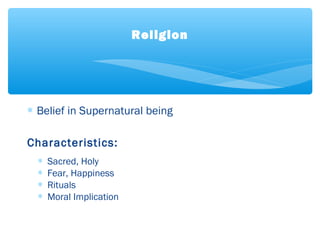
∗ Belief in Supernatural being
Characteristics:
∗ Sacred, Holy
∗ Fear, Happiness
∗ Rituals
∗ Moral Implication
Religion
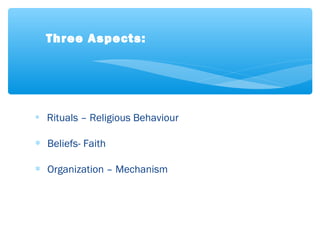
∗ Rituals – Religious Behaviour
∗ Beliefs- Faith
∗ Organization – Mechanism
Three Aspects:
∗ Discipline
∗ Integration
∗ Cohesive Function
∗ Social wellbeing
∗ Means of control
∗ Moral Standards
Functions:
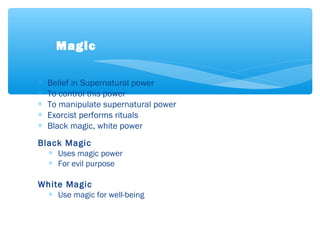
∗ Belief in Supernatural power
∗ To control this power
∗ To manipulate supernatural power
∗ Exorcist performs rituals
∗ Black magic, white power
Black Magic
∗ Uses magic power
∗ For evil purpose
White Magic
∗ Use magic for well-being
Magic
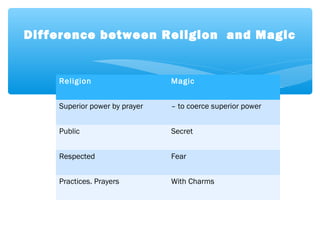
Religion Magic
Superior power by prayer – to coerce superior power
Public Secret
Respected Fear
Practices. Prayers With Charms
Difference between Religion and Magic
Magic
∗ Pseudo science (false science)
∗ Wrong assumption
∗ Deals with super natural
Science
∗ Cause, effect relationship
∗ Empirical facts
∗ Deals with natural
∗ Observation, experiment
Magic and Science
∗ Emerged from idea and soul
∗ All objects inhabited by spirits
∗ All activities caused by spirits
∗ Soul after death transmigrated
∗ These spirits worshipped
Theories of origin of Religion
∗ To control nature
∗ Powers to control nature superior
∗ Evolution in sequence
∗ Magic stage, religious stage, scientific stages
Naturalism by Max Muller
∗ Nature surprising
∗ This surprise led to worship
Magic by JG Frazer
∗ Belief – descended from them
∗ Totem– objects
∗ Collective representations
∗ Totem – treated as sacred
∗ Collective consciousness
∗ Ceremonies, rituals bind people
Totemism by Emile Durkheim
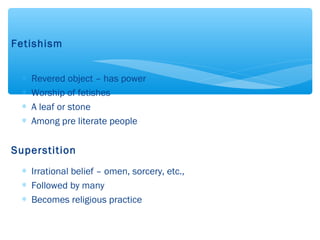
Fetishism
∗ Revered object – has power
∗ Worship of fetishes
∗ A leaf or stone
∗ Among pre literate people
Superstition
∗ Irrational belief – omen, sorcery, etc.,
∗ Followed by many
∗ Becomes religious practice
Christianity
∗ Christ as Prophet
∗ Monotheistic
∗ Faith in Jesus, service, love Neighbours
∗ Ten commandment's
Hinduism
∗ Dates back, thousands of year
∗ Polytheistic, several gods
∗ Dharma, Artha, Kama, Moksha
∗ Moksha [salvation]
∗ Four ashrams of life
Prominent Religions
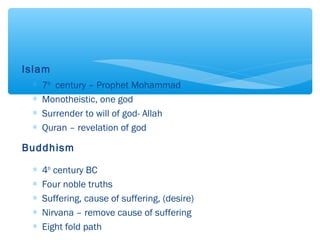
Islam
∗ 7th
century – Prophet Mohammad
∗ Monotheistic, one god
∗ Surrender to will of god- Allah
∗ Quran – revelation of god
Buddhism
∗ 4th
century BC
∗ Four noble truths
∗ Suffering, cause of suffering, (desire)
∗ Nirvana – remove cause of suffering
∗ Eight fold path
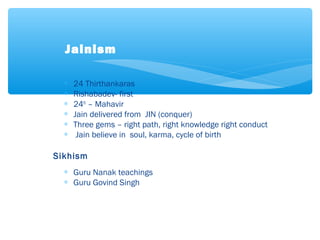
∗ 24 Thirthankaras
∗ Rishabadev- first
∗ 24th
– Mahavir
∗ Jain delivered from JIN (conquer)
∗ Three gems – right path, right knowledge right conduct
∗ Jain believe in soul, karma, cycle of birth
Sikhism
∗ Guru Nanak teachings
∗ Guru Govind Singh
Jainism
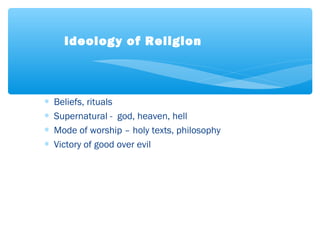
∗ Beliefs, rituals
∗ Supernatural - god, heaven, hell
∗ Mode of worship – holy texts, philosophy
∗ Victory of good over evil
Ideology of Religion
∗ Values of nationality
∗ Secularism
∗ Religion –undergone change
∗ Cause of strife
∗ Communal violence
∗ International terrorism
∗ Notorious activities
Modern society

Religion (Sociology)

  • 1.
  • 2.
    ∗ Belief inSupernatural being Characteristics: ∗ Sacred, Holy ∗ Fear, Happiness ∗ Rituals ∗ Moral Implication Religion
  • 3.
    ∗ Rituals –Religious Behaviour ∗ Beliefs- Faith ∗ Organization – Mechanism Three Aspects:
  • 4.
    ∗ Discipline ∗ Integration ∗Cohesive Function ∗ Social wellbeing ∗ Means of control ∗ Moral Standards Functions:
  • 5.
    ∗ Belief inSupernatural power ∗ To control this power ∗ To manipulate supernatural power ∗ Exorcist performs rituals ∗ Black magic, white power Black Magic ∗ Uses magic power ∗ For evil purpose White Magic ∗ Use magic for well-being Magic
  • 6.
    Religion Magic Superior powerby prayer – to coerce superior power Public Secret Respected Fear Practices. Prayers With Charms Difference between Religion and Magic
  • 7.
    Magic ∗ Pseudo science(false science) ∗ Wrong assumption ∗ Deals with super natural Science ∗ Cause, effect relationship ∗ Empirical facts ∗ Deals with natural ∗ Observation, experiment Magic and Science
  • 8.
    ∗ Emerged fromidea and soul ∗ All objects inhabited by spirits ∗ All activities caused by spirits ∗ Soul after death transmigrated ∗ These spirits worshipped Theories of origin of Religion
  • 9.
    ∗ To controlnature ∗ Powers to control nature superior ∗ Evolution in sequence ∗ Magic stage, religious stage, scientific stages Naturalism by Max Muller ∗ Nature surprising ∗ This surprise led to worship Magic by JG Frazer
  • 10.
    ∗ Belief –descended from them ∗ Totem– objects ∗ Collective representations ∗ Totem – treated as sacred ∗ Collective consciousness ∗ Ceremonies, rituals bind people Totemism by Emile Durkheim
  • 11.
    Fetishism ∗ Revered object– has power ∗ Worship of fetishes ∗ A leaf or stone ∗ Among pre literate people Superstition ∗ Irrational belief – omen, sorcery, etc., ∗ Followed by many ∗ Becomes religious practice
  • 12.
    Christianity ∗ Christ asProphet ∗ Monotheistic ∗ Faith in Jesus, service, love Neighbours ∗ Ten commandment's Hinduism ∗ Dates back, thousands of year ∗ Polytheistic, several gods ∗ Dharma, Artha, Kama, Moksha ∗ Moksha [salvation] ∗ Four ashrams of life Prominent Religions
  • 13.
    Islam ∗ 7th century –Prophet Mohammad ∗ Monotheistic, one god ∗ Surrender to will of god- Allah ∗ Quran – revelation of god Buddhism ∗ 4th century BC ∗ Four noble truths ∗ Suffering, cause of suffering, (desire) ∗ Nirvana – remove cause of suffering ∗ Eight fold path
  • 14.
    ∗ 24 Thirthankaras ∗Rishabadev- first ∗ 24th – Mahavir ∗ Jain delivered from JIN (conquer) ∗ Three gems – right path, right knowledge right conduct ∗ Jain believe in soul, karma, cycle of birth Sikhism ∗ Guru Nanak teachings ∗ Guru Govind Singh Jainism
  • 15.
    ∗ Beliefs, rituals ∗Supernatural - god, heaven, hell ∗ Mode of worship – holy texts, philosophy ∗ Victory of good over evil Ideology of Religion
  • 16.
    ∗ Values ofnationality ∗ Secularism ∗ Religion –undergone change ∗ Cause of strife ∗ Communal violence ∗ International terrorism ∗ Notorious activities Modern society