





















Creativity
for Agile Teams
Roger Brown
Mark Levison
Agile 2010
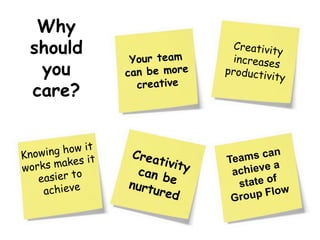
Why
should
you
care?
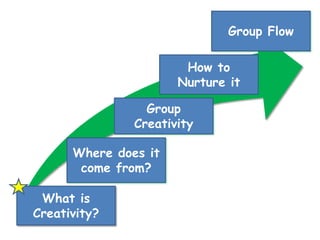
Group Flow
Group
Creativity
How to
Nurture it
Where does it
come from?
What is
Creativity?
•5
What is
Creativity?
Would you like to be more creative?
What is holding you back?
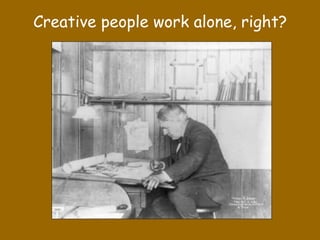
Creative people work alone, right?
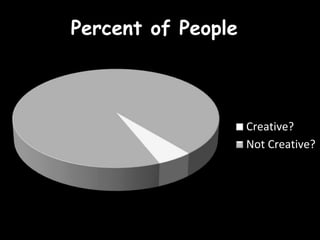
Percent of People
Creative?
Not Creative?
Time Pressure Helps?
Creativity is a
series of many
small insights
What defines a
creative idea?
You tell us…
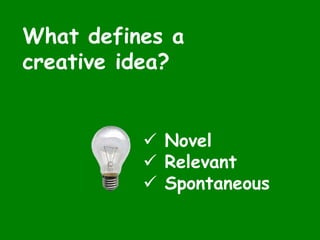
What defines a
creative idea?
 Novel
 Relevant
 Spontaneous
Have you ever
tried really
hard to be
creative?
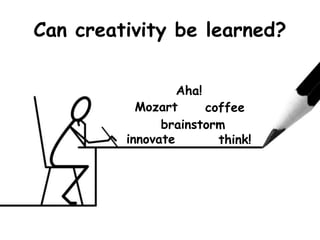
Can creativity be learned?
innovate
brainstorm
think!
Mozart coffee
Aha!
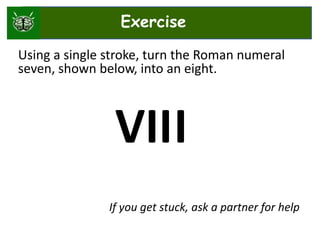
Using a single stroke, turn the Roman numeral
seven, shown below, into an eight.
VII
If you get stuck, ask a partner for help
I
Exercise
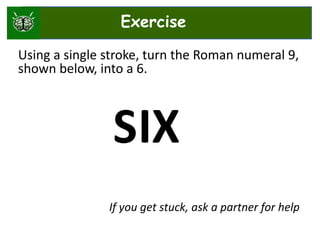
Using a single stroke, turn the Roman numeral 9,
shown below, into a 6.
IX
If you get stuck, ask a partner for help
S
Exercise
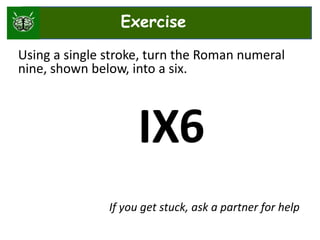
Using a single stroke, turn the Roman numeral
nine, shown below, into a six.
IX
If you get stuck, ask a partner for help
6
Exercise
•20
Creativity
and Your
Brain
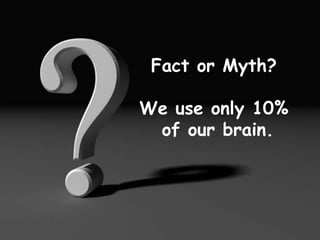
Fact or Myth?
We use only 10%
of our brain.
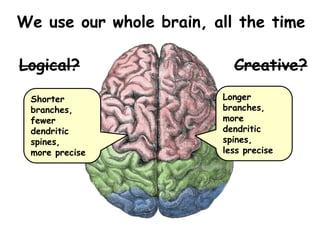
Logical? Creative?
We use our whole brain, all the time
Shorter
branches,
fewer
dendritic
spines,
more precise
Longer
branches,
more
dendritic
spines,
less precise
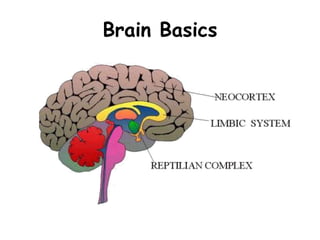
Brain Basics
Most “Thinking” is Subconscious
Test Drive
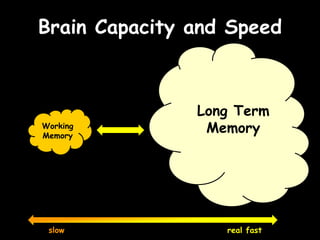
Brain Capacity and Speed
Working
Memory
Long Term
Memory
slow real fast
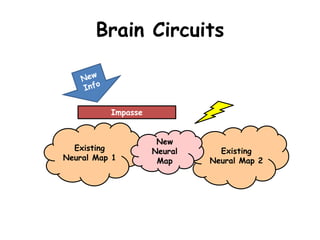
Brain Circuits
Existing
Neural Map 1
Existing
Neural Map 2
Impasse
New
Neural
Map
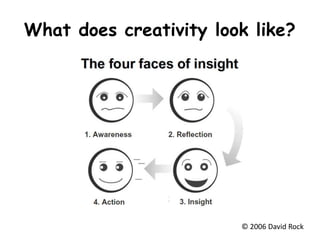
What does creativity look like?
© 2006 David Rock
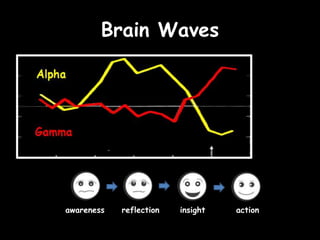
Brain Waves
awareness reflection insight action
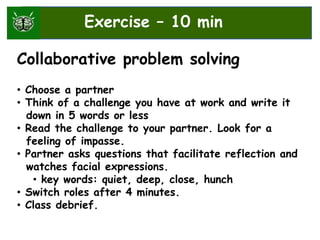
Exercise – 10 min
Collaborative problem solving
• Choose a partner
• Think of a challenge you have at work and write it
down in 5 words or less
• Read the challenge to your partner. Look for a
feeling of impasse.
• Partner asks questions that facilitate reflection and
watches facial expressions.
• key words: quiet, deep, close, hunch
• Switch roles after 4 minutes.
• Class debrief.
Exercise – 10 min
•45
What is
Creativity
Impediments to Creativity
You tell us…
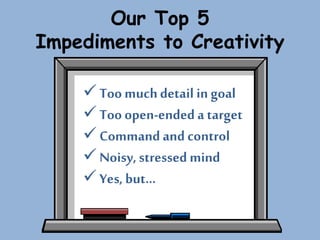
Our Top 5
Impediments to Creativity
Too muchdetail in goal
Too open-ended a target
Command and control
Noisy, stressed mind
Yes, but…
Emotional
Safety
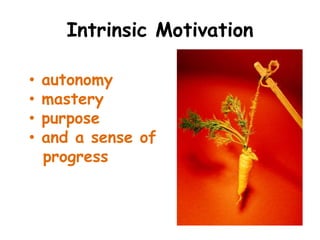
Intrinsic Motivation
• autonomy
• mastery
• purpose
• and a sense of
progress
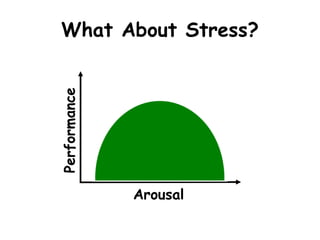
What About Stress?
Arousal
Performance
Creativity Toolbox
Prepare
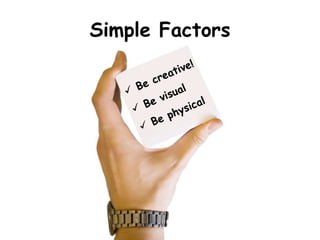
Simple Factors
Check Assumptions
Make it safe
to fail
Play
Quiet Mind
Appropriate Brainstorming
Expand Your Universe
o Engage outsiders
o Examine failures
o Remove predictability
•60
Group Flow
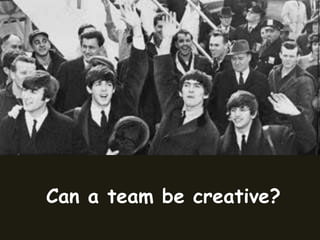
Can a team be creative?
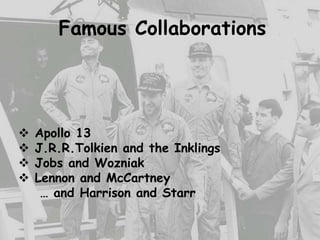
Famous Collaborations
 Apollo 13
 J.R.R.Tolkien and the Inklings
 Jobs and Wozniak
 Lennon and McCartney
… and Harrison and Starr
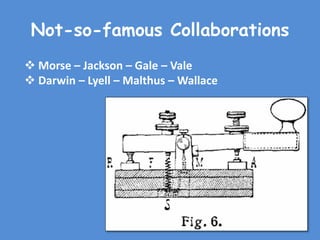
Not-so-famous Collaborations
 Morse – Jackson – Gale – Vale
 Darwin – Lyell – Malthus – Wallace
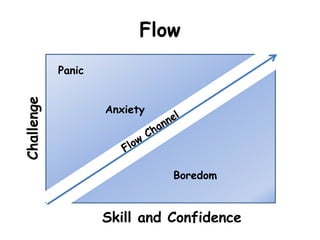
Flow
P
Challenge
Skill and Confidence
Panic
Anxiety
Boredom
Challenging
Group Goal
nasa hq photo
Deep Listening
Blending
Egos
Equal Participation
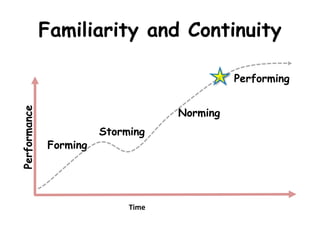
Familiarity and ContinuityPerformance
Forming
Storming
Norming
Performing
Time
Many Perspectives
 Innovation Games ™
 Six Hats
 Agile Games
•70
Your turn
• 3 min: Working in pairs, brainstorm 3 ways
that you can help your team to become more
creative.
• 3 min: As a group, filter the top 3 most interesting
ideas generated at your table.
• 3 min: Debrief
Exercise
•80
Why
should
you
care?
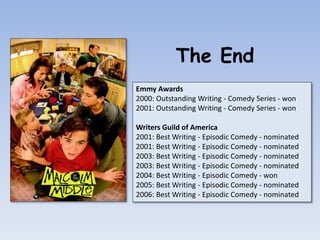
Emmy Awards
2000: Outstanding Writing - Comedy Series - won
2001: Outstanding Writing - Comedy Series - won
Writers Guild of America
2001: Best Writing - Episodic Comedy - nominated
2003: Best Writing - Episodic Comedy - nominated
2004: Best Writing - Episodic Comedy - won
2005: Best Writing - Episodic Comedy - nominated
2006: Best Writing - Episodic Comedy - nominated
The End
Roger Brown , Moonrise Consulting
roger@moonriseconsulting.com, @rwbrown
Mark Levison, Agile Pain Relief Consulting
mark@agilepainrelief.com, @mlevison

Creativity for Agile Teams

Editor's Notes

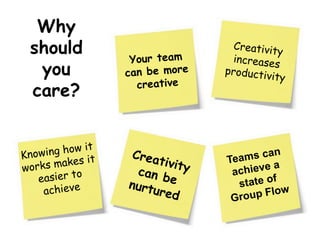
  • #2 Our key point: Your team can be more creative Why do you care? Creativity increases productivity Main takeaway: How creativity works and how you nurture it on your team
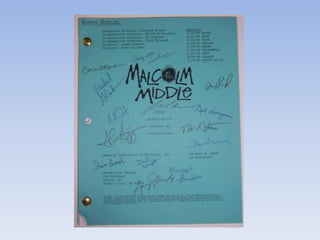
  • #3 In 2000 my daughter worked as an intern on the TV show Malcolm in the Middle. Her job was to pamper the writing team. Their job was to create a script for each week’s show. They had 5 days to come up with and write 30 minutes of irreverent, award-winning comedy. The bar was set high from before Day One. The script for the pilot won an Emmy award. The writers had their own work room. It had what you might expect – a conference table and chairs, a small kitchen setup. It also had a deep pile of brightly colored carpets, bean bag chairs and boxes full of toys. The refrigerator had some unusual items in it at all times. My daughter’s job was to fetch whatever manner of consumable any writer desired – lunch from a special restaurant, 20 year Scotch, Korean Tacos from the truck near Dodger Stadium. They were pampered because they had to be creative on a deadline. Do you pamper your Agile teams like this? Likely not. But then they have a little more leeway in getting their work done – two weeks and a variable scope based on proven velocity. Do Agile teams need to be creative? Their goal is less open-ended than comedy writers but creativity is a great attribute for getting product down well. A successful team is going to be creative. The ideal Agile work environment is conducive to creativity – shared space, close collaboration, charts on the wall, good tools, clear goals. A team that does not feel creative is a team in need of a tune-up. Are their ways to promote, nurture and enhance creativity in Agile Teams? That is what we are going to explore.
  • #4 Our key point: Your team can be more creative Why do you care? Creativity increases productivity Main takeaway: How does creativity work and how can you nurture it on your team
  • #8 Would you like to be more creative?
  • #9 Ask the audience. Prime if needed with Lack of talent? Lack of imagination? Lack of motivation? No time? Culture? Upbringing?
  • #12 Anyone can be creative given the right conditions.
  • #14 Are you right-brained or left-brained creative or logical
  • #15 Marks close – small bits
  • #17 According to Teresa Amabile, 1983
  • #18 Problem Solving Refinement of Product and Process Invention and Innovation
  • #19 How well di ti work for you? We overuse the wrong parts of our brains. It is better to create the right conditions for creativity.
  • #20 Or is nurturing our innate abilities a better approach?
  • #21 Find at http://www.directedcreativity.com/pages/WPModels.html? While there are many models for the process of creative thinking, it is not difficult to see the consistent themes that span them all.   The creative process involves purposeful analysis, imaginative idea generation, and critical evaluation -- the total creative process is a balance of imagination and analysis. Older models tend to imply that creative ideas result from subconscious processes, largely outside the control of the thinker. Modern models tend to imply purposeful generation of new ideas, under the direct control of the thinker. The total creative process requires a drive to action and the implementation of ideas. We must do more than simply imagine new things, we must work to make them concrete realities.   Or recipes: analytical prep insight test
  • #22 This one is easy. Our pre-frontal cortex can handle it with little access to long term memory. From http://web.mit.edu/2.009/www/lectures/2_projectAndCreativity.pdf
  • #23 This one requires a shift into language networks to find a match.
  • #24 This one requires a shift from the previous two into a mathematical solution.
  • #28 We use our whole brain all the time
  • #29 Our brains have 3 general parts based on evolutionary progress. - Old Brain (reptilian, autonomic, survival) - Mid Brain (mammalian, limbic, emotion) - New Brain (neocortex, language, speech, music, reasoning, thinking)
  • #30 Beeman 2004: 40% of word puzzles were solved using logical process. 60% were spontaneous insight (no logical progression) The greater part of our brain us used for subconscious thought, which is faster. There is much more capacity, too.
  • #31 The Fedex Logo has a symbol embedded in it that suggests forward motion. If you do not see the symbol, note your emotional state while you look for it. If you know where that symbol is, keep the answer to your self while you watch others around you hunt for it. Look for changes in their faces. After 1 minute, give this clue: “White space is not always empty.”
  • #32 Working memory is limited in capacity and processing is slow due to complexity and energy demand of the neocortex. Long term memory is vastly larger and information is compressed and coded, allowing for faster access and searching. The hippocampus is the brain organ that manages movement of information between the two types of memory.
  • #33 What is happening in the neural circuits. New information does not fit into old maps. An impasse occurs.
  • #34 1. Awareness of a dilemma – a problem to be solved, we show concern. We are stuck. 2. Reflection – staring into space while watching internal processes. Outer world has gone dim so unconscious can go to work. 3. Insight – “aha!” A new connection has been made between our existing networks that can accommodate the dilemma 4. Action – Energy rises and we want to do something about the problem.
  • #36 How does it work? By explaining the challenge in words, the language and speech processing centers of our brains are activated, bringing more neural maps into use. Rock p 84 introduces, p 213 gives the techniques. Reduction of problem clears neocortex. Listener asks questions that lead to reflection. If you stop and think deeply, do you think you know what you need to do to resolve this? What quiet hunches do you have about a resolution, deeper inside? How close to a solution are you? Which pathway to a solution would be best to follow?
  • #39 Facilitate the audience to identify some. Here are some to look for: Smart Guy and follower syndrome Know-it-all Silos Brainstorming Group think Critical thinking More Physical: poor health or diet Personality: cynicism, critical outlook, pessimism, conservative, controlling Emotional: fear, lack of faith Group: distrust, disagreement, disrupted flow, conflict Perspective: rigid, narrow, controlled, logical Environmental: time pressure, external reward http://www.sxc.hu/browse.phtml?f=download&id=1055944
  • #42 For the individual. Relates to Rock’s SCARF for group movitation.
  • #43 Eustress = good stress. The prefrontal cortex needs just the right amount of stress to be at peek performance. That means the right balance of dopamine and norepenephrine (noradrenaline).
  • #45 Relax One type of creativity can spark others Remember a related experience Ask questions View, touch related objects Do something simple to warm up http://www.sxc.hu/browse.phtml?f=download&id=1290120
  • #46 Be visual Be physical Be creative
  • #47 R: What a cute doggy. R: Mark, does your dog bite? M: No, he is pretty mellow. R: Hi doggy. D: Rowf R: Ouch. I thought you said your dog didn’t bite? M: That’s not my dog. Morale: the solution space may be different from what you assume. Avoid lightpost effect
  • #50 Let your subconscious do the heavy lifting. And sleep (Make sleep explicit?) for integration. Ohlsson in Rock p 79 says to deliberately do something else to stop conscious processing at impasse. Zimmer: When your mind wanders, the brain’s default network (self referential thought) is working with its executive control system (prefrontal cortex) to reach distant goals. New ideas may emerge and be surprising.
  • #51 http://www.sxc.hu/browse.phtml?f=download&id=1090146 Right kinds of topics (not assembly or silo tasks) Better for evaluating than for creating ideas Use proven patterns Have a structure facilitate pairing works well free-form with no judgement focus on quantity filter
  • #52 Engage people from other domains to help see patterns and results that you cannot see due to familiarity. We edit reality to match what we already know and believe. New people in new environments Lehrer – Wired 1/10 The Neuroscience of Screwing Up http://www.sxc.hu/browse.phtml?f=download&id=1024026
  • #53 This one is easy. Our pre-frontal cortex can handle it with little access to long term memory. From http://web.mit.edu/2.009/www/lectures/2_projectAndCreativity.pdf
  • #57 http://commons.wikimedia.org/wiki/File:Apollo_13_Mailbox_at_Mission_Control.jpg
  • #58 Wright Brothers were not the first Fulton was not the first Edison was not the first Ford was not the first Darwin…
  • #59 Flow for individuals is defined by Mihaly Csikszentmihalyi (Cheek-sent-me-high) in Flow: The Psychology of Peak Performance Characteristics: Energizing engaging use your strengths do something slightly out of the ordinary many new but safe neural connections are made major driver of happiness happiness -> neurotransmitters -> right balance –> cycles It is described for groups in Group Creativity by Keith Sawyer
  • #60 Common, agreed-upon goal Enables focus so one can know if we are approaching a solution Basketball (clear goal) vs. Jazz/improv (create good performance) Clear objectives, problem-solving or “innovate”, problem-finding goal (post-it, Elixir strings)
  • #61  quiet, open, curious, receptive mind focused but not stressed jazz metaphor not defensive, intrusive, argumentative
  • #62 All members in sync Whole is greater than sum of parts Ideas build on each other
  • #63 Equivalent skill levels No one in charge
  • #64 Know other members strengths and weaknesses All share tacit knowledge (music, rule of improv, domain, tools) Plus conventions, customs and unwritten rules
  • #65 http://www.sxc.hu/browse.phtml?f=download&id=1284819
  • #75  Which things can benefit Diversity Appropriate skills and knowledge
  • #77 Idling Emergence
  • #81 Perception and imagination use the same neural circuits. Creativity and imagination begin with perception. The ability to imagine outside of common categories will open you up to new possibilities. Berns – Fast Company 2/15/2010
  • #82 Brains respond favorably to novelty. Dopamine is released, neural paths are reinforced, we fell good. Novelty can come from external perception or internal imagination.
  • #83 Using a single stroke… Make VII into an eight Make IX into a 6 Make IX into a 6 another way If you get stuck, ask a partner for help Using a single stroke, turn the Roman numeral seven, shown below, into an eight.