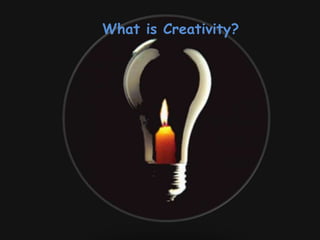
What is Creativity?
Can you define Creativity?Would you know creativity if you saw it?
Defining Creativity:
cre⋅a⋅tiv⋅i⋅ty [  [kree-ey-tiv-i-tee, kree-uh-]–noun 1. the state or quality of being creative. 2. the ability to transcend traditional ideas, rules, patterns, relationships, or the like, and to create meaningful new ideas, forms, methods, interpretations, etc.; originality, progressiveness, or imagination: the need for creativity in modern industry; creativity in the performing arts. 3. the process by which one utilizes creative ability: Extensive reading stimulated his creativity (Dictionary.com Unabridged).
Some Definitions of Creativity according to Dorothy Leonard-Barton and Walter C. Swap, the writers of When Sparks Fly: Igniting Creativity in Groups“Creativity is that process which results in a novel work that is accepted as tenable or useful for satisfying by a group at some point in time.”“A product or response will be judged as creative to the extent that (a) it is both a novel and appropriate, useful, correct or valuable response to the task at hand, and (b) the task is heuristic [not having a clear and readily identifiable path to solution] rather than algorithmic [the path to the solution is clear and straightforward].”“A company is creative when its employees do something new and potentially useful without being directly shown or taught.”“Creativity is…the production of something that is both new and truly valuable.”	“Creativity…involves a process that is extended in time and characterized by originality, adaptiveness, and realization.” Note, each has a distinctive spin on the concept of creativity, all agree that creativity is a process, that it involves the generation of something novel and unusual, and that the outcome of the process is something useful  (Leonard-Barton & Swap, 1999, p. 8).
Why Study Creativity in Teams?Because:
“Innovation distinguishes between a leader and a follower.”Steve JobsIt's not just the product: Apple CEO Steve Jobs and other top corporate executives around the country are successful because of their passion and their great communication skills, writes BusinessWeek's Carmine Gallo.
The opposite of creativity is cynicism. -- Esa Saarinencynicism (countable and uncountable; plural cynicisms)(uncountable) a skeptical, scornful or pessimistic attitude.(uncountable) an emotion of jaded negativity, or a general distrust of the integrity or professed motives of other people. Cynicism can manifest itself by frustration, disillusionment and distrust in regard to organizations, authorities and other aspects of society, often due to previous bad experience. Cynics often view others as motivated solely by disguised self-interest.(countable) a skeptical, scornful or pessimistic comment or act  (Wiktionary, October 2009).
Why Study Creativity in Teams?Because:  People who are trained in creativity are truly more creative!
Overcoming Barriers to Group and Team Creativityand Making Collective Sparks Fly
We have all heard the old adage "two heads are better than one.”  When it comes to generating creative ideas which spark innovation and problem solving, two heads are better than one. 
But first, barriers must be removed.  Realizing the potential of group creativity is the key to a successful organization.  Many organizations stifle creativity by creating an environment unfavorable to the creative process.  Some of these barriers are:
*Making unreasonable demandsOrganizations that demand performance based on time restricted goals and value not wasting time are placing creative barriers on their employees. It can be difficult to produce under pressure.
*Creating a culture where people are fearful   of making a mistakeOne barrier to creativity an organization can make is playing it safe, where taking risks is viewed as risky business.  A more creative way of thinking would be "nothing ventured, nothing gained".
*Inflexible work rulesOrganizations often stifle creative activity with rigid work rules and harboring of employer-employee tensions.  No one can easily spark creative thinking under a strained atmosphere.  Organizations with happy and motivated employees are creative think tanks.
*Not being open to change	Thinking there is only one way to solve a problem.  Sticking with the standard mode of operation limits the possibility of innovation.  
*A Sterile WorkplaceBoring, dull, lifeless work environments do not stimulate the creative mind.  Stimulating, inviting workplaces motivate people to be innovative and creative.
Techniques of CommunicationThere are five main creative techniques used in the small group communication process1st is Brainstorming2nd is Nominal-Group Technique3rd is Delphi Technique4th is Electronic Brainstorming5th is The Affinity Technique
Brainstorming TechniqueBrainstorming is a process to develop solutions to problemsSome steps to Brainstorming include:Including a wide range of people so different points of view are includedWrite down the problem at handWrite down all possible solutionsDo not  evaluate any solutions till process is completedOnce all solutions are created evaluate list and determine best choice
The Nominal Group TechniqueAllow people to individually  brainstorm for solutions to the problemThen as a group collect all possible solutionsHave each person then individually rank the solutions in order of what they think is bestNext compare all rankings to decide what the group thinks is bestLastly allow discussion within the group about the solutions
The Delphi TechniqueThe Delphi Technique involves three stepsThesisAntithesisSynthesisIn thesis and antithesis everyone present gives their opinion and establishes their views and opposing views During the synthesis process opposing views and accepted views are brought together to form a new thesis
Electronic Brainstorming Electronic Brainstorming employs a software that collects employees ideas and shares them with other group members to accomplish a goal faster and without face to face communication However a drawback of this technique is that solutions can not be discussed in as timely a manner as face to face interaction
The Affinity TechniqueFirst have each individual write their solutions to the problem on individual cardsNext order the cards into groups by “affinity” or categoriesOnce the cards are grouped into categories then come up with a central idea from the cards
CREATIVEofBE

Enhancing Creativity1

  • 1.
  • 2.
    Can you defineCreativity?Would you know creativity if you saw it?
  • 3.
  • 4.
    cre⋅a⋅tiv⋅i⋅ty [ [kree-ey-tiv-i-tee, kree-uh-]–noun 1. the state or quality of being creative. 2. the ability to transcend traditional ideas, rules, patterns, relationships, or the like, and to create meaningful new ideas, forms, methods, interpretations, etc.; originality, progressiveness, or imagination: the need for creativity in modern industry; creativity in the performing arts. 3. the process by which one utilizes creative ability: Extensive reading stimulated his creativity (Dictionary.com Unabridged).
  • 5.
    Some Definitions ofCreativity according to Dorothy Leonard-Barton and Walter C. Swap, the writers of When Sparks Fly: Igniting Creativity in Groups“Creativity is that process which results in a novel work that is accepted as tenable or useful for satisfying by a group at some point in time.”“A product or response will be judged as creative to the extent that (a) it is both a novel and appropriate, useful, correct or valuable response to the task at hand, and (b) the task is heuristic [not having a clear and readily identifiable path to solution] rather than algorithmic [the path to the solution is clear and straightforward].”“A company is creative when its employees do something new and potentially useful without being directly shown or taught.”“Creativity is…the production of something that is both new and truly valuable.” “Creativity…involves a process that is extended in time and characterized by originality, adaptiveness, and realization.” Note, each has a distinctive spin on the concept of creativity, all agree that creativity is a process, that it involves the generation of something novel and unusual, and that the outcome of the process is something useful (Leonard-Barton & Swap, 1999, p. 8).
  • 6.
    Why Study Creativityin Teams?Because:
  • 7.
    “Innovation distinguishes betweena leader and a follower.”Steve JobsIt's not just the product: Apple CEO Steve Jobs and other top corporate executives around the country are successful because of their passion and their great communication skills, writes BusinessWeek's Carmine Gallo.
  • 8.
    The opposite ofcreativity is cynicism. -- Esa Saarinencynicism (countable and uncountable; plural cynicisms)(uncountable) a skeptical, scornful or pessimistic attitude.(uncountable) an emotion of jaded negativity, or a general distrust of the integrity or professed motives of other people. Cynicism can manifest itself by frustration, disillusionment and distrust in regard to organizations, authorities and other aspects of society, often due to previous bad experience. Cynics often view others as motivated solely by disguised self-interest.(countable) a skeptical, scornful or pessimistic comment or act (Wiktionary, October 2009).
  • 9.
    Why Study Creativityin Teams?Because: People who are trained in creativity are truly more creative!
  • 10.
    Overcoming Barriers toGroup and Team Creativityand Making Collective Sparks Fly
  • 12.
    We have allheard the old adage "two heads are better than one.”  When it comes to generating creative ideas which spark innovation and problem solving, two heads are better than one. 
  • 13.
    But first, barriersmust be removed.  Realizing the potential of group creativity is the key to a successful organization.  Many organizations stifle creativity by creating an environment unfavorable to the creative process.  Some of these barriers are:
  • 14.
    *Making unreasonable demandsOrganizationsthat demand performance based on time restricted goals and value not wasting time are placing creative barriers on their employees. It can be difficult to produce under pressure.
  • 15.
    *Creating a culturewhere people are fearful of making a mistakeOne barrier to creativity an organization can make is playing it safe, where taking risks is viewed as risky business.  A more creative way of thinking would be "nothing ventured, nothing gained".
  • 16.
    *Inflexible work rulesOrganizationsoften stifle creative activity with rigid work rules and harboring of employer-employee tensions.  No one can easily spark creative thinking under a strained atmosphere.  Organizations with happy and motivated employees are creative think tanks.
  • 17.
    *Not being opento change Thinking there is only one way to solve a problem.  Sticking with the standard mode of operation limits the possibility of innovation.  
  • 18.
    *A Sterile WorkplaceBoring,dull, lifeless work environments do not stimulate the creative mind.  Stimulating, inviting workplaces motivate people to be innovative and creative.
  • 19.
    Techniques of CommunicationThereare five main creative techniques used in the small group communication process1st is Brainstorming2nd is Nominal-Group Technique3rd is Delphi Technique4th is Electronic Brainstorming5th is The Affinity Technique
  • 20.
    Brainstorming TechniqueBrainstorming isa process to develop solutions to problemsSome steps to Brainstorming include:Including a wide range of people so different points of view are includedWrite down the problem at handWrite down all possible solutionsDo not evaluate any solutions till process is completedOnce all solutions are created evaluate list and determine best choice
  • 21.
    The Nominal GroupTechniqueAllow people to individually brainstorm for solutions to the problemThen as a group collect all possible solutionsHave each person then individually rank the solutions in order of what they think is bestNext compare all rankings to decide what the group thinks is bestLastly allow discussion within the group about the solutions
  • 22.
    The Delphi TechniqueTheDelphi Technique involves three stepsThesisAntithesisSynthesisIn thesis and antithesis everyone present gives their opinion and establishes their views and opposing views During the synthesis process opposing views and accepted views are brought together to form a new thesis
  • 23.
    Electronic Brainstorming ElectronicBrainstorming employs a software that collects employees ideas and shares them with other group members to accomplish a goal faster and without face to face communication However a drawback of this technique is that solutions can not be discussed in as timely a manner as face to face interaction
  • 24.
    The Affinity TechniqueFirsthave each individual write their solutions to the problem on individual cardsNext order the cards into groups by “affinity” or categoriesOnce the cards are grouped into categories then come up with a central idea from the cards
  • 25.

Editor's Notes

  • #6 creativity. (n.d.). Dictionary.com Unabridged (v 1.1). Retrieved September 28, 2009, from Dictionary.com website: http://dictionary.reference.com/browse/creativity
  • #9 http://en.wiktionary.org/wiki/cynicism 24 October 2009