Creative and Participatory
Transcultural Practices and Problem Solving
Through Game Design and Computational Thinking
NEWTON UK-SEA (AHRC – MoHE)
Kuching, Malaysia
7th -18th August 2017
Overarching aim
• To introduce Game-Based Learning (GBL) – The USE of GBL
resources for teaching and learning
• Provide GBL resources for students and teachers to explore at their local lab/hub
also in the online hub (downloadable tools, etc.)
• To use Game Design Process - as a Learning and Teaching tool
• Provide series of workshops for introducing the approach
• Guide local champions to personalise the process (localisation)
Objective 1
To collaboratively:
• develop a game design and computational thinking programme (CreativeCulture Lab)
• that will make game design and development accessible to teachers and students,
• promoting transcultural and trans-disciplinary 'learning by designing’
Key deliverables:
• Adaptable/adoptable CreativeCulture Lab blueprint and toolkits to be developed and
validated,
• Ambassadors/champions from the pilot locations to be identified and trained and
• an online Hub that will host the CreativeCulture resources (tools, case studies, game-
based outcomes from the community) to be developed.
Objective 2
To design and implement participatory studies, involving the local, rural and indigenous
communities in Malaysian Borneo (learners and teachers). 2 stages:
• Mock up a lab that will involve a small number of participants, which will inform…
• The final pilot participatory study in the different sites in Sarawak, involving larger
number of stakeholders and participants.
Key deliverables:
• CreativeCulture Lab to be carried out as an extra-curricular at the telecentres,
• Feasibility studies carried out to inform the larger scale deployment in stage 2.
Objective 3
To facilitate, capture and evaluate
• experience,
• learning outcomes and
• transferability of the creative approach towards refining the adaptable CreativeCulture
blueprints
Key deliverables:
• Analysis of lessons learnt and
• Finalised CreativeCulture Lab blueprint(s) for adoption and adaptation.
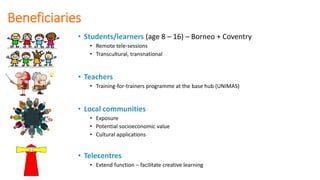
Beneficiaries
• Students/learners (age 8 – 16) – Borneo + Coventry
• Remote tele-sessions
• Transcultural, transnational
• Teachers
• Training-for-trainers programme at the base hub (UNIMAS)
• Local communities
• Exposure
• Potential socioeconomic value
• Cultural applications
• Telecentres
• Extend function – facilitate creative learning
Aim for these 2 weeks
• Develop and finalise programme blueprint
• Unimas team – onboarding champions, trainers, etc.
• Local schools/programme – what to run, lab, etc.
• Explore content of programme
• Remix play approach
• Lego landscape approach
• Capture evidence of others already practicing play and games in teaching
• Website/hub - myCapsule
• Etc…
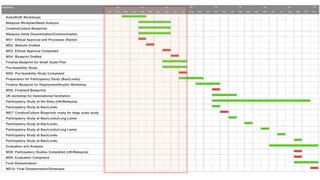
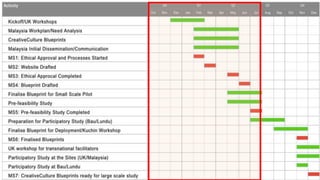
• Strategise way forward - timeline
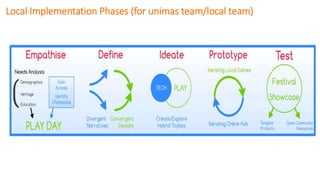
Local Implementation Phases (for unimas team/local team)
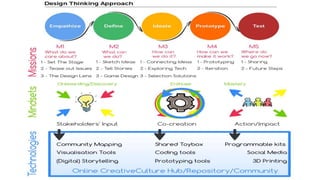
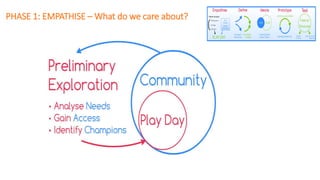
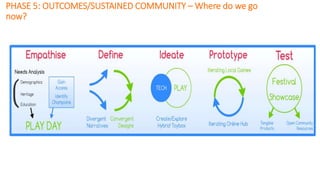
PHASE 1: EMPATHISE – What do we care about?
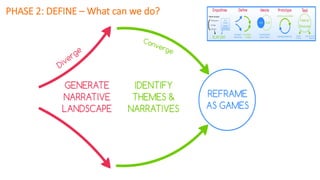
PHASE 2: DEFINE – What can we do?
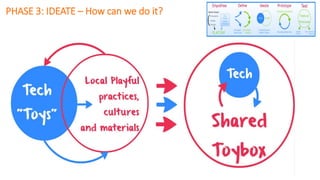
PHASE 3: IDEATE – How can we do it?
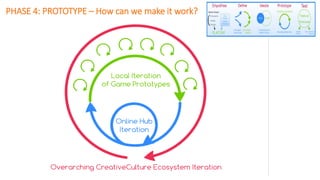
PHASE 4: PROTOTYPE – How can we make it work?
PHASE 5: OUTCOMES/SUSTAINED COMMUNITY – Where do we go
now?
Tools
• Remixing play approach (create games inspired by simple play)
• Lego – using tangible bricks to represent ideas/culture/STEM
• What is your story? Cards – to get learners to be creative in story
telling (can be used for language learning, team playing, etc.)
• Lego Mindstorm – computational thinking and robotics (can
reuse Lego STEM education guidelines)
• Rasberry Pii – computational thinking
• Free game authoring – e.g. constructs, etc.
Lego landscape
1. Build a landscape to represent a village (literal), a futuristic
village, cultural artefacts, etc. (each member can create his/her
own favourite representation/artefact)
2. Create a story around this landscape (group story)
3. Create a pathway based on the story
4. Use Lego Mindstorm to visit each location
5. Narrate the journey (video, etc.)
6. This can be used for different themes
7. Landscape and legomindstorm programme can be shared with
other schools (Malaysia, UK)
Remixing gameplay
1. Pick a theme/topic for the groups to address
2. Pick favourite games – understand those games, play them, deconstruct
their mechanics/rules
3. How can we use these game(s) to teach/address the specific
theme/topic
4. Create a new game/solution based on those games
5. Iteratively test and refine the game (paper-based prototype
6. Share the games with others
7. Use existing tools (can be physical, card, board, digital) to prototype
8. Play festival/showcase (also including exchanging games with UK)
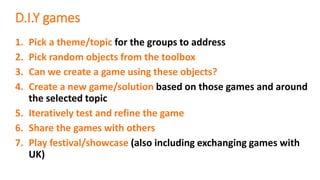
D.I.Y games
1. Pick a theme/topic for the groups to address
2. Pick random objects from the toolbox
3. Can we create a game using these objects?
4. Create a new game/solution based on those games and around
the selected topic
5. Iteratively test and refine the game
6. Share the games with others
7. Play festival/showcase (also including exchanging games with
UK)

Creativeculture updates

  • 1.
    Creative and Participatory TransculturalPractices and Problem Solving Through Game Design and Computational Thinking NEWTON UK-SEA (AHRC – MoHE) Kuching, Malaysia 7th -18th August 2017
  • 2.
    Overarching aim • Tointroduce Game-Based Learning (GBL) – The USE of GBL resources for teaching and learning • Provide GBL resources for students and teachers to explore at their local lab/hub also in the online hub (downloadable tools, etc.) • To use Game Design Process - as a Learning and Teaching tool • Provide series of workshops for introducing the approach • Guide local champions to personalise the process (localisation)
  • 3.
    Objective 1 To collaboratively: •develop a game design and computational thinking programme (CreativeCulture Lab) • that will make game design and development accessible to teachers and students, • promoting transcultural and trans-disciplinary 'learning by designing’ Key deliverables: • Adaptable/adoptable CreativeCulture Lab blueprint and toolkits to be developed and validated, • Ambassadors/champions from the pilot locations to be identified and trained and • an online Hub that will host the CreativeCulture resources (tools, case studies, game- based outcomes from the community) to be developed.
  • 4.
    Objective 2 To designand implement participatory studies, involving the local, rural and indigenous communities in Malaysian Borneo (learners and teachers). 2 stages: • Mock up a lab that will involve a small number of participants, which will inform… • The final pilot participatory study in the different sites in Sarawak, involving larger number of stakeholders and participants. Key deliverables: • CreativeCulture Lab to be carried out as an extra-curricular at the telecentres, • Feasibility studies carried out to inform the larger scale deployment in stage 2.
  • 5.
    Objective 3 To facilitate,capture and evaluate • experience, • learning outcomes and • transferability of the creative approach towards refining the adaptable CreativeCulture blueprints Key deliverables: • Analysis of lessons learnt and • Finalised CreativeCulture Lab blueprint(s) for adoption and adaptation.
  • 6.
    Beneficiaries • Students/learners (age8 – 16) – Borneo + Coventry • Remote tele-sessions • Transcultural, transnational • Teachers • Training-for-trainers programme at the base hub (UNIMAS) • Local communities • Exposure • Potential socioeconomic value • Cultural applications • Telecentres • Extend function – facilitate creative learning
  • 9.
    Aim for these2 weeks • Develop and finalise programme blueprint • Unimas team – onboarding champions, trainers, etc. • Local schools/programme – what to run, lab, etc. • Explore content of programme • Remix play approach • Lego landscape approach • Capture evidence of others already practicing play and games in teaching • Website/hub - myCapsule • Etc… • Strategise way forward - timeline
  • 12.
    Local Implementation Phases(for unimas team/local team)
  • 13.
    PHASE 1: EMPATHISE– What do we care about?
  • 14.
    PHASE 2: DEFINE– What can we do?
  • 15.
    PHASE 3: IDEATE– How can we do it?
  • 16.
    PHASE 4: PROTOTYPE– How can we make it work?
  • 17.
    PHASE 5: OUTCOMES/SUSTAINEDCOMMUNITY – Where do we go now?
  • 18.
    Tools • Remixing playapproach (create games inspired by simple play) • Lego – using tangible bricks to represent ideas/culture/STEM • What is your story? Cards – to get learners to be creative in story telling (can be used for language learning, team playing, etc.) • Lego Mindstorm – computational thinking and robotics (can reuse Lego STEM education guidelines) • Rasberry Pii – computational thinking • Free game authoring – e.g. constructs, etc.
  • 19.
    Lego landscape 1. Builda landscape to represent a village (literal), a futuristic village, cultural artefacts, etc. (each member can create his/her own favourite representation/artefact) 2. Create a story around this landscape (group story) 3. Create a pathway based on the story 4. Use Lego Mindstorm to visit each location 5. Narrate the journey (video, etc.) 6. This can be used for different themes 7. Landscape and legomindstorm programme can be shared with other schools (Malaysia, UK)
  • 20.
    Remixing gameplay 1. Picka theme/topic for the groups to address 2. Pick favourite games – understand those games, play them, deconstruct their mechanics/rules 3. How can we use these game(s) to teach/address the specific theme/topic 4. Create a new game/solution based on those games 5. Iteratively test and refine the game (paper-based prototype 6. Share the games with others 7. Use existing tools (can be physical, card, board, digital) to prototype 8. Play festival/showcase (also including exchanging games with UK)
  • 21.
    D.I.Y games 1. Picka theme/topic for the groups to address 2. Pick random objects from the toolbox 3. Can we create a game using these objects? 4. Create a new game/solution based on those games and around the selected topic 5. Iteratively test and refine the game 6. Share the games with others 7. Play festival/showcase (also including exchanging games with UK)

Editor's Notes