Gamification in Museums?
Play | Your | Future
Jacey-Lynn Minoi, PhD
@jlminoi #gamification #creativeculture
We do not stop playing because we grow old
We grow old because we stop playing
Play is unique because it produces benefits than span
multiple functional domains including: emotional, mental
and social.
It involves a voluntary activity – imaginary
Disruptions and Opportunities
Creativity is intelligence having fun
-Einstein-
… a great idea stems from something that
already exists…
http://chronicle.com/article/The-Looming-Gamification-of/233992
Design Experience inspired by PLAY
(Amy Jo Kim, MFW15)
Inspirations: Escape rooms, problem-based learning
Remix Play – Flash Game
Activity: Flash cards for onboarding into the remix play
process
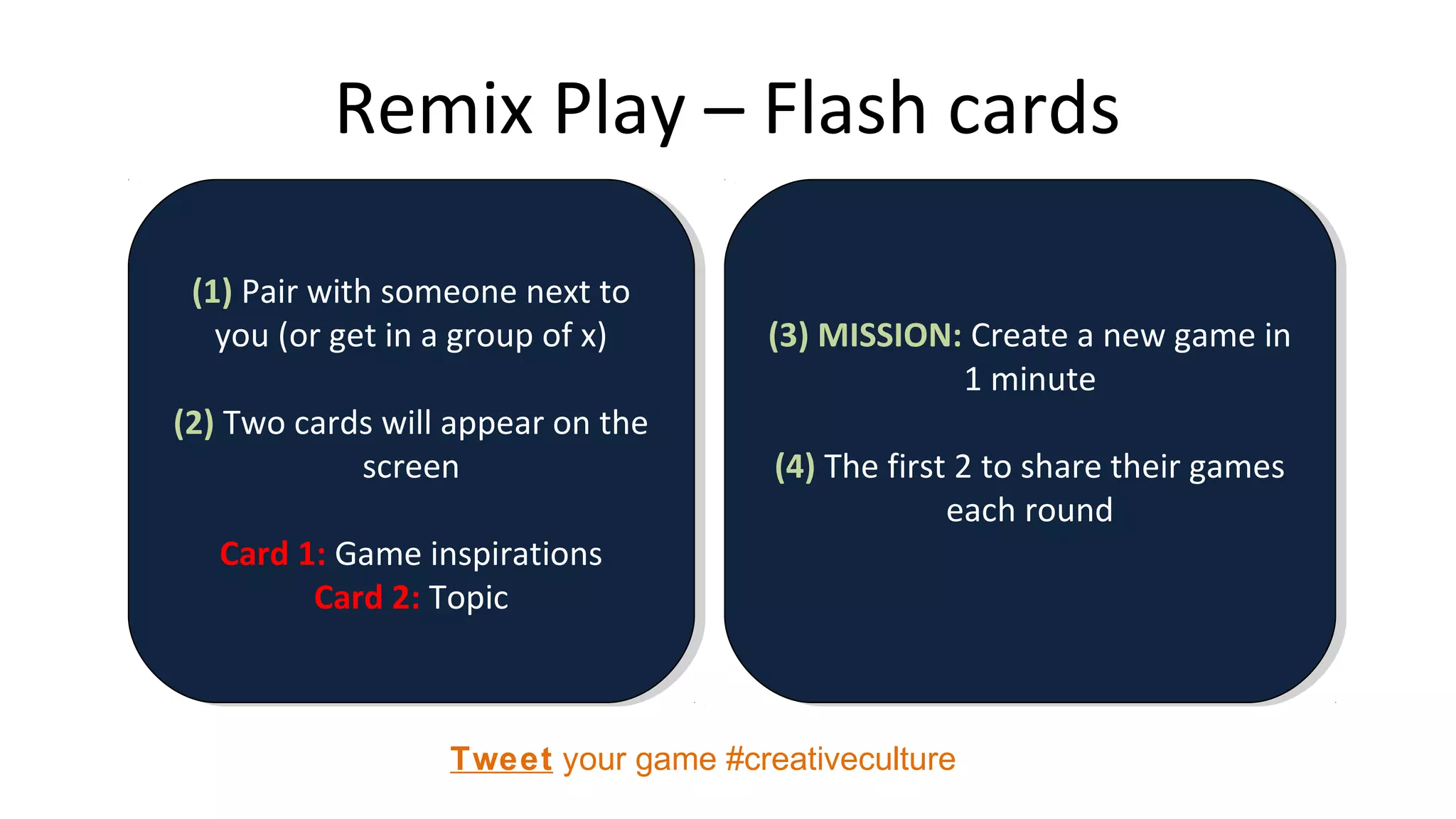
Remix Play – Flash cards
(1) Pair with someone next to
you (or get in a group of x)
(2) Two cards will appear on the
screen
Card 1: Game inspirations
Card 2: Topic
(1) Pair with someone next to
you (or get in a group of x)
(2) Two cards will appear on the
screen
Card 1: Game inspirations
Card 2: Topic
(3) MISSION: Create a new game in
1 minute
(4) The first 2 to share their games
each round
(3) MISSION: Create a new game in
1 minute
(4) The first 2 to share their games
each round
Tweet your game #creativeculture
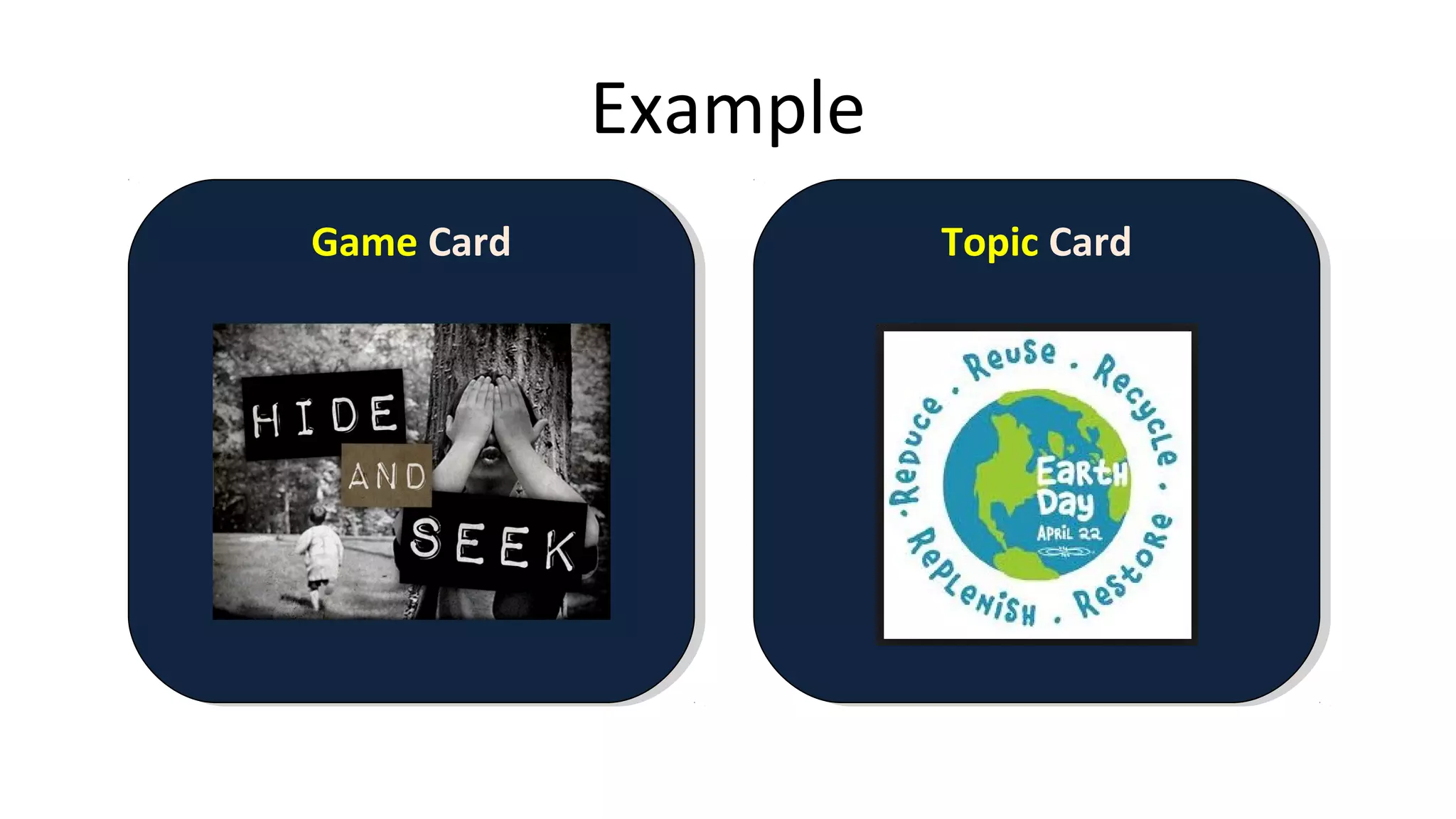
Example
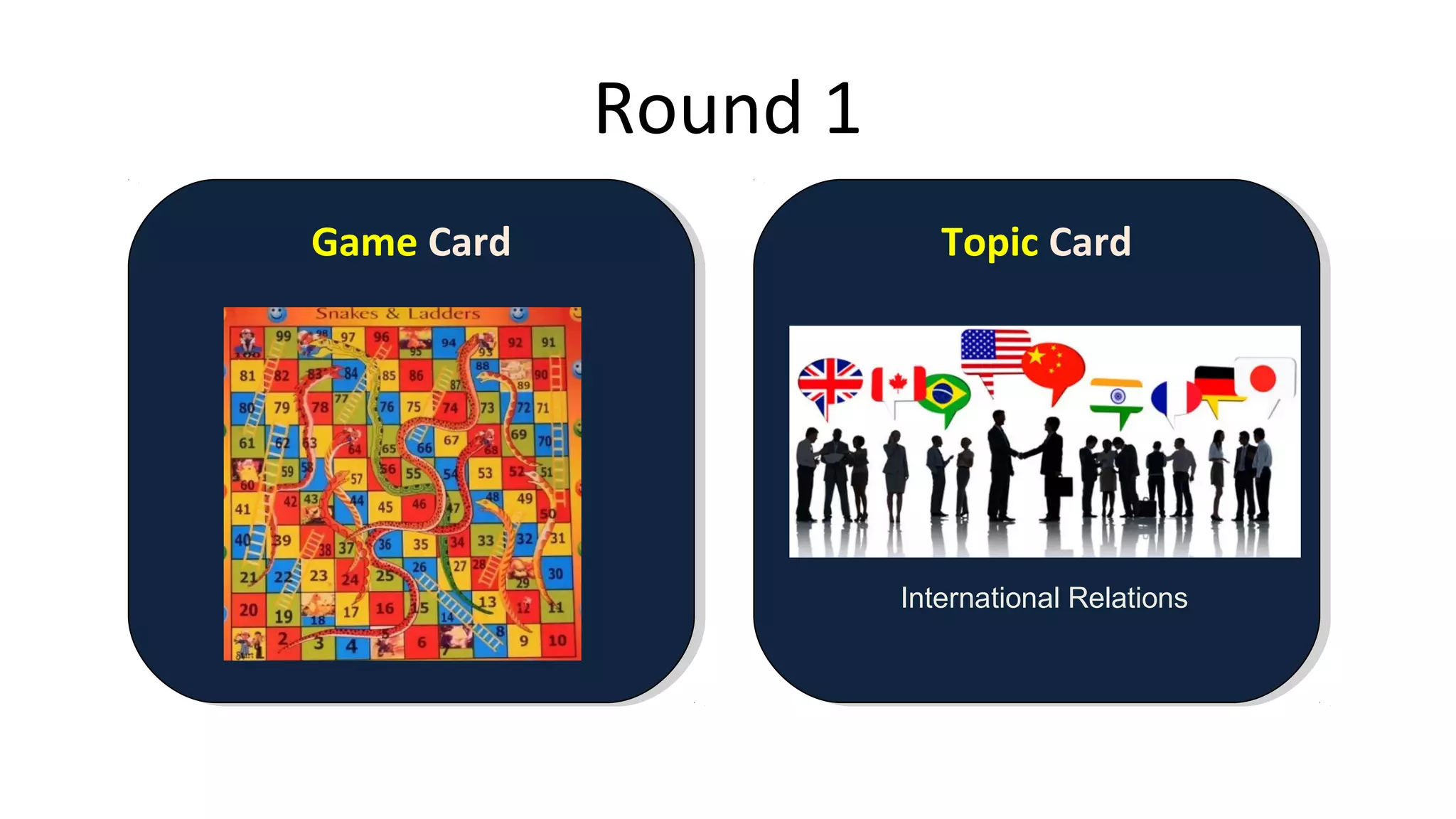
Game CardGame Card Topic CardTopic Card
Round 1
Game CardGame Card Topic CardTopic Card
International Relations
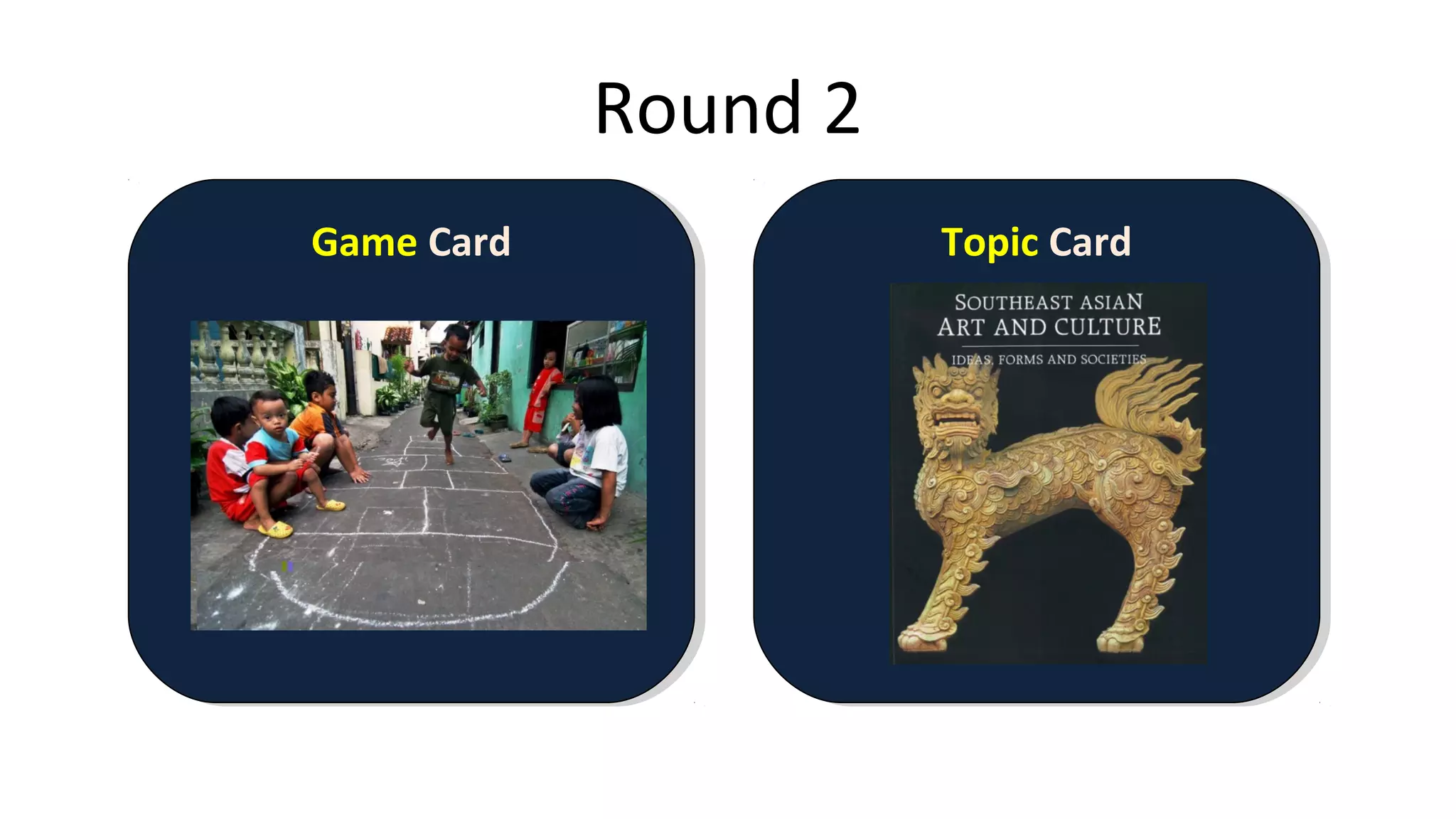
Round 2
Game CardGame Card Topic CardTopic Card
Thinking, playing and innovating
with Lego®Serious Play®
Create, Think, Learn
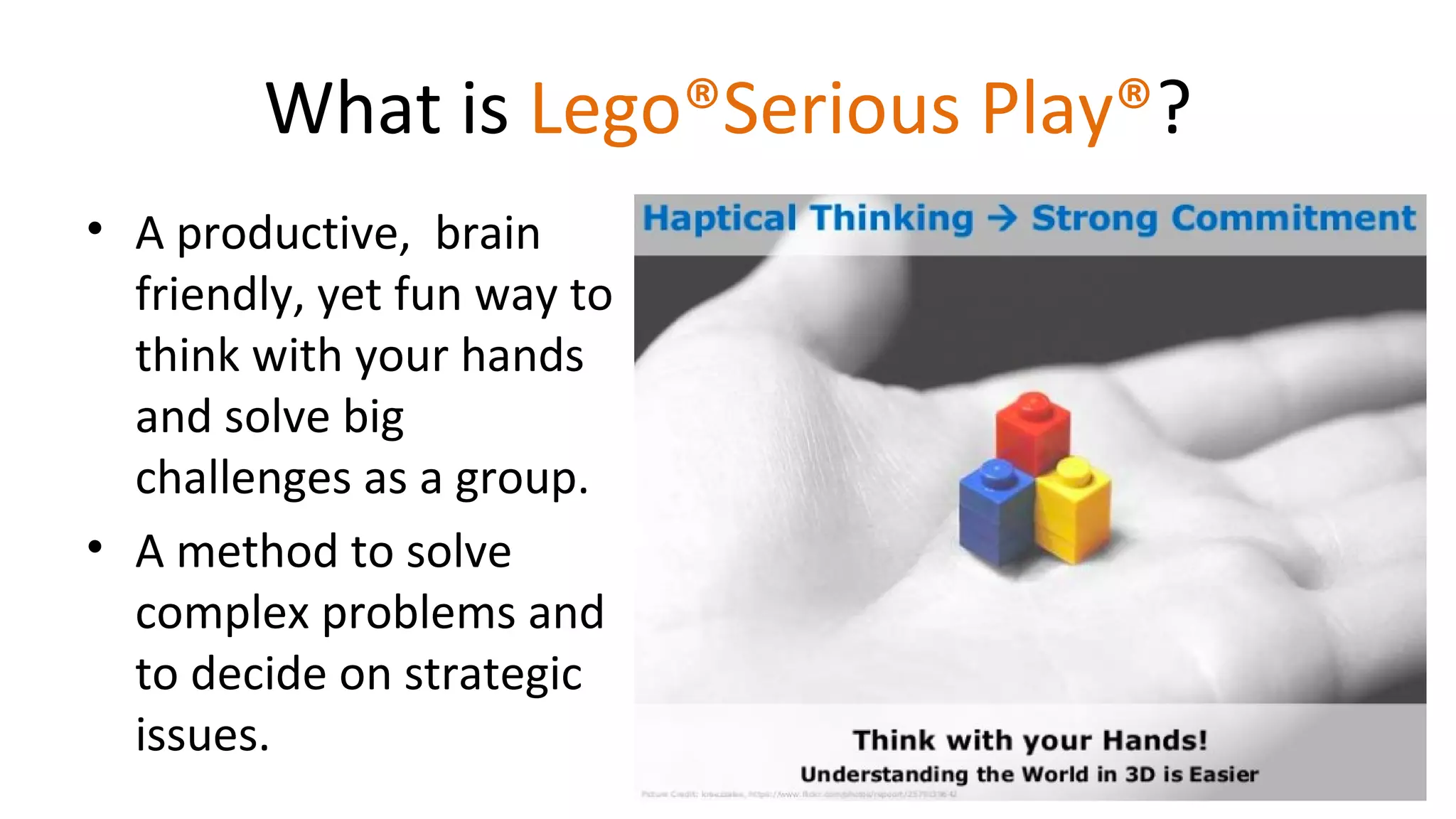
What is Lego®Serious Play®?
• A productive, brain
friendly, yet fun way to
think with your hands
and solve big
challenges as a group.
• A method to solve
complex problems and
to decide on strategic
issues.
Lego gives you a chance!
• Engaging
• Playfully
• Constructively
• Appreciatively
• Innovatively
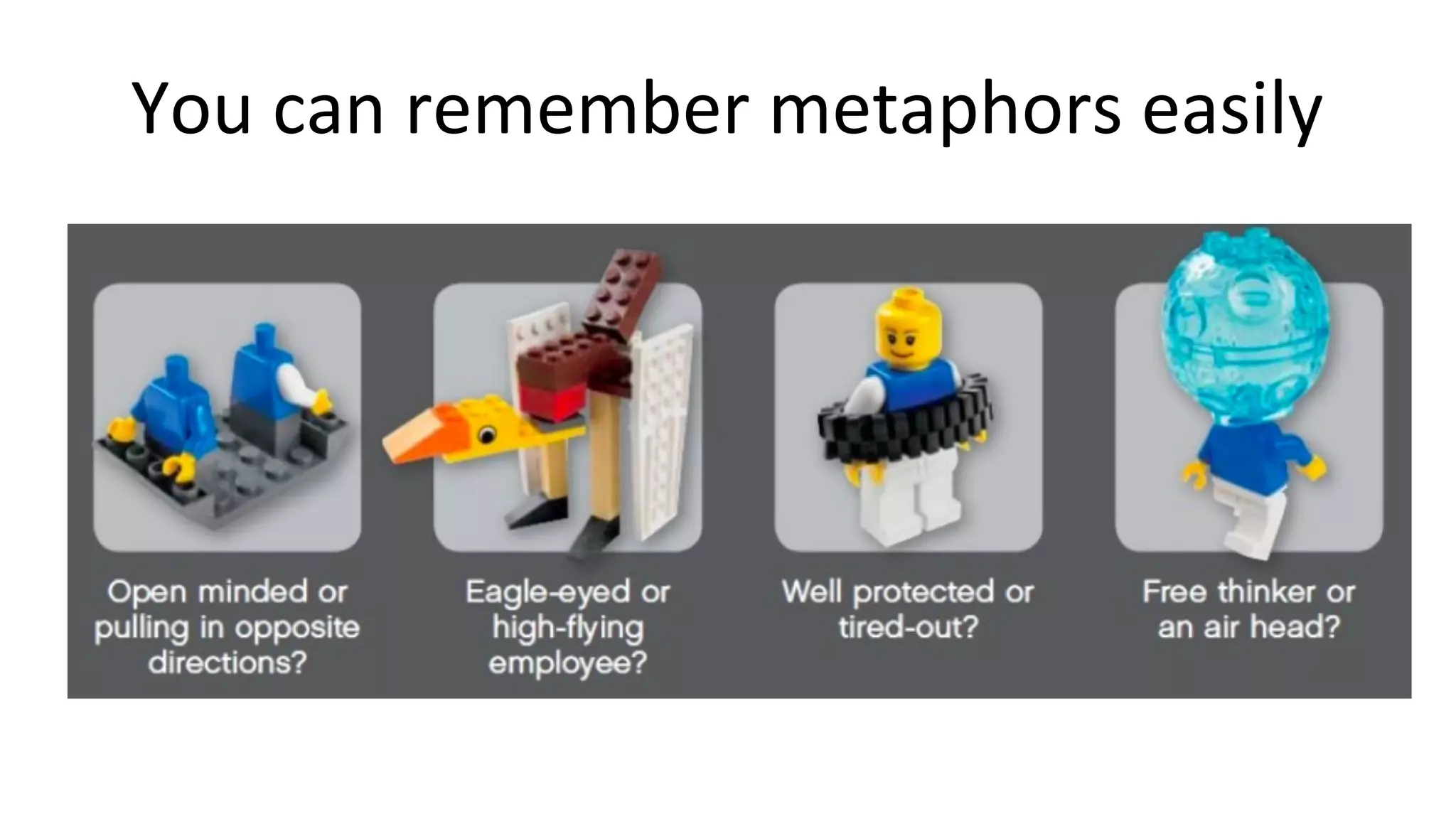
Metaphors
• Metaphors can be
serve as powerful
tools leading us to
think about our
realities in a new or
different ways.
You can remember metaphors easily
Activity: Thinking with your hands
using Lego
Warm up activity
• Build a duck.
Timer for 1 minute
Activity 2
• What is the biggest challenge you faced in your
work?
Timer for 3 minutes
Individuals tell their story
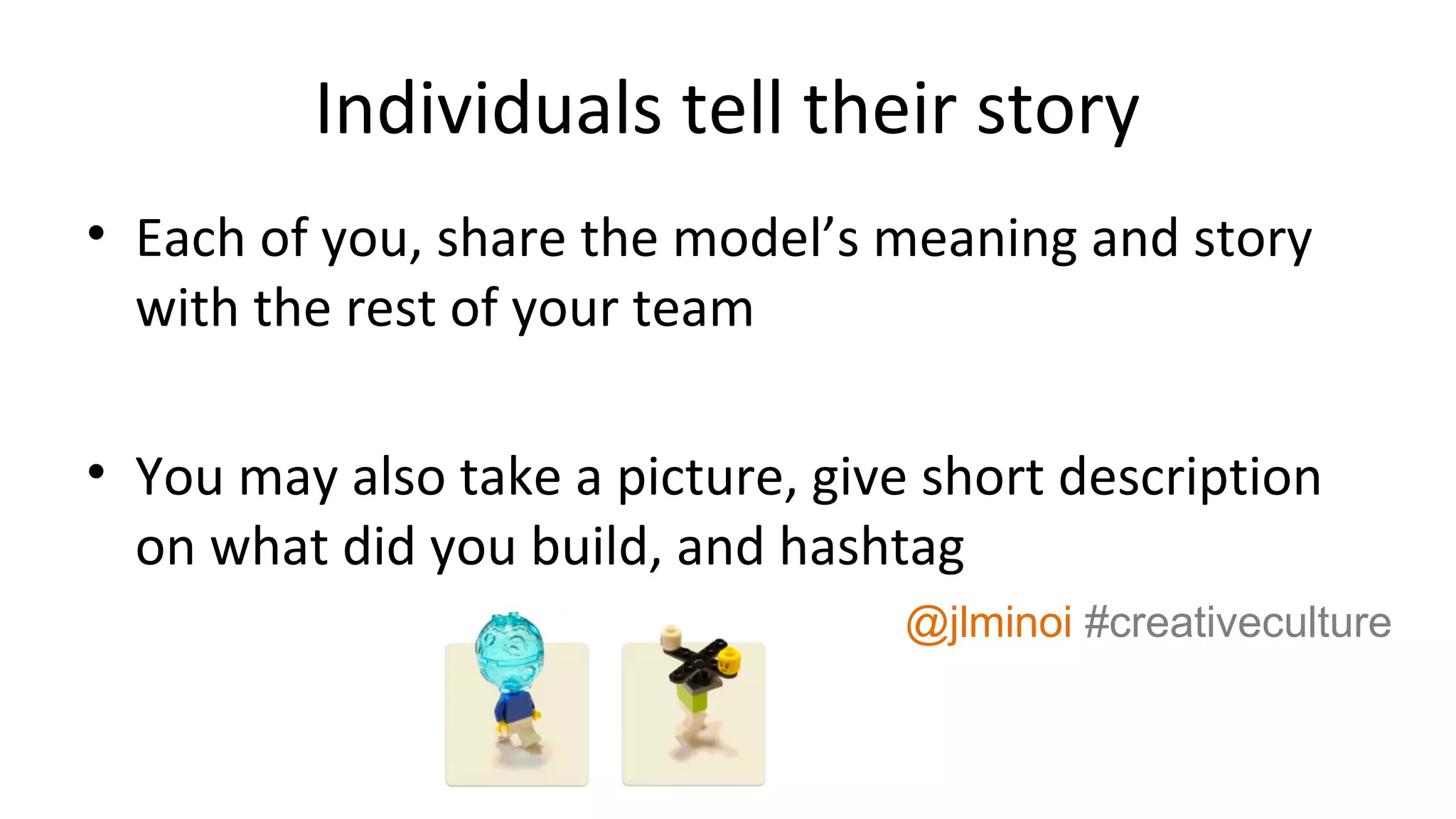
• Each of you, share the model’s meaning and story
with the rest of your team
• You may also take a picture, give short description
on what did you build, and hashtag
@jlminoi #creativeculture
Playful Design Thinking
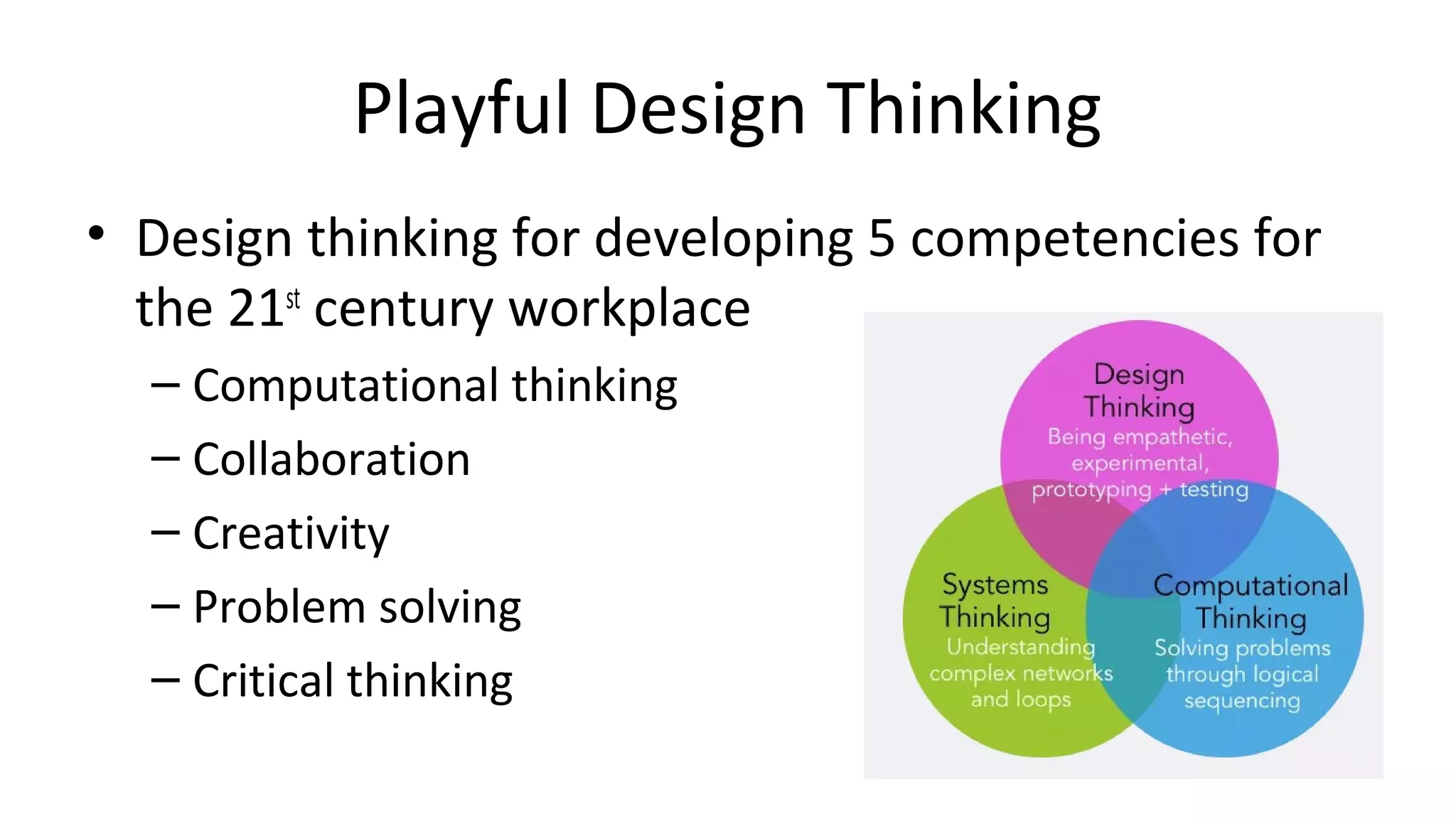
• Design thinking for developing 5 competencies for
the 21st
century workplace
– Computational thinking
– Collaboration
– Creativity
– Problem solving
– Critical thinking
with Play and Games
inspirations
Video link: https://www.youtube.com/watch?v=kErtBVfp66I
JESSICA MATTHEWS: INSPIRED
Presented by Moroccanoil
💡 Empathy
”The empathy at the core of it will be another
useful skill to have in not only the line of work I
want to achieve, but in everyday life and social
situations.”
“Knowing you can create something
to help others is very rewarding”
“… appreciation of different
mindsets and skillsets”
“…being imaginative and empathetic would greatly help the hole I
am missing from my course…”
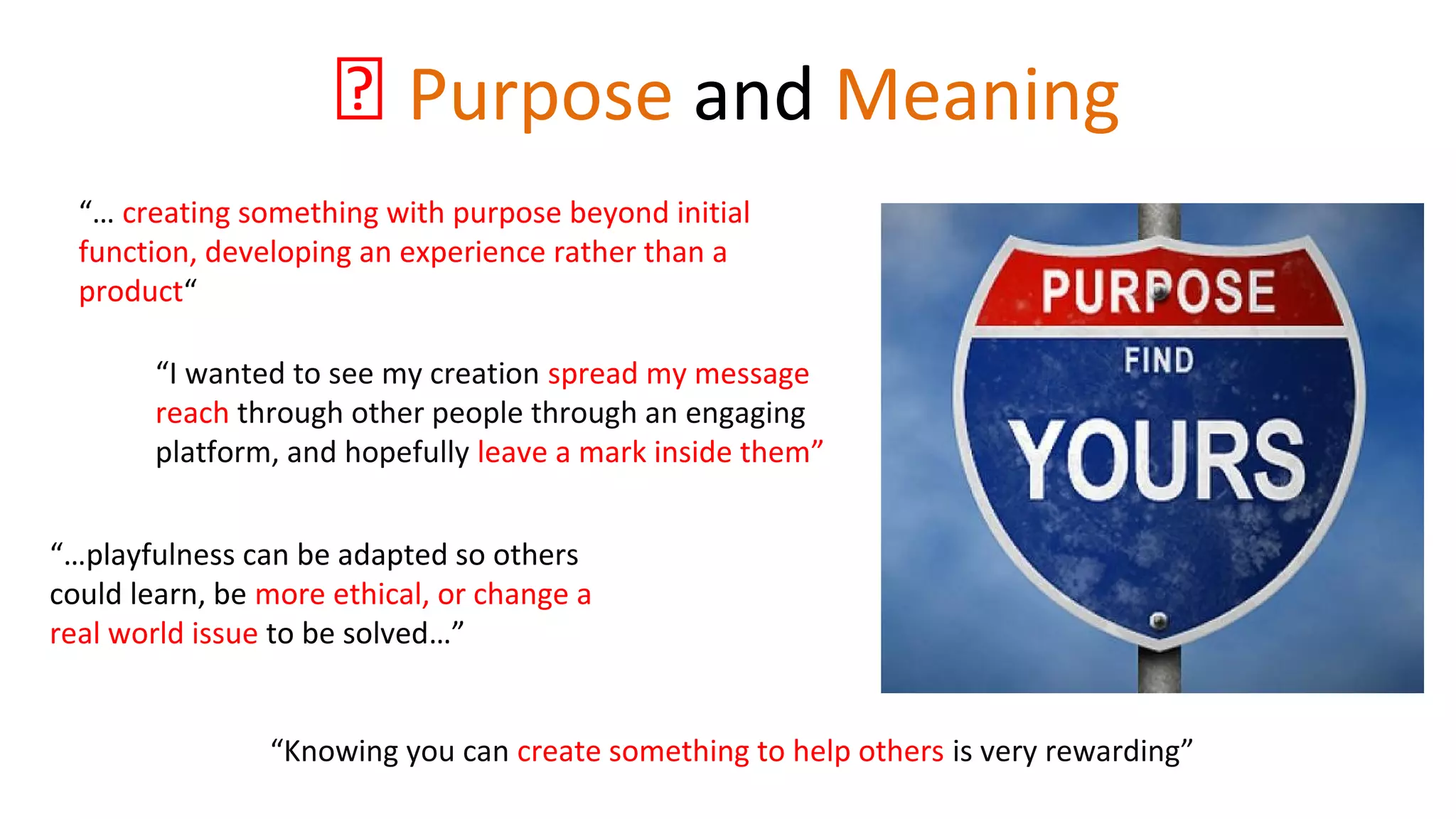
💡 Purpose and Meaning
“… creating something with purpose beyond initial
function, developing an experience rather than a
product“
“Knowing you can create something to help others is very rewarding”
“I wanted to see my creation spread my message
reach through other people through an engaging
platform, and hopefully leave a mark inside them”
“…playfulness can be adapted so others
could learn, be more ethical, or change a
real world issue to be solved…”
Tapping into play inspirations:
“Remixing Play into a Playful
Planning Session”
Reuse the tools and
mechanics of play for creative
and strategic thinking
1.Empathise
● What are the common problems encountered by people,
learners, communities?
○ In terms of,
■ Content, issues, culture
■ Environment
■ Level of understanding (prior knowledge)
■ Resources
● Consult experts/head community/leaders to find out more about
the area of concern by observing, engaging and empathizing
● Example : Needs analysis - interviews, observations - field notes
2. Define (The problem)
● Identify all possible problems from the gathered
information.
● Find the core problem.
● Define the problem in a human-centered manner.
● Example: Brainstorming
● Listing down problems
● Describe how the problems are addressed in class (or not)
● Describe existing interventions (if any)
● Show the connections between chunks of input, and how they are presented
in the lesson
3. Ideate
● Generate ideas, based on PLAY, to solve the problem.
○ Solution: Gamification of <theme> subjects.
● From 1st and 2nd stage, you and your team members can
start to ‘think outside the box’.
○ Creative thinking/Critical thinking to solve the problems.
● Example of ideas done : Using elements (items, strategies,
etc.) from traditional games/etc.
○ Snake and ladders, Monopoly, Congkak, Hopscotch, Soduku, Solitaire, etc.
4. Prototype
● Produce a number of inexpensive products
● Identify the best possible solution for each of the problems.
● Improve and re-examine (or reject) the prototype on the
basis of the users’ experiences.
● By the end of this stage, you will have a better idea of the
problems that are present and have a better/more informed
of how real learners would behave, think and feel when
interacting with the end product.
5. Test
● Test the complete products using the best solutions
identified during the prototyping phase
○ The result from the test will be use to redefine/improve
the prototype,
■ Understanding of the users
■ The conditions of the use
■ How people think, behave and feel, and
■ How to empathize
Our Gameplan for today
• Pick you theme (10 minutes)
1. Leadership and management
2. Training and education
3. Culture and arts
4. Social change
5. Transformation (mindset/practice)
6. Technology and development
Empathy
• Within your group, identify the
–Goals (objectives, inspirations)
–People (beneficiaries, users, etc.)
–Context (domain, industry, etc.)
Pick Common Games
• Pick 1-3 games that you know
• Unpick the mechanics and rules
• Game strategies
Strategy-mechanics Mapping
• Reuse the mechanics to inform
strategy
• Test each strategy-mechanics
mapping
• Iterate the process
Build your idea using Lego
● Work together to build and merge a
solution using Lego.
● Within your group, discuss a story, the
goals.
Pitching time! Tell your story
• Each of you, share the problem(s) and your solution
with the rest of the teams. (2 minutes pitching)
• Tweet your landscapes or your models, give a short
description on what did you build and hashtag
@jlminoi #creativeculture
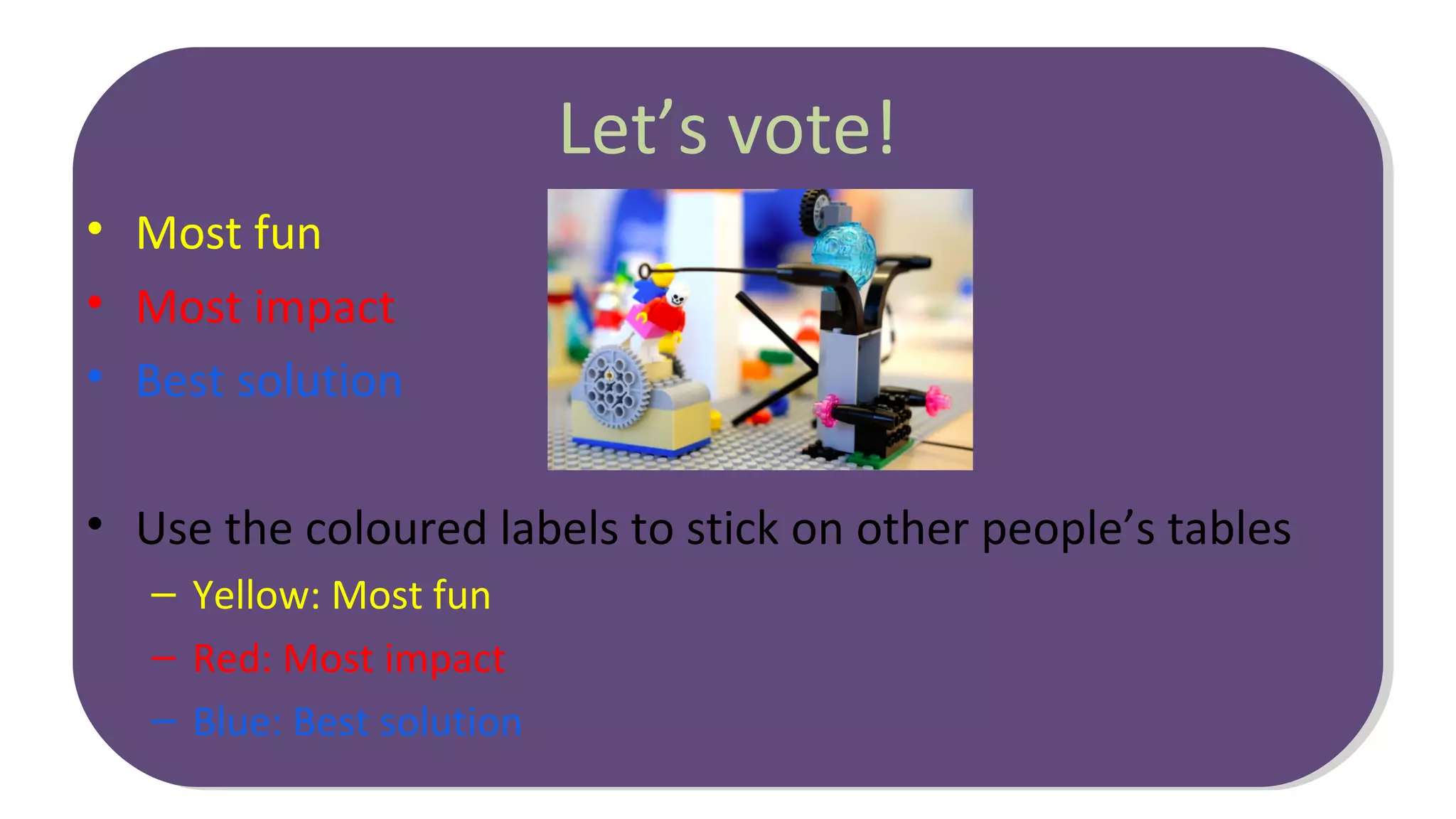
Let’s vote!
• Most fun
• Most impact
• Best solution
• Use the coloured labels to stick on other people’s tables
– Yellow: Most fun
– Red: Most impact
– Blue: Best solution
Thank YOU!
@jlminoi #gamification #creativeculture
Feedback
• Build a model to describe this activity, how you feel
and/or how can we change in the future for similar
workshop
• Write the keywords on the Post-it® notes.
This slides can be found in
https://www.slideshare.net/JaceyLynnMinoi/cr
eativeculture-gamification-at-asemus2018
Gamification in Museums?
Play | Your | Future
Jacey-Lynn Minoi, PhD
@jlminoi #gamification #creativeculture

CreativeCulture: Gamification at ASEMUS2018

  • 1.
    Gamification in Museums? Play| Your | Future Jacey-Lynn Minoi, PhD @jlminoi #gamification #creativeculture
  • 2.
    We do notstop playing because we grow old We grow old because we stop playing
  • 3.
    Play is uniquebecause it produces benefits than span multiple functional domains including: emotional, mental and social. It involves a voluntary activity – imaginary
  • 6.
  • 7.
    Creativity is intelligencehaving fun -Einstein-
  • 8.
    … a greatidea stems from something that already exists…
  • 10.
  • 13.
    Inspirations: Escape rooms,problem-based learning
  • 16.
    Remix Play –Flash Game Activity: Flash cards for onboarding into the remix play process
  • 17.
    Remix Play –Flash cards (1) Pair with someone next to you (or get in a group of x) (2) Two cards will appear on the screen Card 1: Game inspirations Card 2: Topic (1) Pair with someone next to you (or get in a group of x) (2) Two cards will appear on the screen Card 1: Game inspirations Card 2: Topic (3) MISSION: Create a new game in 1 minute (4) The first 2 to share their games each round (3) MISSION: Create a new game in 1 minute (4) The first 2 to share their games each round Tweet your game #creativeculture
  • 18.
    Example Game CardGame CardTopic CardTopic Card
  • 19.
    Round 1 Game CardGameCard Topic CardTopic Card International Relations
  • 20.
    Round 2 Game CardGameCard Topic CardTopic Card
  • 21.
    Thinking, playing andinnovating with Lego®Serious Play®
  • 22.
  • 23.
    What is Lego®SeriousPlay®? • A productive, brain friendly, yet fun way to think with your hands and solve big challenges as a group. • A method to solve complex problems and to decide on strategic issues.
  • 24.
    Lego gives youa chance! • Engaging • Playfully • Constructively • Appreciatively • Innovatively
  • 25.
    Metaphors • Metaphors canbe serve as powerful tools leading us to think about our realities in a new or different ways.
  • 26.
    You can remembermetaphors easily
  • 27.
    Activity: Thinking withyour hands using Lego
  • 28.
    Warm up activity •Build a duck. Timer for 1 minute
  • 29.
    Activity 2 • Whatis the biggest challenge you faced in your work? Timer for 3 minutes
  • 30.
    Individuals tell theirstory • Each of you, share the model’s meaning and story with the rest of your team • You may also take a picture, give short description on what did you build, and hashtag @jlminoi #creativeculture
  • 31.
    Playful Design Thinking •Design thinking for developing 5 competencies for the 21st century workplace – Computational thinking – Collaboration – Creativity – Problem solving – Critical thinking
  • 32.
    with Play andGames inspirations
  • 33.
    Video link: https://www.youtube.com/watch?v=kErtBVfp66I JESSICAMATTHEWS: INSPIRED Presented by Moroccanoil
  • 35.
    💡 Empathy ”The empathyat the core of it will be another useful skill to have in not only the line of work I want to achieve, but in everyday life and social situations.” “Knowing you can create something to help others is very rewarding” “… appreciation of different mindsets and skillsets” “…being imaginative and empathetic would greatly help the hole I am missing from my course…”
  • 36.
    💡 Purpose andMeaning “… creating something with purpose beyond initial function, developing an experience rather than a product“ “Knowing you can create something to help others is very rewarding” “I wanted to see my creation spread my message reach through other people through an engaging platform, and hopefully leave a mark inside them” “…playfulness can be adapted so others could learn, be more ethical, or change a real world issue to be solved…”
  • 37.
    Tapping into playinspirations: “Remixing Play into a Playful Planning Session” Reuse the tools and mechanics of play for creative and strategic thinking
  • 38.
    1.Empathise ● What arethe common problems encountered by people, learners, communities? ○ In terms of, ■ Content, issues, culture ■ Environment ■ Level of understanding (prior knowledge) ■ Resources ● Consult experts/head community/leaders to find out more about the area of concern by observing, engaging and empathizing ● Example : Needs analysis - interviews, observations - field notes
  • 39.
    2. Define (Theproblem) ● Identify all possible problems from the gathered information. ● Find the core problem. ● Define the problem in a human-centered manner. ● Example: Brainstorming ● Listing down problems ● Describe how the problems are addressed in class (or not) ● Describe existing interventions (if any) ● Show the connections between chunks of input, and how they are presented in the lesson
  • 40.
    3. Ideate ● Generateideas, based on PLAY, to solve the problem. ○ Solution: Gamification of <theme> subjects. ● From 1st and 2nd stage, you and your team members can start to ‘think outside the box’. ○ Creative thinking/Critical thinking to solve the problems. ● Example of ideas done : Using elements (items, strategies, etc.) from traditional games/etc. ○ Snake and ladders, Monopoly, Congkak, Hopscotch, Soduku, Solitaire, etc.
  • 41.
    4. Prototype ● Producea number of inexpensive products ● Identify the best possible solution for each of the problems. ● Improve and re-examine (or reject) the prototype on the basis of the users’ experiences. ● By the end of this stage, you will have a better idea of the problems that are present and have a better/more informed of how real learners would behave, think and feel when interacting with the end product.
  • 42.
    5. Test ● Testthe complete products using the best solutions identified during the prototyping phase ○ The result from the test will be use to redefine/improve the prototype, ■ Understanding of the users ■ The conditions of the use ■ How people think, behave and feel, and ■ How to empathize
  • 43.
    Our Gameplan fortoday • Pick you theme (10 minutes) 1. Leadership and management 2. Training and education 3. Culture and arts 4. Social change 5. Transformation (mindset/practice) 6. Technology and development
  • 44.
    Empathy • Within yourgroup, identify the –Goals (objectives, inspirations) –People (beneficiaries, users, etc.) –Context (domain, industry, etc.)
  • 45.
    Pick Common Games •Pick 1-3 games that you know • Unpick the mechanics and rules • Game strategies
  • 46.
    Strategy-mechanics Mapping • Reusethe mechanics to inform strategy • Test each strategy-mechanics mapping • Iterate the process
  • 47.
    Build your ideausing Lego ● Work together to build and merge a solution using Lego. ● Within your group, discuss a story, the goals.
  • 48.
    Pitching time! Tellyour story • Each of you, share the problem(s) and your solution with the rest of the teams. (2 minutes pitching) • Tweet your landscapes or your models, give a short description on what did you build and hashtag @jlminoi #creativeculture
  • 49.
    Let’s vote! • Mostfun • Most impact • Best solution • Use the coloured labels to stick on other people’s tables – Yellow: Most fun – Red: Most impact – Blue: Best solution
  • 50.
  • 51.
    Feedback • Build amodel to describe this activity, how you feel and/or how can we change in the future for similar workshop • Write the keywords on the Post-it® notes. This slides can be found in https://www.slideshare.net/JaceyLynnMinoi/cr eativeculture-gamification-at-asemus2018
  • 52.
    Gamification in Museums? Play| Your | Future Jacey-Lynn Minoi, PhD @jlminoi #gamification #creativeculture

Editor's Notes

  • #2 Both
  • #11 What if education is a non-linear adventure game where you can make decisions on your own path, fight battles, power up and level up in missions and quests?
  • #16 1 minute
  • #53 Both