Underlying Issues with
Homework
 As a student, did you like doing
  homework?
 As a teacher, did you like coming up with
  homework assignments, assigning
  homework, grading homework, etc.?
 As an administrator, do you like hearing
  from students, teachers, or parents about
  homework?
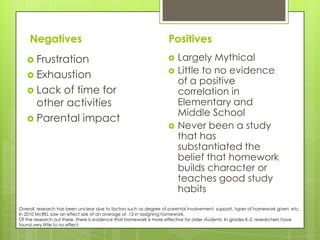
Negatives                                                       Positives
    Frustration                                                       Largely Mythical
    Exhaustion
                                                                       Little to no evidence
                                                                        of a positive
    Lack of time for                                                   correlation in
     other activities                                                   Elementary and
                                                                        Middle School
    Parental impact
                                                                       Never been a study
                                                                        that has
                                                                        substantiated the
                                                                        belief that homework
                                                                        builds character or
                                                                        teaches good study
                                                                        habits
Overall, research has been unclear due to factors such as degree of parental involvement, support, types of homework given, etc.
In 2010 McREL saw an effect size of an average of .13 in assigning homework.
Of the research out there, there is evidence that homework is more effective for older students. In grades K-2, researchers have
found very little to no effect.
Let’s talk purpose and
practice...
 We  know homework is intended as an opportunity
  to provide practice, and should never be used as a
  means for students to learn something new.
 Speaking of practice…


Practice is the act of repeating a specific skill or
reviewing small amounts of information to increase
recall, speed and accuracy.
  Remember- practice makes…
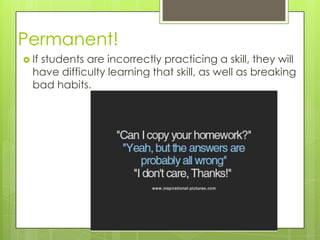
Permanent!
 If
   students are incorrectly practicing a skill, they will
  have difficulty learning that skill, as well as breaking
  bad habits.
Let’s Replace the Word
Homework with Practice
   What would you give for “practice” to
    students?
   Practice is more effective when it requires
    students to work on more than one skill at a
    time- if students practice finding the radius of
    a circle given the circumference, but not
    finding the circumference given the radius,
    the students tend to do less well.
   Practice is more effective when students
    receive and can access feedback.
Wormeli on Homework Practice
Homework Dos and Don’ts
   It should be assigned as needed.
   Homework should be directly tied to the skills
    needed for achieving mastery or learning
    objectives
   If it is given, there needs to be feedback.
   Time is less important than the quality and
    type of assignment.
   “5 are as good as 15, 10 as good as 30. One
    page can demonstrate mastery more often
    than 3 pages.”- Pete Grande
What is Being Assigned as
           Homework?
    Put your teacher hat
                             Let’s think

    on for a minute…
   Think about when         progressively
    the students need        about how
    you. Is it during the
    lecture or the           homework is
    discussion?
   Do they need you for
                             utilized in the
    the YouTube video        flipped
    you are showing, or
    the assignment after     classroom.
    watching?
The Flipped Classroom
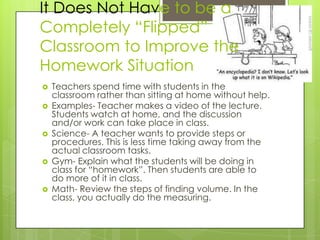
It Does Not Have to be a
Completely “Flipped”
Classroom to Improve the
Homework Situation
   Teachers spend time with students in the
    classroom rather than sitting at home without help.
   Examples- Teacher makes a video of the lecture.
    Students watch at home, and the discussion
    and/or work can take place in class.
   Science- A teacher wants to provide steps or
    procedures. This is less time taking away from the
    actual classroom tasks.
   Gym- Explain what the students will be doing in
    class for “homework”. Then students are able to
    do more of it in class.
   Math- Review the steps of finding volume. In the
    class, you actually do the measuring.
The Concepts Behind the
Flipped Classroom Just Make
Sense
 The  beauty of the flipped classroom lies in
  the realization that instruction takes place
  in different mediums.
 We need to match the instructional
  activity with the environment that makes
  the most sense.
 Classrooms are not a place for students to
  be passive observers and consumers in
  the learning process.
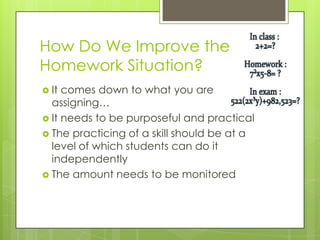
How Do We Improve the
Homework Situation?
 It comes down to what you are
  assigning…
 It needs to be purposeful and practical
 The practicing of a skill should be at a
  level of which students can do it
  independently
 The amount needs to be monitored
What will it take from us?
   Sharing the information… Our teachers probably
    just don’t know. They assign the types of
    homework they are because that’s what has
    always been done. That has been the
    expectation.
   Don’t include in the actual grading- it should be
    reported separately.
   Involve parents and students in the process
   Taking the concepts of the flipped classroom and
    apply them to homework and creating an active
    learning environment to the classroom

Homework Presentation 1

  • 2.
    Underlying Issues with Homework As a student, did you like doing homework?  As a teacher, did you like coming up with homework assignments, assigning homework, grading homework, etc.?  As an administrator, do you like hearing from students, teachers, or parents about homework?
  • 3.
    Negatives Positives  Frustration  Largely Mythical  Exhaustion  Little to no evidence of a positive  Lack of time for correlation in other activities Elementary and Middle School  Parental impact  Never been a study that has substantiated the belief that homework builds character or teaches good study habits Overall, research has been unclear due to factors such as degree of parental involvement, support, types of homework given, etc. In 2010 McREL saw an effect size of an average of .13 in assigning homework. Of the research out there, there is evidence that homework is more effective for older students. In grades K-2, researchers have found very little to no effect.
  • 4.
    Let’s talk purposeand practice...  We know homework is intended as an opportunity to provide practice, and should never be used as a means for students to learn something new.  Speaking of practice… Practice is the act of repeating a specific skill or reviewing small amounts of information to increase recall, speed and accuracy.  Remember- practice makes…
  • 5.
    Permanent!  If students are incorrectly practicing a skill, they will have difficulty learning that skill, as well as breaking bad habits.
  • 6.
    Let’s Replace theWord Homework with Practice  What would you give for “practice” to students?  Practice is more effective when it requires students to work on more than one skill at a time- if students practice finding the radius of a circle given the circumference, but not finding the circumference given the radius, the students tend to do less well.  Practice is more effective when students receive and can access feedback.
  • 7.
  • 8.
    Homework Dos andDon’ts  It should be assigned as needed.  Homework should be directly tied to the skills needed for achieving mastery or learning objectives  If it is given, there needs to be feedback.  Time is less important than the quality and type of assignment.  “5 are as good as 15, 10 as good as 30. One page can demonstrate mastery more often than 3 pages.”- Pete Grande
  • 9.
    What is BeingAssigned as Homework? Put your teacher hat  Let’s think  on for a minute…  Think about when progressively the students need about how you. Is it during the lecture or the homework is discussion?  Do they need you for utilized in the the YouTube video flipped you are showing, or the assignment after classroom. watching?
  • 10.
  • 11.
    It Does NotHave to be a Completely “Flipped” Classroom to Improve the Homework Situation  Teachers spend time with students in the classroom rather than sitting at home without help.  Examples- Teacher makes a video of the lecture. Students watch at home, and the discussion and/or work can take place in class.  Science- A teacher wants to provide steps or procedures. This is less time taking away from the actual classroom tasks.  Gym- Explain what the students will be doing in class for “homework”. Then students are able to do more of it in class.  Math- Review the steps of finding volume. In the class, you actually do the measuring.
  • 12.
    The Concepts Behindthe Flipped Classroom Just Make Sense  The beauty of the flipped classroom lies in the realization that instruction takes place in different mediums.  We need to match the instructional activity with the environment that makes the most sense.  Classrooms are not a place for students to be passive observers and consumers in the learning process.
  • 13.
    How Do WeImprove the Homework Situation?  It comes down to what you are assigning…  It needs to be purposeful and practical  The practicing of a skill should be at a level of which students can do it independently  The amount needs to be monitored
  • 14.
    What will ittake from us?  Sharing the information… Our teachers probably just don’t know. They assign the types of homework they are because that’s what has always been done. That has been the expectation.  Don’t include in the actual grading- it should be reported separately.  Involve parents and students in the process  Taking the concepts of the flipped classroom and apply them to homework and creating an active learning environment to the classroom