z
Arts of the
Neoclassic and
Romantic Period
Neoclassic
Neoclassicism, 1780-1840, the word
neoclassic came from the Greek word
neos meaning “new” and Latin word
classicus which is similar in the
meaning to the English phrase “first
class.”
z
The Western movement in
decorative and visual arts was called
Neoclassicism. It also applies to
literature, theater, music and
architecture that were influenced by
the classical art and culture of
Ancient Greece and Ancient Rome.
z
 The Neoclassical movement coincided with the
18th century age of reason also known as the Age of
Enlightenment. The art styles in this period was
brought about by the renewed interest in Greek
and Roman classics. Neoclassical art pieces such as
painting, sculptures, and architecture generally
portrayed Roman History which elevated the Roman
heroes.
Characteristic
Portrayal of Roman history
Formal composition
The use of diagonal to show the peak of an emotion or
moment (versus a regular moment)
Local color
Overall lighting
Classic geo-structure
NEO-
CLASSICAL
ARTISTS
1748–1825
Jacques-Louis David (1748-
1825) France
Jean-Auguste-Dominique
Ingres (1780-1867) France
1780–1867
Jacques-Louis
David (1748-1825)
France
•influential French
painter in the
Neoclassical style
and considered to
be the pre-eminent
painter of the era.
Famous Artworks:
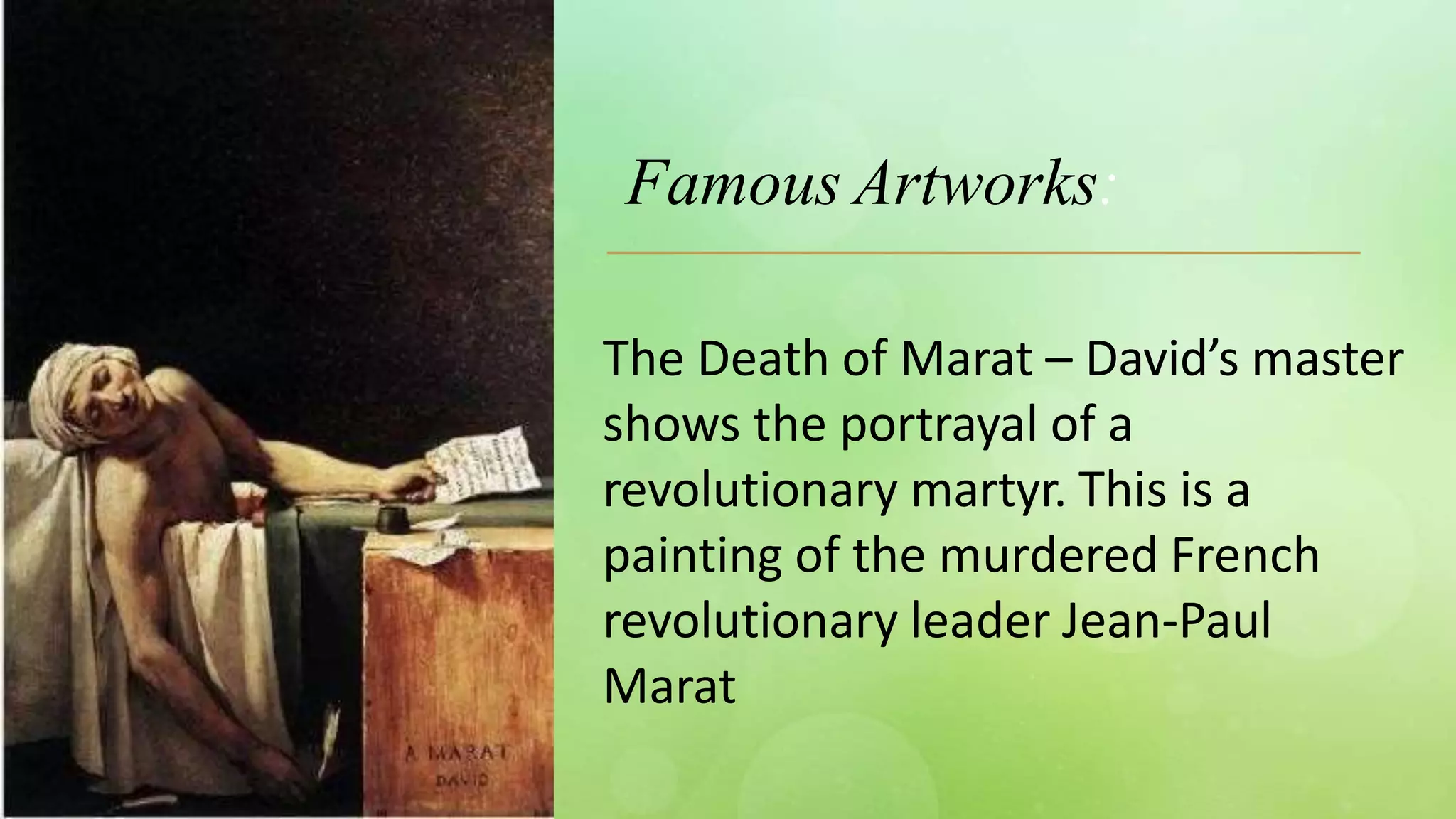
The Death of Marat – David’s master
shows the portrayal of a
revolutionary martyr. This is a
painting of the murdered French
revolutionary leader Jean-Paul
Marat
Famous Artworks:
Napoleon Crossing the Alps –
the painting that showed
strongly idealized view of the
real crossing that Napoleon
and his army made the Alps
through the Great St. Bernard
Pass in May 1800.
Famous
Artworks:
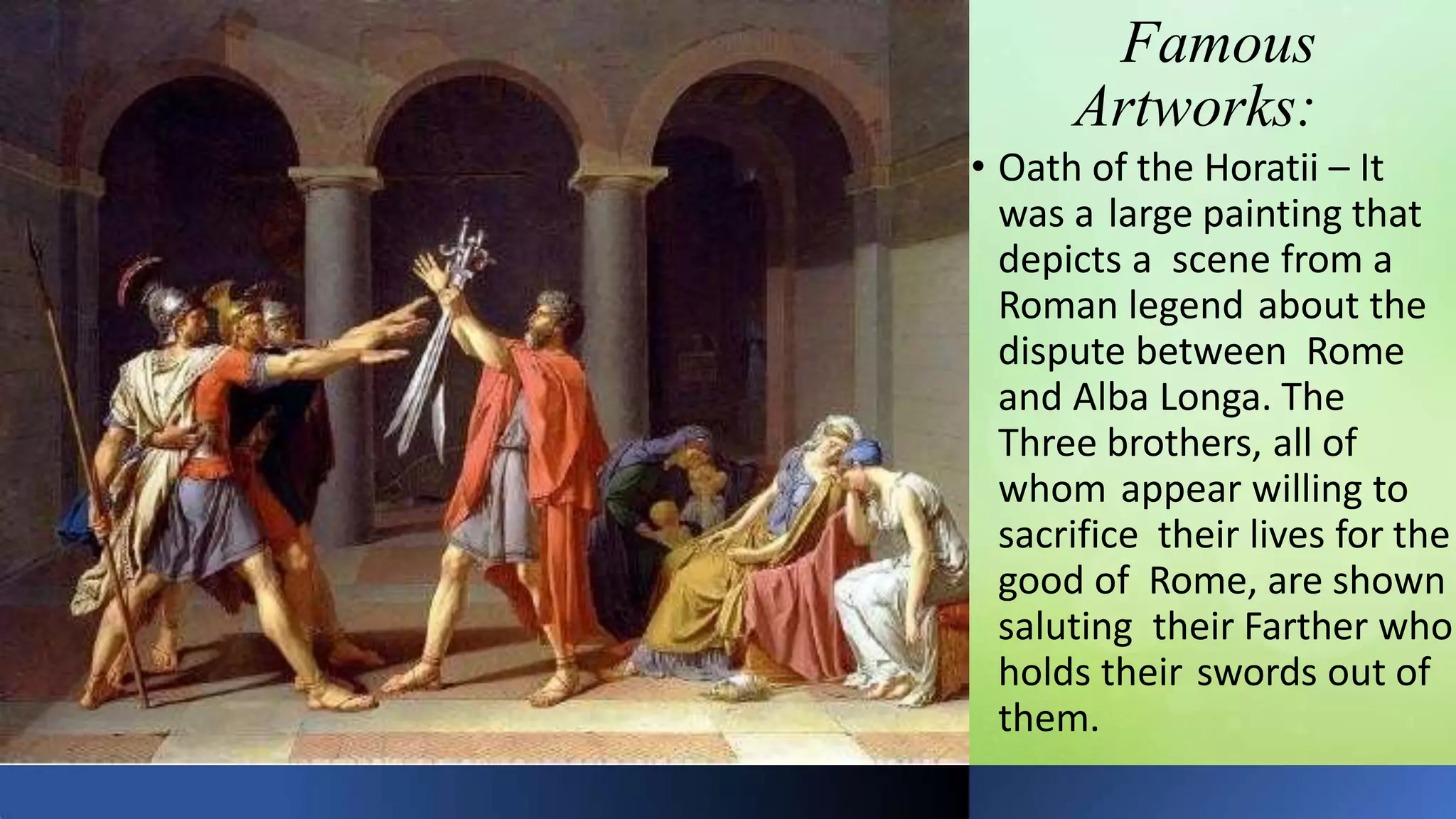
• Oath of the Horatii – It
was a large painting that
depicts a scene from a
Roman legend about the
dispute between Rome
and Alba Longa. The
Three brothers, all of
whom appear willing to
sacrifice their lives for the
good of Rome, are shown
saluting their Farther who
holds their swords out of
them.
Jean-
Auguste-
Dominique
Ingres
(1780-
1867) France
pupil of Jacques-Louis David. He was
influenced by Italian Renaissance
painters like Raphael, Nicolas Pousin,
Botticelli, and his mentor, Jacques-Louis
David
paintings were usually nudes, portraits,
and mythological themes.
Famous Artworks:
Portrait of Napoleon on the
Imperial Throne - the painting
depicts Napoleon in his
decadent coronation costume,
seated upon his golden-
encrusted throne, hand resting
upon smooth ivory balls.
Famous
Artworks:
• The Apotheosis of
Homer – the painting
was a state-
commission by Charles
X to have him
remembered in the
building works of the
Louvre. The painting
depicts an image of
Homer, receiving all
brilliant men of Rome,
Greece, and
contemporary times.
NEOCLASSICAL
SCULPTURES
• The Neoclassical
period was one of the
great ages of public
sculpture. Artists
looked to Roman
styles during the time
of Alexander the
Great for inspiration
as well as to mimic
their style.
NEO-CLASSICAL SCULPTORS
1757–1822
Antonio Canova (1757-1822) Italy
1789–1838
Bertel Thorvaldsen (1789-1838) Denmark
Antonio Canova
(1757-
1822) Italy
•a prolific Italian
artist and sculptor
who became
famous for his
marble sculptures
that delicately
rendered nude
flesh
Famous
Artworks:
• Psyche Awakened by
Cupid’s Kiss – A marble
sculpture portraying the
relationship of Psyche and
Cupid.
• Washington – this is made
marble sculpture of
Washington currently
displayed at North
Carolina Museum of
History.
Bertel Thorvaldsen (1789-
1838) Denmark
the first international
acclaimed Danish artist. He
executed sculptures of
mythological and religious
themes characters
Famous
Artworks:
A.Christ –Amarble
sculpture image of
resurrected Christ
currently located at the
Thorvaldesen Museum.
B.Lion of Lucerne –A sculpture
of a dying lion in Lucerne,
Switzerland that
commemorates the Swiss
Guards who were massacred
in 1792 during the French
revolution.
NEOCLASSICALARCHITECTURE
Neoclassical architectural styles started in the mid-18th
century.it turned away from the grandeur of Rococo styles
and the Late Baroque.
Neoclassical architecture was a style principally derived
from the architecture of Classical Greece and Rome and the
architectural designs of the Italian architect Andrea Palladio
Types of Neoclassical
Architecture:
TEMPLE STYLE
PALLADIAN STYLE
CLASSICAL BLOCK STYLE
TEMPLE STYLE
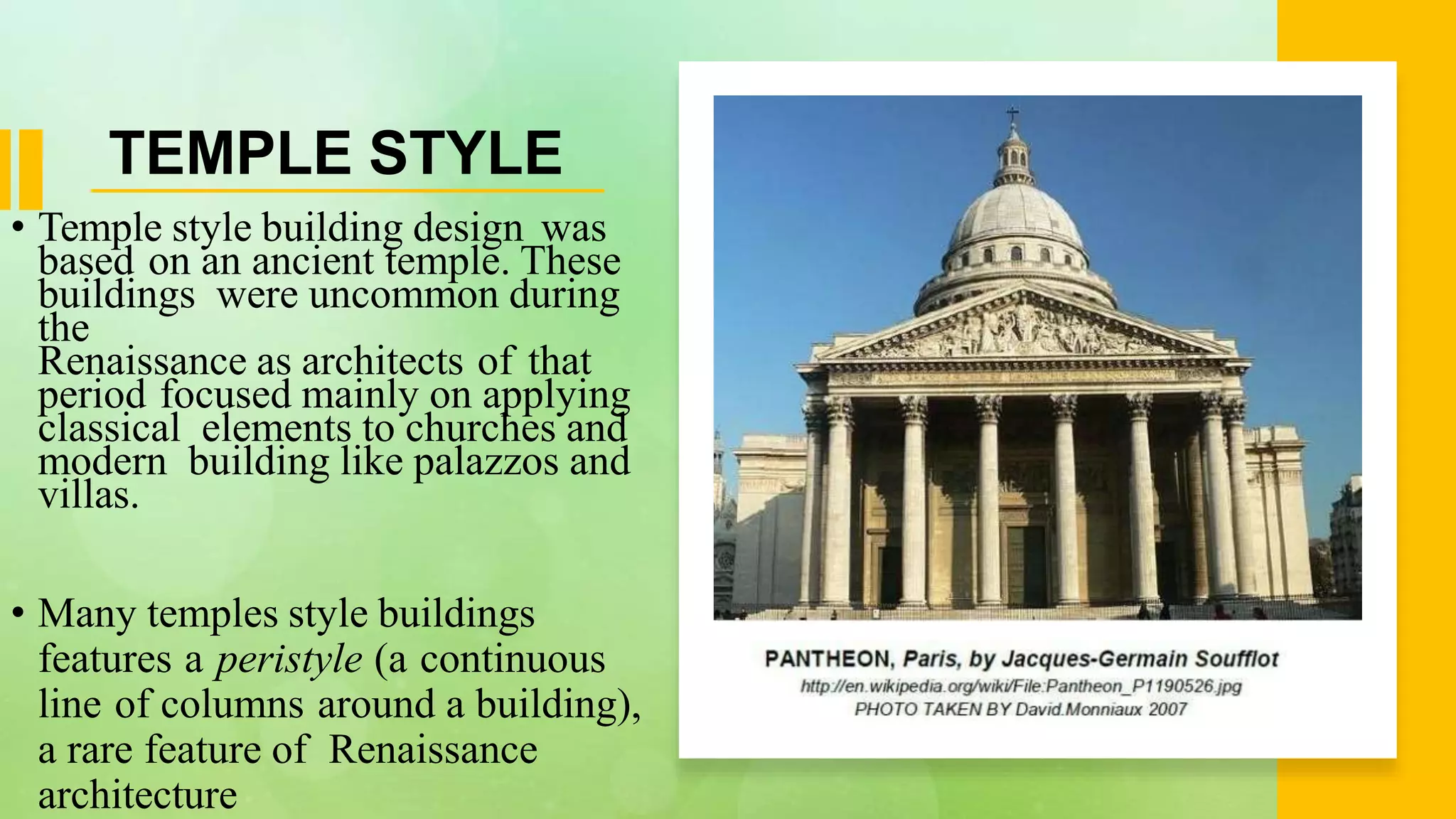
• Temple style building design was
based on an ancient temple. These
buildings were uncommon during
the
Renaissance as architects of that
period focused mainly on applying
classical elements to churches and
modern building like palazzos and
villas.
• Many temples style buildings
features a peristyle (a continuous
line of columns around a building),
a rare feature of Renaissance
architecture
PALLADIAN
STYLE
• Palladian buildings were based on
Andrea Palladio’s style of villa
construction.
• Some of the building feature a balustrade which
is a railing with vertical supports along the edge
of the roof. There are vertical supports within a
balustrade known as “balusters” or “spindles.” It
is also a classical method of crowning a building
that has a flat or low lying roof. One of the
famous architects in the era was:
•Robert Adam (1728-1792) Britain
Robert Adam (1728-
1792) Britain
•He was known as the
Palladian architect of the
Neoclassical who
designed two well-
known American civic
buildings- the White
House and the United
States capitol.
CLASSICAL
BLOCK
STYLE
• The building features a rectangular or
square plan, with a flat roof and an
exterior rich in classical detail. The
exterior features a repeated classical
patterns or series of arches and/or
columns. The overall impression of such a
building was huge, classically- decorated
rectangular block.
• Classical block aesthetic was also known as “Beaux-
Arts styles,” since it was developed principally by
the French École des Beaux-Arts (School of Fine
arts).
• Classical block architecture also flourished in the
United States, particularly in New York.
Famous Architects of
classical block style
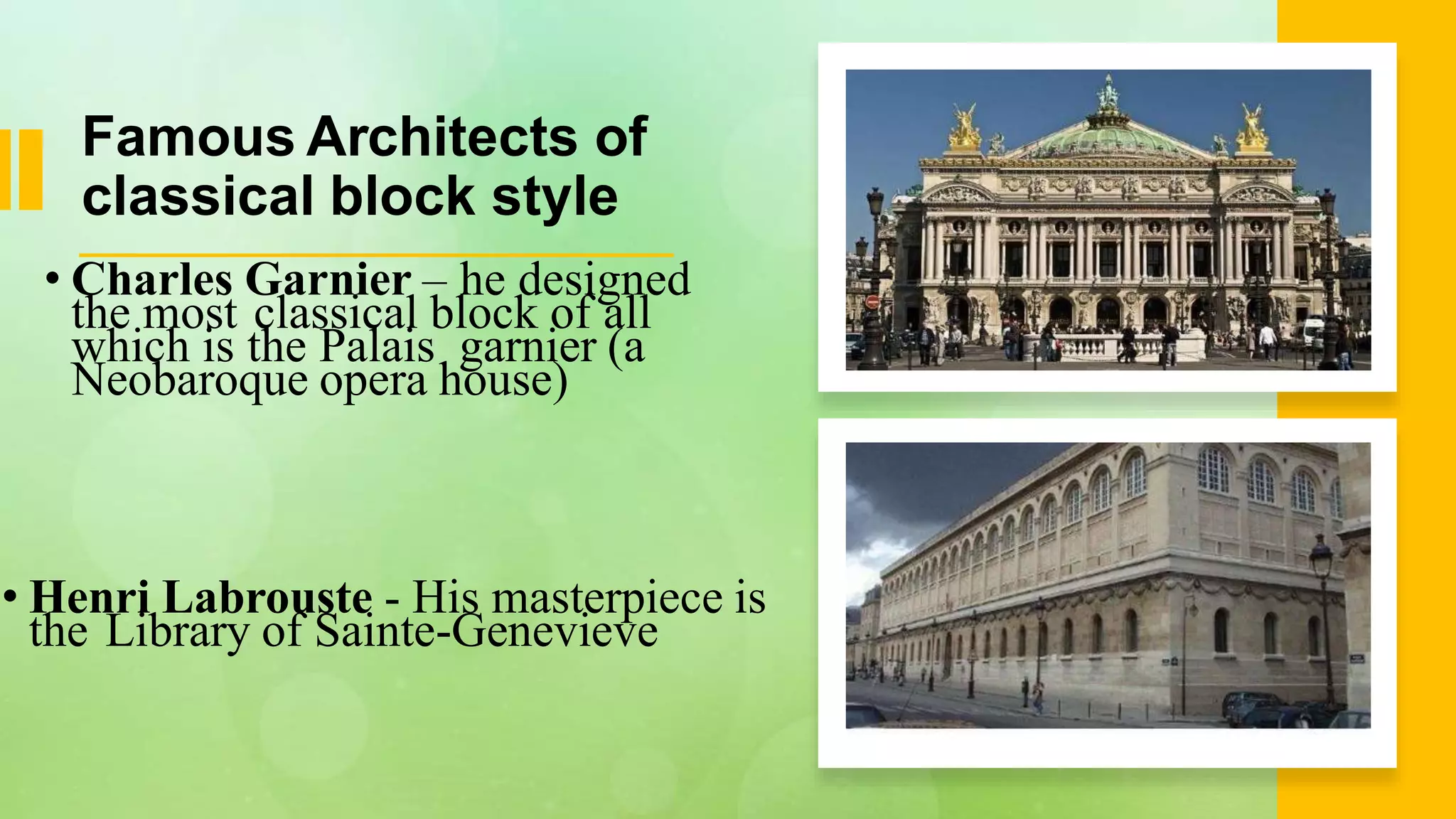
• Charles Garnier – he designed
the most classical block of all
which is the Palais garnier (a
Neobaroque opera house)
• Henri Labrouste - His masterpiece is
the Library of Sainte-Genevieve
z
z
ACTIVITY
z
QUIZ
z
Identification:
1. It comes from Greek
word NEOS which also
means “first class”.
z
2&3. Give at least
two characteristics of
the Neoclassical Art.
z
4. A pupil of David whose
artworks are mostly
nudes, portraits and
mythological themes.
z
5. An influential
French Painter known
in history.
z
Answer
z
1. Neoclassical/Neoclassicism
Characteristic
Portrayal of Roman history
Formal composition
The use of diagonal to show the peak of an emotion or
moment (versus a regular moment)
Local color
Overall lighting
Classic geo-structure
z
Jean-
Auguste-
Dominique
Ingres
(1780-
1867) France
pupil of Jacques-Louis David. He was
influenced by Italian Renaissance
painters like Raphael, Nicolas Pousin,
Botticelli, and his mentor, Jacques-Louis
David
paintings were usually nudes, portraits,
and mythological themes.
z
Jacques-Louis
David (1748-
1825)
France
• influential French painter in the
Neoclassical style and considered
to be the pre-eminent painter of
the era.
z
z
ROMANTICISM,
1800s-1810s
• Romanticism was a movement in which the
artist of Neoclassical period sought to break
new ground in the expression of emotion,
both subtle and stormy. It embraced a
number of distinctive themes, such as a
longing for history, supernatural elements,
social injustices, and nature.
• Landscape painting also became more
popular due to the people’s romantic
adoration of nature.
• Romanticism was a reaction to the classical,
contemplative nature of Neoclassical pieces.
Characteristics
:
Height of action
Emotional extremes
Celebrated nature as out of control
Dramatic composition
Heightened sensation (life and death moments)
PAINTERS
OF
ROMANTIC
PERIOD
Jean Louis Theodore
Gericult (1791-1824) France
Eugene Delacroix (1798-
1863) France
Francisco Goya (1746-1828)
Jean Louis Theodore Gericult
(1791-1824) France
• was the first French master and the
leader of the French realistic school.
His masterpieces were energetic,
powerful, brilliantly colored, and tightly
composed.
Famous Artworks:
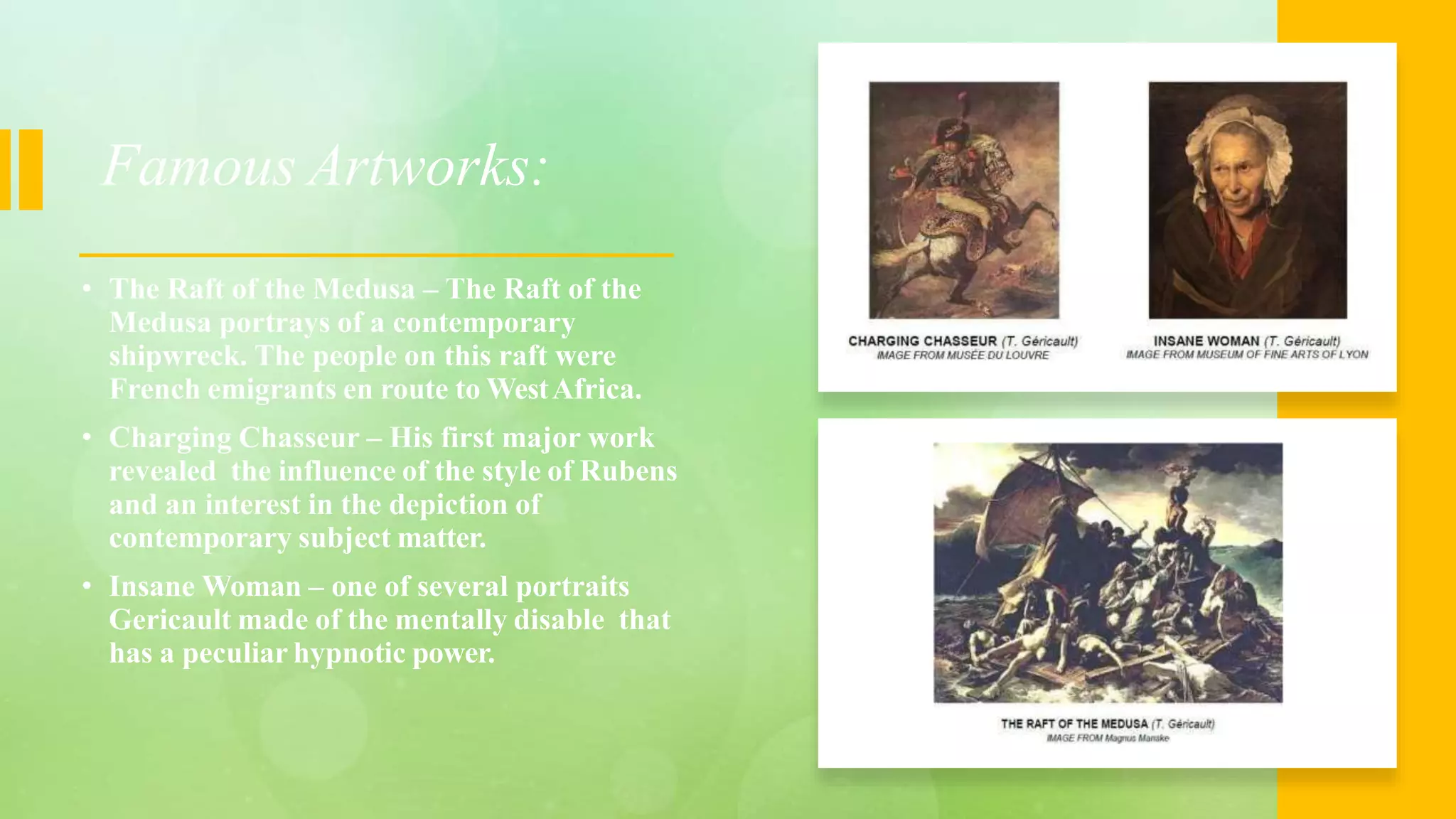
• The Raft of the Medusa – The Raft of the
Medusa portrays of a contemporary
shipwreck. The people on this raft were
French emigrants en route to WestAfrica.
• Charging Chasseur – His first major work
revealed the influence of the style of Rubens
and an interest in the depiction of
contemporary subject matter.
• Insane Woman – one of several portraits
Gericault made of the mentally disable that
has a peculiar hypnotic power.
Eugene Delacroix
(1798-1863)
France
• considered the greatest French
Romantic painters of all.
• achieved brilliant visual effects using
small, adjacent strokes of contrasting
color. He was the most influential to
most of Romantic painters and
eventually his techniques was adapted
and extended by the Impressionist artist
Famous Artworks:
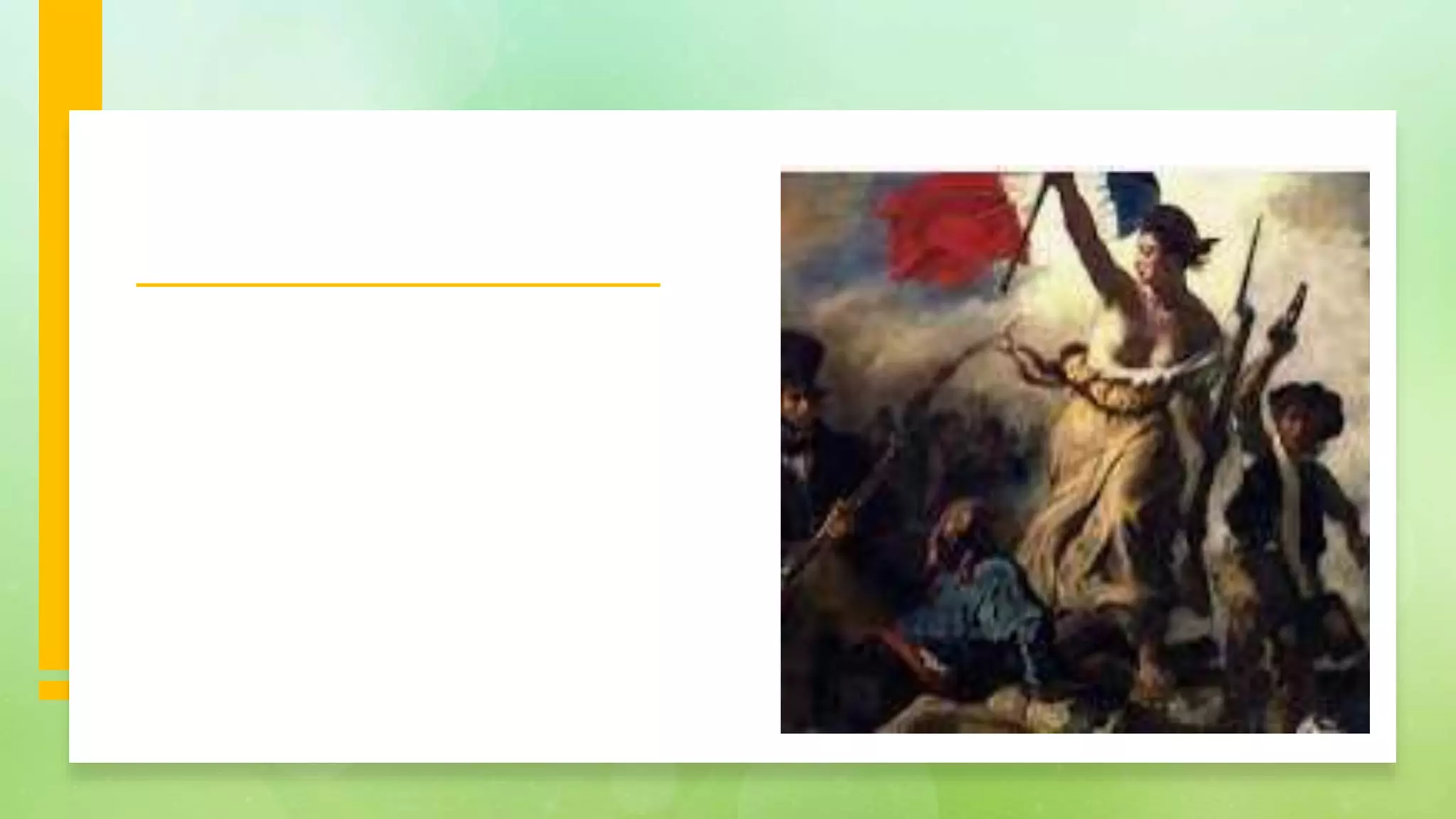
• Liberty Leading The People – this
painting commemorates the July
Revolution of 1830, which toppled King
Charles X of France.Awoman holding
the flag of the French Revolution
personifies Liberty and leads the people
forward over the bodies of the fallen
Francisco
Goya (1746-
1828)
• commissioned Romantic painter by the
king of Spain
• also a printmaker regarded both as the
last of the “old Masters” and the first of
the “Moderns”
Famous Artworks:
• The Third of May – Goya’s masterpiece that
sought to commemorate Spanish resistance to
Napoleon’s armies during the occupation of 1808
in the PeninsularWar.
• Saturn Devouring His Son – this artwork depicts
Greek myth of the Titan Cronus (Saturn),who
fears that he would be overthrown by one of his
children, so he ate each one upon their birth.
• The Burial of Sardine – was a Spanish ceremony
celebrate onAsh Wednesday and was a symbol
burial of the past to allow society to be reborn,
transformed with new vigor.
ROMANTIC
PAINTING
(Landscap
e
Painting)
Landscape painting depicts the physical
world that surrounded us and includes
features such as mountain, valleys,
vegetation, and bodies of water.
Sky is another important element
shaping the mood of landscape
painting. Landscape art ranges from
highly detailed and realistic to
impressionistic, romantic, and idealized.
Famous landscape artist during
the Romantic Period
1.Jean-Bapstiste-Camille
Corot
2. Theodore Rousseau
ROMANTIC
SCULPTURE
• Romantic sculpture can be divided into works that concern
about the human world and those that concern the natural
world.
Sculptors 1784–1855
Francois Rude (1784-1855)
France
1796–1875
Antoine-Louis Barye
Francois Rude
(1784-1855)
France
• best known for his social art
which aimed to inspire and
capture the interest of a broad
public. He rejected the
classical repose of the late 18th
and early 19th-century French
sculpture in favour of a
dynamic, emotional style and
created many monuments that
stirred the public for
Generation
Famous Artworks:
• Departure of the Volunteers – known as La
Marseilles, this work portrays the goddess
liberty urging the forces of the French
Revolution onward
Antoine-Louis
Barye (1796-1875)
• the most famous animal sculptor of all
time. He studied the anatomy of his
subjects by sketching resident of the
Paris zoo
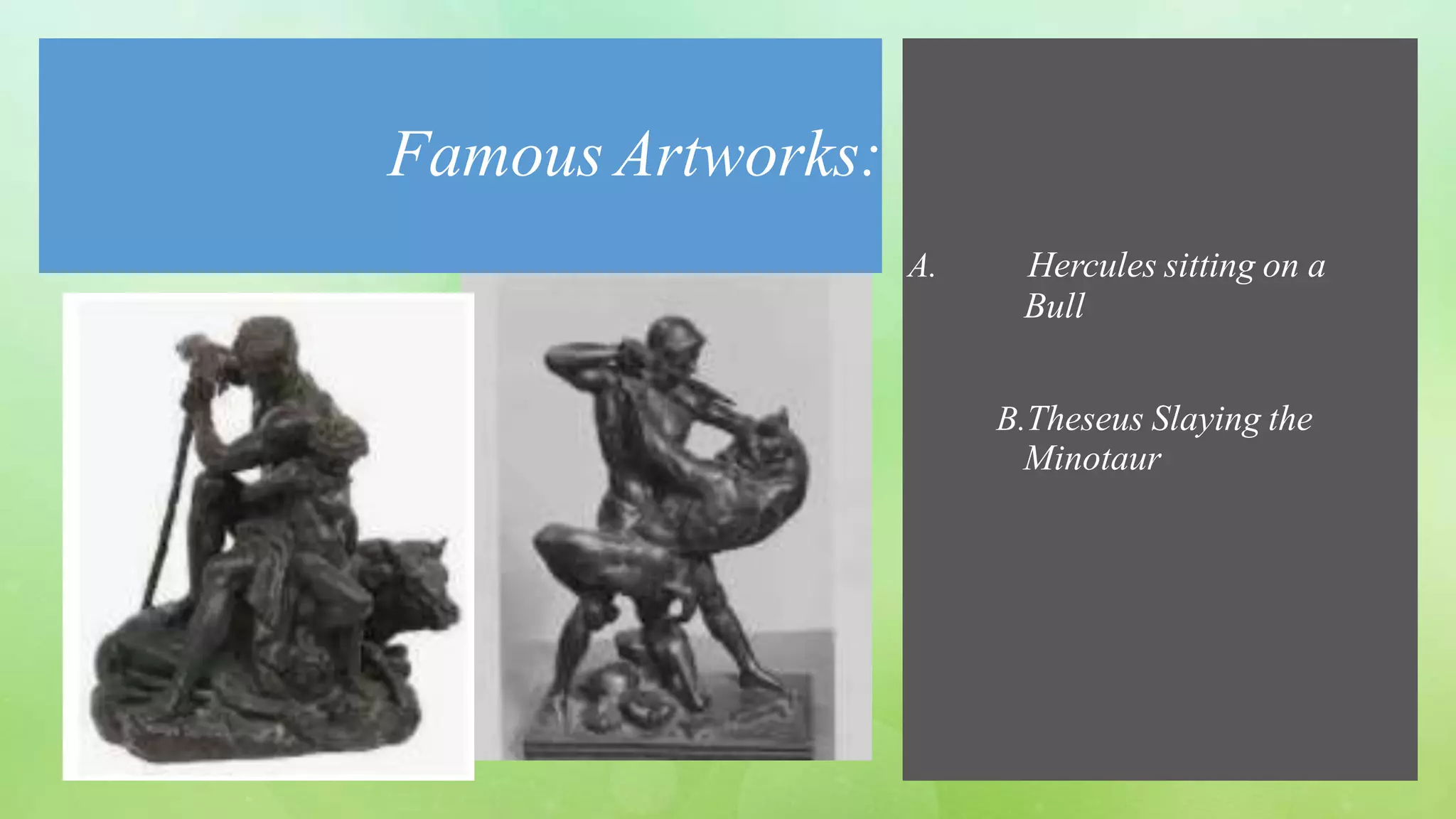
Famous Artworks:
A. Hercules sitting on a
Bull
B.Theseus Slaying the
Minotaur

Art 3rd Quarter G9.pptx

  • 1.
    z Arts of the Neoclassicand Romantic Period
  • 2.
  • 3.
    Neoclassicism, 1780-1840, theword neoclassic came from the Greek word neos meaning “new” and Latin word classicus which is similar in the meaning to the English phrase “first class.”
  • 4.
    z The Western movementin decorative and visual arts was called Neoclassicism. It also applies to literature, theater, music and architecture that were influenced by the classical art and culture of Ancient Greece and Ancient Rome.
  • 5.
    z  The Neoclassicalmovement coincided with the 18th century age of reason also known as the Age of Enlightenment. The art styles in this period was brought about by the renewed interest in Greek and Roman classics. Neoclassical art pieces such as painting, sculptures, and architecture generally portrayed Roman History which elevated the Roman heroes.
  • 6.
    Characteristic Portrayal of Romanhistory Formal composition The use of diagonal to show the peak of an emotion or moment (versus a regular moment) Local color Overall lighting Classic geo-structure
  • 7.
    NEO- CLASSICAL ARTISTS 1748–1825 Jacques-Louis David (1748- 1825)France Jean-Auguste-Dominique Ingres (1780-1867) France 1780–1867
  • 8.
    Jacques-Louis David (1748-1825) France •influential French painterin the Neoclassical style and considered to be the pre-eminent painter of the era.
  • 9.
    Famous Artworks: The Deathof Marat – David’s master shows the portrayal of a revolutionary martyr. This is a painting of the murdered French revolutionary leader Jean-Paul Marat
  • 10.
    Famous Artworks: Napoleon Crossingthe Alps – the painting that showed strongly idealized view of the real crossing that Napoleon and his army made the Alps through the Great St. Bernard Pass in May 1800.
  • 11.
    Famous Artworks: • Oath ofthe Horatii – It was a large painting that depicts a scene from a Roman legend about the dispute between Rome and Alba Longa. The Three brothers, all of whom appear willing to sacrifice their lives for the good of Rome, are shown saluting their Farther who holds their swords out of them.
  • 12.
    Jean- Auguste- Dominique Ingres (1780- 1867) France pupil ofJacques-Louis David. He was influenced by Italian Renaissance painters like Raphael, Nicolas Pousin, Botticelli, and his mentor, Jacques-Louis David paintings were usually nudes, portraits, and mythological themes.
  • 13.
    Famous Artworks: Portrait ofNapoleon on the Imperial Throne - the painting depicts Napoleon in his decadent coronation costume, seated upon his golden- encrusted throne, hand resting upon smooth ivory balls.
  • 14.
    Famous Artworks: • The Apotheosisof Homer – the painting was a state- commission by Charles X to have him remembered in the building works of the Louvre. The painting depicts an image of Homer, receiving all brilliant men of Rome, Greece, and contemporary times.
  • 15.
    NEOCLASSICAL SCULPTURES • The Neoclassical periodwas one of the great ages of public sculpture. Artists looked to Roman styles during the time of Alexander the Great for inspiration as well as to mimic their style.
  • 16.
    NEO-CLASSICAL SCULPTORS 1757–1822 Antonio Canova(1757-1822) Italy 1789–1838 Bertel Thorvaldsen (1789-1838) Denmark
  • 17.
    Antonio Canova (1757- 1822) Italy •aprolific Italian artist and sculptor who became famous for his marble sculptures that delicately rendered nude flesh
  • 18.
    Famous Artworks: • Psyche Awakenedby Cupid’s Kiss – A marble sculpture portraying the relationship of Psyche and Cupid. • Washington – this is made marble sculpture of Washington currently displayed at North Carolina Museum of History.
  • 19.
    Bertel Thorvaldsen (1789- 1838)Denmark the first international acclaimed Danish artist. He executed sculptures of mythological and religious themes characters
  • 20.
    Famous Artworks: A.Christ –Amarble sculpture imageof resurrected Christ currently located at the Thorvaldesen Museum. B.Lion of Lucerne –A sculpture of a dying lion in Lucerne, Switzerland that commemorates the Swiss Guards who were massacred in 1792 during the French revolution.
  • 21.
    NEOCLASSICALARCHITECTURE Neoclassical architectural stylesstarted in the mid-18th century.it turned away from the grandeur of Rococo styles and the Late Baroque. Neoclassical architecture was a style principally derived from the architecture of Classical Greece and Rome and the architectural designs of the Italian architect Andrea Palladio
  • 22.
    Types of Neoclassical Architecture: TEMPLESTYLE PALLADIAN STYLE CLASSICAL BLOCK STYLE
  • 23.
    TEMPLE STYLE • Templestyle building design was based on an ancient temple. These buildings were uncommon during the Renaissance as architects of that period focused mainly on applying classical elements to churches and modern building like palazzos and villas. • Many temples style buildings features a peristyle (a continuous line of columns around a building), a rare feature of Renaissance architecture
  • 24.
    PALLADIAN STYLE • Palladian buildingswere based on Andrea Palladio’s style of villa construction. • Some of the building feature a balustrade which is a railing with vertical supports along the edge of the roof. There are vertical supports within a balustrade known as “balusters” or “spindles.” It is also a classical method of crowning a building that has a flat or low lying roof. One of the famous architects in the era was: •Robert Adam (1728-1792) Britain
  • 25.
    Robert Adam (1728- 1792)Britain •He was known as the Palladian architect of the Neoclassical who designed two well- known American civic buildings- the White House and the United States capitol.
  • 26.
    CLASSICAL BLOCK STYLE • The buildingfeatures a rectangular or square plan, with a flat roof and an exterior rich in classical detail. The exterior features a repeated classical patterns or series of arches and/or columns. The overall impression of such a building was huge, classically- decorated rectangular block. • Classical block aesthetic was also known as “Beaux- Arts styles,” since it was developed principally by the French École des Beaux-Arts (School of Fine arts). • Classical block architecture also flourished in the United States, particularly in New York.
  • 27.
    Famous Architects of classicalblock style • Charles Garnier – he designed the most classical block of all which is the Palais garnier (a Neobaroque opera house) • Henri Labrouste - His masterpiece is the Library of Sainte-Genevieve
  • 28.
  • 29.
  • 30.
  • 31.
    z Identification: 1. It comesfrom Greek word NEOS which also means “first class”.
  • 32.
    z 2&3. Give atleast two characteristics of the Neoclassical Art.
  • 33.
    z 4. A pupilof David whose artworks are mostly nudes, portraits and mythological themes.
  • 34.
    z 5. An influential FrenchPainter known in history.
  • 35.
  • 36.
  • 37.
    Characteristic Portrayal of Romanhistory Formal composition The use of diagonal to show the peak of an emotion or moment (versus a regular moment) Local color Overall lighting Classic geo-structure
  • 38.
    z Jean- Auguste- Dominique Ingres (1780- 1867) France pupil ofJacques-Louis David. He was influenced by Italian Renaissance painters like Raphael, Nicolas Pousin, Botticelli, and his mentor, Jacques-Louis David paintings were usually nudes, portraits, and mythological themes.
  • 39.
    z Jacques-Louis David (1748- 1825) France • influentialFrench painter in the Neoclassical style and considered to be the pre-eminent painter of the era.
  • 40.
  • 41.
  • 42.
    ROMANTICISM, 1800s-1810s • Romanticism wasa movement in which the artist of Neoclassical period sought to break new ground in the expression of emotion, both subtle and stormy. It embraced a number of distinctive themes, such as a longing for history, supernatural elements, social injustices, and nature. • Landscape painting also became more popular due to the people’s romantic adoration of nature. • Romanticism was a reaction to the classical, contemplative nature of Neoclassical pieces.
  • 43.
    Characteristics : Height of action Emotionalextremes Celebrated nature as out of control Dramatic composition Heightened sensation (life and death moments)
  • 44.
    PAINTERS OF ROMANTIC PERIOD Jean Louis Theodore Gericult(1791-1824) France Eugene Delacroix (1798- 1863) France Francisco Goya (1746-1828)
  • 45.
    Jean Louis TheodoreGericult (1791-1824) France • was the first French master and the leader of the French realistic school. His masterpieces were energetic, powerful, brilliantly colored, and tightly composed.
  • 46.
    Famous Artworks: • TheRaft of the Medusa – The Raft of the Medusa portrays of a contemporary shipwreck. The people on this raft were French emigrants en route to WestAfrica. • Charging Chasseur – His first major work revealed the influence of the style of Rubens and an interest in the depiction of contemporary subject matter. • Insane Woman – one of several portraits Gericault made of the mentally disable that has a peculiar hypnotic power.
  • 47.
    Eugene Delacroix (1798-1863) France • consideredthe greatest French Romantic painters of all. • achieved brilliant visual effects using small, adjacent strokes of contrasting color. He was the most influential to most of Romantic painters and eventually his techniques was adapted and extended by the Impressionist artist
  • 48.
    Famous Artworks: • LibertyLeading The People – this painting commemorates the July Revolution of 1830, which toppled King Charles X of France.Awoman holding the flag of the French Revolution personifies Liberty and leads the people forward over the bodies of the fallen
  • 49.
    Francisco Goya (1746- 1828) • commissionedRomantic painter by the king of Spain • also a printmaker regarded both as the last of the “old Masters” and the first of the “Moderns”
  • 50.
    Famous Artworks: • TheThird of May – Goya’s masterpiece that sought to commemorate Spanish resistance to Napoleon’s armies during the occupation of 1808 in the PeninsularWar. • Saturn Devouring His Son – this artwork depicts Greek myth of the Titan Cronus (Saturn),who fears that he would be overthrown by one of his children, so he ate each one upon their birth. • The Burial of Sardine – was a Spanish ceremony celebrate onAsh Wednesday and was a symbol burial of the past to allow society to be reborn, transformed with new vigor.
  • 51.
    ROMANTIC PAINTING (Landscap e Painting) Landscape painting depictsthe physical world that surrounded us and includes features such as mountain, valleys, vegetation, and bodies of water. Sky is another important element shaping the mood of landscape painting. Landscape art ranges from highly detailed and realistic to impressionistic, romantic, and idealized.
  • 52.
    Famous landscape artistduring the Romantic Period 1.Jean-Bapstiste-Camille Corot 2. Theodore Rousseau
  • 53.
    ROMANTIC SCULPTURE • Romantic sculpturecan be divided into works that concern about the human world and those that concern the natural world.
  • 54.
    Sculptors 1784–1855 Francois Rude(1784-1855) France 1796–1875 Antoine-Louis Barye
  • 55.
    Francois Rude (1784-1855) France • bestknown for his social art which aimed to inspire and capture the interest of a broad public. He rejected the classical repose of the late 18th and early 19th-century French sculpture in favour of a dynamic, emotional style and created many monuments that stirred the public for Generation
  • 56.
    Famous Artworks: • Departureof the Volunteers – known as La Marseilles, this work portrays the goddess liberty urging the forces of the French Revolution onward
  • 57.
    Antoine-Louis Barye (1796-1875) • themost famous animal sculptor of all time. He studied the anatomy of his subjects by sketching resident of the Paris zoo
  • 58.
    Famous Artworks: A. Herculessitting on a Bull B.Theseus Slaying the Minotaur