

Pauline Tambling

    Joint CEO, Creative & Cultural Skills
Managing Director, National Skills Academy for
            Creative & Cultural
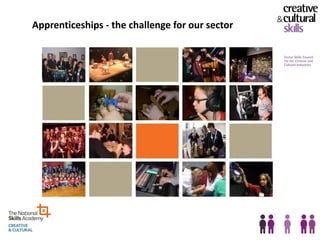
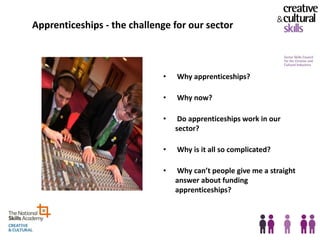
Apprenticeships - the challenge for our sector


                             •   Why apprenticeships?

                             •   Why now?

                             •    Do apprenticeships work in our
                                 sector?

                             •   Why is it all so complicated?

                             •   Why can’t people give me a straight
                                 answer about funding
                                 apprenticeships?


                                                                       3
Sector Skills Councils


•   Work with employers, education and Government to make sure that
    their sectors can recruit people with the right skills for the job market.

•   Produce Labour Market Intelligence, support qualifications
    development and engage with employers.

•   Funded and licensed by the UK Commission for Employment and Skills
    (UKCES) and working closely with the Department of Business,
    Innovation and Skills (BIS) and the Skills Funding Agency.
Creative & Cultural Skills

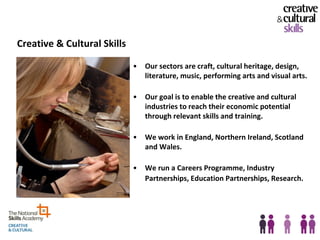
                             •   Our sectors are craft, cultural heritage, design,
                                 literature, music, performing arts and visual arts.

                             •   Our goal is to enable the creative and cultural
                                 industries to reach their economic potential
                                 through relevant skills and training.

                             •   We work in England, Northern Ireland, Scotland
                                 and Wales.

                             •   We run a Careers Programme, Industry
                                 Partnerships, Education Partnerships, Research.
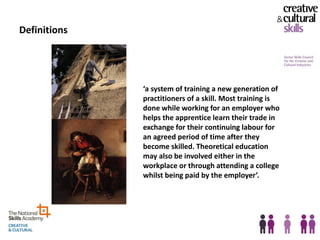
Definitions


              ‘a system of training a new generation of
              practitioners of a skill. Most training is
              done while working for an employer who
              helps the apprentice learn their trade in
              exchange for their continuing labour for
              an agreed period of time after they
              become skilled. Theoretical education
              may also be involved either in the
              workplace or through attending a college
              whilst being paid by the employer’.
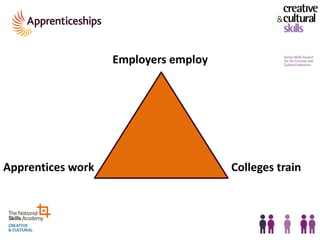
Employers employ


Apprentices work                      Colleges train
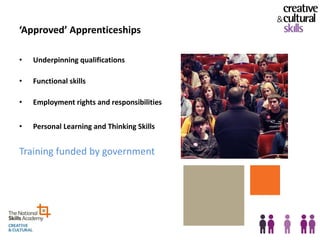
‘Approved’ Apprenticeships

•   Underpinning qualifications

•   Functional skills

•   Employment rights and responsibilities


•   Personal Learning and Thinking Skills


Training funded by government


                                             8
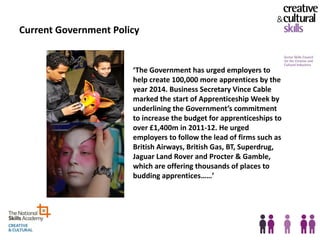
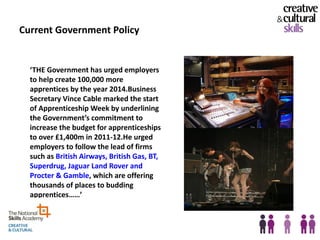
Current Government Policy


                       ‘The Government has urged employers to
                       help create 100,000 more apprentices by the
                       year 2014. Business Secretary Vince Cable
                       marked the start of Apprenticeship Week by
                       underlining the Government’s commitment
                       to increase the budget for apprenticeships to
                       over £1,400m in 2011-12. He urged
                       employers to follow the lead of firms such as
                       British Airways, British Gas, BT, Superdrug,
                       Jaguar Land Rover and Procter & Gamble,
                       which are offering thousands of places to
                       budding apprentices……’


                                                                       9
Jobs in the creative industries...
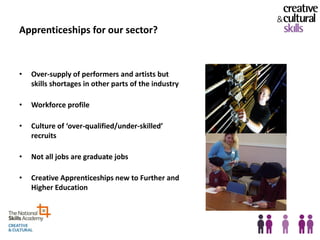
Apprenticeships for our sector?


•   Over-supply of performers and artists but
    skills shortages in other parts of the industry

•   Workforce profile

•   Culture of ‘over-qualified/under-skilled’
    recruits

•   Not all jobs are graduate jobs

•   Creative Apprenticeships new to Further and
    Higher Education


                                                      11
The Creative Industries


•   66,900 businesses, 85% of which employ fewer than 5 people.

•   Highly qualified: 54% of workers educated to level 4 or above.

•   Far more qualified than the UK economy as a whole, where only 34% are
    educated to this level.

•   The average worker earns £8.60 an hour, compared with the total
    economy, where the average hourly wage is £8.69.
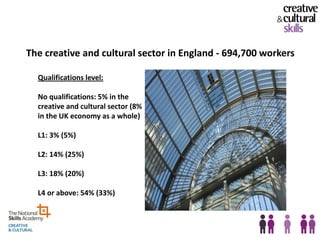
The creative and cultural sector in England - 694,700 workers

  Qualifications level:

  No qualifications: 5% in the
  creative and cultural sector (8%
  in the UK economy as a whole)

  L1: 3% (5%)

  L2: 14% (25%)

  L3: 18% (20%)

  L4 or above: 54% (33%)
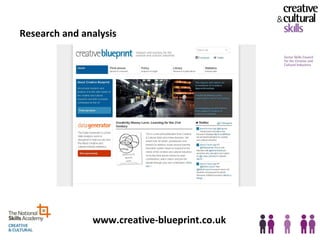
Research and analysis


               www.creative-blueprint.co.uk
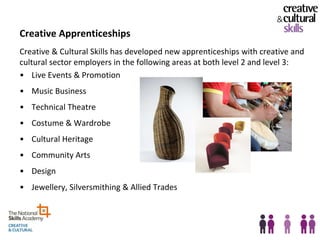
Creative Apprenticeships
Creative & Cultural Skills has developed new apprenticeships with creative and
cultural sector employers in the following areas at both level 2 and level 3:
• Live Events & Promotion
• Music Business
• Technical Theatre
• Costume & Wardrobe
• Cultural Heritage
• Community Arts
• Design
• Jewellery, Silversmithing & Allied Trades
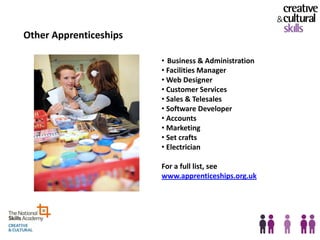
Other Apprenticeships

                        • Business & Administration
                        • Facilities Manager
                        • Web Designer
                        • Customer Services
                        • Sales & Telesales
                        • Software Developer
                        • Accounts
                        • Marketing
                        • Set crafts
                        • Electrician

                        For a full list, see
                        www.apprenticeships.org.uk
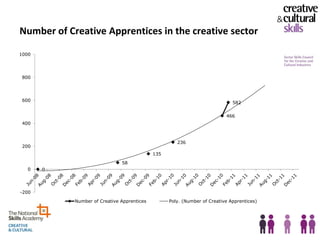
Number of Creative Apprentices in the creative sector

1000

                                                                                            923


800


600
                                                                              582

                                                                           466
400


                                                      236
200
                                             135
                               58
  0    0


-200

            Number of Creative Apprentices         Poly. (Number of Creative Apprentices)
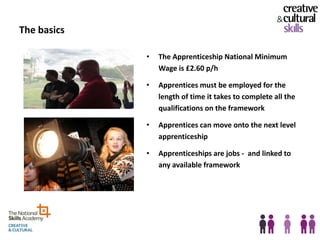
The basics

             •   The Apprenticeship National Minimum
                 Wage is £2.60 p/h

             •   Apprentices must be employed for the
                 length of time it takes to complete all the
                 qualifications on the framework

             •   Apprentices can move onto the next level
                 apprenticeship

             •   Apprenticeships are jobs - and linked to
                 any available framework
Some Apprenticeship Myths

 •   Apprenticeships are expensive

 •   Apprenticeships are only for large businesses

 •   I’d have to allocate so much money to train an apprentice

 •   I’d be better off with a graduate intern

 •   I’d have to get all my staff CRB checked

 •   All my jobs are graduate jobs

 •   An apprentice would be too immature for the workplace

 •   The whole process is bureaucracy-heavy
Challenges (1)


There are 21,620 creative businesses in London

•   88% employer fewer than 5 people.

•   93% employer fewer than 50 people

The sector is dependent on freelancers

Visual Arts (81%), Literary Arts (65%), Music (59%), Performing Arts (56%), Craft
(53%), Design (48%) and Cultural Heritage (6%).
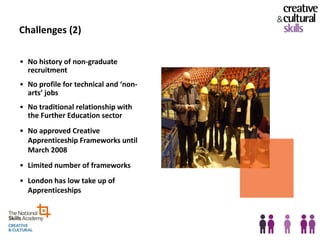
Challenges (2)

• No history of non-graduate
  recruitment
• No profile for technical and ‘non-
  arts’ jobs
• No traditional relationship with
  the Further Education sector
• No approved Creative
  Apprenticeship Frameworks until
  March 2008
• Limited number of frameworks
• London has low take up of
  Apprenticeships
Current Government Policy


  ‘THE Government has urged employers
  to help create 100,000 more
  apprentices by the year 2014.Business
  Secretary Vince Cable marked the start
  of Apprenticeship Week by underlining
  the Government’s commitment to
  increase the budget for apprenticeships
  to over £1,400m in 2011-12.He urged
  employers to follow the lead of firms
  such as British Airways, British Gas, BT,
  Superdrug, Jaguar Land Rover and
  Procter & Gamble, which are offering
  thousands of places to budding
  apprentices……’


                                              22
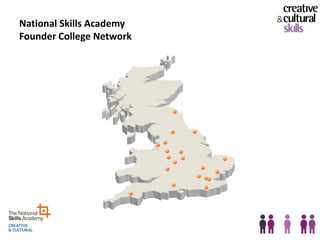
National Skills Academy
Founder College Network


                          23
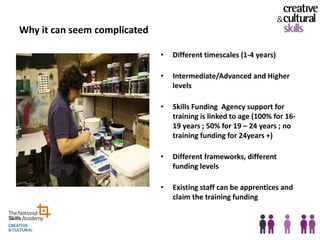
Why it can seem complicated

                              •   Different timescales (1-4 years)

                              •   Intermediate/Advanced and Higher
                                  levels

                              •   Skills Funding Agency support for
                                  training is linked to age (100% for 16-
                                  19 years ; 50% for 19 – 24 years ; no
                                  training funding for 24years +)

                              •   Different frameworks, different
                                  funding levels

                              •   Existing staff can be apprentices and
                                  claim the training funding
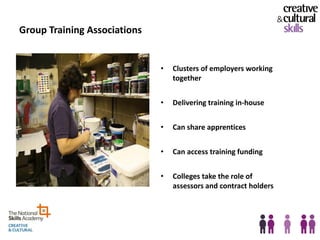
Group Training Associations


                              •   Clusters of employers working
                                  together


                              •   Delivering training in-house


                              •   Can share apprentices


                              •   Can access training funding


                              •   Colleges take the role of
                                  assessors and contract holders
Sector Skills Councils


•   Develop and approve National Occupational Standards (NOS)

•   Operate as an ‘Issuing Authority’ for apprenticeships

•   Develop and issue apprenticeship frameworks

•   Ensure apprenticeships are relevant and fit for purpose

•   ‘Quality assure’ apprenticeship frameworks.
Industry-endorsed careers advice and guidance


                 www.getintotheatre.org
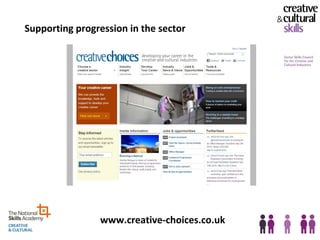
Supporting progression in the sector


                www.creative-choices.co.uk
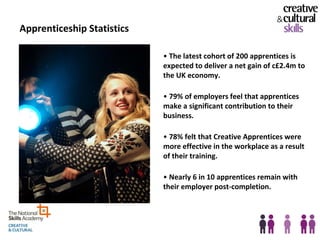
Apprenticeship Statistics

                            • The latest cohort of 200 apprentices is
                            expected to deliver a net gain of c£2.4m to
                            the UK economy.

                            • 79% of employers feel that apprentices
                            make a significant contribution to their
                            business.

                            • 78% felt that Creative Apprentices were
                            more effective in the workplace as a result
                            of their training.

                            • Nearly 6 in 10 apprentices remain with
                            their employer post-completion.
Further Information


                      pauline.tambling@ccskills.org.uk

                      www.twitter.com/NSACreative

                          www.nsa-ccskills.co.uk

                            www.ccskills.org.uk

Creative Apprenticeships presentation - Pauline Tambling

  • 1.
    Pauline Tambling Joint CEO, Creative & Cultural Skills Managing Director, National Skills Academy for Creative & Cultural
  • 2.
    Apprenticeships - thechallenge for our sector
  • 3.
    Apprenticeships - thechallenge for our sector • Why apprenticeships? • Why now? • Do apprenticeships work in our sector? • Why is it all so complicated? • Why can’t people give me a straight answer about funding apprenticeships? 3
  • 4.
    Sector Skills Councils • Work with employers, education and Government to make sure that their sectors can recruit people with the right skills for the job market. • Produce Labour Market Intelligence, support qualifications development and engage with employers. • Funded and licensed by the UK Commission for Employment and Skills (UKCES) and working closely with the Department of Business, Innovation and Skills (BIS) and the Skills Funding Agency.
  • 5.
    Creative & CulturalSkills • Our sectors are craft, cultural heritage, design, literature, music, performing arts and visual arts. • Our goal is to enable the creative and cultural industries to reach their economic potential through relevant skills and training. • We work in England, Northern Ireland, Scotland and Wales. • We run a Careers Programme, Industry Partnerships, Education Partnerships, Research.
  • 6.
    Definitions ‘a system of training a new generation of practitioners of a skill. Most training is done while working for an employer who helps the apprentice learn their trade in exchange for their continuing labour for an agreed period of time after they become skilled. Theoretical education may also be involved either in the workplace or through attending a college whilst being paid by the employer’.
  • 7.
  • 8.
    ‘Approved’ Apprenticeships • Underpinning qualifications • Functional skills • Employment rights and responsibilities • Personal Learning and Thinking Skills Training funded by government 8
  • 9.
    Current Government Policy ‘The Government has urged employers to help create 100,000 more apprentices by the year 2014. Business Secretary Vince Cable marked the start of Apprenticeship Week by underlining the Government’s commitment to increase the budget for apprenticeships to over £1,400m in 2011-12. He urged employers to follow the lead of firms such as British Airways, British Gas, BT, Superdrug, Jaguar Land Rover and Procter & Gamble, which are offering thousands of places to budding apprentices……’ 9
  • 10.
    Jobs in thecreative industries...
  • 11.
    Apprenticeships for oursector? • Over-supply of performers and artists but skills shortages in other parts of the industry • Workforce profile • Culture of ‘over-qualified/under-skilled’ recruits • Not all jobs are graduate jobs • Creative Apprenticeships new to Further and Higher Education 11
  • 12.
    The Creative Industries • 66,900 businesses, 85% of which employ fewer than 5 people. • Highly qualified: 54% of workers educated to level 4 or above. • Far more qualified than the UK economy as a whole, where only 34% are educated to this level. • The average worker earns £8.60 an hour, compared with the total economy, where the average hourly wage is £8.69.
  • 13.
    The creative andcultural sector in England - 694,700 workers Qualifications level: No qualifications: 5% in the creative and cultural sector (8% in the UK economy as a whole) L1: 3% (5%) L2: 14% (25%) L3: 18% (20%) L4 or above: 54% (33%)
  • 14.
    Research and analysis www.creative-blueprint.co.uk
  • 15.
    Creative Apprenticeships Creative &Cultural Skills has developed new apprenticeships with creative and cultural sector employers in the following areas at both level 2 and level 3: • Live Events & Promotion • Music Business • Technical Theatre • Costume & Wardrobe • Cultural Heritage • Community Arts • Design • Jewellery, Silversmithing & Allied Trades
  • 16.
    Other Apprenticeships • Business & Administration • Facilities Manager • Web Designer • Customer Services • Sales & Telesales • Software Developer • Accounts • Marketing • Set crafts • Electrician For a full list, see www.apprenticeships.org.uk
  • 17.
    Number of CreativeApprentices in the creative sector 1000 923 800 600 582 466 400 236 200 135 58 0 0 -200 Number of Creative Apprentices Poly. (Number of Creative Apprentices)
  • 18.
    The basics • The Apprenticeship National Minimum Wage is £2.60 p/h • Apprentices must be employed for the length of time it takes to complete all the qualifications on the framework • Apprentices can move onto the next level apprenticeship • Apprenticeships are jobs - and linked to any available framework
  • 19.
    Some Apprenticeship Myths • Apprenticeships are expensive • Apprenticeships are only for large businesses • I’d have to allocate so much money to train an apprentice • I’d be better off with a graduate intern • I’d have to get all my staff CRB checked • All my jobs are graduate jobs • An apprentice would be too immature for the workplace • The whole process is bureaucracy-heavy
  • 20.
    Challenges (1) There are21,620 creative businesses in London • 88% employer fewer than 5 people. • 93% employer fewer than 50 people The sector is dependent on freelancers Visual Arts (81%), Literary Arts (65%), Music (59%), Performing Arts (56%), Craft (53%), Design (48%) and Cultural Heritage (6%).
  • 21.
    Challenges (2) • Nohistory of non-graduate recruitment • No profile for technical and ‘non- arts’ jobs • No traditional relationship with the Further Education sector • No approved Creative Apprenticeship Frameworks until March 2008 • Limited number of frameworks • London has low take up of Apprenticeships
  • 22.
    Current Government Policy ‘THE Government has urged employers to help create 100,000 more apprentices by the year 2014.Business Secretary Vince Cable marked the start of Apprenticeship Week by underlining the Government’s commitment to increase the budget for apprenticeships to over £1,400m in 2011-12.He urged employers to follow the lead of firms such as British Airways, British Gas, BT, Superdrug, Jaguar Land Rover and Procter & Gamble, which are offering thousands of places to budding apprentices……’ 22
  • 23.
  • 24.
    Why it canseem complicated • Different timescales (1-4 years) • Intermediate/Advanced and Higher levels • Skills Funding Agency support for training is linked to age (100% for 16- 19 years ; 50% for 19 – 24 years ; no training funding for 24years +) • Different frameworks, different funding levels • Existing staff can be apprentices and claim the training funding
  • 25.
    Group Training Associations • Clusters of employers working together • Delivering training in-house • Can share apprentices • Can access training funding • Colleges take the role of assessors and contract holders
  • 26.
    Sector Skills Councils • Develop and approve National Occupational Standards (NOS) • Operate as an ‘Issuing Authority’ for apprenticeships • Develop and issue apprenticeship frameworks • Ensure apprenticeships are relevant and fit for purpose • ‘Quality assure’ apprenticeship frameworks.
  • 27.
    Industry-endorsed careers adviceand guidance www.getintotheatre.org
  • 28.
    Supporting progression inthe sector www.creative-choices.co.uk
  • 29.
    Apprenticeship Statistics • The latest cohort of 200 apprentices is expected to deliver a net gain of c£2.4m to the UK economy. • 79% of employers feel that apprentices make a significant contribution to their business. • 78% felt that Creative Apprentices were more effective in the workplace as a result of their training. • Nearly 6 in 10 apprentices remain with their employer post-completion.
  • 30.
    Further Information pauline.tambling@ccskills.org.uk www.twitter.com/NSACreative www.nsa-ccskills.co.uk www.ccskills.org.uk