COMPETENCY MAPPING   – Effective Uses & Application
What is a Competency ?   The word competency is derived from Latin word "Competere" which means 'to be suitable‘. Competency can be defined as knowledge, skill or ability of employees relevant for organizational performance.  The minimum requirement an employee must comply with in order to deliver specific outcomes at a predefined standard.
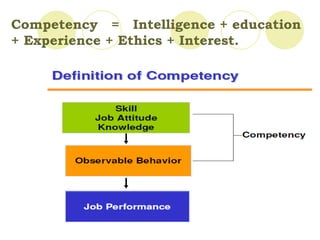
Competency  =  Intelligence + education + Experience + Ethics + Interest.
TYPES OF COMPETENCIES Generic:  Competencies which are considered essential for all staff, regardless of their function or level,   Specific: Competencies  required to do particular job or task. Threshold or performance:  Basic competencies required to do the job, which do not differentiate  between high and low performers Performance competencies are those that differentiate between high and low performers Differentiating Competencies:  Behavioral characteristics that high performers display.
Managerial Competencies: Competencies which are considered essential for staff with managerial or supervisory responsibility in any service or program area, including directors and senior posts. Example - Decision Making,  team leadership, change management  etc Technical Competencies:  Specific competencies which are considered essential to perform any job in the Organization within a defined technical or functional area of work  Example - Investment  Management, Finance and Administration, HRM etc  Behavioral Competencies: Competencies considered essential for all. Example – Communication skill, Assertive, Negotiation, Effective listener, Empathy etc TYPES OF COMPETENCIES
Why are Competencies Important? To  guide direction; To Increase productivity; They are measurable; To Improve work performance Competencies can be learned; They can distinguish and differentiate the organization; They can help to integrate management practices; Employees know well what is expected of them; Help to  focus on organizational objectives; Approach to build trust between employees and management.
What is Competency Mapping? Competency Mapping is processes of identifying key competencies for an organization and/or a job and incorporating those competencies throughout the various processes (i.e. job evaluation, training, recruitment) of the organization. Competency Mapping is a process an individual uses to identify and describe competencies that are critical to success in work situation and work role. To map  a gap between the existing knowledge in the organization and the knowledge needed in future.
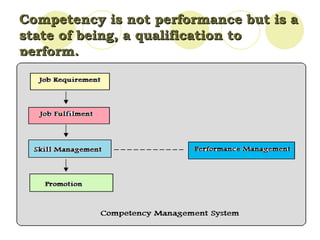
Competency is not performance but is a state of being, a qualification to perform.
Competency Framework  Competency framework is collection of competencies and behavioral indicator.  Competency framework is of two forms-  Role specific  – contain details of behavioral indicator related to particular role & responsibility. Core framework  – contains those which are appropriate to all roles & responsibilities.
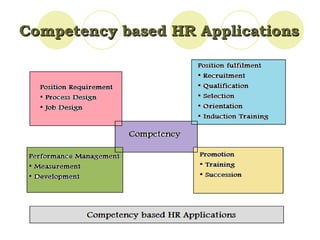
Competency based HR Applications
COMPETENCY IDENTIFICATION & ASSESSMENT TOOLS 360 Degree feedback;  Assessment Centre; Snapshot of Productivity & Effectiveness of Key Managers; Role plays;  Benchmarking & Case study; Observation of critical skills, behavior & attitude to succeed; Measuring Outcomes : Organizational, Team & Individual Gaps; Structured Experiences/Simulations/Business Games; Top Performer Survey; Behavioral Event Interview (BEI)
 
Why Competency Models fails to achieve desired results? Competencies are focused more on Behaviour than Results; Competencies are too Generic; Competencies are Linked to the Past and not the Future; Insufficient attention paid to competency application; Lack of proper implementation of Competency identification & assessment tools; Competency Models are owned by HR more than line management; Management focus more on middle & lower level while ignoring top level.
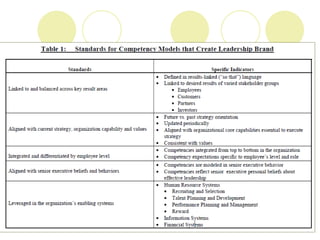
What Needs to be Done? Competencies must be linked to the organization’s key result areas and balanced across them; Competencies must be aligned with current strategy, organization capabilities and values; Competency expectations must be differentiated to fit with varying employee roles-- yet integrated from top to bottom; Competency expectations must be aligned with the beliefs of senior executives and modelled in their personal behaviour and commitment; Competencies must be connected to and leveraged within the organization’s enabling systems.
Benefits of Competency Models that Build Leadership Brand Branding is not just developing generic attributes, but developing attributes that lead to a set of specific outcomes and that are aligned with its strategy, core capabilities and values. Employees with branded leaders know what is expected of them, both in terms of how they work and what they must accomplish at work. When an entire leadership hierarchy gets focused on delivering the same results and has developed models identifying relevant attributes to deliver these results, they gain and can sustain a  Competitive Advantage.
Thanks Savinder Kaur Positiveness is in my blood; I’m  B+

Competency Mapping

  • 1.
    COMPETENCY MAPPING – Effective Uses & Application
  • 2.
    What is aCompetency ? The word competency is derived from Latin word "Competere" which means 'to be suitable‘. Competency can be defined as knowledge, skill or ability of employees relevant for organizational performance. The minimum requirement an employee must comply with in order to deliver specific outcomes at a predefined standard.
  • 3.
    Competency = Intelligence + education + Experience + Ethics + Interest.
  • 4.
    TYPES OF COMPETENCIESGeneric: Competencies which are considered essential for all staff, regardless of their function or level, Specific: Competencies required to do particular job or task. Threshold or performance: Basic competencies required to do the job, which do not differentiate between high and low performers Performance competencies are those that differentiate between high and low performers Differentiating Competencies: Behavioral characteristics that high performers display.
  • 5.
    Managerial Competencies: Competencieswhich are considered essential for staff with managerial or supervisory responsibility in any service or program area, including directors and senior posts. Example - Decision Making, team leadership, change management etc Technical Competencies: Specific competencies which are considered essential to perform any job in the Organization within a defined technical or functional area of work Example - Investment Management, Finance and Administration, HRM etc Behavioral Competencies: Competencies considered essential for all. Example – Communication skill, Assertive, Negotiation, Effective listener, Empathy etc TYPES OF COMPETENCIES
  • 6.
    Why are CompetenciesImportant? To guide direction; To Increase productivity; They are measurable; To Improve work performance Competencies can be learned; They can distinguish and differentiate the organization; They can help to integrate management practices; Employees know well what is expected of them; Help to focus on organizational objectives; Approach to build trust between employees and management.
  • 7.
    What is CompetencyMapping? Competency Mapping is processes of identifying key competencies for an organization and/or a job and incorporating those competencies throughout the various processes (i.e. job evaluation, training, recruitment) of the organization. Competency Mapping is a process an individual uses to identify and describe competencies that are critical to success in work situation and work role. To map a gap between the existing knowledge in the organization and the knowledge needed in future.
  • 8.
    Competency is notperformance but is a state of being, a qualification to perform.
  • 9.
    Competency Framework Competency framework is collection of competencies and behavioral indicator. Competency framework is of two forms- Role specific – contain details of behavioral indicator related to particular role & responsibility. Core framework – contains those which are appropriate to all roles & responsibilities.
  • 10.
    Competency based HRApplications
  • 11.
    COMPETENCY IDENTIFICATION &ASSESSMENT TOOLS 360 Degree feedback; Assessment Centre; Snapshot of Productivity & Effectiveness of Key Managers; Role plays; Benchmarking & Case study; Observation of critical skills, behavior & attitude to succeed; Measuring Outcomes : Organizational, Team & Individual Gaps; Structured Experiences/Simulations/Business Games; Top Performer Survey; Behavioral Event Interview (BEI)
  • 12.
  • 13.
    Why Competency Modelsfails to achieve desired results? Competencies are focused more on Behaviour than Results; Competencies are too Generic; Competencies are Linked to the Past and not the Future; Insufficient attention paid to competency application; Lack of proper implementation of Competency identification & assessment tools; Competency Models are owned by HR more than line management; Management focus more on middle & lower level while ignoring top level.
  • 14.
    What Needs tobe Done? Competencies must be linked to the organization’s key result areas and balanced across them; Competencies must be aligned with current strategy, organization capabilities and values; Competency expectations must be differentiated to fit with varying employee roles-- yet integrated from top to bottom; Competency expectations must be aligned with the beliefs of senior executives and modelled in their personal behaviour and commitment; Competencies must be connected to and leveraged within the organization’s enabling systems.
  • 15.
    Benefits of CompetencyModels that Build Leadership Brand Branding is not just developing generic attributes, but developing attributes that lead to a set of specific outcomes and that are aligned with its strategy, core capabilities and values. Employees with branded leaders know what is expected of them, both in terms of how they work and what they must accomplish at work. When an entire leadership hierarchy gets focused on delivering the same results and has developed models identifying relevant attributes to deliver these results, they gain and can sustain a Competitive Advantage.
  • 16.
    Thanks Savinder KaurPositiveness is in my blood; I’m B+