Competency-based Selection SystemsBy: Omar Terani
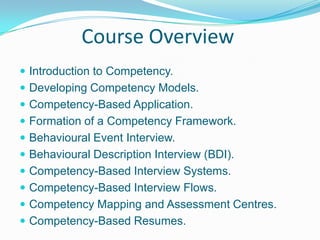
Course OverviewIntroduction to Competency.Developing Competency Models.Competency-Based Application.Formation of a Competency Framework.Behavioural Event Interview.Behavioural Description Interview (BDI).Competency-Based Interview Systems.Competency-Based Interview Flows.Competency Mapping and Assessment Centres.Competency-Based Resumes.
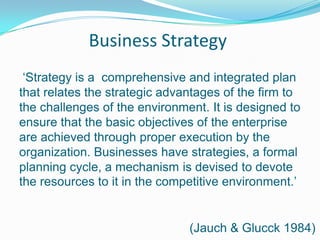
Business Strategy‘Strategy is a comprehensive and integrated plan that relates the strategic advantages of the firm to the challenges of the environment. It is designed to ensure that the basic objectives of the enterprise are achieved through proper execution by the organization. Businesses have strategies, a formal planning cycle, a mechanism is devised to devote the resources to it in the competitive environment.’(Jauch & Glucck 1984)
The Competitive AdvantagePorter's Generic Competitive StrategiesCost LeadershipDifferentiationFocus coast leadershipFocus differentiation.(Porter, M.,  1985)
Environmental ImperativesCommunication channelsIT services and IT enabled servicesValue-based managementGrowth opportunitiesIncreased operational efficiency and effectiveness with technology supportOn and off shore delivery from/to third world economiesImpact of globalisationBusiness has taken ownership for performanceRegulatory mechanisms and converging industriesIncreased sensitivity to shareholder values.Demand side and competition.Fast changing technologies.
Competency definition‘A cluster of related knowledge, skills and attitudes that affects a major part of one’s job (a role or responsibility), that correlates with performance on the job, that can be measured against well-accepted standards and that can be improved via training and development’.“Competencies can be defined as skills, areas of knowledge, attitudes and abilities that distinguish high performers”(Parry 1996)
Competency?Competencies are Characteristics.Competencies lead to the demonstration of skills and abilities.Competencies must lead to effective performanceCompetency also embodies the capacity to transfer skills and abilities from one area to another.
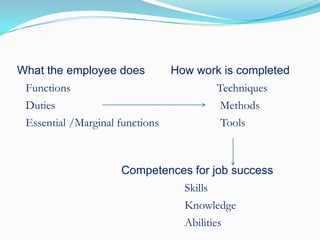
What the employee does        How work is completed   Functions 	                                               Techniques   DutiesMethods   Essential /Marginal functions 	               ToolsCompetences for job success                 Skills               Knowledge               Abilities
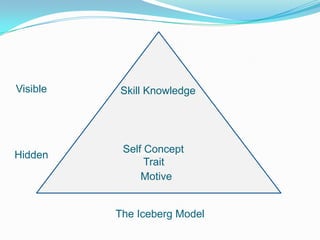
Self Concept VisibleSkill Knowledge Self Concept        Trait       MotiveHiddenThe Iceberg Model
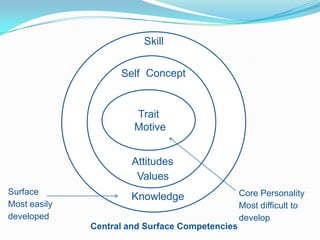
SkillConceptSelfTraitMotive Attitudes   ValuesSurfaceMost easily developedCore PersonalityMost difficult to developKnowledgeCentral and Surface Competencies
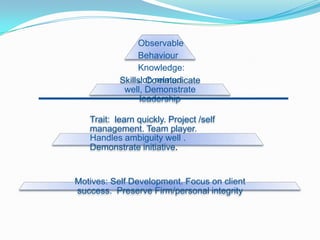
Observable BehaviourKnowledge: Job related
Core Competencies   vs.  Workplace Competencies                                  Core                           WorkplaceScope                       Organisation               IndividualPurpose                    Strategic                     TacticalParticipant(s)             Business unit              WorkerTasks                         Processes                    ActivitiesCompetencies           Global                          Position
Competencies for Competitive AdvantageArt of good management is the ability to make a practical assessment of an organisation’s suitability to its task or strategy.Competencies are an organisation’s most important resources because they are valuable, rare and difficult to initiate.Mapping competencies is most important and has to be related to the corporate strategy.
Myths about CompetencyCompetence is not performance.Competence is not process input.Competence is not process output.Competence is not a trait.Competence is not capability or ability.Competence is not a motivational attitude.
Developing Competency ModelsMaximise the advantages of state-of-the-art technology, superior products, and steady source of capital.Identify the essential knowledge, skills and attributes needed for successful performance in a job aligned with the strategy.Highly concrete proficiencies.Ability to think strategically or to influence others
Competencies ModelCompetencies must be defined along with examples. Some models are meant to identify the core competencies.Competency model should be developed with a specific role in mind.What skills, knowledge and characteristics are required to do the job?What behaviour has the most direct impact on performance and success in the job?
How HRM systems are ensured by a competency model?Training and Development.Succession Planning.Performance.Hiring the Best Available People.Productivity Maximisation.Adapting to Change.Aligning Behaviour with Organisational Strategies and Values.
Various Competency ModelsJob Competence Assessment Method.Modified Job Competence Assessment Method.Generic Model Overlay Method.Customised Generic Model Method.Flexible Job Competency Model Method.Accelerated Competency Systems Method.
The Personal Competency FrameworkIntellectual.                         Personal.                                  Communication.   Interpersonal.                                     Leadership.                      Result Oriented.Performance Rating Scale.Importance Rating Scale
The Lancaster (Burgoyne) Model of Managerial Competencies.Command of Basic Facts.Relevant Professional KnowledgeContinuing Sensitivity to Events.Social Skills and Abilities.Balanced Learning Habits and SkillsEmotional Resilience.Proactivity or Inclination to Respond Purposefully to Events.CreativityMental Agility.Self-knowledge(Burgoyne and Stuart 1976)

Competency Based Selection System Pub

  • 1.
  • 2.
    Course OverviewIntroduction toCompetency.Developing Competency Models.Competency-Based Application.Formation of a Competency Framework.Behavioural Event Interview.Behavioural Description Interview (BDI).Competency-Based Interview Systems.Competency-Based Interview Flows.Competency Mapping and Assessment Centres.Competency-Based Resumes.
  • 3.
    Business Strategy‘Strategy isa comprehensive and integrated plan that relates the strategic advantages of the firm to the challenges of the environment. It is designed to ensure that the basic objectives of the enterprise are achieved through proper execution by the organization. Businesses have strategies, a formal planning cycle, a mechanism is devised to devote the resources to it in the competitive environment.’(Jauch & Glucck 1984)
  • 4.
    The Competitive AdvantagePorter'sGeneric Competitive StrategiesCost LeadershipDifferentiationFocus coast leadershipFocus differentiation.(Porter, M., 1985)
  • 5.
    Environmental ImperativesCommunication channelsITservices and IT enabled servicesValue-based managementGrowth opportunitiesIncreased operational efficiency and effectiveness with technology supportOn and off shore delivery from/to third world economiesImpact of globalisationBusiness has taken ownership for performanceRegulatory mechanisms and converging industriesIncreased sensitivity to shareholder values.Demand side and competition.Fast changing technologies.
  • 6.
    Competency definition‘A clusterof related knowledge, skills and attitudes that affects a major part of one’s job (a role or responsibility), that correlates with performance on the job, that can be measured against well-accepted standards and that can be improved via training and development’.“Competencies can be defined as skills, areas of knowledge, attitudes and abilities that distinguish high performers”(Parry 1996)
  • 7.
    Competency?Competencies are Characteristics.Competencieslead to the demonstration of skills and abilities.Competencies must lead to effective performanceCompetency also embodies the capacity to transfer skills and abilities from one area to another.
  • 8.
    What the employeedoes How work is completed Functions Techniques DutiesMethods Essential /Marginal functions ToolsCompetences for job success Skills Knowledge Abilities
  • 9.
    Self Concept VisibleSkillKnowledge Self Concept Trait MotiveHiddenThe Iceberg Model
  • 10.
    SkillConceptSelfTraitMotive Attitudes ValuesSurfaceMost easily developedCore PersonalityMost difficult to developKnowledgeCentral and Surface Competencies
  • 11.
  • 12.
    Core Competencies vs. Workplace Competencies Core WorkplaceScope Organisation IndividualPurpose Strategic TacticalParticipant(s) Business unit WorkerTasks Processes ActivitiesCompetencies Global Position
  • 13.
    Competencies for CompetitiveAdvantageArt of good management is the ability to make a practical assessment of an organisation’s suitability to its task or strategy.Competencies are an organisation’s most important resources because they are valuable, rare and difficult to initiate.Mapping competencies is most important and has to be related to the corporate strategy.
  • 14.
    Myths about CompetencyCompetenceis not performance.Competence is not process input.Competence is not process output.Competence is not a trait.Competence is not capability or ability.Competence is not a motivational attitude.
  • 15.
    Developing Competency ModelsMaximisethe advantages of state-of-the-art technology, superior products, and steady source of capital.Identify the essential knowledge, skills and attributes needed for successful performance in a job aligned with the strategy.Highly concrete proficiencies.Ability to think strategically or to influence others
  • 16.
    Competencies ModelCompetencies mustbe defined along with examples. Some models are meant to identify the core competencies.Competency model should be developed with a specific role in mind.What skills, knowledge and characteristics are required to do the job?What behaviour has the most direct impact on performance and success in the job?
  • 17.
    How HRM systemsare ensured by a competency model?Training and Development.Succession Planning.Performance.Hiring the Best Available People.Productivity Maximisation.Adapting to Change.Aligning Behaviour with Organisational Strategies and Values.
  • 18.
    Various Competency ModelsJobCompetence Assessment Method.Modified Job Competence Assessment Method.Generic Model Overlay Method.Customised Generic Model Method.Flexible Job Competency Model Method.Accelerated Competency Systems Method.
  • 19.
    The Personal CompetencyFrameworkIntellectual. Personal. Communication. Interpersonal. Leadership. Result Oriented.Performance Rating Scale.Importance Rating Scale
  • 20.
    The Lancaster (Burgoyne)Model of Managerial Competencies.Command of Basic Facts.Relevant Professional KnowledgeContinuing Sensitivity to Events.Social Skills and Abilities.Balanced Learning Habits and SkillsEmotional Resilience.Proactivity or Inclination to Respond Purposefully to Events.CreativityMental Agility.Self-knowledge(Burgoyne and Stuart 1976)