NHRDN’s Learning Center – 9th April, 2010“Competencies : Concept and Framework”by:P. Dwarakanath Director – Group Human Capital Max India Ltd.
2What will we cover ……..Understanding Competencies?Why Competencies?Developing a Competency Model Linking Competency Model to HR SystemsA look at HR Competencies – HR CompassThe Max Story !!The GSK Story !!
3Understanding Competencies
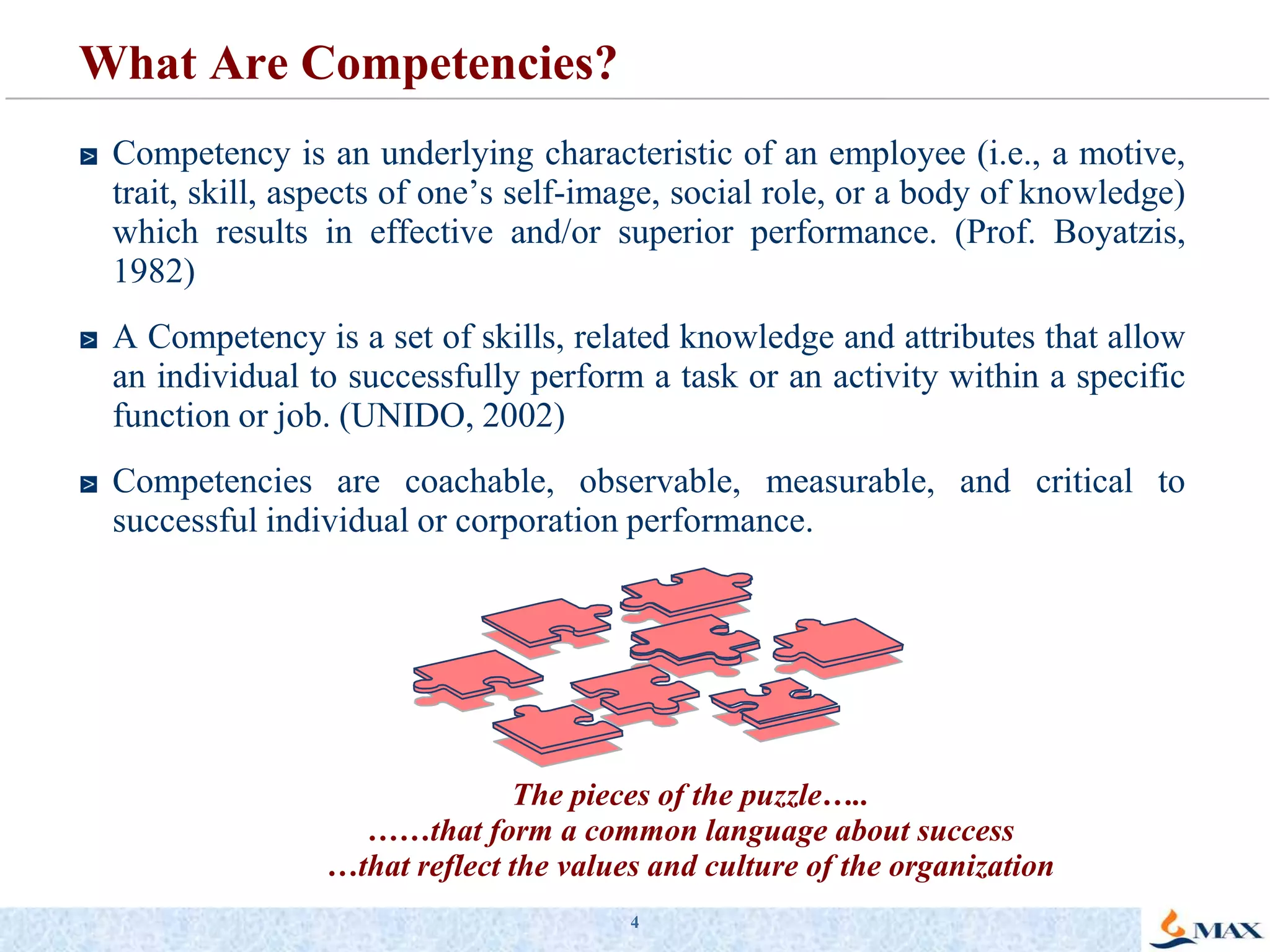
4What Are Competencies?Competency is an underlying characteristic of an employee (i.e., a motive, trait, skill, aspects of one’s self-image, social role, or a body of knowledge) which results in effective and/or superior performance. (Prof. Boyatzis, 1982) A Competency is a set of skills, related knowledge and attributes that allow an individual to successfully perform a task or an activity within a specific function or job. (UNIDO, 2002)Competencies are coachable, observable, measurable, and critical to successful individual or corporation performance.The pieces of the puzzle…..……that form a common language about success…that reflect the values and culture of the organization
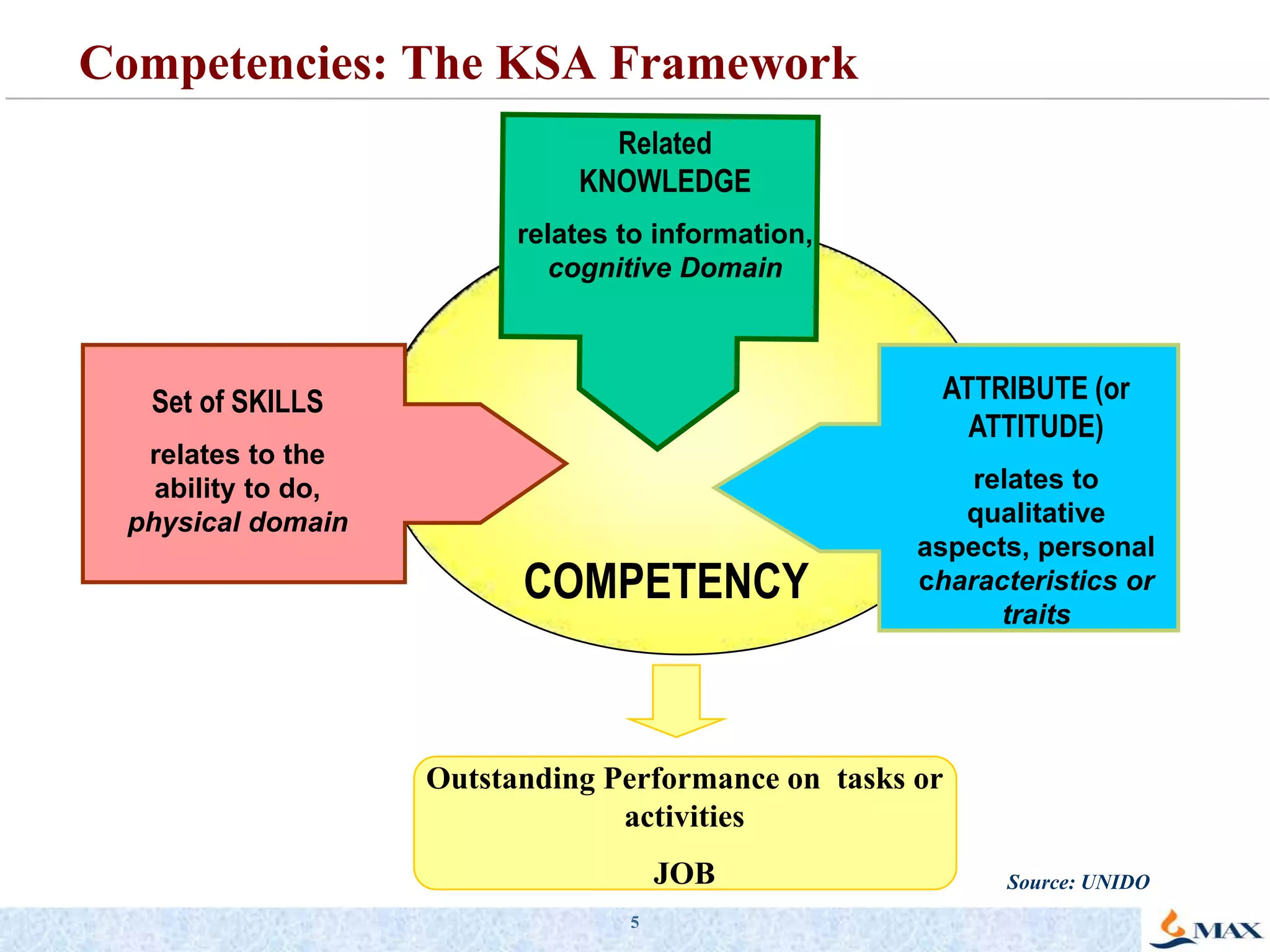
5Related KNOWLEDGErelates to information, cognitive DomainATTRIBUTE (or ATTITUDE)relates to qualitative aspects, personal characteristics or traitsSet of SKILLSrelates to the ability to do, physical domainCOMPETENCYOutstanding Performance on  tasks or activitiesJOBCompetencies: The KSA FrameworkSource: UNIDO
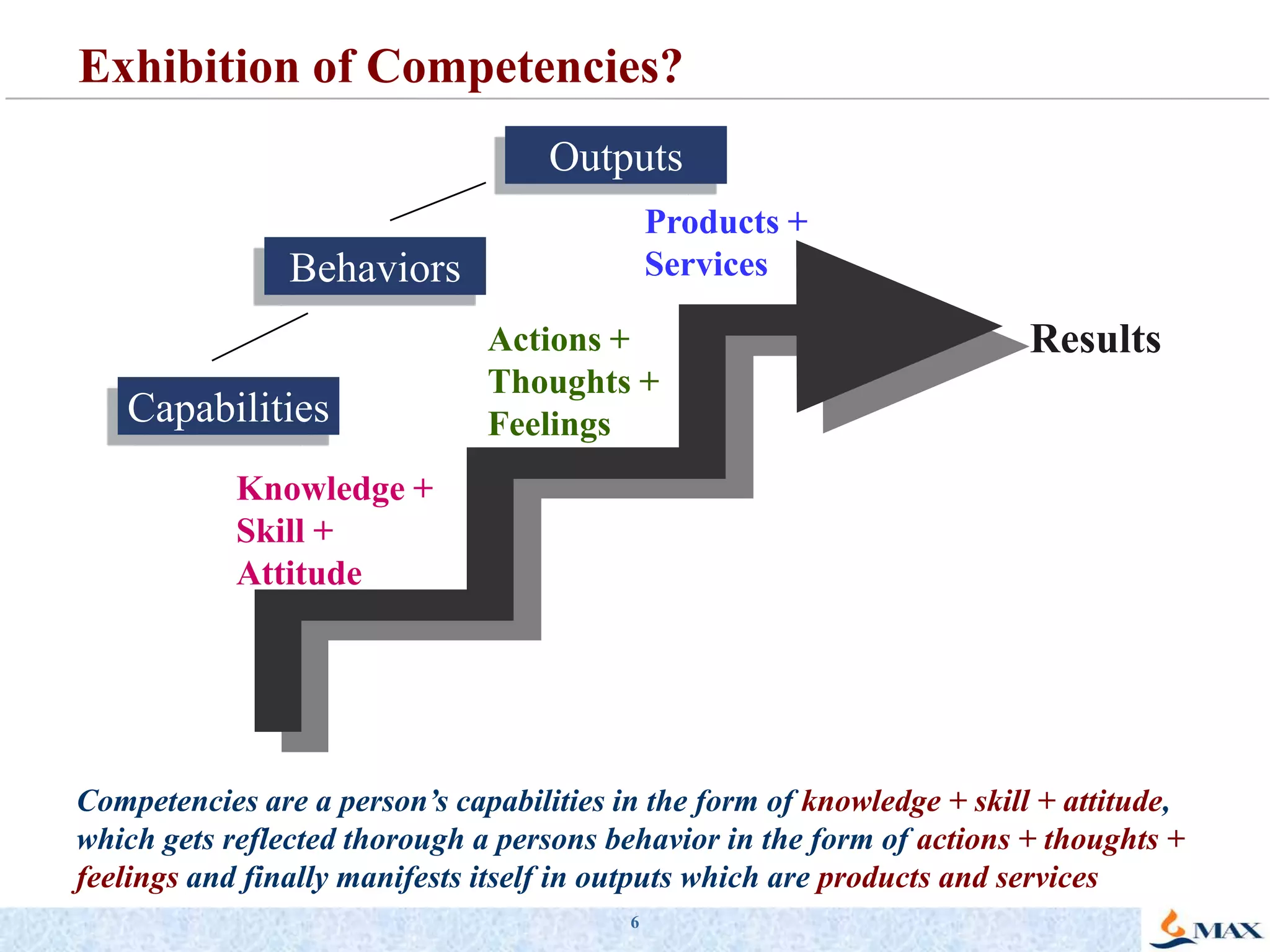
6Exhibition of Competencies?OutputsProducts + ServicesBehaviorsResultsActions + Thoughts + FeelingsCapabilitiesKnowledge + Skill + AttitudeCompetencies are a person’s capabilities in the form of knowledge + skill + attitude, which gets reflected thorough a persons behavior in the form of actions + thoughts + feelings and finally manifests itself in outputs which are products and services
7Let’s Have Few Examples of Competencies ……
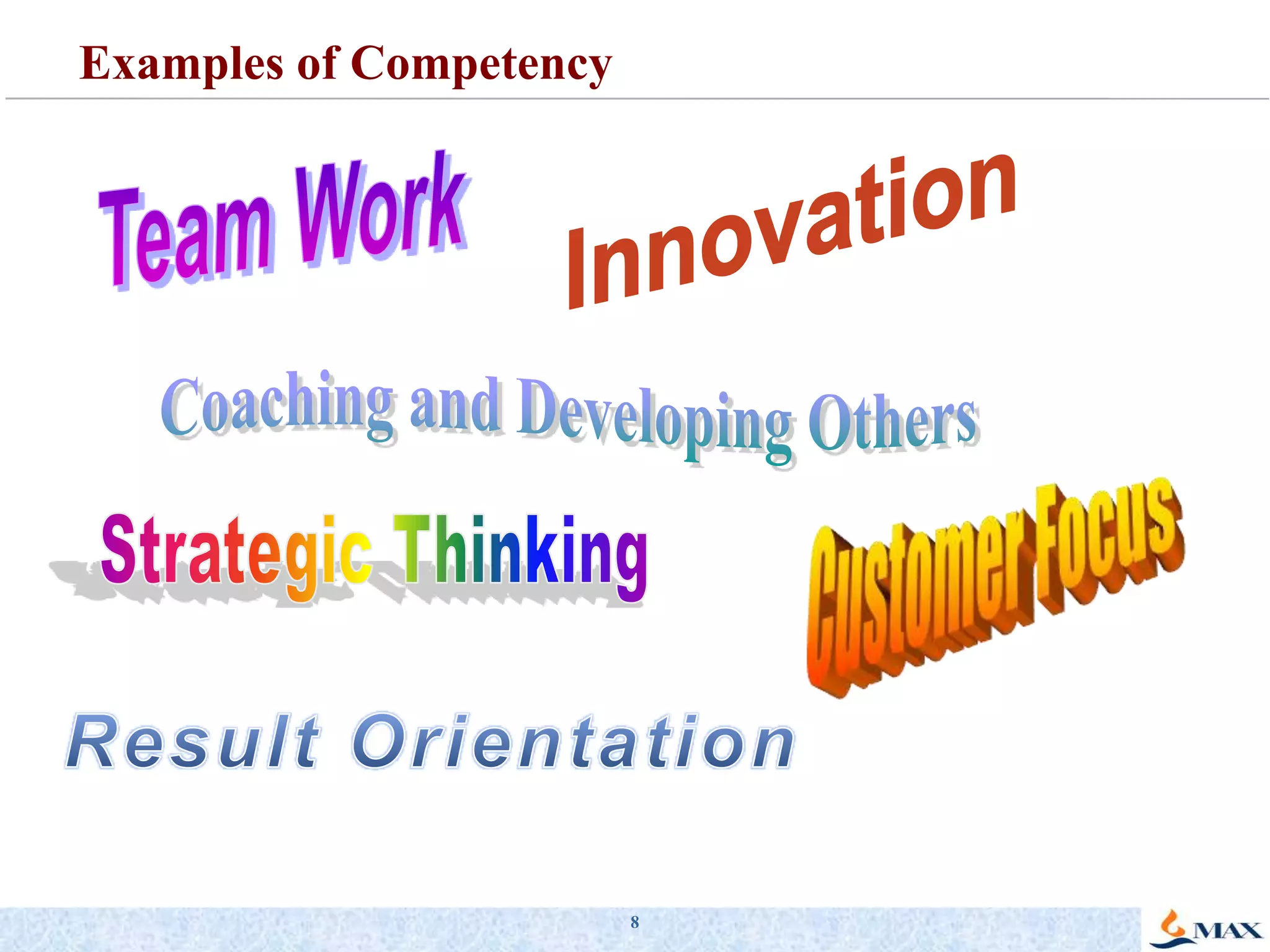
8Examples of CompetencyInnovationTeam WorkCoaching and Developing OthersCustomer FocusStrategic ThinkingResult Orientation
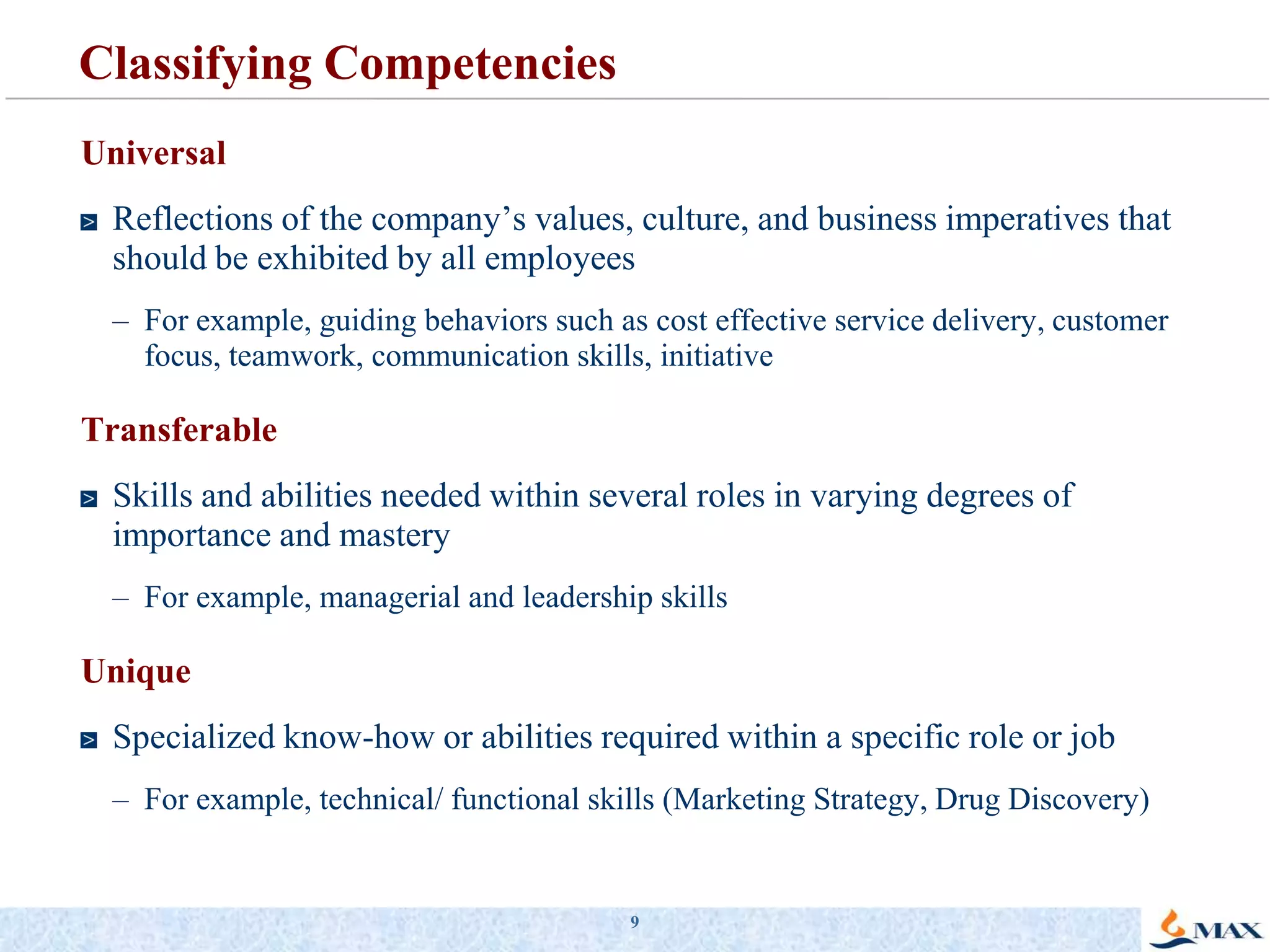
9Classifying CompetenciesUniversalReflections of the company’s values, culture, and business imperatives that should be exhibited by all employeesFor example, guiding behaviors such as cost effective service delivery, customer focus, teamwork, communication skills, initiativeTransferableSkills and abilities needed within several roles in varying degrees of importance and masteryFor example, managerial and leadership skillsUniqueSpecialized know-how or abilities required within a specific role or jobFor example, technical/ functional skills (Marketing Strategy, Drug Discovery)
10Why Competencies?Does it pay to integrate management systems around competencies?
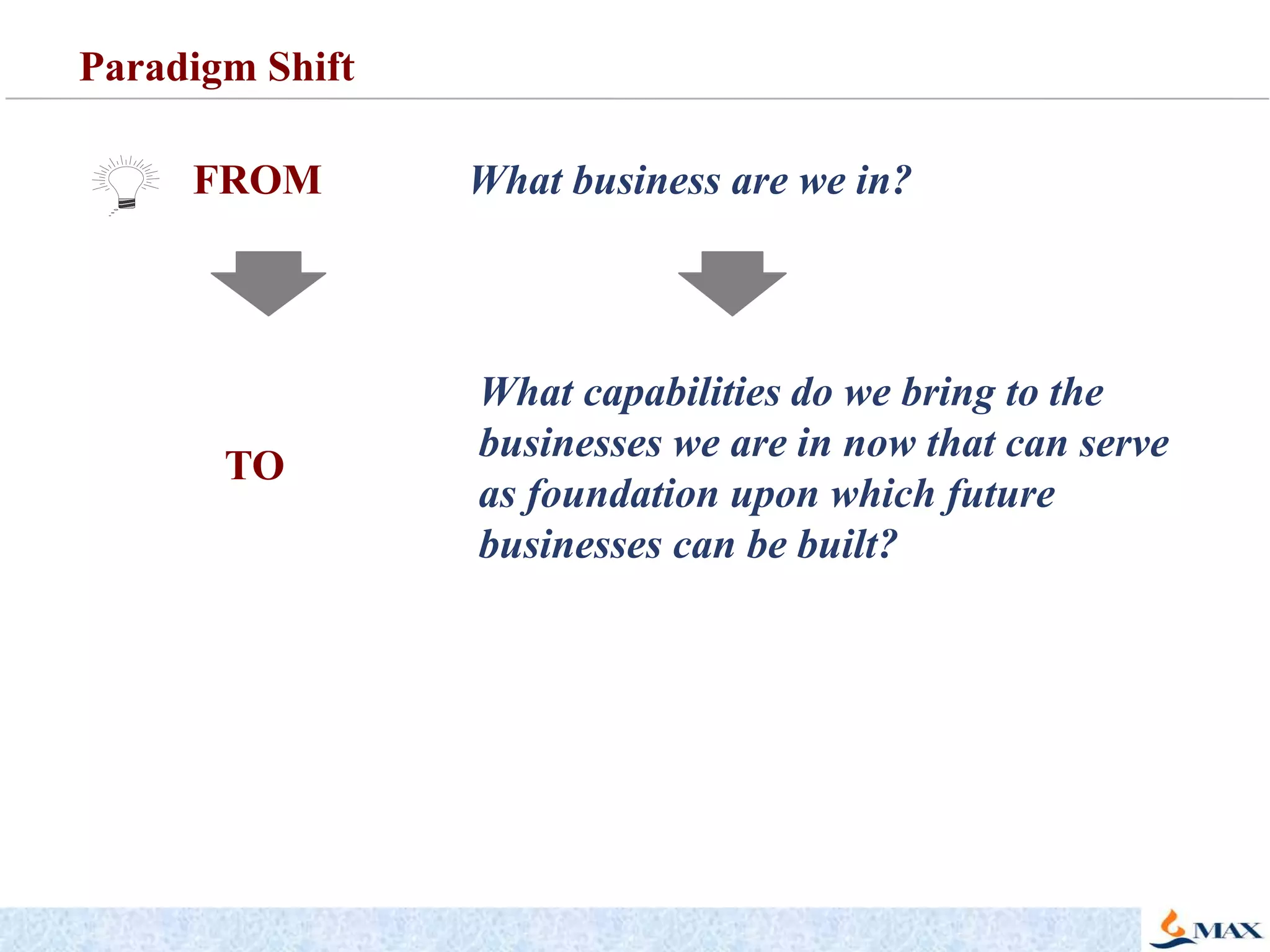
FROMWhat business are we in?What capabilities do we bring to the businesses we are in now that can serve as foundation upon which future businesses can be built?TOParadigm Shift
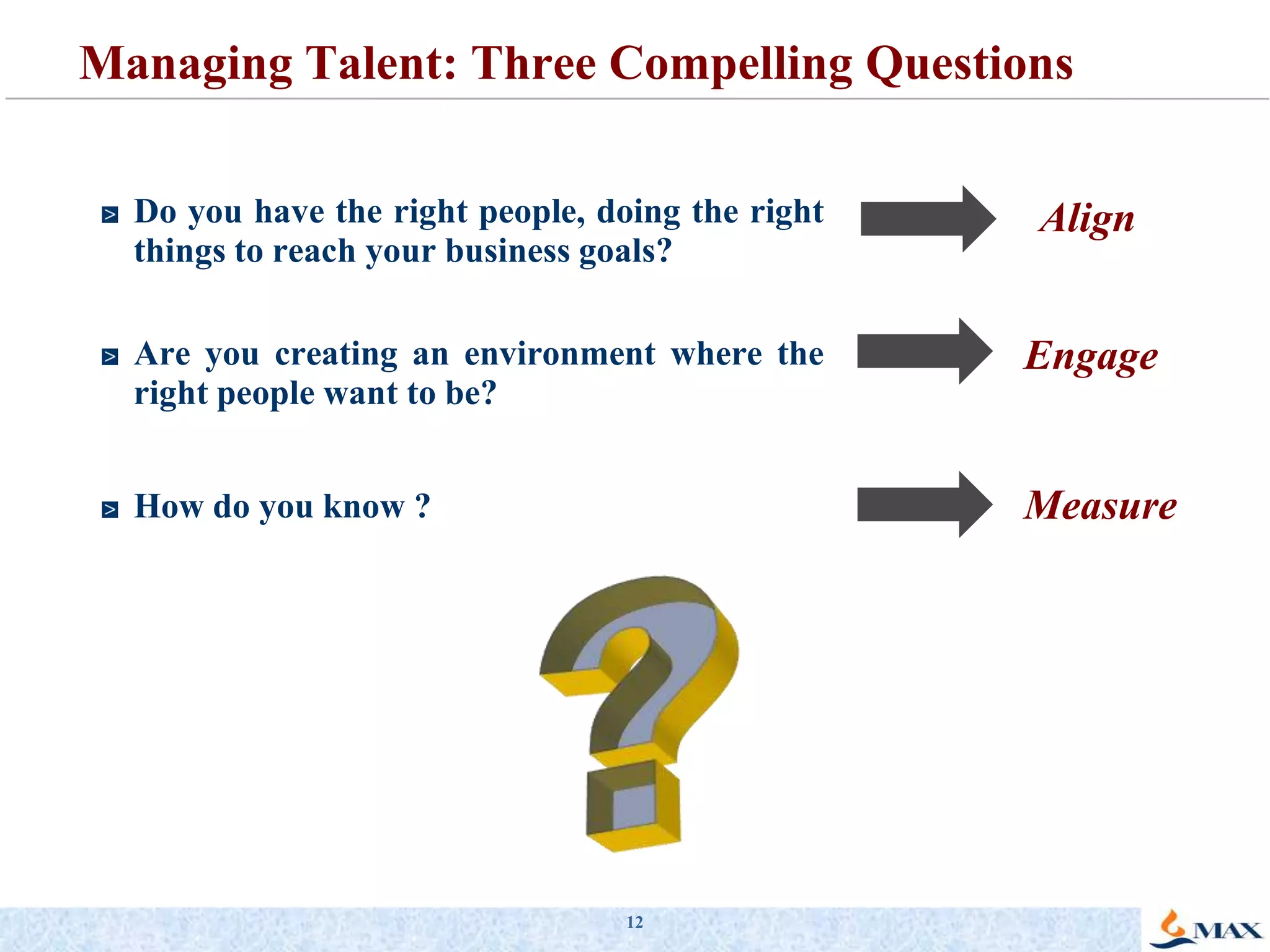
12Managing Talent: Three Compelling QuestionsAlignDo you have the right people, doing the right things to reach your business goals?Are you creating an environment where the right people want to be?How do you know ?EngageMeasure?
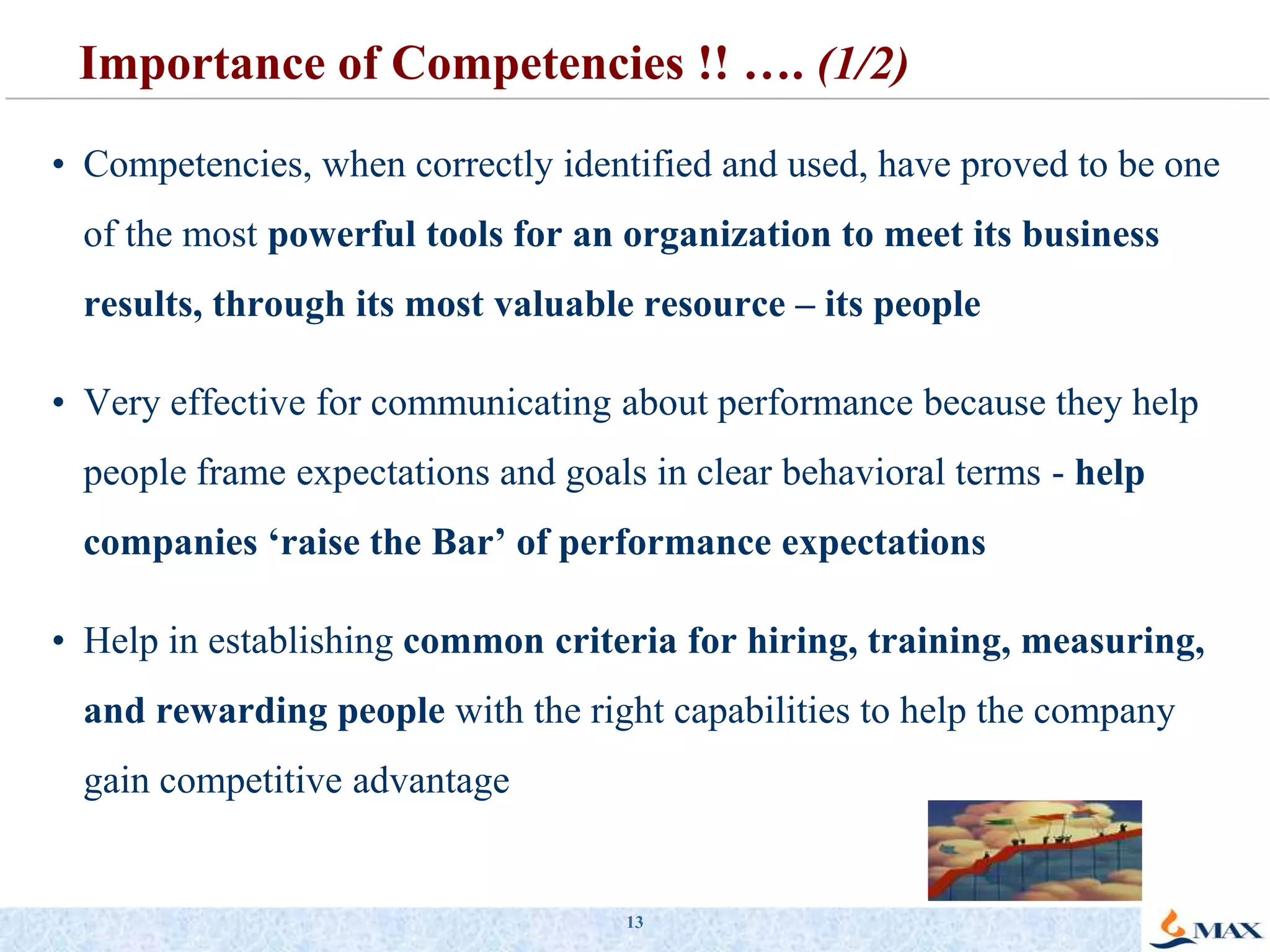
13Importance of Competencies !! …. (1/2)Competencies, when correctly identified and used, have proved to be one of the most powerful tools for an organization to meet its business results, through its most valuable resource – its people
Very effective for communicating about performance because they help people frame expectations and goals in clear behavioral terms - help companies ‘raise the Bar’ of performance expectations
Help in establishing common criteria for hiring, training, measuring, and rewarding people with the right capabilities to help the company gain competitive advantage14Importance of Competencies !! ….(2/2)Remind employees how they do things is as important as what they do
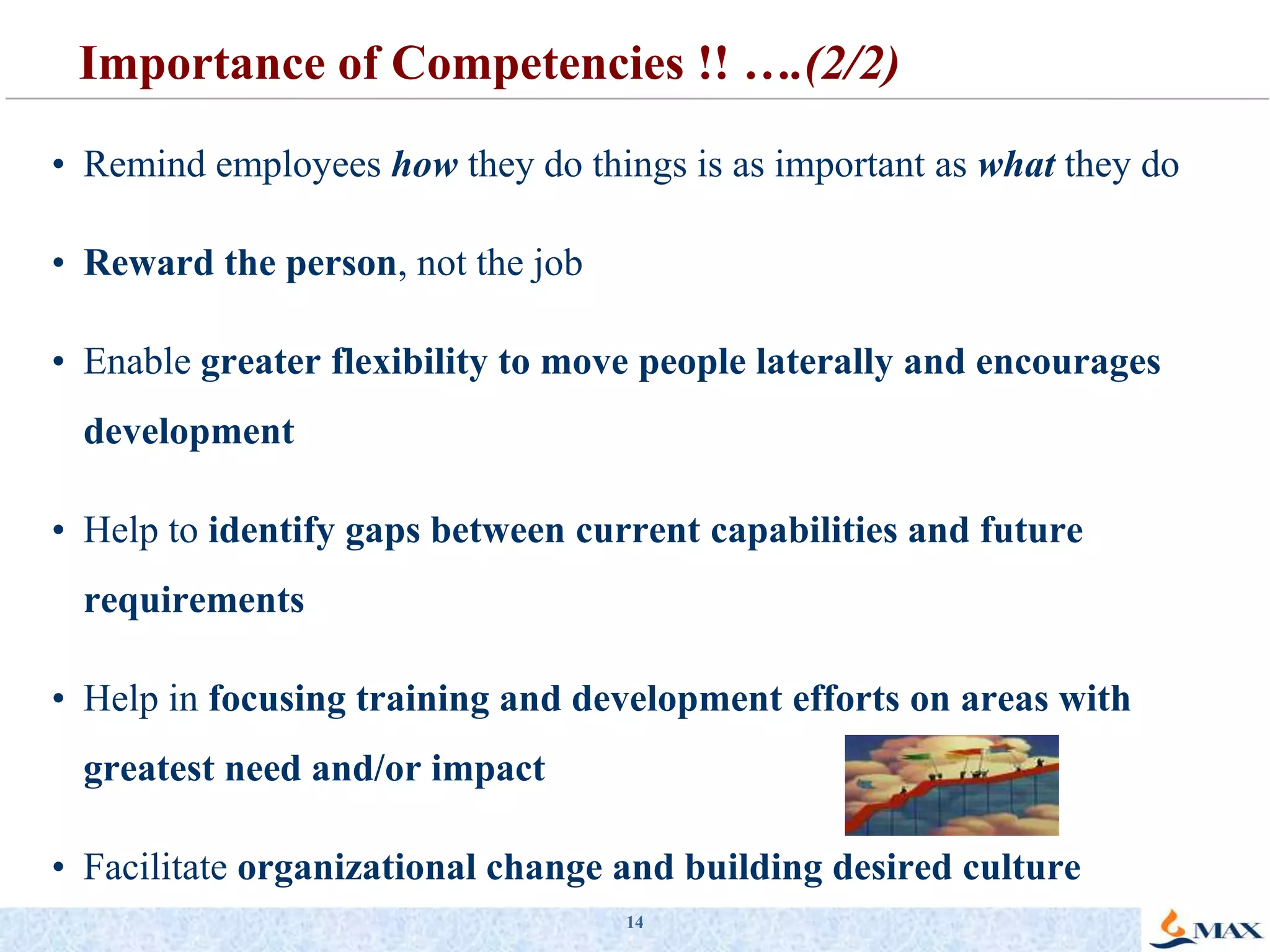
Reward the person, not the job
Enable greater flexibility to move people laterally and encourages development
Help to identify gaps between current capabilities and future requirements
Help in focusing training and development efforts on areas with greatest need and/or impact
Facilitate organizational change and building desired culture15Developing a Competency Model
16What is a Competency Model?A group of competencies that describe successful performance for a particular organisation, function, level, role or jobA competency model consists of:CompetenciesProficiency Levels and Behavioural IndicatorsMeasurement approachRating scale
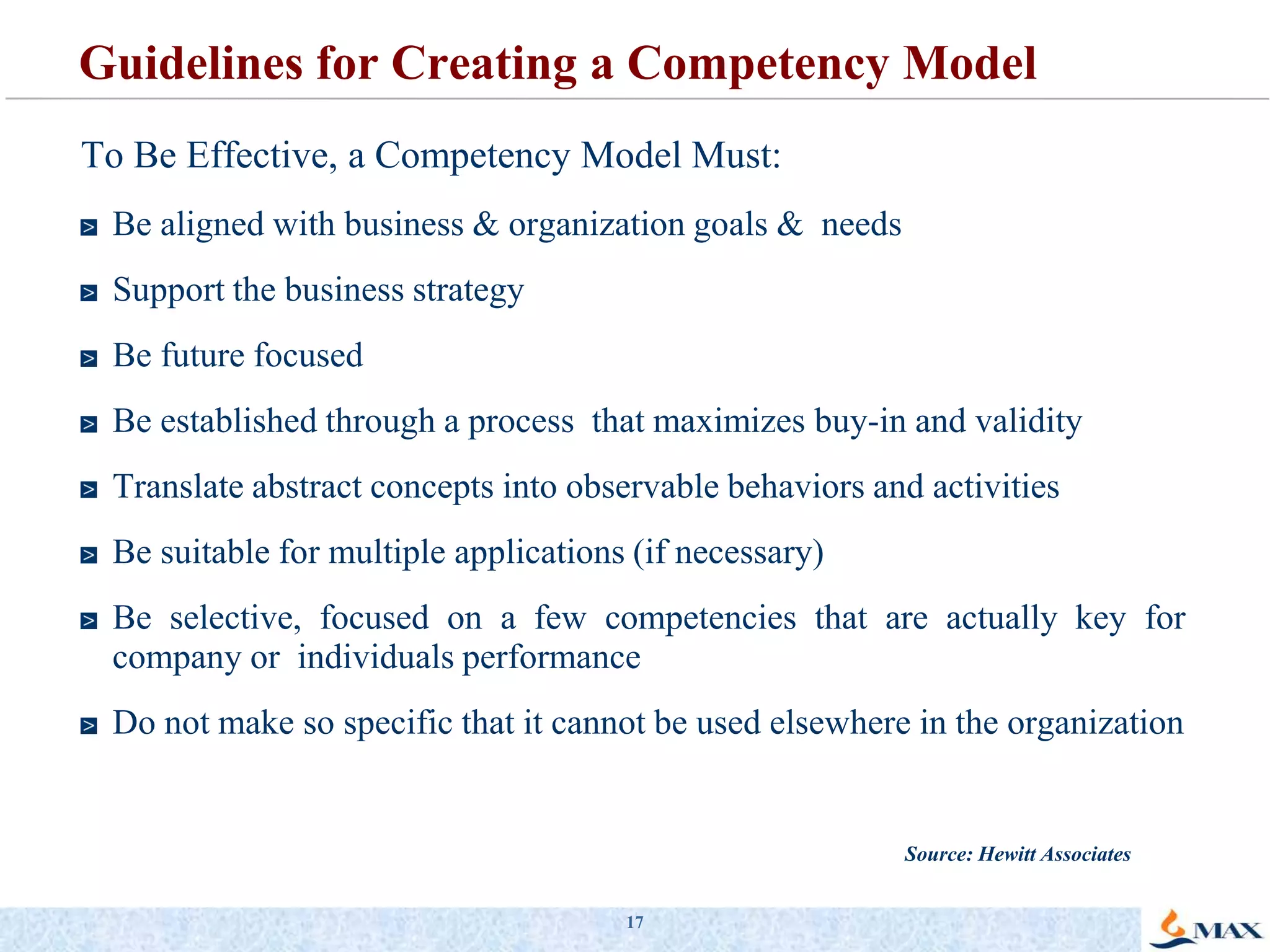
17Guidelines for Creating a Competency ModelTo Be Effective, a Competency Model Must:Be aligned with business & organization goals &  needsSupport the business strategyBe future focusedBe established through a process  that maximizes buy-in and validityTranslate abstract concepts into observable behaviors and activitiesBe suitable for multiple applications (if necessary)Be selective, focused on a few competencies that are actually key for company or  individuals performance Do not make so specific that it cannot be used elsewhere in the organizationSource: Hewitt Associates
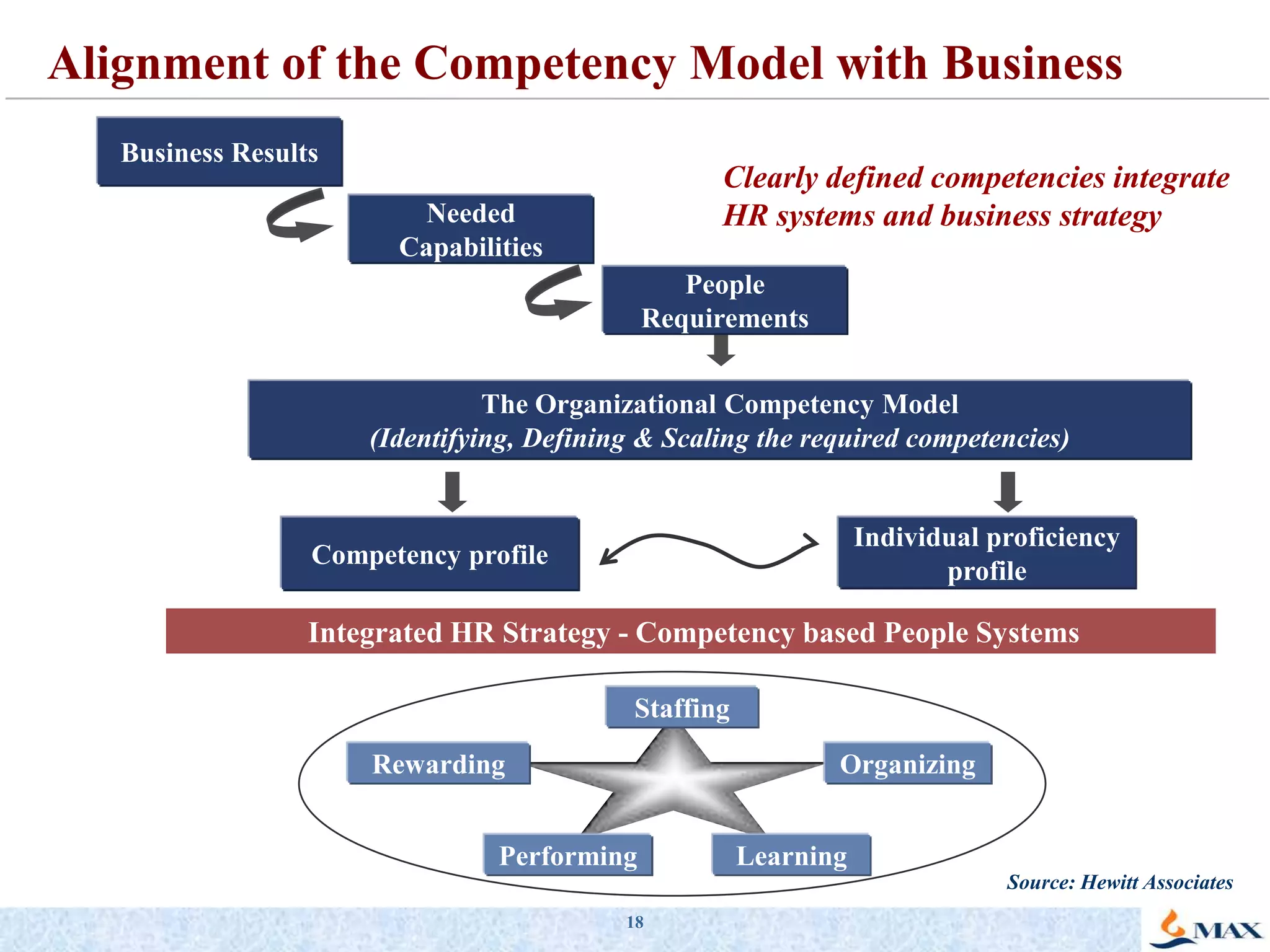
18StaffingRewardingOrganizingLearningPerformingAlignment of the Competency Model with BusinessBusiness ResultsClearly defined competencies integrate HR systems and business strategyNeeded CapabilitiesPeople RequirementsThe Organizational Competency Model (Identifying, Defining & Scaling the required competencies) Competency profileIndividual proficiency profileIntegrated HR Strategy - Competency based People Systems Source: Hewitt Associates
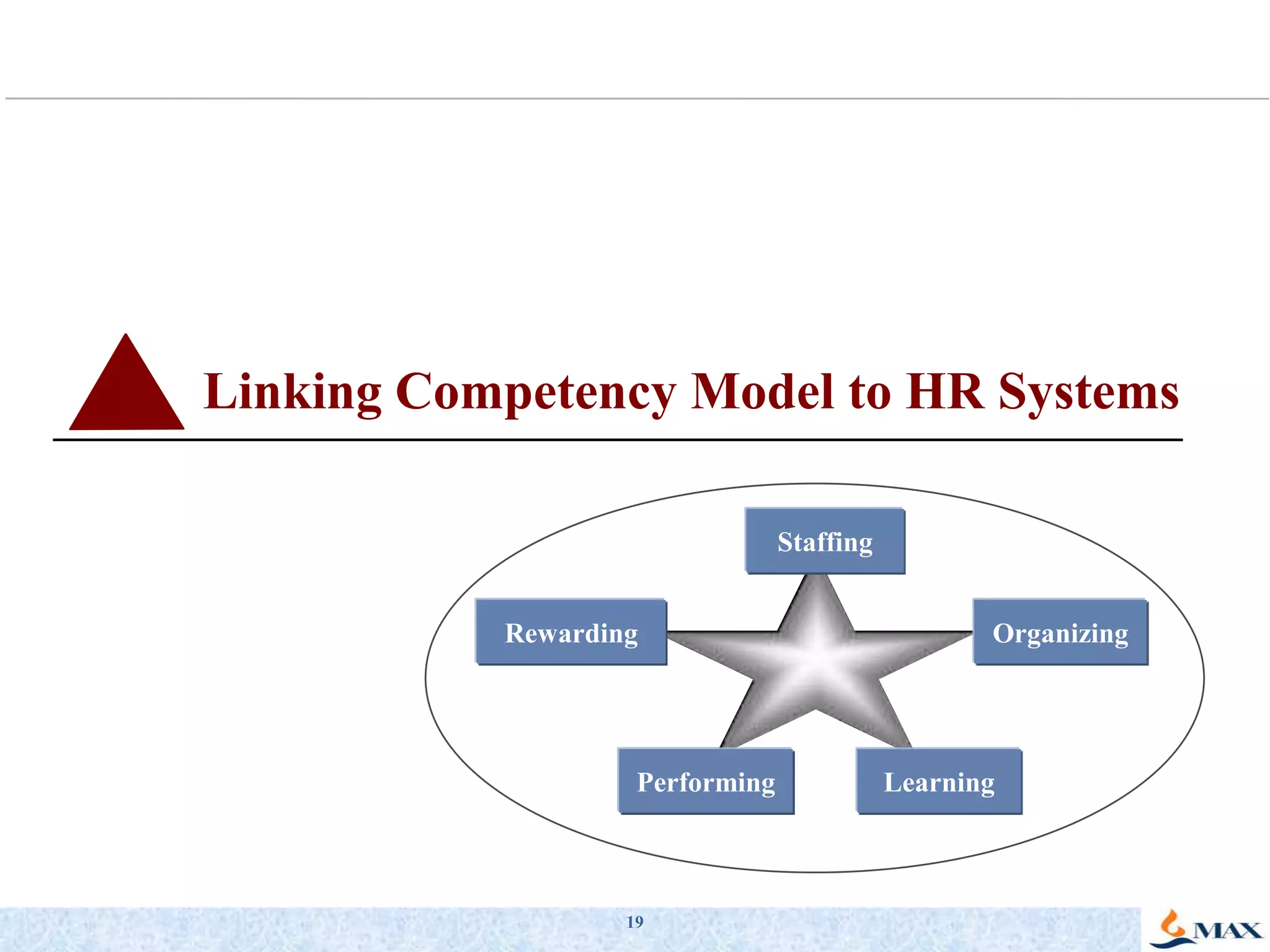
19StaffingRewardingOrganizingLearningPerformingLinking Competency Model to HR Systems
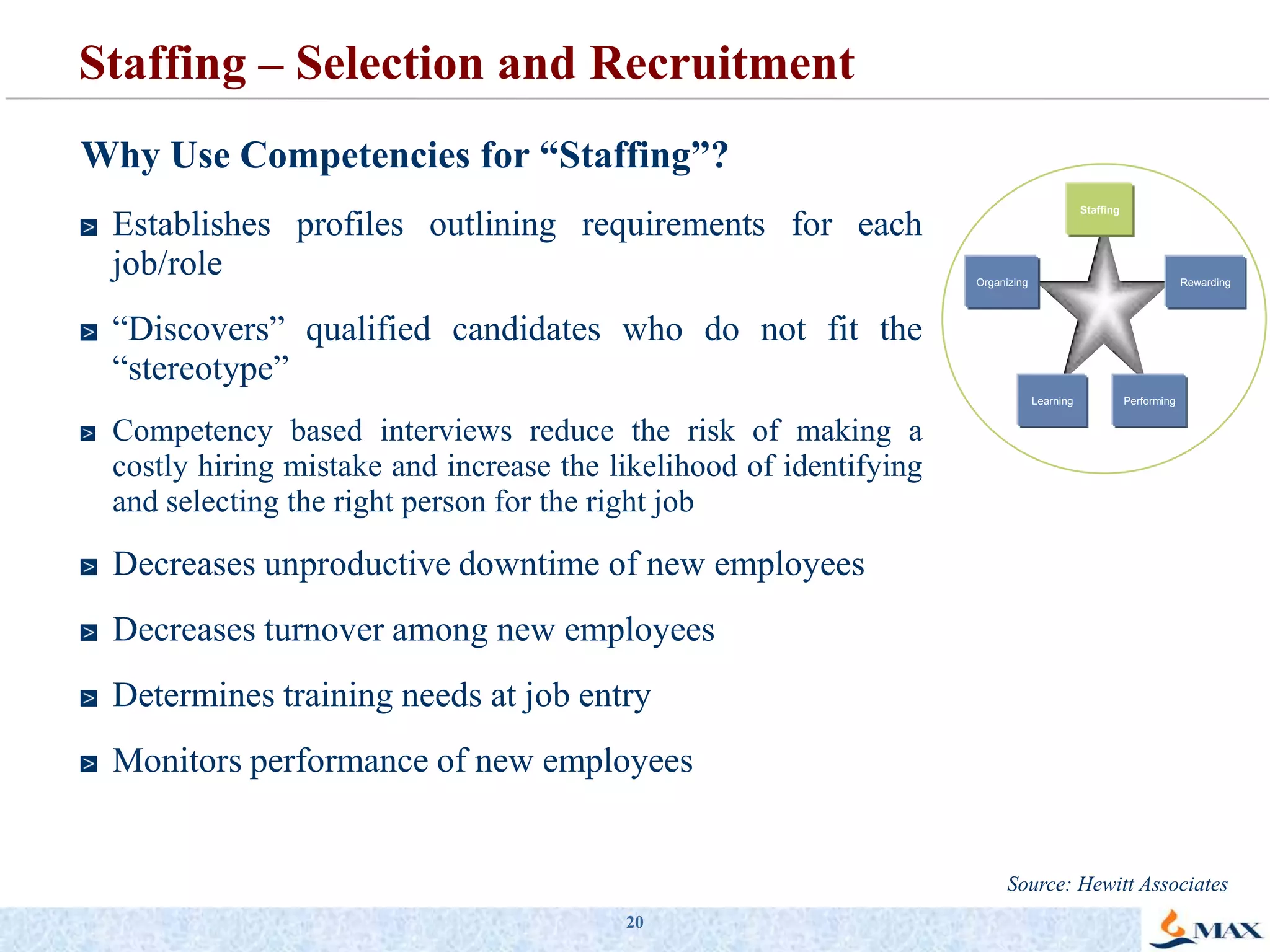
20Staffing – Selection and RecruitmentStaffingRewardingOrganizingLearningPerformingWhy Use Competencies for “Staffing”?Establishes profiles outlining requirements for each job/role“Discovers” qualified candidates who do not fit the “stereotype”Competency based interviews reduce the risk of making a costly hiring mistake and increase the likelihood of identifying and selecting the right person for the right jobDecreases unproductive downtime of new employeesDecreases turnover among new employeesDetermines training needs at job entryMonitors performance of new employeesSource: Hewitt Associates
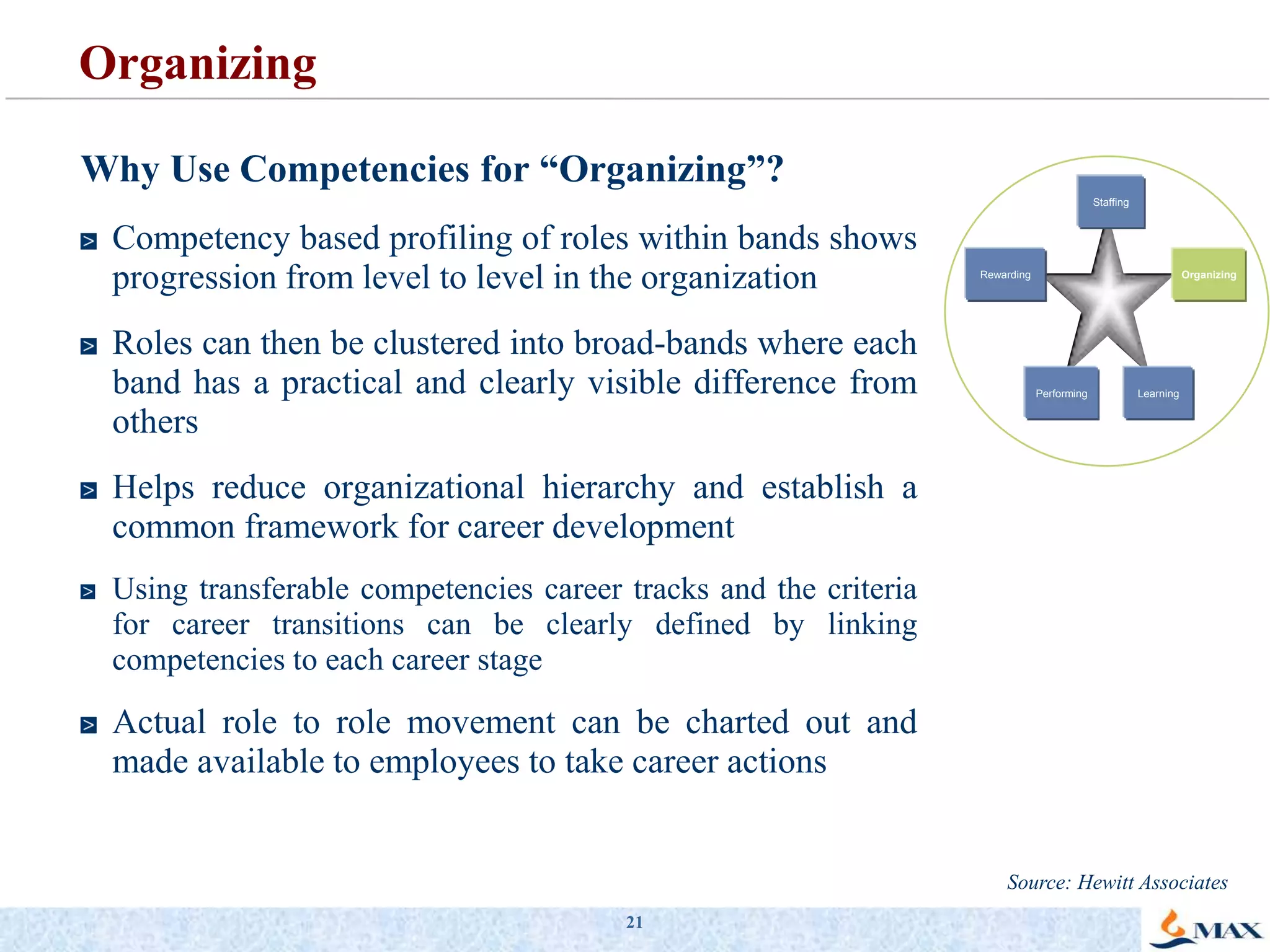
21OrganizingStaffingRewardingOrganizingLearningPerformingWhy Use Competencies for “Organizing”?Competency based profiling of roles within bands shows progression from level to level in the organizationRoles can then be clustered into broad-bands where each band has a practical and clearly visible difference from othersHelps reduce organizational hierarchy and establish a common framework for career developmentUsing transferable competencies career tracks and the criteria for career transitions can be clearly defined by linking competencies to each career stageActual role to role movement can be charted out and made available to employees to take career actionsSource: Hewitt Associates
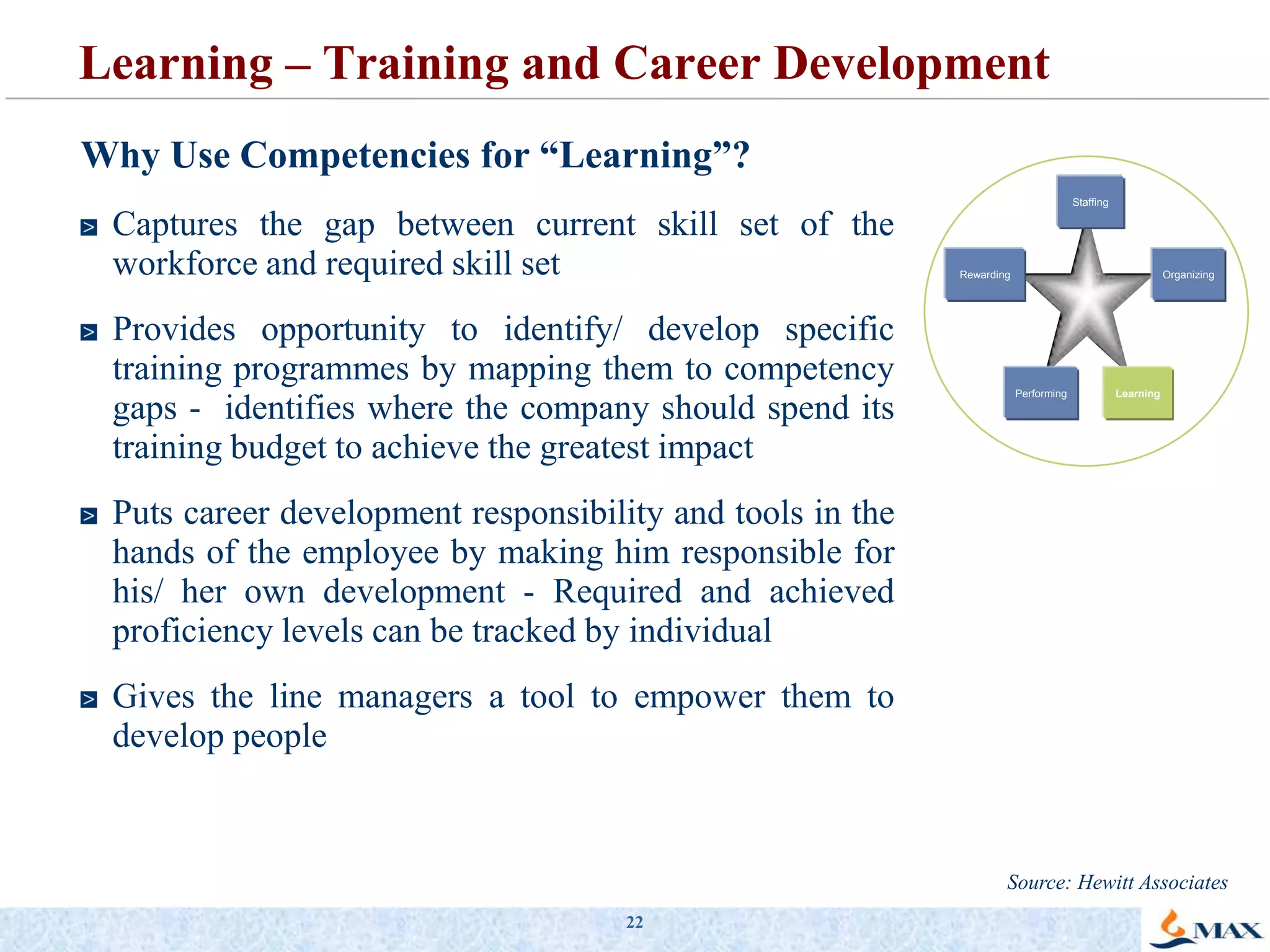
22Learning – Training and Career DevelopmentStaffingRewardingOrganizingLearningPerformingWhy Use Competencies for “Learning”?Captures the gap between current skill set of the workforce and required skill setProvides opportunity to identify/ develop specific training programmes by mapping them to competency gaps -  identifies where the company should spend its training budget to achieve the greatest impact Puts career development responsibility and tools in the hands of the employee by making him responsible for his/ her own development - Required and achieved proficiency levels can be tracked by individualGives the line managers a tool to empower them to develop peopleSource: Hewitt Associates
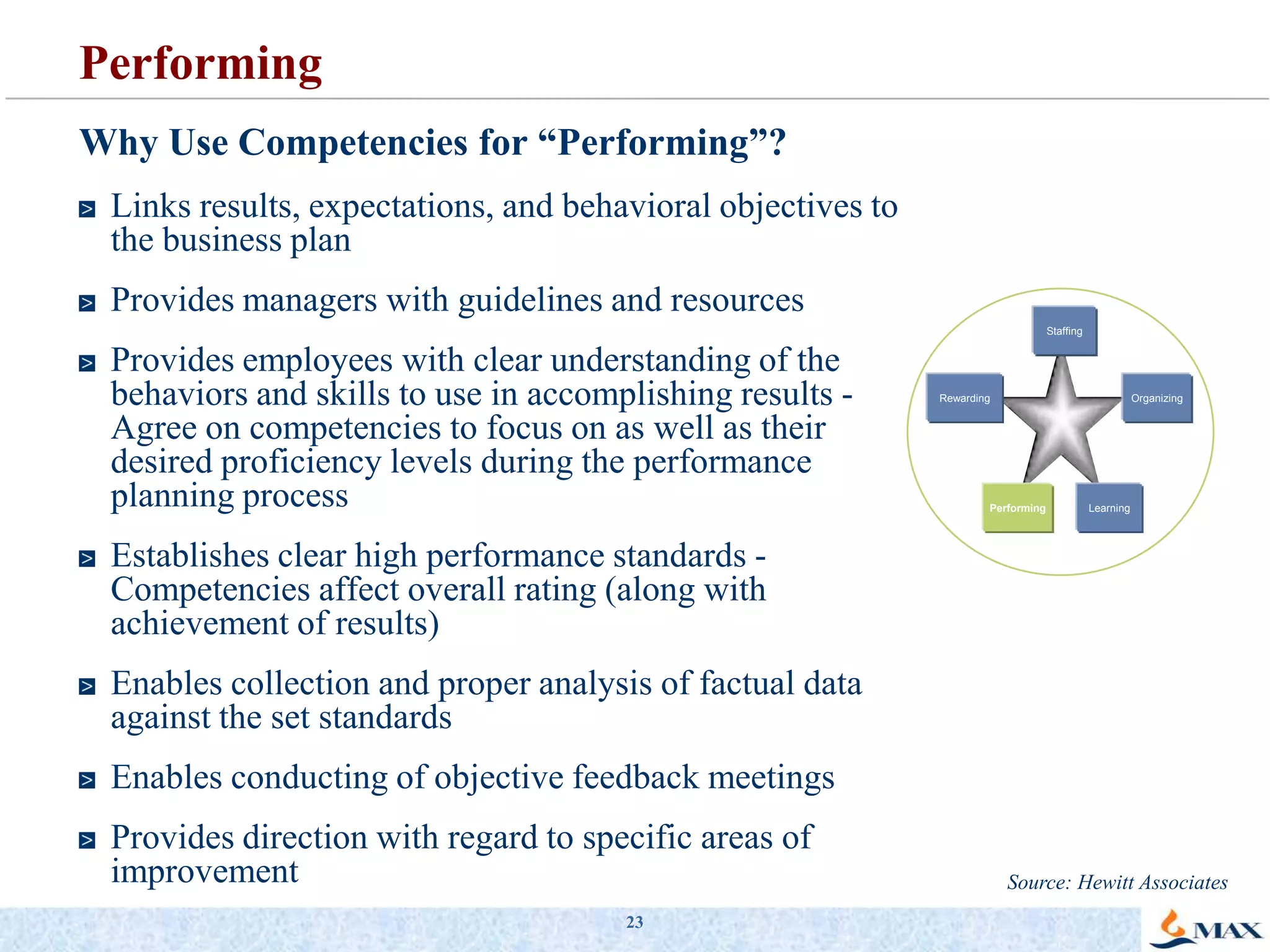
23PerformingStaffingRewardingOrganizingLearningPerformingWhy Use Competencies for “Performing”?Links results, expectations, and behavioral objectives to the business planProvides managers with guidelines and resources Provides employees with clear understanding of the behaviors and skills to use in accomplishing results - Agree on competencies to focus on as well as their desired proficiency levels during the performanceplanning processEstablishes clear high performance standards - Competencies affect overall rating (along with achievement of results)Enables collection and proper analysis of factual data against the set standardsEnables conducting of objective feedback meetings Provides direction with regard to specific areas of improvementSource: Hewitt Associates
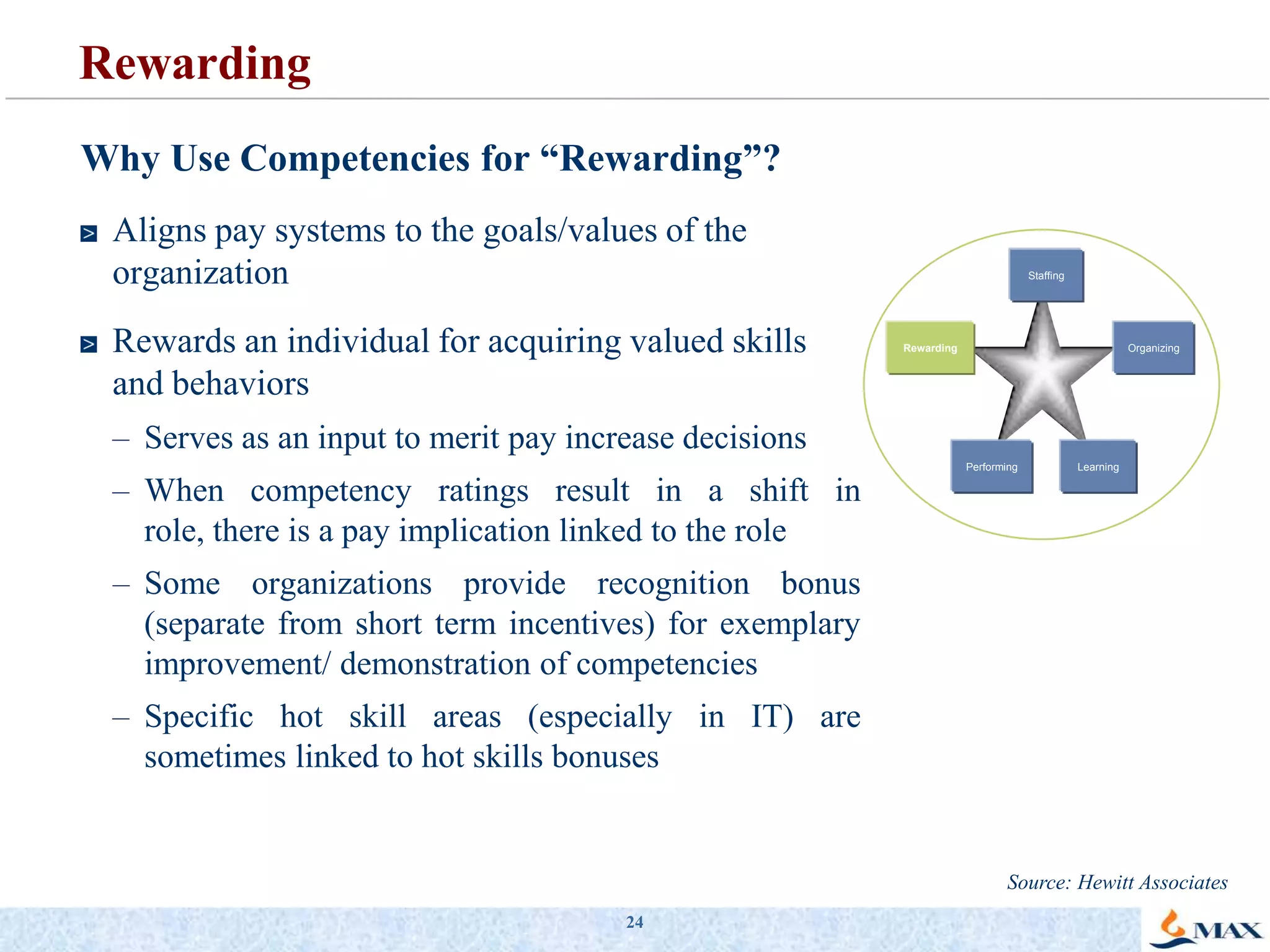
24RewardingStaffingRewardingOrganizingLearningPerformingWhy Use Competencies for “Rewarding”?Aligns pay systems to the goals/values of the organizationRewards an individual for acquiring valued skills and behaviorsServes as an input to merit pay increase decisions When competency ratings result in a shift in role, there is a pay implication linked to the roleSome organizations provide recognition bonus (separate from short term incentives) for exemplary improvement/ demonstration of competenciesSpecific hot skill areas (especially in IT) are sometimes linked to hot skills bonuses    Source: Hewitt Associates
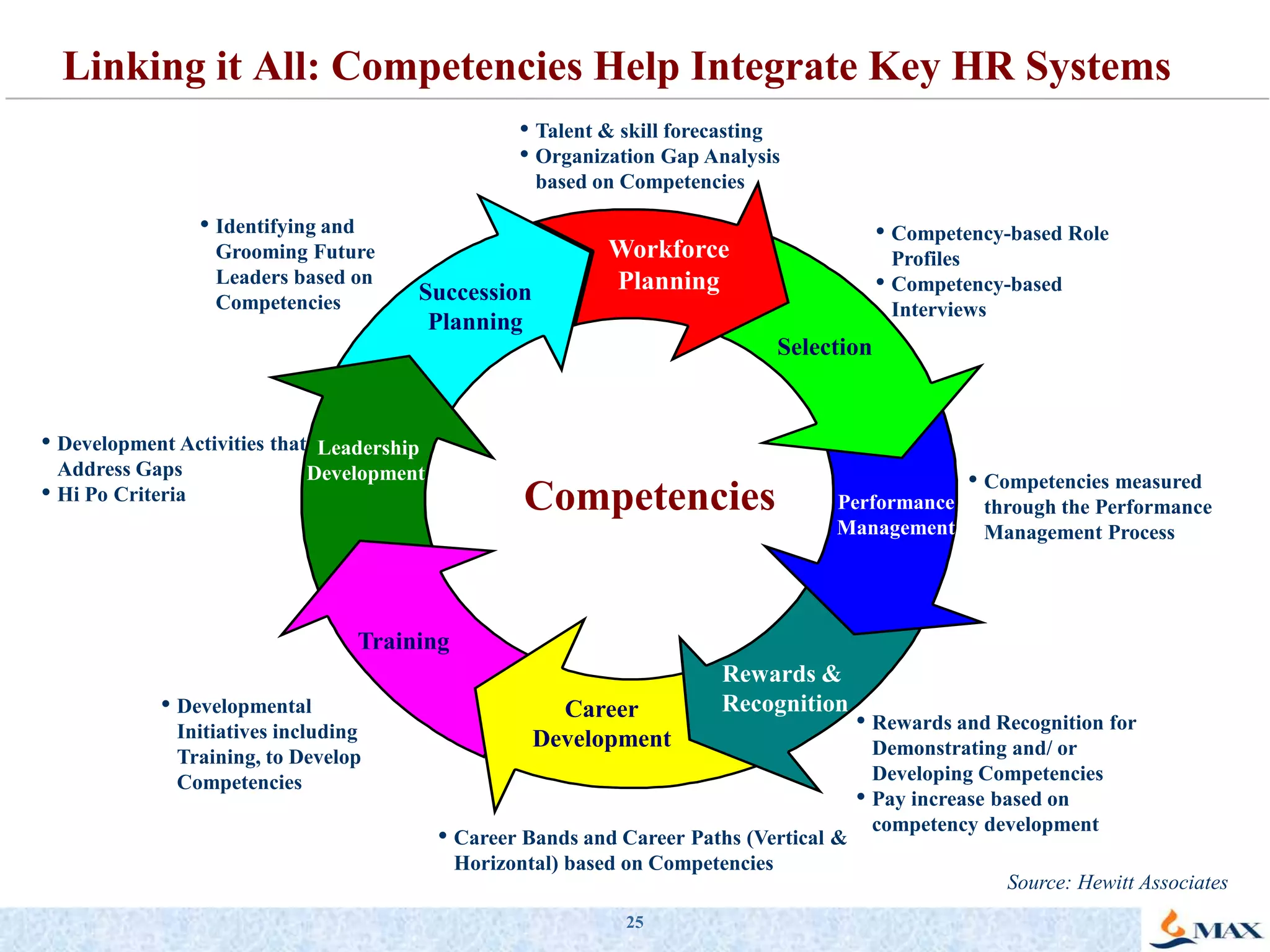
25Linking it All: Competencies Help Integrate Key HR SystemsTalent & skill forecasting
Organization Gap Analysis based on Competencies
Identifying and Grooming Future Leaders based on Competencies
Competency-based Role Profiles
Competency-based InterviewsWorkforcePlanningSuccessionPlanningSelectionDevelopment Activities that Address Gaps
Hi Po CriteriaLeadershipDevelopment Competencies measured through the Performance Management ProcessCompetenciesPerformanceManagementTrainingRewards & RecognitionDevelopmental Initiatives including Training, to Develop CompetenciesCareerDevelopmentRewards and Recognition for Demonstrating and/ or Developing Competencies
Pay increase based on competency development
Career Bands and Career Paths (Vertical & Horizontal) based on Competencies Source: Hewitt Associates
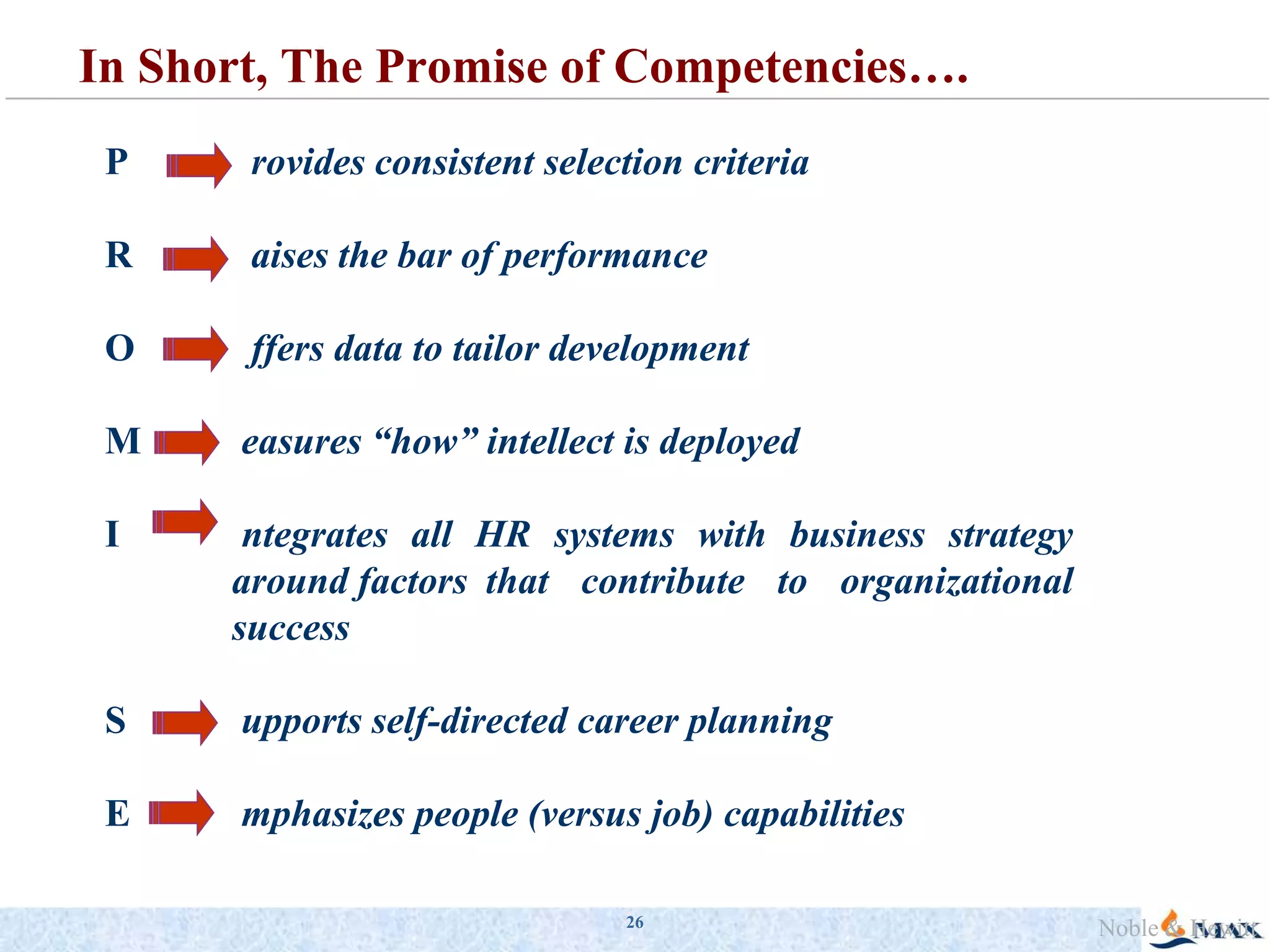
26In Short, The Promise of Competencies….Provides consistent selection criteriaR 		  aises the bar of performanceO 		  ffers data to tailor developmentM 		 easures “how” intellect is deployedI		 ntegrates all HR systems with business strategy 	around factors 	that contribute to organizational 	successS		 upports self-directed career planningE 		 mphasizes people (versus job) capabilitiesNoble & Hewitt
27A look at HR Competencies – The HR Compass
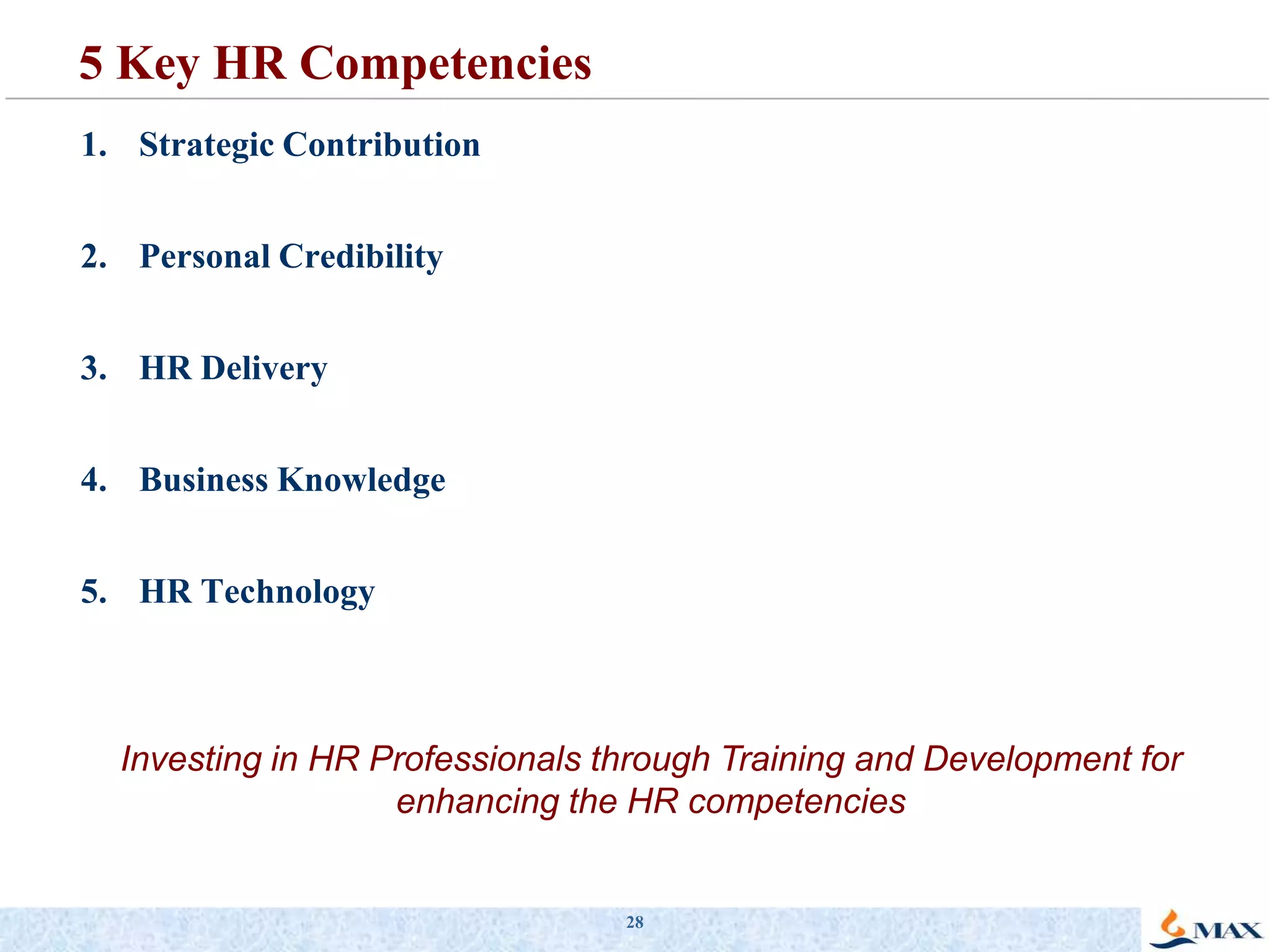
285 Key HR CompetenciesStrategic ContributionPersonal CredibilityHR DeliveryBusiness KnowledgeHR TechnologyInvesting in HR Professionals through Training and Development for enhancing the HR competencies
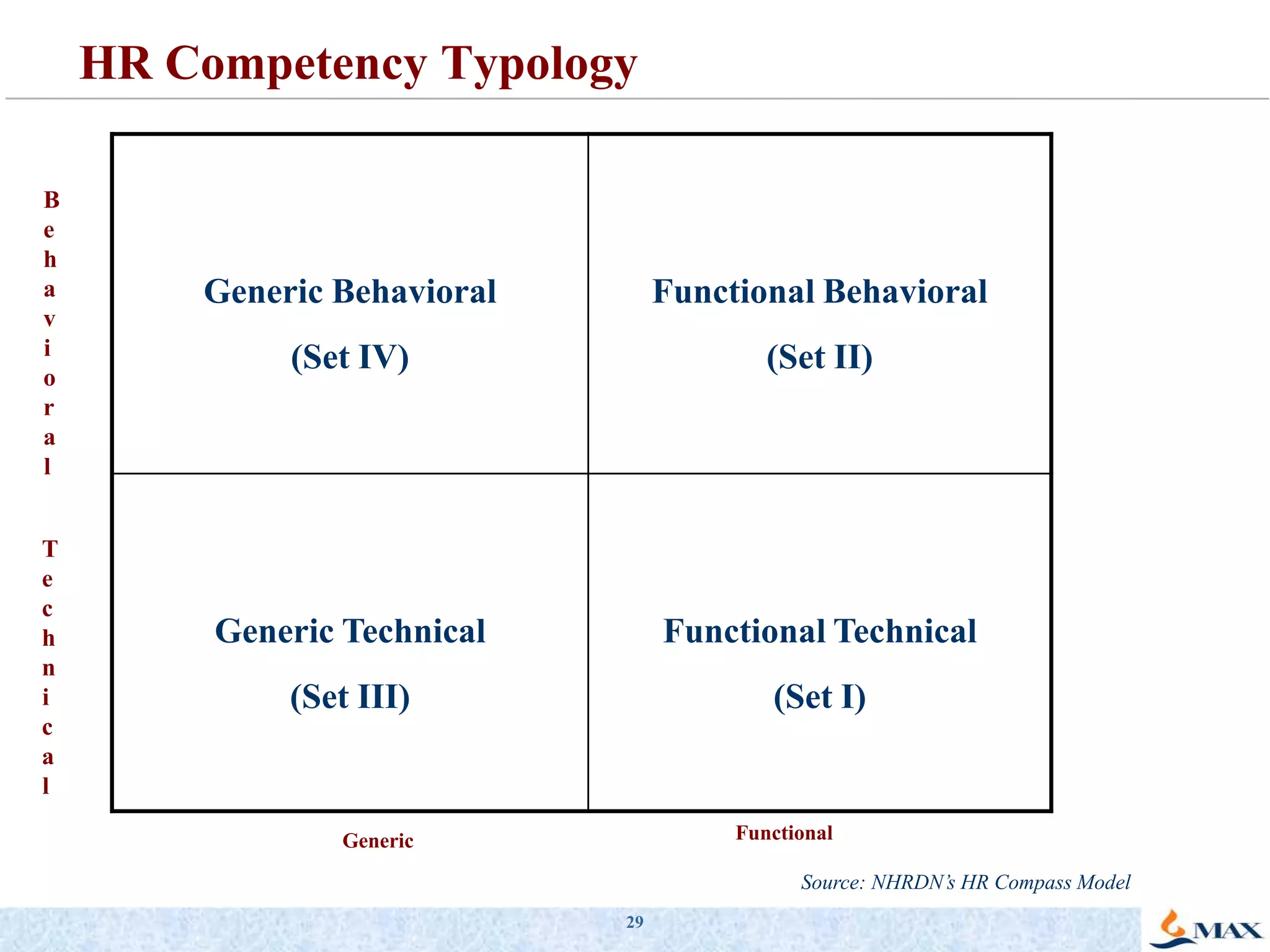
29HR Competency TypologyBehavioralTechnicalFunctionalGenericSource: NHRDN’s HR Compass Model
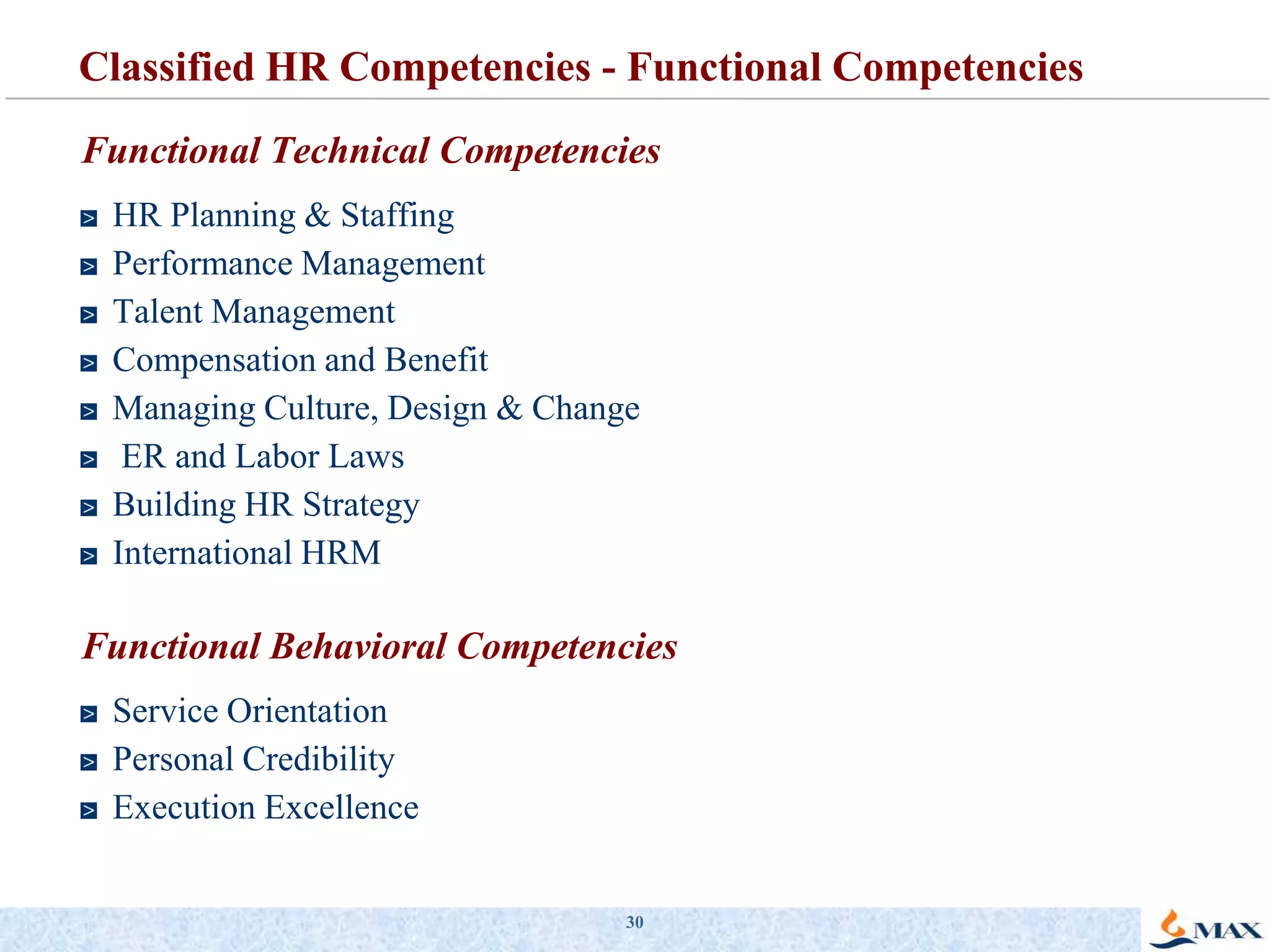
30Classified HR Competencies - Functional CompetenciesFunctional Technical CompetenciesHR Planning & StaffingPerformance ManagementTalent ManagementCompensation and BenefitManaging Culture, Design & Change ER and Labor LawsBuilding HR StrategyInternational HRMFunctional Behavioral CompetenciesService Orientation Personal Credibility Execution Excellence
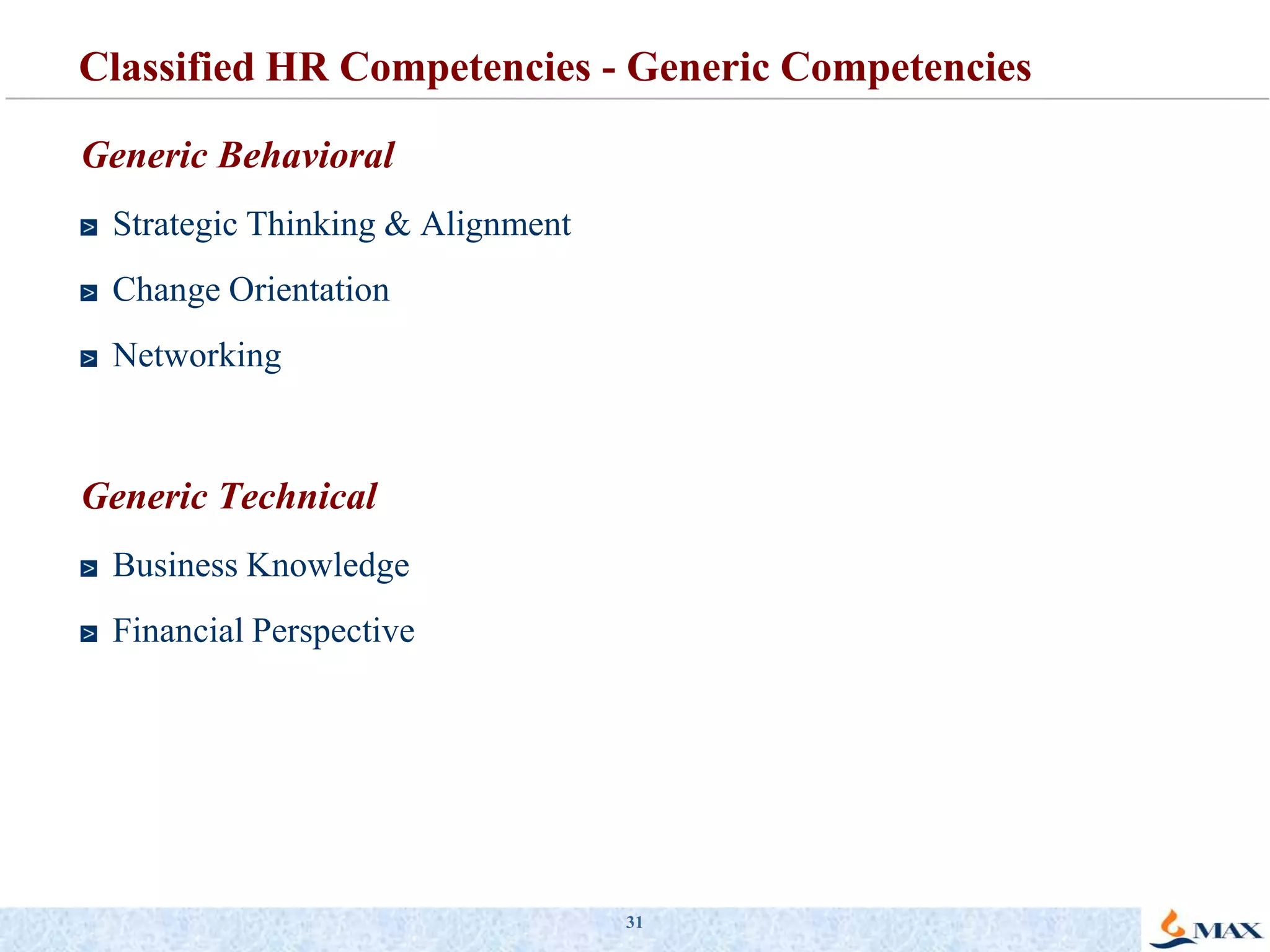
31Classified HR Competencies - Generic CompetenciesGeneric BehavioralStrategic Thinking & Alignment Change Orientation NetworkingGeneric TechnicalBusiness KnowledgeFinancial Perspective
32The Max Story!!
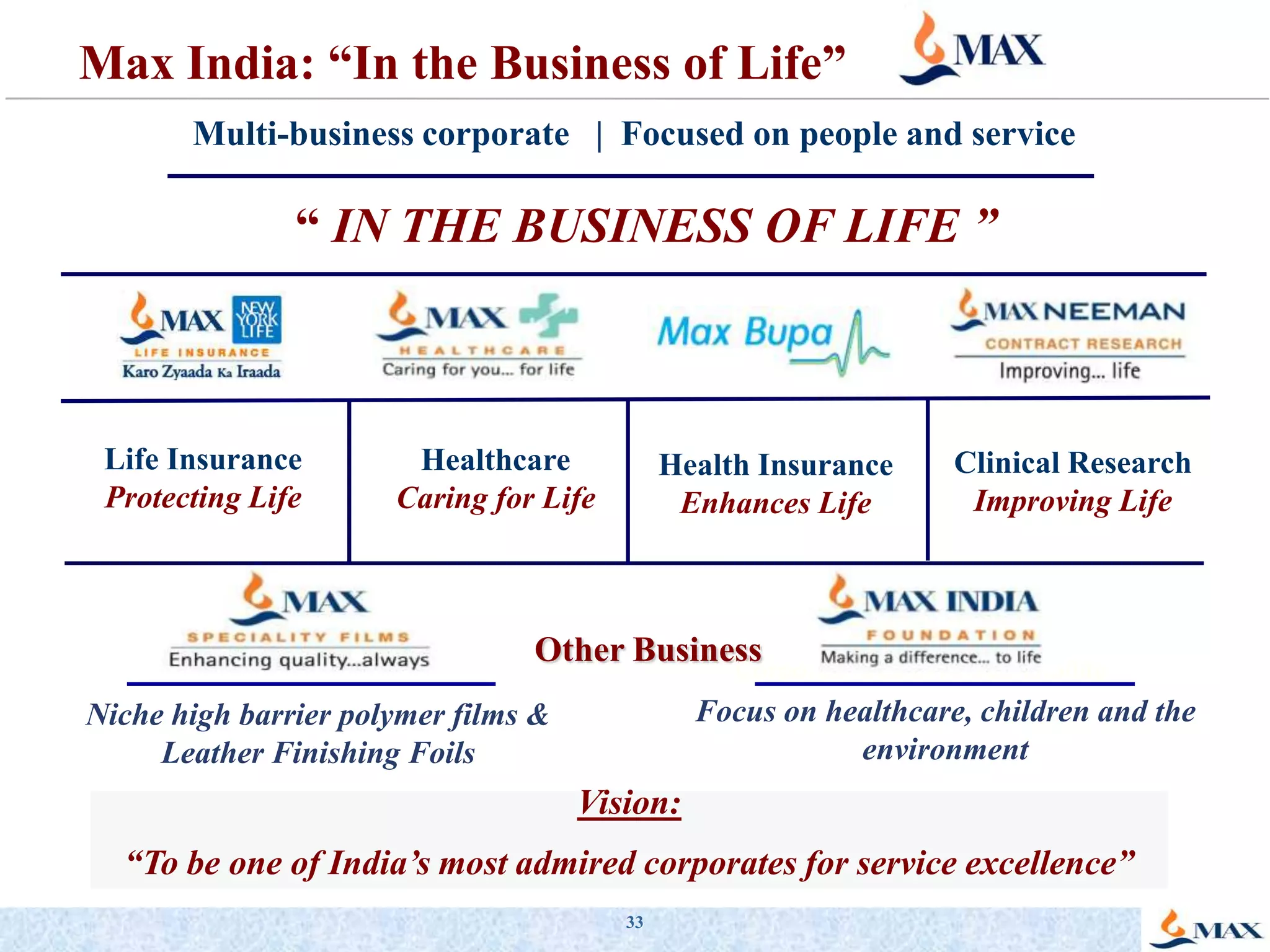
33Multi-business corporate   |  Focused on people and service         “ IN THE BUSINESS OF LIFE ”Life InsuranceProtecting LifeHealthcareCaring for LifeClinical ResearchImproving LifeHealth InsuranceEnhances LifeVision:“To be one of India’s most admired corporates for service excellence”Max India: “In the Business of Life” Other Business Corporate Social ResponsibilityFocus on healthcare, children and the environmentNiche high barrier polymer films & Leather Finishing Foils
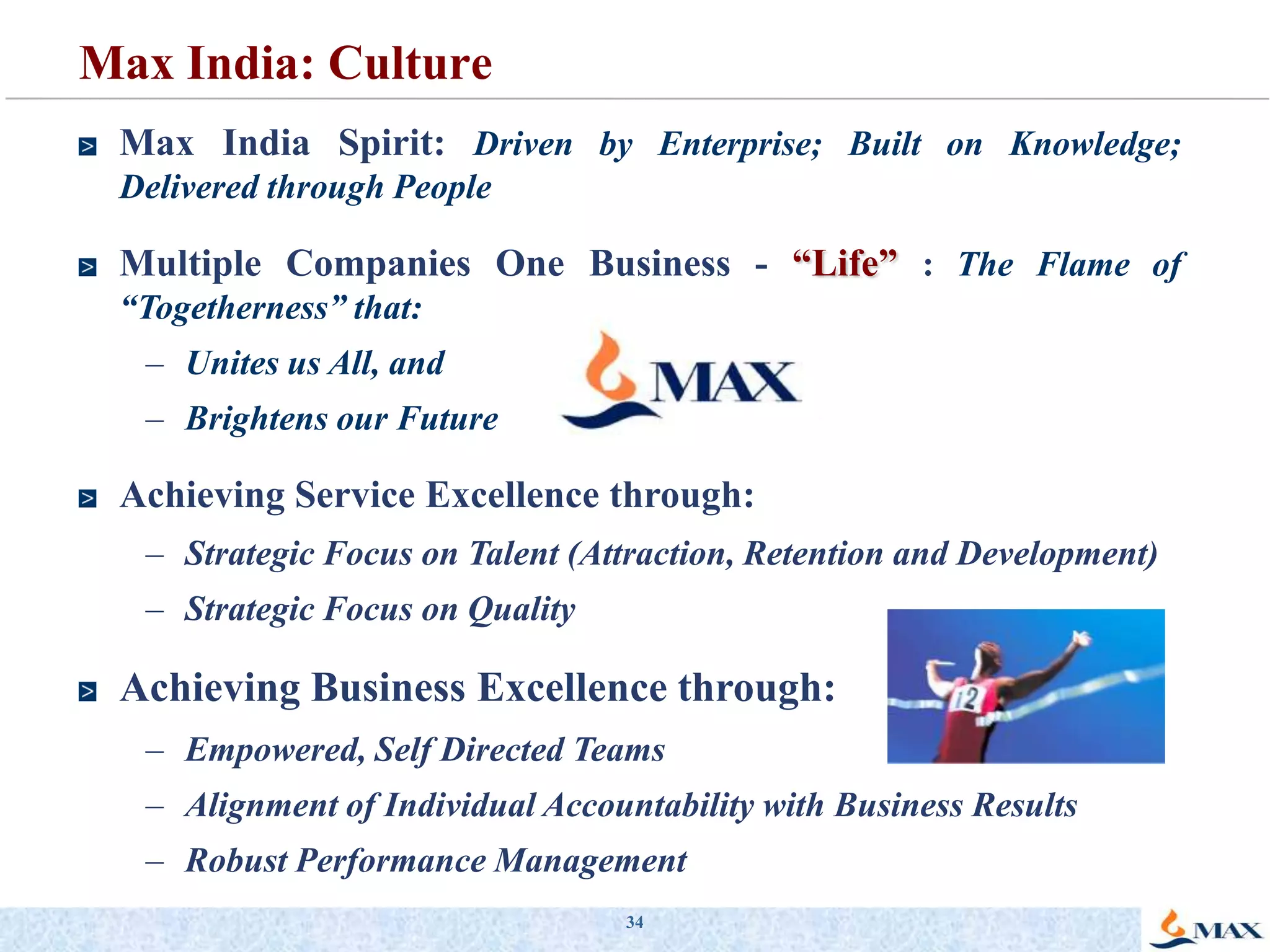
34Max India: Culture Max India Spirit: Driven by Enterprise; Built on Knowledge; Delivered through PeopleMultiple Companies One Business - “Life”: The Flame of “Togetherness” that:Unites us All, and
Brightens our FutureAchieving Service Excellence through:Strategic Focus on Talent (Attraction, Retention and Development)
Strategic Focus on QualityAchieving Business Excellence through:Empowered, Self Directed Teams
Alignment of Individual Accountability with Business Results
Robust Performance ManagementClassification of Competencies @ MNYL35Core CompetenciesFunctional CompetenciesLeadership Competencies

Nhrdn learning center 09.04.10

  • 1.
    NHRDN’s Learning Center– 9th April, 2010“Competencies : Concept and Framework”by:P. Dwarakanath Director – Group Human Capital Max India Ltd.
  • 2.
    2What will wecover ……..Understanding Competencies?Why Competencies?Developing a Competency Model Linking Competency Model to HR SystemsA look at HR Competencies – HR CompassThe Max Story !!The GSK Story !!
  • 3.
  • 4.
    4What Are Competencies?Competencyis an underlying characteristic of an employee (i.e., a motive, trait, skill, aspects of one’s self-image, social role, or a body of knowledge) which results in effective and/or superior performance. (Prof. Boyatzis, 1982) A Competency is a set of skills, related knowledge and attributes that allow an individual to successfully perform a task or an activity within a specific function or job. (UNIDO, 2002)Competencies are coachable, observable, measurable, and critical to successful individual or corporation performance.The pieces of the puzzle…..……that form a common language about success…that reflect the values and culture of the organization
  • 5.
    5Related KNOWLEDGErelates toinformation, cognitive DomainATTRIBUTE (or ATTITUDE)relates to qualitative aspects, personal characteristics or traitsSet of SKILLSrelates to the ability to do, physical domainCOMPETENCYOutstanding Performance on tasks or activitiesJOBCompetencies: The KSA FrameworkSource: UNIDO
  • 6.
    6Exhibition of Competencies?OutputsProducts+ ServicesBehaviorsResultsActions + Thoughts + FeelingsCapabilitiesKnowledge + Skill + AttitudeCompetencies are a person’s capabilities in the form of knowledge + skill + attitude, which gets reflected thorough a persons behavior in the form of actions + thoughts + feelings and finally manifests itself in outputs which are products and services
  • 7.
    7Let’s Have FewExamples of Competencies ……
  • 8.
    8Examples of CompetencyInnovationTeamWorkCoaching and Developing OthersCustomer FocusStrategic ThinkingResult Orientation
  • 9.
    9Classifying CompetenciesUniversalReflections ofthe company’s values, culture, and business imperatives that should be exhibited by all employeesFor example, guiding behaviors such as cost effective service delivery, customer focus, teamwork, communication skills, initiativeTransferableSkills and abilities needed within several roles in varying degrees of importance and masteryFor example, managerial and leadership skillsUniqueSpecialized know-how or abilities required within a specific role or jobFor example, technical/ functional skills (Marketing Strategy, Drug Discovery)
  • 10.
    10Why Competencies?Does itpay to integrate management systems around competencies?
  • 11.
    FROMWhat business arewe in?What capabilities do we bring to the businesses we are in now that can serve as foundation upon which future businesses can be built?TOParadigm Shift
  • 12.
    12Managing Talent: ThreeCompelling QuestionsAlignDo you have the right people, doing the right things to reach your business goals?Are you creating an environment where the right people want to be?How do you know ?EngageMeasure?
  • 13.
    13Importance of Competencies!! …. (1/2)Competencies, when correctly identified and used, have proved to be one of the most powerful tools for an organization to meet its business results, through its most valuable resource – its people
  • 14.
    Very effective forcommunicating about performance because they help people frame expectations and goals in clear behavioral terms - help companies ‘raise the Bar’ of performance expectations
  • 15.
    Help in establishingcommon criteria for hiring, training, measuring, and rewarding people with the right capabilities to help the company gain competitive advantage14Importance of Competencies !! ….(2/2)Remind employees how they do things is as important as what they do
  • 16.
  • 17.
    Enable greater flexibilityto move people laterally and encourages development
  • 18.
    Help to identifygaps between current capabilities and future requirements
  • 19.
    Help in focusingtraining and development efforts on areas with greatest need and/or impact
  • 20.
    Facilitate organizational changeand building desired culture15Developing a Competency Model
  • 21.
    16What is aCompetency Model?A group of competencies that describe successful performance for a particular organisation, function, level, role or jobA competency model consists of:CompetenciesProficiency Levels and Behavioural IndicatorsMeasurement approachRating scale
  • 22.
    17Guidelines for Creatinga Competency ModelTo Be Effective, a Competency Model Must:Be aligned with business & organization goals & needsSupport the business strategyBe future focusedBe established through a process that maximizes buy-in and validityTranslate abstract concepts into observable behaviors and activitiesBe suitable for multiple applications (if necessary)Be selective, focused on a few competencies that are actually key for company or individuals performance Do not make so specific that it cannot be used elsewhere in the organizationSource: Hewitt Associates
  • 23.
    18StaffingRewardingOrganizingLearningPerformingAlignment of theCompetency Model with BusinessBusiness ResultsClearly defined competencies integrate HR systems and business strategyNeeded CapabilitiesPeople RequirementsThe Organizational Competency Model (Identifying, Defining & Scaling the required competencies) Competency profileIndividual proficiency profileIntegrated HR Strategy - Competency based People Systems Source: Hewitt Associates
  • 24.
  • 25.
    20Staffing – Selectionand RecruitmentStaffingRewardingOrganizingLearningPerformingWhy Use Competencies for “Staffing”?Establishes profiles outlining requirements for each job/role“Discovers” qualified candidates who do not fit the “stereotype”Competency based interviews reduce the risk of making a costly hiring mistake and increase the likelihood of identifying and selecting the right person for the right jobDecreases unproductive downtime of new employeesDecreases turnover among new employeesDetermines training needs at job entryMonitors performance of new employeesSource: Hewitt Associates
  • 26.
    21OrganizingStaffingRewardingOrganizingLearningPerformingWhy Use Competenciesfor “Organizing”?Competency based profiling of roles within bands shows progression from level to level in the organizationRoles can then be clustered into broad-bands where each band has a practical and clearly visible difference from othersHelps reduce organizational hierarchy and establish a common framework for career developmentUsing transferable competencies career tracks and the criteria for career transitions can be clearly defined by linking competencies to each career stageActual role to role movement can be charted out and made available to employees to take career actionsSource: Hewitt Associates
  • 27.
    22Learning – Trainingand Career DevelopmentStaffingRewardingOrganizingLearningPerformingWhy Use Competencies for “Learning”?Captures the gap between current skill set of the workforce and required skill setProvides opportunity to identify/ develop specific training programmes by mapping them to competency gaps - identifies where the company should spend its training budget to achieve the greatest impact Puts career development responsibility and tools in the hands of the employee by making him responsible for his/ her own development - Required and achieved proficiency levels can be tracked by individualGives the line managers a tool to empower them to develop peopleSource: Hewitt Associates
  • 28.
    23PerformingStaffingRewardingOrganizingLearningPerformingWhy Use Competenciesfor “Performing”?Links results, expectations, and behavioral objectives to the business planProvides managers with guidelines and resources Provides employees with clear understanding of the behaviors and skills to use in accomplishing results - Agree on competencies to focus on as well as their desired proficiency levels during the performanceplanning processEstablishes clear high performance standards - Competencies affect overall rating (along with achievement of results)Enables collection and proper analysis of factual data against the set standardsEnables conducting of objective feedback meetings Provides direction with regard to specific areas of improvementSource: Hewitt Associates
  • 29.
    24RewardingStaffingRewardingOrganizingLearningPerformingWhy Use Competenciesfor “Rewarding”?Aligns pay systems to the goals/values of the organizationRewards an individual for acquiring valued skills and behaviorsServes as an input to merit pay increase decisions When competency ratings result in a shift in role, there is a pay implication linked to the roleSome organizations provide recognition bonus (separate from short term incentives) for exemplary improvement/ demonstration of competenciesSpecific hot skill areas (especially in IT) are sometimes linked to hot skills bonuses Source: Hewitt Associates
  • 30.
    25Linking it All:Competencies Help Integrate Key HR SystemsTalent & skill forecasting
  • 31.
    Organization Gap Analysisbased on Competencies
  • 32.
    Identifying and GroomingFuture Leaders based on Competencies
  • 33.
  • 34.
  • 35.
    Hi Po CriteriaLeadershipDevelopmentCompetencies measured through the Performance Management ProcessCompetenciesPerformanceManagementTrainingRewards & RecognitionDevelopmental Initiatives including Training, to Develop CompetenciesCareerDevelopmentRewards and Recognition for Demonstrating and/ or Developing Competencies
  • 36.
    Pay increase basedon competency development
  • 37.
    Career Bands andCareer Paths (Vertical & Horizontal) based on Competencies Source: Hewitt Associates
  • 38.
    26In Short, ThePromise of Competencies….Provides consistent selection criteriaR aises the bar of performanceO ffers data to tailor developmentM easures “how” intellect is deployedI ntegrates all HR systems with business strategy around factors that contribute to organizational successS upports self-directed career planningE mphasizes people (versus job) capabilitiesNoble & Hewitt
  • 39.
    27A look atHR Competencies – The HR Compass
  • 40.
    285 Key HRCompetenciesStrategic ContributionPersonal CredibilityHR DeliveryBusiness KnowledgeHR TechnologyInvesting in HR Professionals through Training and Development for enhancing the HR competencies
  • 41.
  • 42.
    30Classified HR Competencies- Functional CompetenciesFunctional Technical CompetenciesHR Planning & StaffingPerformance ManagementTalent ManagementCompensation and BenefitManaging Culture, Design & Change ER and Labor LawsBuilding HR StrategyInternational HRMFunctional Behavioral CompetenciesService Orientation Personal Credibility Execution Excellence
  • 43.
    31Classified HR Competencies- Generic CompetenciesGeneric BehavioralStrategic Thinking & Alignment Change Orientation NetworkingGeneric TechnicalBusiness KnowledgeFinancial Perspective
  • 44.
  • 45.
    33Multi-business corporate | Focused on people and service “ IN THE BUSINESS OF LIFE ”Life InsuranceProtecting LifeHealthcareCaring for LifeClinical ResearchImproving LifeHealth InsuranceEnhances LifeVision:“To be one of India’s most admired corporates for service excellence”Max India: “In the Business of Life” Other Business Corporate Social ResponsibilityFocus on healthcare, children and the environmentNiche high barrier polymer films & Leather Finishing Foils
  • 46.
    34Max India: CultureMax India Spirit: Driven by Enterprise; Built on Knowledge; Delivered through PeopleMultiple Companies One Business - “Life”: The Flame of “Togetherness” that:Unites us All, and
  • 47.
    Brightens our FutureAchievingService Excellence through:Strategic Focus on Talent (Attraction, Retention and Development)
  • 48.
    Strategic Focus onQualityAchieving Business Excellence through:Empowered, Self Directed Teams
  • 49.
    Alignment of IndividualAccountability with Business Results
  • 50.
    Robust Performance ManagementClassificationof Competencies @ MNYL35Core CompetenciesFunctional CompetenciesLeadership Competencies
  • 51.
  • 52.
    37GSK Mission“Our globalquest is to improve the quality of human life by enabling people to do more, feel better and live longer”
  • 53.
    38Our quest isto facilitate a culture that enables the realisation of human potential “As a strategic business partner we strive to attract, retain and develop talent, champion change and manage performance to achieve our goals”GSK’s HR Mission
  • 54.
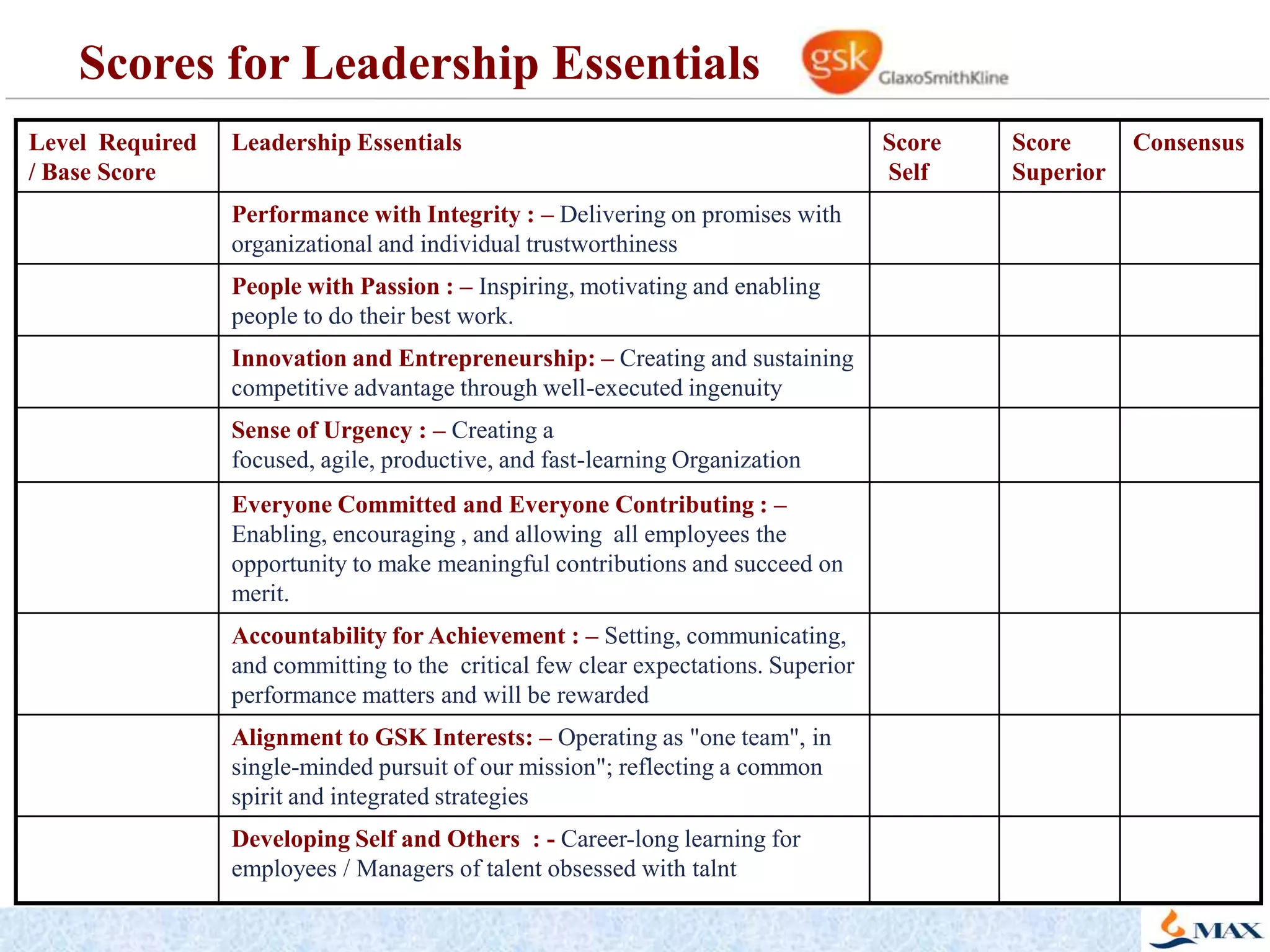
    39GSK: Living theSpiritPerformance with IntegrityOrganisational and individual trustworthinessPeople with PassionPeople are enabled and motivated to do their best workInnovation and EntrepreneurshipCompetitive advantage through well-executed ingenuitySense of UrgencyA nimble, focused, resilient and fast-learning organisation
  • 55.
    40GSK: Living theSpiritEveryone Committed, Everyone ContributingAll employees have opportunity to make a meaningful contribution and to succeed based on meritAccountability for AchievementClear expectations; focus on the critical few. Performance matters and will be rewardedAlignment with GSK InterestsOne team, in single-minded pursuit of our mission, reflecting a common spirit and integrated strategiesDevelop Self and Others A norm of career-long learning agility across the organisation
  • 56.
    Scores for LeadershipEssentialsScores for Leadership Essentials
  • 57.
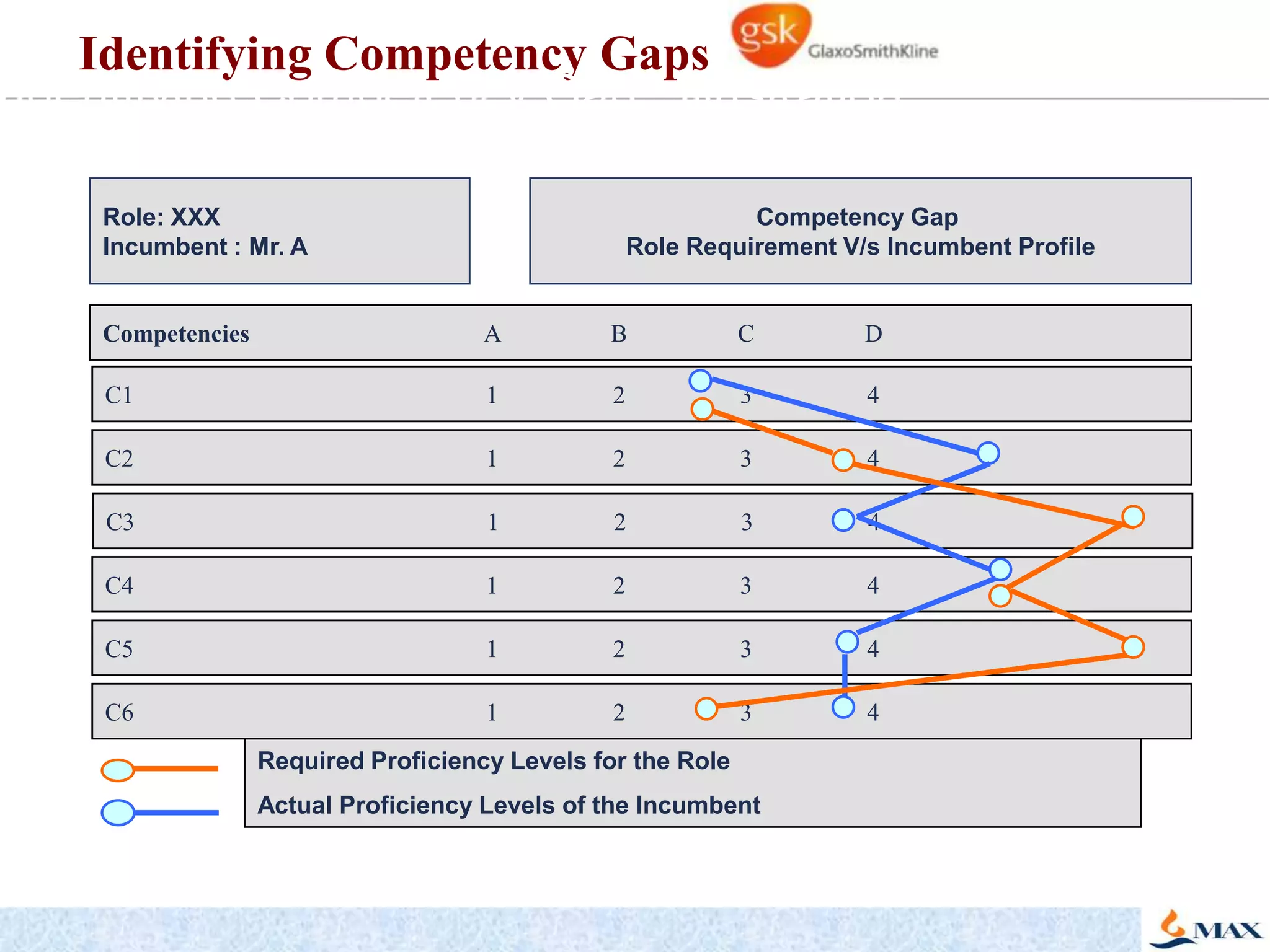
    Identifying Competency Gap: IllustrationRole: XXXIncumbent : Mr. ACompetency Gap Role Requirement V/s Incumbent ProfileCompetencies A B C DC1 1 2 3 4C2 1 2 3 4C3 1 2 3 4C4 1 2 3 4C5 1 2 3 4C6 1 2 3 4Required Proficiency Levels for the RoleActual Proficiency Levels of the IncumbentIdentifying Competency Gaps
  • 58.
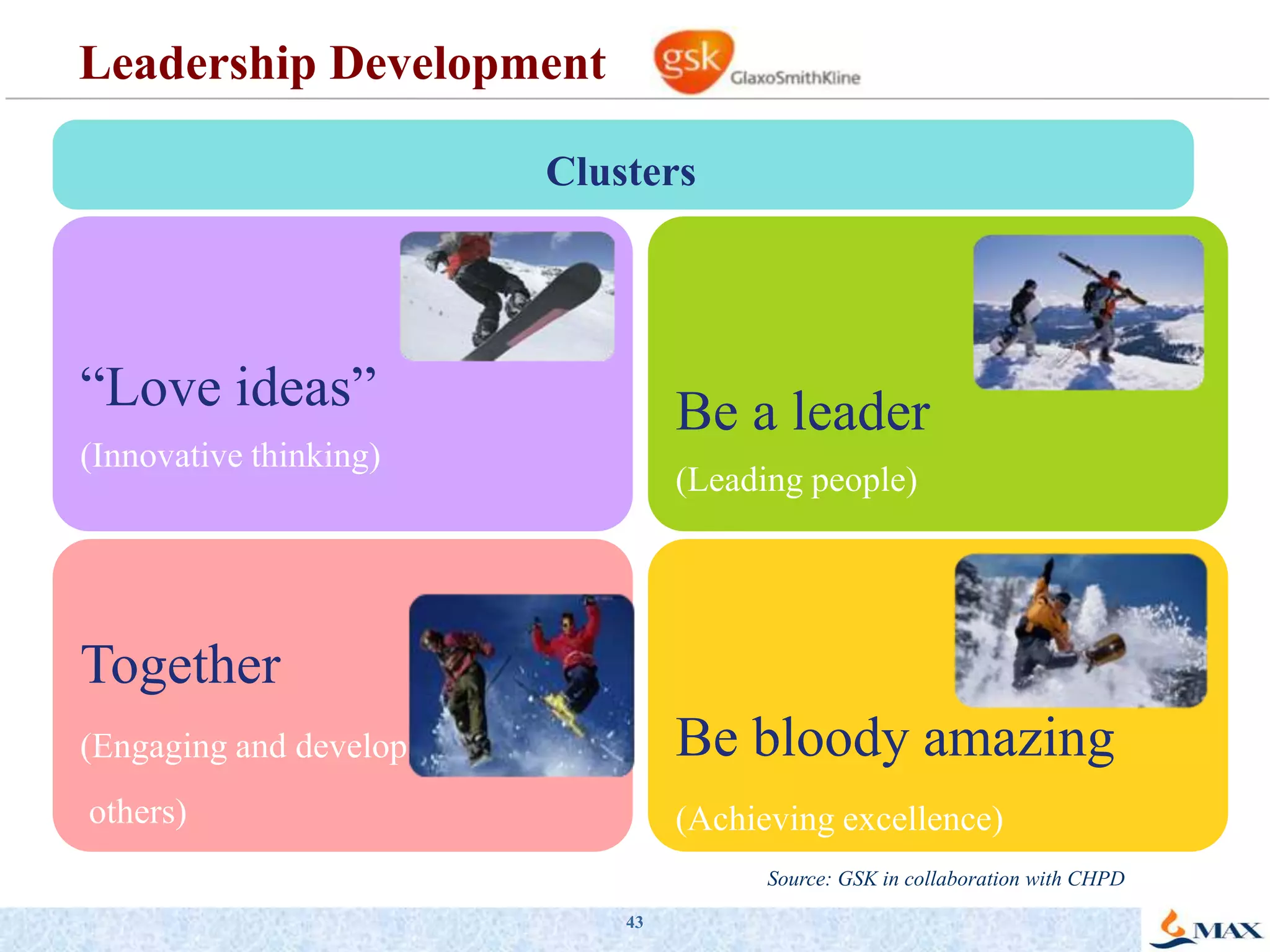
    43Leadership DevelopmentClusters“Love ideas”(Innovativethinking)Be a leader(Leading people)Together(Engaging and developing others)Be bloody amazing(Achieving excellence)Source: GSK in collaboration with CHPD
  • 59.
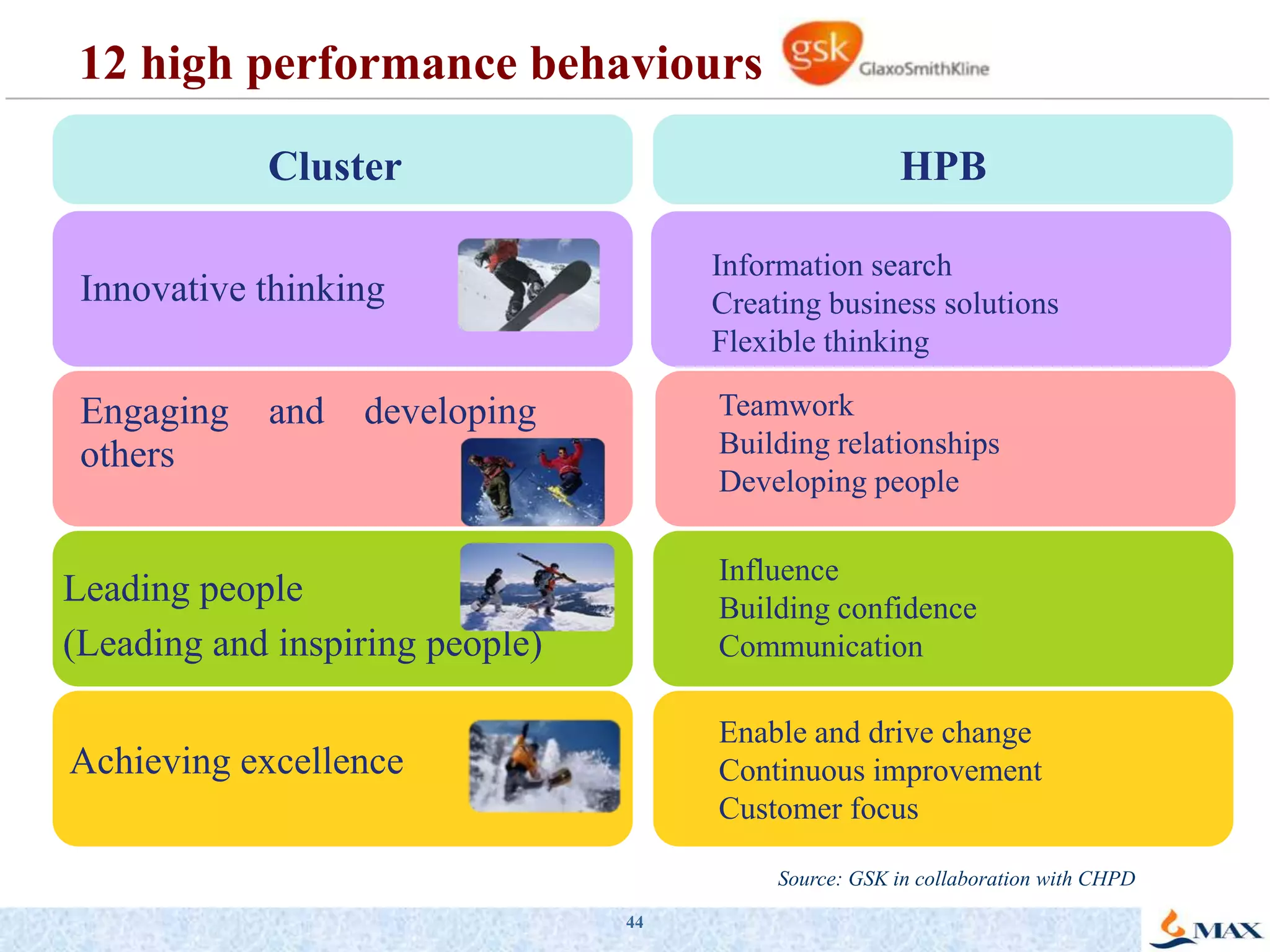
    4412 high performancebehavioursClusterHPBInformation searchCreating business solutions Flexible thinkingInnovative thinkingEngaging and developing othersTeamworkBuilding relationshipsDeveloping peopleInfluence Building confidenceCommunicationLeading people(Leading and inspiring people)Enable and drive changeContinuous improvement Customer focusAchieving excellenceSource: GSK in collaboration with CHPD
  • 60.
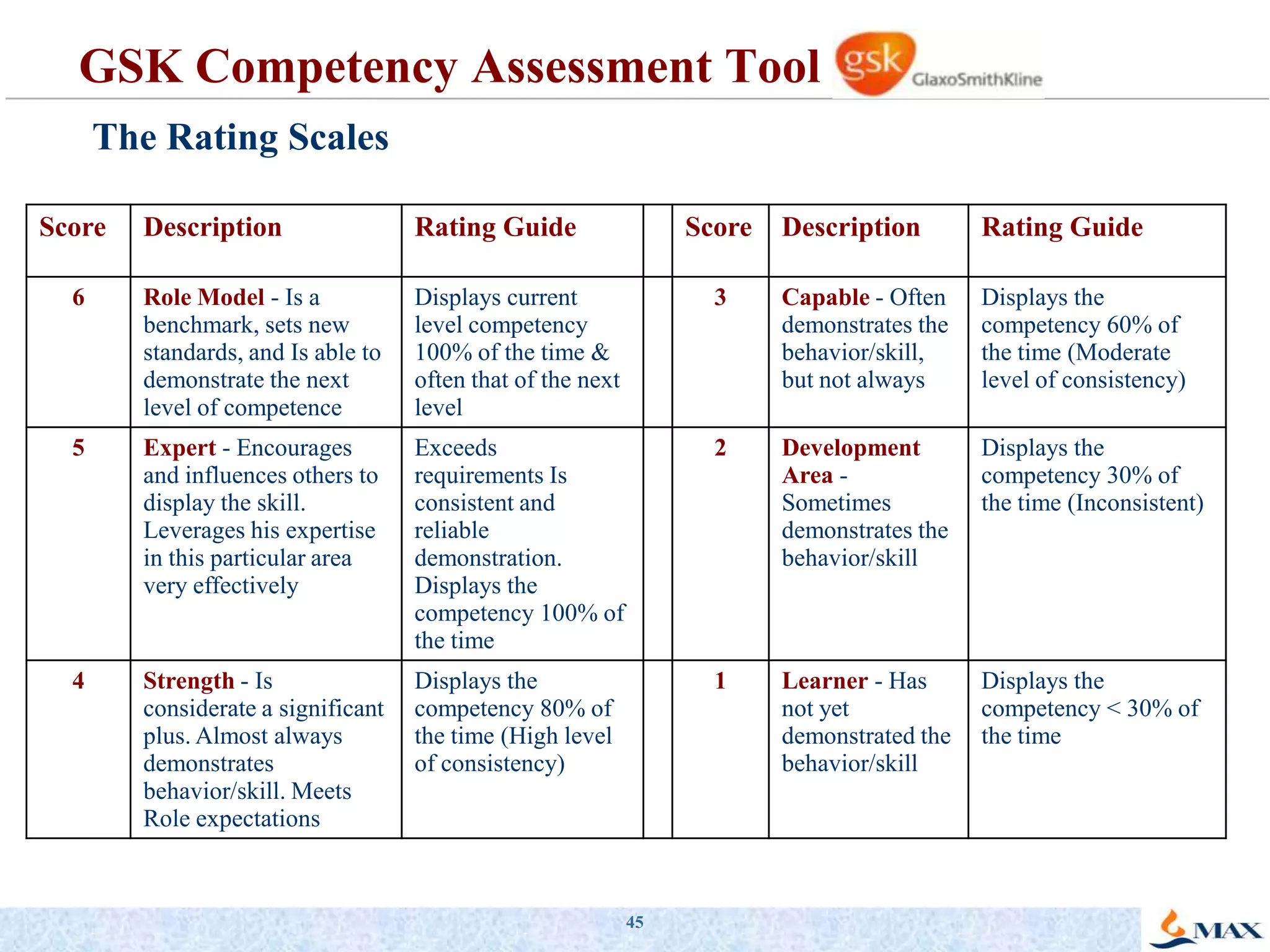
    45The Rating ScalesGSKCompetency Assessment Tool
  • 61.
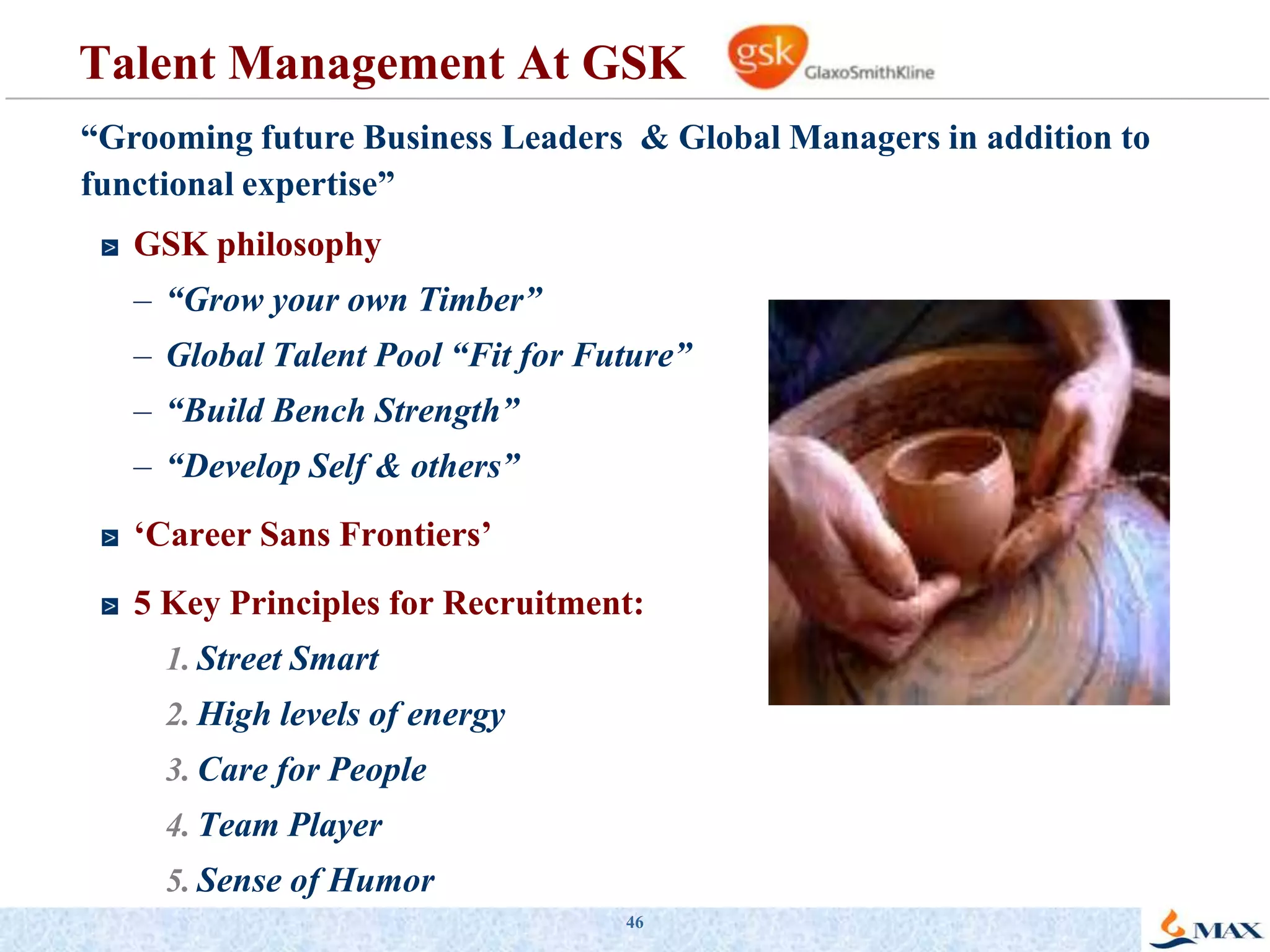
    46Talent Management AtGSK“Grooming future Business Leaders & Global Managers in addition to functional expertise”GSK philosophy “Grow your own Timber” Global Talent Pool “Fit for Future”“Build Bench Strength”“Develop Self & others”‘Career Sans Frontiers’5 Key Principles for Recruitment:Street SmartHigh levels of energyCare for PeopleTeam PlayerSense of Humor
  • 62.
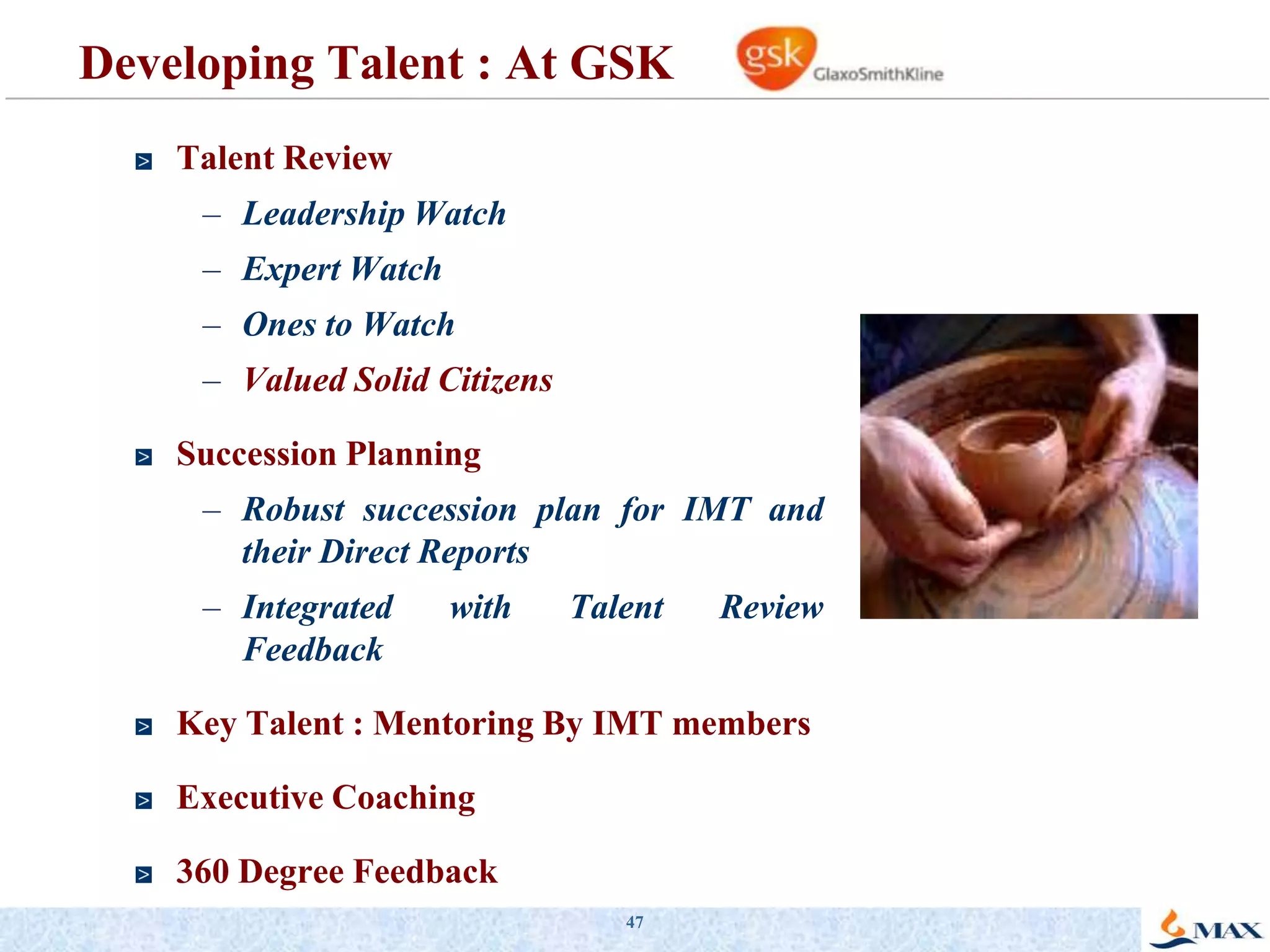
    47Developing Talent :At GSK Talent ReviewLeadership WatchExpert Watch Ones to WatchValued Solid CitizensSuccession PlanningRobust succession plan for IMT and their Direct ReportsIntegrated with Talent Review FeedbackKey Talent : Mentoring By IMT membersExecutive Coaching360 Degree Feedback
  • 63.
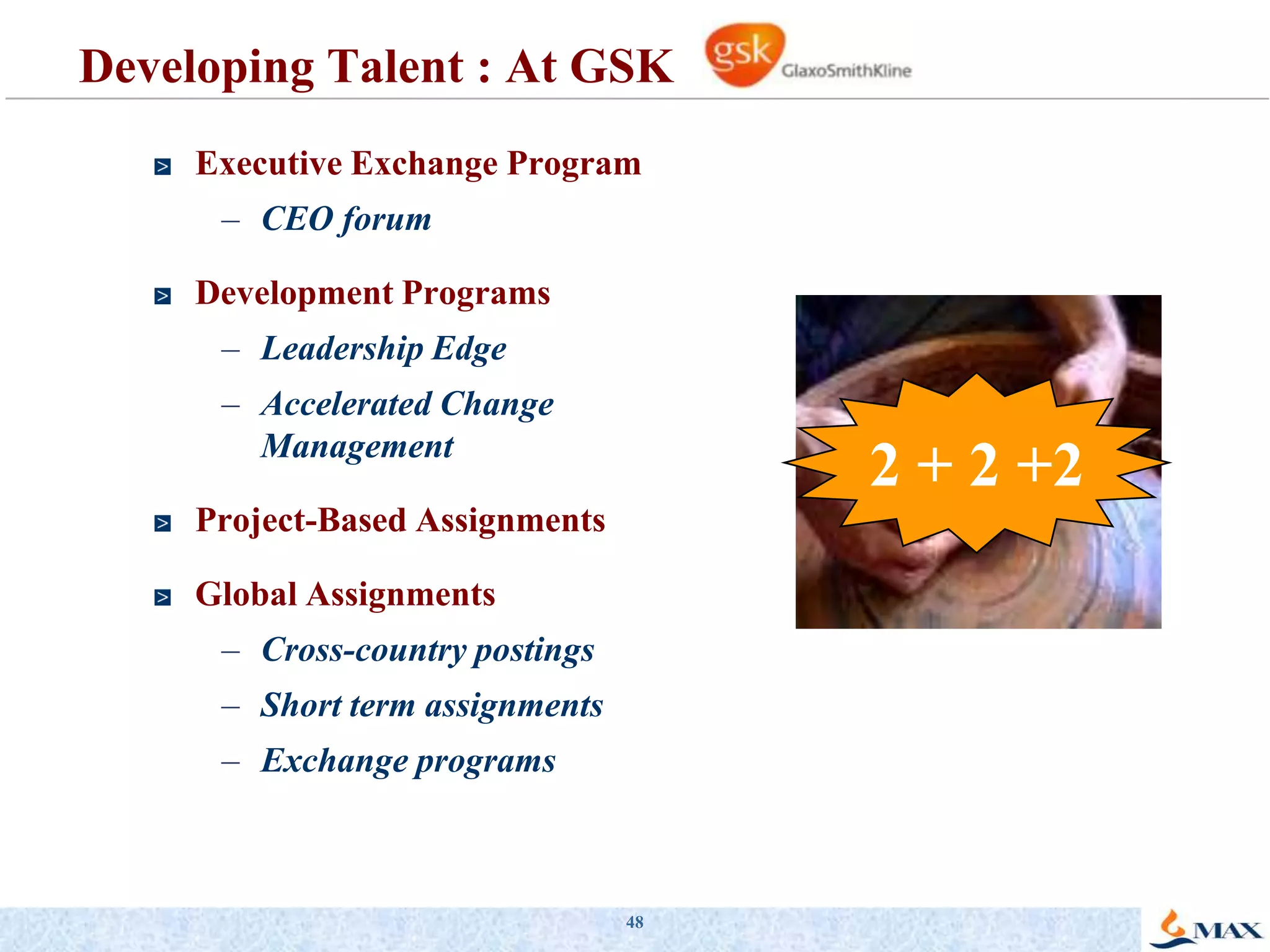
    48Developing Talent :At GSKExecutive Exchange ProgramCEO forumDevelopment ProgramsLeadership EdgeAccelerated Change ManagementProject-Based AssignmentsGlobal AssignmentsCross-country postingsShort term assignmentsExchange programs2 + 2 +2
  • 64.
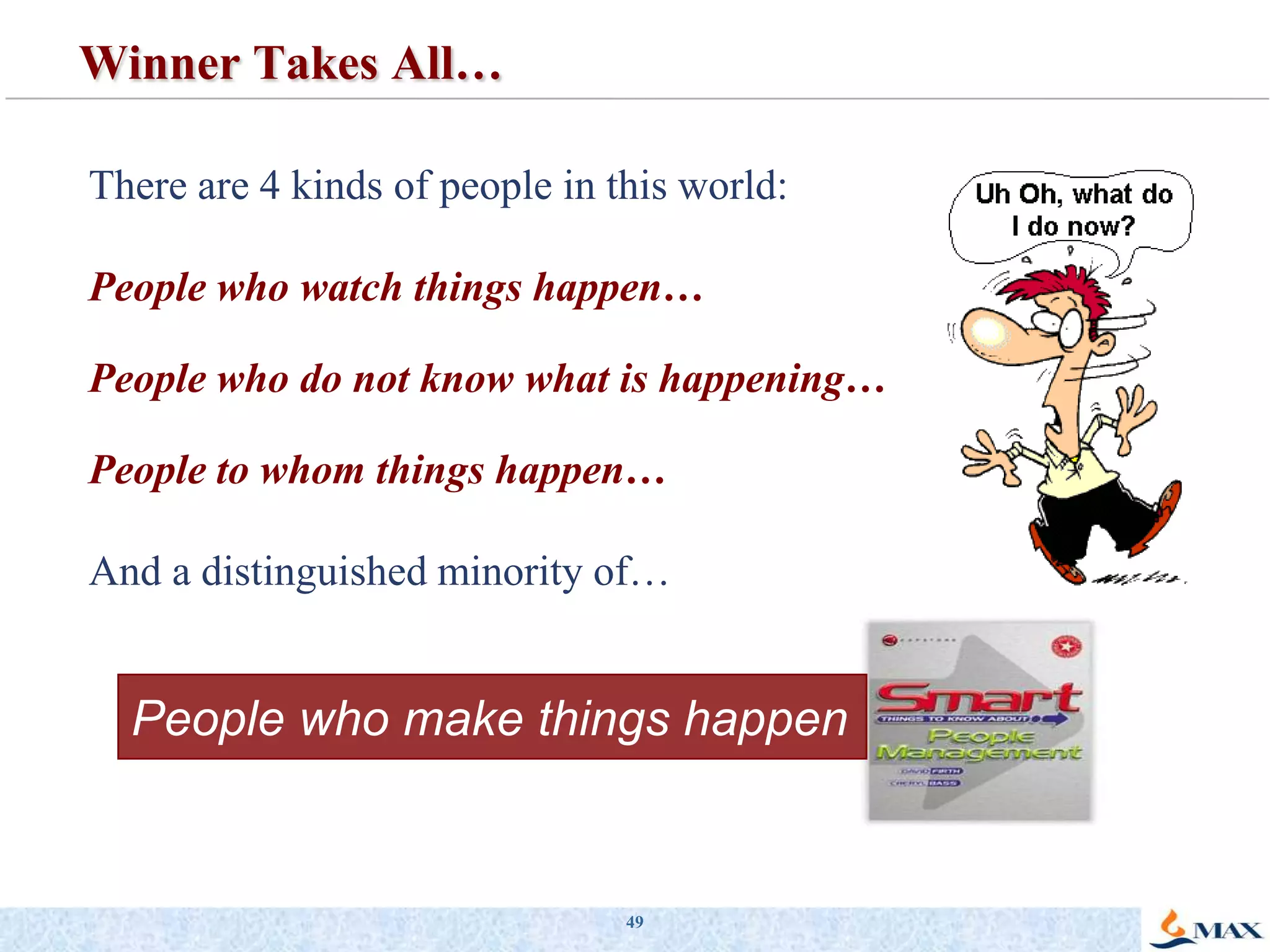
    49There are 4kinds of people in this world:People who watch things happen…People who do not know what is happening…People to whom things happen…And a distinguished minority of…Winner Takes All…People who make things happen
  • 65.