What are competencies – some definitions ……… Competencies are the characteristics of an employee that lead to  the demonstration of skills & abilities, which result in effective  performance within an occupational area. A cluster of related knowledge, skills and abilities that affects a  major part of ones job, that correlates with the performance on the job, that can be measured against well –accepted standards and that can be improved via training and development. An underlying characteristic of a person result in effective and / or  superior performance on the job.  In other words, competencies are characteristics that outstanding  performers do more often in more situations with better results, than  average performers
Why do we need it? People will have to know their respective * Roles * Key competencies Address employee needs * What am I on skills? * What are the gaps? How to improve on skills? * What is expected of my role? * What are possible future roles? People have to know about competencies which help them  deliver better to customers Address organizational / business needs * High performance * Expectation management on career and promotions * Higher productivity with improved skills
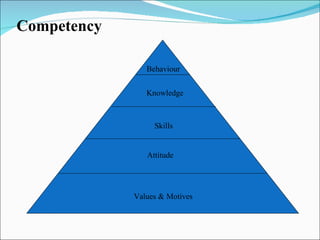
Competency Behaviour Knowledge Skills Attitude Values & Motives
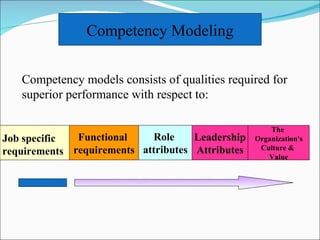
Competency Modeling Competency models consists of qualities required for superior performance with respect to: Functional  requirements Leadership Attributes Job specific requirements Role  attributes The  Organization's Culture &  Value
Competency Based Management
Step 1 : Competency Profile What capabilities currently exist  within the organization?
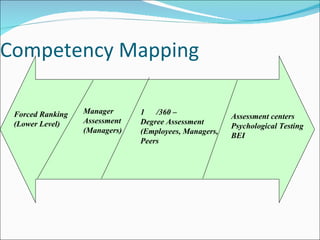
Competency Mapping Forced Ranking (Lower Level) Manager  Assessment (Managers) /360 – Degree Assessment (Employees, Managers, Peers Assessment centers Psychological Testing BEI
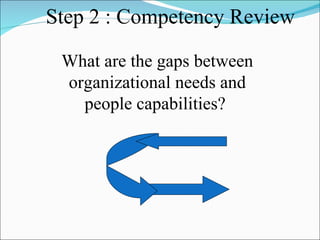
Step 2 : Competency Review What are the gaps between organizational needs and  people capabilities?
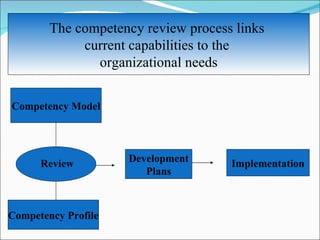
The competency review process links  current capabilities to the  organizational needs Competency Model Review Competency Profile Development Plans Implementation
Step 3 : Development Plans Create Plans for shoring any  identified gaps
Developing Competency Model
Developing competency model depends on the nature of the organization & some basic consideration: The practices for which they will be used The financial & personnel resource available  Who needs to be included in the process of developing  & endorsing the applications Who is going to be included in the implementation process
Select the optimal approach Generic model Adapted Generic Model Survey  Driven Expert Panel Behavioral Event  Interviews Most Rigorous Least Rigorous Considerations: *  Practicality *  Fairness *  Speed *  Validity
Data Collection tools Behavioral Events Interview Expert Panels Surveys Expert Systems Job Analysis Role Analysis Direct Observation
Behavioral Events Interview Advantages: Empirical Identification of competencies Precision about how competencies are expressed Freedom from gender, cultural, bias Generation of data for assessment, training etc.
Behavioral Events Interview Disadvantages: Time & Expense Expertise requirements Missed job tasks
Expert Panels Advantages Quick and efficient collection of a great deal of valuable data Helps ensure better buy-in
Expert Panels Disadvantages Possible identification of folklore or motherhood items. Omission of critical competency factors which  panelists are unaware of.
Surveys Advantages Quick and cheap collection of sufficient data for  statistical analyses A large number of employees can provide input Help build consensus
Surveys  Disadvantages Data are limited to items and concepts included in the survey It cannot identify new competencies or nuances of  competency Can also be ineffecient
Expert Systems Advantages Access to data Efficiency Productivity
Expert Systems Disadvantages Garbage in –garbage out May overlook specialized competition Cost of system hardware and software
Job Analysis Advantages Produces complete job descriptions Can validate or elaborate on data collected by other methods
Job Analysis Disadvantages Provides characteristics of job rather than those of the people who do the job well Task lists too detailed to be practical and do not  separate truly important tasks from the routine activities
Direct Observation Advantages A good way to check competencies suggested by panel, survey, and BEI Disadvantages Expensive and inefficient
Kinds of competencies that can be included in  competency  models : Differentiating competencies  -  that most differentiate  superior  performers from mediocre performers. Includes results orientation, influence, and initiative Threshold competencies - in which a minimum level of  proficiency is required for job success, but a higher  level of  proficiency is not highly correlated with superior  performance. Transformation competencies- at which managers and employees are  generally  weak, which if improved will most likely to result in improved performance.
Alternate ways of choosing the  Competencies in your job models Traditional approaches involve studying superior  performers , &  identifying the traits, characteristics, and behaviors that differentiate then from average performers:- First approach- follow superior and average performers as they go  about their workday  Second approach- Perform interviews and organize focus groups of managers and superior performers
Competency models by position, function, level, or company One universal set of competencies for all employees and positions. Merits It builds a common language & frame of reference for  everyone It makes it easier to compare employees to one another across  position and job functions   It eases administration of selection & development practices It helps align everyone towards a common culture & can  support the culture change process.
Competency models by position Difficulties: Developing models for each position will take considerable time, efforts & expense if done well The lack of competency commonality from position to position will make it more difficult to compare & contrast candidates currently in  different positions. Every time employees move from one position to another, they will have to learn new competencies & abandon those they have been  focusing on improving.
Competency model by job function Advantage The number of competency models-generally in the range of  10 to 15 is manageable in terms of both creation & their maintenance  The same model applies to all the positions with in  a job function Easy to compare different employees in the same job function for the purpose of succession planning & Organizational development Disadvantage: Managers have the same competency models as individual  contributors within a job function.
The competency matrix – level & proficiency Defines level of proficiency on competencies in terms of a set of behaviors expected for a grade level or rank at a particular position The numbers in the rating system are replaced by job titles Helps employees understand the desired level of  proficiency for each competency at each job level.

Competency Mapping

  • 1.
    What are competencies– some definitions ……… Competencies are the characteristics of an employee that lead to the demonstration of skills & abilities, which result in effective performance within an occupational area. A cluster of related knowledge, skills and abilities that affects a major part of ones job, that correlates with the performance on the job, that can be measured against well –accepted standards and that can be improved via training and development. An underlying characteristic of a person result in effective and / or superior performance on the job. In other words, competencies are characteristics that outstanding performers do more often in more situations with better results, than average performers
  • 2.
    Why do weneed it? People will have to know their respective * Roles * Key competencies Address employee needs * What am I on skills? * What are the gaps? How to improve on skills? * What is expected of my role? * What are possible future roles? People have to know about competencies which help them deliver better to customers Address organizational / business needs * High performance * Expectation management on career and promotions * Higher productivity with improved skills
  • 3.
    Competency Behaviour KnowledgeSkills Attitude Values & Motives
  • 4.
    Competency Modeling Competencymodels consists of qualities required for superior performance with respect to: Functional requirements Leadership Attributes Job specific requirements Role attributes The Organization's Culture & Value
  • 5.
  • 6.
    Step 1 :Competency Profile What capabilities currently exist within the organization?
  • 7.
    Competency Mapping ForcedRanking (Lower Level) Manager Assessment (Managers) /360 – Degree Assessment (Employees, Managers, Peers Assessment centers Psychological Testing BEI
  • 8.
    Step 2 :Competency Review What are the gaps between organizational needs and people capabilities?
  • 9.
    The competency reviewprocess links current capabilities to the organizational needs Competency Model Review Competency Profile Development Plans Implementation
  • 10.
    Step 3 :Development Plans Create Plans for shoring any identified gaps
  • 11.
  • 12.
    Developing competency modeldepends on the nature of the organization & some basic consideration: The practices for which they will be used The financial & personnel resource available Who needs to be included in the process of developing & endorsing the applications Who is going to be included in the implementation process
  • 13.
    Select the optimalapproach Generic model Adapted Generic Model Survey Driven Expert Panel Behavioral Event Interviews Most Rigorous Least Rigorous Considerations: * Practicality * Fairness * Speed * Validity
  • 14.
    Data Collection toolsBehavioral Events Interview Expert Panels Surveys Expert Systems Job Analysis Role Analysis Direct Observation
  • 15.
    Behavioral Events InterviewAdvantages: Empirical Identification of competencies Precision about how competencies are expressed Freedom from gender, cultural, bias Generation of data for assessment, training etc.
  • 16.
    Behavioral Events InterviewDisadvantages: Time & Expense Expertise requirements Missed job tasks
  • 17.
    Expert Panels AdvantagesQuick and efficient collection of a great deal of valuable data Helps ensure better buy-in
  • 18.
    Expert Panels DisadvantagesPossible identification of folklore or motherhood items. Omission of critical competency factors which panelists are unaware of.
  • 19.
    Surveys Advantages Quickand cheap collection of sufficient data for statistical analyses A large number of employees can provide input Help build consensus
  • 20.
    Surveys DisadvantagesData are limited to items and concepts included in the survey It cannot identify new competencies or nuances of competency Can also be ineffecient
  • 21.
    Expert Systems AdvantagesAccess to data Efficiency Productivity
  • 22.
    Expert Systems DisadvantagesGarbage in –garbage out May overlook specialized competition Cost of system hardware and software
  • 23.
    Job Analysis AdvantagesProduces complete job descriptions Can validate or elaborate on data collected by other methods
  • 24.
    Job Analysis DisadvantagesProvides characteristics of job rather than those of the people who do the job well Task lists too detailed to be practical and do not separate truly important tasks from the routine activities
  • 25.
    Direct Observation AdvantagesA good way to check competencies suggested by panel, survey, and BEI Disadvantages Expensive and inefficient
  • 26.
    Kinds of competenciesthat can be included in competency models : Differentiating competencies - that most differentiate superior performers from mediocre performers. Includes results orientation, influence, and initiative Threshold competencies - in which a minimum level of proficiency is required for job success, but a higher level of proficiency is not highly correlated with superior performance. Transformation competencies- at which managers and employees are generally weak, which if improved will most likely to result in improved performance.
  • 27.
    Alternate ways ofchoosing the Competencies in your job models Traditional approaches involve studying superior performers , & identifying the traits, characteristics, and behaviors that differentiate then from average performers:- First approach- follow superior and average performers as they go about their workday Second approach- Perform interviews and organize focus groups of managers and superior performers
  • 28.
    Competency models byposition, function, level, or company One universal set of competencies for all employees and positions. Merits It builds a common language & frame of reference for everyone It makes it easier to compare employees to one another across position and job functions It eases administration of selection & development practices It helps align everyone towards a common culture & can support the culture change process.
  • 29.
    Competency models byposition Difficulties: Developing models for each position will take considerable time, efforts & expense if done well The lack of competency commonality from position to position will make it more difficult to compare & contrast candidates currently in different positions. Every time employees move from one position to another, they will have to learn new competencies & abandon those they have been focusing on improving.
  • 30.
    Competency model byjob function Advantage The number of competency models-generally in the range of 10 to 15 is manageable in terms of both creation & their maintenance The same model applies to all the positions with in a job function Easy to compare different employees in the same job function for the purpose of succession planning & Organizational development Disadvantage: Managers have the same competency models as individual contributors within a job function.
  • 31.
    The competency matrix– level & proficiency Defines level of proficiency on competencies in terms of a set of behaviors expected for a grade level or rank at a particular position The numbers in the rating system are replaced by job titles Helps employees understand the desired level of proficiency for each competency at each job level.