Competencies and competences


     by Toronto Training and HR

           February 2012
3-4     Introduction to Toronto Training and HR
           5-6     Definitions
Contents   7-9     Commonly sought competencies
           10-11   Core competences
           12-22   Competency frameworks
           23-25   Questions to ask
           26-27   Organizational capacity and context
           28-29   Clusters of competencies leading to high
                   performance
           30-32   Role analysis
           33-34   Rules around competence-related pay
           35-37   Benefits of a competency-based system
           38-41   Criticisms of a competency-based system
           42-43   Building a competency model
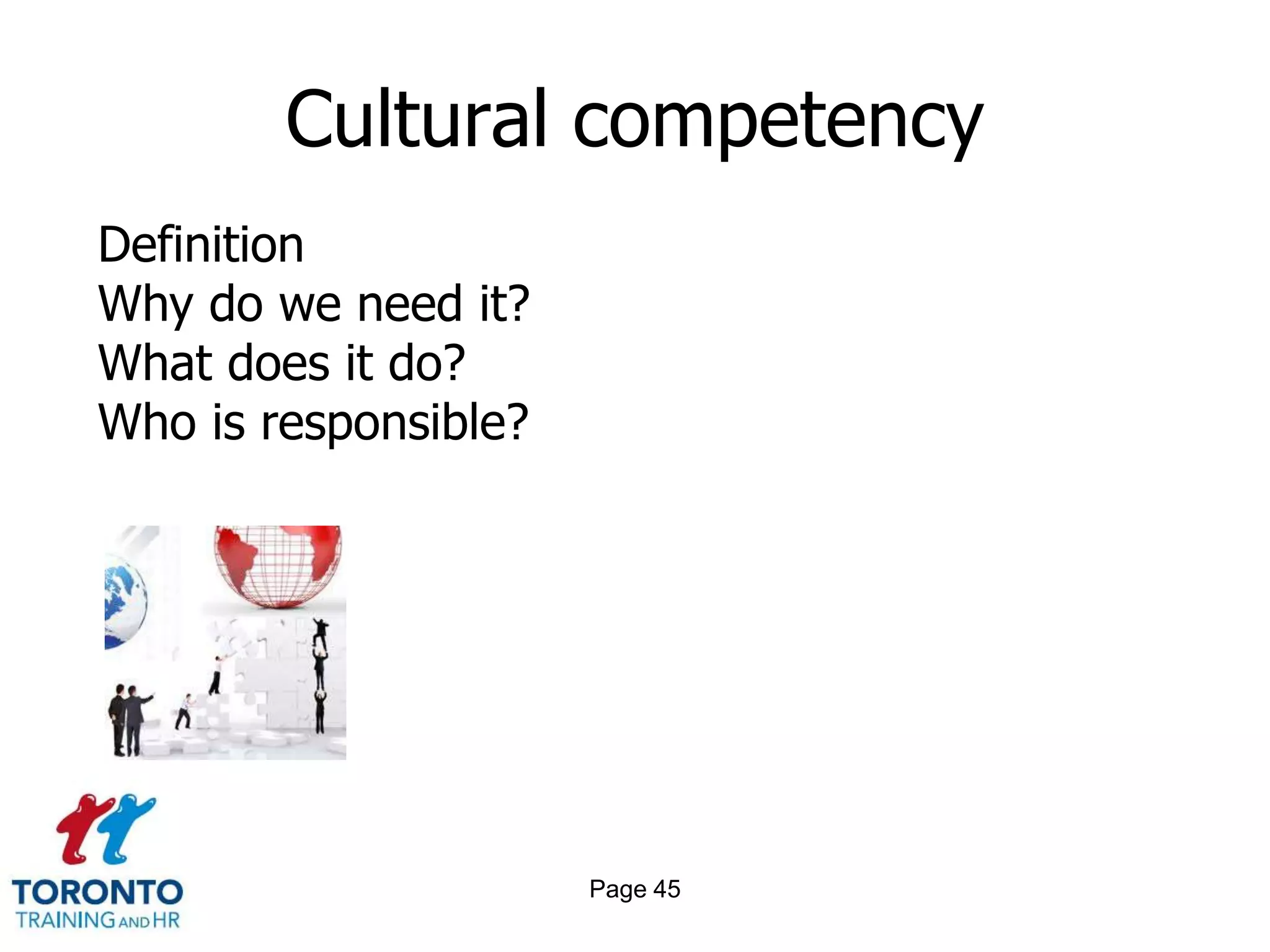
           44-45   Cultural competency
           46-47   What influences performance on the job?
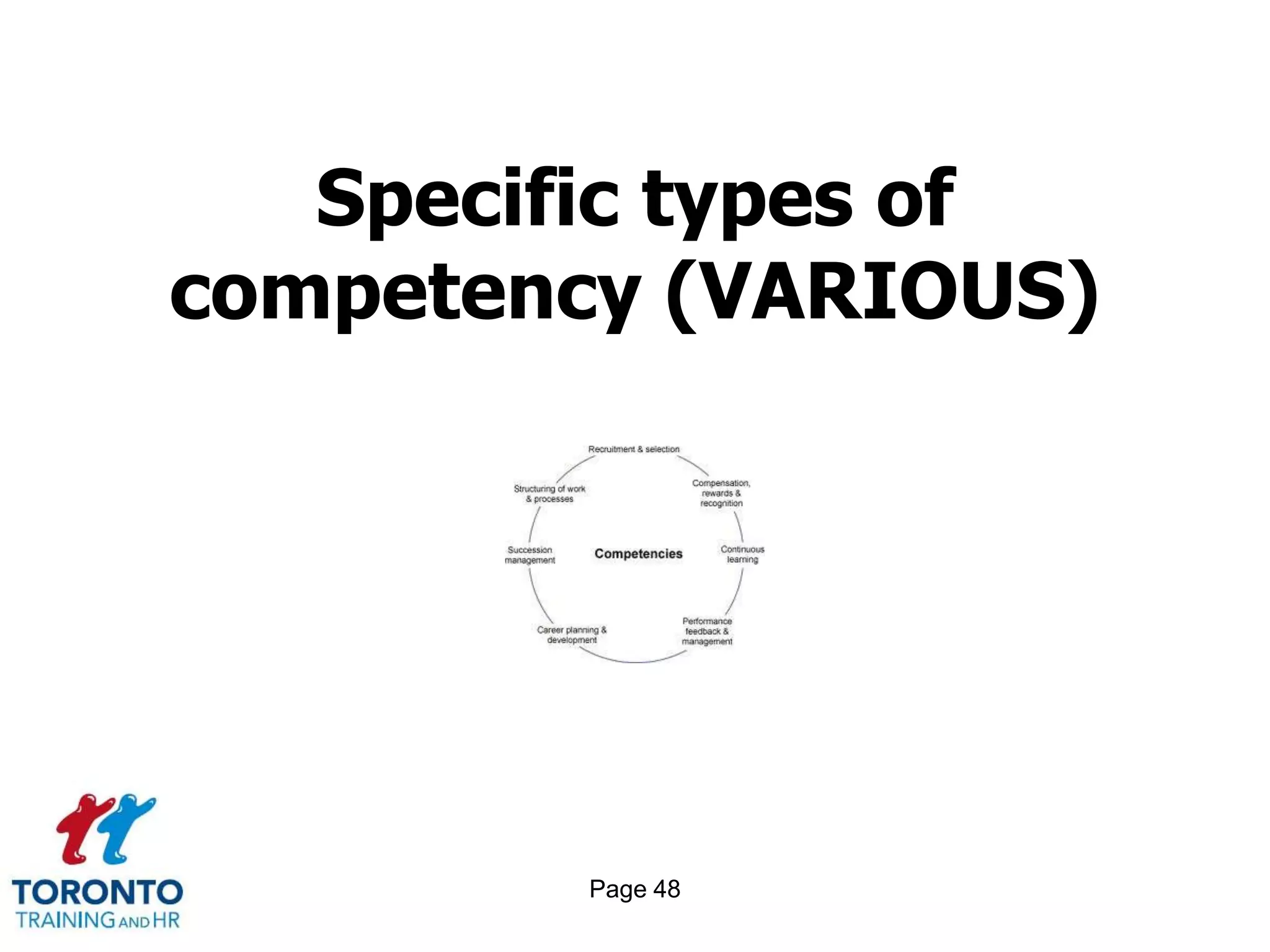
           48-83   Specific types of competency (VARIOUS)
           84-87   Benefits for employers
           88-91   Benefits for employees
           92-101 Case studies
           102-103 Conclusion and questions
Introduction


     Page 3
Introduction to Toronto Training
            and HR
• Toronto Training and HR is a specialist training and human
  resources consultancy headed by Timothy Holden
• 10 years in banking
• 10 years in training and human resources
• Freelance practitioner since 2006
• The core services provided by Toronto Training and HR are:
              - Training event design
              - Training event delivery
              - Reducing costs
              - Saving time
              - Improving employee engagement & morale
              - Services for job seekers

                            Page 4
Definitions


    Page 5
Definitions
What are competencies?
Competence
Competency


                    Page 6
Commonly sought
  competencies


      Page 7
Commonly sought competencies
           1 of 2
Communication
Achievement/results orientation
Customer focus
Teamwork
Leadership
Planning and organizing
Commercial acumen and business awareness
Flexibility and adaptability


                    Page 8
Commonly sought competencies
           2 of 2
Developing others
Problem-solving
Analytical thinking
Building relationships


                         Page 9
Core competences


      Page 10
Core competences
Strategic management
HR management


                       Page 11
Competency frameworks


         Page 12
Competency frameworks 1 of 10
TYPES:
Off the shelf
Customized


                Page 13
Competency frameworks 2 of 10
BEHAVIOURS TO INCLUDE:
Communication skills
People management
Team skills
Customer service skills
Results orientation
Problem solving


                  Page 14
Competency frameworks 3 of 10
THE PROCESS, STEP ONE:
A review (and potentially a refresh) of the current
vision, mission statement and business strategy-
this is likely to involve a series of discussions with
the senior management team
THE PROCESS, STEP TWO:
Conducting workshops, focus groups and surveys
to gather views and data from employees (at all
levels) on what they see as being the values, ethos
and culture of the organization

                       Page 15
Competency frameworks 4 of 10
THE PROCESS, STEP TWO:
This is likely to include asking questions such as:
What is important around here?
What do we want our clients to think of us?
What do we want the public to think of us?
What attracts people to work here?
What informs the way we do business?
What are our guiding principles?
How do we expect our colleagues to behave?


                       Page 16
Competency frameworks 5 of 10
THE PROCESS, STEP TWO:
How do we do what we do?
What do we do best?
What’s good about working here?
What sets us apart from our competitors?
What makes us successful?


                     Page 17
Competency frameworks 6 of 10
THE PROCESS, STEP THREE:
Using the data gathered to collaboratively agree
and finalise a clear set of agreed organizational
values
THE PROCESS, STEP FOUR:
Presenting these values back to the organization
for discussion and review, possibly as a series of
internal briefings


                       Page 18
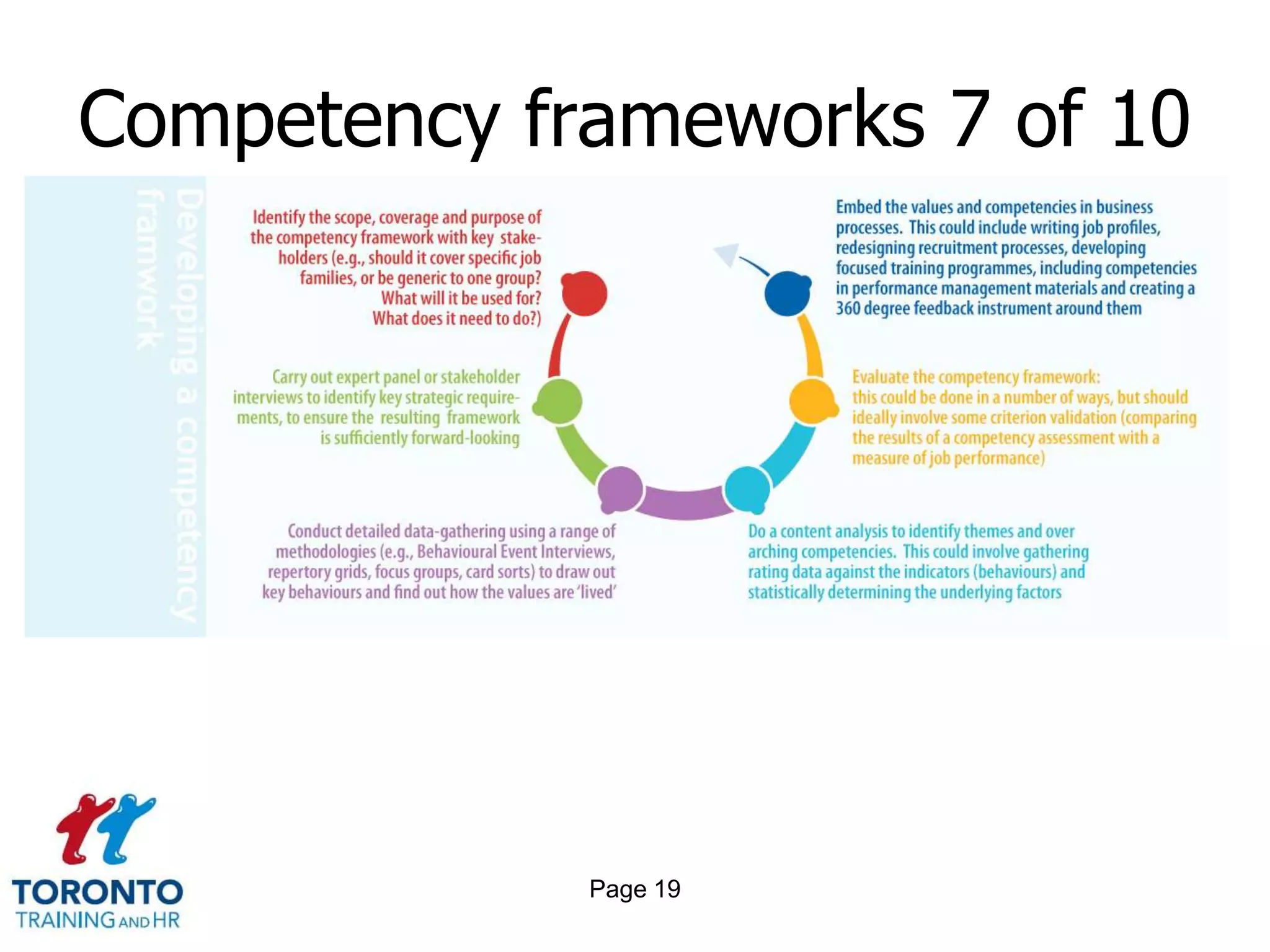
Competency frameworks 7 of 10


             Page 19
Competency frameworks 8 of 10
AN INTEGRATED BALANCED FRAMEWORK:
Innate qualities
Acquired skill
Adapting behaviours


                 Page 20
Competency frameworks 9 of 10
GOALS:
Underpinning of performance appraisals
Enhanced employee effectiveness
Greater organizational effectiveness
Better analysis of training needs
Enhanced career management


                     Page 21
Competency frameworks 10 of 10
 IS YOUR COMPETENCY FRAMEWORK FIT FOR
 PURPOSE?
 Communicate the purpose
 Identify key themes
 Get conditions right
 Tackle the root cause
 Keep it simple
 Train, don’t blame


                  Page 22
Questions to ask


      Page 23
Questions to ask 1 of 2
How would you describe the perfect employee?
What’s different about employees here?
What do you value most in your staff/colleagues?
What really sets apart the best people from
others?
Think of the most effective person in your team-
what characteristics and qualities make them
effective?


                     Page 24
Questions to ask 2 of 2
What do people need to do to get promoted?
What will get in the way of people getting
promoted here?
What gets you noticed around here?
What sorts of behaviours are ‘career limiting’
around here – for instance, what might cause an
individual to derail, or what would prevent them
from ‘fitting in’?


                      Page 25
Organizational capacity
     and context


          Page 26
Organizational capacity and
            context
DIMENSIONS TO CONSIDER
Structural facet
Cultural component
Psychological element
Policy component
Contextual facet


                 Page 27
Clusters of competencies
     leading to high
      performance


          Page 28
Clusters of competencies leading
      to high performance
Cognitive competencies
Emotional intelligence competencies
Social intelligence competencies


                     Page 29
Role analysis


     Page 30
Role analysis 1 of 2
ACTIVITY-BASED TECHNIQUES
Focus groups
Inventories or questionnaires
Interviews including critical incident interview
Diaries and work logs


                       Page 31
Role analysis 2 of 2
PEOPLE-BASED TECHNIQUES
Repertory grids
Observation
Testing


                 Page 32
Rules around
competence-related pay


         Page 33
Rules around
     competence-related pay
Consistency rule
Bias-suppression rule
Accuracy rule
Correctability rule
Representativeness rule
Ethicality rule


                     Page 34
Benefits of a competency-
      based system


           Page 35
Benefits of a competency-based
         system 1 of 2
Employees have a well-defined set of behaviours
required in their work and are clear about how
they are expected to perform their jobs
The appraisal and recruitment systems are fairer
and more open
Recruiters are able to assess transferable skills and
identify required behaviours regardless of career
background


                       Page 36
Benefits of a competency-based
         system 2 of 2
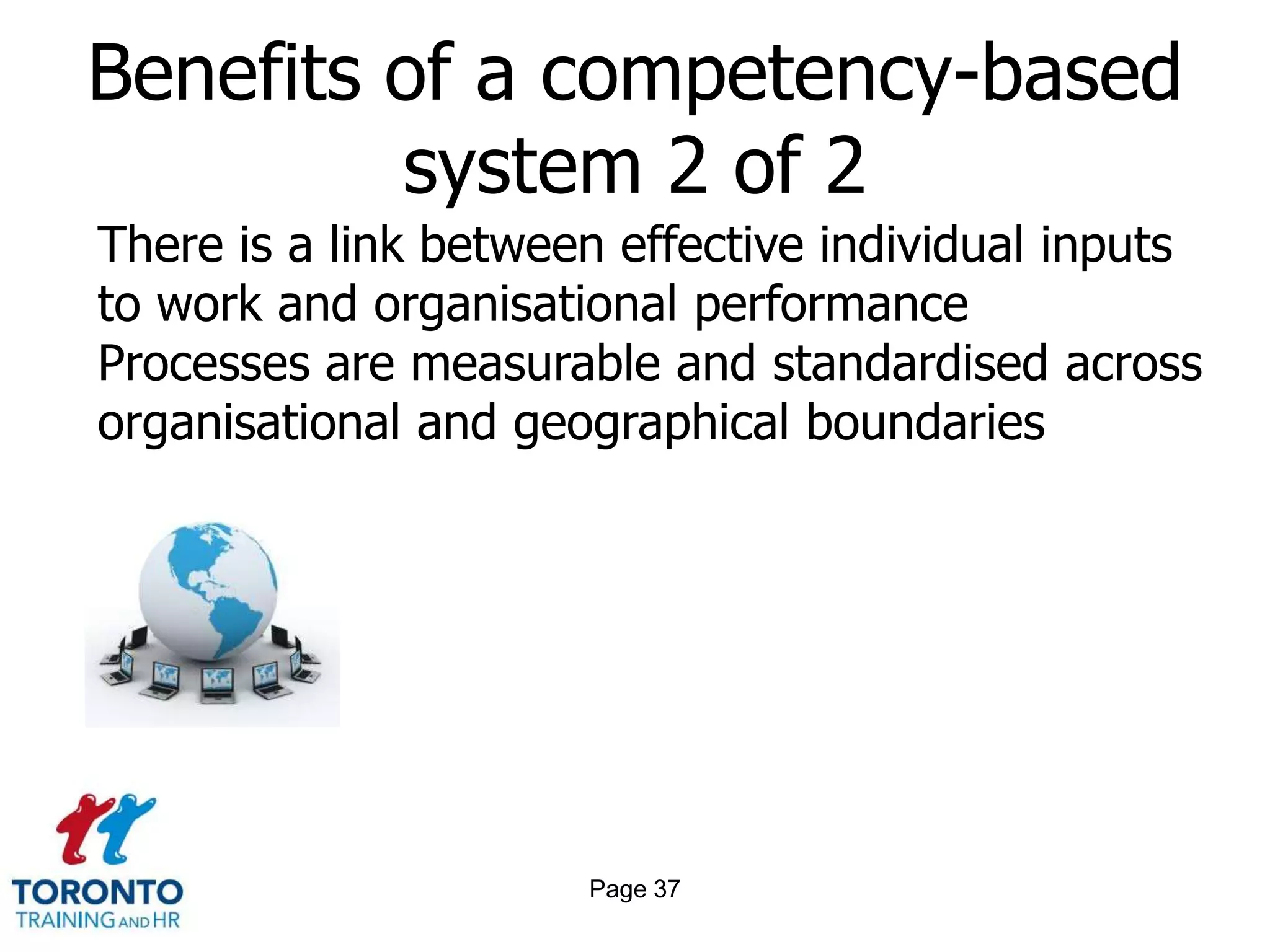
There is a link between effective individual inputs
to work and organisational performance
Processes are measurable and standardised across
organisational and geographical boundaries


                      Page 37
Criticisms of a
competency-based system


          Page 38
Criticisms of a competency-based
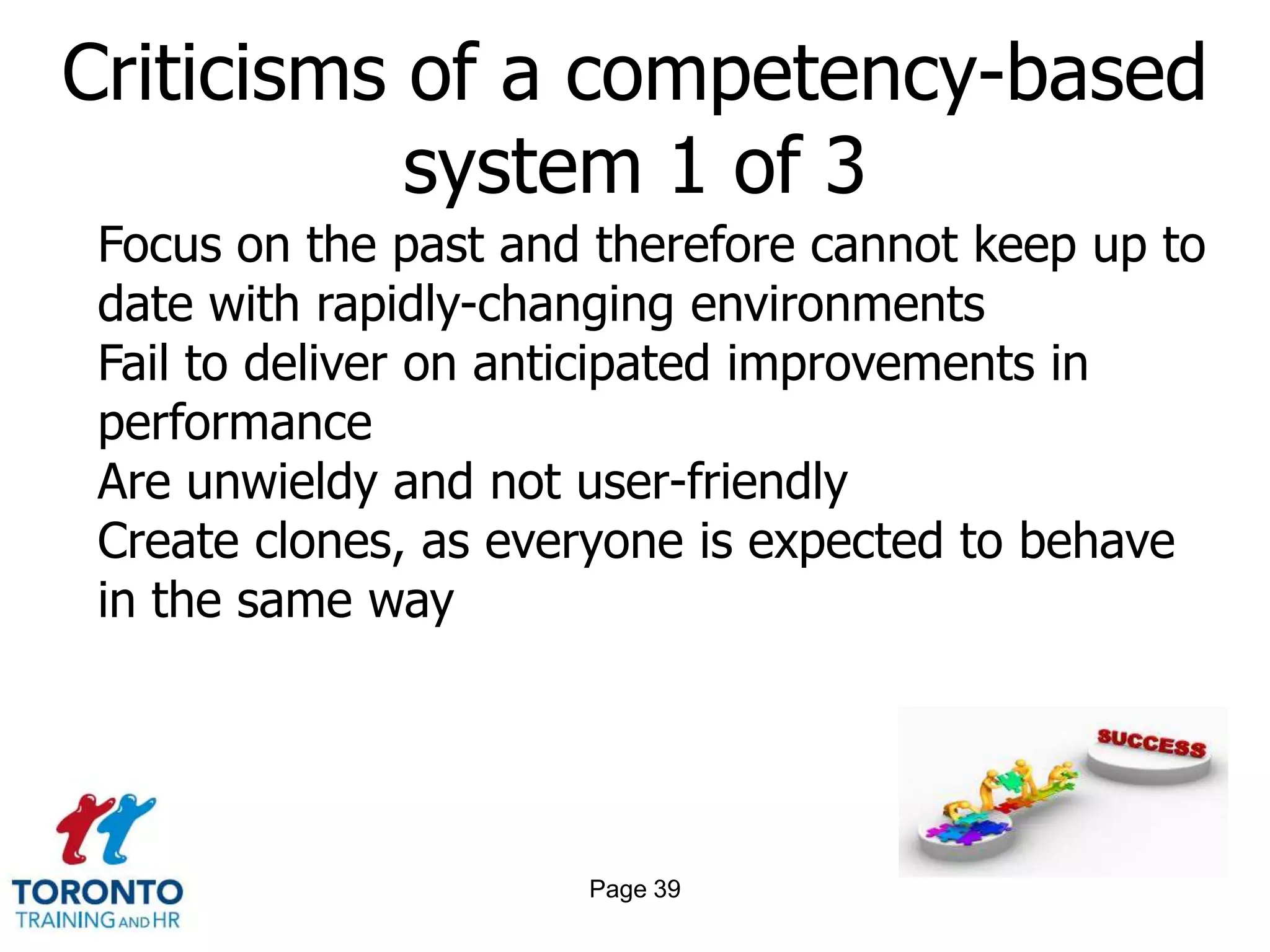
           system 1 of 3
Focus on the past and therefore cannot keep up to
date with rapidly-changing environments
Fail to deliver on anticipated improvements in
performance
Are unwieldy and not user-friendly
Create clones, as everyone is expected to behave
in the same way


                     Page 39
Criticisms of a competency-based
           system 2 of 3
LEADERSHIP AND MANAGEMENT DEVLOPMENT
Competency frameworks are expensive to design,
install, administer and monitor
Encourage a focus on sameness and can therefore
impede diversity
Carry the assumption that selected individuals can
be ‘trained’ into leadership or management
positions and then provide good role models for
others

                      Page 40
Criticisms of a competency-based
           system 3 of 3
LEADERSHIP AND MANAGEMENT DEVELOPMENT
Rarely discriminate enough between leadership &
management
Assume that a number of discrete components can
adequately describe critical features of a role, and
that those components will remain relatively
constant and standardized through time
Narrow leadership & management perspectives
can stifle questioning and prevent unlearning


                       Page 41
Building a competency
        model


         Page 42
Building a competency model

Determine performance criteria
Select criterion sample
Collect data
Develop model
Validate model


                     Page 43
Cultural competency


        Page 44
Cultural competency
Definition
Why do we need it?
What does it do?
Who is responsible?


                      Page 45
What influences
performance on the job?


          Page 46
What influences performance on
            the job?
Knowledge abilities and aptitudes
Work styles, personality, interests, principles,
values, attitudes, beliefs and
leadership/subordinate styles


                        Page 47
Specific types of
competency (VARIOUS)


         Page 48
Communication
 competencies


     Page 49
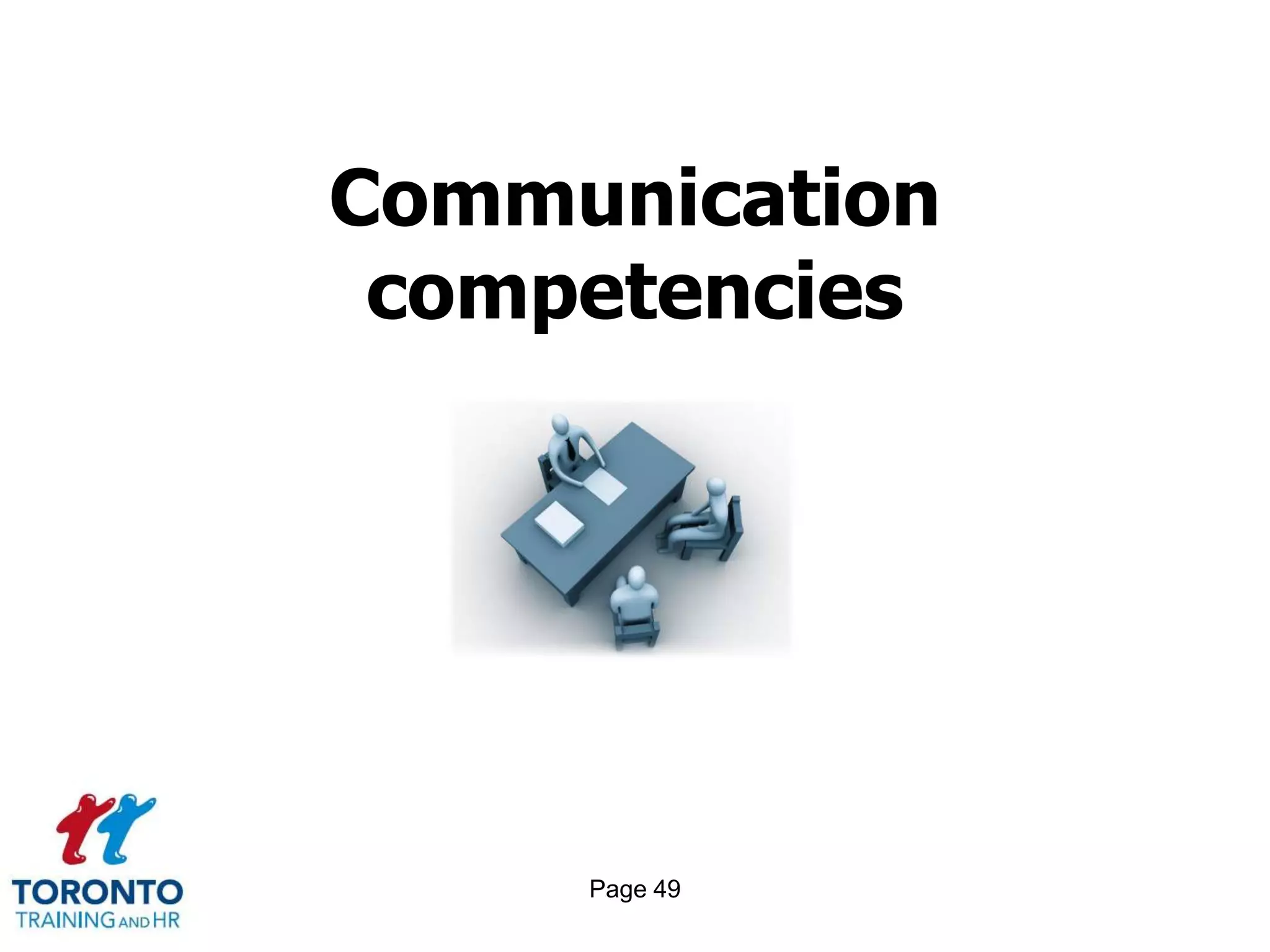
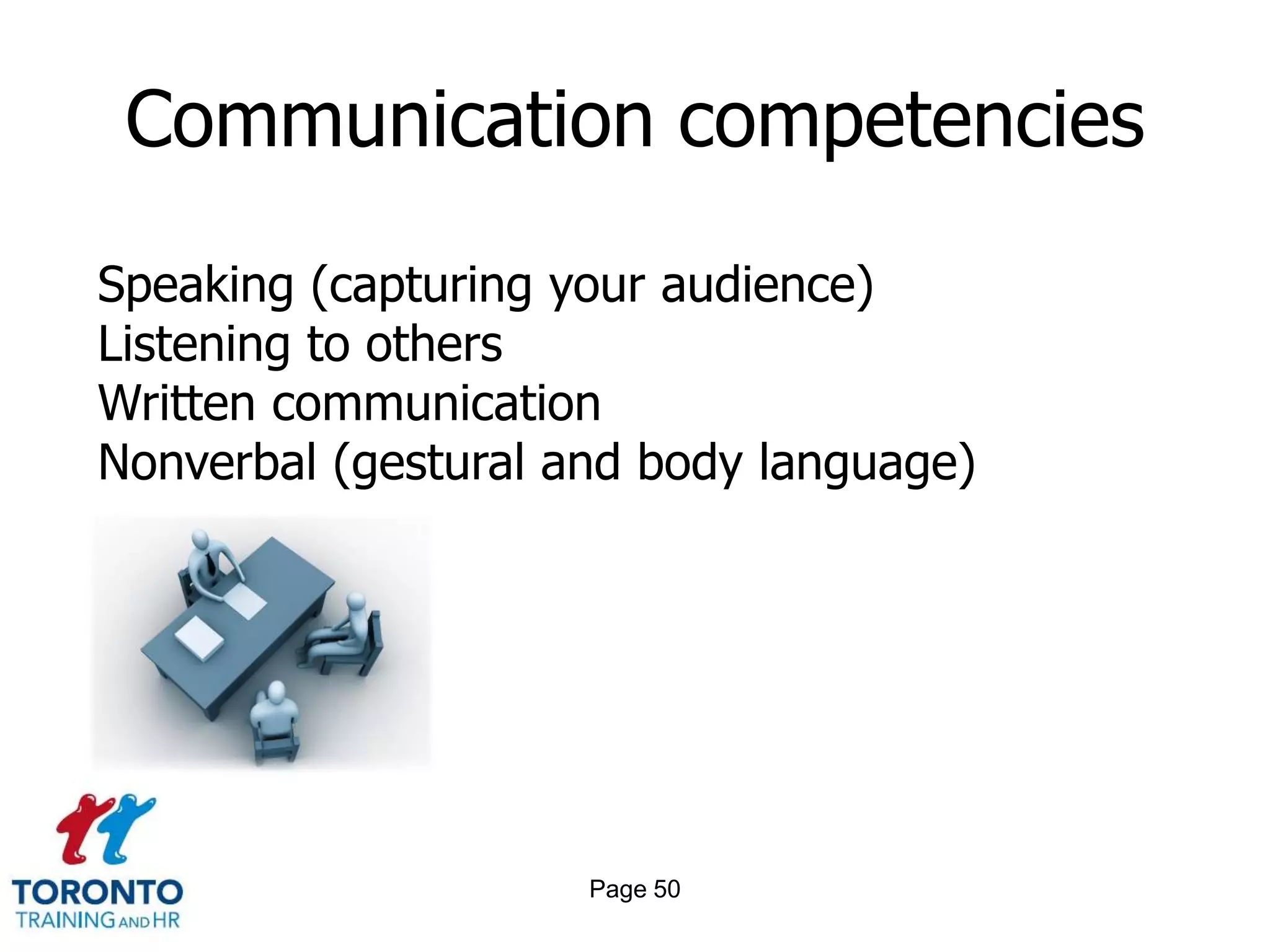
Communication competencies

Speaking (capturing your audience)
Listening to others
Written communication
Nonverbal (gestural and body language)


                     Page 50
Interpersonal
competencies


     Page 51
Interpersonal competencies

Empathy
Consensus building
Networking
Persuasiveness
Negotiating
Diplomacy
Conflict management (resolving conflict)
Respecting others
Being a team player

                      Page 52
Organizational
competencies


     Page 53
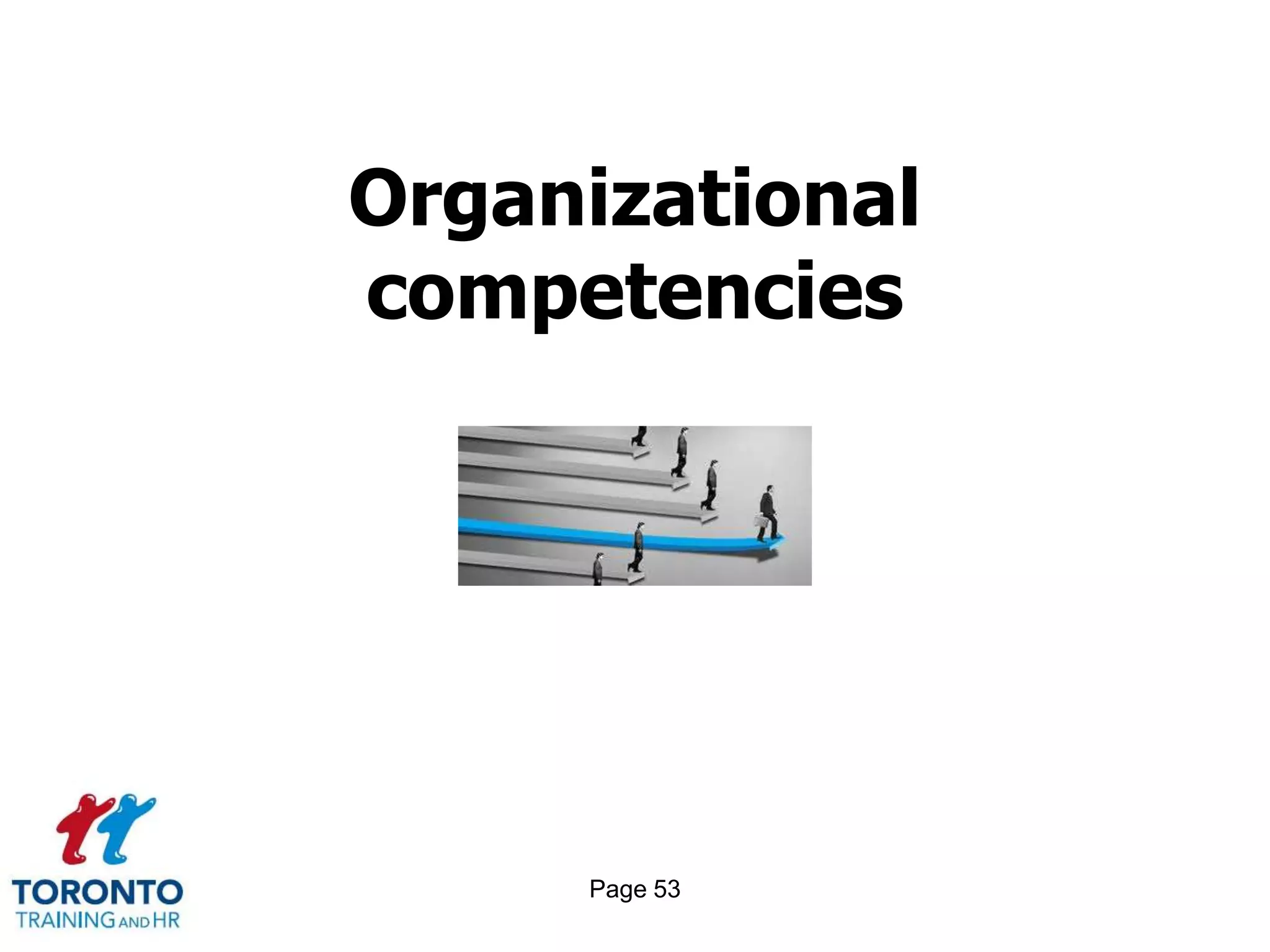
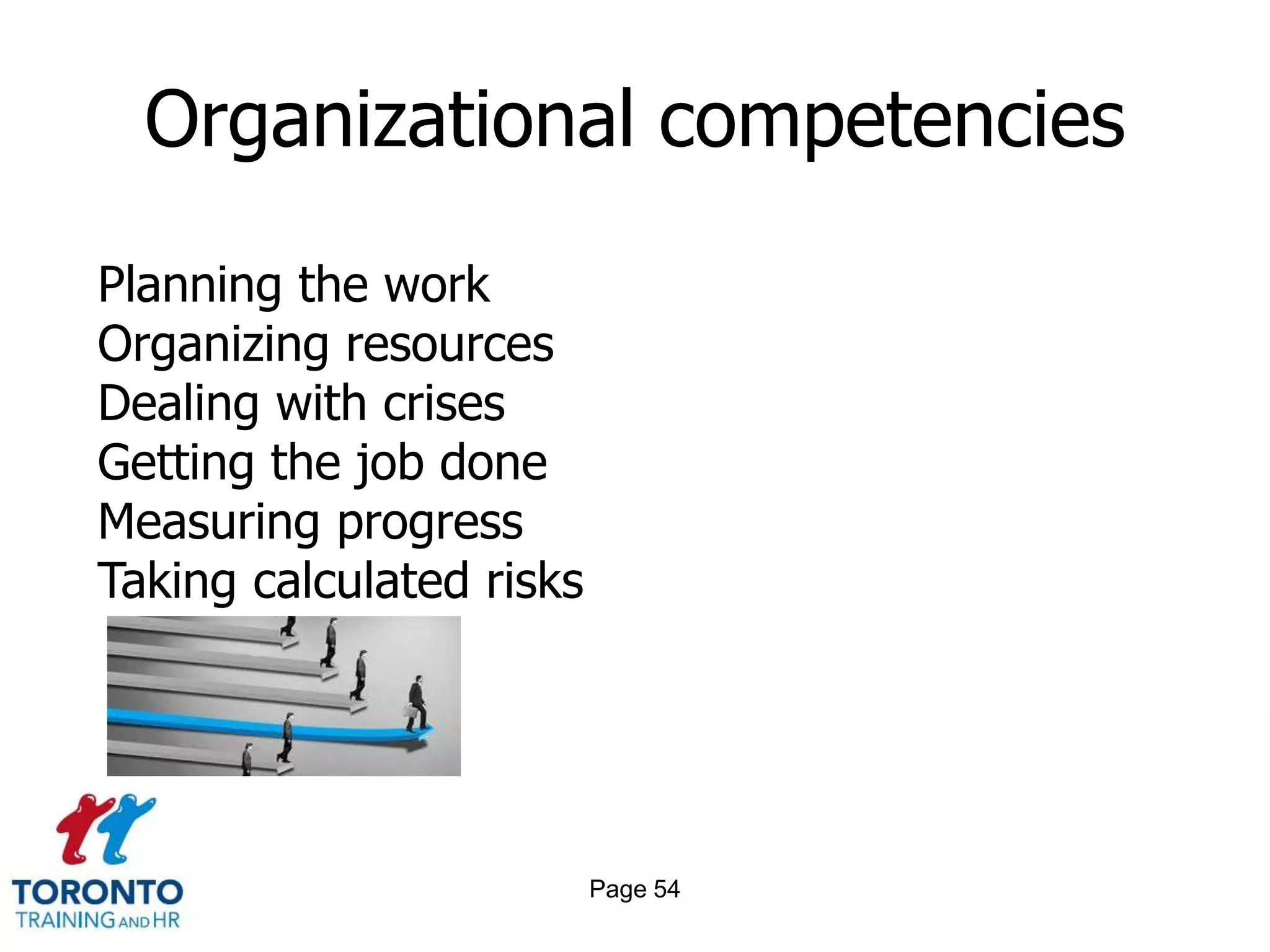
Organizational competencies

Planning the work
Organizing resources
Dealing with crises
Getting the job done
Measuring progress
Taking calculated risks


                          Page 54
Thinking competencies


         Page 55
Thinking competencies

Strategic thinking
Analytical thinking (analyzing problems)
Committing to action
Applying one's cognitive capability
Identifying the links
Generating creative ideas


                      Page 56
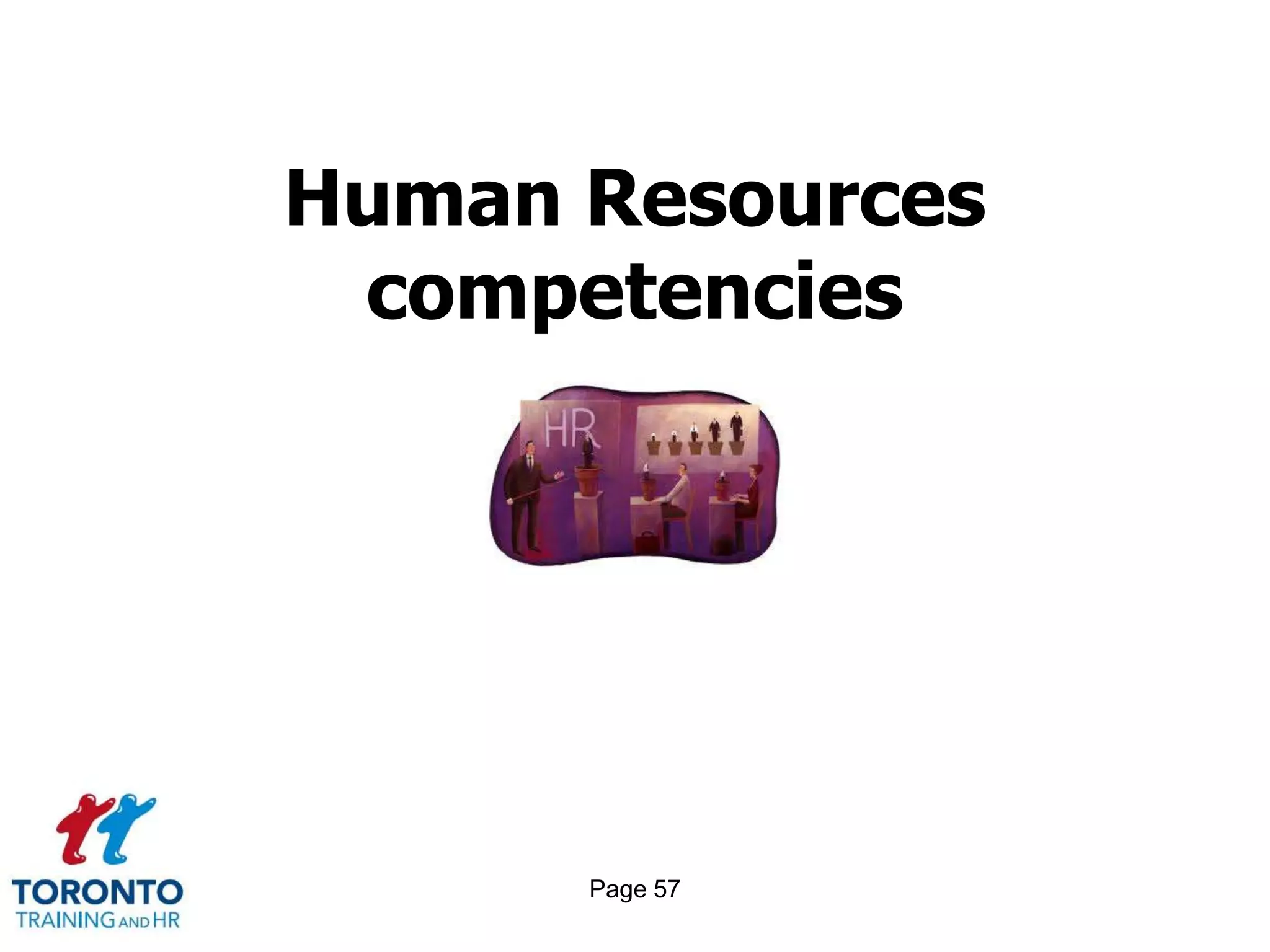
Human Resources
 competencies


      Page 57
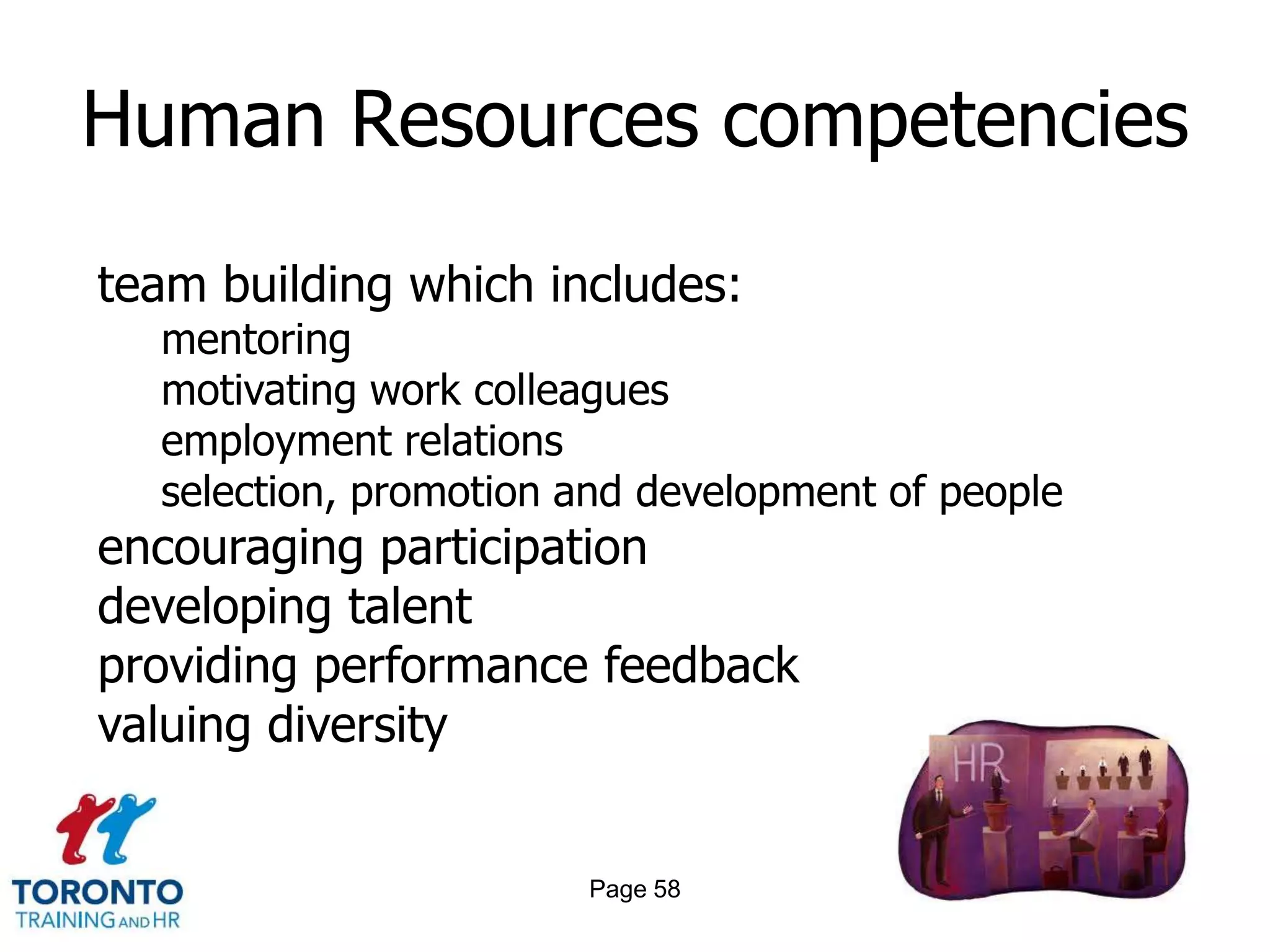
Human Resources competencies

team building which includes:
  mentoring
  motivating work colleagues
  employment relations
  selection, promotion and development of people
encouraging participation
developing talent
providing performance feedback
valuing diversity


                       Page 58
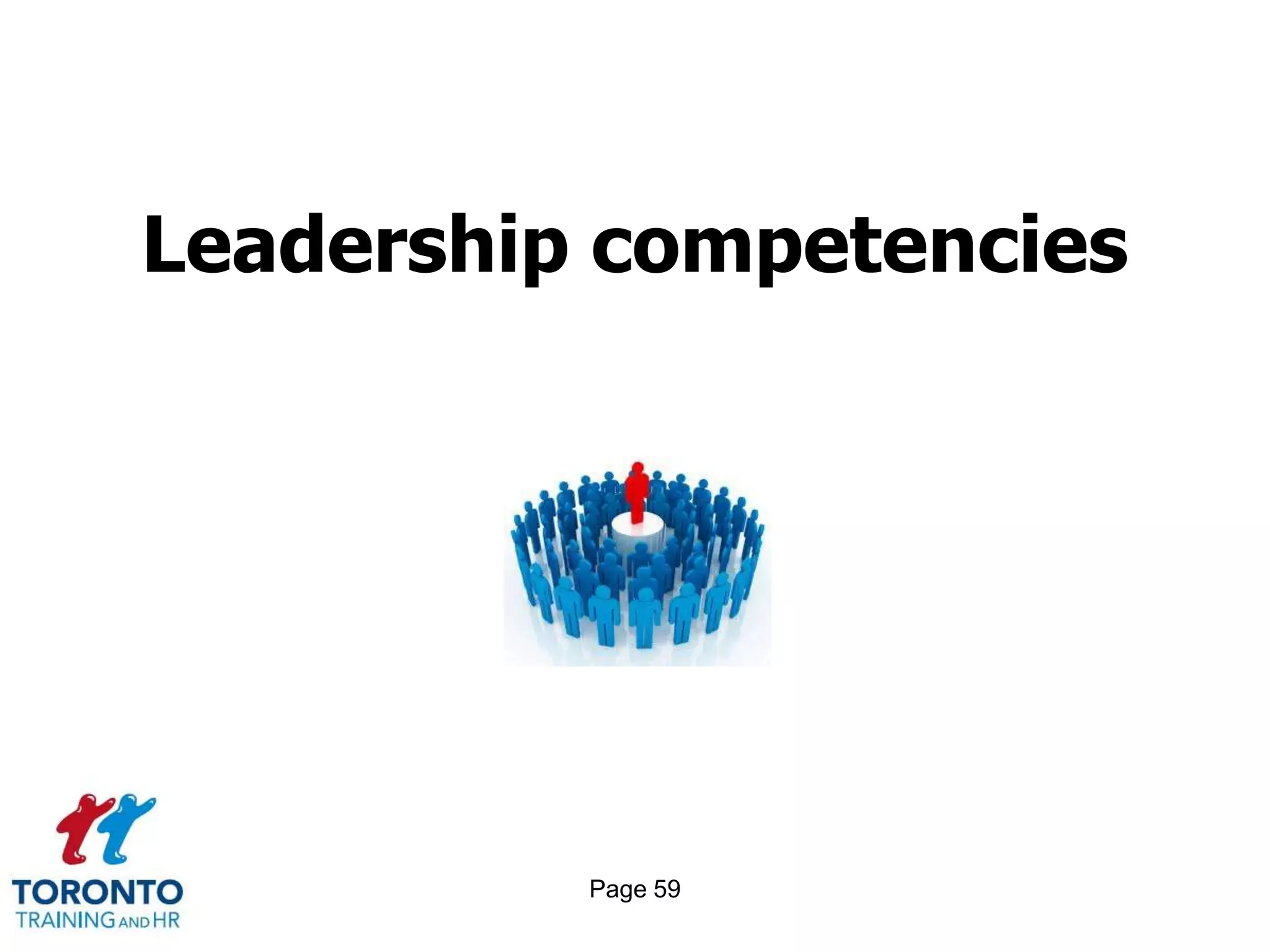
Leadership competencies


          Page 59
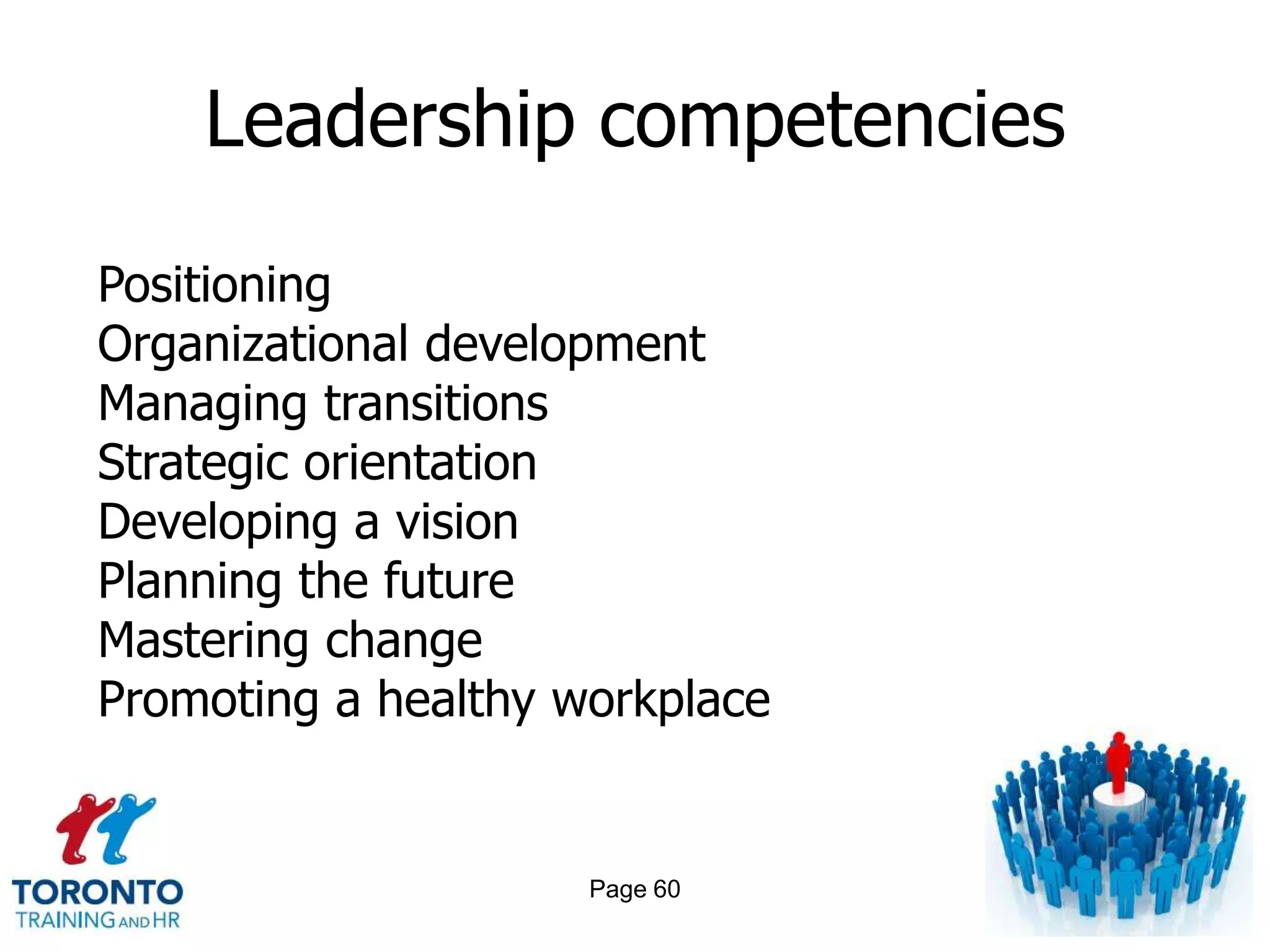
Leadership competencies

Positioning
Organizational development
Managing transitions
Strategic orientation
Developing a vision
Planning the future
Mastering change
Promoting a healthy workplace


                     Page 60
Client service
competencies


     Page 61
Client service competencies

Identification and analysis of client needs
Service orientation and delivery
Working with clients
Following up with clients
Building partnerships
Committing to quality


                       Page 62
Business competencies


         Page 63
Business competencies

Financial management
Business decision-making skills
Working within the system
Using business acumen
Making business decisions
Generating revenue


                      Page 64
Self-management
  competencies


      Page 65
Self-management competencies

Being self-motivated
Acting with confidence
Managing own learning
Demonstrating flexibility
Initiating


                       Page 66
Technical and operational
     competencies


           Page 67
Technical and operational
         competencies
Performing office tasks
Working with computer technology
Using other equipment and tools
Demonstrating technical/professional expertise
Working with data/numbers


                      Page 68
Competencies for people
 working in substance
        abuse


          Page 69
Competencies for people working
   in substance abuse 1 of 5
TECHNICAL COMPETENCIES:
Counselling
Case management
Crisis intervention
Community development
Family and social support
Group facilitation
Mental health


                   Page 70
Competencies for people working
   in substance abuse 2 of 5
TECHNICAL COMPETENCIES:
Pharmacology
Prevention and health promotion
Program development, implementation and
evaluation
Screening and assessment
Treatment planning
Understanding substance use, abuse and
dependency

                    Page 71
Competencies for people working
   in substance abuse 3 of 5
BEHAVIOURAL COMPETENCIES:
Analytical thinking and decision making
Adaptability and flexibility
Client-centred change
Client service orientation
Continuous learning
Creativity and innovation
Collaboration and network building
Developing others

                      Page 72
Competencies for people working
   in substance abuse 4 of 5
BEHAVIOURAL COMPETENCIES:
Diversity and cultural responsiveness
Effective communication
Ethical conduct and professionalism
Interpersonal rapport and savvy
Leadership
Planning and organizing


                      Page 73
Competencies for people working
   in substance abuse 5 of 5
BEHAVIOURAL COMPETENCIES:
Self-care
Self-management
Self motivation and drive
Teamwork and cooperation


                 Page 74
Competencies for people
  working in sales &
     marketing


          Page 75
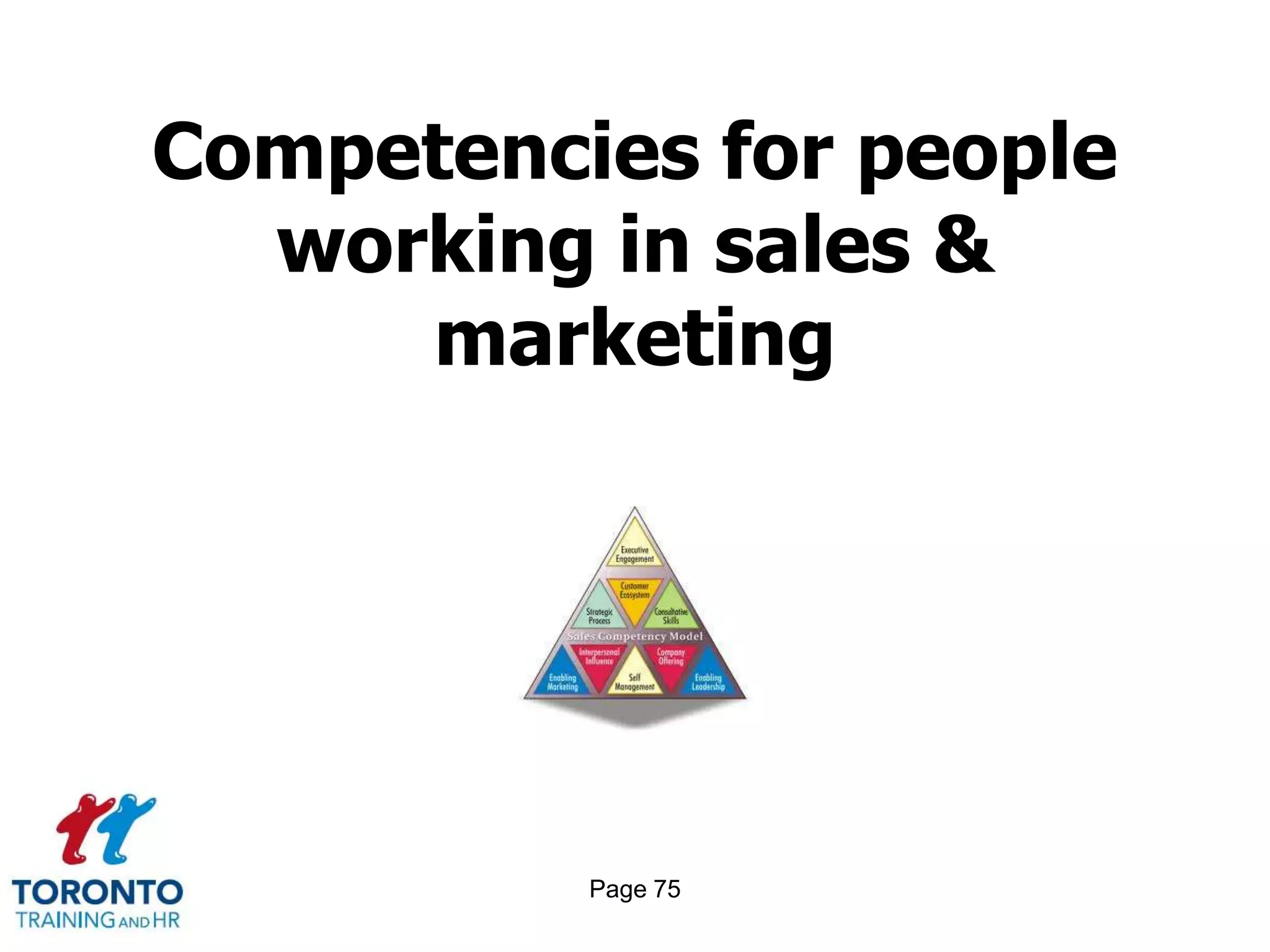
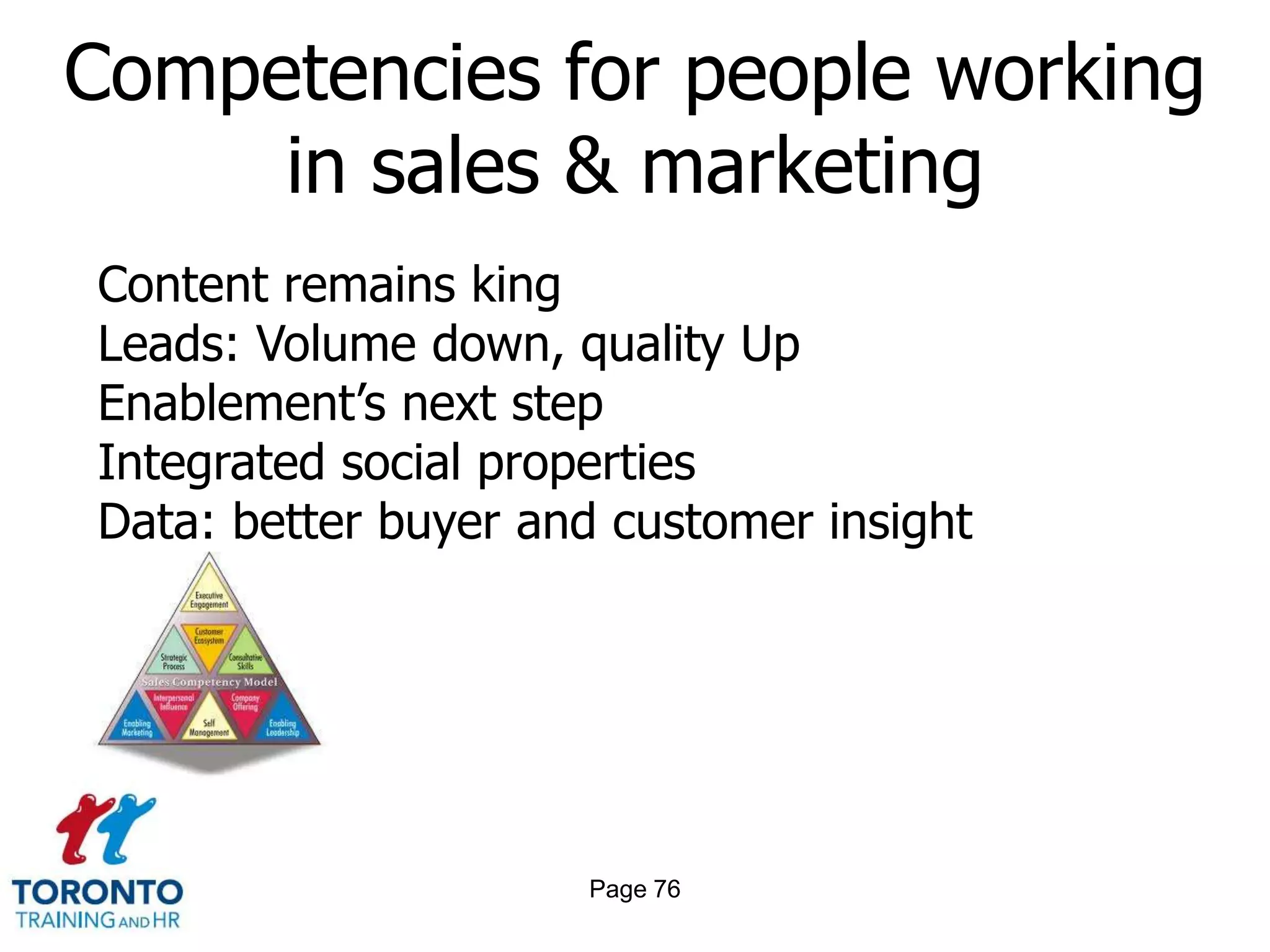
Competencies for people working
     in sales & marketing
Content remains king
Leads: Volume down, quality Up
Enablement’s next step
Integrated social properties
Data: better buyer and customer insight


                     Page 76
Competencies for
occupational therapists


          Page 77
Competencies for occupational
     therapists 1 of 2
CLINICAL
Assumes professional responsibility
Thinks critically
Demonstrates practice knowledge
Utilizes an occupational therapy process to enable
occupation
Communicates and collaborates effectively
Engages in professional development
Manages own practice, advocates within systems

                      Page 78
Competencies for occupational
     therapists 2 of 2
NON-CLINICAL
Assumes professional responsibility
Thinks critically
Communicates and collaborates effectively
Engages in professional development
Manages own work, advocates within systems


                    Page 79
Competencies at the
Treasury Board of Canada
       Secretariat


          Page 80
Competencies at the Treasury
Board of Canada Secretariat 1 of 3
 Deputy Minister
 Assistant Deputy Minister
 Director General
 Director
 Manager
 Supervisor
 Employee


                       Page 81
Competencies at the Treasury
Board of Canada Secretariat 2 of 3
 ALL EXCLUDING EMPLOYEE
 Values and ethics - Serving through integrity and
 respect
 Strategic thinking - Innovating through analysis
 and ideas
 Engagement - Mobilizing people, organizations,
 partners
 Management excellence - Delivering through
 action management, people management,
 financial management

                       Page 82
Competencies at the Treasury
Board of Canada Secretariat 3 of 3
 EMPLOYEE
 Values and ethics - Serving through integrity and
 respect
 Thinking things through - Innovating through
 Analysis and Ideas
 Engagement -Working effectively with people,
 organizations, partners
 Excellence through results - Delivering through
 own work, relationships and responsibilities


                       Page 83
Benefits for employers


         Page 84
Benefits for employers 1 of 3

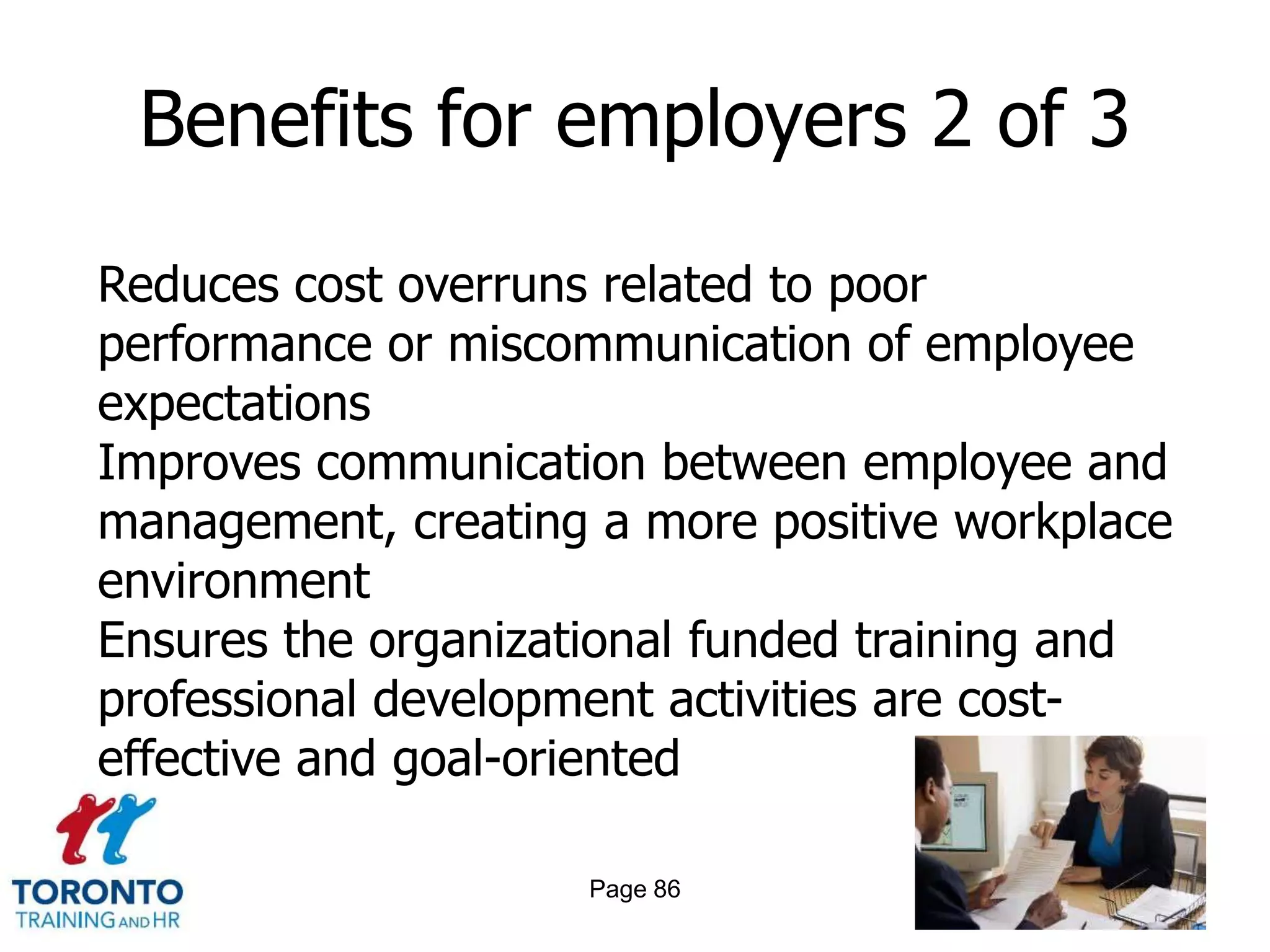
Ensures that on-the-job training is cost-effective
and productive
Ensures employees achieve a high level of
competence in an efficient manner
Provides documentation of the employee’s
acquisition of the knowledge, safety, and
procedures relating to each task


                       Page 85
Benefits for employers 2 of 3

Reduces cost overruns related to poor
performance or miscommunication of employee
expectations
Improves communication between employee and
management, creating a more positive workplace
environment
Ensures the organizational funded training and
professional development activities are cost-
effective and goal-oriented

                     Page 86
Benefits for employers 3 of 3

Increases employee mobility within the
organization, providing the organization with
greater ability scale and flex as needed
Establishes a framework for positive feedback by
management at scheduled training and
performance appraisal intervals
Clarifies job standards for performance appraisals
Outlines employee development and promotional
paths within the organization

                      Page 87
Benefits for employees


         Page 88
Benefits for employees 1 of 3

Provides a clear set of expectations for employees,
enabling them to make better decisions and work
more effectively
Provides employees with insight into the overall
strategy of their team, department, and
organization, leading to greater engagement and
motivation


                      Page 89
Benefits for employees 2 of 3

Enables employees to be more proactive beyond
their individual roles, by learning additional
competencies that are valued by the organization
Provides clear direction for learning new job skills
Provides a reference resource for day-to-day
requirements
Increases the potential for job satisfaction


                       Page 90
Benefits for employees 3 of 3

Provides a mechanism for the recognition of
employees’ abilities
Ensures that individual professional development
and training milestones are recorded and
acknowledged by the organization


                      Page 91
Case study A


    Page 92
Case study A


    Page 93
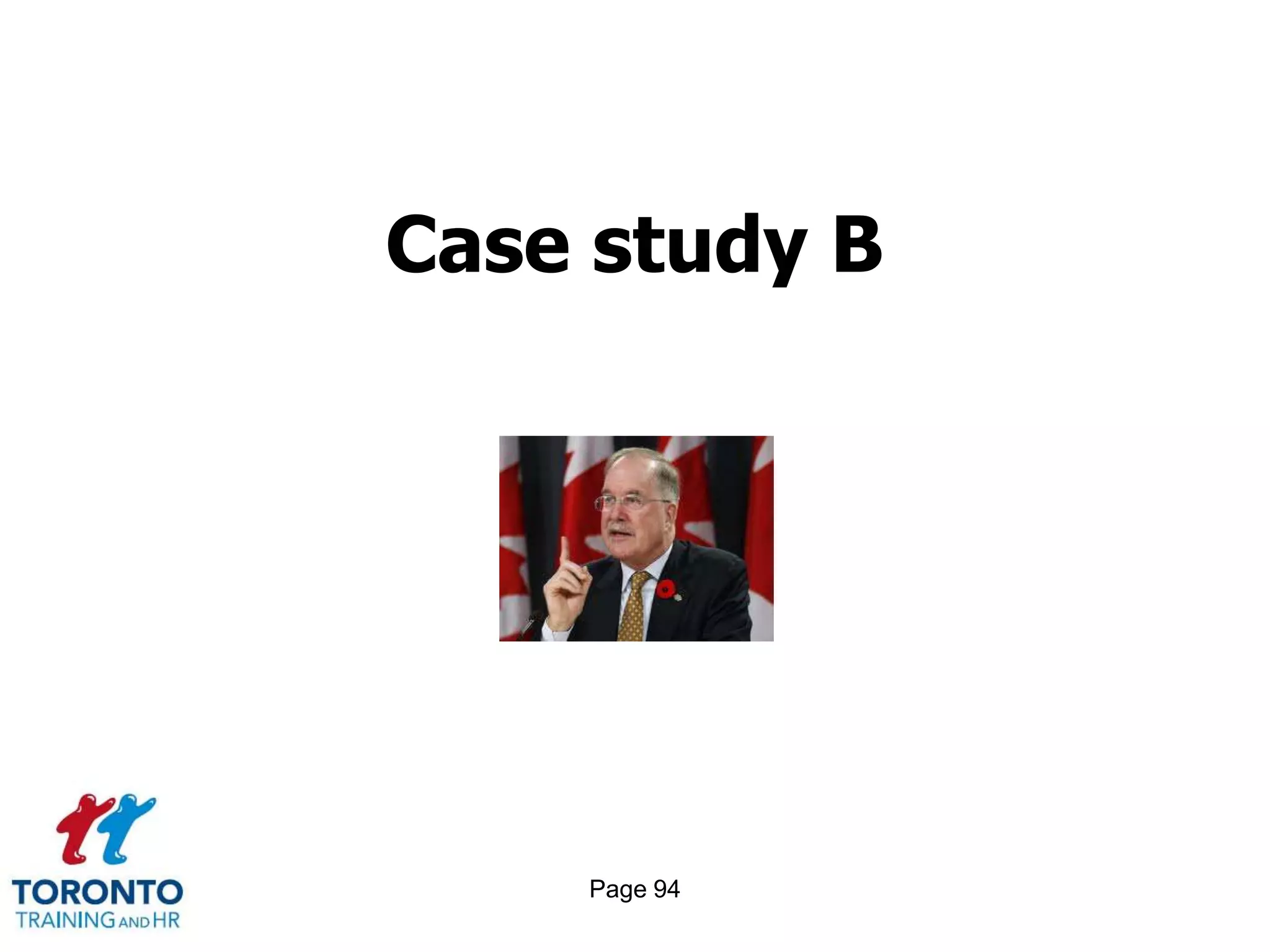
Case study B


    Page 94
Case study B


    Page 95
Case study C


    Page 96
Case study C


    Page 97
Case study D


    Page 98
Case study D


    Page 99
Case study E


    Page 100
Case study E


    Page 101
Conclusion & Questions


         Page 102
Conclusion
Summary
Videos
Questions


               Page 103

Competencies and competences February 2012

  • 1.
    Competencies and competences by Toronto Training and HR February 2012
  • 2.
    3-4 Introduction to Toronto Training and HR 5-6 Definitions Contents 7-9 Commonly sought competencies 10-11 Core competences 12-22 Competency frameworks 23-25 Questions to ask 26-27 Organizational capacity and context 28-29 Clusters of competencies leading to high performance 30-32 Role analysis 33-34 Rules around competence-related pay 35-37 Benefits of a competency-based system 38-41 Criticisms of a competency-based system 42-43 Building a competency model 44-45 Cultural competency 46-47 What influences performance on the job? 48-83 Specific types of competency (VARIOUS) 84-87 Benefits for employers 88-91 Benefits for employees 92-101 Case studies 102-103 Conclusion and questions
  • 3.
  • 4.
    Introduction to TorontoTraining and HR • Toronto Training and HR is a specialist training and human resources consultancy headed by Timothy Holden • 10 years in banking • 10 years in training and human resources • Freelance practitioner since 2006 • The core services provided by Toronto Training and HR are: - Training event design - Training event delivery - Reducing costs - Saving time - Improving employee engagement & morale - Services for job seekers Page 4
  • 5.
  • 6.
  • 7.
    Commonly sought competencies Page 7
  • 8.
    Commonly sought competencies 1 of 2 Communication Achievement/results orientation Customer focus Teamwork Leadership Planning and organizing Commercial acumen and business awareness Flexibility and adaptability Page 8
  • 9.
    Commonly sought competencies 2 of 2 Developing others Problem-solving Analytical thinking Building relationships Page 9
  • 10.
  • 11.
  • 12.
  • 13.
    Competency frameworks 1of 10 TYPES: Off the shelf Customized Page 13
  • 14.
    Competency frameworks 2of 10 BEHAVIOURS TO INCLUDE: Communication skills People management Team skills Customer service skills Results orientation Problem solving Page 14
  • 15.
    Competency frameworks 3of 10 THE PROCESS, STEP ONE: A review (and potentially a refresh) of the current vision, mission statement and business strategy- this is likely to involve a series of discussions with the senior management team THE PROCESS, STEP TWO: Conducting workshops, focus groups and surveys to gather views and data from employees (at all levels) on what they see as being the values, ethos and culture of the organization Page 15
  • 16.
    Competency frameworks 4of 10 THE PROCESS, STEP TWO: This is likely to include asking questions such as: What is important around here? What do we want our clients to think of us? What do we want the public to think of us? What attracts people to work here? What informs the way we do business? What are our guiding principles? How do we expect our colleagues to behave? Page 16
  • 17.
    Competency frameworks 5of 10 THE PROCESS, STEP TWO: How do we do what we do? What do we do best? What’s good about working here? What sets us apart from our competitors? What makes us successful? Page 17
  • 18.
    Competency frameworks 6of 10 THE PROCESS, STEP THREE: Using the data gathered to collaboratively agree and finalise a clear set of agreed organizational values THE PROCESS, STEP FOUR: Presenting these values back to the organization for discussion and review, possibly as a series of internal briefings Page 18
  • 19.
  • 20.
    Competency frameworks 8of 10 AN INTEGRATED BALANCED FRAMEWORK: Innate qualities Acquired skill Adapting behaviours Page 20
  • 21.
    Competency frameworks 9of 10 GOALS: Underpinning of performance appraisals Enhanced employee effectiveness Greater organizational effectiveness Better analysis of training needs Enhanced career management Page 21
  • 22.
    Competency frameworks 10of 10 IS YOUR COMPETENCY FRAMEWORK FIT FOR PURPOSE? Communicate the purpose Identify key themes Get conditions right Tackle the root cause Keep it simple Train, don’t blame Page 22
  • 23.
  • 24.
    Questions to ask1 of 2 How would you describe the perfect employee? What’s different about employees here? What do you value most in your staff/colleagues? What really sets apart the best people from others? Think of the most effective person in your team- what characteristics and qualities make them effective? Page 24
  • 25.
    Questions to ask2 of 2 What do people need to do to get promoted? What will get in the way of people getting promoted here? What gets you noticed around here? What sorts of behaviours are ‘career limiting’ around here – for instance, what might cause an individual to derail, or what would prevent them from ‘fitting in’? Page 25
  • 26.
    Organizational capacity and context Page 26
  • 27.
    Organizational capacity and context DIMENSIONS TO CONSIDER Structural facet Cultural component Psychological element Policy component Contextual facet Page 27
  • 28.
    Clusters of competencies leading to high performance Page 28
  • 29.
    Clusters of competenciesleading to high performance Cognitive competencies Emotional intelligence competencies Social intelligence competencies Page 29
  • 30.
  • 31.
    Role analysis 1of 2 ACTIVITY-BASED TECHNIQUES Focus groups Inventories or questionnaires Interviews including critical incident interview Diaries and work logs Page 31
  • 32.
    Role analysis 2of 2 PEOPLE-BASED TECHNIQUES Repertory grids Observation Testing Page 32
  • 33.
  • 34.
    Rules around competence-related pay Consistency rule Bias-suppression rule Accuracy rule Correctability rule Representativeness rule Ethicality rule Page 34
  • 35.
    Benefits of acompetency- based system Page 35
  • 36.
    Benefits of acompetency-based system 1 of 2 Employees have a well-defined set of behaviours required in their work and are clear about how they are expected to perform their jobs The appraisal and recruitment systems are fairer and more open Recruiters are able to assess transferable skills and identify required behaviours regardless of career background Page 36
  • 37.
    Benefits of acompetency-based system 2 of 2 There is a link between effective individual inputs to work and organisational performance Processes are measurable and standardised across organisational and geographical boundaries Page 37
  • 38.
  • 39.
    Criticisms of acompetency-based system 1 of 3 Focus on the past and therefore cannot keep up to date with rapidly-changing environments Fail to deliver on anticipated improvements in performance Are unwieldy and not user-friendly Create clones, as everyone is expected to behave in the same way Page 39
  • 40.
    Criticisms of acompetency-based system 2 of 3 LEADERSHIP AND MANAGEMENT DEVLOPMENT Competency frameworks are expensive to design, install, administer and monitor Encourage a focus on sameness and can therefore impede diversity Carry the assumption that selected individuals can be ‘trained’ into leadership or management positions and then provide good role models for others Page 40
  • 41.
    Criticisms of acompetency-based system 3 of 3 LEADERSHIP AND MANAGEMENT DEVELOPMENT Rarely discriminate enough between leadership & management Assume that a number of discrete components can adequately describe critical features of a role, and that those components will remain relatively constant and standardized through time Narrow leadership & management perspectives can stifle questioning and prevent unlearning Page 41
  • 42.
  • 43.
    Building a competencymodel Determine performance criteria Select criterion sample Collect data Develop model Validate model Page 43
  • 44.
  • 45.
    Cultural competency Definition Why dowe need it? What does it do? Who is responsible? Page 45
  • 46.
  • 47.
    What influences performanceon the job? Knowledge abilities and aptitudes Work styles, personality, interests, principles, values, attitudes, beliefs and leadership/subordinate styles Page 47
  • 48.
  • 49.
  • 50.
    Communication competencies Speaking (capturingyour audience) Listening to others Written communication Nonverbal (gestural and body language) Page 50
  • 51.
  • 52.
    Interpersonal competencies Empathy Consensus building Networking Persuasiveness Negotiating Diplomacy Conflictmanagement (resolving conflict) Respecting others Being a team player Page 52
  • 53.
  • 54.
    Organizational competencies Planning thework Organizing resources Dealing with crises Getting the job done Measuring progress Taking calculated risks Page 54
  • 55.
  • 56.
    Thinking competencies Strategic thinking Analyticalthinking (analyzing problems) Committing to action Applying one's cognitive capability Identifying the links Generating creative ideas Page 56
  • 57.
  • 58.
    Human Resources competencies teambuilding which includes: mentoring motivating work colleagues employment relations selection, promotion and development of people encouraging participation developing talent providing performance feedback valuing diversity Page 58
  • 59.
  • 60.
    Leadership competencies Positioning Organizational development Managingtransitions Strategic orientation Developing a vision Planning the future Mastering change Promoting a healthy workplace Page 60
  • 61.
  • 62.
    Client service competencies Identificationand analysis of client needs Service orientation and delivery Working with clients Following up with clients Building partnerships Committing to quality Page 62
  • 63.
  • 64.
    Business competencies Financial management Businessdecision-making skills Working within the system Using business acumen Making business decisions Generating revenue Page 64
  • 65.
  • 66.
    Self-management competencies Being self-motivated Actingwith confidence Managing own learning Demonstrating flexibility Initiating Page 66
  • 67.
    Technical and operational competencies Page 67
  • 68.
    Technical and operational competencies Performing office tasks Working with computer technology Using other equipment and tools Demonstrating technical/professional expertise Working with data/numbers Page 68
  • 69.
    Competencies for people working in substance abuse Page 69
  • 70.
    Competencies for peopleworking in substance abuse 1 of 5 TECHNICAL COMPETENCIES: Counselling Case management Crisis intervention Community development Family and social support Group facilitation Mental health Page 70
  • 71.
    Competencies for peopleworking in substance abuse 2 of 5 TECHNICAL COMPETENCIES: Pharmacology Prevention and health promotion Program development, implementation and evaluation Screening and assessment Treatment planning Understanding substance use, abuse and dependency Page 71
  • 72.
    Competencies for peopleworking in substance abuse 3 of 5 BEHAVIOURAL COMPETENCIES: Analytical thinking and decision making Adaptability and flexibility Client-centred change Client service orientation Continuous learning Creativity and innovation Collaboration and network building Developing others Page 72
  • 73.
    Competencies for peopleworking in substance abuse 4 of 5 BEHAVIOURAL COMPETENCIES: Diversity and cultural responsiveness Effective communication Ethical conduct and professionalism Interpersonal rapport and savvy Leadership Planning and organizing Page 73
  • 74.
    Competencies for peopleworking in substance abuse 5 of 5 BEHAVIOURAL COMPETENCIES: Self-care Self-management Self motivation and drive Teamwork and cooperation Page 74
  • 75.
    Competencies for people working in sales & marketing Page 75
  • 76.
    Competencies for peopleworking in sales & marketing Content remains king Leads: Volume down, quality Up Enablement’s next step Integrated social properties Data: better buyer and customer insight Page 76
  • 77.
  • 78.
    Competencies for occupational therapists 1 of 2 CLINICAL Assumes professional responsibility Thinks critically Demonstrates practice knowledge Utilizes an occupational therapy process to enable occupation Communicates and collaborates effectively Engages in professional development Manages own practice, advocates within systems Page 78
  • 79.
    Competencies for occupational therapists 2 of 2 NON-CLINICAL Assumes professional responsibility Thinks critically Communicates and collaborates effectively Engages in professional development Manages own work, advocates within systems Page 79
  • 80.
    Competencies at the TreasuryBoard of Canada Secretariat Page 80
  • 81.
    Competencies at theTreasury Board of Canada Secretariat 1 of 3 Deputy Minister Assistant Deputy Minister Director General Director Manager Supervisor Employee Page 81
  • 82.
    Competencies at theTreasury Board of Canada Secretariat 2 of 3 ALL EXCLUDING EMPLOYEE Values and ethics - Serving through integrity and respect Strategic thinking - Innovating through analysis and ideas Engagement - Mobilizing people, organizations, partners Management excellence - Delivering through action management, people management, financial management Page 82
  • 83.
    Competencies at theTreasury Board of Canada Secretariat 3 of 3 EMPLOYEE Values and ethics - Serving through integrity and respect Thinking things through - Innovating through Analysis and Ideas Engagement -Working effectively with people, organizations, partners Excellence through results - Delivering through own work, relationships and responsibilities Page 83
  • 84.
  • 85.
    Benefits for employers1 of 3 Ensures that on-the-job training is cost-effective and productive Ensures employees achieve a high level of competence in an efficient manner Provides documentation of the employee’s acquisition of the knowledge, safety, and procedures relating to each task Page 85
  • 86.
    Benefits for employers2 of 3 Reduces cost overruns related to poor performance or miscommunication of employee expectations Improves communication between employee and management, creating a more positive workplace environment Ensures the organizational funded training and professional development activities are cost- effective and goal-oriented Page 86
  • 87.
    Benefits for employers3 of 3 Increases employee mobility within the organization, providing the organization with greater ability scale and flex as needed Establishes a framework for positive feedback by management at scheduled training and performance appraisal intervals Clarifies job standards for performance appraisals Outlines employee development and promotional paths within the organization Page 87
  • 88.
  • 89.
    Benefits for employees1 of 3 Provides a clear set of expectations for employees, enabling them to make better decisions and work more effectively Provides employees with insight into the overall strategy of their team, department, and organization, leading to greater engagement and motivation Page 89
  • 90.
    Benefits for employees2 of 3 Enables employees to be more proactive beyond their individual roles, by learning additional competencies that are valued by the organization Provides clear direction for learning new job skills Provides a reference resource for day-to-day requirements Increases the potential for job satisfaction Page 90
  • 91.
    Benefits for employees3 of 3 Provides a mechanism for the recognition of employees’ abilities Ensures that individual professional development and training milestones are recorded and acknowledged by the organization Page 91
  • 92.
  • 93.
  • 94.
  • 95.
  • 96.
  • 97.
  • 98.
  • 99.
  • 100.
    Case study E Page 100
  • 101.
    Case study E Page 101
  • 102.
  • 103.