DEVELOPING
COMPETENCY
MODEL
Chapter 2
The key to gaining a competitive edge is
the ability of the workforce of an
organization to maximize the advantages
of state-of-the-art technology, superior
products, and steady source of capital to
enter into the marketplace.
A company’s technological tools are only
as useful as its employer’s ability to employ
them; they are perceived in terms of how
effectively the benefits are
communicated (McLagan 1989).
◦ Determining whether the
workforce possesses the abilities
critical for its success is indeed
difficult.
◦ Behaviors necessary for effective
performance vary from business
to business and role to role.
◦ Many organizations have thus
developed competency models
to help them identify the essential
knowledge, skills and attributes
needed for successful
performance in a job aligned with
the strategy and integrating it to
the HR strategy
COMPETENCY MODEL
◦ describes the combination of knowledge,
skills and characteristics needed to
effectively perform a role in an
organization and is used as a human
resource tool for selection, training and
development, appraisal and succession
planning. Identifying and mapping these
competencies is rather complex.
◦ Skills can range from highly concrete
proficiencies like the ability to operate a
particular machine or to write a sentence,
to far less tangible capabilities such as the
ability to think strategically or to influence
others.
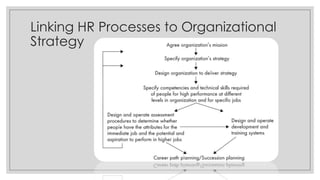
Linking HR Processes to Organizational
Strategy
Scenario Example of Competency
Model
◦ A banking company launched a new
scheme of private banking and realized
that for its growth it had to develop its
sales force.
◦ It needed a rapid increase in the
number of sales associates.
◦ The sales force was needed not only to
sell the new product but also address
high turnover in field offices and wide
variance in sales effectiveness among
officers
Thus, a sales competency model was
developed
It had an objective:
• To integrate into the company’s
selection system on the job, the same
criteria for hiring people, as required for
effective performance.
• It was incorporated into the
performance management system to
ensure that salespeople would receive
coaching and feedback on the
behaviors and skills that had strong
correlation to success on the job.
• The focus was to increase productivity
and check turnover.
◦ Attributes or characteristics of the
person are most complex and most
difficult to measure.
◦ Aptitude, reasons and inclination
suggests a potential to acquire a
particular skill or knowledge.
◦ Traits such as extroversion, self-
sufficiency and tenacity may
indicate a disposition for dealing
with certain types of situations or
performing certain roles.
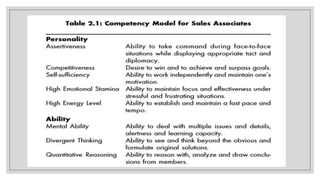
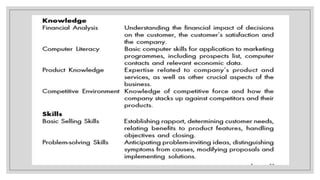
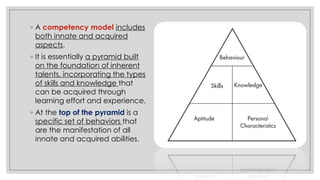
◦ A competency model includes
both innate and acquired
aspects.
◦ It is essentially a pyramid built
on the foundation of inherent
talents, incorporating the types
of skills and knowledge that
can be acquired through
learning effort and experience.
◦ At the top of the pyramid is a
specific set of behaviors that
are the manifestation of all
innate and acquired abilities.
For a competency model to be useful
as a human resource tool:
◦ Competencies must be
defined along with examples to
illustrate when a particular
competency is being
demonstrated.
◦ Although the innate
characteristics are fixed in a
person for the most part,
behaviours can be modified
and taught
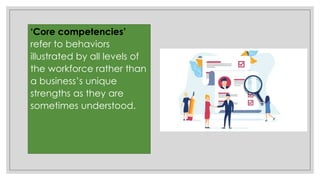
‘Core competencies’
refer to behaviors
illustrated by all levels of
the workforce rather than
a business’s unique
strengths as they are
sometimes understood.
When a core competency customer focus is
to be demonstrated it would be:
•Answering a telephone call by the third ring,
using polite service representative language,
etc.
Entry-level Customer
•Resolving customer problems by coordinating
cross-organizational resources, analysing buying
patterns to ensure availability of products, etc.
Regional Manager
When developing a competency
model, keep the following in mind:
Certain competencies as customer focus might be
generic across several organizations, but the
behaviour relating to those competencies can still
vary widely from one organization to another.
Within the same organization two management jobs
may present very different challenges and require
very different skills.
In order to be as useful as possible, the competency
model should be developed with a specific role in
mind.
Questions to be asked:
What business
needs are
addressed in
the
competency
models?
What skills,
knowledge and
characteristics
are required to
do the job?
What behaviour
has the most
direct impact
on
performance
and success in
the job?
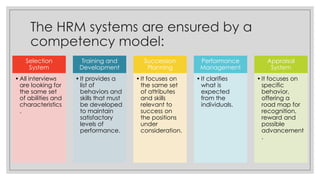
The HRM systems are ensured by a
competency model:
Selection
System
•All interviews
are looking for
the same set
of abilities and
characteristics
.
Training and
Development
•It provides a
list of
behaviors and
skills that must
be developed
to maintain
satisfactory
levels of
performance.
Succession
Planning
•It focuses on
the same set
of attributes
and skills
relevant to
success on
the positions
under
consideration.
Performance
Management
•It clarifies
what is
expected
from the
individuals.
Appraisal
System
•It focuses on
specific
behavior,
offering a
road map for
recognition,
reward and
possible
advancement
.
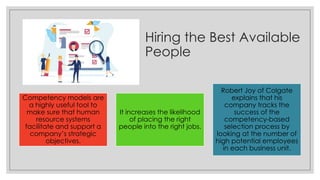
Hiring the Best Available
People
Competency models are
a highly useful tool to
make sure that human
resource systems
facilitate and support a
company’s strategic
objectives.
It increases the likelihood
of placing the right
people into the right jobs.
Robert Joy of Colgate
explains that his
company tracks the
success of the
competency-based
selection process by
looking at the number of
high potential employees
in each business unit.
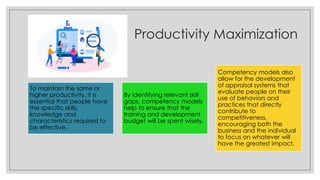
Productivity Maximization
To maintain the same or
higher productivity, it is
essential that people have
the specific skills,
knowledge and
characteristics required to
be effective.
By identifying relevant skill
gaps, competency models
help to ensure that the
training and development
budget will be spent wisely.
Competency models also
allow for the development
of appraisal systems that
evaluate people on their
use of behaviors and
practices that directly
contribute to
competitiveness,
encouraging both the
business and the individual
to focus on whatever will
have the greatest impact.
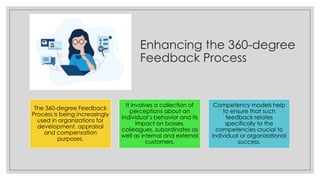
Enhancing the 360-degree
Feedback Process
The 360-degree Feedback
Process is being increasingly
used in organizations for
development, appraisal
and compensation
purposes.
It involves a collection of
perceptions about an
individual’s behavior and its
impact on bosses,
colleagues, subordinates as
well as internal and external
customers.
Competency models help
to ensure that such
feedback relates
specifically to the
competencies crucial to
individual or organizational
success.
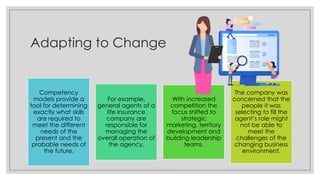
Adapting to Change
Competency
models provide a
tool for determining
exactly what skills
are required to
meet the different
needs of the
present and the
probable needs of
the future.
For example,
general agents of a
life insurance
company are
responsible for
managing the
overall operation of
the agency.
With increased
competition the
focus shifted to
strategic
marketing, territory
development and
building leadership
teams.
The company was
concerned that the
people it was
selecting to fill the
agent’s role might
not be able to
meet the
challenges of the
changing business
environment.
Aligning Behavior with Organizational
Strategies and Values
◦ A competency model can be an effective way of
communicating to the workforce the values of the
senior management and what people should focus
on in their own behavior.
◦ There are two principles that are followed in these
models:
1. Focus on the superior performers without making an
assumption.
2. Focus on what they do to perform the given role.
Various Models
Job Competence Assessment
Method
• This is developed using interviews and
observations of outstanding and average
performers to determine the
competencies that differentiate between
them in critical incidents
Modified Job Competence
Assessment Method
• This also identifies such behavioural
differences, but to reduce costs,
interviewees provide a written account of
critical incidents
Generic Model Overlay Method
• Organizations purchase an off-the-shelf
generic competency model for a specific
role or function
Customized Generic Model
Method
• Organizations use a tentative list of
competencies that are identified internally
to aid in their selection of a generic model
and then validate it with the input of
outstanding and average performers
Various Models
Flexible Job Competency Model
Method
• This seeks to identify the competencies
that will be required to perform effectively
under different conditions in the future
Systems Method
• This demands reflecting on not only what
exemplary performers do now, or what
they do overall, but also behaviours that
may be important in the future
Accelerated Competency Systems
Method
• This places the focus on the competencies
that specifically support the production of
output, such as an organization’s
products, services or information
Development of the Personal Competency
In 1986 the first version of the Job Competences Survey (JCS) was produced in the fields
of assessment centers and management competencies in the 1970s and 1980s.
It was originally used as a questionnaire for the first stage of the job analysis process, for
identifying competencies of senior and middle managers in large companies such as
Shell International, Barclays, British Gas and Smiths Industries.
The JCS was first conducted in 1988 during the general and senior management courses
in the executive development workshop at Hevley Management College.
Much of the extensive research which underpins the Personal Competence Framework
(PCF) was conducted on those managers.
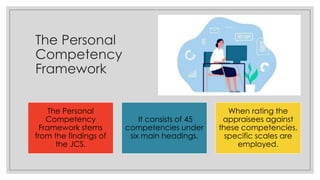
The Personal
Competency
Framework
The Personal
Competency
Framework stems
from the findings of
the JCS.
It consists of 45
competencies under
six main headings.
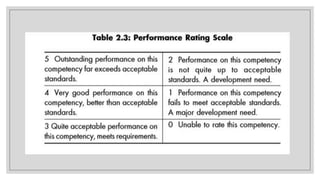
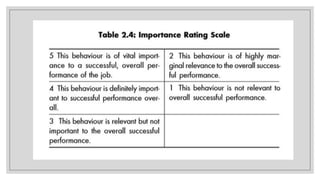
When rating the
appraisees against
these competencies,
specific scales are
employed.
The Lancaster Model of Managerial
Competencies
The Lancaster Model of
Managerial Competencies is a
universal management
competency framework,
developed by Burgoyne and
Stuart (1976) and first published
in Personnel Review, used with
permission of authors.
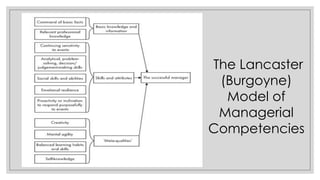
The 11 qualities separated into
three groups, as shown in Fig.
2.3, represent three different
levels. The first level forms the
foundation level and
comprises of two kinds of basic
knowledge and information a
manager may need to use in
decision making and action
taking.
The Lancaster
(Burgoyne)
Model of
Managerial
Competencies
Level One
Competence One: Command of Basic Facts
• This competency states that a successful
manager should understand the business
and have a sound knowledge of basic facts
surrounding the business such as short- and
long-term goals, product knowledge, and
the roles and relationships between various
departments.
Competence Two: Relevant Professional
Knowledge
• This includes knowledge of a specification
such as legislation, management
techniques, sources of finance or knowledge
of basic background management
principles including planning, organizing and
controlling. The second category comprises
specific skills and attributes that directly
affect behavior and performance.
Level Two
Competence One:
Continuing Sensitivity to
Events
• This means the manager is
aware of what is going on
and is perceptive and open
to information: hard
information such as figures
and facts and soft
information such as feelings
of other people. As a result,
a successful manager is
able to respond in a
suitable manner to
situations as they arise
Competence Two:
Analytical, Problem-solving
and Decision-making Skills
• A manager must make
many decisions—
sometimes these can be
made using logical,
optimizing techniques. At
other times it means using
the ability to weigh the pros
and cons in what is a very
uncertain or ambiguous
situation, calling for a high
level of judgement or even
intuition. Consequently, the
manager must develop
judgement-making skills.
Competence Three: Social
Skills and Abilities
• Burgoyne and Stuart (1976)
describe interpersonal skills
as ‘one of the key features
of the manager’s job’. A
successful manager needs
to develop a range of skills
such as communicating,
delegating, negotiating,
resolving conflict,
persuading, using and
responding to authority and
power, all of which are
essential to interpersonal
activities.
Level Two
Competence Four: Emotional Resilience
• This is the ability to deal with the emotional
stress and strain that arises as a
consequence of working in situations of
authority, leadership, power, targets and
deadlines. Burgoyne and Stuart (1976) talk
about being resilient in coping with this stress.
They explain: ‘Resilient means, that when
feeling stressed, we don’t get thick skinned
and insensitive but manage to cope by
maintaining self-control and by “giving” to
some extent.’
Competence Five: Proactivity or Inclination to
Respond Purposefully to Events
• At times managers must respond to the
needs of the instant situation, but whilst
making such a response, the successful
manager considers the longer-term aims
and goals and the impact of the immediate
decision. This competence also includes
abilities such as dedication and
commitment, having a sense of mission and
taking responsibility.
Level Three
Competence One: Creativity
•This is the ability to come up with
unique ideas or solutions, and to have
the insight to take up useful ideas—
either your own ideas or ideas from
another source.
Competence Two: Mental Agility
•This competence is concerned with
being able to grasp problems quickly,
to think about several things at once, to
understand the whole situation quickly
and to ‘think on one’s feet’. ‘Given the
hectic nature of managerial work these
are particularly necessary qualities for
success,’ explain Burgoyne and Stuart
(1976).
Level Three
Competence Three: Balanced Learning
Habits and Skills
•Successful managers according to
Burgoyne et al. exhibit independence
as learners rather than depending on
an authority figure capable of abstract
thinking. Such managers have the
ability to use a range of learning
processes including use of inputs like
teaching, discovery from one’s
personal experiences and reflection, a
process of analysing and reorganizing
pre-existing experiences.
Competence Four: Self-knowledge
•The final competence concerns the
extent to which managers are aware of
their own beliefs, goals, values, feelings,
behaviour and the part they play in
influencing their actions. ‘The successful
manager therefore needs skills of
introspection,’ explain Burgoyne and
Stuart (1976).
Transcultural Managerial Competencies
The Managerial
Competency Mapping Test
has been developed to
map competencies.
This model was used during
the selection of candidates
for the management
course.
Another study was
conducted with the
objective of redefining and
ranking competencies to
reflect the current business
environment.
The study was conducted
on 308 managers of UK as
well as those of Asian origin
based in France, Germany,
Spain, England and India.

Chapter 2 Developing a Competency Model.pptx

  • 1.
  • 2.
    The key togaining a competitive edge is the ability of the workforce of an organization to maximize the advantages of state-of-the-art technology, superior products, and steady source of capital to enter into the marketplace. A company’s technological tools are only as useful as its employer’s ability to employ them; they are perceived in terms of how effectively the benefits are communicated (McLagan 1989).
  • 3.
    ◦ Determining whetherthe workforce possesses the abilities critical for its success is indeed difficult. ◦ Behaviors necessary for effective performance vary from business to business and role to role. ◦ Many organizations have thus developed competency models to help them identify the essential knowledge, skills and attributes needed for successful performance in a job aligned with the strategy and integrating it to the HR strategy
  • 4.
    COMPETENCY MODEL ◦ describesthe combination of knowledge, skills and characteristics needed to effectively perform a role in an organization and is used as a human resource tool for selection, training and development, appraisal and succession planning. Identifying and mapping these competencies is rather complex. ◦ Skills can range from highly concrete proficiencies like the ability to operate a particular machine or to write a sentence, to far less tangible capabilities such as the ability to think strategically or to influence others.
  • 5.
    Linking HR Processesto Organizational Strategy
  • 6.
    Scenario Example ofCompetency Model ◦ A banking company launched a new scheme of private banking and realized that for its growth it had to develop its sales force. ◦ It needed a rapid increase in the number of sales associates. ◦ The sales force was needed not only to sell the new product but also address high turnover in field offices and wide variance in sales effectiveness among officers
  • 7.
    Thus, a salescompetency model was developed It had an objective: • To integrate into the company’s selection system on the job, the same criteria for hiring people, as required for effective performance. • It was incorporated into the performance management system to ensure that salespeople would receive coaching and feedback on the behaviors and skills that had strong correlation to success on the job. • The focus was to increase productivity and check turnover.
  • 11.
    ◦ Attributes orcharacteristics of the person are most complex and most difficult to measure. ◦ Aptitude, reasons and inclination suggests a potential to acquire a particular skill or knowledge. ◦ Traits such as extroversion, self- sufficiency and tenacity may indicate a disposition for dealing with certain types of situations or performing certain roles.
  • 12.
    ◦ A competencymodel includes both innate and acquired aspects. ◦ It is essentially a pyramid built on the foundation of inherent talents, incorporating the types of skills and knowledge that can be acquired through learning effort and experience. ◦ At the top of the pyramid is a specific set of behaviors that are the manifestation of all innate and acquired abilities.
  • 13.
    For a competencymodel to be useful as a human resource tool: ◦ Competencies must be defined along with examples to illustrate when a particular competency is being demonstrated. ◦ Although the innate characteristics are fixed in a person for the most part, behaviours can be modified and taught
  • 14.
    ‘Core competencies’ refer tobehaviors illustrated by all levels of the workforce rather than a business’s unique strengths as they are sometimes understood.
  • 15.
    When a corecompetency customer focus is to be demonstrated it would be: •Answering a telephone call by the third ring, using polite service representative language, etc. Entry-level Customer •Resolving customer problems by coordinating cross-organizational resources, analysing buying patterns to ensure availability of products, etc. Regional Manager
  • 16.
    When developing acompetency model, keep the following in mind: Certain competencies as customer focus might be generic across several organizations, but the behaviour relating to those competencies can still vary widely from one organization to another. Within the same organization two management jobs may present very different challenges and require very different skills. In order to be as useful as possible, the competency model should be developed with a specific role in mind.
  • 17.
    Questions to beasked: What business needs are addressed in the competency models? What skills, knowledge and characteristics are required to do the job? What behaviour has the most direct impact on performance and success in the job?
  • 18.
    The HRM systemsare ensured by a competency model: Selection System •All interviews are looking for the same set of abilities and characteristics . Training and Development •It provides a list of behaviors and skills that must be developed to maintain satisfactory levels of performance. Succession Planning •It focuses on the same set of attributes and skills relevant to success on the positions under consideration. Performance Management •It clarifies what is expected from the individuals. Appraisal System •It focuses on specific behavior, offering a road map for recognition, reward and possible advancement .
  • 19.
    Hiring the BestAvailable People Competency models are a highly useful tool to make sure that human resource systems facilitate and support a company’s strategic objectives. It increases the likelihood of placing the right people into the right jobs. Robert Joy of Colgate explains that his company tracks the success of the competency-based selection process by looking at the number of high potential employees in each business unit.
  • 20.
    Productivity Maximization To maintainthe same or higher productivity, it is essential that people have the specific skills, knowledge and characteristics required to be effective. By identifying relevant skill gaps, competency models help to ensure that the training and development budget will be spent wisely. Competency models also allow for the development of appraisal systems that evaluate people on their use of behaviors and practices that directly contribute to competitiveness, encouraging both the business and the individual to focus on whatever will have the greatest impact.
  • 21.
    Enhancing the 360-degree FeedbackProcess The 360-degree Feedback Process is being increasingly used in organizations for development, appraisal and compensation purposes. It involves a collection of perceptions about an individual’s behavior and its impact on bosses, colleagues, subordinates as well as internal and external customers. Competency models help to ensure that such feedback relates specifically to the competencies crucial to individual or organizational success.
  • 22.
    Adapting to Change Competency modelsprovide a tool for determining exactly what skills are required to meet the different needs of the present and the probable needs of the future. For example, general agents of a life insurance company are responsible for managing the overall operation of the agency. With increased competition the focus shifted to strategic marketing, territory development and building leadership teams. The company was concerned that the people it was selecting to fill the agent’s role might not be able to meet the challenges of the changing business environment.
  • 23.
    Aligning Behavior withOrganizational Strategies and Values ◦ A competency model can be an effective way of communicating to the workforce the values of the senior management and what people should focus on in their own behavior. ◦ There are two principles that are followed in these models: 1. Focus on the superior performers without making an assumption. 2. Focus on what they do to perform the given role.
  • 24.
    Various Models Job CompetenceAssessment Method • This is developed using interviews and observations of outstanding and average performers to determine the competencies that differentiate between them in critical incidents Modified Job Competence Assessment Method • This also identifies such behavioural differences, but to reduce costs, interviewees provide a written account of critical incidents Generic Model Overlay Method • Organizations purchase an off-the-shelf generic competency model for a specific role or function Customized Generic Model Method • Organizations use a tentative list of competencies that are identified internally to aid in their selection of a generic model and then validate it with the input of outstanding and average performers
  • 25.
    Various Models Flexible JobCompetency Model Method • This seeks to identify the competencies that will be required to perform effectively under different conditions in the future Systems Method • This demands reflecting on not only what exemplary performers do now, or what they do overall, but also behaviours that may be important in the future Accelerated Competency Systems Method • This places the focus on the competencies that specifically support the production of output, such as an organization’s products, services or information
  • 26.
    Development of thePersonal Competency In 1986 the first version of the Job Competences Survey (JCS) was produced in the fields of assessment centers and management competencies in the 1970s and 1980s. It was originally used as a questionnaire for the first stage of the job analysis process, for identifying competencies of senior and middle managers in large companies such as Shell International, Barclays, British Gas and Smiths Industries. The JCS was first conducted in 1988 during the general and senior management courses in the executive development workshop at Hevley Management College. Much of the extensive research which underpins the Personal Competence Framework (PCF) was conducted on those managers.
  • 27.
    The Personal Competency Framework The Personal Competency Frameworkstems from the findings of the JCS. It consists of 45 competencies under six main headings. When rating the appraisees against these competencies, specific scales are employed.
  • 30.
    The Lancaster Modelof Managerial Competencies The Lancaster Model of Managerial Competencies is a universal management competency framework, developed by Burgoyne and Stuart (1976) and first published in Personnel Review, used with permission of authors. The 11 qualities separated into three groups, as shown in Fig. 2.3, represent three different levels. The first level forms the foundation level and comprises of two kinds of basic knowledge and information a manager may need to use in decision making and action taking.
  • 31.
  • 32.
    Level One Competence One:Command of Basic Facts • This competency states that a successful manager should understand the business and have a sound knowledge of basic facts surrounding the business such as short- and long-term goals, product knowledge, and the roles and relationships between various departments. Competence Two: Relevant Professional Knowledge • This includes knowledge of a specification such as legislation, management techniques, sources of finance or knowledge of basic background management principles including planning, organizing and controlling. The second category comprises specific skills and attributes that directly affect behavior and performance.
  • 33.
    Level Two Competence One: ContinuingSensitivity to Events • This means the manager is aware of what is going on and is perceptive and open to information: hard information such as figures and facts and soft information such as feelings of other people. As a result, a successful manager is able to respond in a suitable manner to situations as they arise Competence Two: Analytical, Problem-solving and Decision-making Skills • A manager must make many decisions— sometimes these can be made using logical, optimizing techniques. At other times it means using the ability to weigh the pros and cons in what is a very uncertain or ambiguous situation, calling for a high level of judgement or even intuition. Consequently, the manager must develop judgement-making skills. Competence Three: Social Skills and Abilities • Burgoyne and Stuart (1976) describe interpersonal skills as ‘one of the key features of the manager’s job’. A successful manager needs to develop a range of skills such as communicating, delegating, negotiating, resolving conflict, persuading, using and responding to authority and power, all of which are essential to interpersonal activities.
  • 34.
    Level Two Competence Four:Emotional Resilience • This is the ability to deal with the emotional stress and strain that arises as a consequence of working in situations of authority, leadership, power, targets and deadlines. Burgoyne and Stuart (1976) talk about being resilient in coping with this stress. They explain: ‘Resilient means, that when feeling stressed, we don’t get thick skinned and insensitive but manage to cope by maintaining self-control and by “giving” to some extent.’ Competence Five: Proactivity or Inclination to Respond Purposefully to Events • At times managers must respond to the needs of the instant situation, but whilst making such a response, the successful manager considers the longer-term aims and goals and the impact of the immediate decision. This competence also includes abilities such as dedication and commitment, having a sense of mission and taking responsibility.
  • 35.
    Level Three Competence One:Creativity •This is the ability to come up with unique ideas or solutions, and to have the insight to take up useful ideas— either your own ideas or ideas from another source. Competence Two: Mental Agility •This competence is concerned with being able to grasp problems quickly, to think about several things at once, to understand the whole situation quickly and to ‘think on one’s feet’. ‘Given the hectic nature of managerial work these are particularly necessary qualities for success,’ explain Burgoyne and Stuart (1976).
  • 36.
    Level Three Competence Three:Balanced Learning Habits and Skills •Successful managers according to Burgoyne et al. exhibit independence as learners rather than depending on an authority figure capable of abstract thinking. Such managers have the ability to use a range of learning processes including use of inputs like teaching, discovery from one’s personal experiences and reflection, a process of analysing and reorganizing pre-existing experiences. Competence Four: Self-knowledge •The final competence concerns the extent to which managers are aware of their own beliefs, goals, values, feelings, behaviour and the part they play in influencing their actions. ‘The successful manager therefore needs skills of introspection,’ explain Burgoyne and Stuart (1976).
  • 37.
    Transcultural Managerial Competencies TheManagerial Competency Mapping Test has been developed to map competencies. This model was used during the selection of candidates for the management course. Another study was conducted with the objective of redefining and ranking competencies to reflect the current business environment. The study was conducted on 308 managers of UK as well as those of Asian origin based in France, Germany, Spain, England and India.